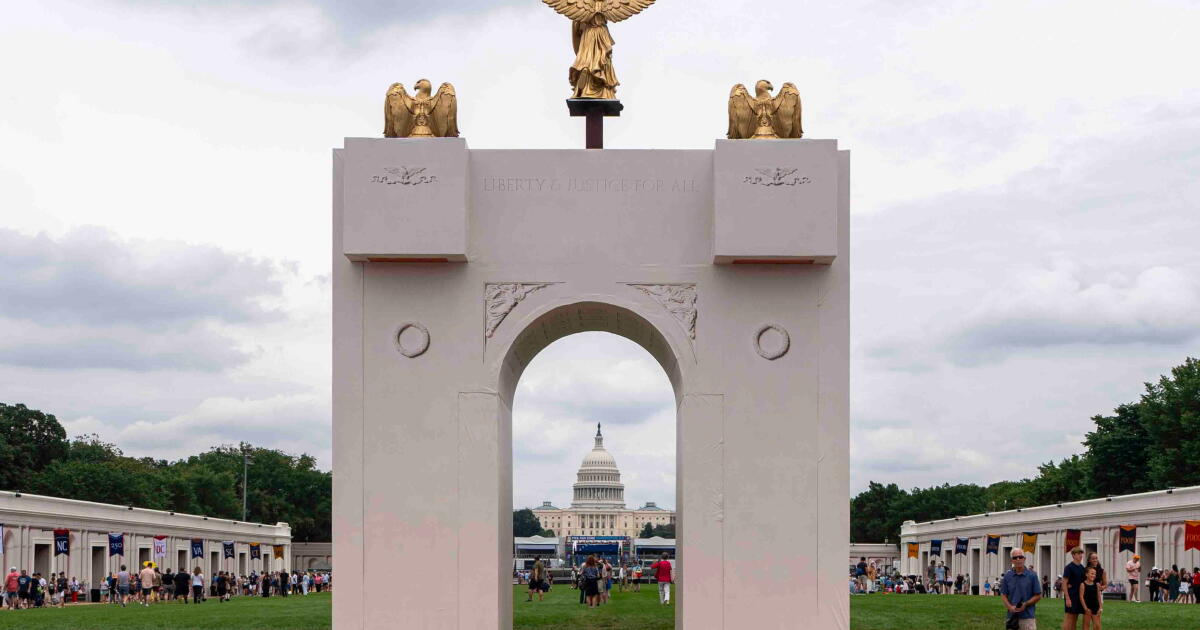
memorial arch

Federal judge orders 14-day delay on any work beginning on Trump’s monumental arch

A federal judge late Thursday blocked the Trump administration from breaking ground on a towering memorial arch for 14 days.

The temporary restraining order by U.S. District Judge Tanya Chutkan halting the work represents a major setback for one of President Trump’s most prominent projects in his vision to remake Washington.

The decision followed a series of steps taken earlier Thursday by the government, including the final approval of the arch by the National Capital Planning Commission in an 8-4 vote after a 9 ½ hour hearing where scores of witnesses opposed the construction.

The administration said the work could begin as soon as the approval and the Interior Department issued a final decision authorizing construction and the proper notification was published by the National Park Service.

In approving the temporary stop, Chutkan said Virginia and the District of Columbia had shown that the immediacy of the construction would cause real harm to the plaintiffs.

“The harm is certain,” she wrote. “Defendants initially notified the court that construction could begin as early as November 5, 2026, if the NCPC approves the project at its meeting that day and the Department of the Interior authorizes construction.” In their filing, Virginia and D.C. warned of traffic pattern distortions as well as concerns about the impact on mutual aid emergency calls if the arch were to proceed.

“Second, the District and Virginia will incur significant unrecoverable costs. As soon as construction begins, DDOT will need to expend staff time and operating resources to affirmatively and proactively manage temporary detours, crashes or disabled vehicles,” Chutkan wrote.

The judge ordered the government to provide a status report next Monday to ensure they are complying with the order.

The judge’s decision came just over an hour after the National Capital Planning Commission hearing ended. The vote by the commission broke along federal and local lines. Those in favor work for the administration or are connected to the president, who was pushing for the immediate construction. Opponents represented the city of Washington.

The remote, call-in hearing — which crashed repeatedly in the first few hours and was accompanied by a nearly universally negative comment section — drew witnesses who gave impassioned comments opposing an arch they said will destroy the solemnity of the nearby Arlington National Cemetery, where hundreds of thousands of fallen service members and military veterans are buried.

The panel’s Trump-appointed chairman launched the meeting with a gushing appraisal of the towering monument and lauded Trump for wanting to build it.

“President Trump understands as president and a superb builder that it’s important to our national identity to display who we are through grand monuments,” said Mark Paoletta, the commission’s chairman.

As Trump has often remarked, “the great cities around the world have arches: Paris, Rome, London,” said Paoletta, who also serves as general counsel for the White House Office of Management and Budget.

Commissioner Paul Ingrassia, a lawyer for the General Services Administration, said the arch was “not about politics. It’s about remembrance. It’s about celebrating our history. It’s about commemorating veterans. And it’s really something that’s a noble tribute to our nation and something that we can all rally behind.”

But D.C. City Council Chairman Phil Mendelson, who also serves on the planning panel, said the project has not received required approval from Congress, nor has Congress appropriated any money for it. The plan submitted to the commission does not include a reference to military use cited by Trump and other administration officials, Mendelson said.

“We cannot approve final site and building plans until we have the final site and building plans,” he said.

The commission oversees construction on federal land in the city and began reviewing the arch plan in June.

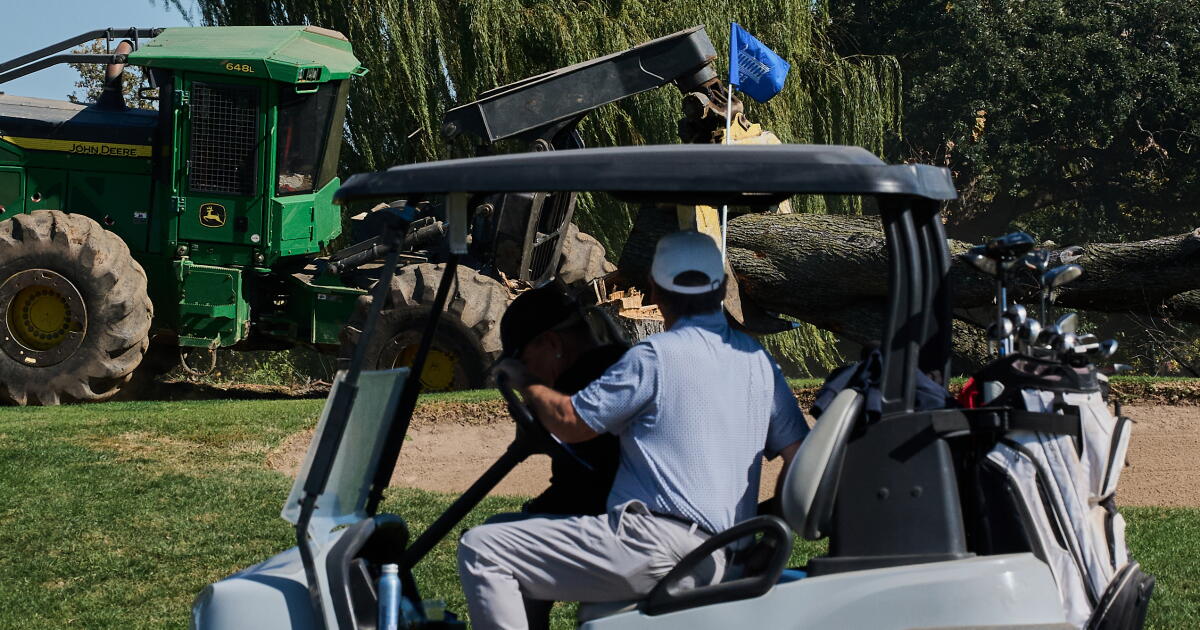
The arch is one of several projects around Washington that the Republican president has undertaken as he alters the capital to his tastes — from renovating one of its storied public golf courses to threatening to demolish the John F. Kennedy Center for the Performing Arts. Those projects could soon face intense scrutiny after Democrats gained control of Congress in the midterm elections this week.

Rep. Jared Huffman, a California Democrat who is set to chair the House Natural Resources Committee, called the project ill-advised and illegal.

“This arch would dishonor America,” Huffman told the commission. He called the proposed arch “a tribute to Donald Trump,” not veterans as Trump administration officials claim. The monument is similar to those built for emperors or kings, Huffman said, adding that Trump was using veterans as a pretext to build a memorial to himself.

Other critics, including the plaintiffs, argue that the Trump administration must seek congressional approval. The administration maintains that Congress cleared the way for a monument at Memorial Circle decades ago.

Several members of the Planning Commission used that logic in approving the project. Paoletta said it was a “national disgrace” that a memorial arch had not been placed there, despite a 1925 law that designated such a memorial, he said.

Chutkan rejected that argument in her ruling: “The sheer improbability that a 100-year-old statute would contain authority, unknown to every previous administration, to erect a 250-foot arch at a principal location in the Nation’s capital indicates how far defendants must stretch to justify this project.”

Daly and Fields write for the Associated Press. AP videographer Nathan Ellgren contributed to this report.
Source link

Key federal panel is expected to approve Trump’s arch while it’s being challenged in court

A federal panel was expected Thursday to approve President Trump’s proposed memorial arch in Washington at the end of a meeting that drew dozens of opponents to a key part of the president’s push to leave his imprint on the nation’s capital.

The approval would clear a hurdle on the road to breaking ground on the project, and the administration has said it could launch construction within a day of the vote. But the proposed 250-foot tall gilded arch still faced legal challenges.

The remote, call-in hearing — which crashed repeatedly and was accompanied by a nearly universally negative comment section — drew witnesses who gave impassioned, three-minute comments opposing an arch they said will destroy the solemnity of the nearby Arlington National Cemetery.

The Trump-appointed chairman of the commission, however, launched into a gushing appraisal of the towering monument and lauded Trump for wanting to build it.

“President Trump understands as president and a superb builder that it’s important to our national identity to display who we are through grand monuments,” said Mark Paoletta, the commission’s chairman.

As Trump has often remarked, “the great cities around the world have arches: Paris, Rome, London,” said Paoletta, who also serves as general counsel for the White House Office of Management and Budget. In addition to Paoletta, the arch received support during the hearing from Republican lawmakers and a veteran who praised the administration’s efforts to build the monument.

The commission oversees construction on federal land in the city and began reviewing the arch plan in June.

Trump is working to remake Washington

The arch is one of several projects around Washington that the Republican president has undertaken as he alters the capital to his tastes — from renovating one of its storied public golf courses to threatening to demolish the John F. Kennedy Center for the Performing Arts. Those projects could soon face intense scrutiny after Democrats gained control of Congress in the midterm elections this week.

Many of the plans are being challenged in the courts, and three lawsuits have been filed opposing the arch. A judge has been asked to block the construction so long as lawsuits are still being litigated, and she could rule as early as Thursday.

Rep. Jared Huffman, a California Democrat who is set to chair the House Natural Resources Committee, called the project ill-advised and illegal.

“This arch would dishonor America,” Huffman told the commission. He called the proposed arch “a tribute to Donald Trump,” not veterans as Trump administration officials claim. The monument is similar to those built for emperors or kings, Huffman said, adding that Trump was using veterans as a pretext to build a memorial to himself.

Opponents argue the arch is too big for the skyline and would disrupt carefully designed sight lines between landmarks in and around the capital — most prominently the Lincoln Memorial and Arlington National Cemetery — that were meant to symbolize the reunification of the North and the South after the Civil War.

But the opposition has done little to influence the members of the commission, which is led by some of Trump’s closest allies. Trump appointed Paoletta to chair the 12-member panel. Two other commissioners are also White House aides.

Trump wants an arch, but it faces legal challenges

Still, a federal judge on Monday complicated Trump’s efforts to move quickly on the project.

U.S. District Judge Tanya Chutkan, who is overseeing a lawsuit challenging the Trump administration’s plans, said she must be told of any decision by the planning commission within an hour. The order set the same time limits for any decision by the National Park Service and the Department of the Interior.

Before Thursday’s hearing began, attorneys with the Justice Department filed a notice with Chutkan informing her that a contractor had already done site prep work on Oct. 31, with what she said appeared to be no authorization from the National Park Service.

The plaintiffs in the three lawsuits are calling for a halt to work on a monument that is set to be built on a patch of grass off a bridge that spans the Potomac River and connects Washington with Arlington National Cemetery, in Arlington, Va. When complete, the monument would be 100 feet taller than the Statue of Liberty without its pedestal.

Critics, including the plaintiffs, argue that the Trump administration must seek congressional approval. The administration maintains that Congress cleared the way for a monument at Memorial Circle decades ago.

Paoletta said it was a “national disgrace” that a memorial arch had not been placed there, despite a 1925 law that designated such a memorial, he said.

Last week, the government submitted a 106-page plan for the arch that envisions a massive structure more than 12 stories high that includes a huge bronze statue of Lady Liberty with wings and carrying a torch with an eternal flame. The structure would include an observation deck with views to the east and the west and two mezzanines.

Inside the arch are rooms for program space, offices, a staff lounge, circular staircases, multiple elevators and a fire command center. The project proposes significant traffic changes in the area, including rerouting traffic on nearby roads. Administration officials have said the arch also will have a national security function.

In a recent hearing, Chutkan asked why the Trump administration was so keen on moving ahead quickly with the arch despite the ongoing lawsuits, aside from Trump’s “desire to bedazzle the city.”

Administration lawyer Robert Stander said the arch was “absolutely a high-priority project” and that any ruling delaying construction would impede the work of the government.

Daly and Fields write for the Associated Press.

Source link

Judge wants to know if Trump attorneys violated ethics in one of 2 cases to change D.C. landscape

A federal judge said Friday she would open a “formal inquiry” to investigate if attorneys for the Trump administration violated ethical boundaries during a legal dispute about a golf course project — one in a pair of plans that are revealing the breadth of the president’s attempts to mold parts of the District of Columbia to his own vision.

The two cases, unfolding at the same time in the same federal courthouse, also showcase the underlying executive authority claims that lie beneath them — a glimpse into the uses of presidential power under Donald Trump.

U.S. District Judge Ana Reyes’ declaration that the court would appoint a “special master” into whether agency officials, and Justice Department attorneys, had made misrepresentations in the court is a far cry from her relationship with the government until this month. She had rejected numerous motions from the plaintiffs to step in, saying she trusted the government attorneys.

The cases involved are an impending shutdown and reconfiguration of a historic public golf course and the construction of a monumental arch that, at 250 feet, would be 100 feet taller than the Statue of Liberty is from its base to the top of the torch. The two projects are barely three miles apart.

The hearing on the golf course change began as other recent ones have: Reyes questioned Associate Atty. Gen. Stanley Woodward Jr. over how Trump’s desires to turn the golf course, near the National Mall, into a world-class facility have become urgent plans that match his public pronouncements.

Reyes stopped the hearing several times and adjourned to her chambers to check previous transcripts of the trial as she questioned Woodward. Among things she wants examined: Was a National Park Service official told to exclude details in a court declaration? Did witnesses offer misleading testimony about the extent of plans in place for the course’s closure and renovation?

At one point, Reyes read the code of conduct to government attorneys on presenting erroneous or false information during a hearing.

Reyes ordered Friday’s hearing after multiple Truth Social posts by Trump indicated that there were plans for the golf course and construction was expected to begin Nov. 15. Trump said the park would be closed for 15 months while work goes on.

The presidential posts, which began Oct. 18, created a tense dynamic in multiple court hearings afterward when officials from the Interior Department, Justice and Park Service could not confirm the existence of the plans under questioning from Reyes. She eventually asked whom she should trust. The Justice Department filed notice Wednesday night that the plans were real.

“On Friday, October 30, 2026, the National Park Service will submit to the National Capital Planning Commission for review a rendering designed by Tom Fazio for a World Class, championship-level golf course that is capable of hosting major events,” the notice said.

Reyes locked in on the filing and Trump’s multiple Truth Social announcements as she questioned Woodward.

At one point, as they talked about plans that Woodward said came about only this week, he slipped and included tree cutting as part of the preparation for the closure.

Reyes responded immediately: “News flash.” She allowed him to correct himself that the tree cutting, which occurred earlier this month, was not part of the plan to close the East Potomac Park Golf Course.

The golf course lawsuit was one of two cases in court Friday dealing with the Trump administration’s push to expand its executive authority as the president remakes the federal areas of the capital near the National Mall and along the Potomac River.

Three courtrooms away, U.S. District Judge Tanya Chutkan was to hold a hearing on a motion asking that she call a temporary halt to plans to begin construction as early as Nov. 5 on the memorial arch. The arch is opposed by a small group of veterans and an architectural historian who sued in federal court in Washington, saying Congress must endorse the project.

“The public interest leans heavily against allowing defendants to blaze ahead,” the plaintiffs said in seeking the injunction. “This court should enter a preliminary injunction blocking defendants from beginning construction on Memorial Circle in the hope that they can render the arch a fait accompli before this Court has made a final determination.”

Legal experts who have been watching the numerous cases underway say that what might appear at first glance to be vanity projects are in truth cases that test the limits of presidential power.

Past administrations pursued legal theories that were sometimes legally sound, sometimes not, said David Super, law professor at the Georgetown University Law Center.

“But there was always the assumption that you would try to do things that were legal,” he said. “What we’re seeing here now is that if you think the federal courts can’t stop you,” you can break the law.

That’s ”going to do long-term damage to the country,” Super said.

Fields writes for the Associated Press.

Source link