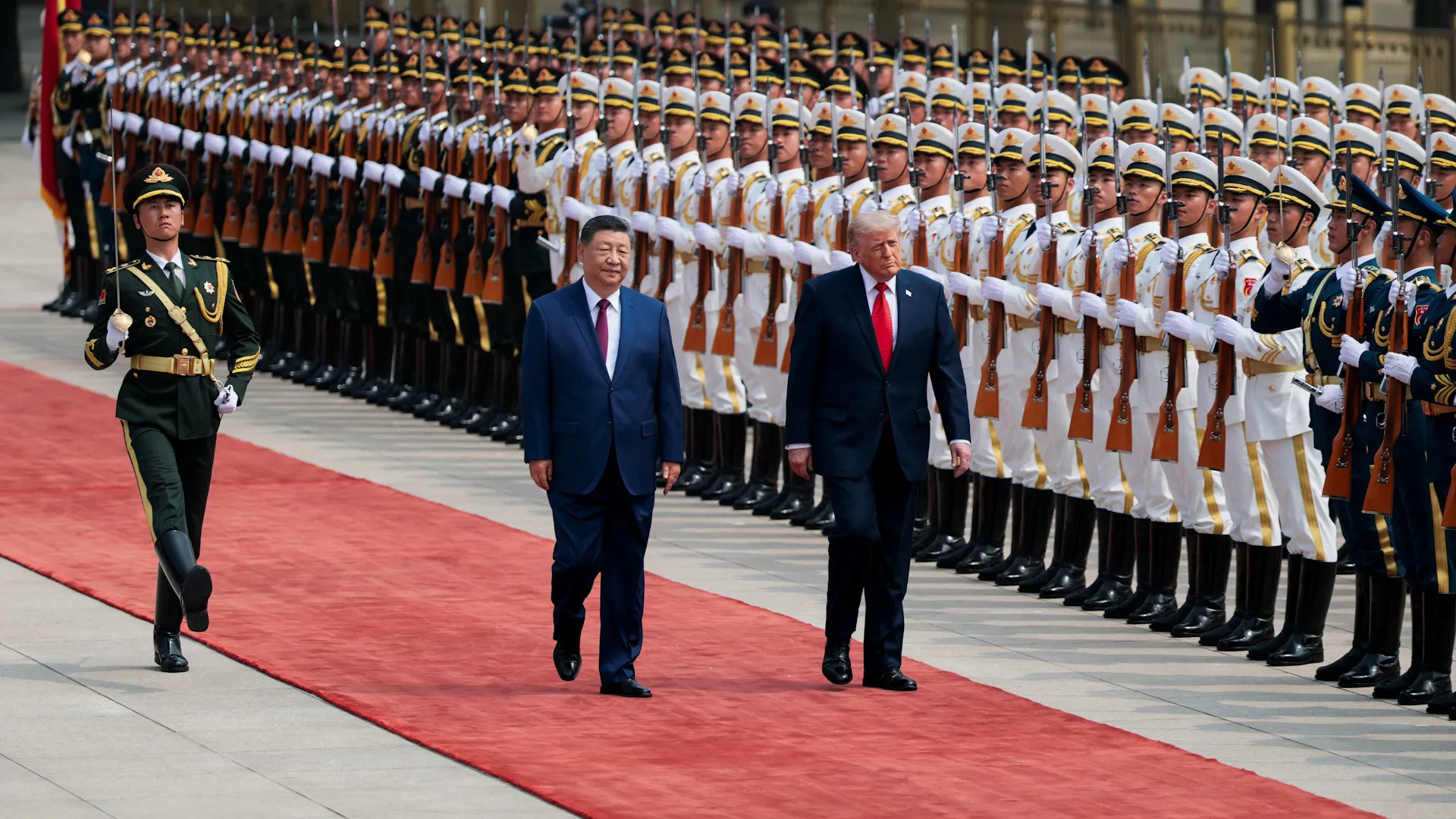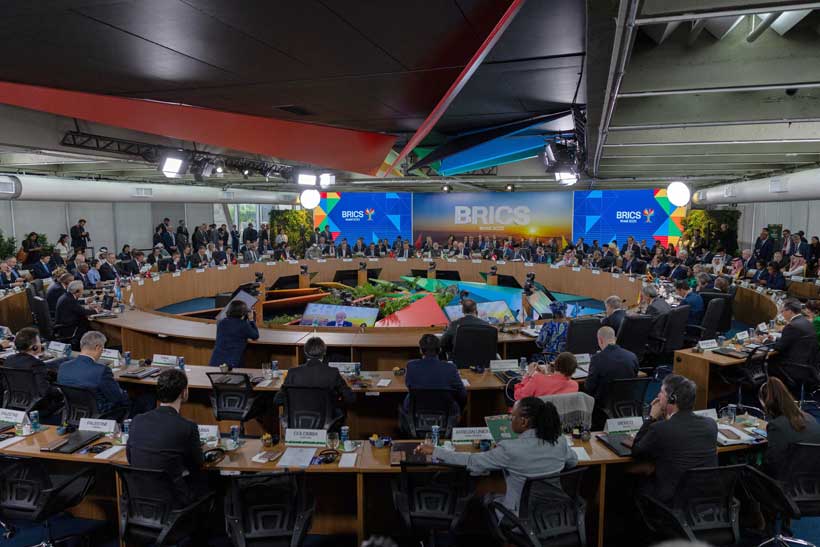
meeting

Vatican and State Department stress solid ties after Rubio’s fence-mending visit over Trump attacks

The Vatican raised the “need to work tirelessly in favor of peace” in talks Thursday with U.S. Secretary of State Marco Rubio, who came to Rome on a fence-mending visit after President Trump’s criticisms of Pope Leo XIV over the Iran war.

Both the Vatican and the U.S. State Department stressed that Rubio’s meetings with Leo and the Vatican’s top diplomat underscored strong bilateral ties. Those relations, though, have been strained over Trump’s repeated broadsides about Leo’s calls for peace and dialogue to end the U.S.-Israeli war.

Rubio, a practicing Catholic, has often been called on to tone down or explain Trump’s harsh rhetoric. He had an audience first with Leo, which was complicated at the last minute by Trump’s latest criticism of the Chicago-born pope. During a 2½-hour visit, Rubio then met with the Vatican secretary of state, Cardinal Pietro Parolin, who on the eve of his visit had strongly defended Leo and criticized Trump’s attacks.

“Attacking him like that or criticizing what he does seems a bit strange to me, to say the least,” Parolin said Wednesday.

After the meetings, the U.S. State Department said that Rubio and Parolin discussed “ongoing humanitarian efforts in the Western Hemisphere and efforts to achieve a durable peace in the Middle East. The discussion reflected the enduring partnership between the United States and the Holy See in advancing religious freedom.”

In a separate statement about the audience with Leo, U.S. State Department spokesperson Tommy Pigott said that the two discussed the situation in the Middle East and the Western Hemisphere. “The meeting underscored the strong relationship between the United States and the Holy See and their shared commitment to promoting peace and human dignity,” he said.

The Vatican, for its part, said that during Rubio’s meetings with both Leo and Parolin, “the shared commitment to fostering good bilateral relations between the Holy See and the United States of America was reaffirmed.”

It said the two sides exchanged views on the current events “with particular attention to countries marked by war, political tensions, and difficult humanitarian situations, as well as on the need to work tirelessly in favor of peace.”

Rubio also has meetings Friday with Italian Premier Giorgia Meloni and Foreign Minister Antonio Tajani. Those meetings might not be much easier for Washington’s top diplomat, given both have strongly defended Leo against Trump’s attacks and have criticized the Iran war as illegal — drawing the president’s ire.

A mission to smooth ties

The tensions began when Trump lashed out at Leo on social media last month, saying the pope was soft on crime and terrorism for comments about the administration’s immigration policies and deportations as well as the Iran war. Leo then said that God doesn’t listen to the prayers of those who wage war.

Later, Trump posted a social media image appearing to liken himself to Jesus Christ, which was deleted after a backlash. He has refused to apologize to Leo and has sought to explain away the post by saying that he thought the image was a representation of him as a doctor.

Rubio said that Trump’s recent criticisms of Leo were rooted in his opposition to Iran potentially obtaining a nuclear weapon, which he said could be used against millions of Catholics and other Christians.

Leo has never said Iran should obtain nuclear weapons and that the Catholic Church “for years has spoken out against all nuclear weapons, so there is no doubt there.”

“The mission of the church is to preach the Gospel, to preach peace. If someone wants to criticize me for announcing the Gospel, let him do it with the truth,” Leo said late Tuesday, after Trump again accused him of being “OK” with Iran having a nuclear weapon.

By Thursday, tensions seemed to have eased.

Rubio gave Leo a small crystal football paperweight. He acknowledged Leo’s known allegiance to the Chicago White Sox, saying “you’re a baseball guy,” but noted that the football had the seal of the State Department on it.

“What to get someone who has everything?” Rubio joked as he gave Leo the paperweight.

Leo, for his part, gave Rubio a pen apparently made of olive wood — “olive being of course the plant of peace,” Leo said — with his coat of arms on it and a picture book of Vatican artworks.

Trump also has criticized Meloni and other NATO allies for a lack of support for the Iran war, recently announcing plans to withdraw thousands of American troops from Germany in the coming months.

Vatican seen as willing to have dialogue

Giampiero Gramaglia, former head of the ANSA news agency and its onetime Washington correspondent, said that he didn’t expect much to come out of Rubio’s visit for Italian or Vatican relations. He, and other Italian commentators, believe Rubio instead was looking to smooth over relations with the pope for his own political ambitions, as well as the upcoming midterm U.S. congressional elections and 2028 presidential race.

“I doubt Rubio has the role of conciliator for Trump,” he told Italy’s Foreign Press Association. “I have the perception that Rubio’s mission is more about himself” and his political ambitions as a prominent Catholic Republican.

The Rev. Antonio Spadaro, undersecretary in the Vatican’s culture office, said that Rubio’s mission wasn’t to “convert” the pope to Trump’s side. Rather, Washington “has come to acknowledge — implicitly but legibly — that (Leo’s) voice carries weight in the world that cannot simply be dismissed.”

“The situation created by President Trump’s remarks required a high-level, direct intervention, conducted in the proper language of diplomacy: a semantic corrective to a narrative of frontal conflict with the church,” he wrote in an essay this week.

Cuba is also on the agenda

Rubio said that topics other than the Iran war were on the agenda for the Vatican visit, including Cuba. The Holy See is particularly concerned about the Trump administration’s threats of potential military action there following its January ouster of Venezuelan President Nicolás Maduro.

Trump has said frequently that Cuba could be “next,” and even suggested that once the Iran war is over, naval assets deployed in the Middle East could return to the United States by way of Cuba.

Rubio is the son of Cuban immigrants and a longtime Cuba hawk.

“We gave Cuba $6 million of humanitarian aid, but obviously they won’t let us distribute it,” Rubio said. “We distributed it through the church. We’d like to do more.”

Winfield and Lee write for the Associated Press. Lee reported from Washington.

Source link

Find your next great read and new friends at the Yacht Girls Book Club

It’s 11:30 a.m. on a beautiful and unseasonably warm day in Marina del Rey, half an hour before the starting time for the Yacht Girls Book Club meeting, but several women are already standing at the gate leading to a vintage yacht docked at the California Yacht Club.

Nicole Vaughn, a first-time attendee who has driven from Woodland Hills with her friend Cani Gonzalez for the meeting, had been looking for author events on Eventbrite when she found the Yacht Girls Book Club’s “Brunch and Sound Bath,” which also includes a signed copy of the featured author’s book, a boat ride and swag bag for $65. “I read ‘sound bath, poetry and manifesting,’ which sounded intriguing, so I said, ‘Why not?’” Vaughn says.

Once the gate opens, Vaughn, Gonzalez and the others stream in, alone or in pairs. The mostly female attendees range from 30 years old to over 70 and are attired in outfits including cutoffs, tank tops, straw fedoras and glamorous full-length dresses. There are approximately 60 first-timers and returning members.

Brittany Goodwin, another first-timer and Mid-City resident who does social marketing and media for HBO Max, also heard about the meeting on Eventbrite. “I saw the word manifestation [in the ad] and I was there!” she enthuses, taking in the colorful array of arriving women. “And today is the full moon, so it’s very appropriate.”

That’s because the speaker is local poet and author Melody Godfred, whose latest book, “Moon Garden,” attracted the attention of Aloni Ford, Yacht Girls founder and organizer of the meeting.

“I thought Melody would be perfect for the official relaunch of the Yacht Girls,” Ford said in an earlier phone conversation. “Her message of self-love and living more authentically is the reason I started the book club in the first place.”

That was in 2018, when Ford, an Altadena-born manager of professional athletes and boating enthusiast who has lived in Marina del Rey for the last decade, was tired of conversations with women that only focused on relationships. “I wanted conversations with like-minded women that were intellectual but fun. And talking about books seemed to be the ideal way to achieve that.”

Erin Nelson, left, and Lisa Nelson make a brunch plate at the Yacht Girls Book Club.

Erin Nelson, left, and Lisa Nelson make a brunch plate at the Yacht Girls Book Club.

(Carlin Stiehl / For The Times)

For that first meeting, Ford gathered six women — female friends, her masseuse, a favorite aunt. “We discussed Ruth Ware’s ‘The Woman in Cabin 10,’ so I held that first meeting on a local yacht cruise.” After the discussion, the women agreed they wanted to continue meeting, and brainstormed names until Ford suggested Yacht Girls, and the book club was launched.

Some of those “OGs” — Ford’s term for the original Yacht Girls who attended those first few meetings — now embrace each other, introduce the friends they’ve brought, and recount previous discussions of memoirs and books on self-care, building self-confidence and financial literacy. Tarzana resident and OG Felicia Smith still remembers her favorite book discussion. “It was ‘Let Your Fears Make You Fierce’,” she says, reaching for her phone to show the book is still in her audiobook library. Ford recalls that a highlight of those early years was a discussion of Gabrielle Union’s memoir, “We’re Going to Need More Wine,” which was held at Malibu Wines & Beer Garden and attracted more than 300 participants. “I tried to match the venue with the author whenever I could,” Ford says of those early meetings.

But then COVID-19 struck and, although she wanted to continue the book club via Zoom, Ford admits, “I’m not a Zoom kind of girl. I need the interaction, the face-to-face connection with women.” In the interim, Ford pursued other interests, including yachting, a hobby she picked in 2023 that birthed ideas for Yacht Yoga and other female empowerment gatherings of the Yacht Girls.

Ford’s chosen venue for Yacht Girls Book Club meetings is the “Northwind,” a 100-year-old, lovingly restored 130-foot vessel that once hosted Jacqueline Kennedy in 1961 and is open to the California Yacht Club’s members, of which Ford is one. After check-in, attendees are invited to take a ride on a smaller vessel docked nearby, enjoy the buffet luncheon on the main deck, get a tarot card reading from Ruby Sheng Nichols or take in the sun, ocean breeze and marina views from the upper deck, which is outfitted with umbrellas, tables for four and comfortable lounge seating, all arranged with a view of the ship’s stern, where Godfred is preparing to read and where Amber Melvisha is setting up a sound bath, which will accompany the reading.

1

Felicia Smith listens to Melody Godfred recite poems from her book "Moon Garden."

2

Members of the Yacht Girls Book Club enjoy brunch.

1. Felicia Smith listens to Melody Godfred recite poems from her book “Moon Garden.” 2. Members of the Yacht Girls Book Club enjoy brunch. (Carlin Stiehl / For The Times)

Godfred, 43, is delighted to be with such a diverse group of kindred spirits. “I’ve been craving in-person experiences lately,” she says, “especially with people outside my bubble. This absolutely fulfills that desire.”

Olympia Auset, a book club OG and founder of a nonprofit South Central organic grocery store, is pleased with the turnout. “There is a real spirit of community in this book club,” she says, after quietly taking in the scene.

That spirit is exemplified by Ford, a gregarious hostess who moves through the various groupings of women in a diaphanous full-length blue dress, introducing Godfred to a group of attendees and hugging both first-timers and her OGs enthusiastically. It feels a little like a reunion, with everyone a part of the extended family. “I come for the networking, to meet women of all different levels,” observes View Park resident Alicia Sutton, an OG who proudly displays her original Yacht Girls badge. “We have more in common than we think. We are a group of women of all colors.”

As the women — plus Ty Jessick of Santa Monica, a friend of Ford’s and the lone man at the event — settle into their seats, Ford greets them again, recounts the Yacht Girls’ early days and her vision for the book club’s next chapter. “This is an opportunity to unplug from our daily lives,” she tells the assembled group, amid nods and murmurs of agreement. “We schedule so much but we must not forget to schedule joy. Today you may meet your new best friend, a business partner, or just someone who loves books. After our first post-pandemic meeting last fall, we wanted to relaunch the Yacht Girls Book Club in a big way. And after today, I’m definitely back in those book streets again!”

With that, Ford hands the mic to Godfred, who shares her own story of immigrating to Los Angeles with her parents from Iran when she was three months old, of being a “recovering attorney” who was managing two businesses and raising three children with her husband but not taking time for herself. That self-neglect resulted in a health challenge, which eventually led to Godfred reconnecting with her passion for poetry and self-exploration. “It was a signal to start honoring my truth more fully,” she explains.

After introducing the inspiration behind “Moon Garden,” which contains 12 sections of spiritual poems, insights and affirmations tied to Earth’s lunar cycles, Godfred answers questions posed by Ford and the audience. Then, she invites participants to get comfortable in their seats while she reads selections from the book that encourage surrender, rest and contemplation during the winter months. The sound bath and a chiming bell provide a resonant echo in which attendees visibly relax, most with their eyes closed.

Members of the Yacht Girls Book Club enjoy drinks on the upper deck of the "Northwind."

Members of the Yacht Girls Book Club enjoy drinks on the upper deck of the “Northwind.”

(Carlin Stiehl / For The Times)

The meeting breaks up around 2 p.m. and is followed by music-filled, informal mingling, where the participants discuss the book and the afternoon. From their tables in the “Northwind’s” aft section, Vaughn, seated with Gonzalez and a group of new acquaintances, says she definitely will return.

“This book club may attract women who are high achievers,” Auset says as she gathers with other regular members for a photo, “but we all need to make time for self-care and community.”

The next Yacht Girls Book Club will be held at noon June 13 at the California Yacht Club with brunch included. The featured book is “Proof of Life” by best-selling author and visual artist Jennifer Pastiloff. Pastiloff will be in attendance. Tickets required.

Woods is an editor, author, book critic and a regular contributor to the Times.


Source link

Former Miami Congressman David Rivera is convicted in a secret Venezuela lobbying case

A former Miami congressman and longtime friend of U.S. Secretary of State Marco Rubio was convicted Friday in connection with a secret $50-million lobbying campaign on behalf of Venezuela during the first Trump administration.

Jurors found Republican David Rivera and an associate, Esther Nuhfer, guilty on all counts, including failing to register as a foreign agent with the Justice Department and conspiracy to commit money laundering as part of their work for former President Nicolás Maduro’s government.

The seven-week trial offered a rare glimpse into Miami’s role as a crossroads for foreign influence campaigns aimed at shaping U.S. policy toward Latin America, one highlighting the city’s reputation as a magnet for corruption and anti-Communist crusaders among its sizable exile population.

It included testimony from Rubio, Texas Congressman Pete Sessions and a top Washington lobbyist — all of whom testified that they were shocked to learn belatedly of Rivera’s consulting contract with a U.S.-based affiliate of Venezuela’s state oil company, PDVSA.

In an 11-count indictment unsealed in 2022, prosecutors alleged that Rivera was tapped by then Foreign Minister Delcy Rodríguez — now Venezuela’s acting president — to work Republican connections from Rivera’s time in Congress to get the first Trump administration to abandon its hard-line stance and ease crippling sanctions on Venezuela.

As part of the charm offensive, prosecutors alleged, Rivera and Nuhfer, a political consultant, manipulated influential friends, including Rubio and Sessions, like “pawns on a chess board.” The goal: to try to normalize relations with the new Trump administration at a time when the Maduro government was buffeted by serious accusations of human rights violations.

“As long as the money kept coming in, they didn’t care from where,” prosecutor Roger Cruz said of the defendants during closing arguments.

‘Massive secret’ threatened to damage Rivera’s political career

But the two held onto the “massive secret” and didn’t disclose their lobbying work as required, for fear it would have ended Rivera’s political career as an anti-Communist stalwart, Cruz said.

To hide his work, prosecutors allege, Rivera also set up an encrypted chat group called MIA — for Miami — with his main conduit to the Maduro government: Venezuelan media tycoon Raúl Gorrín, who was subsequently charged in the U.S. with bribing top Venezuelan officials.

Members of the group used playful code words to discuss their activities: Maduro was the “bus driver,” Sessions “Sombrero,” Rodríguez “The Lady in Red,” and millions of dollars “melons,” according to copies of text messages presented to the jury.

“It was all about la Luz,” Cruz said, referring to the Spanish word for light, which Rivera and others repeatedly used to discuss payments from Caracas.

Attorneys for Rivera and Nuhfer said the two acted in good faith and believed they were under no requirement to disclose their work. The three-month, $50-million contract with Rivera’s one-man consulting firm, they say, was focused exclusively on luring oil giant ExxonMobil back to Venezuela — commercial work that is generally exempt from the Foreign Agents Registration Act.

Wholly distinct from that consulting work, they say, were Rivera’s meetings with Rubio and Sessions, which occurred after the consulting contract had expired and was focused on ushering in leadership in Venezuela that would be less hostile to the U.S.

“He was working every possible angle to get Nicolás Maduro out,” defense attorney Ed Shohat said during closing arguments. “There was not a word in the chats about normalizing relations.”

Nuhfer’s attorney, David Oscar Markus, likened the government’s case to the 17th century Salem witch trials, presuming ill intent that was belied by the flimsiest of evidence.

“My client does not have a dark heart,” he said.

Exxon meetings for Rodríguez

Prosecutors said Rivera used the contract with New York-based PDV USA as cover for illegal lobbying.

Once exposed, the partners tried to hide the work — backdating documents and coming up with sham agreements like one to justify a wire transfer of $3.75 million to a South Florida company that maintained Gorrín’s luxury yacht.

The political activity included setting up meetings for Rodríguez in New York, Caracas, Washington and Dallas. As part of the effort, the two roped in Sessions, who later tried to broker a meeting for Rodríguez with the CEO of ExxonMobil that had succeeded Trump’s then-secretary of State, Rex Tillerson. After a secret meeting in Caracas with Maduro, Sessions also agreed to deliver a letter from the Venezuelan president to Trump.

The outreach quickly unraveled, however. Within six months of taking office, Trump sanctioned Maduro and labeled him a “dictator,” launching a “maximum pressure” campaign to unseat the president.

However, nearly a decade later, Rodríguez has emerged as the second Trump administration’s trusted partner after the U.S. military’s ousting of Maduro.

Before being elected to Congress in 2010, Rivera was a high-ranking Florida legislator. During that time, he shared a Tallahassee home with Rubio, who eventually became the Florida House speaker.

Rivera has previously faced controversy, including allegations that he secretly funded a Democratic spoiler candidate in a 2012 congressional race. Last year, federal prosecutors dropped the case after an appeals court threw out a sizable fine imposed by a lower court. Rivera was also investigated — but never charged — for alleged campaign finance violations and a $1-million contract with a gambling company while serving in the Florida legislature.

Goodman writes for the Associated Press.

Source link

Jerome Powell Chairs Final FOMC Meeting

After eight years as leader of the Federal Board of Governors, Jerome Powell leaves behind a considerable legacy.

Jerome Powell concluded his final Federal Reserve Open Market Committee (FOMC) meeting as chair on April 29, but said he would remain on the Board of Governors after his term as chair ends on May 15. His four-year term on the board ends January 31, 2028.

Powell’s term was marked by his decisive move at the start of the pandemic to stabilize markets, which could have faced a financial crisis comparable to 2008, said Krishna Guha, Evercore ISI’s vice chairman, in an email interview.

“The Powell Fed was slow to pivot to deal with post-pandemic inflation, but when it turned, it turned decisively, and Powell achieved the remarkable feat of bringing inflation back down without causing a recession,” he said. “Indeed, the data clearly show Powell was on the brink of delivering the fabled soft landing when Trump tariffs pushed inflation up again.”

Guha says Powell will mainly be remembered for the “dignity and professionalism that he brought to public service,” as the Fed endured “the most serious attack on central bank independence in decades, without yielding to political pressure or making the opposite error of turning hawkish in retaliation.”

Fight For Independence

The fight to preserve the Fed’s independence truly began in President Donald Trump’s second administration and has been a sustained conflict over lower interest rates. First came accusations of ballooning cost overruns during the refurbishment of the Federal Reserve’s Washington, D.C., headquarters in late July 2025. Next came the administration’s attempt to fire Federal Reserve Governor Lisa Cook a month later, citing alleged mortgage fraud.

The Department of Justice dropped its investigation into Powell on April 24, a few days before the April FOMC meeting. The Supreme Court has yet to decide on Cook’s case.

The cessation of lawfare against the Fed was welcomed by many in the Beltway, who see it as returning to business as usual.

“I felt like the accusations that Chairman Powell had committed some sort of crime connected to the building construction were a distraction, and it would delay President Trump in selecting a new chairman,” said Republican Rep. French Hill, chairman of the House Financial Services Committee, in a public statement. President Trump has nominated Kevin Warsh, a former Fed official, as Powell’s successor. A vote on his confirmation is expected in the coming weeks.

Editor’s note: This story has been updated to indicate Powell will stay on at the Fed after his term as chair ends.

Source link

Antrim GAA: Senior hurlers request meeting with county board over Davy Fitzgerald position

The Antrim senior hurling squad have requested a meeting with the county board at Tuesday evening’s training session to address “significant concern” after they claimed they received conflicting reports about manager Davy Fitzgerald’s future.

In a letter to the county board, which has been seen by BBC Sport NI, the players say they were under the impression that a decision was made to remove Fitzgerald from his role following last weekend’s Joe McDonagh Cup defeat by Laois, only for the decision to be reversed.

However, the squad said they were subsequently informed “that no such action had taken place” and when the matter was brought to Antrim GAA chairman Seamus McMullan, he “indicated that he had no knowledge of it”.

In the letter, the playing group say McMullan’s response is “particularly concerning” given that Fitzgerald confirmed that “the sequence of events did in fact occur”.

“The contradiction between what occurred and what has been communicated has created uncertainty and a lack of trust among players,” read the letter.

The players added that if the board do not attend the meeting and engage with the squad, they will “not proceed with the scheduled training session and further action could be taken”.

BBC Sport NI has contacted Antrim GAA for comment.

While the run of poor results has led to disquiet among the playing panel and some Antrim GAA administrators, it is understood Fitzgerald has indicated a desire to remain in charge.

Source link

S. Korean special envoy calls for safe Hormuz transit in meeting with Iran’s FM

This photo, released by Iran’s foreign ministry on Thursday, shows South Korea’s special envoy, Chung Byung-ha (L), meeting with Iranian Foreign Minister Abbas Araghchi in Tehran. Photo Courtesy of Ministry of Foreign Affairs of the Islamic Republic of Iran

South Korea’s special envoy to Iran has met with Iranian Foreign Minister Abbas Araghchi in Tehran and called for efforts to ensure safe passage through the Strait of Hormuz and the safety of Korean nationals, Seoul’s foreign ministry said Thursday.

Chung Byung-ha, special envoy for South Korea’s foreign minister, has been in Iran since March 11 as Seoul seeks to secure the safety of its vessels and seafarers stranded in the vital waterway blocked by both Iran and the United States amid the Middle East crisis.

“Special envoy Chung requested Iran’s continued support for the safety of 40 South Korean nationals remaining in Tehran, and 26 Korean vessels and crew on board,” ministry spokesperson Park Il said in a press briefing. The meeting took place late Wednesday (Iran time).

A total of 173 Korean crew members remain aboard the stranded ships.

South Korea has been in talks with Iran and neighboring countries to ensure their safety, sharing details of the vessels and crew with relevant parties, including Iran and the U.S.

Chung expressed hope in his meeting with Araghchi that peace talks between Iran and the United States will resume so as to restore regional peace and stability, the ministry said in a press release.

Chung also noted the importance of developing bilateral relations between Seoul and Tehran.

Echoing Chung’s remark on their ties, Araghchi expressed Iran’s readiness to cooperate in that regard, adding that Tehran will continue to pay attention to Korean nationals staying in the country.

Seoul’s decision to dispatch a special envoy to Iran has sent a positive signal to Tehran in terms of bilateral relations and is seen as contributing to potential future talks with Tehran on the ships and nationals, according to sources familiar with the matter.

South Korea is among a handful of countries that still maintain their embassy operations in Iran. Seoul also recently provided humanitarian aid to the war-hit country through the International Committee of the Red Cross.

Regarding Iran’s blockade of the strait, Araghchi defended the measure as an effort to safeguard its national security and interests, saying that “responsibility for any resulting consequences lies with the parties carrying out the aggression,” Iran’s foreign ministry said on a social media post.

Copyright (c) Yonhap News Agency prohibits its content from being redistributed or reprinted without consent, and forbids the content from being learned and used by artificial intelligence systems.

Source link

Bass, Barger meets with Trump to push for L.A. fire recovery funds

Los Angeles Mayor Karen Bass and L.A. County Supervisor Kathryn Barger met privately with President Trump and administration officials Wednesday to press for federal support and yet-unpaid wildfire recovery funding as the region continues to rebuild from the 2025 fires.

“This afternoon we met with President Trump and Administration officials to advocate for families who lost everything,” Bass and Barger said in a statement. “We had a very positive discussion about FEMA and other rebuilding funds as well as the support of the President to continue joining us in pressuring the insurance companies to pay what they owe — and for the big banks to step up to ease the financial pressure on L.A. families.”

Barger said the two leaders had a “high-level discussion” with the president in the Oval Office, sharing stories about what fire survivors are experiencing day to day. She added that “we left details behind with the President,” but did not specify whether Trump made any funding or policy promises during the meeting.

“First and foremost, today’s meeting was to thank the President for his initial support of infusing federal resources to expedite debris removal, as well as his recent tweet about insurance companies, which have already proven fruitful,” she said in a statement provided to The Times.

Bass was similarly reserved about the discussions, telling reporters that “we will follow up with the details,” but signaled progress is being made on federal support.

“I think what’s important is that we certainly got the president’s support in terms of, you know, what is needed, and then the appropriate people were in the room for us to follow up. And that was Russ Vought, who is the head of the Office of Management and budget,” Bass told KNX on Wednesday.

The meeting comes on the heels of a yearlong standoff between California leaders and the Trump administration over wildfire recovery funding, disaster response and whether the federal government should have a say in local rebuilding permitting.

California leaders, led by Gov. Gavin Newsom, have accused the Trump administration of withholding billions in critical wildfire aid, prompting a lawsuit over stalled recovery funds. Officials allege political bias in the delay of billions of dollars from the Federal Emergency Management Agency.

Newsom visited Washington in December. When he made his rounds on Capitol Hill, he met with five lawmakers, including three who serve on the Senate and House appropriations committees, to renew calls for $33.9 billion in federal aid for Los Angeles County fire recovery.

But the governor said he was denied a meeting with FEMA and would not say whether he had attempted to meet with Trump to discuss the issue.

Bass, meanwhile, appears to have found a path to the president on a subject that has been paramount for her community.

The fruitful meeting comes after Trump lobbed insults at the mayor at a news conference earlier this year, where he called her “incompetent” for how she handled last year’s wildfire recovery efforts. He alleged that under Bass’ leadership, the city’s delay in issuing local building permits will take years when it should have taken “two or three days.”

California officials, including Newsom, have urged the Trump administration to send Congress a formal request for the $33.9 billion in recovery aid needed to rebuild homes, schools, utilities and other critical infrastructure destroyed or damaged when the fires tore through neighborhoods more than 15 months ago.

What Bass and Barger’s meeting with the president ultimately produces remains to be seen.

The billions in recovery aid have not yet materialized, but the meeting could potentially give those discussions new momentum.

The White House did not immediately respond to a request seeking comment about the meeting.

Earlier this month, Trump criticized insurance provider State Farm on Truth Social for its handling of the devastating Los Angeles County wildfires. He accused the insurance giant of abandoning its policyholders when tragedy struck.

“It was brought to my attention that the Insurance Companies, in particular, State Farm, have been absolutely horrible to people that have been paying them large Premiums for years, only to find that when tragedy struck, these horrendous Companies were not there to help!” Trump wrote.

But the rebuke didn’t come out of the blue. It stemmed from a controversial February visit to Los Angeles by Trump administration officials.

Trump tapped Environmental Protection Agency Administrator Lee Zeldin in an effort to strip California state and local governments of their authority to permit the rebuilding of homes destroyed in the Eaton and Palisades fires.

Within the week, Zeldin was in Los Angeles, bashing Newsom and Los Angeles officials at a roundtable with fire victims and reporters, saying that residents were suffering from “bureaucratic, red tape delays and incompetency” and that leadership was “denying them … the ability to rebuild their lives”.

During the trip, officials heard direct complaints from local leaders and fire victims about insurers being slow, restrictive and insufficient with their claim payouts.

After these meetings, Trump directed Zeldin to investigate the insurers’ responses. State Farm, facing roughly $7 billion in fire-related claims, is also under formal investigation by California’s insurance commissioner over its handling of the crisis.

Despite tensions with the administration, Bass and Barger appeared confident that progress was being made on the insurance and funding issues.

“Our job is to fight for our communities,” their joint statement concluded. “When it comes to this recovery, our federal partners are essential, and we are grateful for the support of the President.”

Source link

FDA to weigh looser rules on unproven peptides touted by RFK Jr., MAHA

The Food and Drug Administration will hold a meeting in the summer to consider easing restrictions on more than a half-dozen peptide injections, a group of unapproved therapies that have become popular among wellness influencers, fitness gurus and celebrities.

The meeting announcement Wednesday follows repeated pledges by Health Secretary Robert F. Kennedy Jr. to loosen regulations on peptides, which are often pitched as a quick way to build muscle, heal injuries or appear younger. There’s little research behind those claims and most peptides have not been reviewed for safety by the FDA.

Kennedy has discussed using peptides for his own injuries. And some major supporters of his Make America Healthy Again movement are big proponents of them, including Gary Brecka, a self-described “longevity expert” who sells various peptide formulas through his website.

The FDA said in a federal notice Wednesday that it will ask a panel of outside advisors to review seven peptides at a meeting in July, specifically whether they should be added to a list of substances that can be safely produced by pharmacies. In the meantime, the agency said it would soon remove the chemicals from a restrictive list reserved for unapproved, high-risk drugs. The peptides under discussion include some of the most popular among influencers, such as BPC-157, which is marketed to heal injuries and reduce inflammation.

“The Wild West is about to become wilder,” said Dr. Peter Lurie, a former FDA official who now leads the Center for Science in the Public Interest. In an interview, Lurie said allowing peptides on the market without clinical testing poses a “profound threat” to FDA’s decades-old system for vetting drugs.

“I don’t see why one would take the path of a proper drug approval if there is now this less rigorous, alternative path to market,” he said.

Under President Biden, the FDA added nearly 20 peptides to the federal list of substances that should not be produced by compounding pharmacies — businesses that mix medications that aren’t available from drugmakers.

At the time, the FDA’s panel of pharmacy advisors voted overwhelmingly that the peptides did not meet the criteria for substances that can be safely compounded. And FDA regulators agreed, saying later that the substances “present significant safety risks,” because most have not been extensively tested in humans.

Many of the FDA advisors and internal staff who oversaw those decisions no longer work for the agency. The FDA’s pharmacy panel currently has a number of vacancies, which Kennedy could fill before the July meeting.

Kennedy previewed Wednesday’s move in an interview with podcast host Joe Rogan. Both men have repeatedly spoken about peptides and claimed to have benefited from their use.

RFK Jr. claims personal benefit from peptides

“I’m a big fan of peptides,” Kennedy told Rogan. “I’ve used them myself and with really good effect on a couple of injuries.”

Given Kennedy’s statements, Lurie said it was doubtful the drugs would receive real scrutiny from FDA.

“Everybody knows the outcome that the secretary wants,” Lurie said. “I don’t believe for one moment that what’s going on here is an honest investigation of whether these products should be compounded.”

Scott Brunner of the Alliance for Pharmacy Compounding said the coming meeting will be the start of a “protracted process.” Even if the panel votes to make the peptides available, and the FDA agrees, the agency will still have to draft and publish rules on the change, he noted.

Peptides are essentially the building blocks of more complex proteins. Inside the human body, peptides trigger hormones needed for growth, metabolism and healing.

In recent years peptides have become widely known through the blockbuster success of GLP-1 medications, which the FDA has approved for treating obesity and diabetes. Other FDA-approved peptides include insulin for diabetics and hormone-based drugs for several medical conditions.

But many of the peptides promoted online have never been approved, making them technically illegal to market as drugs. Several peptides, such as BPC-157 and TB-500, are banned by international sports authorities as doping substances.

But that has not stopped them from gaining a foothold in the burgeoning marketplace for wellness hacks and alternative remedies.

“I think this is a disaster in the works,” said Dr. Eric Topol of Scripps Research Translational Institute, who has studied the issue. “These peptides have no data to support their safety and efficacy.”

Meanwhile, some dietary supplement makers have begun mixing peptides into capsules, protein powders and gummies. At a recent FDA meeting, the industry argued for expanding the federal definition of supplements to permit the use of newer ingredients such as peptides in their products.

Safety risks were cited previously

When the FDA added a number of injectable peptides to its list of restricted substances in 2023, it cited safety risks including cancer and liver, kidney and heart problems.

That triggered pushback from wellness entrepreneurs, compounding pharmacies and their allies in Washington.

Last year several members of Congress, including Republican Sen. Tommy Tuberville of Alabama, sent letters to Kennedy asking him to lift limits on peptide production.

Some in the compounding industry argue that FDA restrictions have given rise to an illicit market of imported chemicals from China and other countries, which are not subject to U.S. drug standards.

Kennedy has echoed those concerns.

“With the gray market you have no idea if you’re getting a good product,” Kennedy told Rogan. “And a lot of this stuff that we’ve looked at is just very, very substandard.”

Perrone writes for the Associated Press.

Source link