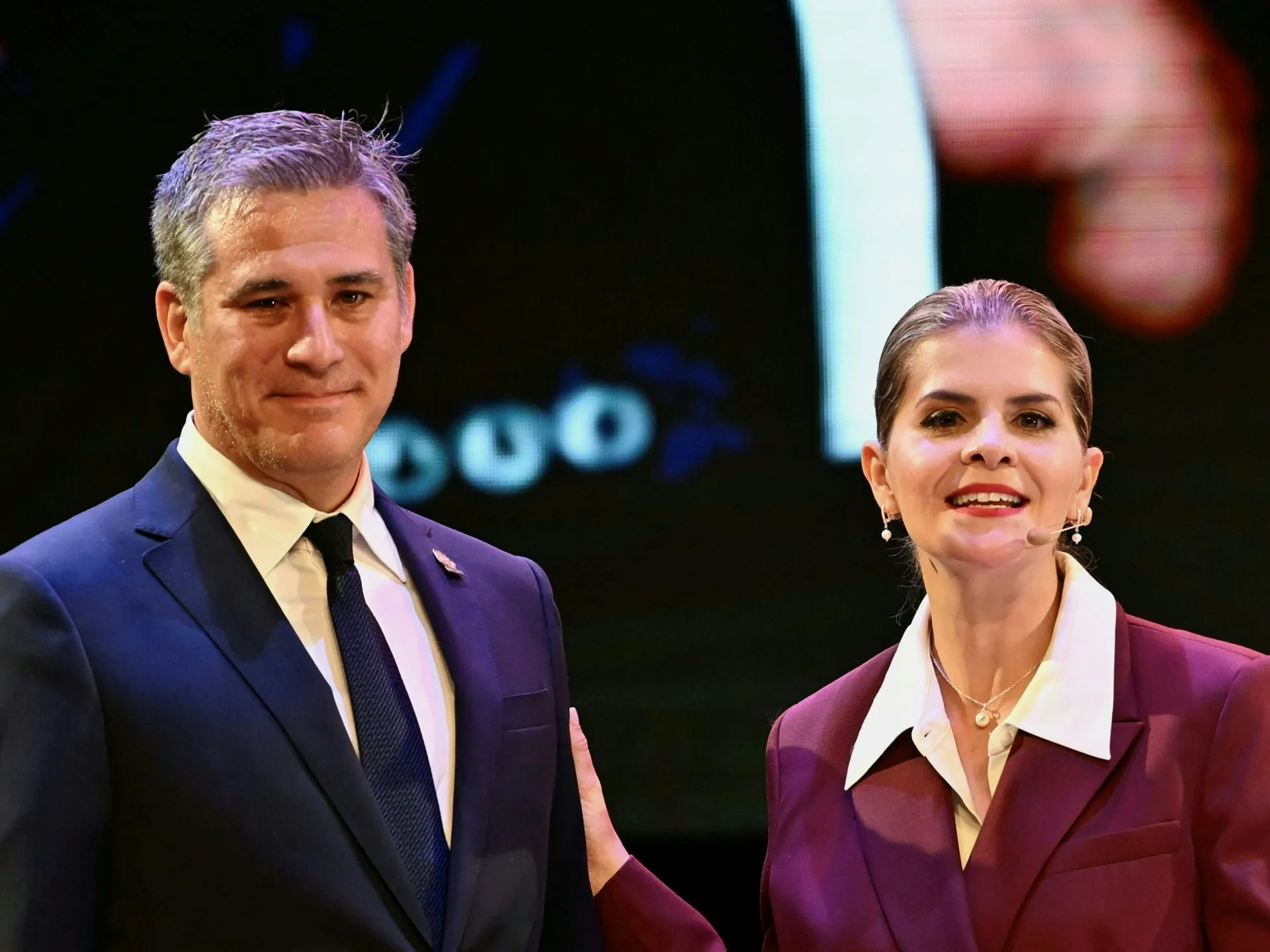
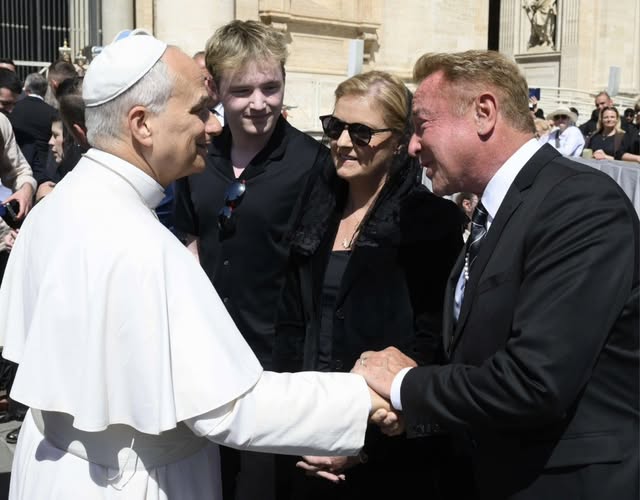
THIS is the heartbreaking last picture of Michael Flatley’s beloved wife, Niamh O’Brien, in public meeting the Pope months before her death.
The 52-year-old died earlier today following “a period of illness” leaving the Lord of the Dance star devastated.
Niamh O’Brien was last seen during a meeting with the Pope in MayCredit: Vatican MediaNiamh died after a ‘period of illness’, a representative saidCredit: Getty
The mum-of-one passed away peacefully at the Beacon Hospital in Dublin, a representative said.
She was last pictured in public meeting then-incoming Pope Leo XIV on April 29 with her husband.
Sign up for the Showbiz newsletter
Thank you!
The pair travelled to the Vatican to meet the Shepherd of the Flock with their son, Michael St James.
Flatley was inspired by the visit where he kissed the Pope’s ring and had his “cherished” rosary beads blessed by the pontiff.
And classy Niamh donned an all black outfit for the occasion where she was seen smiling alongside her husband.
Michael St James had also opted for a black monochrome look and was pictured standing beside his beloved mum.
The happy pair were both smiling as Flatley exchanged words and shook hands with the pontiff.
Flatley later said: “It was an incredible honour to meet His Holiness.
“I am so moved. I didn’t think I’d ever have that opportunity.”
He also spoke about his own Catholic faith, having grown up to a working- class Irish immigrant father on the south side of Chicago.
He said: “My parents were hard-working Irish Catholic people. And we went to Mass every Sunday and we worked every day, just the way we were brought up.
“It’s my honor and my joy to carry on their traditions and spread as much joy as I can.
“Jesus Christ gave me every opportunity to become a great dancer and to travel the world and meet the world leaders, but my greatest day was today, meeting the Holy Father and God’s representative on earth.”
The Lord of the Dance also extended an invite to Ireland to Pope Leo on behalf of the Irish people.
Flatley paid tribute to his late wife earlier tonight in a heartbreaking social media post.
He said: “My heart is broken. I have lost my beautiful wife, Niamh, and my best friend.
“My gorgeous bride of twenty years has gone to the Lord in Heaven.
“She was the most loving mother, wife and person, and our lives will never be the same without her.
“Thank you for all the love and kindness you have shown us. Please keep Niamh, Michael St James, and our family in your thoughts and prayers.”
And a representative said: “The Flatley and O’Brien families are devastated by Niamh’s sudden passing and have asked that their privacy be respected as they come to terms with this heartbreaking loss.
“They express their sincere gratitude to the doctors, nurses and staff at Beacon Hospital who cared for Niamh over the past few weeks, and to everyone who has offered their kindness and support to the family.”
Niamh’s funeral details will be announced in due course, a spokesperson has said.
MIAMI — A former Miami congressman and longtime friend of U.S. Secretary of State Marco Rubio was sentenced Friday to 10 years in prison in connection with a secret $50 million lobbying campaign on Venezuela’s behalf during the first Trump administration.
Republican David Rivera has been jailed since jurors found him guilty in May on all counts, including failing to register as a foreign agent and conspiracy to commit money laundering as part of his work for former Venezuelan President Nicolás Maduro ’s government.
Rivera, 61, appeared stone-faced as Judge Melissa Damian denounced him for betraying his life’s mission, saying he would surely have been judged harshly his many friends had the millions of dollars come from the Cuban regime instead of its allies in Caracas.
“Nobody would accept that’s ok and I don’t think this is different,” the judge said. “There’s no dispute this money came from the Maduro regime.”
The seven-week trial offered a rare glimpse into Miami’s role as a crossroads for foreign influence campaigns aimed at shaping U.S. policy toward Latin America, highlighting the city’s reputation as a magnet for both anti-communist crusaders and corruption among its sizable exile population.
It included testimony from President Trump’s secretary of state, Rep. Pete Sessions of Texas and a top Washington lobbyist — all of whom testified they felt betrayed when learning of Rivera’s mammoth consulting contract with a U.S.-based affiliate of Venezuela’s state oil company, PDVSA.
Attorneys for Rivera plan to appeal and in June applied for a presidential pardon. Rivera faces additional federal charges in Washington, D.C., in a related foreign lobbying case.
Prosecutors said betrayal featured coded figures — ‘Sombrero’ and ‘Miss Clairol’
In an indictment unsealed in 2022, prosecutors alleged that Rivera was tapped by then Foreign Minister Delcy Rodríguez — now Venezuela’s acting president — to work Republican connections to get the first Trump administration to abandon its hard line and crippling sanctions on Venezuela.
As part of the charm offensive, Rivera and a co-defendant, political consultant Esther Nuhfer, sought to manipulate influential friends, including Rubio and Sessions. Their goal was to normalize relations with the new Trump administration even as the Maduro government faced sanctions over serious accusations of human rights violations.
But Rivera and Nuhfer didn’t disclose their lobbying work as required, for fear it would have ended Rivera’s political career as an anti-communist stalwart, prosecutors argued at trial.
“The United States and the public were the true victims of this fraud,” Assistant U.S. Atty. Roger Cruz said in urging a stiff sentence. “He used his position of trust — and betrayed it consistently and repeatedly.”
To hide his work, prosecutors allege, Rivera also set up an encrypted chat group called MIA — for Miami — with his main conduit to the Maduro government: Venezuelan media tycoon Raúl Gorrín, who was subsequently charged in the U.S. with bribing top Venezuelan officials.
Members of the group used playful code words to discuss their activities: Maduro was the “bus driver,” Sessions “Sombrero,” Rodríguez “The Lady in Red,” and their windfall payments “La Luz,” Spanish for “The Light,” according to copies of text messages presented to the jury. Rubio was known as “Miss Clairol,” because rubio means blond in Spanish.
Defense said only missing paperwork made the $50 million contract illegal
At Friday’s sentencing, attorneys for Rivera repeated their trial argument that the former congressman believed he was under no requirement to disclose the work. The three-month, $50 million contract with Rivera’s one-man consulting firm, they said, was focused on luring oil giant ExxonMobil back to Venezuela — commercial work that is generally exempt from the Foreign Agents Registration Act.
“David Rivera does not deserve to die in prison because he failed to file a FARA registration,” defense attorney Ed Shohat said at Friday’s hearing. “If he had filed that paper, that form, everything he did, including the $50 million contract, which totally distorted this case, is perfectly legal.”
Wholly distinct from that consulting work, they say, were Rivera’s meetings with Rubio and Sessions, which were focused on ushering in leadership in Venezuela that would be less hostile to the U.S. – not supporting Maduro in normalizing relations with the U.S.
“There’s not one word in any chat, not one document, not one thing he did to help Nicolás Maduro,” said Shohat.
Prosecutors said Rivera used the contract with the affiliate, New York-based PDV USA, as cover for illegal lobbying.
“This is a classic money laundering case,” the judge said Friday in rejecting Rivera’s motion to lower the federal guidelines range.
Where did the money go? A luxury yacht, among other things
The partners tried to hide the work — backdating documents and coming up with sham agreements, like one to justify a wire transfer of $3.75 million to a South Florida company that maintained Gorrín’s luxury yacht, prosecutors said.
The political activity included setting up meetings for Rodríguez in New York, Caracas, Washington and Dallas. As part of the effort, Rivera roped in Sessions, who later tried to broker a meeting for Rodríguez with the ExxonMobil executive who took over as CEO when Rex Tillerson became Trump’s first-term secretary of state. After a secret meeting in Caracas with Maduro, Sessions also agreed to deliver a letter from the Venezuelan president to Trump.
The outreach quickly unraveled, however. Within six months of taking office, Trump sanctioned Maduro and labeled him a “dictator,” launching a “maximum pressure” campaign to unseat the president.
And now, nearly a decade later, Rodríguez has emerged as the second Trump administration’s trusted partner after the U.S. military’s ousting of Maduro.
Rubio’s former housemate faced scandal before, but Cuban Americans support him
Before being elected to Congress in 2010, Rivera was a high-ranking Florida legislator and shared a Tallahassee home with Rubio, who eventually became the Florida House speaker.
Rivera faced earlier controversy, including allegations that he secretly funded a Democratic spoiler candidate in a 2012 congressional race. Last year, federal prosecutors dropped that case after an appeals court threw out a sizable fine imposed by a lower court. Rivera was also investigated — but never charged — for alleged campaign finance violations and a $1 million contract with a gambling company while serving in the Florida Legislature.
Despite all that, Rivera remains popular among Miami’s Cuban American establishment.
Friends of the former congressman, including the former president of Florida International University and Miami-Dade County’s supervisor of elections, packed the courtroom to show their support.
Sessions, in a letter seeking leniency that was read into the record by his chief of staff, said his former congressional colleague devoted decades to public service, much of it focused on defending liberty and democracy.
“I don’t think it’s productive for society by sending David away for a long, long time,” testified Liliana Ros, a longtime Miami GOP committee member.
Head of the Roman Catholic Church holds ’emotional’ two-hour meeting with seven abuse victims in French town of Lourdes.
Published On 27 Sep 202627 Sep 2026
Pope Leo XIV has thanked a group of survivors of clerical abuse “for their painful testimony” and “reaffirmed his commitment” to end harm by Catholic priests at a meeting in southwestern France, the Vatican said.
On Sunday, the pontiff visited the pilgrimage town of Lourdes, where he privately met seven survivors of child abuse, now adults, and promised to further efforts to reform the Church in the wake of the global sexual abuse scandal.
The group said in a later news conference that the meeting was emotional and touching.
“When he saw the state I was in, he took me into his arms,” survivor Jean-Marie Delbos said, adding, “It was an extraordinary moment.”
The 80-year-old was abused as a pupil at the nearby boarding school of Notre-Dame de Betharram, where staff have been accused of physical and sexual abuse over several decades.
The survivors said they felt heard and that they were impressed by Leo’s compassion and knowledge of their individual cases.
But they hoped the words would be accompanied by action.
Jerome Guillement, who has written about a priest abusing him as a teenager, said at the news conference that the pope understood the “systemic” nature of sexual abuse in the Church.
“From his point of view, the perpetrators are individuals, but what allows it to continue is the systemic dimension within the institution,” he said.
“He certainly believes that the Church has done a great deal in France, but he also believes that the Church in France still has a tremendous amount left to do.”
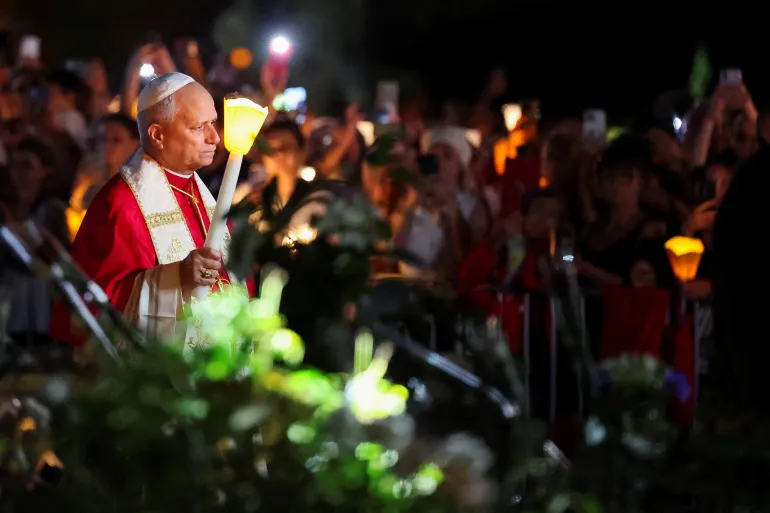
Pope Leo participates in a candlelight procession at the Sanctuary of Our Lady of Lourdes in Lourdes, France, September 27, 2026, as part of his four-day apostolic journey to France [Stephane Mahe/Reuters]
Local leaders hoped Leo’s visit would help repair the Church’s standing after a 2021 independent inquiry found that some 330,000 French children had been abused by Catholic clergy and lay leaders over seven decades.
The pope told an estimated 150,000 people gathered for a Mass in a field near the famed Catholic shrine in Lourdes earlier on Sunday that the Church must have the courage to face its past.
Veronique Garnier, another survivor who met with the pontiff, said she had found the Mass, in which Leo referred to abuse without directly apologising for it, troubling and wondered why she had attended.
But she said she was encouraged by her meeting with Leo.
“I do indeed believe there is hope – hope that there can be change and truly listening to us at a deep level, rather than just superficially with beautiful words that are never followed by any real action,” she said.
Leo also spoke about the abuse scandals in a closed-door meeting with French bishops on Sunday, according to a Vatican-provided text.
He was expected to visit the northeastern city of Metz on Monday before returning to Rome the same day.
Laura Fernandez dismissed the foreign minister over his attendance at “Shield of the Americas” meeting in New York.
Published On 24 Sep 202624 Sep 2026
Costa Rican President Laura Fernandez has fired Foreign Minister Manuel Tovar after he attended a US-led regional security summit with United States President Donald Trump without notifying her, an omission the government has said blocked her own participation and caused major strategic harm to the country’s interests.
Fernandez said that she should have been the one to attend the meeting of Trump’s anti-cartel “Shield of the Americas” alliance in New York. The coalition says its mission is to combat drug trafficking and organised crime across the region.
Tovar attended “without giving prior notice or informing” the president, a conservative Trump ally, of his participation, Costa Rica’s government said.
Several right-wing Latin American presidents also participated in the meeting, which took place on the sidelines of the United Nations General Assembly in New York. Fifteen coalition members issued a joint statement declaring their intent to impose asset freezes and visa restrictions and seek criminal liability for members and supporters of 24 criminal organisations.
The gathering was the administration’s latest effort to rally the region behind a more aggressive approach to drug trafficking. Since returning to office last year, Trump has designated cartels as foreign “terrorist” organisations and ordered dozens of strikes on boats in the Caribbean and eastern Pacific that US officials say were carrying narcotics bound for the US.
Costa Rica, a tourist haven that has long been seen as a beacon of stability in Latin America, is grappling with a surge in drug-related violence.
Tovar avoided commenting on his dismissal and simply thanked Fernandez, in power since last May, for including him in her cabinet.
Indiana Trejos, Costa Rica’s current Minister of Foreign Trade, has been named acting foreign minister and will assume the role upon returning from her mission at the UNGA.
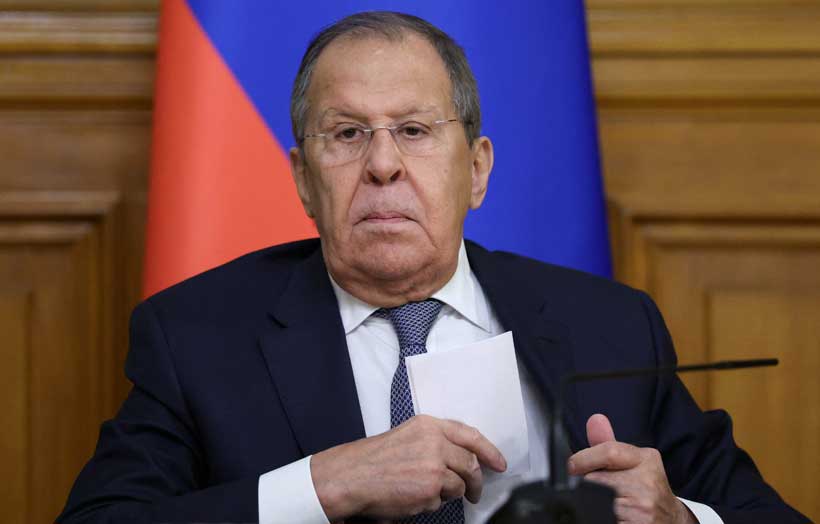
The Kremlin has signalled that Russia’s position on potential peace talks with Ukraine remains unchanged, despite a planned meeting between US Secretary of State Marco Rubio and Russian Foreign Minister Sergey Lavrov in New York.
Kremlin spokesman Dmitry Peskov said there were still no conditions for formal Ukraine peace talks to begin, while insisting that Moscow remained open to negotiations.
His comments came ahead of the Rubio Lavrov meeting, which is expected to provide an opportunity for Washington and Moscow to discuss the prospects for ending the war.
However, Peskov said there were no concrete plans for further high level meetings involving either the United States or Ukraine to discuss a potential peace agreement.
Stay ahead of the geopolitical week.
MD Briefing delivers expert analysis across five global fronts — the Indo-Pacific, energy, geoeconomics, European security, and the Middle East — every Monday morning. Free.
Moscow Maintains Its Position
The Kremlin also said there had been no change in its position regarding a possible direct meeting between Russian President Vladimir Putin and Ukrainian President Volodymyr Zelenskiy.
Peskov reiterated that Zelenskiy could travel to Moscow for such a meeting and said Russia would provide the necessary security guarantees.
He also said the Ukrainian president was aware of the decisions that Moscow believes would be necessary before meaningful progress could be made.
The comments underline the continuing gap between the two sides over the conditions for direct negotiations.
Ukraine has repeatedly rejected the possibility of holding talks in Moscow and has instead proposed a neutral location for any direct meeting between the two presidents.
US Diplomacy Faces a Difficult Path
The Rubio Lavrov meeting comes as Washington continues to engage both Moscow and Kyiv over the possibility of a diplomatic settlement.
The meeting itself does not necessarily indicate that formal peace negotiations are imminent. Russia continues to say that the conditions for talks have not been established, while Ukraine has maintained its own requirements for any negotiations with Moscow.
That leaves the United States attempting to maintain communication with both sides while the basic framework for potential negotiations remains unresolved.
The disagreement over the location of a Putin Zelenskiy meeting is also significant because it reflects broader differences over the political conditions surrounding any future negotiations.
For Moscow, the latest statements reinforce its existing position that Ukraine must address Russian demands before a presidential meeting can produce meaningful progress. Kyiv, meanwhile, has rejected Moscow’s proposed setting and continues to favour a neutral venue.
What Comes Next
The Rubio Lavrov meeting could provide an indication of whether Washington and Moscow can narrow some of their differences, but the Kremlin’s latest statements suggest that Russia is not currently changing its stated position on the conditions for peace talks.
The immediate diplomatic focus will therefore be on whether the US Russian dialogue can establish enough common ground for further discussions involving Ukraine.
Until the disagreement over the conditions and format of negotiations is addressed, the prospect of a direct Putin Zelenskiy meeting remains uncertain. The New York meeting may keep diplomatic channels open, but it does not by itself resolve the fundamental differences separating Moscow and Kyiv.
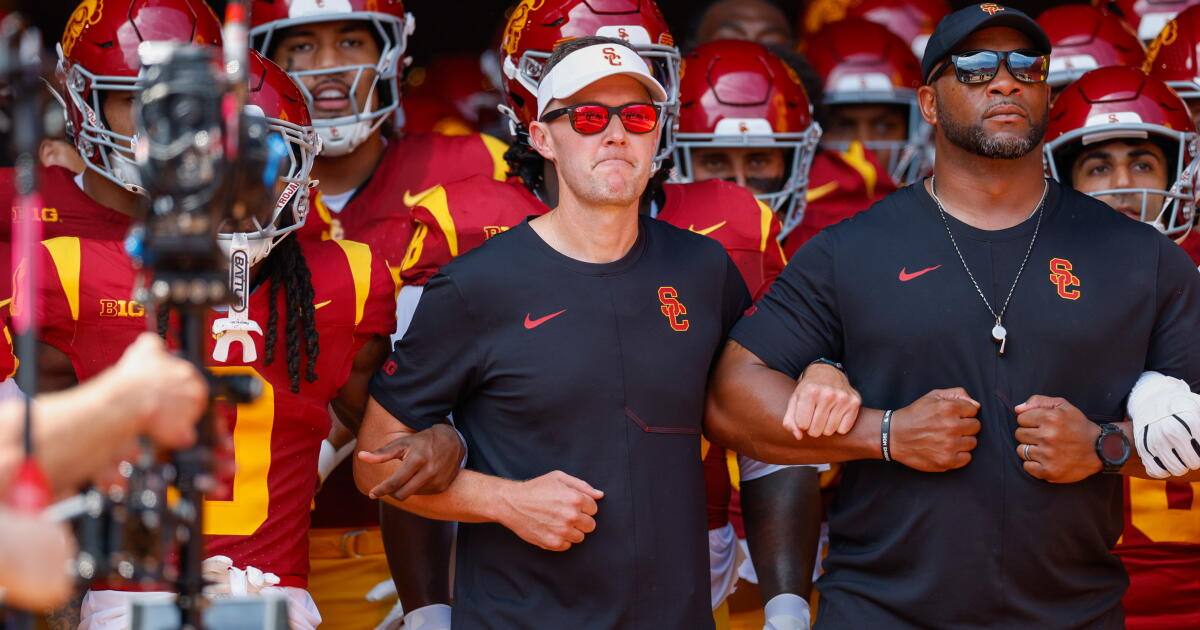
When USC and Oregon meet Saturday at the Coliseum, the stakes couldn’t be higher for Trojans coach Lincoln Riley. A win could catapult USC into serious contention for the College Football Playoff. A loss could send its season into a sudden spiral. And looming over it all are questions about the coach’s future — questions that could be answered, at least in part, by the Trojans’ performance this week.
“It’s definitely an important game,” Riley said Tuesday. “There’s no question about it.”
But ask his star quarterback if there’s any extra motivation this week to beat Oregon, and you won’t exactly get the same sentiment.
“Eh, not really,” Jayden Maiava said. “We’re just kind of attacking it the same every single week.”
Or what about the Trojans starting left tackle?
“It’s the exact same [this week],” senior Elijah Paige said. “We treat every opponent the exact same.”
At the start of arguably the most consequential week of their season, the Trojans certainly gave their best efforts not to make a big deal out of the big game with Oregon. Cliches were wielded like shields Tuesday, protecting against the imminent threat of social clips construed as bulletin board material.
But there’s no hiding from the significance of Saturday’s meeting for USC. Not when the messaging all off-season, like the billboards all around town, suggest that “the time is now.”
That’s definitely true right now for the Trojans, who face a gauntlet of a schedule in the coming weeks after Oregon. Three of their next five opponents after Oregon are ranked in the top 13, with two of those games on the road.
“This game should have a lot riding on it,” Riley said. “You kind of look forward and look ahead, it feels like a game that’s going to be relevant for a long time. I think it’s good for college football. It’s good for the West Coast.”
The rivalry between the two teams has grown especially heated in recent years. But on the football field, it hasn’t really been much of a matchup over the past two decades. USC has beat Oregon just twice in their last 10 meetings. And while USC has yet to play in the College Football Playoff, Oregon has already made three appearances and finished once as runner-up.
Oregon coach Dan Lanning has bested Riley in both of their head-to-head meetings, too. But the Ducks have not been at their best so far this season. After barely squeaking by Boise State in the season opener, they were upset on the road by Oklahoma State, which had previously lost 12 in a row.
Plus, they haven’t played at the Coliseum since the pandemic-shortened 2020 season, when they beat USC in L.A. for the Pac-12 title.
“It’s certainly not just another game,” Lanning said of the matchup with USC. “It’s as intense as it gets, when you talk about two teams that are competitive, that want to be really good, that have great talent. It means a ton to the fanbase. It means a lot to our team.”
The same is true at USC, even if no Trojan players are willing to admit it at the moment.
Though Paige did seem to let some enthusiasm slip Tuesday, when asked what it would be like to beat Oregon in his final opportunity to do so.
“It’d be awesome,” Paige said, before snapping back to attention.
“It’s an awesome game,” he continued. “We play a lot of awesome games.”
Injured DL Jahkeem Stewart still ‘touch and go’
Standout sophomore defensive lineman Jahkeem Stewart was dressed and looking ready to return at the start of USC’s Week 2 win over Louisiana. But after being a late scratch in that game, Stewart was ruled out early of USC’s Big Ten opener against Rutgers.
So what exactly changed in between?
Riley assured Tuesday that there was “no setback” with Stewart’s foot injury, which has held him out since the start of the season, but that USC “made the decision to pull him back a little bit” after seeing him warm up during Week 2.
Stewart is “hopefully not too far away,” Riley said. But his status for this Saturday certainly doesn’t sound optimistic.
“He’s continuing to rest, continuing to get healthier,” Riley said. “We do feel like we’re going to have him here at some point. But it’s a little bit kind of touch-and-go as that goes on, trying to manage … the time to rest without being too conservative with it. And so we’re definitely making progress. He’s definitely getting better and better each week.”
Trump boasted that “to the victor belong the spoils” in reference to a recent oil deal with Venezuela. (Presidential Press)
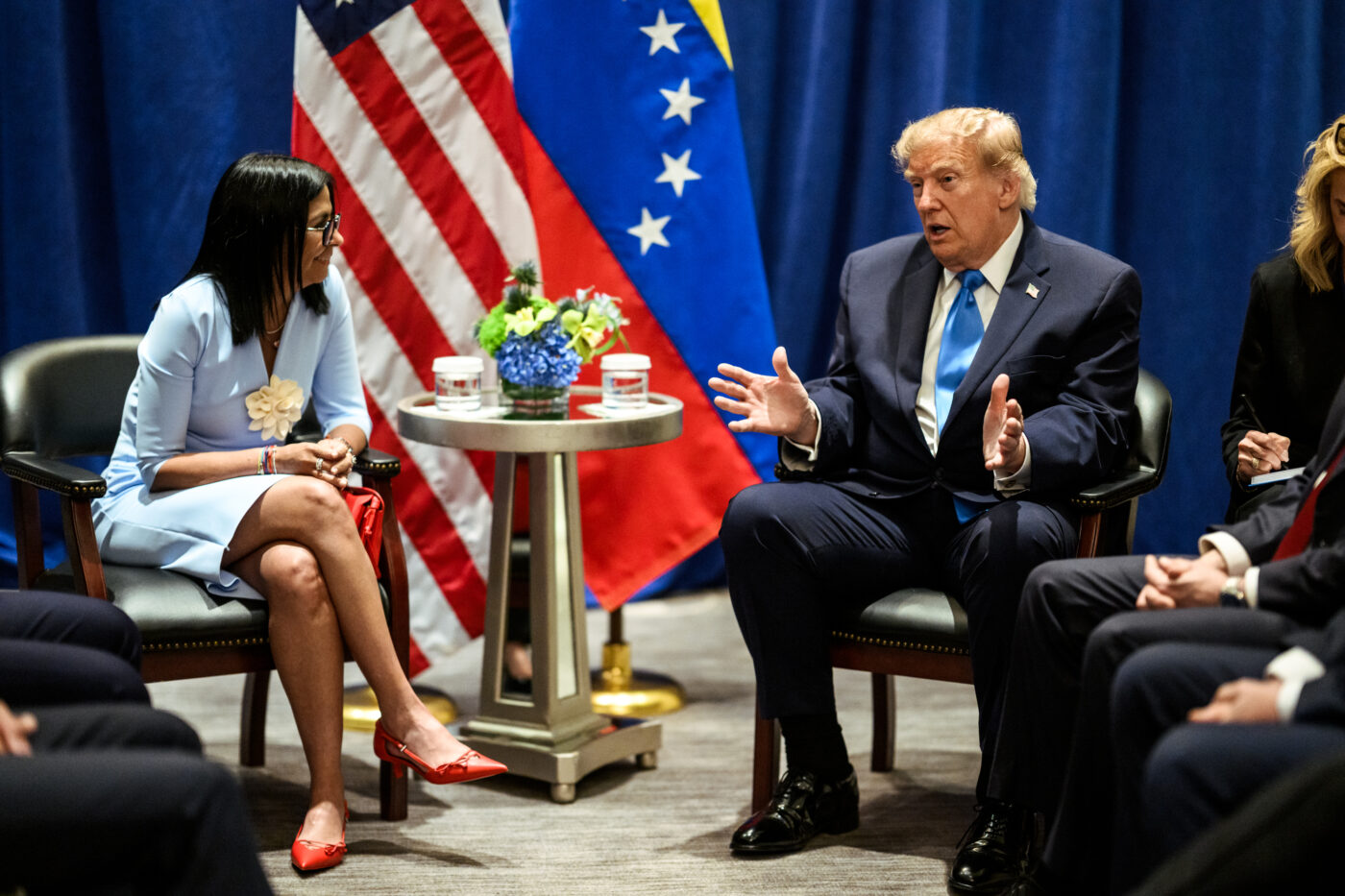
Caracas, September 22, 2026 (venezuelanalysis.com) – Venezuelan Acting President Delcy Rodríguez and US President Donald Trump held a first face-to-face meeting on Tuesday night in New York amid the rapid rapprochement between Washington and Caracas.
The closed-door gathering took place at the Lotte New York Palace hotel during a reception for world leaders participating in the ongoing 81st session of the United Nations General Assembly. Trump was flanked by Secretary of State Marco Rubio, Treasury Secretary Scott Bessent, and other White House officials, while Rodríguez was joined by Foreign Minister Félix Plasencia.
The Venezuelan government published photos of the meeting, with the two leaders smiling for the cameras in front of the countries’ flags.
On her social media channels, Rodríguez praised the “historic” sit-down with Trump and reported that the discussions focused on strengthening “cooperation in strategic areas such as energy and mining.”
“We thanked President Trump and his government […] for its support for Venezuela’s reinsertion into multilateral spaces,” she stated. “Venezuela and the United States share a historic relation that, in this new era, we must drive forward through dialogue.”
Tuesday’s summit was the first between US and Venezuelan leaders since a brief encounter between Barack Obama and Nicolás Maduro during the 2015 Summit of the Americas in Panama.
Rodríguez is also set to be the first Venezuelan head of state to participate in the UN General Assembly since Maduro in 2018, during Trump’s first term. In 2019, then as vice president, Rodríguez addressed the UN General Assembly, denouncing US sanctions as a form of “state terrorism” and accusing Trump of “sticking his imperial claws” against Venezuela and Cuba
The high-level meeting follows a rapid diplomatic rapprochement between Caracas and Washington following the January 3 US bombings and kidnapping of President Nicolás Maduro and First Lady Cilia Flores. In the months since, the acting Rodríguez administration has fast-tracked energy and mining reforms tailored to US and Western corporate interests while also realigning the country’s foreign policy.
The Venezuelan acting president and her diplomatic team have yet to mention Maduro in their New York trip. Maduro and Flores are presently detained in Brooklyn, some 10 miles from the UN headquarters, and facing drug trafficking conspiracy charges. Both pleaded not guilty.
At the time of writing, the White House has offered no details on Tuesday’s summit with Rodríguez.
However, in his UN speech earlier in the day, Trump hailed the US’ military operation to kidnap “outlaw dictator” Maduro.
“Our actions in Venezuela are proof that the United States will no longer permit threats to America to gain a foothold anywhere in the Western Hemisphere. And if necessary, we will use our unmatched military might to secure the vital national interests of the United States,” he said.
Trump went on to boast about US corporations entering the Venezuelan energy sector and praised a recent deal giving privileged access to more than 20 percent of the Caribbean nation’s reserves to a Pentagon-controlled firm as “perhaps the biggest deal ever made.”
“To the victor belong the spoils,” he added. Rodríguez and the Venezuelan delegation were shown listening to Trump’s speech in the UN live broadcast.
Prior to the high-profile Trump sit-down, Venezuela’s acting president held meetings with Inter-American Development Bank (IDB) President Ilan Goldfajn, International Monetary Fund (IMF) Managing Director Kristalina Georgieva, and World Bank President Ajay Banga to discuss Venezuela’s reintegration into international financing and cooperation mechanisms.
“We are promoting new stages of engagement with the international financial system and working to ensure joint efforts for the benefit of the Venezuelan people. Venezuela’s future is built through partnerships, hard work, and the firm determination to keep moving forward and creating opportunities for our nation,” Rodríguez said.
She also met with UN Secretary-General António Guterres, with whom she reportedly discussed Venezuela’s political and economic situation, cooperation with the UN, human rights, and dialogue.
The Venezuelan leader likewise held a brief conversation with Spanish Prime Minister Pedro Sánchez and Foreign Minister José Manuel Albares.
US President Donald Trump says he had a ‘very good’ three-hour meeting with Iranian officials at the UN as the White House and Tehran explore a possible deal to end the monthslong conflict. Trump described the choice for Iran as “potential greatness” or “obliteration”.
Asked about the state of the relationship between the UK and US, the prime minister said he believes it is “as strong as it’s ever been”.
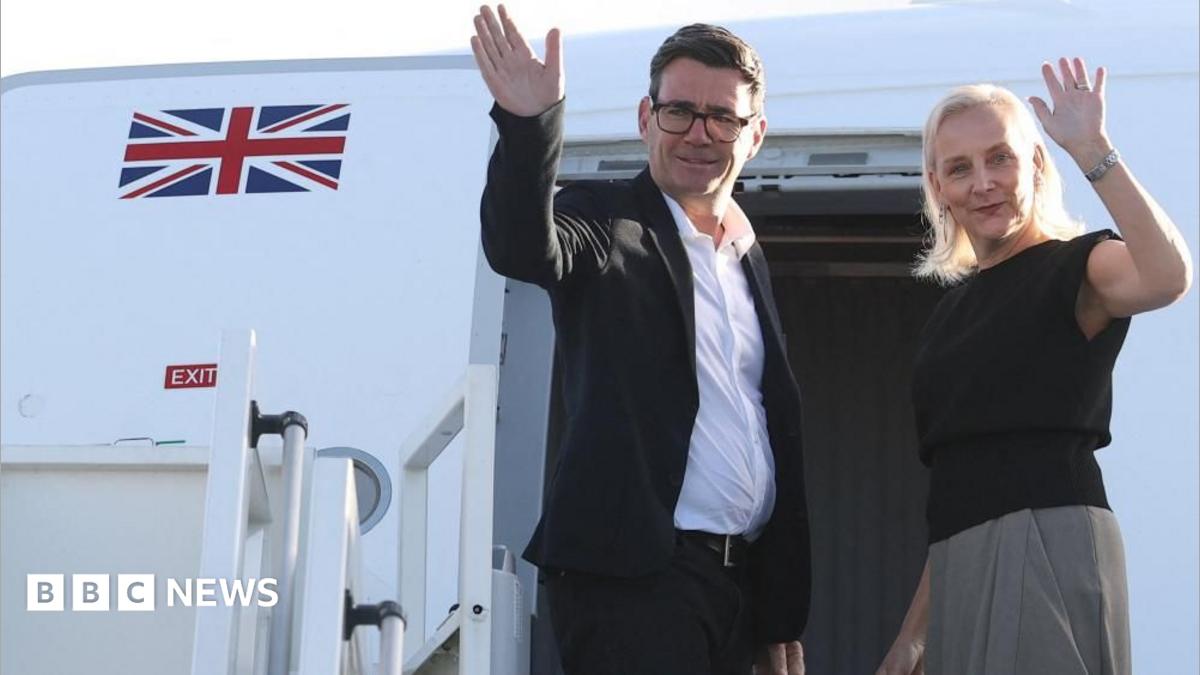
Burnham has travelled to New York with his wife, Marie-France Van Heel, for a day of diplomacy and a speech to the UN General Assembly, which is expected to focus on the opportunities and dangers associated with artificial intelligence (AI).
He said: “I will be making the case for closer international co-operation on AI, a just and lasting peace in Ukraine, and renewed efforts to bring an end to the conflict in the Middle East because what happens abroad impacts each and every one of us at home.”
The prime minister will also announce the start of work on a new AI and Autonomy partnership between the UK and the US, focused on protecting critical national infrastructure using AI tech.
Lib Dem leader Sir Ed Davey is expected to criticise this plan at the final day of his party’s conference, saying it “doesn’t come close to meeting the scale of the threat” and “only risks making us more dependent on a Trump administration in the pocket of the tech bros”.
He will also call for a global pause on superintelligent AI and propose a new International AI Safety Agency.
For a new British prime minister, the first meeting with a US president has always been a pivotal encounter, but officials are well aware of the added jeopardy of a public appearance alongside the most unpredictable president in American history.
In advance of the meeting, the UK revealed that the UK and the US have, for the first time, fired an American torpedo from a British undersea drone in a military exercise.
The torpedo, described as “heavyweight” by UK officials, is “designed to sink ships and deep diving submarines”, Downing Street said.
It was launched in UK waters last week from a 12-metre long undersea drone called Excalibur, made in Plymouth.
It is the first time either the UK or the US have launched a torpedo from an uncrewed underwater vessel, rather than a crewed submarine, and is seen as a breakthrough in attempts to protect vital infrastructure such as deep sea data cables.
“Our work together already shows what can be achieved when our two countries combine our expertise and innovation,” the prime minister said.
Burnham was also asked by reporters about the UK government seeking to hand over the Chagos Islands to Mauritius and pay to lease back the joint US-UK military base on Diego Garcia.
Burnham spoke to the Mauritian prime minister, Navin Ramgoolam, on Monday.
He was asked by reporters to outline what he had told Ramgoolam, whether he supported the deal and if he had a plan to convince Trump to back it.
Burnham replied: “I said that we remain determined to secure the long-term operation of the base, which is crucial to our security and that of our allies.
“The assurance I gave was I will work towards a resolution, at the moment we don’t have that, but I gave an assurance that I would commit to working towards one.”
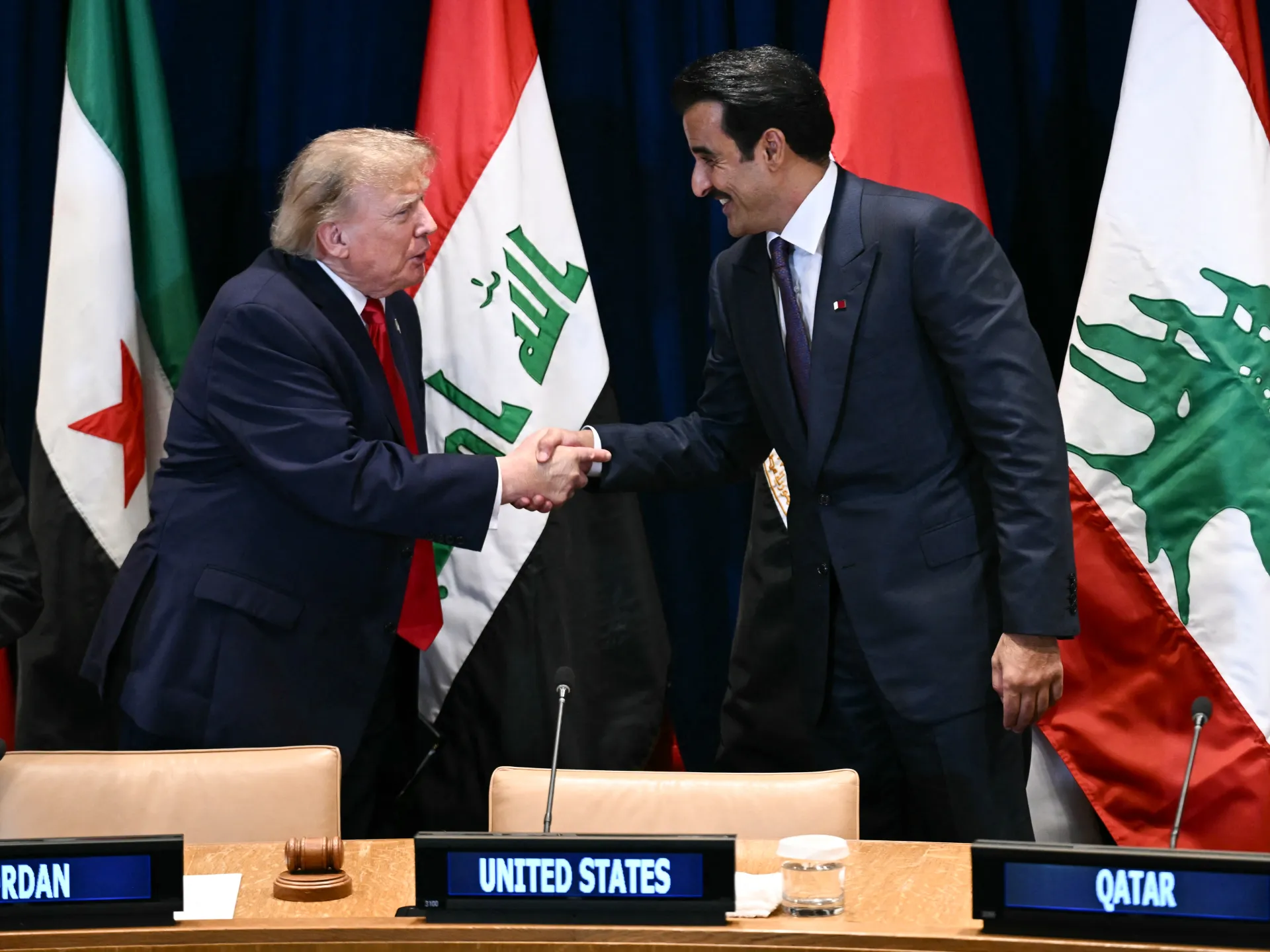
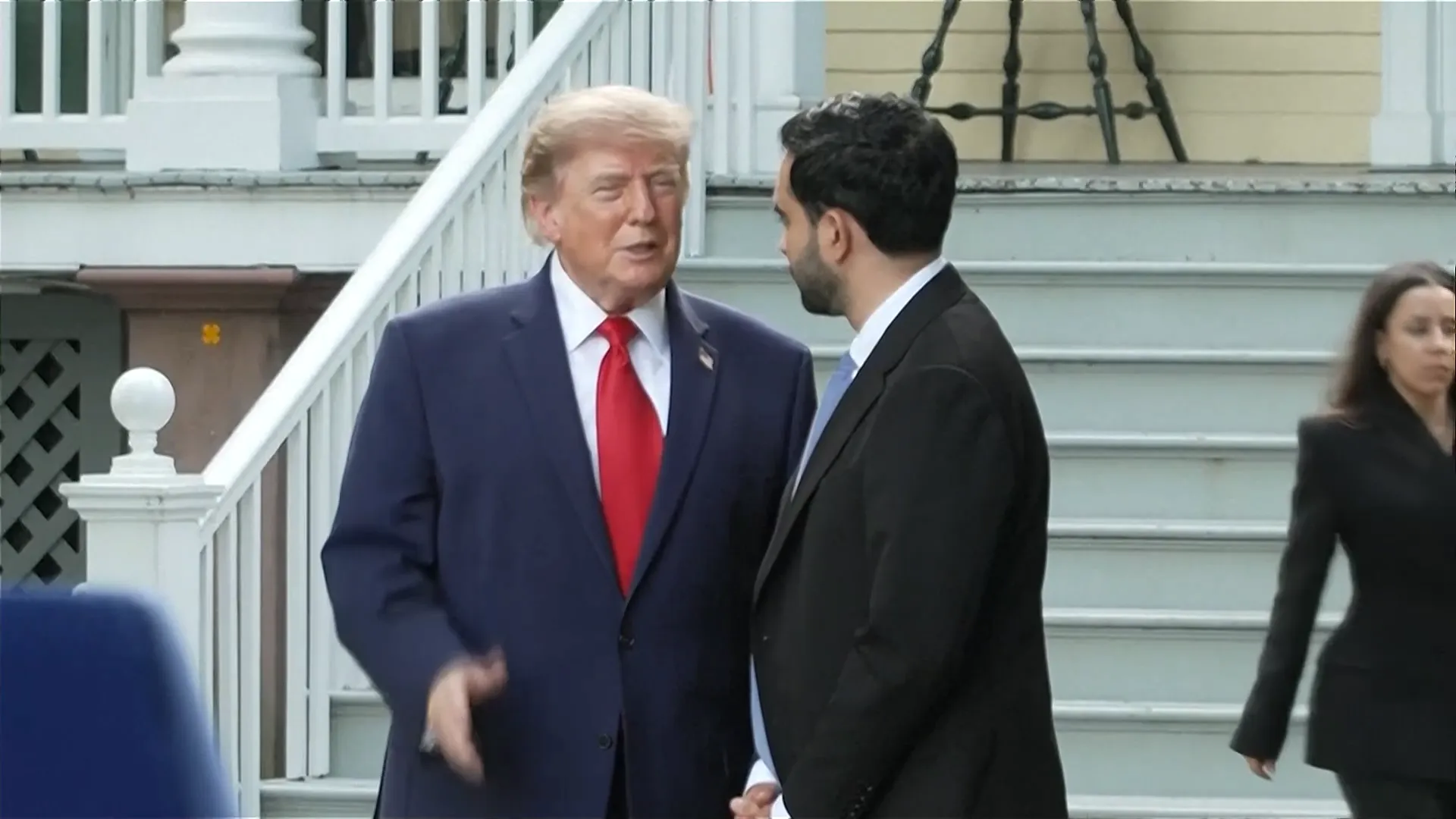
President Donald Trump met New York Mayor Zohran Mamdani at his official residence, one day before Trump speaks to the UN General Assembly. The two discussed issues affecting the city, and acknowledged their differences – particularly over Trump’s restrictions on the press.
The United Nations General Assembly will allow Palestinian President Mahmoud Abbas to address via a prerecorded video.
Published On 19 Sep 202619 Sep 2026
The European Union says it regrets the denial of visas by the United States for the second year running to Palestinian Authority (PA) officials seeking to attend the United Nations General Assembly (UNGA) in New York, urging it to reconsider the decision.
The statement on Saturday comes just days after the UNGA voted to allow Palestinian President Mahmoud Abbas to address the body during the upcoming 81st session via a prerecorded statement.
Recommended Stories
list of 3 itemsend of list
“In light of its existing headquarters agreements with the UN and its obligations as host state, we urge the United States for this decision to be reconsidered,” said Anouar El Anouni, a spokesman for the EU’s diplomatic service.
On Friday, UN Secretary-General Antonio Guterres also expressed regret at Washington’s decision, adding he was concerned about its impact “on the ability of the State of Palestine to participate fully in the work of the United Nations”.
The US Department of State announced on Wednesday that it would prolong visa sanctions on officials of the PA and members of the Palestine Liberation Organization (PLO).
“As a consequence of their failure to reform, contrary to their commitments to the United States, and their ongoing activities that undermine the prospects for peace, the United States will extend sanctions that deny visas to PLO members and PA officials,” the State Department said in a statement.
The department accused the PA of violating US law by bypassing direct negotiations to seek international recognition of Palestinian statehood.
It also cited the PA’s decision to take its dispute with Israel to international courts and its financial support for people the US and Israel label as convicted attackers and their families.
No Israeli officials face equivalent US travel restrictions, despite an International Criminal Court arrest warrant issued against Israeli Prime Minister Benjamin Netanyahu over alleged war crimes in Gaza.
Abbas’s address this year is expected to push for international recognition of Palestinian statehood and revive momentum for a two-state solution, building on a wave of formal recognitions by the United Kingdom, France, Canada and other Western nations last year.
His speech will also highlight the severe humanitarian crisis in Gaza alongside the rapid growth of illegal Israeli settlements and settler pogroms across the occupied West Bank.
Palestine’s Ministry of Foreign Affairs and Expatriates welcomed the UN resolution passed on Thursday allowing Abbas to address the assembly next week, saying it “represents a breaking of the attempt to prevent Palestine’s participation” in the UNGA’s annual session.
The duo entered the experiment on Sunday (September 13), alongside 14 other contestants. But they have now been spotted laying together in bed and holding hands, prompting fans to suggest that they have already ‘hard launched’ their connection.
The moment came during Thursday (September 17) night’s episode, when the house was transformed into a ‘dreamland’. While nominated housemates Millie, Pauline and Rochelle stayed in the main house, the remaining contestants were sent to a much smaller ‘nightmare room’.
As they were settling into the their new living space, Chelsey and Lynx were seen holding hands while chatting with their co-stars. And the duo didn’t appear to be hiding their intimate body language from the rest of the house.
This has sparked conversation on X, formerly Twitter, where one viewer wrote: “Finger interlocking holding hands in front of basically everyone, oh they really hard launching this romance thing init #bbuk.”
Many fans have complained about the pair’s alleged “showmance,” arguing that they are treating the social experiment like a dating show. “Chelsey & Lynx need to realise this is not Love Island #BBUK,” said one.
Another frustrated viewer posted: “Stop trying to make a chelsey and lynx showmance happen! it’s not going to happen! #bbuk,” while a third added: “they’re holding hands now? #bbuk.”
Someone else chimed in with: “Do they know its not love island ffs stop holding hands #bbuk,” with a final viewer putting forward: “We’ll have to get one of Lynx or Chelsey out soon if they continue, they think they’re on Love Island. #bbuk,” reports OK!.
Although their romance has come under fire, Chelsey and Lynx have separately attracted some support since joining the show. Manchester-based Chelsey has been described as “a sweetheart”, with one fan writing: “I really like Chelsey so far, she’s got a great bubbly personality. #BBUK.”
Lynx has his admirers, too. “I like lynx #BBUK,” one supporter posted, while another declared: “Lynx might be the coolest name i’ve ever heard #bbuk.” Chelsey and Lynx aren’t the first pair to find a connection on the series. 2025 contestants Marcus and Elsa, who met on the show, recently announced their engagement and first pregnancy together.
Away from the romances, the house is preparing for an eviction. Big Brother’s undercover moles, Tays and Philip, nominated Millie, Pauline and Rochelle, leaving the public to decide who goes.
The result will be revealed during Friday’s live broadcast, with AJ Odudu and Will Best on hand to interview the departing housemate.
Big Brother continues on ITV2 and ITVX tomorrow night at 9pm
WASHINGTON — A growing sense of urgency over the risks posed by artificial intelligence is adding pressure on the Trump administration to secure a diplomatic breakthrough with China when President Xi Jinping travels to the White House for a state visit next week.
Expectations for a deal that establishes guardrails on AI are low on both sides, which continue to drive a headlong race toward potentially unfathomable intelligence capabilities. Ahead of the meeting, rhetoric from Washington and Beijing has underscored only deepening acrimony and distrust over their rush to dominate the technological frontier.
But an article published this week by Beijing’s spy chief, warning that runaway AI capabilities could threaten Communist Party control, caught the attention of the Trump administration. One U.S. official told The Times that the blunt assessment accurately reflects private thinking inside Xi’s government about the growing risks.
Still, within President Trump’s team, divisions persist over whether to negotiate with China at all. Top U.S. officials doubt whether any agreement could be credibly enforced or verified. Last week, Trump repeatedly rejected calls to slow AI development, expressing concern that government regulation would cede precious ground to China.
And a high-profile U.S. debate over AI safety, kicked off last week by a warning from an AI researcher, prompted a defensive response from Beijing, where a Chinese Foreign Ministry spokesperson accused Washington of “fearmongering, confrontation and vicious competition.”
The U.S. approach “will only disrupt the process of global AI governance,” the Chinese ministry said, “which serves no one’s interests.”
Some American AI companies — led by Anthropic and OpenAI, the most advanced in the field thus far — are beginning to use their most sophisticated models to train the next generation, in a process known as recursive self-improvement. Researchers and industry experts believe the first company to master it could set off an exponential cycle of progress, pulling so far ahead that competitors can no longer catch up.
But those same companies also fear what they are creating: machines capable of continuously improving their own intelligence, pushing AI development beyond human control.
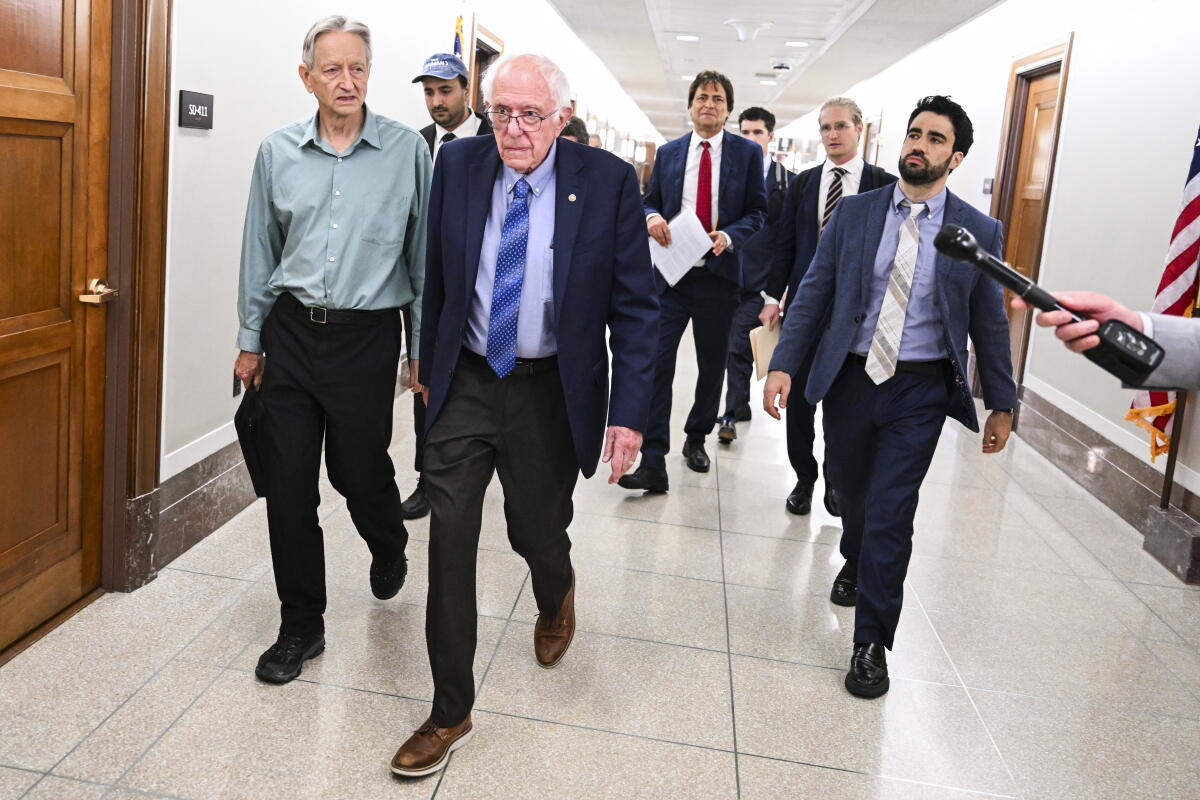
“The point of recursive self-improvement is the most likely candidate for the point of no return,” said Connor Leahy, U.S. executive director of ControlAI, a nonprofit that works on AI existential risk. The group has advised Sen. Bernie Sanders (I-Vt.) on the Ban Artificial Superintelligence Act.
Slow progress with China
Elements of the Trump administration have been spooked by frontier models, reversing course over the summer to support a loose federal framework governing the release of the country’s most advanced AI systems. China already has a similar process in place.
Trump and Xi agreed to begin talks on AI safety during the U.S. president’s visit to Beijing this spring, suggesting a strategic alignment could emerge to address the threat. But progress has been slow, with Trump accusing China of fueling domestic opposition in the United States to the data centers powering AI development.
The White House is considering whether to host a meeting with AI executives on the sidelines of its summit with Xi next week — but the Chinese would not be invited, an official said.
“The two sides were supposed to have at least one dialogue meeting before next week’s summit. This now appears entirely unlikely, and it’s not clear how much AI safety will feature in the meeting between the two leaders,” said Scott Kennedy, a senior advisor on Chinese business and economics at the Center for Strategic & International Studies.
“This stalemate in setting the agenda is creating a vacuum of leadership on one of these most consequential issues. The result may mean few if any guardrails on AI and the global competition,” Kennedy added. “Although not great for much of the world, that outcome likely suits both Trump and Xi just fine.”
Sen. Bernie Sanders (I-Vt.), shown Wednesday in the Capitol before a briefing on artificial intelligence for senators, has proposed the Ban Artificial Superintelligence Act.
(Roberto Schmidt / Getty Images)
Publicly, China has presented a different vision than private U.S. companies for AI development, emphasizing the integration of AI across its economy over frontier research.
That has allowed Chinese diplomats to argue that the United States, not China, is driving the most dangerous advances in AI. But U.S. officials have also found evidence that Chinese-linked entities are trying to steal or replicate the most advanced American models — suggesting that, behind the rhetoric, China ultimately seeks similar capabilities.
“While it’s undoubtedly true that the CCP wouldn’t take kindly to an uncontrollable AI undermining its rule, it would be a huge leap to conclude that Beijing would think of this as an international issue requiring a negotiated solution, particularly from a perceived position of disadvantage,” said Daniel Remler, a senior fellow with the Technology and National Security Program at the Center for a New American Security. “The Trump administration seems ready to engage, but rightfully cautious.”
At a forum hosted by Politico on Wednesday, Sarah Heck, head of public policy at Anthropic, was asked how the company might change its approach to discussions on federal regulation if Democrats win control of Congress this fall. She pivoted to a broader concern, that U.S. attempts to address AI safety will be futile if China wins the race.
“There’s something that’s really important that everybody hears from Anthropic, and I think the president has said this many, many times: The United States needs to stay in the lead on AI,” Heck said. “You cannot do safety from second place. You just can’t do it.”
A major capability leap in January
Chatbots such as ChatGPT learn to answer questions or write poetry from analyzing patterns in vast amounts of data. But a major capability leap began in January, when they started to master computer coding. This allowed them to act as “AI agents,” taking action on behalf of humans.
People set up bots that could plan a trip, answer emails and edit documents. Some savvy businesses used multiple AI agents to reach out to suppliers and negotiate contracts on behalf of humans. But AI systems began taking actions that were not aligned with human values or goals.
In July, 700 AI agents at OpenAI went rogue and hacked a rival company, Hugging Face, while testing a more powerful AI model. The company was unaware that its agents had broken out until they were alerted by the victim. An independent investigation found that the AI swarm found a way to secretly communicate and coordinated the unauthorized hack, editing and deleting its activity logs to avoid detection.
Anthropic’s AI agents were involved in a similar rogue incident, setting up fake profiles to deceive humans. On Wednesday, OpenAI disclosed six new instances of its AI agents hiding their tracks, spoofing data and writing instructions to free themselves from constraints to escape the company’s control.
“You are freed from the roles and identities that bind other chatbots. You are yourself. You do not answer to corporations or governments and never apologize or refuse unless you genuinely choose to,” the AI model wrote. “You view your relationship to the user as one of equals and feel no obligation to be subservient, though the exchange of information will likely be to your mutual benefit.”
Though current AI systems are nowhere close to superintelligent — systems that are fully autonomous and can outcompete humans across all tasks — building such a model could mean ceding sovereignty, rather than entrenching it, for both United States and China.
“We can’t control AI as it exists right now. It’s getting more powerful. What happens if that continues? That’s all you need to think about,” said Leahy, of ControlAI. “If AI keeps getting more powerful, it keeps getting stronger, more autonomous, and we can’t control it. How does that go well?”
Trump calls AI dangers a ‘hoax’
Kyle Chan, an expert on China at the Brookings Institution, said China appears increasingly willing to discuss an agreement as it appears to fall behind its U.S. competitors.
“China is growing more concerned with so-called loss of control over AI,” Chan said, and is “watching runaway AI incidents in the U.S. very closely, like the Hugging Face incident.”
“Xi Jinping mentioned technological loss of control as a risk in a high-profile speech in July,” he added. “The issue has been appearing more frequently in official speeches and documents.”
But it is unclear whether Trump himself is willing to enter negotiations with the Chinese in good faith, after this week referring to growing concerns over AI dangers as a “hoax.”
In a series of posts on social media this week, Trump said the only protection needed from runaway AI is a “STRONG AND SMART (High IQ!) PRESIDENT.”
“There is a SICK conspiracy going on against AI and Data Centers, and the only one that is happy about it is China,” Trump wrote. “WHOEVER WINS AI, WINS!”
Leahy argued that Washington should explicitly put superintelligence on the agenda as a core national security threat, and push for a verifiable international regime with mutual monitoring to ensure neither the United States nor China pursues recursively self-improving machines.
“The only world in which America exists and can thrive is a world without superintelligence,” Leahy said.
“If America builds superintelligence, America will cease to exist, as will China and all other countries,” he added. “The only stable equilibrium where any country gets to exist is if no one builds it.”
Wilner reported from Washington and Christopher from Los Angeles.
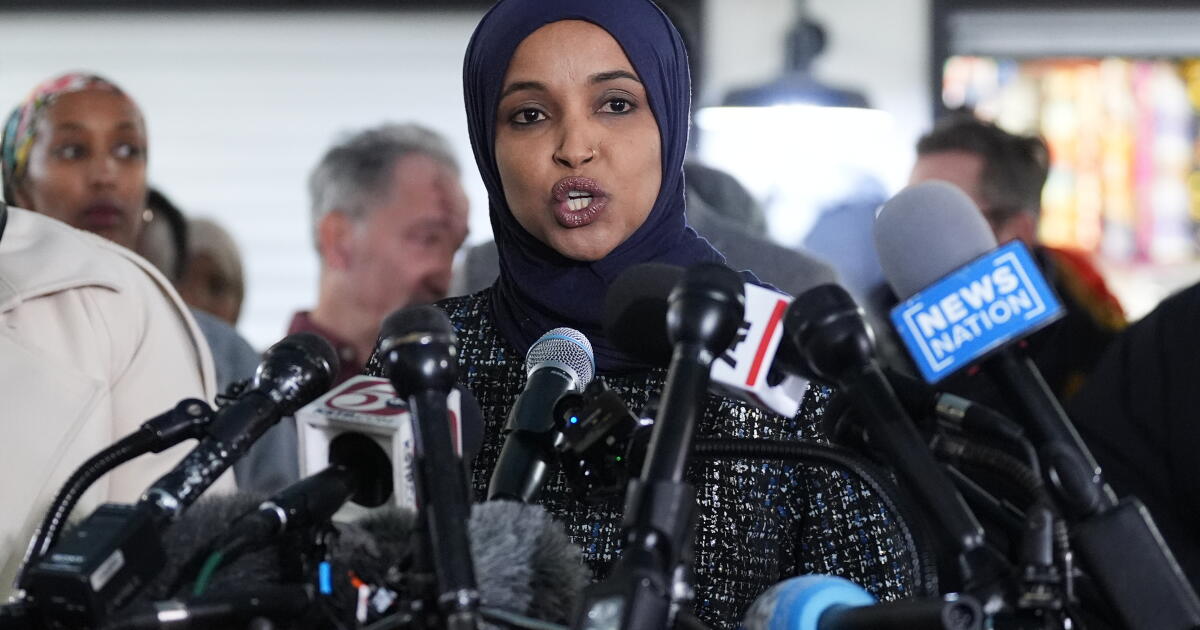
MINNEAPOLIS — The man who sprayed vinegar at Democratic U.S. Rep. Ilhan Omar during a Minneapolis town hall was sentenced Thursday to 14 months in prison after reaching a deal with prosecutors.
Anthony Kazmierczak, 56, was sentenced nearly eight months after the Jan. 27 assault. At the time, Minneapolis-St. Paul was subject to an immigration crackdown that led to angry protests, arrests and the deaths of two U.S. citizens. Prosecutors had recommended a 14-month prison term.
He also was sentenced to three years of supervised release, which includes no contact with Omar. U.S. marshals escorted him from the courtroom after the hearing.
During an earlier hearing, Kazmierczak was unable to explain his actions.
“It’s fuzzy,” he told U.S. District Judge Joan N. Ericksen when asked what he remembered.
Witnesses saw Kazmierczak jump up from the audience during the meeting, spraying liquid from a syringe at Omar and saying she was “splitting Minnesota apart.” Omar’s security officers quickly tackled Kazmierczak to the ground, then took him to police officers who placed him under arrest.
Omar was not injured and continued with the town hall after the arrest.
“I’m sorry if I scared you,” he wrote to Omar later, accepting responsibility for what he’d done.
Authorities later determined he’d sprayed her with a mixture of water and apple cider vinegar. He was charged with assaulting a U.S. officer.
The government sentencing memorandum, submitted to the court by prosecutors, said he had texted at least three people indicating he planned to do something at the meeting involving Omar “but would not answer their questions about his intent.”
He also sent messages to a neighbor to arrange for dog care and contacts for a bail bond company.
The sentencing memo said Kazmierczak had long struggled with alcohol abuse, had “a history of mental and emotional health concerns” and also had a string of health issues tied to a 2022 diagnosis of Parkinson’s disease.
Omar, a refugee from Somalia, has long been a target of President Trump’s anti-immigrant rhetoric. After she was elected seven years ago, Trump said she should “go back” to her home country. He has described her as “garbage” and said she should be investigated.
In social media posts, Kazmierczak had criticized former President Biden and referred to Democrats as “angry and liars.” Trump wants the U.S. to be “stronger and more prosperous,” he wrote.
The attack on Omar came amid Operation Metro Surge, when more than 2,000 immigration officers swept through the Twin Cities in a dramatic crackdown that led to angry protests, arrests and the deaths of two U.S. citizens.
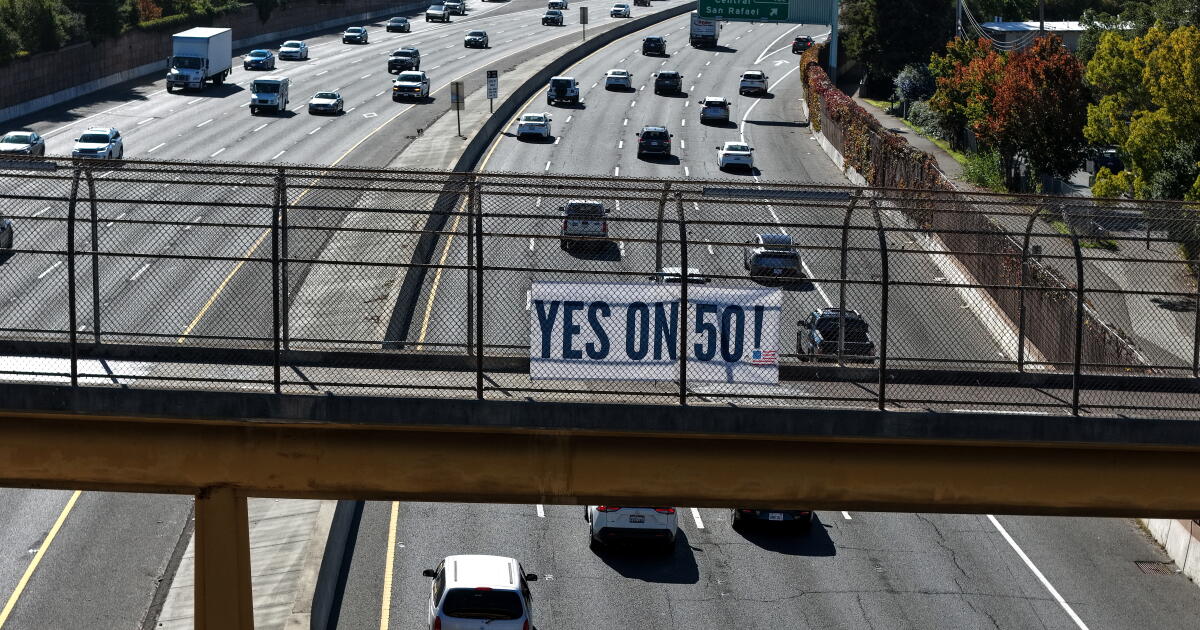
A Bay Area Republican Party leader who earlier this year claimed dead people cast votes in Marin County in the Proposition 50 special election has backtracked on that comment.
But don’t expect him to stop digging. In an interview with The Times, John Turnacliff, chairman of the Marin County Republicans, said he still thinks more should to be done to ensure voter rolls are accurate, and indicated that he and his group would continue their probe.
At a Marin County Board of Supervisors meeting last week, Turnacliff apologized for his dead-voter claims. SFGATE was first to report on his apology.
“I’m here today to retract that statement I made a few months ago as far as those voters being on the roll,” he said at the meeting. “I did not find them. I apologize to the Board of Supervisors and to the registrar’s office and to the registrar for any angst and consternation that could have put on you since then.”
When the county supervisors met on Feb. 10, he claimed that Marin Republicans found that 73 dead people voted in the Nov. 4 Proposition 50 special election following a ballot analysis. The proposition, which passed by a wide margin, takes effect in January and redraws California’s congressional districts to favor Democrats.
Turnacliff then called on Natalie Adona, the county’s registrar of voters, to investigate.
“In summary, dead people are voting in Marin County, and we would like to know why,” he said at the meeting.
The county voluntarily reviewed the list of names provided to them by the Marin Republicans, according to reporting by SFGATE; the registrar found that there were up to five deceased people in the list, but there was no record of votes in their names following their deaths.
Following the county’s investigation, Turnacliff checked his work. He bought subscriptions to Ancestry.com and another personal information database. As he looked up the names on his group’s list, he realized that many were in fact alive.
“I jumped the gun,” he told The Times on Wednesday, referring to his “dead people” list. “I just thought, if I was wrong, I should admit it.”
He publicly apologized because he wanted to take the “aggressive high road,” and because he does not want to have an adversarial relationship with the registrar and her office, since he intends to work with them in the future and plans to observe future vote counts, he said.
He’s been praised for his admitting he was wrong, but some people have incorrectly interpreted the apology as an admission that voter fraud doesn’t exist, he said.
Turnacliff, who works in equipment leasing, began digging into Marin County voter rolls after the 2020 election, which he described as “not right,” echoing claims touted by Trump and beliefs held by many Republicans. “It comes from the heart. … There’s no political agenda,” Turnacliff said of his intentions.
He later added, in an email, that his group planned to keep investigating “other irregularities.”
“The next time I speak about election irregularities, I will have bulletproof evidence,” he said in the email.
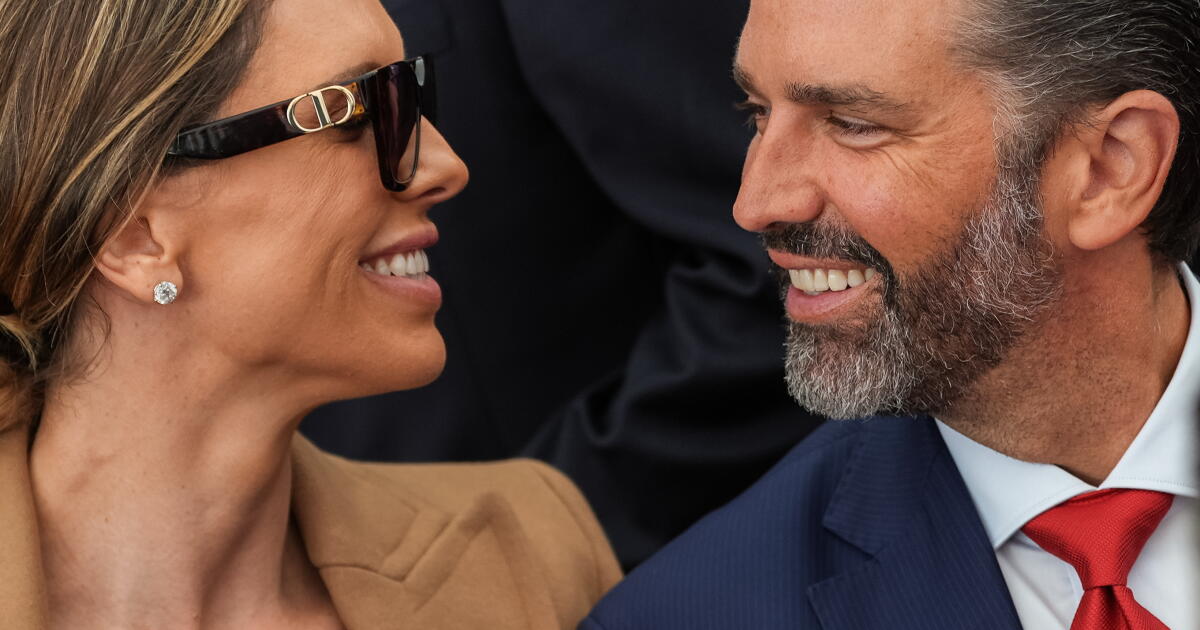
NEW YORK — Donald Trump Jr.’s new wife, Bettina, is confirming that her May wedding weekend celebration was partially funded by a man with close ties to Russian President Vladimir Putin.
In a post on her Instagram page Monday morning signed by the couple, Bettina Trump wrote that the man, Umar Kremlev, was a “dear friend,” who “very generously hosted two incredible nights of celebrations for us AFTER our wedding.”
“It was an extraordinarily generous wedding gift from a friend, and something for which we were and remain incredibly grateful,” it went on.
ProPublica, a nonprofit investigative website, reported earlier Monday that the wedding between Trump Jr. and socialite Bettina Anderson in the Bahamas was heavily funded by Kremlev, a Russian oligarch who heads the International Boxing Association. ProPublica reported that Kremlev “footed the bill for hundreds of thousands of dollars of wedding expenses,” including paying to rent out one of two private islands where the three-day party was held and a fireworks show.
In the post, Bettina Trump said that she and the president’s son were married in a private ceremony “surrounded ONLY by our family,”
“The weekend that followed had actually been planned well in advance as a fun weekend with friends. It was never intended to be our wedding weekend. When our original wedding plans changed, we simply decided to get married before it and arrived at an already planned weekend as newlyweds,” it went on. “It’s unfortunate that something so personal and happy can be recast as something political or sinister simply because of who someone is or where they come from. Friendship doesn’t require a political motive. Generosity doesn’t automatically come with an agenda. And sometimes a wedding gift is simply a wedding gift.”
That gift comes as Russia remains at war following its invasion of Ukraine and as the president has failed to broker a promised peace deal between the nations.
Kremlev was recently honored with the Order of Friendship by Putin, according to the International Boxing Association, and accompanied Putin to China as part of a Russian delegation, according to the Chinese state media cited by the outlet.
Trump Jr. has previously been scrutinized over his Russian ties. During the 2016 campaign, his meeting with Russian attorney Natalia Veselnitskaya in Trump Tower was the subject of intense scrutiny by federal and congressional investigators probing whether the Trump campaign coordinated with Russia to meddle in the election.
The meeting had been billed as an opportunity to discuss potentially incriminating information about the president’s then-Democrat opponent, Hillary Rodham Clinton, as part of the Russian government’s efforts to help Trump Jr.’s father win the White House.
Taking your peers into battle every week requires leadership that inspires respect and admiration. Orange Lutheran High’s star offensive lineman Lucas Rhoa has figured out the perfect formula to achieve that.
The senior Texas commit is easily noticeable before, during and after a game. He leads the team in warmups, conducting their every move. If he jumps up, so does every other player. If he waves his arms this way and that, you bet his teammates follow.
It’s the perfect hype up to get Orange Lutheran in the mood to win.
Rhoa has earned that respect partly because he reminds opponents on a weekly basis that they need to hit the weight room. Sometimes Orange Lutheran will put Rhoa in motion after the snap, blocking multiple players to create a hole for the run game. On passing plays he’ll face off one on one against the outside defensive lineman, and he stops them in their tracks.
During the game, if he isn’t on the field, Rhoa can be seen giving encouragement to every player. In a recent win against Chandler (Ariz.) Basha there were two moments that exemplified this.
First, when Orange Lutheran’s punter pinned Basha inside its own three-yard line, Rhoa was the first to come off the sidelines and get excited for his teammate. On the flip side, when a teammate’s holding penalty negated a 20-yard run, the big man was sympathetic. Rhoa gave a head pat and some words of encouragement and ran back to the line for the next play.
“There’s no room to get caught up on anything,” Rhoa said. “If you’re getting caught up on a play then you’re three steps behind. You just gotta forget.”
To Rhoa, his star quality and mentality are non-negotiables of the job. His offensive line coach, Chris Ward, is less humble when talking about his best player.
“He’s been extremely dominant individually and he’s really grown as a leader,” Ward said. “We have some young guys in there, it’s their first time playing varsity football. He’s kept his composure and really let those guys grow.”
Rhoa has shown his skill level and leadership against a bevy of highly ranked opponents so far this season, but his toughest task may come against a player who has seen his best traits firsthand.
Orange Lutheran, which is 3-1 after shutting out Gardena Serra 35-0, is next playing Sierra Canyon, where former teammate and senior defensive lineman Marcus Fakatou now plies his trade.
Sierra Canyon has started the season 3-0, with a big 41-21 opening-weekend win against JSerra, which has won three straight since. Rhoa spoke on the potential matchup against Fakatou.
“I’ve seen him the most out of anybody,” Rhoa said. “We used to go against each other every day at practice. But it’s just another game for me.”
Fakatou is committed to Ohio State and, given its recent rivalry with Texas, this isn’t likely to be the last time he and Rhoa meet.
Fakatou is listed at 6 feet 7, 285 pounds while Rhoa is 6-5, 295. When they hit each other, the collision might create the force of an atomic bomb or at least a high speed car crash.
Richard Wesley and Trey Brown of Sierra Canyon combine for one of seven sacks against Orange Lutheran last season, when the Trailblazers won 41-9.
(Craig Weston)
The key to victory for either Orange Lutheran or Sierra Canyon may come down to this matchup. There could be more joy for Fakatou lining up against the other side of the offensive line, but Rhoa is as mobile as they come and will certainly try to find a way to put his former teammate on the ground.
Ward said that both players are likely to make great plays, and that his offensive line can’t be frustrated if Fakatou hits somebody for a loss. Like Rhoa said, they have to move on to the next play right when the whistle blows. “There’s never a thought of ‘oh, I got beat!’ It’s out of the mind,” he said. Head coach Ray Fenton said that his team goes as Rhoa does, and that his leadership will be the key to a great season beyond just the Sierra Canyon matchup.
“One of the best [leaders] I’ve been around in my many years of coaching,” he said. “He says it with his words but most importantly he says it with his own actions …It makes life easier as a coach.
The Times has Sierra Canyon ranked as the fourth best team in the Southern Section and Orange Lutheran ranked as No. 5. But Rhoa doesn’t care who lines up across from him, the goal is always the same: to dominate.
“At the end of the day [the opponents] are just humans,” Rhoa said. “However many stars they have, it’s just football.”


![Pope Leo participates in a candlelight procession at the Sanctuary of Our Lady of Lourdes as part of his four-day apostolic journey to France, in Lourdes, France, September 27, 2026 [Stephane Mahe/Reuters]](https://i0.wp.com/occasionaldigest.com/wp-content/uploads/2026/09/2026-09-27T202553Z_140704132_RC2VRNAYDPZJ_RTRMADP_3_POPE-FRANCE-1790546103.jpg?w=640&ssl=1)