Measure LA could hasten the end of L.A.’s Public Works board
The Los Angeles Board of Public Works has been overseeing work on streets, sidewalks and sewers since 1905. But if voters approve Measure LA on Tuesday’s ballot, it might not be around much longer.
The charter amendment enacts a half-dozen changes, and the most divisive is a provision that would “allow for the elimination of or changes to the Board of Public Works.”
Proponents assert that passage would lead to better city services and quicker repairs of deteriorating infrastructure. They also say the five-member board wouldn’t just disappear, and disbanding it actually would require a two-thirds vote of the 15-member City Council.
Opponents say the board plays a crucial role in managing billions of dollars of infrastructure projects while maintaining public accessibility and handling matters that don’t merit council attention (such as tree removal votes). They fear that eliminating the five-member oversight panel, and putting a single person in charge, would open the door to graft, with some citing San Francisco’s former director of public works being sentenced in 2022 to seven years in federal prison for his role in a kickback and bribery scheme.
“If the Board of Public Works was eliminated and concentrated within the authority of one person, I think that gives way to more corruption than transparency,” Councilmember Monica Rodriguez said.
Storm drains and sidewalk repairs
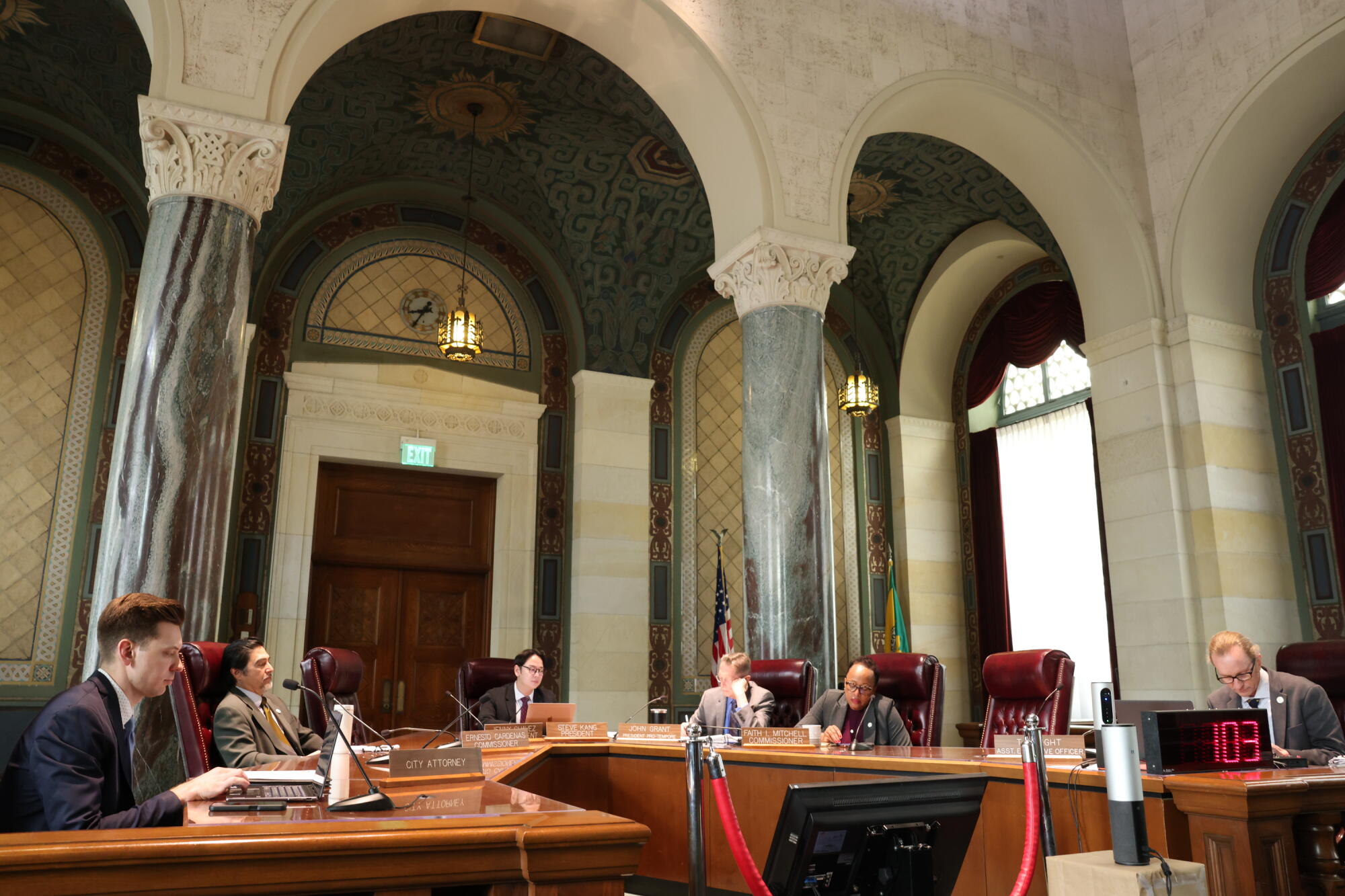
The board generally convenes Mondays, Wednesdays and Fridays in an ornate, high-ceilinged room on the fourth floor of City Hall.
One recent 2½-hour meeting kicked off with a lengthy celebration of Latino Heritage Month, and then the four members present moved through a series of agenda items tied to low-profile infrastructure projects, including:
- A reveal of seven bids for a package of sidewalk repairs, with Acting Executive Officer TJ Knight reading aloud the name of each applicant, and the bid amount, sometimes down to the penny. They ranged from a high of $2.47 million to a low of $1.9 million
- A Bureau of Engineering representative requested authority to boost the budget of a storm drain project in the Pacific Palisades in advance of El Niño storms.
- A Bureau of Street Services staffer broke down a request to remove protected trees (with plans for replacement) on a project on Mulholland Drive.
Each discussion item drew questions from the commissioners. All items were unanimously approved.
Paid positions
The five board members are all full-time city employees who earn slightly less than $200,000 a year. The members, including the board president, are appointed by the mayor and together oversee more than 5,500 people who work for city bureaus and offices that handle sanitation, street lighting, engineering, graffiti removal and more. Each bureau also has its own head.

A Board of Public Works meeting at City Hall.
(Jonathan Alcorn/For The Times)
The board members aren’t commenting on Measure LA. Former members, however, say the five-member board is an effective way to manage and coordinate a wealth of projects.
Rodriguez, who served on the board from 2013-16, said that during her tenure she focused on overhauling the procurement process to allow small, women-owned and minority-owned businesses to better compete for city contracts. She also learned the inner workings of the panel that approves more than 85% of the city’s construction contracts.
Diffusing the workload, former members say, allows for regular interaction with elected officials and the private sector.
Valerie Lynne Shaw, who served on the board from 1996 to 2013, said the board plays an important role in serving as a “coordinating mechanism” for infrastructure projects, and that commissioners regularly assist in solving problems raised by the public. She echoed the benefits of a larger panel.
“Power in the hands of many better serves the city as opposed to power in the hands of one,” she stated.
One former board member, who asked not to be identified to preserve professional relationships, said the existing system yields frequent public interaction, whether it’s people speaking during meetings or via other channels.
“I regularly went to neighborhood council meetings, homeowners association meetings, town halls, county board of supervisors meetings, to the state legislature,” the former member said. “A director can do some of that, but not all of that.”
Who’s in charge?
Councilmember Katy Yaroslavsky begs to differ. From her vantage point, the current system is fragmented with no clear authority.
Yaroslavsky has been frustrated in getting information on a long-running intersection repair project on La Cienega Boulevard in her Fairfax area district.
“I can’t get any information from anybody, and I’m the councilperson,” she says.
Yaroslavsky contrasts the city setup with that of Los Angeles County, which she says has a well-known leader in Director of Public Works Mark Pestrella. She believes the city system of five board members serving as a collective general manager is a vestige of another era that never would be created today.
“When you have one person in charge, you know who you can hold accountable,” she says.
Councilmember Bob Blumenfield, another Measure LA supporter, agrees that accountability and efficiency could be bolstered under a revamped system. He believes that when certain projects require the participation of multiple bureaus, there can be a silo effect that slows progress.
“For years we’ve talked about, how do we better coordinate the bureaus? There have been advances, but it’s still fundamentally been a challenge,” he says.
In June, when the full council discussed changes to the board, during a marathon meeting about what would go on Tuesday’s ballot, panel President Marqueece Harris-Dawson also indicated that the current setup can cause confusion.
He said that, when discussing a project, “I have someone from Street Lighting saying to me, ‘Well, yeah, I can fix that light, but you also have to talk to Engineering.’ And Engineering says, ‘Well, that isn’t on our list to do.’ So it just feels like it’s bounced around, and there isn’t any one person that can say, ‘Here’s how the problem gets solved.’”
At the meeting, Rodriguez countered that having a single person in charge would not necessarily change that.
“A director isn’t going to be the omnipotent one that knows everything about what’s being coordinated between the different bureaus,” she said. Instead, she added, “If we want to talk about the real problems, we’ve got to talk about the resources and staffing support of each of these bureaus.”
Hiding the poison?
According to a City Ethics Commission database, no money has been spent by groups either supporting or opposing Measure LA. But for some political observers, the measure remains multifaceted and the debate heated.
Opponents of Measure LA question why something so significant and controversial as the potential eradication of a board that has been in existence for more than 150 years is on a ballot measure with more palatable proposals, such as adopting a two-year budget cycle and establishing a capital infrastructure plan.
Some have compared it with city Measure EE, the November charter amendment that includes good-governance elements such as boosting penalties for campaign finance violations and a more consequential proposal to allow the full council to meet at least once a week, rather than the current requirement of three times a week.
The former Board of Public Works member suggested that altering the five-member panel should have been its own item, saying, “The longer the paragraphs are, the fewer words the public will read.”
Rodriguez was even more direct, saying, “I think those are all tethered together to make you swallow the poison.”
Yaroslavsky described some of the board members as “very talented,” including its president, Steve Kang, and she acknowledges that separating aspects in the measure would have allowed a more focused conversation on public works. But she believes putting everything together is part of addressing “common-sense, obvious stuff” that will help the city function better.
Blumenfield also understands the objection but points out that the ballot already is overwhelming, and that everything in Measure LA addresses a change in governance and efficiency.
He also points out that voter approval would only set the stage for a later discussion. If a future council opts to change or eliminate the board, it would require 10 votes — or 12 if the mayor vetoed such a move.
“It’s a question that is worth asking, but nobody wants to take the time to go deep on how could we be better if we can’t even have the authority?” Blumenfield said.