mccotter

Federal officials charge 28 in California noncitizen voting case

Federal authorities have charged 28 people from across California with illegally registering to vote or casting ballots in federal elections despite not being U.S. citizens — again escalating an election battle between the state and the Trump administration just weeks before the Nov. 3 midterms.

Authorities said 11 of the 28 were arrested as of Monday morning and that the 17 others “will be in custody in the near future.” Some of the 28, all of whom are lawful permanent residents of the U.S., are charged with lying about registering or voting on their naturalization paperwork, officials said; 21 of them are suspected of casting votes, some in multiple elections. None are undocumented immigrants, a favorite target of President Trump and a group he has accused of infiltrating U.S. elections in the past.

Those charged represent a tiny fraction of the 20,000 “likely noncitizens” that the Justice Department alleged are on California rolls just last week, and an even tinier fraction of the more than 190,000 noncitizens the Trump administration alleged were on state rolls as recently as July.

State officials have previously warned, along with independent elections experts, that the Trump administration has badly overstated voter fraud claims in other states. In Nevada, for example, officials recently found that all 185 people the Justice Department flagged as potential noncitizens were in fact citizens. The administration has repeatedly revised downward its estimate for how many “likely noncitizens” are on California’s rolls.

Acting Deputy Atty. Gen. Trent McCotter cast the arrests during a Monday news conference as proof that California voter rolls are corrupted and need to be purged to prevent noncitizens from negating the legitimate votes of U.S. citizens, and that California officials who have rebuffed recent Trump administration efforts to purge the state’s rolls are willfully obstructing justice.

“This Department of Justice will not look the other way while non-citizens vote in federal elections,” McCotter said. “Unfortunately, the same can’t be said for California and L.A. County.”

State and local officials — some of whom are being sued by the Justice Department over their handling of the broader claims — said voter fraud should be taken seriously, but that isolated cases are not evidence of widespread problems and that any voting allegations from the Trump administration must be viewed with skepticism.

Los Angeles County Supervisor Janice Hahn referred to Monday’s arrests as “voter intimidation and a blatant attempt to undermine trust in our midterm elections.”

“These arrests are being used to paint a picture of widespread voter fraud when we know that is not the case,” Hahn said. “California has laws in place to protect the integrity of our elections, and L.A. County is fully abiding by them.”

California Atty. Gen. Rob Bonta’s office said the 28 individuals charged Monday “represent a tiny fraction” of California’s 23 million registered voters, and that the Trump administration has not shown “evidence of widespread voter fraud, even if the allegations are true.”

Shifting claims

For months, federal prosecutors have been issuing grand jury subpoenas for voter records in California — suggesting a sweeping criminal investigation was underway.

In July, Homeland Security Secretary Markwayne Mullin asserted in a letter to California Secretary of State Shirley Weber that California may have more than 190,000 noncitizen voters on its rolls. Last week, McCotter wrote letters to Weber and Dean Logan, head of the L.A. County Registrar-Recorder/County Clerk’s office, giving them 48 hours to set aside the ballots of about 20,000 voters the Justice Department said were “likely noncitizens.”

When Weber and Logan balked at the demand — arguing the Justice Department had provided no proof the voters were ineligible, had presented similar and inaccurate claims in other states and had made the request too close to the upcoming election — the Justice Department sued Thursday, asking a court to immediately intervene and force the state and L.A. County to comply with McCotter’s demands.

In a filing in that case Monday, federal authorities cited the latest charges as more reason for the court to intervene, and before the election, to segregate out the flagged ballots until those voters’ citizenship can be verified — again raising uncertainty as to their citizenship status despite alleging during their news conference Monday that all were permanent residents.

“This Court should order California to set aside vote-by-mail ballots from likely noncitizens in the federal election — including any ballots cast by the individuals charged with [federal election] crimes this morning — until the voter’s citizenship status can be determined,” federal attorneys wrote.

The Trump administration’s apparent uncertainty about the citizenship of the voters it has flagged — and even those it’s charged — has been a focus of state and local officials. Bonta and others have questioned the drop from 190,000 to 20,000 and repeatedly pointed to what occurred in Nevada, where federal officials initially flagged more than 15,000 potential noncitizen voters. Independent election experts have also highlighted those discrepancies.

Rick Hasen, director of the Safeguarding Democracy Project at UCLA School of Law, wrote online Monday that the data the federal government relies on to find purported noncitizens are “unreliable.” He wrote that the Justice Department’s demands on California risk “disenfranchising thousands of voters, and from DOJ’s track record, the lion’s share will be eligible voters.”

David Becker, executive director of the nonpartisan Center for Election Innovation & Research, said the 28 alleged noncitizens charged represent “.0001% of California voters,” and that the Trump administration charging 28 people days after flagging 20,000 “raises serious questions as to whether DOJ has any evidence at all supporting their claims on the other 19,972 on their list.”

McCotter said the original 190,000 figure was “the ceiling,” while “20,000 is the floor” — with the larger figure representing individuals the administration had low, medium or high levels of confidence were noncitizens, and the smaller figure representing only those it has high confidence are noncitizens.

“So there’s not inconsistency between those numbers. They’re just looking at different levels of confidence,” he said.

McCotter also said the notion that a federal list of more than 15,000 alleged noncitizens in Nevada had resulted in zero noncitizens being found was a “false storyline,” in part because the larger group was never vetted by the state. However, he also acknowledged that the 185 that were vetted — and found to be citizens — were those the federal government had held “high confidence” in being noncitizens.

How the Justice Department further zeroed in on the 28 charged individuals also was not entirely clear.

U.S. Atty. Craig Missakian, the top federal prosecutor in Northern California, said prosecutors compared information from Homeland Security with voter information they subpoenaed from Weber’s office and various county election offices. Some of the criminal complaints said Homeland Security Investigations received investigative referrals from its Identity and Benefit Fraud Unit, which provided “relevant information regarding alleged voter fraud or related identity-based fraud indicators.”

Kevin Murphy, special agent in charge of Homeland Security Investigations in San Diego, said the underlying investigations were not “based on assumptions or a single piece of information,” but required “thorough investigative work, coordination, and a commitment to ensuring that enforcement action is supported by the facts.”

Those charged include 13 people from the Central District of California, who live in Los Angeles, Long Beach, Rancho Palos Verdes, Anaheim, West Covina and other cities. They hail from a mix of nations, including Belize, Canada, El Salvador, Guatemala, Honduras, India and Mexico. Five others were charged in the Northern District of California, with one from San Francisco and others from the wider Bay Area; four in the Southern District and six in the Eastern District.

First Assistant U.S. Atty. Bill Essayli, the top federal prosecutor in L.A., dismissed the idea that such fraud is rare or that Trump officials are overstating the threat. “This is not a conspiracy theory,” Essayli said. “This is not made-up stuff.”

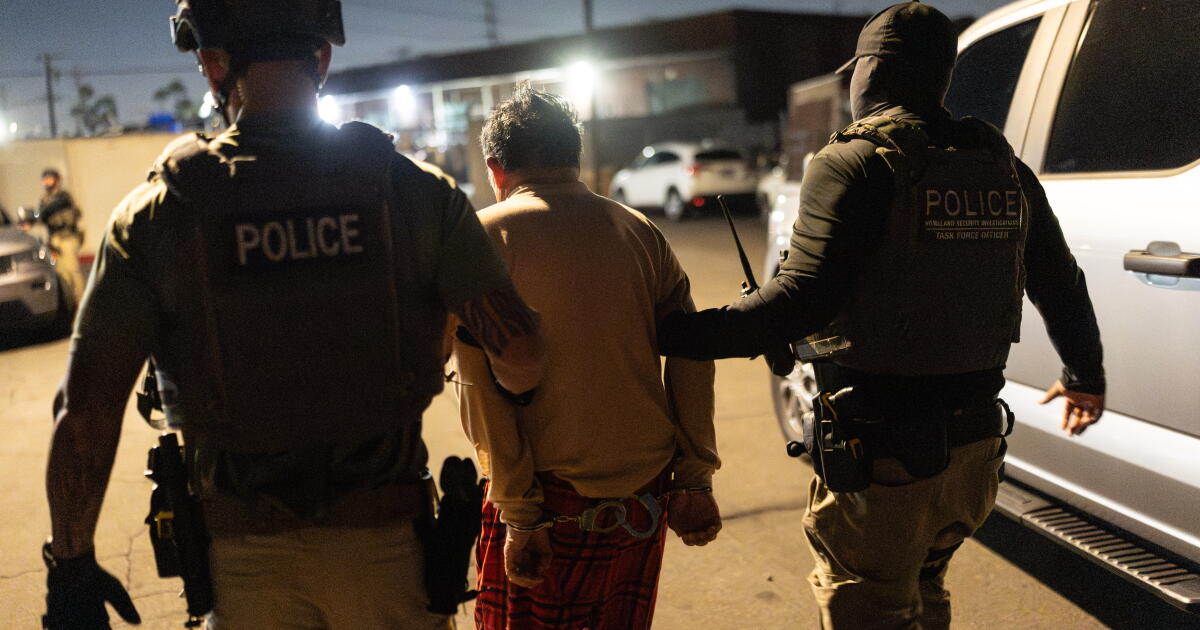
Essayli specifically highlighted the case of a 72-year-old Omar Munoz from Belize, who was arrested in a pre-dawn raid Monday at his home in Commerce. Federal authorities allege that he fraudulently registered to vote in 2019, voted in 2020, twice in 2022 and again in 2024. He is also accused of lying on his naturalization application.

In federal court downtown late Monday, Munoz’s daughter Lliani Orantes, a nurse born in the U.S., said the family was trying to figure out what happened, after federal officials swarmed their block and took her father, who is recovering from a recent surgery.

She said her brother, a registered voter, shares her father’s name, as does a nephew, and the family is wondering if it is all a mix-up. “Did the names get misconstrued,” she wondered.

McCotter said in the last seven weeks, the Trump administration has charged 113 people across 20 states with voting-related crimes. More than 154 million people voted nationally in the 2024 presidential election.

What’s ahead

Federal officials said their work — dubbed “Operation Protect the Vote” — would continue through the election and beyond.

Essayli said California’s own process for verifying voters’ citizenship, including requiring that they attest to being a citizen when they register, is insufficient. He said California election officials have “no idea who is a citizen,” but also know “they have noncitizens who are getting ballots as we speak” and several years ago admitted in an audit that noncitizens were being registered at the DMV.

“When we submit a list of 20,000 noncitizens to California that we are pretty sure are not citizens, it is outrageous that the response from the state is, ‘We don’t believe you and we’re not even going to look at it,’” he said. “That is not good faith actors. They are being complicit.”

McCotter said there “may be some names” on the list of 20,000 flagged voters “who, it turns out, ultimately are citizens.” He said federal authorities are “not perfect,” which is why they’ve asked California officials to work with them. “We could knock through most of these names pretty quickly, probably in a day or two, if California would work with us.”

He said the timeline — amid an ongoing election — was due to state officials refusing to cooperate sooner. “It’s an emergency of their own creation.”
Source link

Justice Dept. sues California, seeks to stop state from counting 20,000 ballots

The Trump administration on Thursday sued California over its handling of voter fraud claims, asking a federal court to immediately bar the state from counting ballots from about 20,000 voters statewide — many in Los Angeles County — whom the administration alleges are “likely noncitizens.”

The lawsuit is highly unusual, particularly given that California voters have already begun voting in the Nov. 3 midterms via mail ballots, experts said.

It’s also highly inappropriate and based on questionable federal data that have proved wildly inaccurate in other states, state officials said.

“This is a sad, desperate attempt by Trump to use his politicized Justice Department to try to suppress California voters just three weeks before Election Day,” Gov. Gavin Newsom wrote on X. “Courts have made clear the federal government has no role in running state elections. We will defend free and fair elections in the Golden State and call out every authoritarian attempt to undermine our democracy.”

U.S. Atty. Gen. Todd Blanche, in his own statement, defended the lawsuit.

“State-facilitated voter fraud is unacceptable in the United States of America,” he said. “If found responsible in a court of law, the State of California will have seriously undermined confidence in our electoral system and violated laws that protect our nation’s representative system of government.”

The lawsuit states that “as part of an investigation into unlawful voting,” U.S. Citizenship and Immigration Services conducted a “multiagency and multilevel review” of state voter and federal citizenship data and determined with “high confidence” that around 20,000 “likely noncitizens” are registered to vote in the state.

It then forwarded those names to Homeland Security Investigations, which conducted its own investigation and concluded the same, the lawsuit says.

“This means that, consistent with state law, nearly 20,000 noncitizens in California have been sent a vote-by-mail ballot to participate in the federal election (or will receive one), with many addresses listed in Los Angeles County,” the lawsuit alleges.

The lawsuit comes two days after Acting Deputy Atty. Gen. Trent McCotter wrote to California Secretary of State Shirley Weber and Dean Logan, head of the L.A. County Registrar-Recorder/County Clerk’s office, giving them 48 hours to set aside the same ballots in order to investigate those voters’ citizenship status.

McCotter had said the Trump administration would be forced to file for emergency relief in the courts if Weber and Logan did not comply.

The lawsuit comes about three months after Homeland Security Secretary Markwayne Mullin wrote his own letter to Weber, alleging that there may be more than 190,000 noncitizens registered to vote in California.

The lawsuit makes no mention of that prior estimate, or why Homeland Security’s initial estimate was so much larger than its current estimate. It does say that USCIS identifying with “high confidence” that a voter is a likely noncitizen “means that the match between voter information on the voting roll and USCIS’ internal records is strong and consistent based on multiple identifiers that support a strong identity link.”

It also said, “The Federal Government notified California months ago that numerous noncitizens may be registered to vote in California. Despite knowing that California must send vote-by-mail ballots to every registered voter, the State made no serious attempt to work with the Federal Government to determine whether noncitizens are registered to vote.”

The Department of Homeland Security did not immediately respond to a request for more information as to how the 190,000 figure dropped to 20,000.

In a letter back to McCotter, Weber noted both figures and accused the Trump administration of pushing forward to disenfranchise voters at the last minute before the midterms based on shoddy data work and no certainty that those voters are ineligible.

“Nowhere has the federal government clarified the basis for suspecting — not even confirming with any level of certainty — the listed individuals are non-citizens. And as one court recently noted, the federal government’s citizenship records are ‘known to be unreliable,’” Weber wrote, referring to a case brought against the Justice Department by the organization Common Cause. “To give just one example, in a similar incident in the State of Nevada, DHS initially alleged that Nevada’s voter roll included nearly 16,000 potential non-citizens. However, after working with the State of Nevada, DHS officials failed to establish that a single non-citizen was on the voter rolls.”

Weber called it “remarkable” that the Justice Department would demand that her office “review and confirm the citizenship status of each of the approximately 20,000 individuals on the list on the eve of an election and within a mere 48 hours” despite providing no clear evidence that those individuals are wrongly registered.

“This is an emergency of the DOJ’s creation,” Weber wrote. “California’s election administration will continue to be governed by applicable federal and state law, not by unsubstantiated claims and outrageous demands.”

First Assistant U.S. Atty. Bill Essayli, the lead federal prosecutor in Los Angeles, posted about the lawsuit on X, noting the 48-window given to Weber and Logan had lapsed and writing, “Time is up for California.”

“This is not political or controversial,” he wrote. “We will not allow California to dilute the votes of American citizens.”

The Trump administration’s lawsuit says that while the U.S. “actively investigates and prosecutes incidents of unlawful voting,” it “is not practicable or feasible for the United States to investigate before the 2026 election concludes thousands, let alone tens of thousands, of individuals that two federal investigative offices identified on the California voter roster as likely being sent vote-by-mail ballots.”

Because of that, it argues, “California is thus knowingly imposing an obstacle on the United States’ ability to enforce [federal election law] by facilitating unlawful voting rather than working with the Federal Government to prevent it,” and the state is therefore legally barred from sending mail ballots to the 20,000 voters Homeland Security has flagged.

It asks the federal court in the Central District of California to declare the state’s actions — including providing and counting ballots for those 20,000 people — to be barred by law and in violation of the Supremacy Clause, and to issue an injunction barring the state from counting those ballots in federal elections “until those individuals’ citizenship status can be verified.”

The Trump administration’s attempts to use immigration data to reach conclusions about California voter rolls and intervene in California’s election is already being challenged in a separate federal case in the district of Washington, D.C., brought by attorneys with the UCLA Voting Rights Project on behalf of the Coalition for Humane Immigrant Rights, or CHIRLA, and a California voter named Pedro Trujillo.

The UCLA attorneys filed their own emergency petition Thursday to preclude the Justice Department from moving forward with such actions against California, citing the letters McCotter sent to Weber and Logan.

A judge in that case ordered the parties to meet and file a status report with the court by Friday as to when each side would be able to brief the court on the issue.

Times staff writer Brittny Mejia contributed to this report.

Source link

Justice Dept. demands California prove citizenship for lists of voters

The U.S. Department of Justice has ratcheted up its pressure campaign on California election officials to ferret out alleged voter fraud ahead of the Nov. 3 midterm election, demanding that officials statewide prove the U.S. citizenship of thousands of voters flagged by the federal government as potential noncitizens, or withhold or set aside their ballots.

Acting Deputy Atty. Gen. Trent McCotter made the demand — which experts called highly questionable at a time when votes are already being cast — in letters to state election officials Tuesday, including Secretary of State Shirley Weber and Dean Logan, head of the L.A. County Registrar-Recorder/County Clerk’s office.

The letters, reviewed by The Times, call on the state officials to respond to the Justice Department within 48 hours.

McCotter wrote that the Justice Department had provided Logan’s office with a “password-protected thumb drive with a list of names the Federal Government believes are likely noncitizens who were sent a vote-by-mail ballot” for the Nov. 3 election.

“We request that you review the list within 48 hours to determine whether any citizens are listed. For individuals whom you cannot independently confirm citizenship status, we request that you immediately instruct the appropriate elections officials to segregate — not cancel — those individuals’ vote-by-mail ballots until their citizenship status can be determined,” McCotter wrote to both Weber and Logan.

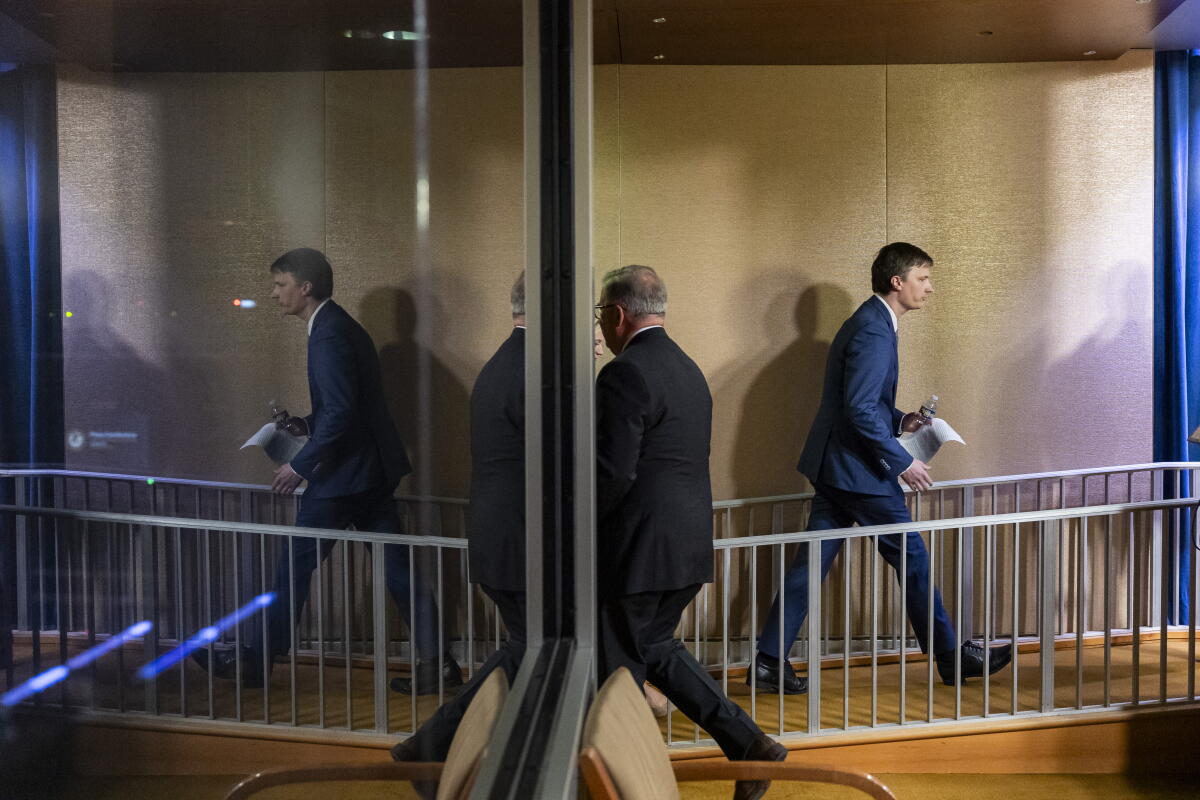
Two men in dark suits walking away from each other

The demand letter came from U.S. Acting Deputy Atty. Gen. Trent McCotter, shown entering a news conference in September 2026 in Washington.

(Finn Gomez / Getty Images)

Voters on the federal list who haven’t already been sent a ballot should not be sent one until their citizenship is verified, while ballots already returned by voters on the list should not be counted until their citizenship is verified, McCotter wrote.

Weber’s office in a statement late Wednesday criticized the Justice Department for telling it to obtain a list of an unknown number of voters it hadn’t been given directly from Logan’s office, investigate all of those voters and “take action” all within 48 hours, based on inaccurate federal data that has led to U.S. citizens being purged from rolls in other states, and under threat of litigation despite the Justice Department providing no legal authority for the demand.

Weber said the Justice Department’s “relentless efforts to unlawfully gain access to states’ protected voter data and purge voter rolls serve only to cause chaos and fuel public distrust in our elections,” and that California already has “robust state law requirements” to ensure only U.S. citizens vote.

Logan said his office was reviewing the Justice Department letter in coordination with Weber and California Atty. Gen. Rob Bonta, but had not accessed the USB drive because state officials “do not consider the device a secure medium” and accessing its contents “would conflict with established data privacy and information security protocols.”

He said that maintaining accurate voter records is a fundamental responsibility of his office, but also that federal and state laws “are clear on how voter eligibility is established — and any action to remove a voter from eligibility must be based on verifiable information, not assertions of unconfirmed data matching.”

Weber previously questioned the basis for a claim by Homeland Security Secretary Markwayne Mullin in July that there may be more than 190,000 noncitizen voters on California rolls, and rebuffed Trump administration offers to work with her office to purge state rolls of such ineligible voters ahead of November without additional information on how it reached its conclusions.

Similar Trump administration lists have been shown in other states to be substantially inaccurate, and to include many voters who are indeed citizens. Election experts say that makes the demand on California — where ballots have already been mailed out — even more concerning.

“One must question why the DOJ would violate its own rules about investigating elections close to election day, and over a week after they knew the state had already mailed ballots out, particularly when their past claims have been full of errors,” said David Becker, executive director of the nonpartisan Center for Election Innovation & Research.

Becker noted the Trump administration alleged that there were nearly 16,000 noncitizens registered in Nevada, later reduced that number to 185 after additional scrutiny, and then determined all of them were in fact citizens.

A Justice Department spokesperson, in a statement to The Times, defended the agency’s demands to California — saying it “should not be controversial, as the criminal statute is clear: only American citizens may vote in federal elections. It is a federal crime for noncitizens to vote in U.S. elections, and the DOJ is asking California to ensure that is not occurring.”

The spokesperson said the agency could not provide the exact number of voters whose citizenship is being questioned, but that it is in the thousands.

A woman with dark hair, wearing an orange and black print jacket, speaks at a lectern

California Secretary of State Shirley N. Weber speaks during the state Democratic Party convention in Anaheim on May 31, 2025.

(Damian Dovarganes / Associated Press)

McCotter wrote that if Weber cannot implement his demands for how to segregate ballots and verify voter citizenship for those on the federal list, the Justice Department “will have no choice but to seek emergency relief” — an apparent reference to seeking court intervention.

McCotter copied on the letters First Assistant U.S. Atty. Bill Essayli, the lead federal prosecutor in Los Angeles whose office previously sent Logan’s office a series of grand jury subpoenas for individual voter records as part of a criminal investigation into illegal voting.

Essayli’s office referred questions to the Justice Department. Bonta’s office referred questions to Weber and Logan.

Rick Hasen, director of the Safeguarding Democracy Project at UCLA School of Law, said that he is “not aware of anything like this ever happening this close to an election,” and that it may in fact be illegal under the National Voter Registration Act, which “prevents systematic purges of voters 90 days before the election.”

He said that the question of whether that preclusion against purges applies to the removal of noncitizens is an issue that is currently before the U.S. Supreme Court, in an Arizona case the high court will hear in December, but that the Justice Department’s actions strike him as “legally questionable.”

Hasen said the “whole point of that 90-day rule is to prevent the inadvertent disenfranchisement of eligible voters by mistake in the rush before the election,” and that risk is increased by the inaccuracies of similar lists presented by the Trump administration in other states. “So if there is an attempt to go to court — if DOJ tries to sue over this — they might have a hard time getting a judge to agree that this is something that the registrar must do or even can do.”

The fact that election officials are already busy receiving and preprocessing ballots would only bolster the state’s position in such a case, Hasen said.

“It’s obviously not a convenient time,” he said. “And given the fact that the lists have proven to be wildly inaccurate, at least in other states, it might be sending the registrar on a wild goose chase, when they have more relevant things to do in the election.”

But that “chaos” may be the point, Hasen said. “This is potentially another example of DOJ just making the work of state and local election administrators — which is already quite difficult and stressful — even harder,” he said.

Attorneys with the UCLA Voting Rights Project filed a lawsuit last month on behalf of the Coalition for Humane Immigrant Rights, or CHIRLA, and a California voter named Pedro Trujillo, in which they challenged the Trump administration’s use of unproven federal databases to allege registered California voters are not citizens.

On Wednesday, they told the Justice Department that they would be seeking emergency relief from such practices, given McCotter’s letters.

“The federal government’s attempt to pressure California election officials into acting on lists that may misidentify eligible voters is an alarming abuse of power as election season gets underway. This puts our communities and our fundamental rights at risk,” said Carl Bergquist, a CHIRLA attorney.

The Justice Department in recent weeks has announced scattered arrests of alleged noncitizen voters around the country, and Trump administration officials — including Essayli — have pointed to such arrests as proof that noncitizens are voting illegally.

Such voting does happen, Hasen said, but after months of the administration aggressively searching for such voters, the relatively small number of arrests “belies the contention that it’s widespread” or criminal, with many of the few cases identified the result of “administrative error or misunderstanding” rather than an intent to illegally cast ballots.

In his letters to Weber and Logan, McCotter wrote that allowing “noncitizens to vote cancels citizen votes,” and that ferreting out illegal noncitizen voters is a joint responsibility of state and federal officials.

“States are responsible for voter registration, and the Federal Government is responsible for maintaining immigration records to enable verification of citizenship,” he wrote. “Working together, we can more effectively protect against voter dilution and promote election integrity.”

Source link