Mayor

L.A. city attorney’s role could be weakened under charter reform proposal

In a few days, Los Angeles voters will be casting ballots for city attorney — and in a few months, they could be voting to sharply diminish the city attorney’s authority.

The city’s Charter Reform Commission has proposed splitting the city attorney’s office into two parts — an elected city prosecutor, charged with handling criminal misdemeanors, and a mayor-appointed and City Council-confirmed city attorney who would represent the city in civil cases and advise the mayor, city council and city departments.

The City Council is reviewing the recommendation as part of sweeping changes to city government, including expanding the council from 15 to 25 seats, which could go before voters in the Nov. 3 general election.

The proposed changes to the city attorney’ office, however, come in the midst of a heated primary campaign, where incumbent Hydee Feldstein Soto is up against three challengers, including a state deputy attorney general and a deputy district attorney.

Both of those challengers say plans to bifurcate the city attorney’s office are rooted in longstanding conflicts between Feldstein Soto and the City Council.

Council members have expressed frustration over her handling of rising costs from an outside law firm, where the payout amount has grown to nearly $7.5 million — with some attorneys billing the city roughly $1,300 an hour.

And last year, City Council took a 12-0 vote to direct Feldstein Soto to withdraw an effort to halt a federal judge’s order prohibiting LAPD officers from targeting journalists with crowd control weapons.

“When I first heard about this idea, I thought it was probably the greatest indictment of the current city attorney that I’ve heard yet,” said John McKinney, a Los Angeles County deputy district attorney who is running for city attorney in Tuesday’s primary.

McKinney opposes the bifurcation, saying it will cause overlap and confusion. “If she was doing a good job … we wouldn’t even be having this discussion,” he said.

Marissa Roy, another candidate in the race, hasn’t taken a position on bifurcation but said Feldstein Soto’s actions triggered the proposed change.

“The only reason that bifurcation, or splitting the city attorney’s office, is even going to be going before voters is because we’ve had an incumbent city attorney who has gone so rogue to politicize the role,” said Roy, a deputy state attorney general.

Roy said accused Feldstein Soto of inappropriately blocking an affordable housing project in Venice. And in her office’s role of drafting ordinance language, Roy said, Feldstein Soto has returned to city council ordinance language that isn’t “faithful to the intent of the drafter.”

Feldstein Soto said the proposal to bifurcate the office has nothing to do with her performance.

“This issue comes up every single time charter reform comes up,” Feldstein Soto said. “To me this is all political opportunism.”

Feldstein Soto has opposed the split, and former city attorneys have also come out against it, saying an appointed position threatens the independence of the city attorney’s office, takes away from voters the right to elect a city attorney and could cost taxpayers money in order to split the office.

In a March letter to the Charter Reform Commission, Feldstein Soto said an attorney “serving at the pleasure” of the mayor and city council would face an “innate, human pressure to harmonize legal advice with the political goals of the appointing officials.”

“I have been able to provide honest, accurate legal advice to the Mayor, City Council, Controller and departments — even when that advice is unwelcome — precisely because I am an independently elected officeholder with an ultimate duty to the public,” she wrote. “An appointed City Attorney, serving at the pleasure of the Mayor and City Council, faces enormous political pressure on all of these issues, behind closed doors, cloaked in privilege without an independent voice.”

Burt Pines, a former city attorney who served from 1973 to 1981, deeply opposes the bifurcation proposal, citing the threat to independence as the largest issue at stake. As city attorney, he said, he was empowered to tell city officials when a proposed action was unlawful and refuse to support it.

“You want to be able to call the shots as you see them, true to the law,” Pines said in an interview.

Advocates say other cities have bifurcated offices, and splitting it could reduce conflict and provide a clear delineation of roles.

After consulting with experts and good governance groups, the commission agreed the benefits of bifurcation outweighed the negatives, and it passed unanimously by the commission.

“It was easy to get consensus on this,” said Raymond Meza, chair of the commission. The commission’s proposal calls for the city attorney to be nominated by the mayor, and confirmed by the City Council.

In its report, the commission said that “the current structure creates conflicts when the same office advises the city and prosecutes cases. Separation provides clearer roles, reduces conflicts, and allows each function to be performed effectively.”

Other cities have different models for the city attorney’s office: Long Beach has a similar model with bifurcated duties, while New York City has legal representation split up several ways. The San Francisco City Attorney provides legal representation for the city and county of San Francisco, and the San Francisco District Attorney’s Office handles criminal cases in the city and county.

Mike Bonin, executive director of the Pat Brown Institute, said he has seen the question of splitting the office come up with at least three different city attorneys to varying degrees.

“Given that the city attorney is an elected position, there’s always going to be somebody who doesn’t like them,” Bonin, a former city council member, said. “You need to divorce the question from the occupant and focus on the role — the charter is not about a particular person, the charter is about the function of the office.”
Source link

Poll shows Bass, Raman and Pratt in tight race for mayor

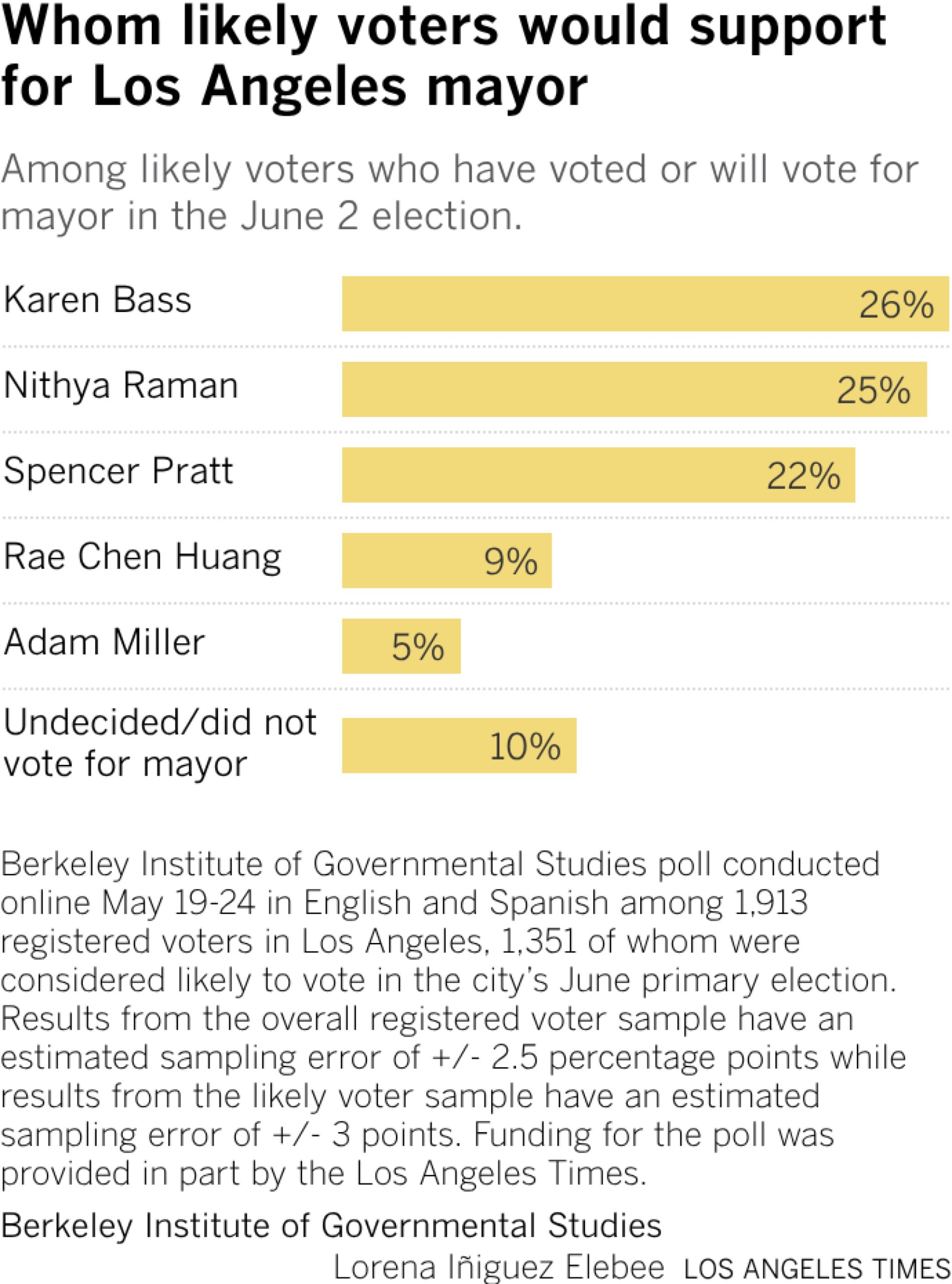
Karen Bass, Nithya Raman and Spencer Pratt are locked in a tight battle for Los Angeles mayor, according to a poll released Thursday, with incumbent Bass holding what pollsters called a statistically insignificant lead ahead of Tuesday’s primary.

Bass had 26% support from likely voters, followed by City Councilmember Raman with 25% support, according to the poll by the UC Berkeley Institute of Governmental Studies, which was co-sponsored by The Times.

Pratt, the former reality TV personality making his first bid for elected office, had support from 22% of the likely voters surveyed.

Up until this latest poll, Bass had enjoyed a substantial lead over her challengers, with analysts predicting she would garner enough votes to make a Nov. 3 runoff with either Raman or Pratt. The latest survey suggests any of the three could advance.

“You’ve got three very different candidates, each with very different constituencies, all within the margin of error. It’s going to boil down to turnout,” said Mark DiCamillo, the director of Berkeley IGS polls.

The poll also showed that in a head-to-head runoff between Bass and Raman, the councilmember would lead, 32% to 28%, among the city’s registered voters, but in this scenario, a quarter of likely voters say they would choose neither or would not vote, and 15% were undecided.

The survey of 1,913 registered voters — 1,351 of whom are considered likely voters — is the largest sample of any public poll released in advance of the election. It was conducted between May 19 and 24. The poll has a margin of error of around 3% in either direction.

Just 10% of voters were still undecided, the poll found, down from 26% when the last survey by Berkeley IGS was conducted March 9-15.

Mayoral candidate Spencer Pratt at a campaign block party in South Los Angeles last week.

Mayoral candidate Spencer Pratt at a campaign block party in South Los Angeles last week.

(Robert Gauthier / Los Angeles Times)

Since then, Pratt and Raman have made steady gains while support for Bass has nearly flatlined.

The March poll had Bass with support from 25% of likely voters, followed by Raman with 17% and Pratt with 14%. Since then, Bass has gained just 1 percentage point, while support for Raman and Pratt jumped by 8 percentage points each.

There are 14 candidates running for mayor in Tuesday’s primary and all were listed in the Berkeley IGS poll, but Bass, Raman and Pratt have consistently led in polling. They’ve also raised the most money in campaign contributions. The latest campaign finance reports, filed last week, showed Pratt with $3.26 million in contributions through May 16, followed by Bass with $3.13 million.

Raman reported a total of more than $931,000 through the May 16 filing period, of which $60,000 came in the form of a loan from Raman to her own campaign. She also received the maximum amount of matching funds available in the race, $1.25 million.

Leftist candidate Rae Huang was favored by 9% of the likely voters surveyed, up 1 percentage point from March, while tech entrepreneur Adam Miller dropped from 6% to 5%, despite infusing his campaign with $4 million of his own money after the first poll.

The major issues in the race have included the city’s approach to homelessness, housing affordability and public safety.

Pratt, whose home burned in the Palisades fire, has blamed Bass for failing to prepare for the conflagration and for her postfire response. Raman has criticized Bass’ Inside Safe program for the unhoused, saying its high cost isn’t sustainable.

Bass has deemed Raman an ineffective City Council member who struggles to build alliances on the legislative body, and has said Pratt does not have a clue about how to run a city like Los Angeles.

Although Pratt now appears to have a chance at making the runoff, the poll showed he would face a steeper climb in potential November runoff scenarios with Bass or Raman. Pratt, a Republican who has been labeled “Trumpian” by Raman, is competing in a city where GOP registration is less than 15%.

“Pratt is an unusual candidate and is generating a lot of enthusiasm in the primary, but he trails by double digits to Raman and Bass in a runoff,” DiCamillo said.

In a showdown between Bass and Pratt, the incumbent mayor was ahead, 47% to 29%, among the city’s registered voters, with 12% undecided and 12% choosing neither or saying they would not vote.

Raman also led Pratt in a potential runoff, 45% to 28%, with 16% undecided and 11% choosing neither or saying they would not vote.

Pratt has repeatedly pointed out that the mayor’s race is nonpartisan. Even so, President Trump said last week that he hopes Pratt does well and that he heard Pratt was “a big MAGA person.”

Trump’s unpopularity in Los Angeles could lessen Pratt’s appeal to Democrats, according to a poll by Cygnal, a national polling group that has worked for Republican candidates.

Los Angeles mayoral candidate Nithya Raman walks down Olvera Street

Los Angeles mayoral candidate Nithya Raman walks down Olvera Street alongside Olvera Street business owners on May 19 in Los Angeles.

(Ronaldo Bolaños / Los Angeles Times)

There’s been just one debate featuring all three of the leading candidates, during which Raman asserted that Bass and Pratt were working to ensure that she would be knocked out in the primary, which Bass and Pratt disputed.

The debate was followed by a huge influx of campaign contributions to Pratt, who also was polling in second in an Emerson College poll earlier this month.

Raman’s strong showing in Thursday’s poll shows she is very much in the race despite assertions by Bass’ campaign and Pratt’s campaign that she is faltering after a lackluster debate performance.

The poll shows Bass and Pratt with high unfavorability ratings. Bass was considered unfavorably by 57% of likely voters, up 1 percentage point from the March survey. Pratt’s unfavorable rating in the current poll was also 57% — up dramatically from the 28% unfavorable rating in the previous poll, although in that poll, 55% of likely voters had no opinion of him.

In the May poll, Pratt was rated favorably by 25% of likely voters, and Bass by 35%.

The poll found that 40% of likely voters rated Raman favorably, with 35% viewing her unfavorably.

Source link