Coverage of the 2026 FIFA World Cup on Fox and Telemundo became the ratings smash of the summer.
Fox TV executives knew their telecast of Sunday’s 2026 FIFA World Cup Final would be big.
But bigger than every NFL game outside of the Super Bowl, the perennial ratings blockbuster, was not on their radar.
“I have to admit that I didn’t see it coming, that we and Telemundo would combine for almost 65 million viewers for the final,” Mike Mulvihill, executive vice president and head of strategy and analytics for Fox Sports. “That’s beyond what we could have hoped for.”
Spain’s World Cup victory over Argentina by a 1-0 score attracted the largest audience for any sports telecast outside of the Super Bowl since the 1994 Winter Olympics when Nancy Kerrigan and Tonya Harding competed in the women’s figure skating short program.
The 38.9 million viewers who tuned in on Fox was enough to make the final the most-watched soccer telecast in history. Telemundo’s coverage set the record for a Spanish language soccer telecast with 23.9 million viewers.
It capped a month of massive viewing for the quadrennial tournament. In the United States,128.4 million people watched some portion of the World Cup across Fox’s broadcast network, its cable outlet FS1 and streaming platform Tubi. The 104 matches averaged a record high 7.7 million viewers, a 116% increase over the 2022 World Cup in Qatar.
Spanish language coverage on NBCUniversal’s Telemundo and the Peacock streaming platform combined to average 6.3 million viewers across the 104 matches, up 143% over the 2022 tournament.
Ad revenues for the tournament topped $1.2 billion, according to data from Guideline, which tracks media spending.
Having the tournament in the U.S. with games airing in daytime and prime time helped. Mulvihill noted the tournament came up at a fortunate time on the sports viewing calendar. The NBA Finals were over and Major League Baseball’s post-season and the NFL season are months away.
But even with that soft competition for sports fans’ attention, the World Cup demonstrated an ability to bring in viewers who don’t follow the sport. Fox data showed 53% of viewers who tuned into its coverage had not watched any soccer in the past year. The network’s research found that a majority of U.S. sports fans could name only two stars, Cristiano Ronaldo and Lionel Messi, and their home countries.
What brought the audience in? Mulvihill credits social media, which tends to be an angry place during big sporting events. The lead up to the World Cup was no different, but the doom and gloom went away once the action began.
“There was a lot of negativity around this tournament on social as there always is about everything related to the cost of tickets and related to challenges that foreign visitors might face coming to the U.S.,” Mulvihill noted. “As soon as the ball was kicked, and the matches were in progress, that just completely pivoted to overwhelming positivity.”
Patrick Rishe, director of the sports business program at Washington University in St. Louis, said the global reach of social media made the international stars accessible to U.S. fans and created a “fear of missing out” effect that likely drove them to watch.
“There is a communal aspect of soccer, in particular, where you can be in a room with people wearing 10 different colored jerseys, and they all just kind of get into the camaraderie of it, and the highs and lows of it, and the drama of it,” Rishe said. “So even if you don’t have rooting interests, it’s just fun to be a part of it.”
The appeal of communal viewing showed up in the Nielsen data. Out-of-home viewing accounted for 27% of the audience. For Sunday’s final, the figure was 35%
People were having viewing parties or gatherings at home as well. An average of 1.955 viewers per home watched the World Cup. The figure for last year’s regular season NFL games was 1.685 viewers.
The question going forward is whether the World Cup will spur more interest in soccer in the U.S. Major League Soccer has reportedly seen significant increases in ticket sales. The league, which has most of its matches on Apple TV, launched an ad campaign with the tagline, “Thanks World, We’ll Take It From Here.”
Versant acquired the rights to carry 300 Bundesliga matches. The company’s USA Network will carry at least 30 matches from the German domestic league, with the rest streaming on the company’s free Fandango platform. The league was previously available on ESPN’s streaming service, which required a subscription.
Telemundo acquired the Spanish-language TV rights to the Union of European Football Assns. men’s club competitions, including the Champions League.
Fox paid $485 million for the rights to the 2026 World Cup, while Telemundo shelled out $600 million for the Spanish-language telecasts.
But the real prize is the rights for the 2030 World Cup, which both TV networks and streamers are expected to vigorously pursue, even though the time zones will not be as hospitable to the U.S. (The host countries are Morocco, Portugal, and Spain.)
During a recent appearance at the CNBC Sport x Boardroom Game Plan Summit in New York, ESPN Chairman Jimmy Pitaro made it clear where he stands.
“Of course we’re interested,” Pitaro said. “This has been a juggernaut. We’re not at all surprised by it.”
The final weekend of the 2026 FIFA World Cup is here, with France and England playing for third place on Saturday before defending champion Argentina takes on 2010 winner Spain for the title on Sunday.
Here’s everything you need to know about the last two matches of the 39-day, 48-team tournament in North America (all times Pacific).
Saturday’s third-place game
France vs. England
France star Kylian Mbappé smiles during a World Cup semifinal match against Spain on Tuesday.
(David Ramos / Getty Images)
Where: Hard Rock Stadium, Miami Gardens, Fla. Time: 2 p.m. TV: Fox, Telemundo | Streaming:Fox One, Peacock
The buzz: This is a game neither team really wants to play. The disappointment of missing the final is fresh and the weather report calls for temperatures in the high 80s with 68% humidity and a chance of thundershowers — a brutal South Florida summer day. The $2-million difference in prize money between third and fourth place isn’t likely to make any of that more palatable. Still, the game will have meaning for France since it will be the final match for coach Didier Deschamps, the winningest World Cup manager in history. And captain Kylian Mbappé, tied with Argentina’s Lionel Messi for most goals in the tournament (8), has a chance to become the first player to win consecutive Golden Boots. England is playing in the consolation final for the second time in three World Cups; it lost to Belgium 2-1 in 2018. But this one will probably sting even more since the Three Lions were five minutes away from their first final in six decades before collapsing against Argentina. This could be the last World Cup game for England’s Golden Generation of Harry Kane, Jordan Pickford, John Stones and Jordan Henderson.
Sunday’s championship game
Spain vs. Argentina
Argentina star Lionel Messi celebrates after a win over England in the World Cup semifinals on Wednesday.
The buzz: Argentina has a chance to become the first repeat World Cup champion since Brazil in 1962, which would give Messi another grand achievement in his sixth and likely final World Cup. Messi enters the weekend as the all-time leader in goals, assists and games played in tournament history. But unbeaten Argentina hasn’t made things easy, with its winning goals in the four knockout-round games coming in the 92nd minute or later. Spain, the reigning European champion, will be playing to put a second star on its jersey to match the one it won in 2010. La Roja, with the sixth-youngest roster in the World Cup, got to the final on the strength of spectacular defense led by Unai Simón, who has six clean sheets in seven games. Mikel Oyarzabal is the team’s leading scorer with five World Cup goals. The teams had one common opponent in this tournament, tiny Cape Verde, a World Cup debutante. It played Spain to a scoreless draw in its opener, then held Argentina to a 1-1 standoff into extra time before falling.
Erling Haaland and SoFi Stadium, ladies and gentlemen. Your breakout stars of the World Cup.
We’ve all fallen for the blond forward who has rowed Norway to its first World Cup quarterfinal berth — and also for SoFi Stadium.
Or “Los Angeles Stadium,” FIFA’s designation for the $5.5-billion architectural masterpiece that welcomed the world to Inglewood.
I cover Rams and Chargers games there regularly, but the World Cup changed how I feel about the place. It has more soul now, more character.
There is more history attached, “core memories,” as Kevin Demoff, president of parent company Kroenke Sports & Entertainment, put it.
The exultation when the United States went up 1-0 in the seventh minute of its tournament-opening, 4-1 victory over Paraguay? “That’s now a core memory of this stadium,” Demoff said.
So is the proud Iranian diaspora showing up en masse to mostly support Team Melli twice, in draws with New Zealand and Belgium.
And the goal by LAFC’s Stephen Eustáquio in the second minute of second-half stoppage time to lead Canada to a 1-0 victory over South Africa in its first knockout game.
And Spain’s taut, 2-1 victory over Belgium in Friday’s high-stakes quarterfinals match.
FIFA might say these sensational scenes put L.A. — our tiny hamlet of more than 18 million people — “on the map.”
What they did was put SoFi Stadium on everyone’s radar as one of the world’s foremost football stadiums.
Jose Ovalle, a 34-year-old from Reynosa, Mexico, has watched matches at Estadio Azteca in Mexico City and Estadio BBVA in Monterey, both sites of World Cup action this summer.
“They’re amazing stadiums — a lot of history, so much history,” Ovalle said Friday. “But [SoFi Stadium] is one of the top stadiums in the world.”
Spain midfielder Fabián Ruiz, left, celebrates after scoring past Belgium goalkeeper Thibaut Courtois, right, in the World Cup quarterfinals at SoFi Stadium on Friday.
(Allen J. Schaben / Los Angeles Times)
Nah, said New Zealand coach Darren Bazeley: “This is the best football stadium I’ve ever been in.”
Swiss center back Manuel Akanji plays for Inter Milan and roots for the Atlanta Falcons. It was a big deal for him to play at their home field, Mercedes-Benz Stadium, in last year’s FIFA Club World Cup.
“It’s really nice, but this is the best,” Akanji said after Switzerland defeated Bosnia-Herzegovina in group play at Sofi Stadium. “This is the best I’ve seen overall among all the stadiums I’ve ever been to. It’s amazing.”
Eight matches, five group stage games, two round-of-32 knockout affairs, Friday’s quarterfinal and a partridge in a pear tree — it was a monthlong run that was everything SoFi Stadium’s team could have wished for when it began preparing to host eight years ago. And more.
“I don’t think you can envision the passion of national team fans,” Demoff said. “We’ve seen so many great events here, NFL games, concerts, but the pride of a national event and seeing people come to Los Angeles and the U.S. for the first time, and seeing this building for the first time…
“There’s something magical about 30,000 Bosnians in blue singing, marching from the airport to here. You can’t properly envision that, no matter how many times you’ve been here.”
People raved about sight lines and sound. They admired the architecture and the infinity screen and the way the canopy kept things cool. In line to buy merchandise Friday, Orange County’s Nick Valencia looked around and mused: “Wow, humans made this.”
Players had the run of the place on real grass, not the artificial turf in place for NFL games. (Don’t expect that to change, Demoff said, noting that upkeep would be doubly challenging at SoFi Stadium with two NFL teams using the field.)
Soccer fans amplified their positive reviews online, where the only complaint having to do with SoFi Stadium was that FIFA decided to give the World Cup final to the archaic-by-comparison MetLife Stadium — a.k.a. “New York/New Jersey Stadium” — instead.
The stadium popped in person and on TV, its distinctive, futuristic shape making it immediately recognizable in a way that not every stadium is.
Vibes were good among volunteers and visitors from around the world and every corner of the United States — and among stadium staffers, who won raises in a late-breaking contract agreement that resulted in increases to more than $30 per hour.
The Rams’ house — and Chargers’ — was full almost every match, with four sold-out crowds of 70,492 and an eight-game total of 561,656.
People paid thousands of dollars for tickets and got their money’s worth at the world’s most-expensive stadium, a modern marvel that’s only getting better with age.
Dodger Stadium is dripping in lore, from Kirk Gibson’s legendary walk-off home run in 1988 to more history, like Shohei Ohtani playing perhaps the greatest game ever last postseason.
Staples — er, Crypto.com Arena — is where Kobe Bryant dropped 81. Decathlete Rafer Johnson lit the Olympic flame in 1984 at the Los Angeles Coliseum. And we all can picture Brandi Chastain ripping off her top in her iconic celebration after scoring the game-winning penalty kick in the 1999 Women’s World Cup at the Rose Bowl.
“We may not have the Brandi Chastain moment from ‘99,” Demoff said. “But we’ve had so many great moments off this tournament that I think will be replayed over and over and over again.”
There are more moments to come, with SoFi Stadium slated to host Super Bowl LXI in February and then, in 2028, to stage the Olympic Opening Ceremony and the Olympic swimming competition.
“Where the U.S. scored the opening goal,” Demoff said, “is going to be the middle of the Olympic swimming pool. I think that contrast blows people’s minds. It certainly blows mine.”
And for the past month, Los Angeles’ stadium blew the world’s mind.
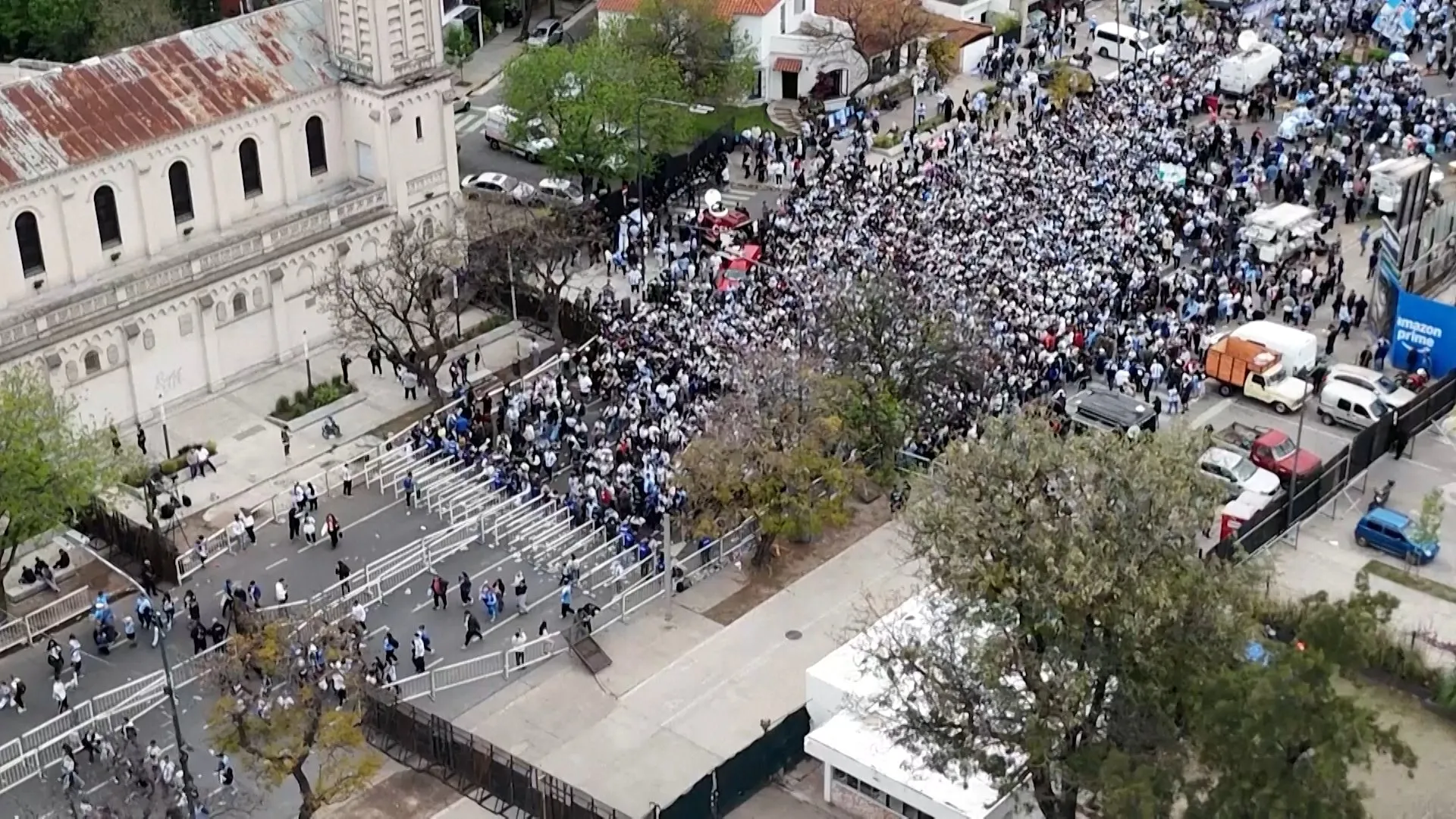
Thousands of Argentina fans held a banderazo in the streets of Atlanta ahead of their World Cup semi-final against England. The fan tradition transforms public spaces into celebrations before a major match.
The 14-team 2027 ODI tournament in Africa will have a Super Seven stage but no quarterfinals.
Published On 15 Jul 202615 Jul 2026
The International Cricket Council (ICC) has announced a revamped format for the men’s 2027 one-day international World Cup that could lead to an additional fixture between India and Pakistan.
The restructure, revealed on Wednesday, comes after concerns were expressed about the prospect of too many dead rubbers, which in turn would lead to sparse crowds at venues, and the number of foregone conclusions at the recent T20 World Cup.
While next year’s edition in Southern Africa remains a 14-team competition, the three lowest-ranked qualifiers will now take part in a preliminary round, and just one of them will progress to a 12-team main group stage.
That will now feature just two pools of six teams with a new “Super Seven” stage replacing the previous “Super Six” round robin.
Significantly, there will be no quarterfinals with the 50-over tournament denied the further jeopardy and interest that comes with an extra round of clear-cut knockout matches.
The ICC, however, insisted in a statement that the new ODI World Cup structure “creates greater context, competitiveness and consequence during the event”.
An additional team in the round-robin phase also increases the prospects of an extra match between India and Pakistan, who share a bitter rivalry that has been soured further in recent years.
The passion for cricket on the subcontinent, which in turn generates lucrative broadcast rights and huge commercial revenues for the ICC, makes a match between India and Pakistan the most valuable in the sport.
But India and Pakistan no longer meet outside ICC events as political tensions between the border nations mean they are in effect barred by their own governments from facing each other.
The last bilateral series India played in Pakistan was in 2006 (Test and ODI series).
Another change approved last week at the ICC’s annual board meeting in Edinburgh will see the next men’s T20 World Cup in 2028 remain a 20-team competition but with 10 sides qualifying from the group stage rather than eight.
The two best-performing teams in the “Super 10” will automatically secure a semifinal spot with a new eliminator stage to decide their opponents.
ICC loans Cricket West Indies $12.82m
In a separate announcement, the ICC said it had approved a $12.82m loan to Cricket West Indies (CWI) “to support the member board”.
Unlike other leading international cricket teams, the West Indies are a regional side, and the relative economic weakness of its constituent Caribbean islands and territories along with the travel distances involved puts the CWI at a considerable financial disadvantage compared with the “Big Three” of India, England and Australia.
During the recent women’s T20 World Cup in England, West Indies captain Hayley Matthews lamented an “unfair” funding ecosystem after her cash-strapped side’s eight-wicket semifinal thrashing by Australia.
“The reason we were so successful back in 2012 to 2016 is because women’s cricket was based off pure talent at that time,” Matthews said.
“The minute that investment comes into the picture, we’ve seen the gap widen a lot. … I feel like it’s a bit unfair sometimes.”
England and Argentina met in another quarter-final in Mexico City’s Azteca Stadium at the 1986 World Cup, with the Falklands War four years earlier providing the backdrop.
It was the day of Diego Maradona’s infamous “Hand Of God” – as well as his brilliant second goal – as Argentina won 2-1, and then went on to lift the World Cup.
France ’98 delivered a classic last-16 game best remembered for a wound-up David Beckham being sent off for kicking out at Diego Simeone, and the solo goal that brought an 18-year-old Michael Owen to global superstar status.
Argentina prevailed on penalties to provide yet more World Cup heartache for the Three Lions.
There was still lingering ill-feeling between the two teams when they met again four years later in a World Cup group game under Sapporo’s dome in Japan.
This time it was redemption for Beckham, who scored the winner with a first-half penalty, but Argentina complained long and loud – insisting Owen had dived amid a challenge from future Tottenham Hotspur manager Mauricio Pochettino.
Tuchel said: “It is a very big rivalry between two big footballing nations.
“I could say the history is irrelevant but I’m not sure. The players are aware of it. When a fixture provides so many iconic moments, you can’t say it is just another football match.”
Argentina boss Lionel Scaloni – who represented his nation at the 2006 World Cup – added: “We all have stories from that past time and history and it all makes it very emotional.”
It is this backdrop, this history of acrimony, that elevates this encounter above those other semi-finals.
England have had many memorable games in the past six decades – but winning this match would outstrip them all and offer the chance for a historic triumph in Sunday’s World Cup final against Spain.
Millions of England supporters up and down the country are gearing up for the big match tonight, but what happens if you are due to be flying while the match is being aired?
Passengers are asking the all important World Cup question(Image: Bloomberg via Getty Images)
British Airways has issued an improtant update for passengers hoping to watch the World Cup match tonight.
England will take on Argentina in the semi-finals with a place in the World Cup up for grabs. England supporters up and down the country are gearing up for the big match tonight, with a number of celebrities looking forward to backing their country – incluidng Joe Wickes.
Joe Wickes, widely known as “The Body Coach,” is a British fitness expert, author, and television presenter famous for his high-intensity interval training (HIIT) workouts and recipe books. He gained international prominence as the “PE teacher to the nation” by hosting free daily online exercise classes for children and families during the global pandemic lockdown.
But, now Joe is asking the all important question. Will British Airways passengers be able to watch the match? He took to X yesterday to ask the airline. He asked: “Hey @British_Airways will I be able to watch the @England match on my flight tomorrow?”
British Airways responded: “Hi Joe, for legal reasons we’re unable to stream live sporting events, unfortunately. However, I’m sure the crew will keep you informed of the score throughout your flight.” They added: “We’re sure the crew will be just as eager to keep an eye on events. Have a safe flight.”
Around 30,000 Three Lions supporters will pack in to the 67,382-capacity Mercedes-Benz stadium in Atlanta, US, hoping to see Thomas Tuchel’s boys win one of the nation’s biggest games in recent memory. Back home, an audience of up to 25 million will tune in on TV, and thousands more will flock to hospitality venues or join crowds across the country for the potential grudge match.
Content cannot be displayed without consent
The match has been classed as the “highest risk in the tournament” by the Federal Bureau of Investigation. They issued their warning fearing trouble between the set two sets of fans in one of the biggest rivalries in world football.
Hundreds of extra police were drafted in to Atlanta on Monday and there will be a much bigger presence inside the stadium and at the sold-out fanzone. Police have designated some bars as “England only” or “Argentina only” to try to prevent any confrontations.
Michael Owen has explained why he believes both England and Argentina will find it tough to beat Spain should they reach the World Cup final. In a post on X he wrote: “Brilliant performance from Spain. France had the individual stars but this Spanish team never looked like getting beat.England or Argentina will have to up their game massively to beat this lot.”
Follow our live blog for all the latest World Cup updates by clicking here.
The buzz: This game would be far better suited as a final than a semifinal. Both are unbeaten — in fact, Spain is unbeaten in its last 36 games, one shy of the all-time record. For France, a win would put it in the final for a third straight World Cup while Spain is hoping to get back for the first time since 2010, when it won its only title. The teams got here in different ways. Spain has walked a razor’s edge, giving up just a single goal in the tournament and winning its last two games on late goals from substitute Mikel Merino. France has bludgeoned the opposition, scoring 16 goals while conceding just two. Kylian Mbappé has scored eight times and has 20 goals in 20 World Cup games, leaving him one back of Lionel Messi’s all-time record. It seems unjust that one of these teams will finish its World Cup in the third-place game.
Wednesday’s semifinal
England vs. Argentina
England’s (from left to right) Harry Kane, Jude Bellingham, and Morgan Rogers celebrate after defeating Norway in the World Cup quarterfinals on Saturday.
The buzz: Both teams are unbeaten and each survived scares in the quarterfinals, with England outlasting Norway in extra time in brutal weather in Miami and Argentina beating Switzerland in extra time in Kansas City. Jude Bellingham had a brace in each of England’s last two games to match teammate Harry Kane’s six goals in the tournament. Bellingham is the first player to score at least two goals in consecutive World Cup knockout matches since Diego Maradona in 1986. Argentina, the reigning champion, is unbeaten in its last 12 World Cup games, but four of its last six knockout-stage games have gone to extra time or penalties. Argentina has gotten eight goals and two assists from Messi in this World Cup.
LONDON — Jannik Sinner is starting to make a habit of responding to adversity in Paris with titles at Wimbledon.
The top-ranked Sinner beat Alexander Zverev 6-7 (7), 7-6 (2), 6-3, 6-4 Sunday for his second consecutive title at the All England Club after his German opponent appeared bothered by a knee injury following a slip to the grass on a key point in the third set.
Sinner’s fifth Grand Slam title came in his first tournament since a second-round meltdown at the French Open, when he wilted in a Paris heat wave.
When Sinner ripped a forehand winner up the line on his first match point, the Italian dropped to the grass on his back in celebration.
Jannik Sinner celebrates after winning a point against Alexander Zverev during the men’s singles Wimbledon final in London on Sunday.
(Kin Cheung / Associated Press)
A year ago, Sinner beat Carlos Alcaraz in the final at the All England Club after wasting three match points against his rival in the Roland Garros final.
It was Sinner’s 10th straight victory over Zverev, who was coming off his first Grand Slam title at the French Open.
Linda Noskova beat Karolina Muchova in an all-Czech women’s final on Saturday for her first Grand Slam title.
Prince William joined his wife Kate and two of their children for the final in a star-studded Royal Box that also included actors Dustin Hoffman, Nicole Kidman and Ben Stiller.
Zverev slips
The top two seeds appeared perfectly matched until Zverev earned his first break point of the match at 3-3 in the third set — 2 hours and 42 minutes in. Sinner produced a drop shot and Zverev slipped and appeared to hyperextend his right knee as he attempted to change directions behind the baseline.
Zverev grasped his knee in apparent discomfort and Sinner went around the net and helped his opponent up off the grass. Zverev quickly resumed playing but he appeared slightly hampered and slung his racket across the baseline in frustration when he missed a forehand and handed Sinner the first break of the match and a 5-3 lead in the third. Sinner then served it out.
Zverev had also lost 14 straight sets to Sinner and when he claimed the opening set of the final with a forehand winner up the line to conclude a tight tiebreaker, he let out a loud roar toward his box as he bent over in celebration.
Zverev continually cranked out serves at up to 139 mph, while Sinner produced a series of well-placed aces at a slightly lower speed.
But Sinner began to read Zverev’s serve better in the second-set tiebreaker and Zverev started to miss forehands.
Jannik Sinner kisses his trophy after defeating Alexander Zverev to win the men’s singles Wimbledon title in London on Sunday.
(Kirsty Wigglesworth / Ap Photo/kirsty Wigglesworth)
Paris meltdown
Amid stifling heat and humidity in Paris in late May, Sinner had his 30-match winning streak ended after coming within one game of a straight-set victory over Juan Manuel Cerundolo, who was ranked No. 56.
Conditions were cooler in southwest London for the final, with clear skies and a temperature of 82 degrees but it was also breezy — which led to a series of shanked shots from both players.
Sinner went in for medical exams in Milan after the Paris defeat and didn’t play an official match again until he arrived at Wimbledon, where he twice had to come back from a set down in a five-set marathon against Miomir Kecmanovic in the first round.
Sinner then didn’t drop a set the rest of the way until the final, having dominated against Novak Djokovic in the semifinals.
Despite the defeat in the final, Zverev will leapfrog Alcaraz into the No. 2 spot in the rankings on Monday.
Alcaraz missed both the French Open and Wimbledon this year because of a right wrist injury.
Women’s doubles
Kristina Mladenovic won a seventh career Grand Slam women’s doubles title by teaming up with Guo Hanyu to defeat Gabriela Dabrowski and Luisa Stefani 6-3, 7-5 in the final Sunday.
Mladenovic has won the French Open doubles tournament four times and the Australian Open twice with different partners but lost her only previous Wimbledon final in 2014.
“It’s really a dream,” said the French player, who missed much of last year with an injury. “I definitely cannot believe what just happened now.”
Mattias Karén contributed to this report. Dampf and Karén write for the Associated Press.
LAS VEGAS — Conor McGregor’s return against Max Holloway at UFC 329 ended at just 1:09 of the first round Saturday night because of a knee injury.
Fighting for the first time in more than five years, McGregor flew across the ring with a flying left roundhouse kick when the match started and landed awkwardly on his right knee.
After attempting to kick and strike Holloway (28-9-0) two more times, it was clear McGregor (22-7-0) couldn’t finish the scheduled five-round welterweight bout.
“Five years off in this sport is rough,” UFC president Dana White said. “We’re assuming a blown ACL. That’s what I assumed when I saw it, and that’s what the doctors think too.”
Holloway closed a -300 favorite at Bet MGM Sportsbook, which means a bettor would have to lay $300 to win $100. McGregor was a +240 underdog, which means a bettor would win $240 with a $100 wager on the Irishman.
Conor McGregor reacts after losing to Max Holloway in a welterweight fight at UFC 329 on Saturday.
(John Locher / Associated Press)
McGregor, who strolled to the ring to the sounds of Notorious B.I.G.’s “Hypnotize” and the roar of the sold-out crowd, last fought exactly five years and a day ago before Saturday night.
To the delight of a frenzied audience just hours after his home country of England won its quarterfinal match over Norway in the World Cup, Liverpool’s Paddy Pimblett (24-4-0) made quick work of Benoit Saint Denis (17-4-0) with a first-round TKO. Pimblett, who closed a +120 underdog, blocked a roundkick, shot in and quickly applied a front headlock to put Saint Denis to sleep for the win in 52 seconds.
In a bantamweight battle, Mario Bautista (18-3-0) defeated Cory Sandhagen (18-7-0) by unanimous decision, after taking advantage of a first-round leg kick and applying pressure in each round after. A flurry of punches in the third round secured the decision.
In a scheduled three-round flyweight bout, Brandon Royval (18-9-0) applied a rear-naked choke on Lone’er Kavanagh (10-2-0) to win by submission at the 3:40 mark of the final round.
In an absolute shocker to start the main card, a bloodied King Green (36-17-0) overcame a beating for nearly the entire first round before landing a right hand to the jaw of Terrance McKinney (18-9-0) with roughly 20 seconds left, and then finished him off for a TKO at the 4:59 mark.
World Cup tourists are coming to L.A. for the soccer, but they’re staying for the $21 smoothies and Double-Doubles.
As the last Los Angeles FIFA World Cup event ended Friday, soccer fans were eating like locals and famous chains from the region were cashing in.
In the weeks that L.A. has hosted the World Cup, international soccer enthusiasts have flocked to big brands from the area, often in large groups wearing their countries’ jerseys.
It is a phenomenon seen at many of the host cities. In Dallas, giant gas station Buc-ee’s is the main attraction. For people visiting New Jersey, deli shops have been a hot ticket. In L.A., the place to be between matches was Erewhon.
Thirsty international sports fans gathered for pictures outside different Erewhons, wandered their aisles smiling, and, of course, picked up pricey smoothies.
While Erewhon would not comment on its business, mobility data company Arity, which uses phone data to track consumers, said Erewhon visits at the outlets around SoFi Stadium were quadruple what they were a week earlier on June 12, the day of the U.S. national soccer team’s opening match there.
Arity looked at what stores people visited within a 10-mile radius of SoFi that day and also found surges in visitors to nearby El Pollo Loco and Trader Joe’s.
Locals have spotted groups of people in Korea jerseys huddled together, trying to decide what to order at In-N-Out.
Some complained on social media that international tourists at Trader Joe’s were buying up all the mini canvas tote bags.
Soon after the Belgium vs. Spain quarterfinal ended Friday, the In-N-Out near SoFi had a long line of soccer fans stretching out the door in bright red and yellow and black jerseys and matching striped hats and scarves.
One of the workers said he had to explain “spread” and “animal style” to foreign football fans.
“I didn’t know this place existed,” a fan from Romania said while waiting in line.
Los Angeles and other cities and states that have hosted the event need the soccer fans to spend money to make the event worth all the time, effort and money it requires.
A rosy 2024 report projected the World Cup could bring more than $800 million to the L.A. region as 180,000 people converge on the area to sleep, eat and spend.
There were early concerns people weren’t turning up for the event because of the high ticket prices and the difficulty of obtaining visas for citizens of some countries.
However, at least for some L.A. hotels, there was a surge of last-minute visitors which pushed up occupancy and room rates.
While sports fans are not in the region to shop, they do make time for it.
World Cup customer spending is also apparent in beer sales. Andrew Heritage, the chief economist at the Beer Institute said beer purchases at entertainment and attractions in L.A. – outside of World Cup spaces – were up around 10% from normal.
“That tells me that fans in the L.A. area have decided to extend their stay and take in all the other things that the area has to offer, rather than just the match itself,” he said.
On social media, the purpose of these shoppers is clear: grab a quick souvenir or local specialty and take a selfie.
The data from Arity suggests that fans are very efficient when they spend at local spots, diving in, getting what they want and getting out as soon as possible, said Jeff Schlitt, a director at the company.
“Normally you’re there for an hour. They’re going to be there for 15, 18 minutes,” he said. “Why is that? Because they were purpose-driven shoppers.”
For some travelers, the more popular American chains aren’t unfamiliar. But some of the native L.A. fare still comes as a surprise.
As one Belgium-Spain matchgoer from the Netherlands stood taking a picture of the In-N-Out sign after the game, he said he’d never had a burger like the one he’d just tried.
“We only have McDonald’s and Burger King,” he said. “It’s way better.”
LONDON — A local boy sleeps in his own bed, plays in front of a king and queen and makes a Cinderella run to the Wimbledon semifinals. Sounds like a Hollywood script that might never see the silver screen.
But it’s no fairy tale — it’s Arthur Fery’s out-of-nowhere performance over the last 10 days.
Fery, a virtually unknown British wild card with a triple-digit ranking, has become the emotional heartbeat of Wimbledon while legitimately diverting some national attention from England’s World Cup quest.
The royal treatment at his matches across the All England Club has come in more ways than one.
Fery, who grew up five minutes from Wimbledon and is staying at home during the tournament, first played before grass-court king Roger Federer, Wimbledon’s eight-time singles champion, during Monday’s fourth-round victory. Two days later, he beat No. 9 seed and French Open runner-up Flavio Cobolli of Italy in the quarterfinals 6-4, 7-6 (4), 6-0 in front of Queen Camilla.
Ranked 114th, Fery had never reached the semifinals of an ATP Tour event, let alone a major, before his brief chat with the queen following the match.
“She just said, ‘Congratulations, keep going,’” 23-year-old Fery told reporters later. “I told her it was my birthday on Sunday, so it would be great to play the Wimbledon final on my birthday.”
That’s still a match away. To get there, Fery will have to get past one of the hottest players on tour: No. 2 seed Alexander Zverev, who is fresh off his first Grand Slam title at the French Open. Looming on the other side of the draw is a highly anticipated showdown between defending champion Jannik Sinner against 24-time major winner Novak Djokovic.
If Fery can continue his magical run to the end, he would become the first British wild card to win a Wimbledon title.
Arthur Fery reacts after defeating Flavio Cobolli in the Wimbledon quarterfinals on Wednesday.
(Maja Smiejkowska / Associated Press)
Born in France, Fery’s family moved to Wimbledon when he was an infant. His mother played professional tennis. He was a top British junior but chose to sharpen his game for three years in the U.S. collegiate system at Stanford, as many of his compatriots have done.
“I came out with a lot of hunger coming out of that, and I was ready to attack the pro circuit,” Fery said.
After struggling with bone bruising in his arm that limited him to playing mostly on the lower-tier Challenger circuit in recent years, Fery is finally healthy and playing consistently.
His path to the last four in London has been a masterclass in clutch come-from-behind performances. The Brit has stared down near-certain elimination in multiple matches, repeatedly breaking his opponents’ momentum with Houdini-like on-court acts.
At 5-foot-9, Fery possesses a skill set perfectly suited for low-bounding grass.
His compact strokes, low center of gravity, and elite movement allow him to hug the baseline, take time away from opponents, and confidently execute delicate volleys at the net, according to ESPN analyst Chris Eubanks.
“He defends well,” said Eubanks, a 2023 Wimbledon quarterfinalist. “He can scrap. He can claw. He can dig his way back into points. And when he ventures forward, he’s very, very comfortable at the net. This is a picture-perfect example of someone whose game is built for the surface.”
Still, it’s hard to fathom the multitude of milestones for Fery, who briefly reached the No. 1 ranking in college and earned 2023 Pac-12 Singles Player of the Year honors before leaving early to pursue a pro career.
He arrived at Wimbledon with just one main-draw victory at a major, a losing record as a professional, and only one previous ATP quarterfinal, at Queen’s Club last month. He’s now 11-8, won his first two five-set matches, and is the first British wild card to reach the Wimbledon men’s semifinals in the Open Era. The only other men’s wild-card semifinalist was Goran Ivanisevic, who won the title as a wild card in 2001.
Fery, who started the season ranked No. 185 and will climb to at least No. 36 after the tournament, said there were a “lot of first times” as he reflected on his unprecedented run. “First five-setter, longest match that I’ve ever played, first time breaking into the top 100, first second week in a slam, all at home, five minutes from where I grew up. It’s a great story for me,” he said.
The gap with his fellow semifinalists is understandably massive.
Entering Wimbledon, Djokovic, Sinner and Zverev’s combined records include 29 Grand Slam titles, 2,088 match wins and 155 tour-level titles. Fery was 6-8 in tour-level matches with zero titles.
But he has singlehandedly lifted the tournament for locals. With top hopes Jack Draper and Emma Raducanu withdrawing before the tournament and the rest of Britain’s singles prospects falling one by one — 18 men and women were eliminated by the third round — Fery became the nation’s last knight standing.
If his first name inevitably evokes Arthurian legend, Fery’s march through the draw gave Britain reason to believe again. No sword, no Round Table, just world-class shot-making, a lion’s heart and a Centre Court crowd thrilled to rally behind him.
“This is really quite something to see on home soil,” said Russell Fuller, the BBC’s tennis correspondent, who compared it with Raducanu’s stunning U.S. Open win in 2021 as a qualifier.
Fery earned every bit of it.
In the first round against Damir Dzumhur, Fery dropped the opening set and trailed by a break in the second before surging back. Against Zizou Bergs in the third round, he faced a 4-1 deficit with a double break in the fourth set, and again fell behind 4-1 in the fifth, before somehow surviving.
Then, stepping onto Centre Court for the first time against former top-10 stalwart Grigor Dimitrov of Bulgaria in the fourth round, Fery clawed out of a 2-sets-to-1 hole and a break down in the fourth set to clinch the victory in a fifth-set tiebreak.
“He carries himself with humility, but he’s a fierce competitor, and he’s got a ton of belief in himself,” said Stanford men’s coach and former top-60 player Paul Goldstein, who flew to England Tuesday to see his former charge compete against Cobolli.
While Fery attempts to outmaneuver Zverev on Friday, the other semifinal features a 2025 Wimbledon semifinal rematch between seven-time Wimbledon winner Djokovic and top-ranked Sinner, who defeated the Serb in straight sets on his way to the title. It’s also their second Grand Slam semifinal meeting in 2026. At January’s Australian Open on hard courts, Djokovic bested 24-year-old Sinner in five sets before falling to now-injured Carlos Alcaraz in the Melbourne final.
Arthur Fery hits a return during his Wimbledon quarterfinal win over Flavio Cobolli on Wednesday.
(Clive Brunskill / Getty Images)
Djokovic, 39, enters the match after surviving a grueling five-set, 5-hour-plus quarterfinal slugfest against No. 3 Félix Auger-Aliassime that concluded just minutes before Wimbledon’s 11 p.m. curfew. But the seventh-seeded Serb has a way of defying Father Time and he has had two days to recover on a surface where points are shorter and generally less taxing on the body.
Italy’s Sinner, who defeated Alcaraz in last year’s Wimbledon final, has been efficient if not at the level that saw him capture five consecutive titles before crashing out in the second round at the French Open. After a first-round scare here, the four-time Grand Slam champion has dominated opponents behind his improving serve, winning 80% of his first-serve points. He hasn’t dropped a set since the opening round. Sinner leads the head-to-head with Djokovic 6-5.
According to Eubanks, Djokovic must disrupt Sinner’s movement to break his rhythm, and take his chances.
“He’s got to play similar to how he played in Australia, where it was just all-out aggression,” Eubanks said.
For Sinner, he added: “His serve can be a neutralizing force for what Novak is going to try to do.”
On the other side of the ledger, Fery’s poise under pressure and deft use of the home crowd will be paramount to continue his surprise run against Germany’s Zverev, whom he called a “step up again” from his last five matches. Zverev, 29, is seeking his fifth major final and first at Wimbledon.
“I’m ready for it,” Fery said. “I have nothing to lose. I’m just going to go out there and … put my game on the court, do what I’ve done, believe in myself. We’ll see where that takes me.”
Home has never been closer to Centre Court. Nor has Arthur Fery ever been closer to tennis history.
The 2026 FIFA World Cup quarterfinals are set to begin Thursday when Kylian Mbappé and France take on an upset-minded Morocco team.
World Cup co-hosts U.S., Canada and Mexico will be watching from the sideline after being eliminated in the round of 16.
Here’s everything you need to know about the World Cup matches being played Thursday, Friday and Saturday across the U.S., Mexico and Canada (all times Pacific).
Thursday’s quarterfinal match
France vs. Morocco
France’s Kylian Mbappé jogs on the field during a win over Iraq in the World Cup on June 22.
The buzz: France, bidding to make its third consecutive World Cup final, needed a penalty kick from Kylian Mbappé to dispatch stubborn Paraguay, a third-place team, in the round of 16. France has scored 16 times — Mbappé has seven of them, giving him 19 career World Cup goals — while goalkeeper Mike Maignan has conceded just two goals in five matches. Morocco, a semifinalist four years ago, advanced with a 3-0 win over Canada that ran its unbeaten streak to 34 games. Azzedine Ounahi scored twice in that game and is one of three Moroccan players with multiple goals. Morocco, a former French colony, has almost as many French-born players on its roster, six, as it does native Moroccans, seven.
Friday’s quarterfinal match
Spain vs. Belgium
Spain goalkeeper Unai Simón catches the ball in front of Portugal’s Cristiano Ronaldo during Spain’s round-of-16 win on July 6.
The buzz: Spain is the first team in World Cup history to record six consecutive shutouts and goalkeeper Unai Simón has gone 609 minutes without allowing a World Cup goal, a streak that dates to group play of the last tournament four years ago. Spain, however, has struggled to score consistently, collecting a goal or less in three of its five games, including a round-of-16 win over Portugal on Mikel Merino’s goal in stoppage time. Mikel Oyarzabal is Spain’s leading scorer with four goals. Belgium earned its place in the quarterfinals by thumping the U.S. 4-1 in Seattle in its most complete game of the tournament. Belgium outshot the Americans 15-7, putting seven on target. Charles De Ketelaere had a brace in the first half and Belgium never looked back. For an aging golden generation of Belgian players, including Kevin De Bruyne, Romelu Lukaku, Thibaut Courtois and Axel Witsel, this might be the final chance to grab a title.
Saturday’s quarterfinal matches
Norway vs. England
England’s Harry Kane celebrates after scoring during a win over Mexico on July 5.
(Eduardo Verdugo / Associated Press)
Where: Hard Rock Stadium, Miami Gardens, Fla. Time: 2 p.m. TV: Fox, Telemundo | Streaming: Fox One, Peacock
The buzz: The forecast calls for temperatures in the high 80s, humidity at 77% and a chance of rain, challenging conditions for two teams from northern Europe. Norway, which knocked off Brazil to reach the quarterfinals for the first time, has scored 12 times in five games — Erling Haaland has seven of those, including both against Brazil — but has conceded nine, winning just once by more than a goal. Haaland’s 39% shot-conversation rate is the best in a World Cup since 1986. Unbeaten England had to gut out a tough win in the rare air of Mexico City with just 10 men to reach the quarterfinals for a third straight time. Captain Harry Kane is fourth in the Golden Boot race with six goals.
Argentina vs. Switzerland
Argentina’s Lionel Messi celebrates after scoring against Egypt on July 7 at the World Cup.
(Associated Press)
Where: Arrowhead Stadium, Kansas City, Mo. Time: 6 p.m. TV: Fox, Telemundo | Streaming: Fox One, Peacock
The buzz: Unbeaten Argentina needed three goals in 13 minutes to stay that way, barely escaping its round-of-16 game with Egypt on Enzo Fernández’s goal in stoppage time. Lionel Messi’s tying goal in the 83rd minute extended his World Cup scoring streak to nine games. He entered the quarterfinals leading the tournament with eight goals. Switzerland, also unbeaten, eliminated Colombia on penalties to reach the quarterfinals for the first time since 1954. The Swiss have nine goals, three of those coming from 20-year-old Johan Manzambi, the youngest player on the team.
StubHub is getting a red card from some World Cup fans
Two World Cup customers are suing the New York-based ticket-selling company, alleging “false and misleading” advertising that left them without tickets or a refund for the World Cup games they paid to attend.
In federal court in New York last week, two Californians — Julia Reeker Moghal and Reuben Renteria — sued StubHub seeking monetary damages and a ban on the company selling World Cup tickets. The lawsuit aims to become a class action and comes after weeks of fierce criticism and complaints from customers regarding the company’s practices.
Throughout the World Cup, videos have emerged on Instagram and TikTok of StubHub customers describing their nightmare experiences with the ticket-selling platform.
Some said they had purchased tickets to World Cup games as early as November of last year, booked flights and hotels and arranged travel plans, then StubHub notified them days to weeks before the match of a refund for their tickets, which they never requested.
There were similar complaints about last-minute cancellations from people who bought Coachella tickets on StubHub.
In the lawsuit, Moghal said she had purchased three tickets for nearly $2,000 for the June 18 match between Switzerland and Bosnia-Herzegovina at SoFi Stadium in Inglewood, which were then canceled by StubHub. Moghal said she was contacted by StubHub and told her tickets would remain canceled, then was later told the tickets would be available one hour before the game.
When the match began, Moghal said she was at SoFi Stadium, but the tickets never came.
Renteria said he paid around $2,300 for the June 18 Mexico versus South Korea match in Guadalajara, Mexico, but they were canceled
“Devoted soccer fans have traveled from around the world to attend World Cup matches — and they reasonably relied on StubHub to provide the tickets they paid for as well as on StubHub’s warranty,” Blake Hunter Yagman, the attorney representing the two, said in a statement. “Instead of rewarding their business, StubHub sold them World Cup tickets that they either could not provide or on speculation, only to be stranded, in many cases, at the stadium gates without any recourse.”
According to StubHub’s website, its Fan Protect Guarantee states the platform will deliver valid tickets or refund in the event of a ticket issue, and that it will “go out of our way to find replacement tickets” of a comparable value. The lawsuit alleges the replacement tickets many fans were given by StubHub were worse than their original tickets.
FIFA, the World Cup organizer, states in its terms and conditions that the FIFA Marketplace, its own ticket-selling platform, is the only authorized platform for World Cup tickets, and that only tickets purchased through it are guaranteed by FIFA to be valid.
Despite the risk of purchasing through a third-party platform such as StubHub, many fans opted to do so to avoid the 30% FIFA resale tax, believing that the Fan Protect Guarantee would safeguard their order.
Since World Cup tickets began selling on FIFA Marketplace last September, fans have expressed disappointment in the expensive price tag. FIFA utilized a dynamic pricing system for the sale, and as sales phases progressed leading up to the games, the cost of tickets increased tremendously. In March, the extreme cost of tickets prompted 69 members of Congress to write a letter to FIFA urging them to lower their prices.
Tickets for the upcoming Friday match between Spain and Belgium in Los Angeles are selling on StubHub for over $1,300.
StubHub said in various statements to the news and in legal proceedings that ticket cancellations were a result of transfer problems and issues with FIFA’s ticketing infrastructure.
StubHub did not respond to requests for comment.
A FIFA spokesperson responded to this accusation in a statement, saying, “FIFA has no visibility over, or control of, secondary market ticket transactions carried out on third-party platforms. The transactions facilitated on these platforms occur entirely independently of FIFA’s official ticketing platform. With reference to the reliability of the services available to fans on FIFA’s official ticket platform, FIFA rejects any suggestion that the functional issues being experienced by users of third-party platforms with respect to FIFA World Cup 2026 tickets are the result of FIFA’s ticketing infrastructure.”
An Argentina fan waves the Israeli flag during his team’s Round of 16 match against Egypt. Some viewed it as a provocation towards Egypt’s coach, Hossam Hassan, who dedicated Egypt’s first-ever World Cup knockout victory to the people of Gaza.
Belgium’s football federation (RBFA) says it is “astonished” by FIFA’s controversial decision to suspend the one-match red card ban on USA striker Folarin Balogun and is “investigating all potential options” to uphold integrity in the sport.
The World Cup was plunged into uproar on Sunday after FIFA suspended a red card given to Balogun ahead of the host nation’s clash with Belgium, in a bombshell move welcomed by US President Donald Trump but slammed by Belgian officials.
Recommended Stories
list of 4 itemsend of list
The extraordinary FIFA ruling means that Balogun is now free to play for the USA against Belgium on Monday in Seattle, with a place in the quarterfinals at stake.
The Royal Belgian Football Association said it is “investigating all potential options” to “safeguard the legitimate rights of all participating teams and to protect the fundamental principles of fair play in our sport”.
“I didn’t know that at the FIFA World Cup, the 5th of July is now the 1st of April, and that it’s April Fool’s Day,” added Belgium coach Rudi Garcia at a news conference.
“A lot of our thoughts and opinions are in the release,” Garcia said.
“We’re not defending the national team or the federation, we are defending football.”
Balogun had been set to miss Monday’s last-16 knockout clash with the Belgians after receiving a straight red card following a video review for stepping on the foot of a Bosnian defender in a round-of-32 clash that the US won 2-0.
Under FIFA rules, a straight red card automatically triggers a one-game ban, which cannot be appealed by the player’s team.
But FIFA said on Sunday that the ban will now be suspended for a year, in a stunning move for which no specific explanation was offered.
It is the first instance of a red-carded player being allowed to play in his team’s subsequent match since the introduction of the yellow and red card rules at the 1970 edition of the World Cup.
‘We are not the bad men’
Top scorer Balogun has been key to the USA’s progress in the tournament, netting three times, and his absence against Belgium would have been a blow to the team in Seattle.
The stakes are huge for the cohosts, whose strong start to the tournament has raised expectations to fever-pitch levels among the American public, and they are targeting a run to at least the quarterfinals. The last time the USA reached the quarters was in 2002.
Balogun himself had said on Friday that the red card ban was “something I have to just accept”.
However, the 25-year-old celebrated FIFA’s U-turn with an Instagram post of himself in the US team jersey and Michael Jackson’s Bad attached as the audio.
USA players and officials welcomed the news, which they received on their way to training on Sunday morning.
“I think a lot of us thought it was AI at first,” defender Chris Richards said. “I think we were really excited because we found out through social media; it was cool. It was a lot of question marks, but just very, very happy and excited overall.”
“It feels right,” forward Christian Pulisic added. “Really excited for him to have this opportunity. To see the smile on his face and to be able to give us a boost tomorrow is great.”
Head coach Mauricio Pochettino said that “it’s a fair decision because it should have never been a red card”, calling the punishment “too big” for an unintentional foul.
“It’s not that we are victims, but we are not the bad men, the mean ones here,” he said.
FIFA decision ‘a bit of a surprise’
In its statement, FIFA pointed to “article 27 of the FIFA disciplinary code”, which allows the suspension to be “suspended for a probationary period of one year”.
Balogun would serve the ban only if he commits another similar foul in the next year, it said.
There is some precedent for the decision.
Portugal superstar Cristiano Ronaldo earned a three-game ban for an elbow during qualifying last year, but had two matches of his ban suspended.
The move, which allowed Ronaldo to play in Portugal’s World Cup opener, drew criticism at the time.
Belgium goalkeeper Thibaut Courtois said it was “a bit of a surprise” that Balogun was cleared to play just a day before the match.
“Had it been done earlier, we’d have been able to be mentally more prepared, perhaps,” he said.
FIFA’s decision has stirred up a social media storm, with mixed reactions to the suspension.
DR Congo footballer Yannick Bolasie expressed his dismay at the decision by saying the reaction to FIFA’s U-turn would have been quite different had it been taken in the Africa Cup of Nations.
England’s World Cup last-16 match with Mexico has been delayed by one hour because of severe weather and is set to kick off at 02:00 BST on Monday (Sunday, 19:00 local time).
There has been heavy rain in Mexico City during the day and reports of lightning above the Azteca Stadium, which is staging the match.
Play cannot begin until 30 minutes have passed since lightning was last detected within an eight-mile radius of the stadium.
Fifa held talks with the English and Mexican football associations on Friday after proposing the match be moved to 19:00 BST on Sunday (12:00 local time) before a U-turn resulted in the kick-off time remaining unchanged.
The game will be broadcast live on BBC One, BBC iPlayer, BBC Radio 5 Live and the BBC Sport website and app.
SEATTLE — Folarin Balogun will be able to play for the U.S. in Monday’s World Cup elimination game with Belgium after FIFA rescinded the one-game suspension it handed down when Balogun drew a red card in the second half of the team’s round of 32 match against Bosnia and Herzegovina last week.
In a statement released Sunday morning, FIFA said “In line with article 27 of the FIFA Disciplinary Code, the implementation of the match suspension is suspended for a probationary period of one year. If Folarin Balogun commits another infringement of a similar nature and gravity during the probationary period, the suspension shall be revoked and the sanction enforced without prejudice to any additional sanction imposed for the new infringement.”
Balogun leads the U.S. with three goals in as many games. He is the first American to score three times in a World Cup since 1930.
Balogun got the red card after colliding with Bosnia’s Tarik Muharemovic 16 minutes into the second half when the Bosnian defender planted his right leg below Balogun’s right foot, the American inadvertently stomped on his right ankle, twisting it awkwardly.
Both players went down and referee Raphael Claus did not signal a foul or pull a card. But after the video assistant referee urged him to watch a replay, Claus walked away from the monitor and flashed the red card.
After the game Balogun shook Claus’ hand on the pitch. And on Friday, in his first public comments, he spoke respectfully of the decision to give him a red card.
U.S. Soccer also released a statement Sunday.
“We accept the decision of the Disciplinary Committee and are pleased that Folarin Balogun is eligible to compete tomorrow,” the statement said. ”Our full attention is focused on the Round of 16 match against Belgium in Seattle, and we look forward to the continued support of our amazing fans.”
A U.S. Soccer spokesman said the team was informed of FIFA’s decision Sunday morning and Balogun was told the suspension had been lifted during a bus ride to training.
England famously found itself on the wrong side of World Cup history at Azteca Stadium, surrendering Diego Maradona’s iconic “Hand of God” goal and another strike known as the tournament’s “most beautiful goal.”
Maradona and eventual champion Argentina eliminated England 2-1 in the quarterfinals of the 1986 World Cup, leaving the Brits to stew over their link to a soccer legend.
England will return to Azteca Stadium on Sunday to take on World Cup co-host Mexico in a round-of-16 match kicking off at 5 p.m. PDT and airing on Fox and Telemundo.
England coach Thomas Tuchel said during interviews before their departure for Mexico that this will be a way to “make amends” with the stadium that hosted a goal Maradona punched in with his fist, and “karma will come back for us.”
Argentina’s Diego Maradona punches the ball past England goalkeeper Peter Shilton to score his “Hand of God” goal during a 1986 World Cup match at Azteca Stadium.
(Getty Images / Getty Images)
“It’s one of the most beautiful, most exciting matchups you can have — playing Mexico at the Azteca,” Tuchel said during a news conference after defeating the Democratic Republic of the Congo in the round of 32.
But the road to Azteca Stadium hasn’t been easy for England.
England enters this matchup after a hard-fought victory over Congo. The African team took the lead and had chances to extend it, but ultimately paid dearly for squandering those opportunities. Top England scorer Harry Kane stepped up with two decisive goals that helped his team advance. It was England’s first World Cup victory after trailing 1-0 since the 1966 final, which the English team won as a tournament host.
The English have to contend with not only the ghost of Maradona’s two goals, but also the altitude in Mexico City, which is about 7,350 feet above sea level.
Mexico has lost only two of 89 matches at Azteca Stadium, winning 70 and tying 17. The last time it lost an official match there was a 2-1 defeat to Honduras in a 2013 World Cup qualifier.
“There will be many obstacles — the altitude will be a major disadvantage because we can’t acclimate to it,” Tuchel said. “Let’s hope that when we face difficulties along the way, we’ll find the answers.”
Mexico players celebrate after the team’s World Cup win over Ecuador at Azteca Stadium on Tuesday.
(Luke Hales/Getty Images)
Tuchel noted his team got accustomed to heat and humidity while training in the United States.
“At the end of the day, it’s a soccer game,” said England’s Marcus Rashford, who also plays for Manchester United. “We’ve all been playing soccer since we were kids, and we’ve played in different environments and under different conditions — some more difficult than others, some in terrible places. But it’s up to us to find a way to win and to work as a team.”
England expects to face an intense atmosphere, with the majority of more than 80,000 fans backing Mexico.
“It’s one of the great stadiums in soccer. Playing there is a blessing. Mexico is probably the favorite. They’re at home, playing on their home turf; it will be a big challenge for us, but we’ll be ready,” England’s Marc Guehi told the BBC.
The match also will pose a significant challenge for the Mexican team, which has not conceded a goal during the World Cup but will face an English side that excels in aerial play, with lethal scorers like Kane and Jude Bellingham. Mexico’s defensive performance has been credited to the direction of Rafa Márquez, a former Barcelona player who is one of Mexico’s assistant coaches.
“They’re high-caliber players who can make a difference at any moment, and we have to take advantage of playing at home and maintain our current level of play because no one has given us anything for free,” said veteran backup goalkeeper Guillermo Ochoa, another key voice supporting Mexico’s defensive effort.
Less than 72 hours before the game, FIFA explored moving the evening kickoff to noon local time — a change that would have completely disrupted the sporting, logistical and emotional planning of both teams.
FIFA first weighed the unprecedented change reportedly because of the threat of thunderstorms. The Athletic and media outlets covering both teams later reported security concerns after the death of four Mexico fans during round-of-32 postgame celebrations triggered the potential change, but both team pushed back, and Mexico’s security officials assured FIFA they could keep fans safe. FIFA relented and did not change the start time.
Mexico’s Álvaro Fidalgo celebrates after scoring against Czechia during a World Cup match at Azteca Stadium on June 24.
(Silvia Izquierdo / Ap Photo/silvia Izquierdo)
“No one wants a celebration — such an important moment, a once-in-a-lifetime moment — to turn into a sad occasion because of certain things. We don’t want anyone to lose a loved one,” Mexico midfielder Álvaro Fidalgo said.
Contrary to what many experts expected, Mexico has breezed through the group stage and the second round at home. Coach Javier Aguirre has eased some of the pressure on himself by leading the team to its fifth World Cup match — a feat Mexico had not achieved in eight consecutive World Cups. Two of those failed attempts came under Aguirre’s leadership: in 2002, when Mexico lost to the United States, and in 2010, when it lost to Argentina — both in the round of 16.
“We’ll try to keep this momentum going at home,” Aguirre said. “We’ll try to play a complete game.”
With the support of its fans and a sense of hope that grows with every game, the Mexican team will seek to match its best performances from 1986 and 1970 — World Cups it hosted, though with fewer participating teams.
Mexico’s Raúl Jiménez celebrates after scoring against South Africa during a World Cup match at Azteca Stadium on June 11.
(Carl Recine / Getty Images)
“We have to let them know that we’re just as good,” said Raúl Jiménez, Mexico’s leading scorer. “That we can compete on equal terms, we can play a good game, and we have the support of the fans. It doesn’t matter which goalkeeper is in front of us — if we put it in the corner, no goalkeeper can stop it.”
Advancing past England would mark the first time Mexico defeated a past champion in a knockout round, and it also would be the first time the team strung together two knockout-round victories in a World Cup, after beating Ecuador in the round of 32.
Mexico defeated past champions France and Germany in 2010 and 2018, respectively, but those wins came in the group stage.
“It’s a match everyone always dreams of. Being in the round of 16 at the Azteca — not just saying it, but even thinking about it — is incredible,” Fidalgo said. “We have to rise to the occasion.”
A post-game fireworks show went awry at BMO Stadium on Friday night, when fireworks set off on the playing pitch sent flares streaming into the stands, forcing fans to scatter to safety.
Angel City FC played the Orlando Pride at BMO Stadium, coming back from a month-long break to win the match 2-0. But it was the promised post-game fireworks celebration that made the biggest splash.
Videos of the pyrotechnics display show the pitch filling with tall showers of sparks and dense smoke as dozens of fireworks launched upward. At what was to be the climactic finale of the show, however, fireworks began to take off horizontally, headed into the half-filled stands.
Share via
From her club seat with her friends, season ticket-holder Jade Greenhut captured the center circle spectacle. She said she took out her phone and started recording after the first errant missile from the fusillade sped directly toward the Angel City team bench.
“Oh my god!” a woman’s voice on Greenhut’s video screams as at least two fireworks launched into the stands nearby, sending fans scrambling to get clear. Two more fireworks bounded across the field and into the stands. Off-camera, a man says, “Everybody’s running!”
A spokesperson for the soccer club said the organization had no information “of any serious injury” from the wayward pyrotechnics.
“A third party vendor was hired to facilitate the pyrotechnics,” said Stephanie Rudnick, head of communications for the Angel City Football Club, from her home in Australia.
“A fireworks malfunction did occur during last night’s post-match celebration at Angel City FC’s game vs. Orlando at BMO Stadium,” the team said in a statement to The Times. “Our medical and safety teams were on site and ready to respond. Stadium operations confirmed the venue was secure and guests, staff, players, and crew were able to depart safely.
“We are working closely with our pyrotechnics vendor to review the incident and evaluating appropriate next steps.”
Greenhut was nonplussed about the post-match mayhem. She said many fans had already left in the 20-minute interlude between the end of the game and the fireworks show, leaving the stands relatively empty and reducing the likelihood of injuries.
The air was already clearing by the time the stadium was evacuated. Her ticket ambassador approached her afterward to apologize. “He was like, ‘We did this for the [Los Angeles Football Club], and everything was fine,’” she said. “I don’t blame them at all.
“Honestly, the game was great. We played phenomenal,” Greenhut said.
But perhaps next time, she said, Angel City could go with drones.
Thomas Tuchel has dismissed concerns over England’s treatment in Mexico as they prepare to face the World Cup co-hosts – saying it had been “nicer than I expected” and that home fans were “friendly and respectful”.
Tuchel’s side take on Mexico in a last-16 match that kicks off at 18:00 local time on Sunday (Monday 01:00 BST, live on BBC One, iPlayer and Radio 5 Live).
On Saturday, the team were met with a mixture of cheers and jeers from fans as they left their hotel for training under enhanced security measures in Mexico City.
Ecuador – beaten 2-0 by Mexico in the World Cup last 32 – lodged a noise complaint with Fifa after fans with loudspeakers, motorbikes and horns disrupted their sleep last week.
As a result, members of Mexico’s National Guard lined the entrance to England’s hotel, while police officers in riot gear stood next to barriers on the road outside.
“We had no issues tonight and I think Fifa took care of the situation,” head coach Tuchel said. “We have security around the hotel so we expect a good night’s sleep.
“I don’t want to talk about problems that don’t exist yet. If they come, we will accept them. The best way to approach is to be relaxed and calm.
“We have a six o’clock kick-off, so if we miss some hours of sleep we will have time to get some other hours in the late morning.
“What I experienced until now was very respectful and emotional and very supportive to towards our teams so are very respectful towards everyone. We expect to be treated with respect and that was the case.
“It was even nicer than I expected.”
Tuchel said he had felt the energy in Mexico City.
“It just catches you straight away once you land here and saw the excitement and the emotions,” he said.
“This will be a proper World Cup match. We are in an iconic place, an iconic stadium and a massive knockout game.
“It is a big stage and we feel it. It makes you sharper and brings the best out of you. It makes you feel alive.”
The price for the final 2026 World Cup match in Seattle hit nearly $4,000 but dipped as low as $1,549 on Tuesday.
Published On 4 Jul 20264 Jul 2026
Ticket prices for the United States’ highly anticipated round of 16 game against Belgium on Monday plunged by more than 30 percent before rebounding slightly early Saturday evening.
The get-in price for the final 2026 World Cup match in Seattle hit nearly $4,000 on June 1, according to ticket-tracking service TicketData.com. After dipping to as low as $1,549 on Tuesday, the get-in price spiked to $2,836 after the USA solidified their spot in the round of 16 with a 2-0 win over Bosnia and Herzegovina.
Recommended Stories
list of 4 itemsend of list
However, the get-in price has steadily declined in the days since. It dropped to $1,423 on Saturday afternoon – a 32 percent decrease over the past three days – but the get-in price rebounded to $1,635 at 6pm Eastern Time (23:00 GMT).
That late boost pushed the USA-Belgium game from the fourth-highest get-in price to the second-highest price among the eight round of 16 matches. Mexico’s game against England in Mexico City on Sunday sits at $3,574.
ROUND OF 16 TICKET PRICES*:
Mexico-England, 7/5 (Houston): $3,574
USA-Belgium: 7/6 (Seattle): $1,635
Argentina-Egypt: 7/7 (Atlanta): $1,599
Brazil-Norway: 7/5 (New Jersey): $1,537
Portugal-Spain: 7/6 (Dallas): $1,367
Switzerland-Colombia: $959 (Vancouver): $972
Paraguay-France: 7/4 (Philadelphia): $914
Canada-Morocco: 7/4 (Houston): $721
*TicketData.com as of 6 p.m. ET on July 4.
The significant drop in the get-in price for the US-Belgium game is somewhat surprising considering the Red Devils’ base camp is located just 16 kilometres (10 miles) south of Seattle Stadium at the Sounders FC Performance Center. Monday will mark Belgium’s third match in Seattle following a 1-1 draw with Egypt in the group stage and a dramatic 3-2 comeback victory over Senegal in the round of 32.
Canada was the first team eliminated from the round of 16 with their 3-0 loss to Morocco on Saturday. The get-in price for that match dropped 14 percent from $838 over the final 72 hours.