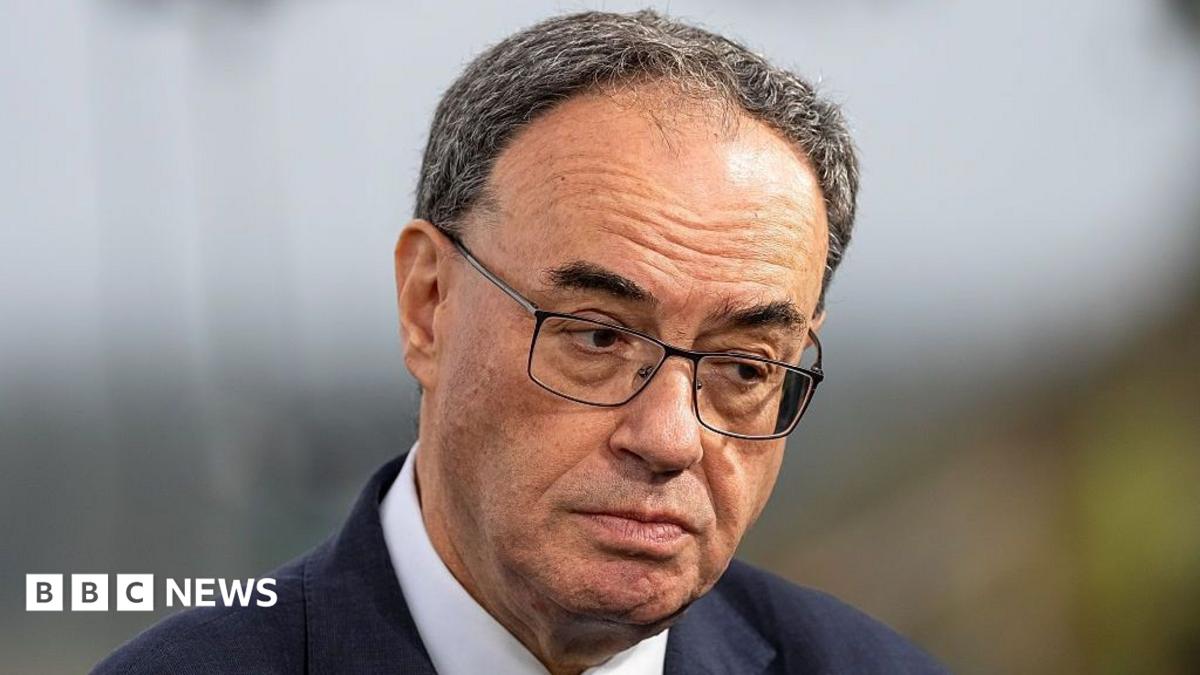
Artificial intelligence (AI) could trigger financial market shocks and the UK needs to be prepared for them, the governor of the Bank of England has warned.
Andrew Bailey said the central bank is watching the huge amounts of money being invested in AI “very carefully” and cautioned that “not everybody always wins”.
The money that has been spent on and loaned to AI firms over the last few years in the hope of large returns is causing markets to value some of them as multi-trillion dollar businesses.
Asked if he believed an AI bubble could burst, Bailey said: “You could see some correction of asset prices at some point.”
He was speaking exclusively to the BBC about what the risks and benefits of AI could be for the UK economy.
Bailey said he believed the technology has “great potential to strengthen growth in our economies”, adding that this was something the country needed.
“But it also brings with it substantial risks and so we have to be on top of both of those.”
One such risk is what happens if the big bets being made on AI don’t pay off.
AI chipmaker Nvidia is currently the world’s most valuable listed company, with a market valuation of $5.5tn (£4.14tn), thanks largely to investors who believe in the big profits AI could create.
Meanwhile, tech giants Alphabet, Meta, Microsoft, and Amazon are spending hundreds of billions of dollars on the technology.
And two of the largest AI companies in the world – Anthropic and OpenAI – are also preparing to sell shares in their firms on the US stock market in moves which many believe will lead to hundreds of billions of dollars more flowing into the industry.
“There is a large, very large, amount of investment going into this sector now, and of course that’s natural because it’s a major area of growth,” said Bailey.
“And of course you see that the asset prices of the companies that are developing it have gone up a lot and that reflects the fact that there are high expectations of what it can deliver.”
“Everybody is currently priced to be a winner,” he added, but warned that “you look back at the past, not everybody is a winner”.
“Google was not the first market leader in internet search. It was Netscape. Nobody can remember Netscape today. It doesn’t exist. So not everybody always wins.
“We are prepared for the fact that there will be, I think, some shocks come along to markets and we have to deal with that. We have to make sure the system is resilient.”
To capitalize on growing demand for products developed for sensitive skin, Bath & Body Works (BBWI) launched Essentials, a new line of hypoallergenic body washes and lotions developed exclusively for sensitive skin.
Tehran, Iran – Hossein, a 32-year-old marketing specialist based in Tehran, has been thinking of replacing his 13-year-old Iranian-made car with a newer model.
Even though he earns about four-and-a-half times the minimum wage after a recent pay rise – his salary is now close to 900 million rials (about $390 at the current exchange rate) – imported vehicles are not even remotely affordable for him.
Recommended Stories
list of 4 itemsend of list
Even finding a locally made car might be out of his budget, with an economic crisis gripping the country since the United States and Israel launched a surprise war on Iran on February 28 and later enacted a crippling siege and sanctions on the country.
“I’m losing hope of ever being able to buy a new domestic production car too, unless the country opens up and becomes a bit more normal again,” Hossein, who asked to keep his full name confidential for security reasons, told Al Jazeera.
His old manual Peugeot 206 model, an originally French-made car but now produced domestically after foreign counterparts left Iran due to sanctions, can fetch up to 10 billion rials ($4,350) if he sells it towards making a new purchase. However, his replacement options are limited.
Upgrading to a slightly improved Peugeot 207 with an automatic gearbox could cost him 28 billion rials ($12,170) now. This means that, after selling his car, he would need more than 20 months of his entire salary.
A domestic sedan Shahin model costs more than 31 billion rials ($13,480), and a crossover Reera is priced at more than 43 billion rials ($18,700).
With these options, he would need to save about 24 months and 37 months of his whole salary, respectively, and that is if prices remain stable and he does not spend a rial on anything else. But the reality of the fast-rising living costs and lagging incomes in Iran means he can barely put aside any money, let alone afford a new car.
Domestic car prices have mostly risen 40 to 80 percent since the start of the war, while some vehicles sell for more than 130 percent of their September 2025 costs.
The costs of maintaining the vehicles are also rising much faster than people’s salaries. Domestically produced tyres, motor oil, brake pads and clutch kits have at least doubled since last year, with some car parts having more than tripled in price.
Domestic vehicles have generally low safety standards, meaning that they contribute to staggering road accident deaths. At least 1,609 Iranians have been killed so far on intercity roads in the current month of Shahrivar of the solar Hijri calendar, which ends on September 22. More than 20,000 people lose their lives on the roads every year. In comparison, fewer people in the whole of the European Union, nearly five times Iran’s population, died on roads last year.
Iran’s fuel-guzzling cars also contribute to smoke-congested city streets, degrade vehicles faster and increase fuel costs, just as petrol prices have risen for users.
How did we get here?
Experts say, due to a combination of protected state-linked businesses, privileged access, economic isolation and a curtailing of imports, Iranian households have no choice but to pay exorbitant prices – compared with their salaries – to buy low-quality cars.
The damage from the war, including the extensive bombing of multiple steel giants by Israel and the US, has only added insult to injury. The naval blockade of Iran’s southern ports has prevented goods coming in from popular neighbouring markets like the United Arab Emirates.
Under such circumstances, domestic vehicle manufacturers have little incentive to improve.
End customers are also beset by government charges, currency and financing costs, margins levied by murky intermediaries – and in numerous documented cases, industry corruption.
“People are forced to buy expensive low-quality cars whose real prices should be a quarter of global prices, and this is a direct harm done to them,” Mohammad Rashidi, a member of the presiding board of Iran’s parliament, told local media on Saturday. “The traces of a mafia system are visible throughout the process.”
His claims echo those of other officials and state-linked media, who have openly described the industry as resembling an organised crime operation.
According to the latest figures released by state media, about 233,000 cars were manufactured or assembled in Iran in the first five months of 2026, compared with 366,000 the year before. Only about 25,000 vehicles were imported in that period.
Only a handful of state-linked companies or intermediaries are allowed to import vehicles, with duties plus value-added tax increasing final prices up to 200 percent.
The government and parliament have discussed lowering import tariffs this year, with no agreement announced so far.
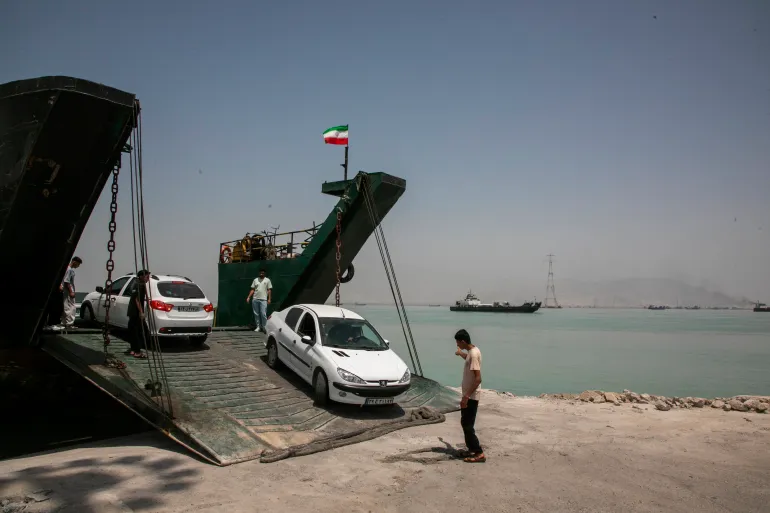
Cars leave a ferry as ships remain anchored on May 16, 2026 in the Strait of Hormuz near Larak Island, Iran [File: Majid Saeedi/Getty Images]
The premiums are more visible for high-end cars, with a 2026 Toyota Land Cruiser VXR going for approximately 660 billion rials ($287,000) in Iran at the moment, while the same model is available for about $86,000 in the UAE. The same story applies to most other models, at different rates depending on the rarity of the vehicle and the availability of parts.
The price of a mid-range Chinese-designed SUV sold as Exeed VX in international markets is listed at about $32,000 in China, while it is priced at about $42,000 in the UAE. The same car, assembled from imported parts by a state-linked company in Iran under a different name, currently costs Iranian customers the equivalent of $53,000.
The bizarre situation was on full display during a three-day “international” car exhibition in Tehran last week that mostly featured Chinese-manufactured vehicles. These remain available in Iran despite the US sanctions, since Tehran exports almost all of its oil to China and barters this for goods, including cars.
Some domestic manufacturers and importers were absent, either because they had no products to offer or because they had angry customers who registered months ago to get vehicles they never received. Spare parts for some of the vehicles on display are currently either not available in the Iranian market or cost several times their price in international markets.
Even the cheapest vehicles offered at the exhibition were completely unaffordable to the average Iranian. It would take a worker on the minimum wage with standard allowances 50 years to buy an XPENG G9, a Chinese-made electric SUV priced at 120 billion rials ($52,150), on his or her salary, without spending a rial on food, housing or clothing.
Still, there were huge queues outside the exhibition centre each of the three days.
“It was sad because most people just came to take pictures with the cars they knew they could never afford,” a young man who attended the exhibition told Al Jazeera. “The doors of the cars were locked too.”
OUR Spotlight On column gives you the lowdown on what to see and do in some of the best holiday destinations abroad as well as some lesser-known spots in the UK.
Learn about the town’s history in wool at Witney Blanket Hall, which dates back to 1721 and is free to visit (make sure to pick up a blanket at the gift shop too).
And kids will love Cogges Manor Farm with 17 acres to explore which includes an adventure playground and animals they can feed and pet.
Tickets start from £12 for adults, see cogges.org.uk.
Otherwise a short drive away is Blenheim Palace as well as Jeremy Clarkson’s The Farmer’s Dog.
HIDDEN GEM
Only known by locals, head straight to Sandwich de Witney for one of the heartiest baguettes you’ll have ever seen.
Just don’t be too late – most of them sell out shortly after lunch.
For evening entertainment, catch some comedy or some live tribute acts at the very tiny Fat Lils music venue.
Previous comedians have included Greg Davies and Milton Jones. Tickets from £5. See fatlils.co.uk.
Did you know the town was known for its blanket making?Credit: Alamy
BEST VIEW
Grab a coffee and head down to the banks of the River Windrush which runs through the town.
The peaceful break from the bustling town is the ideal escape, where you’ll be mainly joined by joggers and a few cows in the distance.
It even used to host the World Pooh Sticks Championships, so grab a stick and get racing.
RATED RESTAURANT
If there is one thing Witney has an abundance of, its pubs.
And one of the finest in town for a meal out is The Fleece, a gastropub and hotel.
You’ll be licking the crumbs off the plate of the Devon crab cakes, and I’d go back just for Aubrey’s Cheeseburger, complete with the crispiest chips and pickles.
There’s a fantastic list of desserts, but my sweet tooth was satisfied by the bizarre, yet strangely delicious Banana Brulee Old Fashioned.
BEST BAR
If you love a beer, head to the Crafty Pint Bar.
It was recently named Oxford Pub of the Year by Campaign for Real Ale (CAMRA), with a number of independent beers both on tap and by the bottle.
Try the Little Ox which is brewed just down the road.
Otherwise for the best vibes on a Friday night, head over to the Como Lounge in the centre of town where you can get two cocktails for £13.25.
HOTEL PICK
The Blue Boar ticks all the boxes – central location, cosy-yet-modern bedrooms and a fantastic restaurant downstairs.
Originally a 17th century coaching inn, there’s just 20 rooms to choose from, each with four poster beds, DAB radios and Nespresso machines.
Some rooms have views over the town centre, and easy has lush bathrooms kitted out with fluffy towels and luxe toiletries.
After recent renovations to the bar and restaurant, it reopened last week. Rooms start from £81. See acornpubs.co.uk/blueboar.
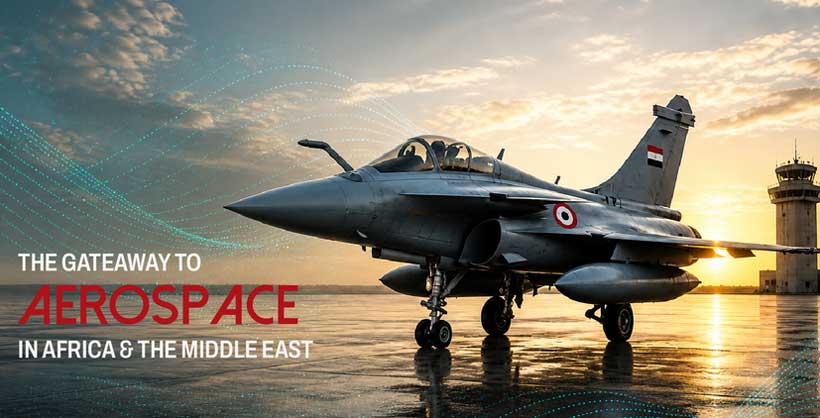
The People’s Republic of China achieved a historic and unprecedented participation in the second edition of the El Alamein International Aerospace Exhibition (EIAS 2026), which was held at El Alamein International Airport from September 8 to 10, 2026. The Chinese participation came just days after the conclusion of the joint Egyptian-Chinese air force exercises Eagles of Civilization 2026. The significance of this Chinese military presence lay in the display of a fully integrated and realistic combat air system, not merely models. In this context, the Egyptian researcher will attempt to divide the significance of China’s participation in the El Alamein Air Show into several key areas, including:
– First: China’s prominent participation in the El Alamein International Air and Space Show in Egypt as a strategic shift in the regional arms market
Here, China’s extensive participation in the El Alamein International Air and Space Show constitutes a significant strategic shift in the regional arms market. Beijing has moved beyond the traditional approach of selling individual military components to present itself as a supplier of comprehensive and integrated air combat systems, competing with Western and American powers in the Middle East and Africa. China’s participation in the El Alamein International Air and Space Exhibition focused on several strategic axes to promote and analyze the concept of a full-suite solution. This was achieved by emphasizing that China does not simply sell aircraft but rather offers a comprehensive defense solution, encompassing attack fighters, logistics support aircraft, aerial refueling, and command and control systems, known as C4ISR.
The People’s Liberation Army of China sought to highlight China’s military and defense role and promote the Chinese model as a ready-made competitive alternative. This was done by showcasing the competitive advantages of Chinese defense industries, such as the absence of complex political conditions, rapid delivery, and comprehensive technology transfer to Middle Eastern and African markets. Furthermore, the focus was on the geopolitical depth, linking the Chinese presence in El Alamein to Beijing’s broader vision of strengthening security and economic partnerships with countries in the region.
Stay ahead of the geopolitical week.
MD Briefing delivers expert analysis across five global fronts — the Indo-Pacific, energy, geoeconomics, European security, and the Middle East — every Monday morning. Free.
– Second: Showcasing the most prominent Chinese aircraft platforms participating for the first time outside of China at the El Alamein exhibition
As for the most prominent Chinese aircraft platforms participating for the first time outside of China, for the first time in its history, the People’s Liberation Army Air Force (PLAAF) showcased four of its latest operational aircraft models at an air show outside of China. The most prominent of these were
– The Chinese J-16 multirole fighter (J-16)
This air superiority and heavy ground attack fighter garnered widespread international attention.
– The Chinese YY-20A aerial refueling tanker (YY-20A)
This Chinese heavy transport aircraft provides refueling to extend the operational range of fighter jets.
– The Chinese KJ-500 airborne early warning and control aircraft (KJ-500)
This represents an airborne command and control system.
– The Chinese Z-20K military helicopter (Z-20K)
This is a multi-role helicopter designed for search and rescue and tactical operations.
Regarding the Chinese weapons and drones on display at the El Alamein International Air and Space Exhibition, the AVIC (Aerospace Industries of China) showcased its advanced defense capabilities in the outdoor exhibition area through:
– A demonstration of the Chinese Wing Loong-10B stealth drone (Wing Loong-10B):
This is a high-altitude, long-range unmanned aerial vehicle (UAV) designed for reconnaissance and precision strikes.
– A demonstration of Chinese smart munitions and missiles:
The Chinese drone was displayed surrounded by advanced air-to-air missiles, such as the PL-108 & PL-12AE. In addition to a demonstration of the Chinese anti-radar and anti-radiation missile (YJ-9ER1).
– Third: The Chinese People’s Liberation Army (PLA) showcased its capabilities through a technical display (capability integration), dividing its export-available air systems into functional groups for attack, others for support and refueling, and a third group for command and control, during China’s extensive participation in the El Alamein Air Show in Egypt.
In this context, the PLA sought to leverage China’s extensive participation in the El Alamein Air Show in Egypt as a new and strategic launchpad for China in North Africa. This included showcasing the size of the Chinese pavilion and the equipment on display, such as aerobatic aircraft and unmanned combat aerobatics. The Chinese Ministry of Defense emphasized the technical aspects of this capability integration display, highlighting the division of its export-available air systems into functional groups for attack, others for support and refueling, and a third group for command and control. As follows:
■ The offensive functional groups were represented by a display of China’s modern fighter jets and attack drones, such as the Wing Loong family.
■ As for the support and refueling functional groups, China’s strategic transport and aerial refueling aircraft, such as the Y-20, were showcased.
■ The third functional group focused on (command and control), with China displaying its early warning aircraft and airborne command centers.
– Fourth: Analyzing and understanding the strategic dimensions of China’s participation in the El Alamein International Air and Space Exhibition, aimed at attracting more interest in the Chinese aerospace sector and promoting widespread military sales of Chinese military, defense, and armament equipment
Thus, we can analyze and understand the strategic dimensions of China’s participation in the El Alamein International Air and Space Exhibition, which aimed to attract more interest in the Chinese aerospace sector and promote widespread military sales of Chinese military, defense, and armament equipment. Therefore, we find that the extensive Chinese presence at the El Alamein International Air and Space Exhibition constitutes a genuine breakthrough. Beijing did not aim to promote individual pieces but rather to demonstrate its ability to provide a comprehensive and integrated air combat system, encompassing attack, support, refueling, and command, as a competitive alternative in the Middle Eastern and African markets.
Analyzing the economic and strategic dimensions of China’s extensive participation in the El Alamein exhibition, we observe the extent to which the Chinese People’s Liberation Army focused on achieving broad military exposure for its participation during the exhibition. This included showcasing how these Chinese defense, military, and air systems can reduce operating costs for purchasing countries while ensuring their independence in defense decision-making, without imposing political conditions or prior operational restrictions, unlike many Western and American systems.
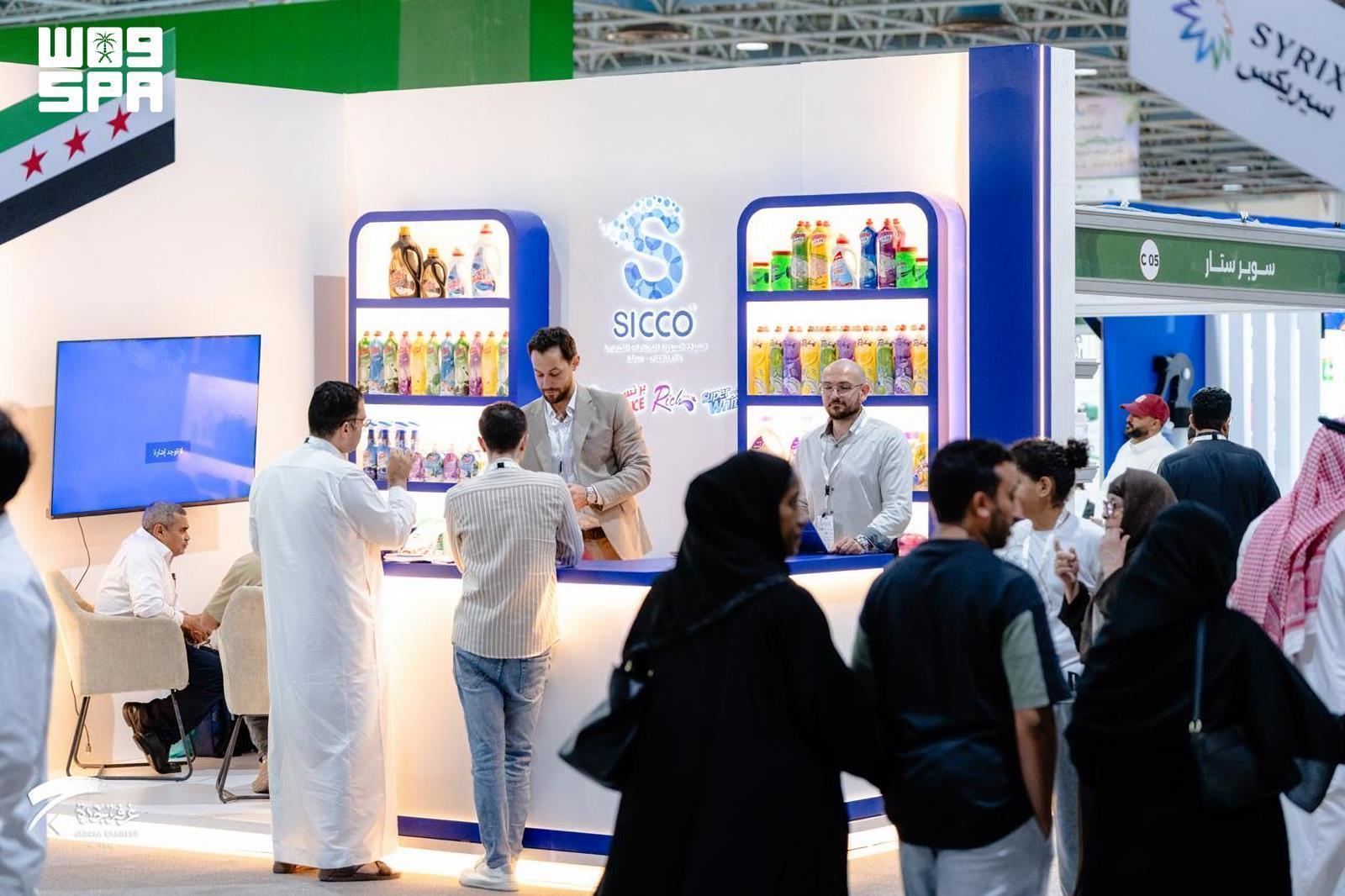
JEDDAH: The first Syrian Industries Exhibition recently concluded in Jeddah, bringing together more than 160 Syrian companies and factories, and attracting business figures, importers and distributors seeking commercial and investment opportunities in the Saudi market.
Held over four days at the Jeddah Center for Exhibitions and Events under the patronage of the Jeddah Chamber, the expo focused on business-to-business opportunities in supply, distribution, investment and partnerships.
The event facilitated meetings between Syrian manufacturers and Saudi businesses to establish partnerships, sign supply and distribution contracts, and conclude memoranda of understanding to support the entry of Syrian products into the Saudi market.
Agreements covered four main sectors: food, textile, chemical and engineering industries. The expo also highlighted investment incentives, facilities and regulatory procedures for establishing joint ventures between the two countries.
A knowledge program featured seminars and panel discussions on legal procedures, trade incentives, partnership mechanisms, and the shift from traditional trade to industrial investment and joint production.
Pavilions showcased food, textile, engineering and chemical industries, along with agriculture, tourism, culture and labor, highlighting opportunities for economic cooperation between Saudi and Syrian businesses.
The expo provided a platform to strengthen economic and trade ties, explore investment opportunities and build partnerships supporting economic development and shared interests.
SAN FRANCISCO: Saudi Arabia is building an integrated model to attract leading artificial intelligence companies and help them expand globally, Communications and Information Technology Minister Abdullah Al-Swaha said in Silicon Valley on Friday.
Speaking at the fourth edition of the Frontier Leaders Forum 2026, held under the theme “AI Forward: A Global Frontier,” Al-Swaha said the Kingdom’s approach was centered on providing AI companies with three key resources: computing capacity, capital and access to customers.
Al-Swaha said the Kingdom aimed to build on that experience and attract more global AI companies. (SPA)
He cited Grok as an example of this approach, highlighting Saudi Arabia’s partnership with US AI company xAI and Saudi AI company Humain to deploy Grok in the Kingdom and develop large-scale AI computing infrastructure.
Al-Swaha said the Kingdom aimed to build on that experience and attract more global AI companies, the Saudi Press Agency reported.
Saudi Arabia is working with the private sector to develop more than 14 gigawatts of computing capacity, he said, providing infrastructure for advanced AI companies while helping reduce operating costs and improve efficiency.
Al-Swaha also highlighted the Kingdom’s expanding use of generative AI, AI agents and augmented-reality applications across sectors including healthcare, government services, transportation and logistics. (SPA)
Humain is developing a range of AI infrastructure and platforms in the Kingdom, including AI cloud and high-performance computing services designed to support training, fine-tuning, inference and other AI workloads.
Al-Swaha also highlighted the Kingdom’s expanding use of generative AI, AI agents and augmented-reality applications across sectors including healthcare, government services, transportation and logistics.
He said Saudi Arabia would continue working with Silicon Valley around talent, technology and trust while providing the computing capacity, customers and capital needed to help the next generation of AI companies scale internationally.
Al-Swaha held a series of meetings during his visit with technology and investment executives to discuss expanding AI investment in the Kingdom, developing advanced models and applications and integrating them with infrastructure and computing capabilities being developed by Humain.
He met General Catalyst’s CEO Hemant Taneja to discuss expanding the investment firm’s AI and advanced-technology activities in Saudi Arabia, enabling its portfolio companies to develop and deploy applied AI solutions and using Humain’s computing capabilities to accelerate implementation in priority sectors.
A further meeting with Velaura AI’s co-founder and CEO Rajiv Khemani focused on integrating energy-efficient computing technologies. (SPA)
Al-Swaha also met Arcee AI’s founder and CEO Mark McQuade to discuss expanding the use of the company’s Trinity open and enterprise models and deploying them across Humain’s infrastructure.
He held talks with Engramme’s co-founder and CEO Gabriel Kreiman on AI memory and continuous-learning applications designed to allow organizations to build models that learn from their own data, knowledge and operating environments.
Infrastructure was another focus of the meetings. Al-Swaha met Supermicro’s founder and CEO Charles Liang to discuss AI factory solutions, including integrated systems, liquid cooling and high-density architectures aimed at improving energy efficiency and supporting large-scale AI data centers.
He also met Upscale AI’s CEO Barun Kar to discuss high-performance AI networking and improving connectivity between computing accelerators, memory and storage to maximize the use of computing resources.
A further meeting with Velaura AI’s co-founder and CEO Rajiv Khemani focused on integrating energy-efficient computing technologies into Humain’s infrastructure and supporting the expansion of AI applications and autonomous systems.
European CFOs must adjust as the region’s biggest pension buyer of long-dated debt cuts back.
This article appears in the September 2026 issue of Global Finance Magazine.
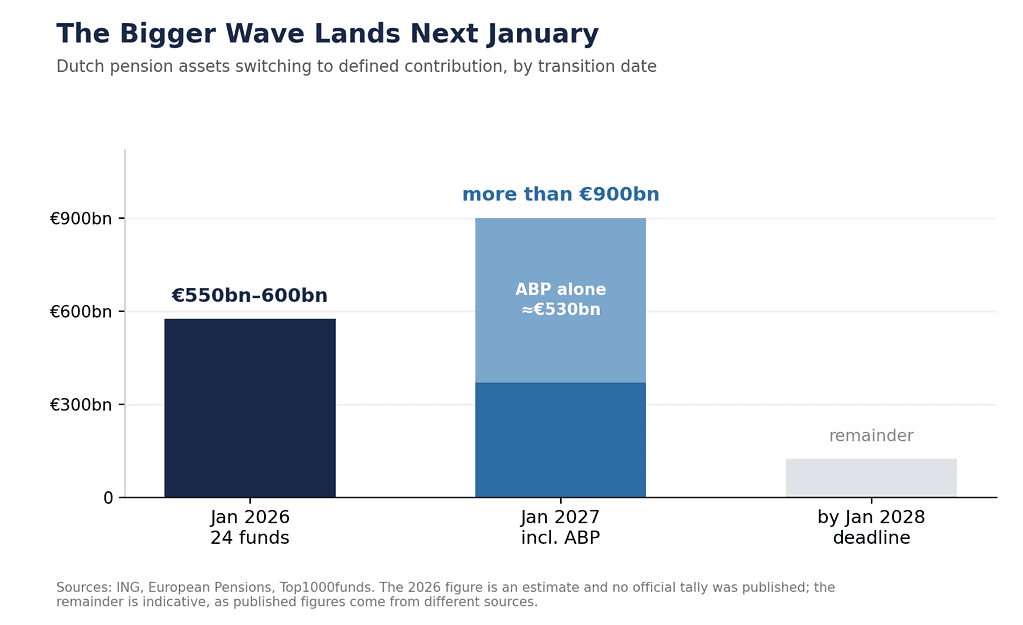
The Netherlands pension system is beginning to reduce one of Europe’s most reliable sources of demand for long-dated debt as a broad regulatory shift changes how Dutch pension funds manage their assets and liabilities. ING Groep NV estimates that nearly €600 billion ($699 billion) of assets have already been affected by the change, with more than €900 billion expected to follow early next year.
Under the old defined-benefit pension system, Dutch funds were required to hedge the interest-rate sensitivity of long-term pension liabilities by using long-dated bonds and swaps to match assets with payments extending decades into the future. Under the new defined-contribution model, which became law in 2023, that liability matching requirement has been significantly reduced, allowing funds to carry less duration and scale back their long-term hedges, resulting in less structural demand for the longest-dated debt and swaps.
For European CFOs, this could mean a higher premium for 20-, 30- and 50-year borrowing as companies and governments compete for a smaller pool of long-duration investors.
The change “should reduce structural demand for long-end duration assets and support curve steepeners over the long-term horizon,” wrote Sara Adjir, senior vice president and portfolio manager, and Jeroen van Bezooijen, account manager, at Pacific Investment Management Co., in a research note. They expect the impact will be mostly concentrated in 50-year swaps, but will also be felt in the demand for 20- and 30-year euro swaps and government bonds, including German and Dutch debt.
Deadlines
The Netherlands runs Europe’s largest pension system, with roughly €1.6 trillion in assets, and every fund must complete the switch by January 2028. Dutch pensions have long dominated the market for European long-dated debt, holding around €88 billion of interest-rate swaps maturing beyond 25 years at the end of last year, roughly a quarter of the total.
The first major wave of the transition came on Jan. 1, when 24 funds converted, among them the healthcare scheme PFZW and the metals scheme PMT, with an estimated €550 billion to €600 billion of pension assets between them. Analysis by the Netherlands central bank shows that Dutch pensions bought almost €34 billion net of swaps maturing inside 25 years while selling more than €12 billion of longer-dated ones.
The bigger test, however, comes when more than €900 billion of pension assets is scheduled to convert on Jan. 1, with the Dutch civil service scheme ABP accounting for about €530 billion of that.
The shift does not mean long-dated Dutch debt is suddenly becoming illiquid or even hard to sell: “Overall, we still see strong demand for our 30-year bond. Remember, we are AAA,” said Saskia van Dun, director of the Dutch State Treasury Agency.
Sovereign Issuers Adjust
Data indicates that sovereign borrowers are already adjusting to the change.
The share of Netherlands government bonds sold at maturities beyond 10 years fell from 42% at the start of 2025 to 31% by the third quarter, according to the Organization for Economic Co-operation and Development (OECD), which calls the constraint on long tenors structural. The OECD expects eurozone debt agencies to sell a record €1.35 trillion of medium- and long-term bonds this year into that thinner pool of demand.
For European finance chiefs, however, times are changing. For two decades, long-dated bond demand was unusually deep and predictable. As it recedes, the shifting cost of locking in 20 or 30 years of funding could become a live question.
Thomas Monteiro is a contributing writer based in Spain.
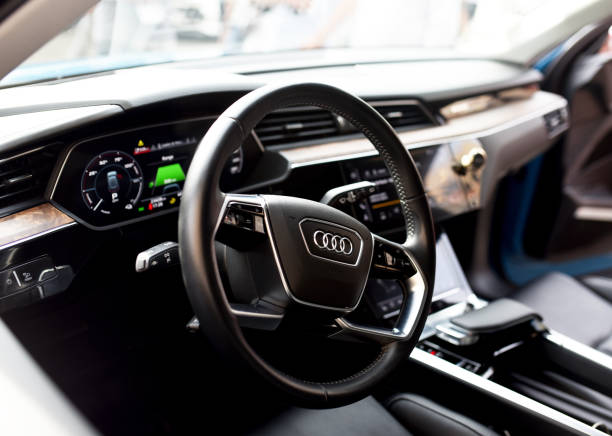
Audi is turning to a smaller electric vehicle to regain momentum in Europe, unveiling the A2 e-tron as competition intensifies from lower-cost Chinese automakers.
The new model, presented in Paris on Monday, brings back the A2 badge used by Audi in the