Mark

Here’s what’s happening with Mark Walter, the Dodgers and the Lakers

For the last month, the Los Angeles Dodgers and Lakers have filled the headlines and airwaves, but not for the reasons either would like.

The Lakers were sold by Mark Walter in mid-August, just over a year after he bought the team.

The sale came about two weeks after the Wall Street Journal reported in late July that the U.S. attorney’s office and securities regulators were investigating Walter’s business and insurance empire regarding $16 billion to $21 billion in possibly fraudulent loans.

In June of last year, 66-year-old Walter and one of his holding companies, TWG Global, purchased a controlling interest in the Lakers for $10 billion, only to sell the franchise to Joshua Kushner and Bob Iger for $12.5 billion this month.

Bloomberg reported that Walter’s sale of the Lakers was done to eliminate some of the billions in outstanding loans that has drawn the ire of federal regulators.

Since then, questions have swirled about whether Walter will put other assets on the market in his fundraising bid, including the Dodgers, which he purchased as chief executive of Chicago investment firm Guggenheim Partners for $2.15 billion in 2012. Sources close to Walter say he’s not likely to sell.

To better understand this tangled story, we spoke with Times sports reporter Steve Henson about why he thinks Walter won’t put the Dodgers up for sale.

You’re reading the Essential California newsletter

Sign up to start every day with California’s most important stories.

What are federal investigators examining

Business reporter Laurence Darmiento wrote Aug. 5 that the heart of the federal investigation swirls around related-party transactions.

These dealings are “between entities with business or personal ties, including loans, sales and other transactions that can have legitimate reasons but pose potential conflicts of interest and typically require extra scrutiny,” Darmiento wrote.

More than $1 billion in financing to buy the Dodgers in 2012 came from insurance companies managed by Guggenheim Partners. The purchase was later vetted by state insurance regulators.

Investigators are checking whether billions of dollars’ worth of similar loans made by Walter’s companies were properly disclosed and that insurance companies were not over-leveraged.

Approximately $21 billion in loans not disclosed to state insurance regulators were made by two Delaware insurers Walter owns, according to ratings agency Fitch. The loans reportedly were made to companies with ties to Walter or his TWG Global holdings company.

The issue with these loans is they raise suspicions, according to Bruce Dubinsky, a forensic accountant who spoke with Darmiento. Dubinsky worked on the Enron and Madoff cases.

Dubinsky said that from an audit standpoint, these types of transactions “are always more suspect to fraud” and manipulation since repayments can be delayed indefinitely.

The insurance industry’s tight regulations for money collected from premiums exists so that money is available for future claims. Regulators believe related-party transaction are a threat to that guarantee.

TWG Global has rejected any allegations of wrongdoing.

Why is Walter fighting to keep the Dodgers

Henson teamed with Times colleagues to write about Walter’s chances of hanging on to the Dodgers amid this federal probe and whether new owners Bob Iger and Josh Kushner overpaid for the Lakers.

Henson reported that Walter owns a broad series of sports interests: English soccer Premier League team Chelsea, the Los Angeles Sparks WNBA team, the Cadillac Formula 1 racing team; a premier women’s tennis competition, the Billie Jean King Cup, and the entire Professional Women’s Hockey League.

He already sold the Lakers and Henson noted that there have been reports he’s putting his shares of Chelsea on the market.

So, why keep the Dodgers?

“No MLB team has ever been run as boldly as this team,” Henson said. “And the revenue from the Dodgers is relentless, from ticket sales, to international merchandise and including friendly [player] salary deferments that help keep money in-house.”

Since Walter and Co.’s takeover, the Dodgers have won three of the last six World Series and 12 division titles after he and partners rescued the franchise from bankruptcy.

Walter noted that a sale of the Lakers, a franchise he’d barely owned for more than a year, was easier than one he’s already helmed for nearly 15 years.

“His identity is totally wrapped up with the Dodgers and this success saga,” Henson said. “It’s dear to his heart and having them to sell them would just tear him up.”

Amid all of this speculation, the boys in blue are attempting to become the first National League team (and third overall) to win three consecutive World Series titles this year.

The week’s biggest stories

Mirror Lake Yosemite National Park.

(Carolyn Cole/Carolyn Cole/Los Angeles Times)

Trump administration policies and pushback

Artist and concert news

A final tribute

Television, advertising entertainment news

More news

Editor’s pick

More picks

Things to do

The pina colada and maui wowie slushies at Belle's Beach House in Venice.

(Melody Xu/Los Angeles Times)

Today’s recipe

The San Juan Islands off Washington state has a much-loved clam chowder served at La Conner Brewing Co. in the tiny picturesque town of La Conner, Wash. The dish is spicy enough and not so thick with cream or flour and is a standout in the clam chowder world, according to Times reader Mary Ann Mollenkamp.

Have a great day, from the Essential California team

Jack Dolan, investigative reporter
Hugo Martín, assistant editor, fast break desk
Kevinisha Walker, multiplatform editor
Andrew J. Campa, weekend writer
Karim Doumar, head of newsletters

How can we make this newsletter more useful? Send comments to essentialcalifornia@latimes.com. Check our top stories, topics and the latest articles on latimes.com.

Source link

Trump to mark 9/11 25th anniversary at Pentagon

U.S. first lady Melania Trump and U.S. President Donald Trump attend a remembrance ceremony at the Pentagon on September 11 to mark 24 years since the September 11, 2001, terrorist attacks in Arlington, Va. File Photo by Annabelle Gordon/UPI | License Photo

Aug. 28 (UPI) — President Donald Trump plans to observe the 25th anniversary of the Sept. 11, 2001, terror attacks at the Pentagon in Washington, D.C., instead of at Ground Zero in New York City, those familiar with the details told media outlets Friday.

People briefed on the details told CNN, The New York Times and The Hill that Trump plans to give remarks at the Pentagon, one of the sites of the terror attacks.

Those familiar with the plans said the president chose the Pentagon because he wants to deliver remarks on the anniversary, and politicians aren’t allowed to give remarks at the New York City site. The National September 11 Memorial and Museum has blocked politicians from speaking at the location since 2012 in an effort to be nonpartisan.

Officials said Vice President JD Vance plans to attend the New York City anniversary event.

“As a proud New Yorker, President Trump has spoken about his own experiences watching the horrific events of September 11, 2001,” White House spokeswoman Anna Kelly said in a statement.

“On the 25th anniversary of this tragic day, the president will remember those who were killed at the hands of evil terrorists, honor their loved ones, and pay tribute to the brave first responders who put their lives on the line to rescue their fellow Americans.”

Trump also marked the anniversary of the terror attacks at the Pentagon last year. He visited Ground Zero in 2024 and previously gave remarks at the Flight 93 National Memorial in Shanksville, Pa.

Retired Deputy Police Chief Sam Pulia from Willow Springs, Ill., places American flags at the 9/11 memorial south pool before the start of the 9/11 Commemoration Ceremony at the National September 11 Memorial & Museum in New York City on September 11, 2025. Photo by Peter Foley/UPI | License Photo

Source link

Sparks are growing but Mark Walter should still sell the team

Mark Walter doesn’t need to sell the Sparks. It said so in a release from his company Wednesday: “TWG is not looking to sell its sports assets at ‘fire sale’ prices to raise capital for its insurance operations.”

He should sell the Sparks anyway.

Not because of the investigations into allegations that insurance companies under Walter’s umbrella failed to properly disclose and conduct transactions between other companies he controls.

But for the sake of the storied WNBA franchise, which hasn’t won a championship in a decade and is about to miss the playoffs for the sixth consecutive season — something that would have been unthinkable six seasons ago.

Sell for the sake of the Sparks, who have long deserved an owner who wants seriously to run the team like Walter’s group runs, well, the Dodgers.

With passion and pride, foresight and smarts.

A steel beam is raised as the final structuarl piece of the Sparks' $150-million training facility in El Segundo.

A steel beam is raised as the final structuarl piece of the Sparks’ $150-million training facility in El Segundo on Wednesday.

(Ronaldo Bolanos / Los Angeles Times)

And, yes, the new $150-million training facility that’s going to open in El Segundo next year is a better-late-than-never step in that direction.

It’s not too little; the 64,000-square-foot space, which will be tremendous in a prime location near the beach and shopping.

But it’s very late. Wednesday’s topping-out ceremony, when a construction crew lifted the final structural beam into place, doesn’t change that.

While so many of the Sparks’ rivals have had the upper hand in recruiting and retaining talent with state-of-the-art private practice spaces for the past few years, the Sparks have been — to use star forward Nneka Ogwumike’s word — “nomads.”

The Sparks have always offered fans a famously fun game-day experience, but their players had to continually get familiar with facilities all over Southern California, from L.A. Southwest and El Camino College to Academy USA in Glendale to Jump Beyond Sports in Torrance, from Windward School and Galen Center to JR286, the gym in Torrance where they practice now.

Starting next season, they’ll have a home.

Photo of a rendering of the Sparks' new training facility in El Segundo.

A rendering of the Sparks’ new training facility in El Segundo.

(Ronaldo Bolanos / Los Angeles Times)

But it’s not because the Sparks’ ownership wanted to do what Mark Davis did with the Las Vegas Aces when he was the first owner to provide fancy new digs in 2023.

Not because they were resolute about giving the Sparks a first-class experience, like Joe Tsai did when he chartered flights for New York Liberty before the league said it was legal, getting himself fined $500,000.

But because the Sparks would fall further behind if they didn’t.

Because now “it’s the bare minimum,” said forward Dearica Hamby, whose input — dedicated spaces for family and naps — was incorporated into the building’s design.

It also will include two regulation basketball courts, a performance and training environment, hydrotherapy and recovery rooms and a player sanctuary.

“It represents a belief in our players,” said Stacy Johns, the team’s president. “It represents a belief in the future of the Sparks. And it represents a belief in where women’s basketball and women’s sports are going.”

Members of the media and guests gather with the Sparks' front-office staff for the topping-out ceremony in on Wednesday.

Members of the media and guests gather with the Sparks’ front-office staff for the topping-out ceremony in El Segundo on Wednesday.

(Ronaldo Bolanos / Los Angeles Times)

Where’s that? Up.

Valuations are growing. In May, CNBC reported that the WNBA’s current teams were worth an average of $460 million — 84% more than the league’s most recent expansion fee of $250 million.

The Sparks — without taking the new facility, the largest investment to date in the history of women’s sports, into account — were valued at $415 million, seventh among the WNBA’s 15 teams.

The Golden State Valkyries, an expansion team in 2025, were valued at a record $1 billion, more than any women’s sports team in history.

That’s because the Valkyries — who are owned by the Golden State Warriors’ Joe Lacob and Peter Guber — have been innovative and imaginative, run more like the Dodgers than the Sparks, who are owned mostly by the same folks as the Dodgers.

The Dodgers instituted a private player-only plane and added Japanese-style toilets after then-recruit Roki Sasaki asked. The Valkyries established a 30-plus network of area bars for fans to gather to watch games and they helped a player with sleeping problems by offering everything from a different comforter to a sleep study.

Photo of a rendering of the outside of the Sparks' new training facility, including a dining area.

Rendering of the inside the contrition of the Sparks’ new training facility, including a dining area.

(Ronaldo Bolanos / Los Angeles Times)

The Dodgers gave the keys to Andrew Friedman and Dave Roberts. The Valkyries’ GM is Ohemaa Nyanin, formerly an assistant GM with the WNBA champion New York Liberty, and their coach is former UCLA Bruin Natalie Nakase, before an assistant on Aces championship teams and an NBA assistant for years with the Clippers.

The Sparks have for the past several seasons cycled through unproven coaches and GMs, or fired experienced ones. Unable to pick a lane and drive it, they keep ricocheting between preaching patience and acting impatiently. And at the moment, they don’t even have a GM after firing Raegan Pebley in July.

Johns, who was brought on to oversee the team’s business in April, said things are changing. And change takes time.

The Sparks are 13-25, behind the expansion Portland Fire in the standings and having lost twice to the expansion Toronto Tempo. But they’ve tripled their sports staff this year, adding performance and mental health therapists and additional basketball data people — who apparently aided in the construction of an old, uncompetitive roster.

“I couldn’t tell you what happened or who woke up one day and decided,” said Johns, who worked for the MLS champion LAFC and Super Bowl champion Indianapolis Colts. “But when I was recruited … I was explicitly told like, ‘This is changing,’ and like, ‘We’re hiring you because we want to signal change.’”

The biggest change that could help the Sparks? At the top, with someone who wants to push the envelope instead of compensate and play catchup.

Rendering of the inside the contrition of the Sparks' new training facility, including a basketball court.

Rendering of the inside the contrition of the Sparks’ new training facility, including a basketball court.

(Ronaldo Bolanos/Los Angeles Times)

Source link

Mark Walter’s TWG Global defends Dodgers financing and Lakers sale

TWG Global — the holding company of Dodgers owner Mark Walter — rejected allegations of financial impropriety in the purchase and operation of the Dodgers and reiterated the team is not for sale.

At a time insurance regulators and federal investigators are looking into allegations that insurance companies under Walter’s umbrella did not properly disclose and conduct transactions between other companies he controls, and after Walter sold his controlling interest in the Lakers at a record $12.5 billion valuation, potential bidders have monitored whether the Dodgers might be sold as well.

In a statement Tuesday, TWG Global decried “multipronged attacks against TWG … by unnamed sources with self-serving interests” and said no insurance policyholder has been hurt as a result of the company’s financial transactions.

“There is no victim here,” the statement said. “No one has been harmed, and no one has claimed they were harmed.”

In 2012, when Walter and his partners bought the Dodgers for $2 billion, The Times reported the use of $1.2 million from Guggenheim Partners insurance funds into the deal. At the time, rival bidders expressed concern over the unusual financing, but state insurance regulators cleared the deal and Major League Baseball approved it.

“The transaction was subject to a full investigation conducted by an outside law firm on behalf of insurance regulators from multiple states,” the statement said, “which identified no irregularities and resulted in no further action.”

Even with the Dodgers issuing over a billion dollars in deferred contracts and amid whatever transactions might have been conducted between TWG-related insurance companies and the Dodgers’ affiliates — including ones that hold the team’s television rights and ticket revenues — the Dodgers’ ability to fund player contracts is not at risk, according to the statement.

“The Dodgers have the highest revenue in baseball, and it significantly exceeds the team’s obligations to its players,” the statement said.

The statement reiterated that, as Dodgers president Stan Kasten has said, “the team is not being sold and no sale process has been initiated.”

The Dodgers, if sold, could likely command a price in the range of $10 million to $13 million, industry analysts have told The Times.

The Lakers sold at a record price for a North American sports franchise, although industry analysts have said a competitive bidding process likely would have resulted in an even higher sale price.

Said the statement: “Mr. Walter was approached by Josh Kushner and his team about this transaction and the agreement represents a 25% premium to the price paid by Mr. Walter less than a year ago (and an even higher premium to the $5.0 billion valuation Mr. Walter paid in 2021) — hardly a ‘fire sale.’”

The statement added: “TWG is not looking to sell its sports assets at ‘fire sale’ prices to raise capital for its insurance operations.”

TWG said it is “working cooperatively and in partnership with the Delaware Department of Insurance” to resolve the regulatory issues and “is committed to working with the U.S. Department of Justice and the Securities and Exchange Commission to resolve their inquiries.”

“TWG stands firmly behind the integrity of its business,” the statement read. “Despite what has been reported, there has been no fraud.”

Source link

Dodgers fans should still fear a team sale by Mark Walter

First inning, Shohei Ohtani walks, steals second, jogs to third on a single by Freddie Freeman, scores on a grounder by Mookie Betts.

That’s great, but is Mark Walter selling the Dodgers?

Second inning, Blake Snell gives up a one-out single to Spencer Horwitz, who advances to second on a passed ball, but Snell strands him with a strikeout of Billy Cook.

Lovely, but what happens if Mark Walter sells the Dodgers?

Third inning, Bryan Reynolds draws a two-out walk, but Snell strands him with a flyout to left by Brandon Lowe.

Walter, Lakers, feds, billions, sell?

On a blistering Sunday afternoon at Dodger Stadium, the Dodgers defeated the Pittsburgh Pirates 4-0 to complete a three-game sweep, but the rumblings beneath Chavez Ravine indicated there was much more at stake.

This is a solid franchise fighting for its footing. This is a powerful dynasty that could be undone by paper.

So, seriously, are the Dodgers getting sold?

Nobody knows, but a reasonable guess would be yes.

The Dodgers, of course, say no way, no how, no chance. Stan Kasten, the Dodgers’ president, even met with the media Friday specifically to say it’s not happening.

“The Dodgers are not being sold,” Kasten said. “They’re not going to be sold. They’re not for sale. There’s no process that has been started to sell [the franchise]. Period.”

Period? Kasten is a busy man, and there’s seemingly no way he holds even an impromptu meeting with reporters about a possible sale if that “period” wasn’t a “question mark.”

It is indeed a huge question mark, one that suddenly appeared less than two weeks ago when Walter stunningly sold the Lakers just 14 months after buying them.

A federal investigation into insurance companies Walter controls may have led to the Lakers sale, and there’s since been plenty of confusing talk about related-party transactions and holding companies and invested assets.

Translated for Dodgers fans?

The owner of your team also owns another business facing a big legal problem that requires billions to fix. And the only way he can raise those billions is to sell his assets. And the $2.5 billion he will receive from the Lakers flip is only a drop in the bucket.

Which means the Dodgers could be next.

There are reports that Walter is selling his shares in the Chelsea Football Club of the English Premier League, but that won’t cut it.

He could sell some of his smaller properties such as the WNBA’s Sparks, the Cadillac Formula 1 racing team, and the entire Professional Women’s Hockey League, but that might not cut it, either.

His richest, most lucrative, and perhaps most expensive property is the Dodgers. A source told The Times’ Bill Shaikin they could be worth between $10 billion and $13 billion, which would be a record price for a baseball team.

Though no charges have been filed against Walter or anyone associated with his businesses, one could imagine Walter pulling the trigger on the Dodgers sale simply to keep the feds at bay.

“I wanted you to hear it definitively: We are not selling the Dodgers,” Kasten repeated. “We are continuing with our plans going forward, like we always have had them. This comes from Mark. He’s gung ho about continuing to try to win, again, including next year, subject to whatever next year’s climate looks like.”

This full-speed-ahead attitude by Dodgers management is what makes it so hard to imagine the team being owned by someone other than Walter.

Without Walter, there is no dynasty. Without Walter, there is no richest team in baseball. Without Walter, there is no happiest fan base in baseball.

Dodgers owner Mark Walter helps Shohei Ohtani put on a jersey during a news conference.

Dodgers owner Mark Walter helps Shohei Ohtani put on a jersey during a news conference on Dec. 14, 2023, after the two-way star signed a 10-year, $700-million deal with the team.

(Wally Skalij / Los Angeles Times)

Since Walter and his Guggenheim Baseball Management Group purchased the team in 2012, they have spared no expense in winning 12 of the last 13 National League West championships and three World Series titles.

Nobody in baseball spends like Walter, or will ever spend like Walter. From allowing the team to travel on two planes to adding baseball’s highest-paid player and relief pitcher last winter — Kyle Tucker and Edwin Díaz have been busts, but there’s time for redemption — nobody is willing to pay more for success than Walter.

Fans benefit from a Walter partnership on a daily basis. Witness Snell’s six shutout innings against the Pirates on Sunday. The Dodgers swept the three-game weekend series against the supposed contenders behind three starting pitchers who will lead off the playoffs yet who would not all be here if Walter didn’t own the joint.

Who else could pay to acquire superstars Yoshinobu Yamamoto and Snell while building up a farm system that could produce prospects who were used to acquire Tarik Skubal?

The three starters combined to allow the Pirates just five runs in 19 innings with 26 strikeouts and five walks, and how good is that going to look in October?

While Andrew Friedman supplies the talent and Kasten works the business, none of it is possible without the seemingly endless flood of money approved by Walter.

Well, the end might be near.

If Walter sells the team, they could possibly lose their two MVPs — Friedman and Ohtani. Unless the new owners give Friedman a piece of the team, he could set off to build another dynasty elsewhere. And Ohtani has a clause famously included in his contract that allows him to leave if either Friedman or Walter leaves. If Walter goes, Ohtani could demand a new contract with terms that a new cash-strapped owner cannot afford.

As of last week, there is so much at stake, so many reasons to worry, and even all the winning by baseball’s best-run team won’t offer much relief.

Now baseball’s best owner is suddenly its most embattled owner, and Dodgers fans should be afraid.

Very afraid.

Source link

Paramount dustup with Mark Ruffalo comes just before mediation talks in antitrust suit

As political pressure builds to resolve the standoff between California Atty. Gen. Rob Bonta and Paramount Skydance Chief Executive David Ellison over his company’s proposed Warner Bros. merger, the two sides are set to face off in a court-ordered mediation session this week.

It’s not clear whether Monday’s meeting will lead to an immediate breakthrough because the parties remain far apart on business concessions that Bonta has said are necessary to settle the antitrust lawsuit that has stalled Ellison’s proposed $111-billion takeover.

In addition, the fight has grown increasingly ugly after Paramount threatened to leave California. Then, on Friday, the company accused actor Mark Ruffalo — a prominent deal critic — of injecting “antisemitic tropes” into the campaign to thwart the industry-reshaping deal.

Leaders of prominent Jewish organizations, including the Simon Wiesenthal Center and the Anti-Defamation League, quickly came to Paramount’s defense, scolding the Emmy-winning actor best known for playing the Hulk and in numerous productions for HBO, the premium channel that Paramount is hoping to buy. Ruffalo is also known for being an outspoken political progressive.

“We are, as always, troubled when antisemitic tropes are invoked,” Paramount said in a statement. “Words like ‘genocide’ and ‘apartheid,’ applied to a corporate transaction, aren’t just wrong — they’re a bridge too far.”

The fracas began last week when Ruffalo highlighted support for Israel by Ellison’s father, Larry Ellison, and his software company, Oracle Corp., which has worked with the Israeli military amid the Israel-Gaza war.

Ruffalo recirculated a two-year-old video clip of Safra Catz, Oracle’s former CEO and a current Paramount board member. During an Israeli-American Council National Summit conference, she said she couldn’t discuss Oracle’s work with Israel’s military, but “we have some profoundly scary technology at Oracle and we wanted to make sure that it was available” to Israel after the Oct. 7, 2023, terror attacks by Hamas.

Ruffalo, in his post, described the war in Gaza as a “genocide” that “was built on an apartheid system of oppression powered by Oracle.”

In a subsequent post, Ruffalo defended his right to speak out against Oracle and the war in Gaza.

Mark Ruffalo stars in HBO's drama "Task."

Mark Ruffalo stars in HBO’s drama “Task.”

(Peter Kramer / HBO)

“The accusation that I am antisemitic is appalling and fundamentally dishonest,” Ruffalo wrote on X. “Criticizing the actions of the Israeli prime minister, a military technology contract, or the executives who supply it is not the same as criticizing Jewish people.”

The fight intensified Sunday when Mark Goldfeder, head of the National Jewish Advocacy Center, lashed out at Bonta and suggested California’s top law enforcement official was doing Ruffalo’s bidding by filing the antitrust lawsuit.

“Your friend @MarkRuffalo said the quiet part out loud. His campaign against the Jewish Ellisons is about Israel, ‘genocide’, and ‘apartheid’,” Goldfeder wrote in a message on X directed at Bonta.

“Did you hear that too before you sued?” Goldfeder asked — a reference to a Feb. 27 message by Bonta, who at the time was responding to Ruffalo’s dismay after Paramount won the bidding war for Warner Bros., which also owns CNN.

In a nearly six-month-old post on X, Bonta wrote: “Mark, I hear you. I’m in conversation with my AG colleagues about Paramount/Warner Bros. As the epicenter of the entertainment industry, California has a special interest in protecting competition.”

Bonta and 11 other state attorney generals, all Democrats, from states including Colorado, Washington, Nevada and New York, filed the antitrust suit last month.

Paramount declined to comment on the latest developments.

Ruffalo has long been an outspoken critic of Israel’s involvement in Gaza. He’s also been a major irritant to David Ellison and other top Paramount executives as the actor took a starring role, drumming up opposition in Hollywood to Paramount’s proposed takeover of Warner Bros.

He helped lead a campaign that garnered signatures of more than 5,000 entertainment workers, including Ben Stiller, Bryan Cranston and Jane Fonda, who spoke out against the merger and its potential effect on Hollywood’s creative community.

Gov. Gavin Newsom has been privately advocating for a truce, in part, to avoid seeing another pillar of industry — the Paramount film studio — leave the state. Newsom reportedly said that he took Paramount’s threat “seriously.”

Mayor Karen Bass has also pushed for a settlement, which the Writers Guild of America criticized, accusing Bass of joining “Paramount’s pressure campaign,” when jobs are at stake.

A Los Angeles County report estimated that 4,500 jobs would be lost in Los Angeles if the merger goes through.

In recent weeks, key movie theater owners have scaled back their opposition, calling for talks to find a truce.

Bonta, in several interviews, has stressed the deal is about competition and antitrust law — not politics.

Paramount would have to sell businesses, what he calls “robust structural remedies,” to make the deal work, Bonta said last week on CNBC. He views Ellison’s pledge to make 30 movies a year post-merger as insufficient and unenforceable once the transaction closes.

Paramount last week demanded that Bonta and the other states post a $1.88-billion bond if the case stretches to March, which is when the judge has scheduled the trial. Paramount must increase its payout to Warner shareholders through “ticking fees” every quarter until the deal is complete.

The mediation talks are part of the judicial process.

During the CNBC interview Bonta criticized Paramount for raising issues that he doesn’t see as central to his group’s antitrust lawsuit.

“We do prefer to resolve cases in the boardroom instead of the courtroom,” Bonta told CNBC, a response to Democratic nominee for governor Xavier Becerra, who earlier this month said he, too, would like to see a settlement.

“For now we’re bringing our case,” Bonta said. “I hope they can focus on the actual allegations we make in our complaint.”


Source link

Dodgers president Stan Kasten: ‘Dodgers are not being sold’

Dodgers president Stan Kasten wants to make it clear that majority owner Mark Walter will not sell the team.

Following Walter’s decision to sell his majority stake in the Lakers, questions about his majority ownership of the Dodgers were raised amid his company’s financial difficulties, which include a federal probe of his businesses. But Kasten said it will have no effect on Walter’s majority ownership of the Dodgers.

“The Dodgers are not being sold,” Kasten said. “They’re not going to be sold. They’re not for sale. There’s no process that has been started to sell [the franchise]. Period. … I just wanted this to be clear because this question keeps coming up. I understand the questions; I do. The Lakers thing was what we call sui generis, one of those one-of-a-kind things. Really has nothing to do with what’s happening with [the Dodgers] or the other teams.

“I wanted you to hear it definitively: We are not selling the Dodgers. We are continuing with our plans going forward, like we always have had them. This comes from Mark. He’s gung-ho about continuing to try to win, again, including next year, subject to whatever next year’s climate looks like.”

Kasten added that he doesn’t expect the Dodgers’ operations to be interrupted, describing the franchise as “very stable, well-managed, and [with] very solid ownership.”

“I know nothing involving the Dodgers is part of the investigation,” Kasten said. “I’m promising you, when it’s over, you’re going to realize [things] are being mischaracterized. You don’t have to trust me, but I’m telling you.”

When Kasten was asked about reports Walter is trying to sell his stake in English Premier League team Chelsea FC and tried to cash out of lucrative TV deals with Charter Communications, he said they were mischaracterized.

“Those things don’t go together for a bunch of reasons I’m not going to get into today,” Kasten said.

Kasten took a similar tone when asked about reports of Walter having to repay insurance companies.

“I’m not in that part of the investigation,” Kasten said. “Things are going on behind the scenes, obviously, in connection with that. I’m not privy to all of them, don’t need to know, don’t want to know. But one thing we are all certain about: the sports portfolio is going to remain intact.”

Walter has additional ownership stakes in the Sparks, the Cadillac Formula One team, the Professional Women’s Hockey League and the Billie Jean King Cup tennis event.

“I can tell you from the guy running the team, knowing how the business runs and what it can support in terms of revenues and expenses — the Dodgers aren’t going anywhere,” Kasten said. “I feel that very strongly, and Mark feels even stronger than I do. I’m 74. I don’t know how long I’m going to be running it, but Mark, I think, is going to be running it a lot longer.

“I think Mark has done an extraordinary job as an owner, and all he’s ever cared about is providing the best experience in order to make us more money, to make this project successful,” Kasten added. “I think so far it has been; I expect that to continue far into the future.”

Source link

The Dodgers are Mark Walter’s crown jewel. Can he hold on to it amid federal probe?

When the news broke last week that Mark Walter was selling the Lakers just one year after buying the storied basketball franchise, executives working for another crown jewel in his sports empire — the Dodgers — were quick to say the billionaire had no plans to sell the team.

The Dodgers have won three of the last six World Series and 12 division titles since an ownership group led by Walter bought the then-bankrupt team in 2012, and the Dodgers now are considered the most successful — and lucrative — franchise in Major League Baseball.

Yet, amid Walter’s financial difficulties, including a federal inquiry into his insurance empire regarding $16 billion to $21 billion in undisclosed loans to his own companies, questions remain over whether the blowback will hit the Dodgers.

Walter has denied wrongdoing, and sports business experts say it’s far too soon to know whether the Dodgers will be in play. No charges have been filed against Walter or anyone associated with his businesses.

“If you’re judging on that — winning and revenue created — he’s been at the helm of all of that. … He does truly look like a white knight as it relates to his ownership of the Dodgers,” said Patrick Rishe, executive director of the Sports Business Program at Washington University in St. Louis. Still, “we don’t know what the issues are, and we don’t know the severity and the magnitude.”

Sign up for Essential California

The most important California stories and recommendations in your inbox every morning.

Aside from the Lakers, the Dodgers are, by far, the most valuable of Walter’s handful of sports franchises, and industry sources not authorized to speak publicly about any potential sale told The Times that the team could fetch $10 billion to $13 billion.

Walter’s sports portfolio includes the Los Angeles Sparks of the Women’s National Basketball Assn.; the Cadillac Formula 1 racing team; a premier women’s tennis competition, the Billie Jean King Cup; and the entire Professional Women’s Hockey League. The Bloomberg Billionaires Index estimates Walter has a net worth of $18.3 billion.

There have been reports that he is putting his shares of his most valuable professional soccer franchise, the Chelsea Football Club of the English Premier League, on the market.

But the Dodgers are the greatest show in baseball, playing before stadiums packed with fans willing to shell out top dollar to see a roster that includes international superstars Shohei Ohtani and Yoshinobu Yamamoto.

Last week, Dodgers president and part-owner Stan Kasten said the Lakers sale “really has nothing to do with the Dodgers” and that “there are no changes here or contemplated here.” And Dodgers manager Dave Roberts said at a news conference that he was “shocked” by news of the Lakers sale and had not heard of any potential changes to Dodgers ownership.

Andrew Granato, a law professor at the University of Texas at Austin who specializes in corporate finance and insurance, said that although it was not yet clear whether Walter would offload the Dodgers, it would not be impossible, given the speed and scale of the billionaire’s recent financial transactions and the mounting federal and public scrutiny.

“I imagine that no fan feels particularly comfortable if the owner of their favorite team is under … investigation. Certainly, it’s not an ideal situation,” he said.

Walter was riding high after the Dodgers’ success and his $10-billion purchase of the Lakers last year. But the last few months have been challenging.

The loans by two Delaware life insurers that Walter owns were made to companies tied to him or his TWG Global holding company but were not disclosed as “related party” transactions as required, the Wall Street Journal reported. Related-party transactions made by insurers are required to be reported to limit conflicts of interest and protect policyholders, who have an interest in the financial strength of their insurers.

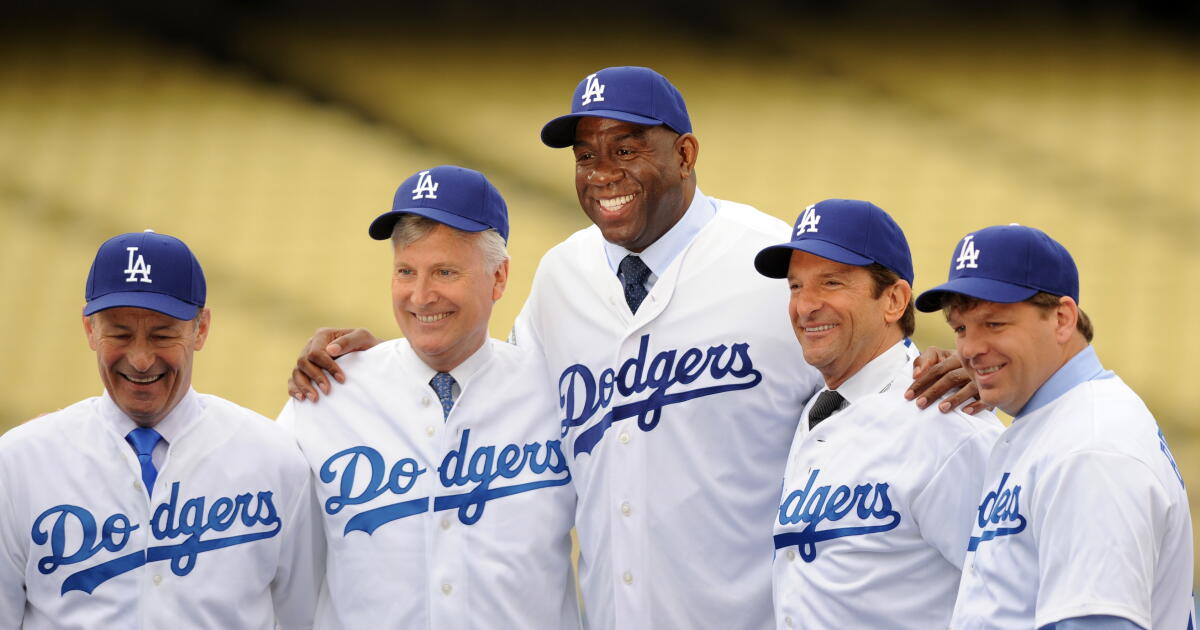
Walter, the 66-year-old chief executive of Chicago investment firm Guggenheim Partners, led a group that included another Guggenheim executive and Magic Johnson in acquiring the Dodgers for $2.15 billion in 2012, then a record for an MLB team.

The Times has reported that he tapped the insurers he owned for financing, a deal that was later vetted by state insurance regulators.

However, the amount of related-party loans made by the two affiliated life insurers now under federal scrutiny is vastly more, amounting to 40% of the invested assets of Delaware Life as of Dec. 31, according to Fitch Ratings. The credit rating firm said that is the most of any North American life insurers it reviews.

It’s unclear where the money went, but the Wall Street Journal reported that billions were passed through a third party before being received by entities tied to Walter or his TWG Global holding company.

Last week, Walter stunned the sports world by selling a majority stake in the Lakers for $12.5 billion to former Disney Chief Executive Bob Iger and venture capitalist Joshua Kushner, who is the brother of President Trump’s son-in-law Jared Kushner.

Walter has declined to comment on whether the sale was tied to the federal investigation.

The framework for a deal was consummated in a matter of days, Iger told interviewers last week. It still must be approved by the NBA Board of Governors, which meets in September.

Projecting an exact value for the Dodgers is difficult because MLB and its players union are engaged in contentious collective bargaining negotiations that many experts believe could result in a lockout when the current agreement expires in December.

Should a salary cap be agreed upon for the first time in MLB history, the valuation could jump to the high end, the source said. And about $1 billion of any sale would be subtracted to cover the Dodgers’ future commitments on deferred contracts.

The Dodgers’ massive local television deal with SportsNet LA directly elevates the franchise’s overall valuation.

Listing potential buyers should the Dodgers be for sale is challenging because the estimated value of the franchise is so much greater than almost any other MLB team. The record price for a sports franchise was the $12.5 billion for the Lakers.

Besides Kushner and Iger, those who have bid for teams aren’t in the $10-billion-plus ballpark. The San Diego Padres were sold last week for $3.9 billion to José E. Feliciano and Kwanza Jones.

Are you a true-blue fan?

Get our Dodgers Dugout newsletter for insights, news and much more.

Another question that has arisen as Walter’s financial troubles have garnered headlines is whether MLB would conduct its own investigation into Dodgers ownership or pressure the billionaire and his partners to sell the team.

“Any time there is any kind of public question about owners, they look into it,” former Dodgers president Bob Graziano told The Times. “I would guess, because there is a federal investigation going on, they’re not launching their own investigation, but they are going to wait to see what comes out of the federal investigation.”

No investigation of any kind into the matter has been announced by MLB.

MLB has never formally stripped an owner of a franchise or forced an outright sale through a vote of franchise owners. But the league forced Frank McCourt to sell the Dodgers in 2012 by exerting pressure and threatening a financial takeover or disciplinary action that would have stripped operational control.

When McCourt sold the team to Walter’s Guggenheim group, the franchise was in Chapter 11 bankruptcy.

When Guggenheim purchased the team in 2012, it outbid billionaire hedge fund manager Steven Cohen, who now owns the New York Mets. A group headed by former Yankees and Dodgers manager Joe Torre and L.A. developer Rick Caruso dropped out of the bidding ahead of Cohen. Additional bidders included media executive Leo Hindery, billionaire Tom Barrack, then-St. Louis Rams owner Stan Kroenke and Jared Kushner.

Times staff writer Laurence Darmiento contributed to this report.

Source link

Mark Wright branded ‘selfish’ as fans spot very green lawn at Essex mansion amid hosepipe ban and drought

THEY say the grass isn’t always greener on the other side, but it appears it is when you look over the fence of Mark Wright’s Essex mansion.

The former Towie star has come under fire from fans for his very healthy looking lawn – despite the region’s new hosepipe ban after multiple heatwaves.

Mark Wright has come under fire for his very green lawn amid a hosepipe ban Credit: Instagram/ @wrighty_
Essex, where he lives, and Suffolk are currently on a temporary use ban of hosepipes due to the lack of rainfall – but many of notices how healthy Mark’s grass is compared to everywhere else Credit: Instagram

Essex and Suffolk Water introduced a hosepipe ban earlier this month as a result of a lack of rain this summer.

Under a temporary use ban, customers cannot use a hosepipe, sprinkler, or pressure washer for various activities, such as watering plants or filling up hot tubs.

However, Mark took to Instagram earlier this week to share a video of himself relaxing in his outdoor pool, with his green garden grass seen behind him.

As he sipped on cocktails in the clip, Mark was sharing his at-home drinks recipe with fans.

top cook

Romeo Beckham shows off pizza making skills – as fans mock Brooklyn’s ‘grim’ pasta


‘CAN’T BEAR IT’

Vogue Williams savages Katie Price’s hubby Lee & rants ‘he’s taking p**s’

The former Towie star and his wife Michelle Keegan moved to their mansion back in 2022 Credit: PA
It came after years of building works on the property Credit: Instagram

However, fans were more confused over his garden than his homemade mojito.

One user commented below the video: “Amazing grass considering a huge hose pipe ban and much of Essex not have basic water access ATM. Man of the people I see”.

“The grass is looking nice and green 😂,” said a second.

A third wrote: “FYI everyone else has a hosepipe ban?! ?”

“Picture of your house with luscious green grass going around social media while every surrounding bit of land is dead?

“Let all the farmers put their cattle on your land and eat the grass!! They are struggling,” slammed another.

Mark and his wife Michelle moved into their £3.5 million mansion in 2022, after spending years building it into their dream home.

Source link

What’s at stake for Dodgers’ owner Mark Walter as authorities probe his businesses

When Mark Walter, the Lakers controlling owner, flipped the storied team last week for $12.5 billion amid a federal probe of his businesses, it stunned the sports world but seemed to make financial and legal sense.

The Dodgers majority owner, who had bought his stake in the basketball team last year at a $10-billion valuation, likely netted a big payday from the sale to former Disney Chief Executive Bob Iger and venture capitalist Joshua Kushner.

And that’s money the billionaire can apply to pay down the debts of two troubled Delaware life insurers he owns that are under federal scrutiny.

It’s not at all clear whether the sale of the Lakers will have any effect on the ongoing investigations. Neither Walter nor his companies have been charged with any crimes.

TWG Global, Walter’s holding company, did not respond to a request for comment Friday, but a spokesperson for the company has previously stated that they are cooperating with authorities and expect the matter to be resolved “favorably.”

“Mark Walter and TWG have always acted in good faith, and those who have done business with Mark know him as honest and straightforward,” the statement said.

After receiving federal grand jury subpoenas in February, Delaware Life and Clear Spring Life and Annuity conducted internal investigations. They found that $21 billion in loans they made should have been recorded as extended to “related parties.”

Related parties have business or personal ties and transactions between them can have legitimate reasons, but they also pose potential conflicts of interest and require disclosure and typically extra regulatory scrutiny.

In the case of insurers, which hold premium dollars from policyholders for future claims payouts, regulators want to ensure the money is there when it’s needed. Related-party transactions can threaten that.

Walter, 66, chief executive of Chicago investment firm Guggenheim Partners, led a group that included another Guggenheim executive and Magic Johnson in acquiring the Dodgers for $2.15 billion in 2012. The Times has reported he tapped the insurers he owned for financing, a deal that was later vetted by state insurance regulators.

However, the amount of related-party loans made by the two affiliated life insurers now under federal scrutiny is vastly more, amounting to 40% of the invested assets of Delaware Life as of Dec. 31, according to Fitch Ratings. The credit rating outfit said that is the most of any North American life insurers it reviews.

It’s unclear exactly where all the money went, but the Wall Street Journal reported billions were passed through a third party before being received by entities tied to Walter or his TWG Global holding company.

Company executives also told Fitch that they were unaware they were making related-party loans. Bloomberg reported that investigators are looking at some loans made to multiple companies affiliated with one Chicago firm to see if they were passed along to Walter’s ventures.

In June regulatory filings that disclosed the $21 billion in restatements, each insurer labeled them as “corrections of errors,” which would imply that they were inadvertent.

Jacob Frenkel, a former U.S. attorney, said it appears clear a focus of the investigation into Walter’s businesses is to determine whether the restatements were just errors.

“If there is intentional concealment of related-party transactions or the creation of intermediaries to help with that concealment, that certainly [could] invite criminal and civil enforcement scrutiny,” said Frenkel, who prosecuted financial crimes and also worked for the Securities and Exchange Commission.

Authorities have seized Walter’s cellphone and laptop, according to Bloomberg. Still, investigations by prosecutors and securities regulators can result in no action.

Frenkel said that if criminality is found in complex investigations such as this one, federal prosecutors will typically file mail or wire fraud charges that carry up to 20 years in prison.

It would not matter whether a company that was the victim of fraudulent conduct closed or is able to continue conducting business after being rescued financially.

“The entity’s failure is not a prerequisite for there to be a crime in intentionally misleading conduct,” he said.

The Securities and Exchange Commission is conducting a parallel investigation into both companies, according to their regulatory filings.

Frenkel said its interest could revolve around how Guggenheim Investments, Walter’s asset management firm, booked revenue from its dealings with the insurers and the disclosures of the transactions.

The SEC can seek civil monetary penalties and the return of illegal profits, and bar or suspend an individual from serving as a corporate officer or director, among other remedies.

Delaware Life and Clear Spring are part of TWG’s Group 1001 Life & Annuity.

Delaware Life has started a remediation plan to restructure some of the loans, review others and address its “control deficiencies,” including through TWG purchasing some of the loans, according to ratings outfit S&P Global. It hopes to complete the plan by the end of the year.

However, Fitch in its downgrade of Delaware Life said the plan may prove “insufficient to fully address governance, reporting, and investment oversight issues.”

The Delaware Department of Insurance did not respond to emails for comment.

Rex Frazier, a former deputy commissioner at the California Department of Insurance, said that in the situation that the insurers find themselves, the state regulator will be looking at a company’s capital sufficiency.

“The change from unaffiliated to affiliated transactions can affect the regulator’s view of whether the insurers have adequate capital and, if the regulator thinks not, then the regulator can impose additional capital requirements,” said Frazier, now president of the Personal Insurance Federation of California, a property and casualty industry trade group.

“If the regulator determines that there is inadequate capital to pay for their obligations … there are many serious remedies they can take to protect vulnerable people depending on those income streams,” he said, including seizing a company or forcing its sale.

There is no indication that either insurer is in such dire straits. Since the disclosures, rating agencies Fitch, AM Best and S&P Global have downgraded the companies’ outlook to negative, but they also have said the insurers maintain a high level of financial strength.

Walter is not the only owner of a life insurer to rely on related-party loans to fund its business dealings.

AM Best, in a December report, said affiliated investments among life insurers and annuity companies grew more than 17% annually in 2024 to more than $373 billion, driven by those owned by private equity and asset managers.

It said the growth of such investments — a type of related-party transactions — presents “regulatory risks” that may suggest “a company’s operations are more intertwined with its parent and affiliated investment management with possible negative consequences.”

“Should the parent/affiliate company experience financial stress, negative impacts to the insurer are heightened due to the higher exposure,” it said.

Frenkel said it’s good to keep in mind that at the end of their investigations, neither the Justice Department nor the SEC may take any action.

However, due to the complexity of the case, it may be a while before that point is even reached.

“This is clearly the type of investigation that the ‘where is this going?’ conversation could easily still be continuing in January of 2028,” he said.

Source link

Mark Rydell, the director of ‘On Golden Pond,’ dies at 97

Mark Rydell, the Oscar-nominated director of the sentimental blockbuster “On Golden Pond” who worked with such Hollywood heavyweights as Henry Fonda, Katharine Hepburn, Steve McQueen and John Wayne, has died. He was 97.

His daughter, Amy Rydell, told the Hollywood Reporter that her father died Thursday of natural causes at a retirement community for the entertainment industry in Woodland Hills.

“Hard to put into words how much I loved my dad,” she posted Friday on her Instagram account. “He was truly one of a kind. Funniest and most talented person I’ve ever known.”

10 Oscar nominations

“On Golden Pond,” his 1981 film that teamed Fonda with Hepburn and his daughter, Jane Fonda, was nominated for 10 Oscars. Henry Fonda and Hepburn won leading acting honors, and the film won for screenplay, which Ernest Thompson adapted from his play of the same name. Rydell was nominated for directing but lost to Warren Beatty for “Reds.”

It earned more than $119 million at the box office, making it the second-highest-grossing film that year behind “Raiders of the Lost Ark.”

“On Golden Pond” was Henry Fonda’s final movie role. He starred as Norman Thayer, an emotionally brittle and distant father who becomes more accessible at the end of his life after his teenage grandson spends the summer with him and his wife, Ethel (played by Hepburn), at their cottage in New England. The film’s story resembled Fonda’s real-life relationship with daughter Jane, who said working on the movie together helped resolve some of their issues. The elder Fonda, at 77, died months after winning his only Oscar.

Rydell’s other Oscar-nominated films were “The Fox” in 1967, “The Reivers” with McQueen in 1969, “Cinderella Liberty” with James Caan and Marsha Mason in 1973, “The Rose” with Bette Midler in 1979 and “The River” with Mel Gibson and Sissy Spacek in 1984.

Born Mortimer Harold Rydell on March 23, 1929 in New York City, he studied with legendary jazz pianist Teddy Wilson at the Julliard School of Music. During a stint in the Army, he spent two years in Japan developing entertainment for military personnel. He majored in English and philosophy at New York University.

Early acting career

He turned to acting when he won a scholarship to the Neighborhood Playhouse in New York. Among his early roles were parts on the CBS soap operas “The Edge of Night” and “As the World Turns.”

Rydell made his Broadway debut in “Seagulls Over Sorrento” with Rod Steiger. In 1956, he made his movie acting debut opposite John Cassavetes and Sal Mineo in Don Siegel’s “Crime in the Streets.”

Among his film acting credits were Robert Altman’s “The Long Goodbye” in 1973 and Woody Allen’s “Hollywood Ending” in 2002.

Rydell moved into directing television, including episodes of “Mr. Novak,” “Ben Casey,” “I Spy,” “The Wild Wild West,” “The Long, Hot Summer,” “The Fugitive” and “Gunsmoke.”

He made his feature film directorial debut with 1967’s “The Fox” starring Sandy Dennis, and it was a hit.

Two years later, Rydell directed McQueen in the comedy-drama “The Reivers.”

Teaming with Sydney Pollack

Rydell and Sydney Pollack, who became friends during their acting days, formed Sanford Productions in 1971. Among their efforts were the films “Jeremiah Johnson” starring Robert Redford and “Scarecrow” with Al Pacino and Gene Hackman, which won the Cannes Film Festival’s top honor, the Palme d’Or.

Rydell directed Wayne in 1972’s “The Cowboys.” He reunited with Caan for the 1976 flop “Harry and Walter Go to New York.”

Rydell scored a major hit with 1979’s “The Rose,” with Midler in her Oscar-nominated role as a self-destructive rock star loosely based on Janis Joplin.

Rydell reteamed with Caan and Midler in “For the Boys” in 1991, but it wasn’t successful.

“He was an actor of note before he became a director, and I was so lucky to have met him when I did; he taught me so much on ‘The Rose’ and later on ‘For The Boys,’” Midler posted on Instagram. “Two Oscars nominations both because of him. He was the actor’s whisperer; just a few words was all it took to understand what was needed. Devoted to Meisner. So many happy memories.”

TV movies and series among his credits

Rydell directed the pilot of the hit ABC drama “Family” in 1976.

Among his TV movie directing credits were “McBride and Groom,” “Crime of the Century” with Isabella Rossellini and Stephen Rea, and “James Dean,” which earned actor James Franco a Golden Globe award and in which Rydell also appeared, as Warner Bros. chief Jack Warner.

He directed the movies “Intersection” in 1994 and “Even Money” in 2006.

In 2009, Rydell, Oscar-winning actor Martin Landau and screenwriter Lyle Kessler taught a film workshop at UCLA. Rydell and Landau were co-artistic directors of the Actors Studio West, teaching and coaching actors, writers and directors.

“All great art rests on telling the truth,” Rydell told UCLA’s student newspaper the Daily Bruin. “The real pursuit of an artist is to tell the truth.”

Besides his daughter, he is survived by son Christopher. The siblings who went into acting were from his first marriage to actor Joanne Linville. He had another son, Alexander, from his second marriage to producer Esther Rydell.

Harris writes for the Associated Press.

Source link

Some questions (and answers) about Mark Walter selling the Lakers

In 2012, on the day after Mark Walter and his partners bought the Dodgers, I sat next to Walter in a conference room. To the sports fan, Walter was virtually anonymous: a super rich guy who had made his money running investment and insurance companies.

Walter’s purchase valued the Dodgers and its related assets at a then-record $2.15 billion. That value stunned the sports world. Mark Cuban had bowed out of the bidding, believing the Dodgers were not worth even $1 billion.

I asked Walter why he believed it made business sense to pay three times as much as any major league team had sold for.

“I think you have a few moments in life where you have the opportunity to own an asset and really be a custodian of something that should be multigenerational and iconic,” he said then. “I understand it’s a lot of money. But it’s not as if you can go buy another one tomorrow. … We hope we never, ever are going to sell it.”

That was essentially the point that someone who travels within the inner circles of pro sports made to me Wednesday morning, as news broke that Walter had sold the Lakers to Bob Iger, the former Disney chief, and Joshua Kushner.

The Steinbrenner family has owned the New York Yankees for 53 years. Jerry Jones has owned the Dallas Cowboys for 37 years. The Buss family owned the Lakers for 46 years.

These trophy assets are few and far between. Walter had agreed to sell the Lakers after less than one year of ownership — and not through a comprehensive bidding process, but to an inquiring caller during the weekend?

“This has more red flags than a May Day parade,” an industry insider said, speaking on condition of anonymity so as not to jeopardize his professional relationships.

The deal, which valued the Lakers at $12.5 billion, was motivated by the spiraling price for an NBA expansion team in Las Vegas, according to ESPN’s Ramona Shelburne. After all, if Iger and Kushner might have to pay $10 billion for a startup team, why not call and see if Walter might accept a bit more for one of the marquee franchises in American sports?

Was this a blind call or was Walter looking to sell?

“It was suggested to us that maybe Mark Walter would be interested in selling his stake in the Lakers,” Iger told the California Post.

What did Dodgers president Stan Kasten have to say about that?

“I never knew that. He never said that to me,” Kasten said. “I think he was surprised by it. That’s what he has expressed to me. Mark had no plan to do this. This just came up, and he thought about it and said yes.”

Why might Walter have been interested in selling?

Mark Walter, chairman and controlling owner of the Dodgers, acknowledges a fan before a game in Chicago on Aug. 4.

Mark Walter acknowledges a fan before a game against the Cubs in Chicago this month.

(Melissa Tamez / Associated Press)

Only he can say for sure, but his companies are under federal investigation for failing to disclose and properly account for billions of dollars of loans among related entities. Bloomberg reported Wednesday that Walter’s holding company is trying to raise money that could help pay off or at least pay down those loans, and the Financial Times reported that company assets could be sold or restructured.

No charges have been filed, and investigations can conclude without charges. No allegations of wrongdoing have been made against Walter.

Is there a baseball angle to this?

Among the investment firms Walter’s holding company approached about “deals to raise cash,” according to Bloomberg: the asset management firm owned by New York Mets owner Steve Cohen.

Cohen’s firm passed, according to the Financial Times.

When Walter and his partners bought the Dodgers, the runners-up: the bid team of Cohen and Los Angeles Times owner Patrick Soon-Shiong.

“No, that never came up. And Mark and I discussed it,” Kasten said. “So, no, we don’t have any reason to think that. I certainly have no reason to think that.”

What does Walter’s sale of the Lakers mean for the Dodgers?

“It means nothing for the Dodgers,” someone who speaks regularly with Walter said, speaking on condition of anonymity. “He owned them long before the Lakers and will own them long after.”

If Walter should later sell the Dodgers, what might have the greatest impact on the team?

Shohei Ohtani has an out clause in his contract if Mark Walter sells the team.

Shohei Ohtani has an out clause in his contract if Mark Walter sells the team.

(Eric Thayer / Los Angeles Times)

Shohei Ohtani’s 10-year, $700-million contract with the Dodgers includes an unusual escape clause: If Walter is no longer the controlling owner, or if Andrew Friedman is no longer running the Dodgers’ baseball operations department, Ohtani can opt out of the contract.

Would he?

Way too soon to tell. If major league owners get their way in collective bargaining, the proposed salary cap would mean Ohtani at $70 million could eat up just about one-third of any team’s payroll. And, in his third year with the Dodgers, he has yet to complete a full season as a pitcher, and a left knee in which manager Dave Roberts says Ohtani suffers from “wear and tear” could make him less of a two-way player as the contract winds down.

On the other hand, playing salary might be less of an issue for him than for any other player in baseball. Ohtani is making more than his annual salary from sponsorships and endorsements — an estimated $125 million this year — and he famously deferred $68 million of each year’s salary so the Dodgers could spend more freely on players that could help him and the team win. After six losing years with the Angels and two World Series championships in two years with the Dodgers, a losing team might not entice Ohtani, no matter how much room it might have under a proposed cap.

Iger used to run Disney. How did Disney’s experience owning the Angels and Mighty Ducks go?

Disney chairman Michael Eisner and NHL commissioner Gary Bettman blow duck calls announcing the name of the team in 1993.

Disney chairman Michael Eisner, left, NHL commissioner Gary Bettman, NHL chairman Bruce McNall and Mighty Ducks chairman Jack Lindquist blow duck calls announcing the name of the team in 1993.

(Doug Pizac / Associated Press)

Disney dressed the Angels in uniforms derided by one player as “pinstripe pajamas,” put cheerleaders on the dugout roof and installed a loud “countdown to first pitch.” This all seemed awful at the time but, given the plagues of in-game hosts and teams sporting jerseys in colors far beyond home white and road gray, perhaps Disney was just ahead of its time. And, for the first few years of the franchise, Mighty Ducks gear was some of the hottest merchandise in American sports.

Ultimately, Disney wanted the Angels and Mighty Ducks to launch an “ESPN West” regional sports channel. When that channel collapsed, Disney no longer needed the teams and eventually sold them. The Angels were such a minimal part of Disney’s portfolio that then-chief executive Michael Eisner showed up in the clubhouse and the players had no idea who he was.

Who owned the Angels when they won their only World Series championship?

Angels players wave to fans during the World Series title parade in Anaheim in 2002.

Angels players wave to fans during the World Series title parade in Anaheim in 2002.

(Jean-Marc Bouju / Associated Press)

Disney. The company hired an investment banker to sell the team in the final month before the Angels won the 2002 World Series and agreed to sell to Arte Moreno in the first month of the following season.

One more try: Why did Walter really sell the Lakers?

“I think it was opportunistic and he found something that made sense to him,” Kasten said. “Mark’s a very sensible guy. But that’s really the only way I can explain it.

“You’ll have to talk to Mark about a more in-depth explanation, and good luck.”

Times staff writer Maddie Lee contributed to this report.

Source link

Homecoming games mark the NBA calendar for 2026-27 season

Jaylen Brown and Giannis Antetokounmpo will play homecoming games a week apart in January.

The 2026-27 NBA schedule was released Thursday, setting the dates for the two former NBA Finals MVPs to return to face the teams that traded them this summer.

The schedules for opening night and Christmas already were unveiled this week, so those two games were among the most intriguing matchups not yet known. Brown, who was dealt from the Celtics to the rival Philadelphia 76ers in a stunning move, will play his first game back in Boston on Jan. 21.

Antetokounmpo was expected to be traded by Milwaukee this offseason — at one point speculation was that he might be swapped for Brown — and eventually was dealt to Miami. The Heat will travel to face the Bucks for the first time on Jan. 28.

Both of those games, which will be on Thursday nights, will stream on Prime Video.

Other details about the schedule:

From start to finish

The season will open Oct. 20 with a tripleheader, highlighted by LeBron James, Brown and the 76ers visiting the New York Knicks, who will receive their rings after winning the franchise’s first championship since 1973.

The regular season ends April 11. All-Star weekend is set for Feb. 19-21 in Phoenix.

Busy nights and nights off

Every team will play on Monday, Nov. 2, and there will then be no games the following night, which is election day in the U.S. The league is leaving that first Tuesday in November as an open day in hopes that fans and members of the NBA community will participate in the voting process.

No teams will play on Saturday, April 10, the second-to-last day of the regular season. Every team is then in action on the final day, with all the games matching Eastern Conference teams and the one interconference matchup scheduled to begin at 6:30 p.m. EDT. The games involving West teams are set for 8:30 p.m.

Where to watch the games

There will be 90 regular-season games televised nationally on ABC or NBC, up from 79 last season. Every team will be scheduled to appear on national TV at least twice.

Throughout the season, games will stream on Peacock on Monday nights, be shown on NBC and Peacock on Tuesdays, be televised by ESPN on Wednesdays, and stream on Prime Video on Fridays.

Saturday night primetime games on ABC begin Dec. 12 with the Knicks visiting the Heat, while NBC’s “Sunday Night Basketball” returns Jan. 24 with Oklahoma City visiting Golden State.

Prime Video will begin streaming Thursday night doubleheaders in January and some Saturday afternoon games starting Feb. 6 with Portland at Memphis, when Ja Morant returns to face the Grizzlies for the first time.

A lot of TV time

The NBA champion Knicks have the most appearances on ABC with six, while the Lakers, 76ers, San Antonio Spurs and Minnesota Timberwolves all are featured on ESPN eight times.

The Knicks, Spurs, 76ers, Thunder, Warriors, Lakers, Denver Nuggets and Houston Rockets all get the maximum 11 appearances on NBC.

Back-to-backs and schedule breaks

Teams will average 14.2 sets of back-to-back games, the lowest total since the NBA Cup was added to the schedule, and no team will have more than 16. No team will play eight games in 12 nights, or 18 in 30.

There are 59 back-to-back games involving at least 750 miles of travel, down from 74 last season.

No team will be scheduled to play the night before games in the NBA Cup, or if they are in nationally televised games on Christmas Day, Martin Luther King Jr. Day, Presidents Day, Sunday nights on NBC or Saturday nights on ABC.

Milestone moments

If Kevin Durant averages 26 points, as he did in his first season in Houston, he could move past Kobe Bryant into fourth place on the career scoring list sometime around Jan. 16, when the Rockets would be at the midpoint of their schedule.

Indiana’s Rick Carlisle is set to become the eighth man to coach 2,000 NBA games on March 8.

Source link

BLACKPINK to mark 10th anniv. with fan event in Seoul

K-pop group BLACKPINK will hold a fan event in Seoul for the tenth anniversary of its debut, sources said Friday. In this August 2022 photo, members (L-R) Lisa, Jisoo, Jennie and Rose arrive at the 2022 MTV Video Music Awards in Newark. File Photo by John Angelillo/UPI | License Photo

K-pop girl group BLACKPINK will celebrate the 10th anniversary of its debut with a small-scale meet-and-greet for fans in Seoul, bringing all four members together for a rare domestic fan appearance, industry sources said Friday.

The quartet is scheduled to attend the event Saturday, the date of its debut in 2016, at the National Museum of Korea with 40 selected fans, according to the sources.

YG Entertainment, the group’s agency, said details of the event would be provided individually to those selected to attend.

Earlier this week, BLACKPINK unveiled the “BLACKPINK Heritage Collection,” a collaboration with Mu:ds, the museum’s merchandise brand in commemoration of the band’s 10th anniversary.

The group also worked with the museum in February for a project that included cultural-heritage programs and activities linked to the group’s music to mark its comeback.

It will be the first time that all four have appeared together for fans in South Korea since July last year, when the group held a stop of its “Deadline” world tour in Goyang in the northwestern suburbs of Seoul.

Since debuting under YG Entertainment in 2016, BLACKPINK has become one of the most influential acts in global pop, turning each release into a chart-topping hit, and extending its reach into fashion, luxury branding and advertising.

Its 2022 album “Born Pink” made history as the first by a female K-pop act to top the U.S. Billboard 200, while also reaching number one on the British Official Albums Top 100.

In February, the group returned with its third EP, “Deadline,” its first group project in more than three years, which debuted at No. 8 on the Billboard 200.

Copyright (c) Yonhap News Agency prohibits its content from being redistributed or reprinted without consent, and forbids the content from being learned and used by artificial intelligence systems.

Source link

Why related-party loans at issue in Mark Walter probe considered risky

The federal law enforcement probe into the financial affairs of the Dodgers’ controlling owner, Mark Walter, seems to focus on what looks like an obscure financial maneuver: related-party transactions.

They are deals between entities with business or personal ties, including loans, sales and other transactions, that can have legitimate reasons but pose potential conflicts of interest and typically require extra scrutiny.

Walter tapped insurers he controlled to provide most of the financing for the $2.15-billion acquisition of the Dodgers in 2012, The Times has reported — a deal later vetted by state insurance regulators.

Now, regulators reportedly are investigating whether billions of dollars’ worth of similar loans made by Walter’s companies were properly disclosed.

There are examples in which related-party transactions led to trouble, including the 2001 bankruptcy of Enron Corp., the largest at the time in Wall Street history. Bernie Madoff profited from his Ponzi scheme through related-party loans.

At issue with Walter is $21 billion in loans not disclosed to state insurance regulators that were made by two Delaware insurers he owns, according to ratings agency Fitch. The loans reportedly were made to companies with ties to Walter or his TWG Global holdings company.

The seriousness of the investigation has been highlighted by subpoenas served on the insurers and the reported seizure of Walter’s cellphone and laptop by federal authorities. Still, investigations by prosecutors and securities regulators can result in no action.

Here are more details on the risk presented by related-party transactions and why they require disclosure and extra regulatory scrutiny.

What do the investigations mean for his ownership of his sport teams?

The 66-year-old billionaire also took a majority stake in the Los Angeles Lakers last year and owns the Chelsea soccer team in the English Premier League. There is no indication yet that any of this has affected his ownership stakes, but the probe has yet to be completed.

What is the problem with related-party transactions?

Bruce Dubinsky, a forensic accountant who worked on the Enron and Madoff cases, says the issue comes down to the motivation of the parties and can be explained through an analogy.

Sell a car to a stranger and you both research its worth and come to an agreed “fair market value,” he said. Sell it to your brother, you might cut the price to “give him a deal,” and later even forgive the payments.

“That’s why, from an audit standpoint, there should be more scrutiny if you’re doing business with the left hand and the right hand, because it’s easier to manipulate things,” Dubinsky said. “Repayments can be delayed indefinitely. They are always more suspect to fraud.”

How does that play out in the insurance industry?

Insurance is one of the most regulated industries, since the companies hold premium dollars from policyholders for future claims payouts — and regulators want to ensure the money is there when it’s needed. Related-party transactions can threaten that.

“There is a conflict of interest between the policyholders’ interest in the company being profitable and the owner’s interest in getting the least expensive financing that is available,” said Jim Donelon, who served as Louisiana insurance commissioner for 18 years before stepping down in 2024.

“It potentially threatens the solvency of the company, which then threatens the welfare of the policyholders,” Donelon said.

The National Assn. of Insurance Commissioners, for whom Donelon served as president, provides guidance to regulators on how to review related-party transactions.

What are some of the most notable examples of related-party transactions turning into financial disasters?

The failure of Enron was a prime lesson in how related-party transactions can lead to a company’s downfall.

As the Houston energy trader struggled and racked up $30 billion in debt, chief financial officer Andrew Fastow thought he found a way to keep it off Enron’s books. He created off-balance sheet entities to unload the debt and took personal stakes in them, allowing him to sit on both sides of the negotiation and pocket millions.

They were “transactions with related parties that were not at arm’s length,” Dubinsky said.

The debacle was a driving force in the passage of the Sarbanes-Oxley Act of 2002, which tightened regulations over governance, accounting and related-party transactions.

What about the Madoff fraud?

The Madoff scandal, in which investors lost $17.5 billion in invested principal, operated like a typical Ponzi scheme with returns to older investors paid by money from new investors.

However, related-party transactions were key too, and some literally involved family members. Madoff’s brother, Peter, pleaded guilty to receiving $15.7 million in sham loans and giving $9.9 million in sham loans to family members. What’s more, the auditor was a related party.

“In Madoff, what were called ‘related‑party loans’ were just sham transactions — there was no real economic substance. It was simply Madoff taking money out of his own firm,” said Dubinsky, an expert witness for the government.

Is there anything comparable with the Walter probe?

The three situations appear entirely different, but the investigation into the related-party loans made by Walter’s Delaware Life and its affiliate, Clear Spring Life and Annuity, involves vast sums of money.

After receiving the subpoenas, the firms conducted internal investigations. They had reported having $1 billion in related-party loans but, after the review, they reclassified $21 billion worth of loans as related, including $4.6 billion held by Clear Spring, said Fitch analyst Jamie Tucker, senior director of North American insurance ratings.

Executives said they were unaware the loans were going to an affiliated company.

Is there any indication what the money was used for?

“Unclear at this stage,” Tucker said. “This a developing situation with ongoing investigations.”

One clue may be a report that Walter tapped insurers to fund more deals than the Dodgers acquisition. The Wall Street Journal said five insurers had provided more than $10 billion in deal funding since Walter’s financial services company, Guggenheim Partners, got into the insurance business after the 2008 financial crisis.

What have been the implications for the insurers owned by Walters?

Fitch said the financial restatement increased the two insurers’ related-party loans from 2% to 40% of their portfolios, the highest exposure among life insurers it rates in North America.

Fitch, A.M. Best and S&P Global also downgraded Delaware Life’s outlook to negative, though they said the insurer maintain a high level of financial strength.

“Our capital position and liquidity remain strong, and our financial strength ratings are unchanged,” said Group 1001, the insurers’ parent company, in a statement.

What has Walter had to say about all this?

He has not publicly commented, but a TWG spokesperson stated that, “Mark Walter and TWG have always acted in good faith, and those who have done business with Mark know him as honest and straightforward. Nothing about these transactions was any different.”

Source link

Mark Hughes’ son died of sudden adult death syndrome

The son of former Manchester United footballer Mark Hughes died from sudden adult death syndrome, a coroner has found.

Alex Hughes was found collapsed at his home in Macclesfield, Cheshire, on 19 June by his two sons.

The 38-year-old, who followed his ex-Wales international father into football and held roles in recruitment at Grimsby Town, Manchester City and other clubs, could not be revived by paramedics, his inquest heard.

Following his death, Mark Hughes and his wife Jill said they were “totally heartbroken by the sudden and unexpected loss of our beloved son”.

Sudden adult death syndrome (SADS) – also known as sudden arrhythmic syndrome – is diagnosed when the cause of death cannot be explained in a post-mortem examination because the structure of the heart appears normal.

It affects about 500 people in the UK every year.

The British Heart Foundation said SADS “usually happens when a dangerously abnormal heart rhythm goes untreated and leads to a cardiac arrest”.

The foundation added that inherited heart conditions are “often the cause of SADS if the person who has it doesn’t know they do”.

Source link

World Cup: Argentina mark England win with National Football Teams Day

The Argentine Football Association, external has announced 15 July will be ‘National Football Teams Day’ to mark Argentina’s 2026 World Cup semi-final victory over England on that date.

Bidding for their first World Cup final since 1966, England took the lead in a tense affair in Atlanta through a 55th-minute Anthony Gordon finish.

But with Thomas Tuchel’s side sitting deep, Argentina struck in the 85th and 92nd minutes to break English hearts and claim a 2-1 win.

The victory came 40 years after Argentina’s previous big World Cup win over England in the controversial quarter-final victory at the 1986 tournament.

After Argentina’s latest win the political tensions surrounding the fixture were fuelled as some of their players celebrated while holding a banner reading “Las Malvinas son Argentinas”, which translates as “The Falklands are Argentine”.

The Falklands, a British Overseas Territory in the south-west Atlantic Ocean, remain the subject of a sovereignty dispute between the UK and Argentina.

Argentina, ruled at the time by a military junta led by General Leopoldo Galtieri, invaded the islands, situated 300 miles off Argentina’s east coast, in 1982.

The conflict, which lasted for 74 days between April and June 1982, led to the deaths of 655 Argentine and 255 British servicemen. Three people from the islands also died.

In a 2013 referendum, 99.8% of Falkland Islanders voted to remain a UK territory.

Argentina went on to lose 1-0 to Spain in the 2026 final, while England beat France 6-4 to claim third place.

Source link

Gaza students overcome Israel’s genocide to mark Tawjihi results | Education News

In the Musa family home in Khan Younis, southern Gaza, for three siblings, the announcement of this year’s high school examination results on July 24 reflected a long journey of determination.

Despite the ongoing genocide in Gaza, Sama, Abdullah and Nada Musa had focused all their attention on their Tawjihi, a series of exams that decide Palestinian high school students’ academic future, to insulate their futures from incessant hardships and uncertainty.

Their trepidation turned into a family celebration when all three found out that they had passed their exams with flying colours. Sama scored 97.5 percent, Abdullah 94.6 percent, and Nada, 94.4 percent.

Sama Musa, who achieved the highest grade among the siblings, said the path to academic success was “exceptional and difficult”.

“Thank God for everything. I expected a higher grade, but the circumstances determined the result we achieved,” he told Al Jazeera.

“Even psychologically, a person did not have the energy to continue, but I challenged all circumstances so I could make my family happy and achieve the grade I had dreamed of for years.”

Educational challenges

The path was particularly demanding for Abdullah and Nada, who could not attend private lessons due to their physical disabilities, so the family arranged for teachers to come to their home.

Their mother, Hind Muhanna, says years of care and support had played a role in their children achieving exceptional grades. “Thank God, we worked very hard for them, and today I am reaping the fruits of their success. Our efforts did not go to waste,” she told Al Jazeera.

“We always made them feel that they were better than everyone else. From kindergarten through school, everyone who knew them would ask me: ‘What is the secret behind their confidence?’”

Nada Musa acknowledged that their parents’ support was a key motivation to push them towards achieving high grades.

“Thank God, because of my parents I was able to challenge all difficulties. They supported me at every step and never fell short,” she said.

Despite the students’ work and parents’ backing, the genocide in Gaza inevitably affected their academic year, so Abdullah was relieved that their grades reflected the family’s joint efforts.

“Thank God, it was a grade that reflected the effort and hard work. It was a very difficult year filled with displacement and hardships, but despite the pain, we were able to reach the top and achieve the goals we worked for,” he said.

The Musa family in Khan Younis [Eman Aby Zayed/Al Jazeera]
The Musa family in Khan Younis [Eman Abyu Zayed/Al Jazeera]

In an environment that makes life for Palestinians unbearable, thousands of students in Gaza – including the three siblings – worked hard over the year to prepare themselves for the exams.

Palestinian Minister of Education Amjad Barham said about 89,000 students in the occupied West Bank, occupied East Jerusalem and the Gaza Strip took the Tawjihi this year. Another 2,000 students sat for the exams in 46 other countries.

Barham said that more than 106,000 students in Gaza have taken the Tawjihi exams over the past three years, including 36,900 students in 2026. More than 1,100 students who were due to take the Tawjihi exams this year were killed by Israel.

Israel’s war on Gaza has also seen thousands of homes destroyed, schools bombed, roads uprooted, and educational resources barred from entering Gaza.

The United Nations said in November, shortly after a truce was announced for Gaza, that more than 97 percent of schools have been damaged or destroyed over the past two years of war.

Gaza’s educational system was on the verge of collapse, the UN added, with nearly 92 percent of education facilities requiring full reconstruction or major rehabilitation to become functional.

Teaching amid a genocide

Also behind the students’ success were teachers who continued their duties despite the exceptional circumstances.

Hanaa al-Sayed, a mathematics teacher, supported a number of Tawjihi students through classes at an educational centre in Deir el-Balah, central Gaza, amid the destruction wrought by Israel.

Many students arrived at class carrying heavy psychological loads caused by the grief and trauma of losing family members. Her response to the situation was to treat them not just as her students, but also as children, with love and care.

“The students did not only need someone to explain the curriculum; they needed someone to listen to them and stand beside them,” she told Al Jazeera.

“I treated them as if they were my own daughters, trying to support them psychologically before teaching them mathematics.”

Children play in a tent camp for displaced Palestinians in Nuseirat, central Gaza Strip Friday, July 31, 2026. (AP Photo/Abdel Kareem Hana)
Thousands of Palestinian children have had to study in tents or shelters during Israel’s war on Gaza [Abdel Kareem Hana]

Inside the school, which also served as a shelter for displaced people, children sat on mats during lessons.

“There were no desks or chairs. The school was divided between Tawjihi students and displaced people, but despite that, we insisted on continuing education,” she said.

Palestinians have demonstrated a commitment to education despite the difficult circumstances they have faced over the past decades, and the Tawjihi results this year reflect this.

“What I saw from the students was something exceptional. They came to study despite everything around them because they believe education is their path to the future,” Hanaa said.

Some of her students who paused their education before the war have since returned to school.

“There were students who had lost hope of completing their education before the war, but they returned and decided to start again,” Hanaa said. “This reflects the level of determination and desire to achieve their dreams.”

Celebrations amid grief

While many students celebrated their Tawjihi results, this was also a time mixed with grief.

Tala Abu Sukkar, from the Bureij refugee camp in central Gaza, lost her mother, Salwa, in 2010 when she was just two years old. During the war on Gaza, she lost her older brother Yusuf, then her father, Mahmoud, followed by her sister and her four nephews and nieces. Tala now lives with her uncle, who became her main support carer after the loss of so many family members, and took her Tawjihi exams this year.

The final year of school was not only an academic challenge, but also a major psychological struggle as she tried to cope with the pain and grief that followed her throughout the year.

“I lost people who were part of my life. The hardest thing was continuing my path while carrying all this pain inside me, but I tried to stay strong and keep going,” she said.

“The Tawjihi period was one of the most difficult stages I have gone through. I was studying while trying to deal with grief, but I had a goal to succeed and achieve something that would make my family proud.”

Tala's father with his grandchildren [Eman Abu Zayed/Al Jazeera]
Tala’s father, Mahmoud, with three of his grandchildren [Supplied/Al Jazeera]

When she received her certificate, achieving an average score of 86 percent, it was a moment mixed with joy and sadness.

“When the results appeared, I felt mixed emotions. I was happy that I succeeded, but I wished my father and my family members were with me to share this joy,” she said.

“My uncle has been my support after losing my family, and his presence beside me helped me continue and not give up.”

The stories of this year’s Tawjihi students in Gaza represent the determination of a generation to continue education and work towards a better future, despite great hardships.

Despite losing loved ones, changing learning environments and daily difficulties, students continued their journey with the support of loving family members and teachers.

The Tawjihi journey is a story of patience and determination but also shows how important education is to Palestinians’ lives. For the children of Gaza, schools remain a place of hope, care and ambition.

Source link

Mark Chamberlain vs Pierce O’Leary: Briton beats Irishman to take IBO light-welterweight belt

Briton Mark Chamberlain stunned Republic of Ireland’s Pierce O’Leary as he dropped him twice on the way to securing a knockout win in the 10th round to claim the IBO light-welterweight belt.

Chamberlain had to climb off the canvas himself in the seventh round as O’Leary struck him with a ferocious body shot in front of a capacity crowd in Dublin.

But just as momentum appeared to be swinging in the favour of O’Leary, Chamberlain found a breakthrough and managed to get the stoppage late on.

Portsmouth’s Chamberlain now moves to 18 wins with one defeat, bouncing back to winning ways for the first time since losing to Josh Padley in 2024.

This was Chamberlain’s first fight since he drew with Jack Rafferty in Altrincham last summer.

“First of all respect to Pierce for giving me this opportunity,” Chamberlain told DAZN after the fight.

“I’m not a stranger to an away day and anyone that knows me knows that I will fight anyone and if that means that I have to go into the champions’ back garden then I will do that.

“I’ve never been hurt before in a fight but that body shot stopped me in my tracks but fortunately I was able to get thorugh it and weather the storm.

“We’ve been working on new things in the gym and it’s all paid off, I asked Frank (Warren) in the dressing room before the fight if we could bring a show down to Portsmouth, I’d love that. “

After a tight and cagey first round, Chamberlain stunned the home crowd of around 7,000 as he landed a flush left hand that sent O’Leary flying back onto the canvas.

Chamberlain then found another big shot in the next round as he sent his opponent to the floor again with a short left hook.

But O’Leary responded well to the knockdowns, rallied by his home crowd as he pressed on to find a way back into the fight.

He then found a breakthrough at the end of the seventh round as he backed Chamberlain into a corner and sent a punishing shot into his chest.

Chamberlain was slow to get to his feet but survived the count and managed to avoid major punishment before the bell sounded.

O’Leary continued to press on, with Chamberlain looking tired and the Irishman buoyed by the crowd.

But Chamberlain struck in the 10th with a combination that saw O’Leary drop his hands and then pressed on, landing a number of clean shots that included a straight right hand to send O’Leary tumbling into the ropes and to the canvas.

Fight promoter Frank Warren revealed after the fight that there is a rematch clause in the fight contract that could see the pair fight again in the near future.

Source link

Financial empire of Dodgers owner Mark Walter reportedly being probed

The business empire of Dodgers and Lakers owner Mark Walter reportedly is being probed by the U.S. Attorney’s Office and securities regulators over $16 billion in possibly fraudulent loans.

The loans by two Delaware life insurers that Walter owns were made to companies tied to him or his TWG Global holding company but were not disclosed as “related party” transactions as required, the Wall Street Journal reported Sunday. Related party transactions made by insurers are required to be reported to limit conflicts of interest and protect policyholders, who have an interest in the financial strength of their insurers.

Walter, 66, chief executive of Chicago investment firm Guggenheim Partners, led a group that included Todd Boehly — another Guggenheim executive — and Magic Johnson in acquiring the Dodgers for $2.15 billion in 2012, a record for a pro sports team at the time. Last year, Walter and TWG acquired a controlling stake in the Lakers at a $10 billion valuation, a new record. Walter also owns the Chelsea soccer team in the English Premier League.

Last week, the financial and sports mogul celebrated the Dodgers’ World Series victory at the White House. It was the second time in two years, following back-to-back World Series wins.

The majority of the money used to buy the Dodgers — more than $1 billion — came from insurance companies managed by Guggenheim Partners and controlled by Walter, the Times has reported.

A number of state insurance regulators investigated the purchase in 2014 and found no irregularities, the Wall Street Journal reported in 2020.

Guggenheim Partners got into the insurance business after America’s 2008 financial crisis, spotting investment opportunities. Walter figured he could increase the returns insurers got on their typical purchases of corporate bonds by connecting them to his deal pipeline, according to the Wall Street Journal, which found that five insurers had provided more than $10 billion in deal funding over the years.

The current probe began after an internal whistleblower filed a complaint questioning the way Walter’s asset-management firm, Guggenheim Investments, booked revenue associated with insurers, the Journal reported this week, and FBI agents seized at least one cellphone related to that probe.

The investigation then spread to examining $16 billion in loans, which were passed through a third party before being received by the companies tied to Walter or TWG, the Journal reported, adding that authorities are trying to determine whether that amounted to fraud, citing an unnamed source.

The insurers, Delaware Life Insurance and its affiliate Clear Spring Life and Annuity, disclosed the investigations in June regulatory filings. Delaware Life, which earlier had stated affiliated investments amounted to only about $1 billion, or 3% of its portfolio, increased that number to $16 billion.

Delaware Life executives told one credit rating firm they were unaware the loans were made to entities tied to Walter, the Journal reported. The companies said they received grand jury subpoenas in February related to an investigation by federal prosecutors in the Southern District of New York and that the Securities and Exchange Commission also is conducting a parallel investigation.

Investigations conducted by prosecutors and securities regulators often result in no action.

The Dodgers, TWG and Guggenheim did not immediately respond to messages for comment.

A TWG spokesperson told the Journal that “Mark Walter and TWG have always acted in good faith,” are cooperating with authorities and are “confident these matters will be resolved favorably.”

After conducting an internal investigation, Delaware Life said it would restructure some related-party loans, address its internal control deficiencies and moderate its business plan, according to S&P Global. While the ratings agency is maintaining its “A-” financial strength and credit ratings of Delaware Life, it reduced its outlook to “negative” because of possible higher credit risk following changes to the insurer’s portfolio.

“In addition, such outcomes could weaken Delaware Life’s regulatory relationships and damage its reputation, which could erode its competitive position,” S&P said.

“Our capital position and liquidity remain strong, and our financial strength ratings are unchanged,” Group 1001, the insurers’ parent company, said in a statement.

“We remain focused on delivering exceptional value and service to our contract and policyholders and their financial representatives,” the statement added.

Bloomberg News contributed to this report.

Source link