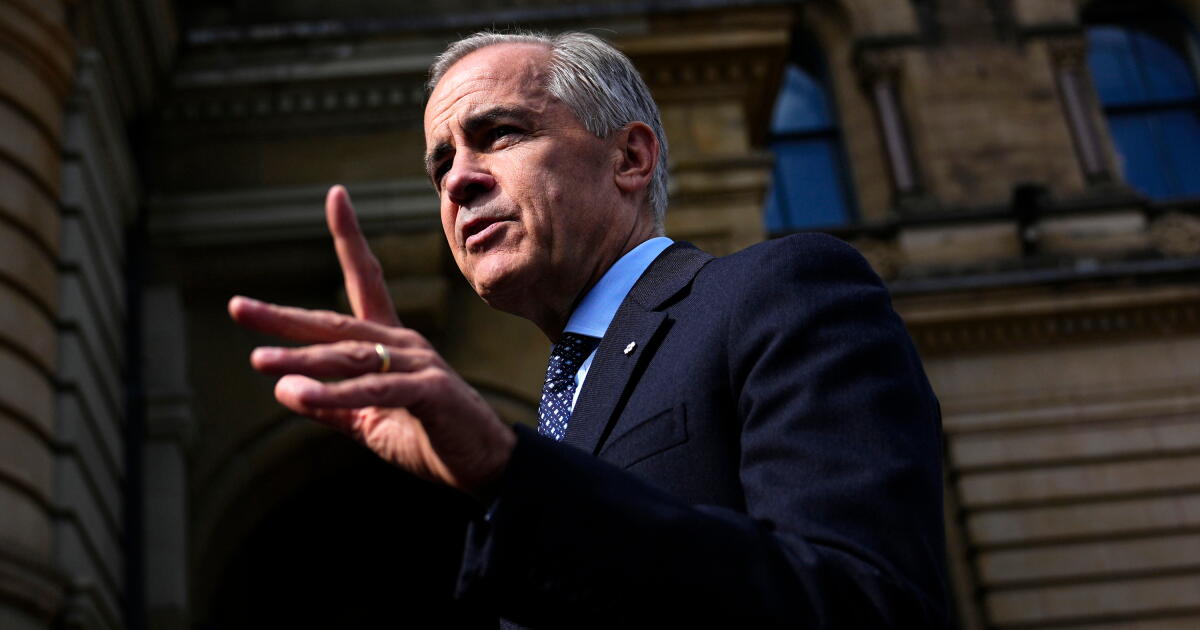
Mark Carney

Canada’s tariffs go into effect, spotlighting soured relations with U.S.

A trade war between the United States and Canada entered a new phase Tuesday as Ottawa’s retaliatory tariffs on American goods took effect, escalating a dispute that has steadily strained relations between the allies.

Canada’s tariffs, which came into force just after midnight, cover roughly $20 billion in U.S. goods and impose duties of as much as 50% on products, from steel and aluminum to farm equipment, clothing and electronics. The list also reaches into the everyday commerce that binds the two economies, including cheese, seafood and cosmetics.

It was the latest sign that relations between the two neighbors have reached their lowest point in decades, after Trump dismissed Canada as the 51st American state, moved to rename Lake Ontario and mocked its armed forces.

Ottawa’s latest measures are a response to tariffs imposed by President Trump last month on Canadian exports. The two governments had appeared close to a trade deal just a month ago. But talks broke down in dramatic fashion, leaving both sides aggrieved and accusing the other of negotiating in bad faith.

In a post Tuesday, Trump said Canada “has been ripping us off for years” and threatened to respond by removing access for Canadian businesses to key American markets.

“What many do not realize is that the Canadian Government, including Canadian Provinces, have banned American Small Businesses and Companies from selling into their Government Procurement Markets,” Trump wrote. “This is the case even though Canada gets broad access into the massive American Government Procurement Market, including those of our States.

“That is not reciprocity, it is a Canadian Trade Scam. From now on, NO RECIPROCITY — NO ACCESS!” he continued. “I am hereby directing the [General Services Administration], working with the [U.S. Trade Representative], to take all necessary steps to REMOVE Canadian-origin products from GSA’s Multiple Award Schedules unless Canada restores full and fair reciprocity for American Farmers and Companies.”

Canada’s prime minister, Mark Carney, has characterized the confrontation as more than a dispute over tariffs, arguing that demands by a bullying Trump administration threaten Canada’s economic independence.

In a video released Tuesday, Carney argued that in the past, the United States has tried to use tariffs to “break us,” only to have Canada’s economy grow stronger and more diversified. He urged Canadians to buy Canadian and break economic dependency from the United States.

“This won’t be easy, and I won’t pretend otherwise,” Carney said. “But Canadians have faced difficult stretches before, and what has carried us through has never ever been any one measure. It’s always been Canadians looking out for each other.”

Trump, meanwhile, has pressed Canada to make concessions on trade and has warned of further tariffs, including potentially higher duties on Canadian automobiles. He also threatened to ban the sale of aircraft from Canada’s Bombardier unless its products are manufactured in the United States.

“If they want our Market, they must build here, and stop treating America like a ‘piggybank,’” Trump wrote on Truth Social on Monday. “BUY AMERICAN. FLY ON AMERICAN AIRLINERS. ENJOY AMERICAN LIQUOR AND BEVERAGES. SAIL ON LAKE AMERICA. AMERICA FIRST!”

Earlier Monday, Trump posted an image showing Mexico, Canada, Central America, Greenland and Caribbean nations with the colors of the American flag. He also posted a caricature of him and Carney playing hockey in which Trump tells him: “Get up, Governor.”

Both sides stand to lose in a trade war poised to hurt businesses large and small across the world’s longest international border.

A prolonged economic conflict poses long-term risks for Canada, which faces price hikes and investment losses from the United States, by far its largest trading partner.

But Americans may also confront higher costs at a time when inflation is already a stubborn problem for the Trump administration. And the trade war may be felt most in northern border states set to hold midterm elections that could swing control of the U.S. Senate, becoming yet another political challenge for embattled Republican lawmakers.

In Maine, Republican Sen. Susan Collins, who is seeking reelection, has called Trump’s tariffs “a mistake.” In Michigan, Democratic Senate nominee Abdul El-Sayed released a video Tuesday highlighting everyday goods that have risen more than 30% over the last year, including Tide Pods, toilet paper and Tim Hortons coffee, as the trade conflict and war in Iran drive up costs.

American alcohol has also been the target of boycotts imposed by several Canadian provinces since March 2025 in response to earlier tariffs on Canadian goods by Trump.

The boycotts since then have erased roughly $360 million in revenue for the U.S. wine industry, according to a Wine Institute report, which represents California wineries. Canada makes up more than 35% of the export market for U.S. wine, more than the EU, U.K. and China markets combined.

For some California winemakers, the impact was even greater. One Sonoma winery referenced in the report said Canada made up about 85% of its international sales. Multiple wineries have had to lay off employees because of hits to their business.

“It’s had a tremendous negative impact,” said Julie Berge, vice president of communications at the Wine Institute.

Wine is not the only California business that has taken a hit — tourism has also seen a sharp decline in arrivals from Canada. In 2025, visitors from the country dropped by 20%.

Canada also targeted the agriculture, electronics and transportation equipment industries with its tariffs announced Tuesday, all of which have a presence in California.

Soon after the World Cup brought positive international attention and tourists to the United States, Trump escalated trade tensions with Canada.

“You went from this really high, exciting moment for the U.S. in terms of international attention, to the next week, it’s negative again,” Deborah Friedland, a hospitality consultant at financial services firm Eisner Advisory Group, told the Associated Press. “It’s one step forward and two steps back.”

Times staff writers Wilner and Ceballos reported from Washington and Duneja from Los Angeles.

Source link

US-Canada Rift Echoes War of 1812

Responding to Trump’s tariff barrage, Canada pivots from continental nostalgia to global dealmaking.

This article appears in the September 2026 issue of Global Finance Magazine.

Following President Donald Trump’s reelection in 2024, something extraordinary occurred, not seen since the War of 1812. The president not only took aim at Canada as a potential annexation target, but also breached his own USMCA trade deal by imposing punitive tariffs on the country to the north (among many others). 

This prompted Canadians to turn away from their traditional focus on continental trade and pursue deals with other, friendlier markets (and, in protest, take liquor from the U.S. off their shelves). 

The Liberal Party’s electoral victory soon after, and Mark Carney’s ascension as prime minister, expedited the process. Responding to the newly hostile environment, the new PM pledged to double Canada’s exports by 2035, diversify foreign trade, and reduce reliance on what was, and still is, Canada’s largest trading partner. 

Mark Carney,
Canadian Prime Minister

“The old relationship we had with the United States, based on deepening integration of our economies and tight security and military cooperation is over,” he said. On another occasion, he was even more pointed: “Our relationship with the United States will never be the same as it was, even though, in the new protectionist world, we have the best trade deal of any country.”

That was then. Of course, now a war of words has become a full-blown trade war. With Canada backing away from what it considered a bad deal, the U.S. added tariffs to autos, auto parts, and aluminum, beginning January 2027, as a punishment for breaking off recent talks. Canada retaliated with tariffs of its own ranging from 15% to up to 50% on many American goods. As Carney stated at a news conference, “You’re at war when you are attacked. And we were attacked.”

A Strategic Reorientation

But a trade reorientation for Canada made sense on its own, some experts say. About four-fifths of the world’s economic activity occurs outside the U.S., much of it in Asia, according to the Fraser Institute, a nonpartisan Canadian think tank. “These facts suggest Canadian policymakers are right to emphasize the importance of expanding trade with non-U.S. markets,” it concluded.

Carney, accordingly, has been crisscrossing the globe, cutting deals with countries including India, China — where it reduced tariffs on electric vehicles, against U.S. wishes — and the United Arab Emirates, and has engaged with ASEAN members on a possible free trade agreement. All this is occurring, incidentally, as he continues to pursue tariff reduction with the U.S. and salvage as much of the free trade Canada has enjoyed with its neighbor to the south as possible.

This past summer, Maninder Sidhu, Minister of International Trade of Canada, established a new Strategic Exports Office and a Strategic Exports Advisory Council. The aim is to bring together diplomatic, commercial, and financial experts to help break down global trade barriers and open doors for Canadian businesses. 

The new bodies “mark a decisive step toward doubling our exports to non-U.S. markets,” he said, “and they give Canadian businesses the whole-of-government support they need to compete and win around the world.” Goods exports to non-U.S. markets are up about 17% from 2024 to 2025, an increase of C$33 billion (US$24 billion), Sidhu’s office said. To some observers, the pivot is not only something to navigate but also an opportunity for the world’s 11th-largest economy, according to the International Monetary Fund.

In the long term, Canada’s economy could expand its manufacturing base and raise its standard of living.

Joel Kranc is a contributing writer based in Canada.

Source link

Canada wants to get closer to the EU – but how far can it go without EU membership?

With the trade war with the US heating back up, Canada’s Prime minister Mark Carney has delivered another pledge to deepen his country’s economic and security partnership with the EU.


ADVERTISEMENT


ADVERTISEMENT

His statement came after trade talks between Ottawa and Washington collapsed last week, with Canada accusing the US of interfering in its sovereignty by demanding French-language concessions.

In retaliation, US President Donald Trump said on Truth Social that on 1 January 2027, tariffs on cars and trucks will be increased to 50%.

“WE DON’T NEED CANADA, THEY NEED US!” he wrote. “They do 95% of their business with the US, with us, the exact opposite!”

Canada announced later that, as of 8 September, it would enact tariffs ranging from 15% to 50% on over 700 American imports, worth about $20 billion (€17.2 billion).

Since Trump’s return to power in 2025 and his repeated attacks on US-Canada trade relations, Ottawa has been turning several times towards the EU, seeking a stable relationship with a “like-minded” partner.

“This fall we will begin intense discussions with the European Union, the world’s second-largest economy, to build a much stronger and deeper economic and security partnership,” Carney said on Monday.

The Canadian Prime minister has confirmed, according to Politico, that he will attend the State of the EU speech in Strasbourg on 16 September after European Commission President Ursula von der Leyen invited him before the trade war with the US broke out.

Since the start of the second Trump administration, Brussels and Ottawa have shared a common objective: diversifying their trade relations away from Washington. But since the EU and Canada are already bound by a trade agreement, how far could a deeper relationship go?

The truth is that both sides have their limits.

Intertwined Canadian and US markets

From critical raw materials to energy and defence, the last months have seen multiple areas of interest come to the fore, and they will likely set the agenda at the Canada-EU summit this fall.

Canada is planning to offer the EU better access to its critical raw materials. Brussels is desperate to move away from China, which holds the monopoly on the production and processing of rare earths. With strong domestic supplies of lithium, graphite and nickel, Ottawa has a lot to offer to integrate the EU into its metal value chain.

Canada might also make offers on energy, which it currently supplies principally to the US.

“We should be talking about a more viable Canada-EU corridor for energy, and not just in respect of oil and gas, but also of nuclear,” Mark Camilleri, President of the Canada-EU Trade and Investment Association, told Euronews. “The EU’s energy needs are increasing, and its energy supply is still very dependent on imports.”

On defence, Canada is already part of SAFE, the €150 billion defence instrument that supports EU member states that wish to invest in defence industrial production through common procurement. But defence cooperation is already set to go further, with Canada selecting German-Norwegian TKMS to build a new fleet of 12 submarines. Deepening the relationship on Arctic security could be another area of collaboration.

Canadian business, meanwhile, is increasingly interested in the European market, but the diversification will not come overnight. Geography, after all, matters.

“The Canadian economy is very much oriented and integrated to the US and North American economy,” Camilleri added. “We are not looking to untangle the relationship, despite the very distressing political issues taking place.”

The Europeans will also put limits on integration with Canada. The trade agreement struck in 2016 is proof enough that the EU market is not easy to access: the deal has not yet been ratified by all EU member states, and has only been provisionally applied since 2017.

Faint EU membership hopes

Geography matters not only for the Canadians, but also for the EU.

Article 49 of the Treaty on European Union opens membership to “any European State”. Morocco was not considered European enough in the past to become a member, so how could Canada, located much further away, be considered a “European state”?

Guntram Wolff, senior fellow at the Brussels-based think tank Bruegel, points out that there is a new openness in Brussels, and that a strategic alignment “could go far”, even if probably it has to fall short of full membership.

Liberalising trade further than what the current agreement involves could be an option. But how far could the integration of the Canadian market into the EU go?

“One can go to the point where Norway is, which is a single market membership,” Wolff told Euronews. “Whether that is where Canada wants to go and whether that’s where all the European countries want to go, we will see in the coming weeks.”

Norway, Iceland and Liechtenstein are members with EU member states of what is called the “European Economic Area”, membership of which involves the implementation of the EU’s four freedoms – free movement of goods, persons, services and capital. These freedoms form the basis of the single market.

But an EU official told Euronews that this option was not on the table yet, and remains a theoretical debate for now.

Source link