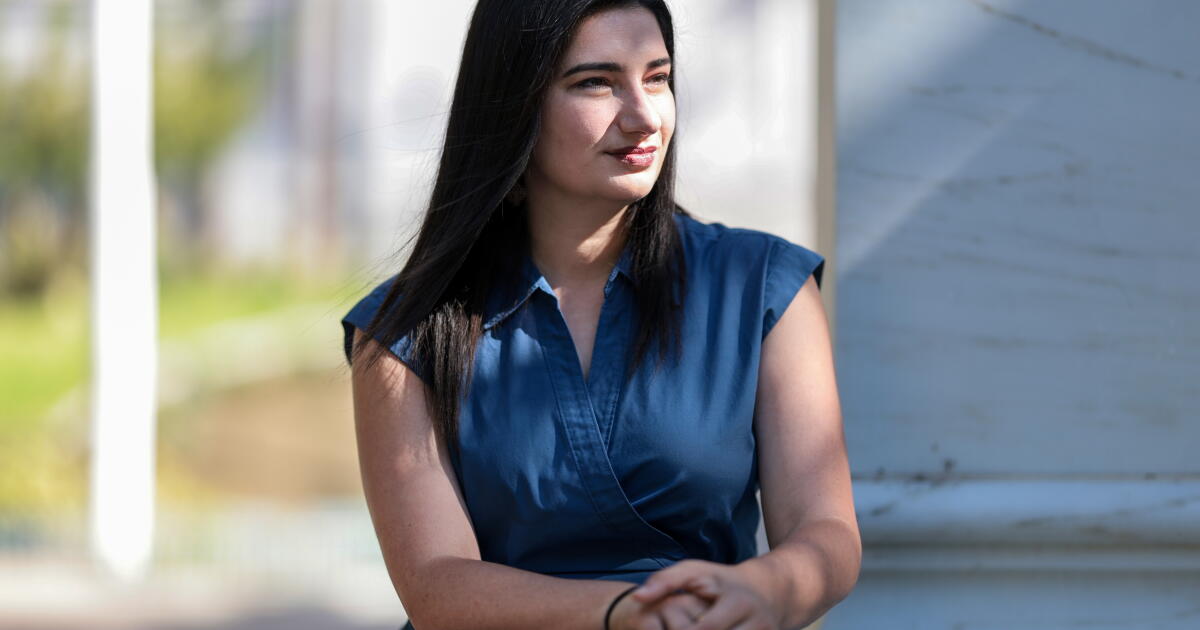
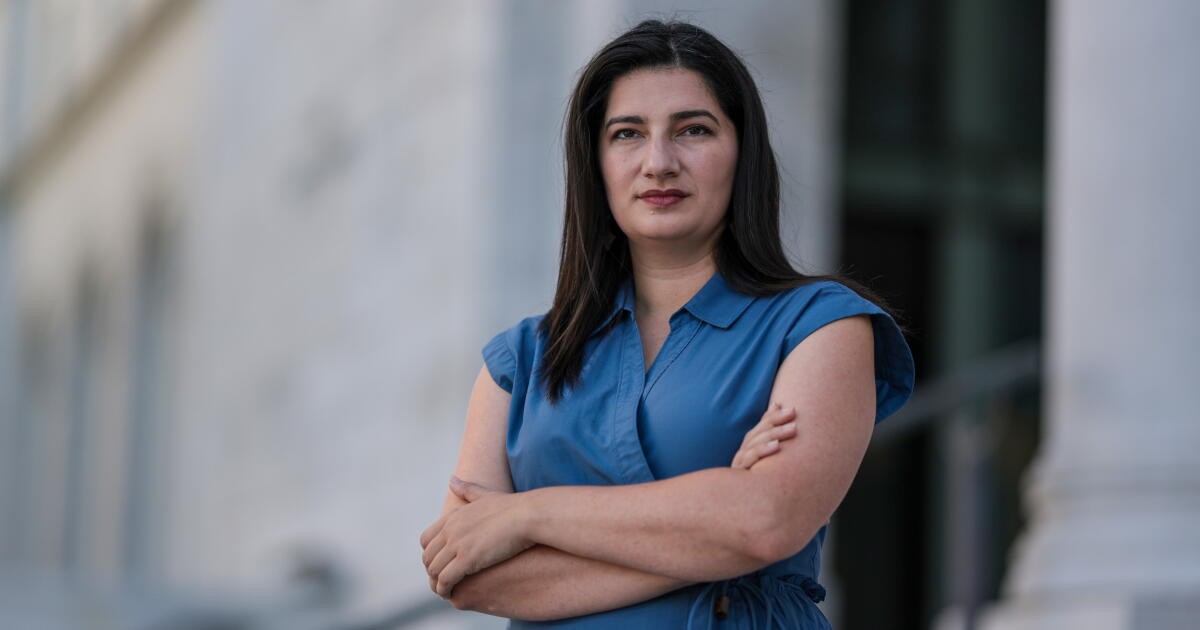
Marissa

Nearly 100 will guide City Atty.-elect Marissa Roy’s agenda

As Marissa Roy prepares to take over as Los Angeles city attorney, she will have a small army of volunteers helping her set priorities for the office.

Roy announced this week that she has created seven committees to support her transition into City Hall East, which collectively have nearly 100 members advising her on such issues as consumer protection, housing, tech accountability, homelessness and renters’ rights.

The transition team is being led by Daniel Suvor, who previously worked as chief of policy for then-California Atty. Gen. Kamala Harris, as well as senior director of government affairs in President Obama’s administration.

Suvor said Roy’s transition will have two tracks: One is internal, filling important executive roles and developing a better understanding of the city attorney’s office. The other will use the transition committees to look at issues facing Angelenos and how they can be addressed.

“The goal is to turn all of Marissa’s bold campaign promises into tangible actions that she can take right as she takes office,” he said.

You’re reading the L.A. on the Record newsletter

Sign up to make sense of the often unexplained world of L.A. politics.

The city attorney-elect has already spoken with outgoing City Atty. Hydee Feldstein Soto, a meeting Suvor called productive. Under the City Charter, Roy has the power to fill eight executive-level jobs after taking office.

Many of the members of Roy’s transition committees come from left-of-center groups, including the nonprofit Alliance of Californians for Community Empowerment, or ACCE; KTown For All; Ground Game LA; LA Community Action Network; and Public Counsel, a public interest civil rights law firm.

The transition team also features representatives from organized labor, including United Teachers Los Angeles and Unite Here Local 11, which represents hotel and restaurant workers. Members of Abundant Housing LA, a local YIMBY group, are also involved.

Faizah Malik, who works for Public Counsel and lost her challenge to Councilmember Traci Park in the June 2 primary, is heading the tenants rights transition committee. Malik, whose group has sued the city several times, said the committee is not discussing specific litigation but rather broader goals for the office.

“I view my role as gathering info on issues that are affecting tenants to help her hit the ground running,” Malik said.

Three for the 4th?

Mayor-elect Nithya Raman took a stand this week in the debate over who should replace her, announcing she wants a special election for her office once she resigns from the City Council.

But another outstanding question looms over Raman’s impending job change: Should council members pick someone to represent her district until an election is held? Raman becomes mayor on Dec. 14, but her seat could remain vacant until the end of the summer — even with a special election.

On Tuesday, about 30 community leaders in Raman’s 4th District said they want a temporary nonvoting caretaker to oversee constituent services in the district until a special election is held. They offered a list of three potential candidates to fill Raman’s post temporarily.

Among them was Kevin James, who served as president of the city’s Board of Public Works under former Mayor Eric Garcetti. James, an assistant city attorney, said he’d be happy if his office lent him out to Raman’s district.

“I would be honored to serve as the temporary caretaker, whether it is voting or nonvoting,” said James, who lives in the Hollywood Hills.

James promised not to run for the seat. So did Joan Pelico and John Popoch, both of them former council aides, who also appeared on the community’s wish list.

Pelico spent nearly nine years as chief of staff to former Councilmember Paul Koretz, retiring in 2023. She currently spends her time doing volunteer work.

Pelico, who lost a bid for council in 2015, said she has no interest in running for another office.

“Those days are way over,” she said.

Popoch, a former aide to Councilmember Bob Blumenfield, now lives in Tarzana, outside Raman’s district. While working for Blumenfield, he worked with residents in communities now located in the western half of Raman’s district — Encino, Sherman Oaks and Reseda.

Popoch said that, if chosen as a temporary caretaker, he would make sure communities at the other end of the district — Silver Lake, Los Feliz and the Hollywood Hills — are also well served.

“I would make darn sure I was always checking with those communities to make sure that what was being done is in their best interest,” he said.

The race that never ends

It’s been nearly three weeks since polls closed, and the 9th Council District remains in limbo: close but still undecided.

Former council aide Jose Ugarte was 87 votes ahead of community organizer Estuardo Mazariegos, according to the latest tally released Thursday. The last two batches of ballots increased Ugarte’s lead in small increments, but he hasn’t declared victory and Mazariegos hasn’t conceded.

Why? Officials with the Los Angeles County Registrar-Recorder/County Clerk say there are still some ballots that have not been counted. But those would need to be “cured” first.

That means voters have been notified by election officials that their ballots were missing a signature, or had a signature that did not match the one contained in their voter file.

Voters have until Wednesday to cure their ballots. That means more could be tabulated in the 9th District council race next week.

Both candidates said they are working to cure ballots from their supporters.

“The numbers continue to move in our favor,” Ugarte said in a statement. “We’re encouraged by today’s results and increasingly hopeful about our path to victory.”

Mazariegos said he is proud of his campiagn team.

“More than anything, I believe that my district deserves dignity, care, resources and a strong future,” he said.

State of play

—JOINING TEAM RAMAN: The mayor-elect has chosen her City Council chief of staff, Andrea Conant, and veteran lawyer George Kieffer to lead her transition team. Other members include Snap Inc. chief executive Evan Spiegel and Nick Pritzker, a member of the family whose interests include the Hyatt hotels and other holdings.

—AN OLYMPIC-SIZED BILL: The cost of protecting the 2028 Summer Olympic Games in L.A. has jumped to between $3.5 billion and $4 billion, according to an estimate provided by Police Chief Jim McDonnell on Wednesday. That figure is much higher than anything announced by the region’s public officials so far, and well above the $1 billion that the U.S. Congress approved last year for policing the massive event.

— MOVEMENT AT METROLINK: The top executive with Metrolink is leaving his job amid sharp criticism over the commuter rail system’s service reductions, fare hikes and mechanical breakdowns. Darren Kettle announced his decision to retire after his agency managed to avert major cuts, with help from a $20-million state bailout.

— EXECUTIVE DECISION: The 2028 campaign for Los Angeles County CEO is officially under way, with County Supervisor Lindsey Horvath launching a campaign for the post and several others being eyed as possible contenders. “It will be the most powerful local government job in California,” said Zev Yaroslavsky, a former county supervisor who is director of the Los Angeles Initiative at the UCLA Luskin School for Public Affairs.

— THE LION SUES TONIGHT: A trio of pro-housing YIMBY groups sued the city of L.A. on Monday over the city planning department’s decision to designate a Woodland Hills golf course as a wildlife habitat for mountain lions, which had thrown a wrench into a developer’s plans for fast-tracking a 400-unit housing project on the site.

— HOLDING OFF HUD: The nonprofit Public Counsel sued the federal government this week in an effort to block the implementation of a new rule requiring every person living in federally funded public housing to prove their legal immigration status. Public Counsel says that Congress, not HUD, has the authority to such make a rule change. L.A. currently has 7,700 mixed-status family members living in public housing, according to the Housing Authority of the City of Los Angeles, or HACLA.

QUICK HITS

  • Where is Inside Safe? The mayor’s signature homelessness program conducted its last two operations before Bass leaves office: one in the Sepulveda Basin, located in Councilmember Imelda Padilla’s district, and the other along the Tujunga Wash in the North Hollywood, which is represented by Councilmember Adrin Nazarian.
  • On the docket next week: L.A. County’s Registrar-Recorder/County Clerk issues its next and possibly final update on the 9th District City Council race on Wednesday. Election officials are scheduled to certify the results of every race two days later.

Stay in touch

That’s it for this week! Send your questions, comments and gossip to LAontheRecord@latimes.com. Did a friend forward you this email? Sign up here to get it in your inbox every Saturday morning.
Source link

How Marissa Roy plans to transform the L.A. city attorney’s office

For more than a year, Marissa Roy has vowed to turn the Los Angeles city attorney’s office into a massive “public interest law firm.”

Now, she has a sweeping mandate to put that plan into action.

As of Wednesday morning, Roy had nearly double the vote tally of her opponent, L.A. County Deputy Dist. Atty. John McKinney, all but assuring the 34-year-old progressive will walk into City Hall in one of her jewel-toned blazers next year as Los Angeles’ chief lawyer. While the contest has not officially been called, McKinney effectively conceded the race in an interview with The Times on Wednesday.

For decades, the L.A. city attorney’s office has focused almost exclusively on prosecuting minor crimes and defending the city from increasingly expensive litigation. In an interview in May, outgoing City Atty. Hydee Feldstein Soto scowled when a reporter mentioned Roy’s campaign line about running the office as a “public interest law firm.”

“That’s insane,” Feldstein Soto said, days before her historic primary defeat.

But in Roy, an enthusiastic and tenacious California deputy attorney general, the city will have a proactive top litigator who’s ready to play offense. Roy has promised to take her experience from a years-long legal battle with Meta to aggressively pursue litigation against corporations and landlords for alleged misconduct that harms the average Angeleno.

Long before she announced her candidacy, Roy had begun courting public servants inside the sprawling city attorney’s office to ensure her plan passed muster.

What began as a series of informal coffees at Pitchoun! Bakery downtown quickly evolved into a network of trusted advisors, who helped shape her campaign promises and fine-tune policy proposals so they could be executed on Day One.

“There’s not a single word on my website that they haven’t reviewed first to make sure that we can implement it,” Roy said in an October interview. “It’s why sometimes I won’t take a hard line on something, because I talk to the deputies involved and they say they need discretion.”

Despite attack ads saying otherwise, Roy hasn’t vowed to block prosecution of certain misdemeanor crimes — even though she prefers diversion programs as a way to aid homeless defendants.

She’s been more direct about her plans to protect the city’s immigrant communities from potential future raids and aggressively fight the Trump administration in court when it targets Los Angeles. Given her affiliation with the Democratic Socialists of America, Roy’s stances on litigation involving the Los Angeles Police Department could also depart from her predecessors’.

The union representing rank-and-file LAPD officers spent millions against Roy. Feldstein Soto also steadfastly defended the LAPD’s widely criticized uses of force on protesters and journalists during immigration raids last year.

Roy also benefits from a deep bench of elected allies across the state, including her current boss, California Atty. Gen. Rob Bonta, and fellow progressive city attorneys in San Diego, San Francisco and Oakland. Many local supporters showed up to toast her presumptive win Tuesday night, already riding high on the blue wave that crashed across the U.S. when the first Los Angeles returns dropped around 8:20 p.m.

The event at Audio Graph Brewery in downtown L.A. had all the energy of a wedding reception, with DSA acolytes munching cookies emblazoned with Roy’s face in icing and union organizers bopping up and down to the viral Slayyyter track “Dance…” as results rolled in.

Roy is an evangelist for affirmative litigation, proactive suits of the type that forced President Trump to cede control of the California National Guard late last year after he deployed thousands of soldiers to quell protests and aid immigration enforcement across the state.

“We need someone who knows how to sue the Trump administration, who also has the relationships and can pick up the phone and call the San Francisco and San Diego city attorney,” Roy said. “We’re all part of this very tiny niche of municipalities suing the federal government. We all became experts [in those methods] together.”

Despite at times amplifying inaccurate claims that McKinney was a conservative, Roy and her opponent shared some policy planks. Both were highly critical of ballooning legal costs under Feldstein Soto, as well as her penchant for hiring outside law firms to fight the city’s battles. Both also said they wanted to revive internal programs the outgoing city attorney had scuttled, such as neighborhood prosecutors and specialized units for handing child abuse and domestic violence.

“This election is gonna go her way, and I’m just really truly grateful for the opportunity to be part of this over the last nine months,” McKinney said Wednesday morning. “I met a remarkable group of people. I learned a lot about the city, the City Attorney’s office, about city politics and I’m a better person for it. I congratulate Marissa on her victory, I wish her well.”

McKinney said he hopes Roy can “uplift that office to be the finest municipal law office in the country,” but also suggested she spend her energy on more than legal combat with business leaders or the White House.

“She’s gonna have to broaden her focus to issues related to public safety, homelessness. Obviously, we both agree that city liabilities need aggressive proactive risk management,” he said.

Meanwhile, Roy could scarcely contain her excitement as she laid out her plan to supporters chanting her name.

“I’m much more comfortable when people chant things like ‘Let’s sue it’, because that’s the work that we’re going to do,” she said.

“Let’s sue it!” the crowd cheered.

Source link

Marissa Roy’s lead grows over John McKinney in L.A. city attorney race

California Deputy Atty. Gen. Marissa Roy has nearly doubled her lead in the race to replace Los Angeles City Atty. Hydee Feldstein Soto, even as the mayor’s race has narrowed dramatically since September, new polling showed.

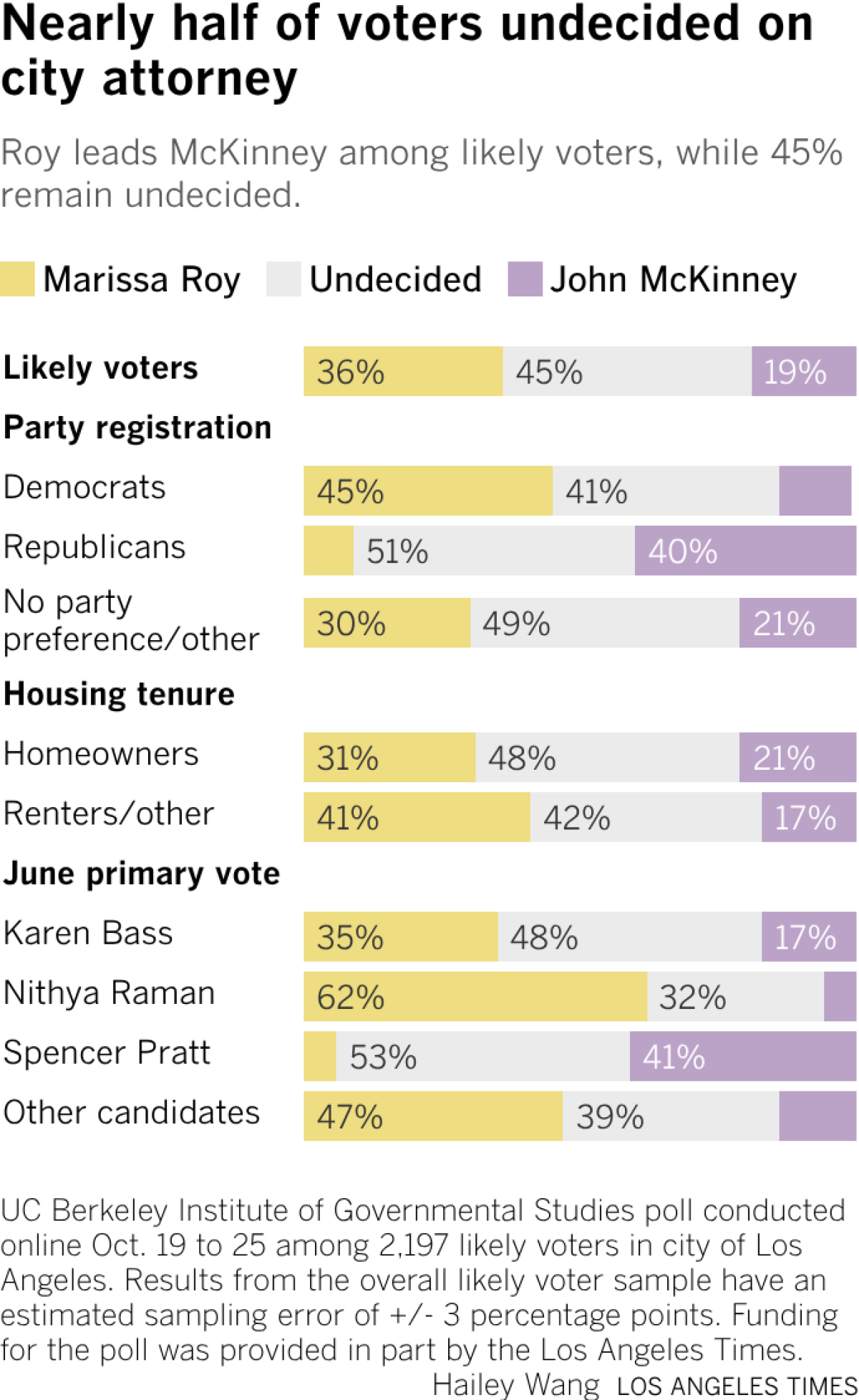
Both Roy and her rival, Los Angeles County Deputy Dist. Atty. John McKinney, made significant inroads among likely Los Angeles voters in October, winnowing the number of undecideds down to 45% from 70% last month, according to a poll released this week by UC Berkeley’s Institute of Governmental Studies and co-sponsored by The Times.

But while the race for mayor is now a dead heat, the contest for the city’s second-most-powerful elected position has widened, with Roy leading McKinney by 17 points in the final days of voting ahead of the Nov. 3 election.

Some 36% of likely voters say they’ve marked their ballot for Roy or will soon, versus 19% who say they’ve bubbled in for McKinney or plan to. About 45% remain undecided — far more than are still mulling the mayor’s race, but far fewer than were on the fence a month ago.

Experts said it’s not uncommon for voters to have uncertainty about city attorney races, since few people realize the question of who should fill the office will be on their ballot and many elect not to answer. About 15% fewer Angelenos voted in the last city attorney’s contest than voted for mayor, data show. Other cities saw a similar slump in returns.

The Los Angeles city attorney controls a budget of nearly $200 million and a staff of 1,000, serving as lawyer for L.A.’s City Council and general counsel for its myriad municipal agencies.

Increasingly, city attorneys around the state also pursue so-called “affirmative litigation” against exploitative corporations or punitive federal policy — a role Los Angeles pioneered, but which Feldstein Soto largely eschewed during her tenure at City Hall.

Roy has built her career on affirmative litigation, making it a centerpiece of her campaign. McKinney has characterized it as grandstanding and “out of alignment” with voters.

The two have also knocked heads over how the city attorney should charge and prosecute misdemeanors, work that accounts for about a third of the job.

Polls show voters split on who is best to address what 43% named as their top issue: street homelessness. Both McKinney and Roy have vowed to use the office to stem encampments — Roy by keeping more Angelenos housed through attacks on wage theft and renter harassment, McKinney by inducing more chronically homeless residents into treatment through individual prosecutions.

On runner-up concerns — building more affordable housing and ensuring public safety — similar percentages of likely voters trust Roy and McKinney, respectively.

McKinney, who has taken pains to highlight himself as a Democrat, retains a commanding lead among registered Republicans and self-identified MAGA voters, as well as the much-sought-after supporters of former mayoral hopeful Spencer Pratt, who will likely decide the contest between Mayor Karen Bass and Councilmember Nithya Raman.

Roy was way ahead among renters, who make up nearly two-thirds of the electorate, as well as progressives and self-described Democratic Socialists.

Independent expenditure groups behind both continue to pump money into the race, with Roy’s supporters seeking to paint McKinney as closely aligned with President Trump, and McKinney’s boosters looking to tar Roy as the second coming of former Los Angeles Dist. Atty. George Gascón.

Source link

Inside Marissa Roy’s group-project bid to become L.A.’s city attorney

It was less than a month before the Nov. 3 election when Los Angeles city attorney front-runner Marissa Roy realized she’d missed her lucky manicure.

A deputy attorney general in the California Department of Justice, she had scarcely slept since her team clinched its historic $17-billion settlement with Meta in August. She’d been canvassing hundreds of voters and sounding out scores of deputy city attorneys in her bid to transform the troubled office where she’d launched her career in 2017 into the “largest public interest law firm” in L.A.

Between filming TikTok spots and prepping for formal debates, Roy has been fine-tuning her plans to avenge exploited tenants and claw back stolen wages, tame runaway civil liability, protect victims of child abuse and domestic violence, and join other elected attorneys in lawsuits against the Trump administration.

Nails didn’t make the cut.

“There’s just been too much to do,” Roy said of the chrome gel ritual she inaugurated as a volunteer for Eunisses Hernandez in 2022.

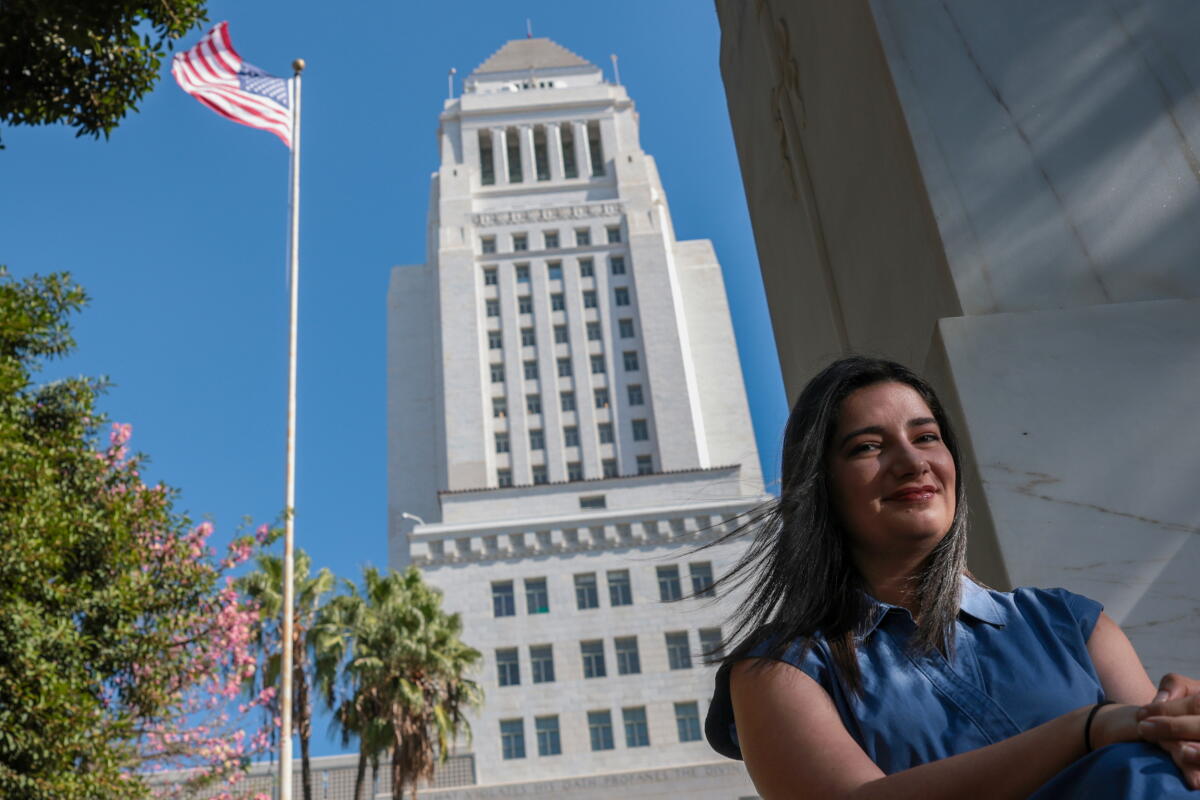
A woman with dark hair, in a blue top, with a white multistory building and a U.S. flag behind her
Marissa Roy outside L.A. City Hall. “I wanted the slogan ‘let’s sue it’ — that was violently nixed,” she said of her campaign.

(Robert Gauthier / Los Angeles Times)

Seen one way, Roy’s talismanic manicure is an object lesson for her fiercest critics: all flash and no substance, evidence the 34-year-old lacks the “gravitas” to be among the state’s most powerful elected lawyers.

But like the iridescent glitter in her campaign-matched chrome polish, the meaning shifts with the viewer’s perspective.

To supporters on the city’s restive left and the clique of California city attorneys eager to add Roy to their group chat, it’s a winking show of solidarity burnished through years of knocking on doors for fellow up-and-coming progressives. It was metallic blue for Hernandez, silver for Ysabel Jurado and ultraviolet for her own historic primary upset in June. Her backers see fierce loyalty reflected in the polish, a ritual she started while hunting salon wage thieves to sue.

“I wanted the slogan ‘let’s sue it’ — that was violently nixed,” Roy said of her campaign.

With her Democratic Socialists of America sass, bright amethyst blazers and Bollywood needle drops on Instagram, the lifelong Angeleno cuts a stark contrast to her rival, Deputy Dist. Atty. John McKinney, 58, who leapfrogged to a second-place finish in the primaries amid a stoic, law-and-order campaign that sometimes slipped into Spencer Pratt-style dystopian imagery.

McKinney’s boosters point to his extraordinary biography — from penniless orphan to director of special prosecutions in the country’s largest district attorney’s office — and celebrated courtroom prowess as evidence he is better suited to handle the 120,000 violations referred to the city attorney for potential charges every year.

“John has the experience, stature, reputation, and gravitas to do the job and will be both effective and respected,” said former Los Angeles City Atty. Burt Pines. “I do not have the same confidence in her.”

Stacks of campaign materials depicting a smiling woman with dark hair and the words Marissa Roy for L.A. City Attorney

Campaign materials for the Los Angeles city attorney candidate at a canvassing event in Silverlake.

(Gary Coronado / For The Times)

Roy’s allies counter that prosecuting misdemeanors is only a third of the city attorney’s job — and typically the less complex part. Whereas McKinney has never worked a civil case, Roy has managed multicity litigation and shares the credit for legal victories no attorney could secure alone. In the Meta case, Roy and her team had argued that the social media giant had intentionally designed its products to hook young children and repeatedly misled the public about known risks.

“She was one of the original four team members in California that stayed up until 2 a.m. filing the [Meta] complaint,” said California Atty. Gen. Rob Bonta. “She helped develop our legal strategy, particularly our deception theory, which was our core theory of legal liability for the case.”

Similarly, while McKinney’s camp paints a lawman of singular personal ability, Roy supporters describe her as brilliant, driven, and eager to lift the best and brightest around her.

“She is tenacious and works around the clock,” said San Francisco City Atty. David Chiu.

She’s also infamously bubbly: When a canvasser door-knocked 9th Circuit Judge Richard Paez, for whom Roy had clerked, he reportedly asked the volunteer to give her a hug.

“She has a natural enthusiasm about her that is infectious,” said Mark Ramos, chair of Los Angeles County Democratic Party. “She’s [always] shown up, and showing up matters.”

Which matters more — individual virtue or collaborative ingenuity — now in effect divides the race for the most abstruse job in local politics: Four of L.A’s former city attorneys have endorsed McKinney, while California’s current top elected lawyers have largely lined up behind Roy.

A head-to-head match with McKinney was not what Roy envisioned last year when she launched her campaign to unseat the incumbent city attorney, Hydee Feldstein Soto. After charming L.A.’s major power brokers, she had hoped to win the primary outright and avoid a runoff so she could focus exclusively on the Meta trial in August.

“I had been planning for things to end in June,” she said.

Feldstein Soto was bogged down by scandal and soaring civil liability costs for the city. She also faced criticism for ducking challenges to President Trump’s policies, including the deployment of military troops to Los Angeles last year, a fight the city joined but did not lead.

By early spring, Roy had racked up endorsements from the state’s legal elites and leftist kingmaker Sen. Bernie Sanders (I-Vt.). She earned the imprimatur of the city’s powerful Democratic clubs and its influential labor unions, while enjoying widespread support from a democratic socialist base.

Two women in dark purple clothing and jeans standing near a door

Marissa Roy, left, candidate for Los Angeles city attorney, and Alyssa Acevedo, with Service Employees International Union canvass in Silverlake.

(Gary Coronado / For The Times)

L.A. voters want “the transformational leadership that they’re seeing in [New York Mayor Zohran] Mamdani, and also in Mayor [Daniel] Lurie in San Francisco,” said L.A. County Supervisor Lindsey Horvath, a longtime friend of Roy’s and among her earliest endorsers. “Angelenos are increasingly impatient in wanting to see that change come to their city, too.”

Then, in April, Feldstein Soto slipped from unpopular to politically radioactive after hackers stole thousands of LAPD files from her office. That inspired a late-breaking police union endorsement and a surge of corporate cash for McKinney, boosting him to a second-place finish and knocking out Feldstein Soto in a historic rout.

McKinney touts the city attorney’s prosecutor role as a means to stem quality-of-life crimes and curb homelessness. Roy has promised to keep more Angelenos housed and protect their livelihoods through “affirmative litigation” — suits brought against slumlords and exploitative corporations under the state’s Unfair Competition Law.

“When you file these suits, you have complete discretion,” said Pines, the former city attorney who successfully lobbied the state to extend Los Angeles that power in 1977 and watched in dismay as Feldstein Soto left it to whither.

In recent years, affirmative litigation has become an essential tool for defending against punitive federal policy and recovering public funds, Pines and others said.

Seeing the San Francisco city attorney’s office sue to overturn California’s ban on gay marriage — a law that would have stymied her gay younger brother — inspired Roy to give up her elementary school dream of decoding ancient texts to pursue the law.

“Childhood Marissa spent recesses in the library buried in books about ancient Egypt,” Roy said. “It was San Francisco suing — that was when I began to become aware of the power of lawyers.”

Unlike her opponent, Roy grew up comfortably in Monrovia, largely shielded from the sacrifices her family made to afford her an elite education. The daughter of an Indian immigrant mother and a white American father, she graduated from Flintridge Prep and attended University of Southern California on scholarship.

While studying law at Yale, she interned in the affirmative litigation department in the San Francisco city attorney’s office — a program Chiu lauded as “an essential training ground for the next generation of government lawyers” in a recent law review article.

Roy and her supporters say those early experiences cemented her commitment to teamwork, which is central to the less glamorous, more costly side of the city attorney’s job: serving as general counsel for myriad city agencies and legal advisor to City Hall.

“There’s absolutely more collaboration and it’s more significant given the things we’re up against,” said San Diego City Atty. Heather Ferbert, a close ally of Roy’s.

A man with dark hair, in dark suit and blue tie, gestures while speaking

John McKinney, a Los Angeles County prosecutor running against Marissa Roy to become L.A. city attorney, speaks during a news conference on May 5, 2026.

(Kayla Bartkowski/Los Angeles Times)

Ferbert and others pointed to a surge in lawsuits against municipalities over everything from sidewalk trip-and-falls to police misconduct — cases that can lead to seven- or eight-figure payouts.

“If it’s not extremely unusual, it doesn’t make it to the city attorney’s desk,” said Oakland City Atty. Ryan Richardson, who endorsed Roy.

As a deputy city attorney, Roy spearheaded a trio of major wage-theft suits just a month after she was admitted to the bar. Independent expenditure groups supporting McKinney spent more than $350,000 trying to strip her of that title because she was paid by a nonprofit — an common arrangement employed by government law offices across the U.S. — while the city attorney’s office itself gave her permission to use it, and lists her as such in its court filings.

McKinney has since sought to paint Roy as the second coming of George Gascón, the polarizing district attorney who was drubbed in 2024 — a move that assumes most voters are still thinking about Gascón, or are likely to see the graying “godfather of progressive prosecutors” in a raven-haired deputy attorney general.

“The only way you disprove that is by putting your head down and doing the work 10 times harder,” Roy said. “Voters are smarter than that. People in the coalition see these tactics and are tired of them too.”

Source link