mail voting

Democratic states urge Supreme Court to block Trump’s new limits on mail ballots

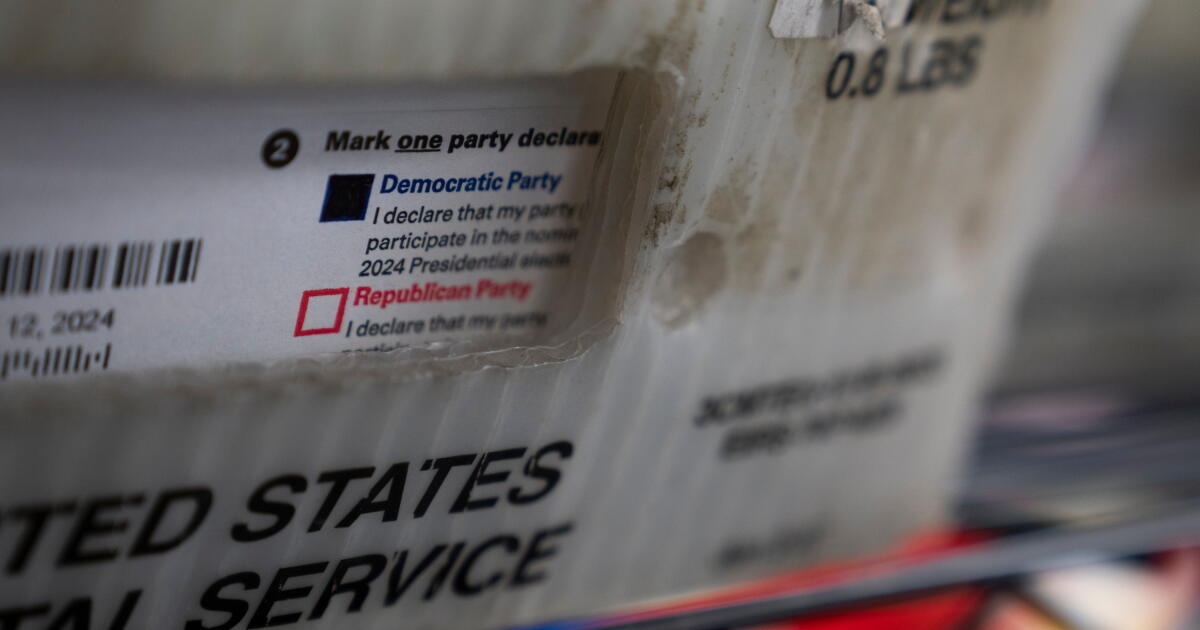
California and 22 other Democratic-led states urged the Supreme Court on Monday to block President Trump’s plan to take control of voting by mail through the U.S. Postal Service.

They said it is too late in the election year to impose a new set of regulations for mail ballots.

Doing so, they said, would lead to mistakes, including eligible and registered voters being told they are not on the federal government’s approved list.

“Because of the high risk of errors and the limited window for correcting mistakes, many of the millions of voters who rely on mail voting — especially voters with disabilities and those in rural areas — would likely be denied mail ballots and disenfranchised,” they told the court.

More broadly, they argued that the Constitution “entrusted the states and Congress — not the president — with the responsibility to set rules for federal elections.”

The justices are likely to act in a few days on whether to allow the Trump administration‘s plan to proceed pending the adoption of new and detailed guidelines.

Last week, Trump Solicitor Gen. D. John Sauer sent an emergency appeal to the Supreme Court contending judges in Boston moved too quickly to halt the administration’s new federal restrictions on voting by mail.

He argued judges should stand back for now, even though the midterm elections are only three months away.

Trump’s executive order required the U.S. Postal Service to use state-by-state lists of eligible voters who may send a ballot by mail.

Until now, states have had the constitutional authority to register voters for federal and state elections. And nearly a third of Americans now vote by mail.

Trump, however, has insisted that voting by mail leads to fraud, including by allowing noncitizens to vote.

Congress has refused to adopt new voting restrictions at Trump’s behest.

Instead, he issued an executive order on March 31 to enlist the Postal Service and the Department of Homeland Security to ensure “citizenship verification and integrity in federal elections.”

The order called on Homeland Security to compile state-by-state lists of citizens who are eligible to vote. And it told the postal service that it must use those lists to restrict who may vote by mail.

“The USPS shall not transmit mail-in or absentee ballots from any individual unless those individuals have been enrolled on a State-specific list,” the order said.

But a federal judge and the 1st Circuit Court in Boston ruled Trump’s new regulations may not be enforced this year, at least in the 23 Democratic-led states which sued.

On Monday, they told the court that USPS delivered nearly 100 million mail ballots to or from voters in 2024, with roughly 30% of all voters nationwide casting ballots by mail.

Source link

Judge refuses to block Trump order to limit mail voting

A federal judge has declined to halt President Trump’s executive order creating a federal voter list and limiting mail voting, clearing the way for potential sweeping changes in how American elections are run shortly before this year’s midterm elections.

U.S. District Judge Carl Nichols, a Trump appointee in Washington, late Wednesday rejected the request by Democrats and civil rights groups that had argued Trump’s order would likely be found unconstitutional because the states and Congress, not the president, have the power to set election rules. Nichols agreed with the Republican Trump administration’s contention that it was too early to block the order because it has yet to be implemented.

Nichols’ ruling leaves the door open for further challenges when the Trump administration moves to implement the president’s directive. A separate lawsuit seeking to block the executive order is underway in Boston. No matter how rapidly the administration acts, no voting changes are expected during primary elections, which continue into next month.

“The Court recognizes that the Postal Service may ultimately issue a final rule that directly affects Plaintiffs or their members, or that the Government may develop State Citizenship Lists that omit specific individuals due to particularized flaws,” Nichols wrote. “Plaintiffs may, of course, renew their motions if and when those future actions occur. Until then, however, Plaintiffs cannot show that preliminary injunctive relief is warranted.”

The Trump administration has yet to formally issue lists of eligible voters, and those who filed the initial request for a temporary halt said they’d be back if the administration moves in that direction.

“We are ready to resume the fight if and when the administration takes those next steps,” said Juan Proaño, chief executive officer of the League of United Latin American Citizens, one of the organizations that sought the stay from Nichols.

Trump issued the order in March after a bill he supported to overhaul voting stalled in Congress. The order would have had the federal government create a list of eligible voters and then directed the U.S. Postal Service to deliver mail ballots only to those on the list. Election officials argued it was ripe for abuse and could cause chaos, and the postal union has objected to the idea of mail carriers policing ballots.

Since his 2020 presidential election loss to Democrat Joe Biden, Trump has groundlessly claimed mail voting is rife with fraud and has launched a federal investigation into that year’s vote, even though repeated audits and investigations, including ones run by Republicans, found it was free of widespread fraud. Trump also has said he wants to “take over” election administration in Democratic areas.

Democrats and civil rights groups argued it was urgent that Nichols issue a restraining order in the midst of primary season and with states already gearing up for the fall midterm elections.

This was Trump’s second executive order seeking to overhaul elections and voting. His initial election executive order, issued just months after he took office in his second term, has been blocked by multiplefederal judges. That order sought to require documentary proof of citizenship to register to vote, among other changes.

Riccardi writes for the Associated Press.

Source link