mail ballot

California leaders cheer Supreme Court ballot ruling while eyeing other ways to speed count

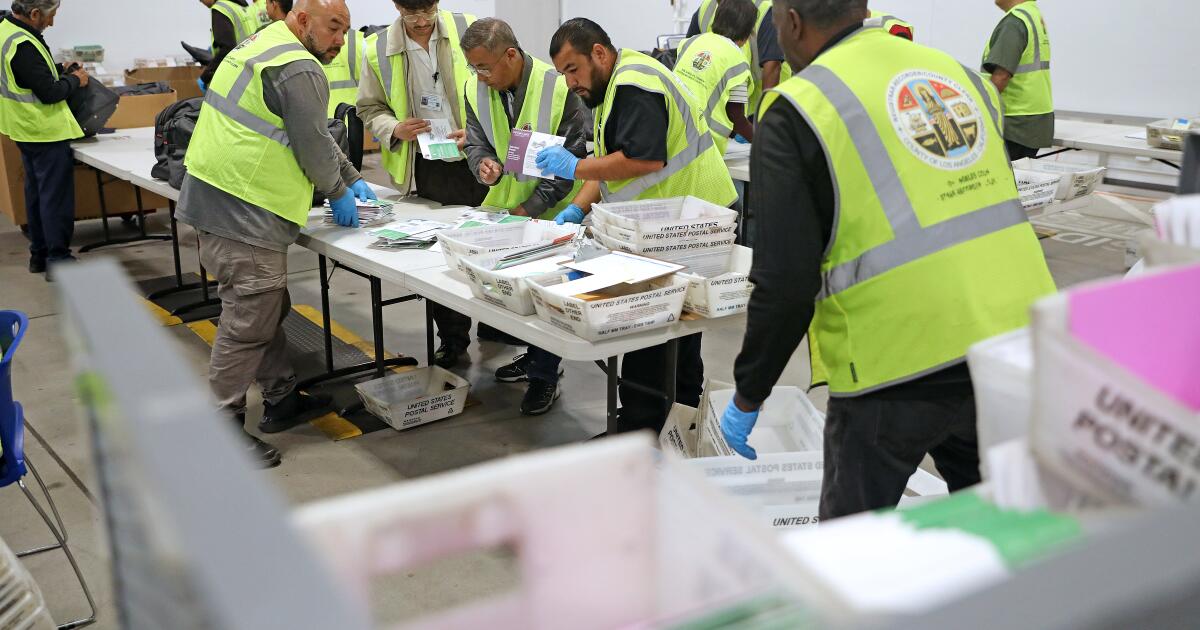
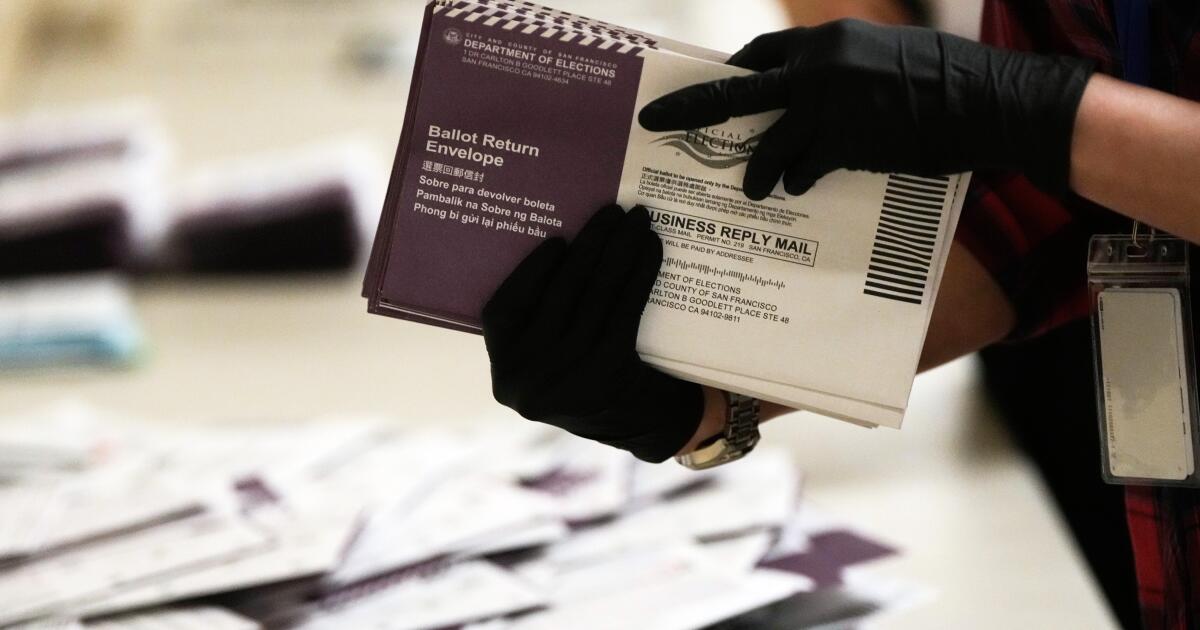
California officials cheered a U.S. Supreme Court ruling Monday that allows states to continue counting mail ballots postmarked by election day but received in the days after — calling it a win for voter participation and access, including in the upcoming November midterm.

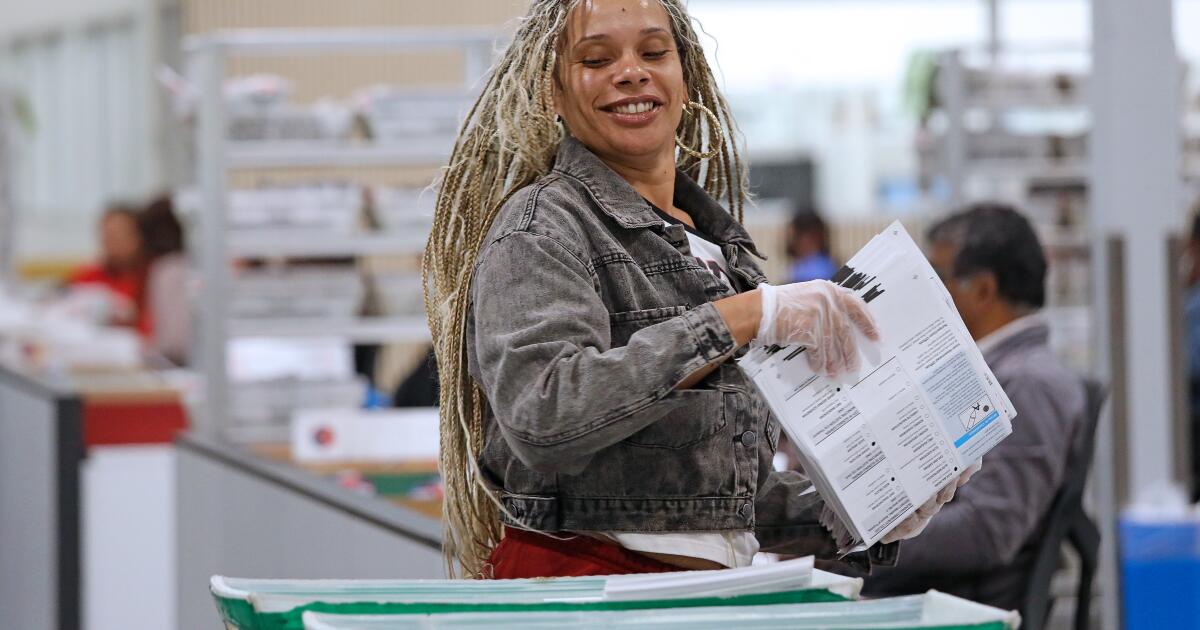
They also acknowledged delays in recent vote counting have spurred frustration, and promised to speed the process through other solutions — including by investing millions into new election infrastructure and vote processing capabilities.

Gov. Gavin Newsom — who called the court ruling a “win for voters, plain and simple” — has previously said the state should be able to count ballots faster, and his latest budget includes $29 million for “increased staffing, technology and equipment upgrades and purchases for counties,” $10 million for voter education and outreach at the state and county levels and $750,000 for combating election misinformation.

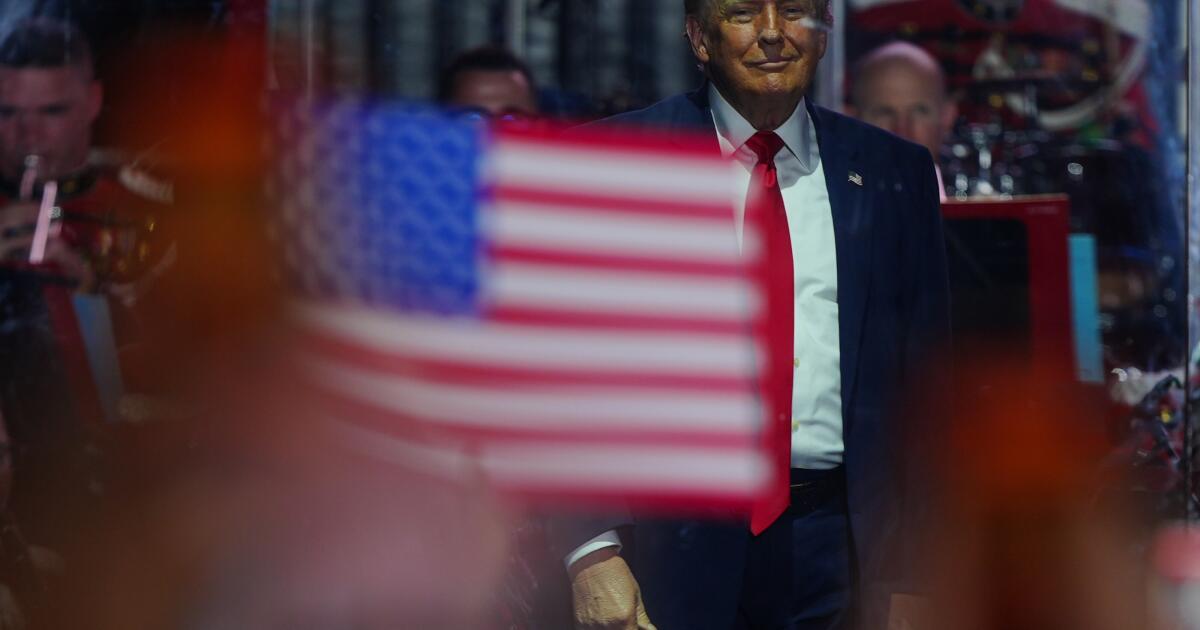
The court decision, a loss for President Trump and other critics who contend such policies contribute to unacceptable delays in vote counting, specifically upheld a Mississippi policy to accept mail ballots received within five business days of an election.

But it also lets stand similar policies in other states — including California, which counts ballots postmarked by and received within seven days of an election.

California Secretary of State Shirley Weber, who has long prioritized voter participation over a speedy count, called the high court’s ruling a “win for voters, for the rule of law, and for the future of our democracy.”

She said that she will “keep working to ensure every eligible Californian has the opportunity to be heard, because our democracy is strongest when every voice and vote count.”

Dean Logan, head of the Los Angeles County registrar-recorder/county clerk’s office, said in a statement to The Times that the ruling “affirms what Los Angeles County voters deserve: the assurance that a ballot cast by Election Day will be counted if received within the legal timeframe established in State Law.”

“Our office will continue to provide voter education, multilingual outreach, and leverage available resources to ensure voting access for our 5.8 million registered voters,” Logan said.

Many voting rights experts agree California’s vote counting should and could be faster, but disagree with the Trump administration’s efforts to step in with policies such as election day deadlines.

In 2024, California counted more than 406,000 late-arriving mail ballots, but they represented only about 2.5% of the statewide total. Experts say California’s delayed results have far more to do with the massive influx of mail ballots that are placed in ballot drop boxes or arrive at processing facilities on or just before election day.

Rick Hasen, an election law expert and director of the Safeguarding Democracy Project at UCLA Law, said the court’s decision was a “symbolic loss” for Trump, in that the court rejected his preferred policy on mail ballots, but “doesn’t appreciably change how long it takes to count ballots” because late-arriving ballots were never the problem.

In a report published Thursday, the California Voter Foundation recommended statewide adoption of “sign, scan, and go” programs that allow elections officials to immediately process mail ballots that voters submit in person at polling centers or drop boxes.

The foundation recommended ballot curing programs that speed up the process by utilizing a secure text platform when double checking whether a ballot is legitimate when a voter’s signature doesn’t match state records.

It also urged the state to invest $35 million in a voter education campaign to encourage early ballot returns, and more than $55 million in improving counting capacity and efficiency in county elections facilities.

Trump and other conservatives had called for an end to state policies allowing late-arriving mail ballots to be counted as an overdue fix to a voting system that often can’t produce election results in close races for days after polls close, as was the case in California’s recent primary races for governor and L.A. mayor.

Trump has pointed to California’s time-consuming count as proof of widespread fraud to undermine Republican candidates, though he has never produced evidence to support that claim and Democrats have fiercely denied it.

On Monday, Trump called the high court’s decision to uphold such state policies a “tremendous loss,” and more reason to pass the Save America Act — a bill he has backed that would enforce new voter ID and proof of citizenship requirements and ban mail ballots except for military personnel, individuals suffering from illness, disability, and in other rare circumstances.

He said politicians have “no excuse” other than “CHEATING!” to oppose such measures, especially at “a time when there is a powerful Communist Movement taking place in our Country, one more dangerous than World War I, World War II, Pearl Harbor, or September 11th.”

But California leaders rejected that — saying the criticisms of mail ballots are baseless and an attempt by Trump and his allies to undermine elections in which they are poised to lose, particularly in big blue states such as California, by attempting to wrest control over voting processes that have always been the purview of states, not the federal government.

California Atty. Gen. Rob Bonta said Monday that states have been “primarily responsible for regulating elections” since the nation’s founding, and his office was “pleased that the U.S. Supreme Court has respected that authority.”

“Today’s decision recognizes a basic reality: Mail delays happen. When people vote by election day, their ballots should not be discarded because of those delays,” he said.

Sen. Alex Padilla (D-Calif.), the ranking Democrat on the Senate Rules and Administration Committee, which has oversight over federal elections, praised the high court Monday for acknowledging that nothing in federal law precludes states from counting mail ballots in the days after an election.

“Today’s decision is a victory for voting rights and a rejection of Trump’s attacks on mail and absentee voters,” Padilla said.

Liberal groups and many voting rights experts also hailed the ruling as a win for voters.

Moving up deadlines for mail ballots is just one effort in a much broader political war over voting and the rules that govern it. The U.S. Constitution generally gives states the authority to run their own elections, but the Trump administration has been trying to assert greater federal control — especially around mail ballots.

Earlier this year, Trump signed an executive order directing the U.S. Postal Service to assert control over mail balloting by designing new envelopes with special bar codes that would allow the federal government to ensure ballots only go to and get returned by eligible voters. The order prompted the Postal Service to propose new rules requiring states to hand over their voter mailing lists so it could implement Trump’s directive.

In a letter to U.S. Postmaster ‌General David Steiner on Wednesday, Democratic senators denounced the proposed rule as an “unconstitutional and illegal attempt to transform [USPS] into an election administration agency controlled by the White House and President Trump.”

In a Senate hearing the same day, Steiner said that under the new rule, the USPS would not mail the ballots of a state that refused to turn over its voter lists, but also that his agency would adhere to any court orders curtailing its implementation.

On Thursday, just such an order came down in a federal case in which California and other Democrat-led states challenged Trump’s executive order. U.S. District Judge Indira Talwani ruled that the Constitution does not grant the president “any specific powers over elections,” and blocked his order as unlawful.

Nevada Secretary of State Cisco Aguilar, who is chair of the Democratic Assn. of Secretaries of State, said states such as California were right to focus on increasing investment in their own election infrastructure rather than accepting the Trump administration’s “bad policy ideas” for speeding things up.

Newsom’s office on Monday said that is exactly what California has been doing. It pointed to laws passed by the state Legislature last year that allow election officials to begin processing mail ballots earlier and require them to finish counting ballots sooner.

Source link

Federal judge halts Trump’s election executive order seeking to create a federal voter list

A federal judge on Thursday halted President Trump’s executive order that sought to create a federal voter list and limit who can receive a mail ballot.

U.S. District Court Judge Indira Talwani, who was nominated by Democratic President Obama, sided with a coalition of nearly two dozen states that challenged the Republican president’s order in granting a summary judgment. Her ruling applies to this year’s midterm election cycle.

Plaintiffs argued in two lawsuits, both filed in federal court in Boston, that Trump’s order should be found unconstitutional because the states and Congress, not the president, have the power to set election rules. The judge agreed, noting in her ruling that the provisions of Trump’s order “unconstitutionally violate the separation of powers.”

It was the second ruling in as many days against executive orders Trump has signed seeking oversight of the nation’s elections. A separate ruling Wednesday prohibited an executive order he had signed last year that would have required people to show documents proving their citizenship when registering to vote.

The administration, in its motions to dismiss the lawsuits challenging the order seeking to establish a federal voter list, argued that the motions are premature and that plaintiffs lacked the legal basis to bring their claim based on the Administrative Procedure Act, which governs how federal agencies develop and issue regulations.

But in an interim order before Thursday’s ruling, Talwani said the motions pertaining to this year’s election cycle were relevant: “In light of the EO’s specific deadlines over the next three months, and the reality that elections will be occurring throughout this period with the November 3, 2026 midterm occurring in just five months, postponing judicial review is impracticable and may inflict significant hardship on Plaintiffs,” she wrote. That order denied the Trump administration’s motion to dismiss the challenges.

Trump’s executive order, the second one aimed at elections during his second term, comes as he continues to raise the specter of widespread voting by noncitizens as a reason to change election rules. But states already have detailed processes aimed at keeping their voter rolls accurate, and voting by noncitizens has been shown to be rare. It also is a felony that can be punishable by deportation.

Trump issued his second order in March after a bill he supported to overhaul voting stalled in Congress. The order would have had the federal government create a list of eligible voters and then directed the U.S. Postal Service to deliver mail ballots only to those on the list. Election officials argued that it was ripe for abuse and could cause chaos, and the postal union has objected to the idea of mail carriers policing ballots.

The Postal Service has published a proposed rule required by Trump’s executive order in the Federal Register. Among other things, the rule would not apply to primary elections or overseas ballots.

The lawsuit seeking summary judgment was filed by Democratic attorneys general representing 22 states and the District of Columbia. Also signing on were attorneys representing Democratic Gov. Josh Shapiro of Pennsylvania, which has a Republican attorney general.

The states also told the court that the move imposes a costly burden on election officials to comply and would spread fear about the possibility of prosecution. Stephen Pezzi, a lawyer for the Trump administration, had argued that no one would be prosecuted for violating the order.

In a separate lawsuit filed against the executive order, a federal judge in Washington, D.C., in May agreed with the Trump administration that it was too early to block the order because it had yet to be implemented. That lawsuit was brought by Democratic and civil rights groups, who have appealed.

Since his 2020 presidential election loss to Democrat Joe Biden, Trump has groundlessly claimed mail voting is rife with fraud and has launched a federal investigation into that year’s vote, even though repeated audits and investigations, including ones run by Republicans, found it was free of widespread fraud. Trump also has said he wants to “take over” election administration in Democratic areas.

Casey writes for the Associated Press.

Source link

Federal judge bars Trump from requiring proof of citizenship to vote

A federal judge on Wednesday permanently barred President Trump’s administration from implementing most of his first executive order on elections, part of which sought to require people to show documentary proof of citizenship when they register to vote.

The ruling by U.S. District Judge Denise Casper in Boston in effect converts a preliminary injunction she issued a year ago, in which she temporarily blocked many of Trump’s efforts to overhaul elections, into a permanent ban.

Casper rejected the administration’s argument that the lawsuit to block the changes brought by Democratic state attorneys general was premature because the rules had yet to be implemented. Instead, she agreed that the Constitution gives states and Congress the authority to regulate elections, and that Trump’s requirements violated the separation of powers.

The Constitution “does not grant the President any specific powers over elections,” she wrote.

Among other proposed changes, Trump’s order would have required people to provide documentary proof of citizenship when registering to vote, prevented mail ballots from being counted if they arrive after election day, even if they were postmarked by then, and punished states that failed to comply by withholding certain federal money.

In a statement, New York Atty. Gen. Letitia James said she was grateful the court had blocked Trump’s “unconstitutional attempt to seize control of our elections” and would continue to defend voting rights in this year’s midterm elections.

“Generations of Americans fought tirelessly for the right to vote, and we honor their legacy by protecting that right against anyone who tries to undermine it,” she said.

Requests for comment sent to the White House and Department of Justice were not immediately returned.

It was the latest in a string of rulings against the elections executive order Trump signed just months after taking office for his second term. He has since signed another executive order on elections, seeking to create a national voter list and limit mail balloting. That directive also faces multiple legal challenges.

In the fall, a federal judge in Washington overseeing a separate challenge to the first election executive order by civil rights and Democratic Party-aligned groups blocked the government from taking steps to include the proof-of-citizenship requirement on the federal voter registration form. That judge later barred the secretary of Defense from requiring documentary proof of citizenship when military personnel register to vote or request ballots.

In an apparent nod to the difficulty of implementing a proof-of-citizen requirement by executive order, Trump is pushing legislation in the Republican-controlled Congress to create such a mandate. The SAVE America Act has passed the House but has stalled in the Senate, leading Trump to advocate for eliminating the filibuster that is blocking the legislation.

On Wednesday, he abruptly canceled the expected signing of a bipartisan housing bill, saying he won’t do so until Congress passes his proof of citizenship requirement for voting.

The president and many of his Republican allies have been promoting the narrative that voting by noncitizens is a major problem, when in fact it’s quite rare. The federal voter registration form already requires people to attest that they are U.S. citizens, and violating that is punishable as a felony that can lead to prison or deportation.

In another major voting case, the U.S. Supreme Court is due to issue an opinion soon on whether mail ballots must arrive by election day. That could immediately change the rules in 14 states that allow grace periods ranging from days to weeks if the ballots are postmarked by election day.

Smyth and Casey write for the Associated Press.

Source link

California’s slow vote count faces changes as Supreme Court decision on late ballots looms

California’s slow vote counting process — still underway and causing friction after last week’s primary — may be forced to change before November’s midterm elections, as the U.S. Supreme Court prepares to rule on whether mail ballots must be received by election day to count.

Whether those changes will speed things up — and help tamp down baseless claims from President Trump and others that the slow count is evidence of fraud — will depend on a variety of factors, election experts said, including how the high court rules, how state lawmakers and local elections officials respond, and whether they push any additional steps to quicken the count.

“We’re all on the edge of our seats, waiting to see what the Supreme Court does,” said Kim Alexander, president of the California Voter Foundation.

“We’re certainly planning for a bad Supreme Court decision in this case, but we don’t really know all of our options for how to respond until we see the court’s decision,” said Assemblymember Gail Pellerin (D-Santa Cruz), chair of the Assembly Elections Committee and a former top elections official in Santa Cruz County.

Pellerin said she has been working on contingency plans with other state officials — including some from the offices of Gov. Gavin Newsom, Secretary of State Shirley Weber and Atty. Gen. Rob Bonta — and has requested $35 million in state funds to educate voters on any new midterm deadlines, though that funding has not been appropriated.

Federal law has, since 1872, set “election day” as the first Tuesday following a Monday in November, and gives Congress oversight over elections for the president and members of Congress. However, most authority for running elections falls to the states.

California currently provides a grace period for ballots to be counted as long as they are postmarked by and received within seven days of election day. More than a dozen states have similar laws that allow for counting late-arriving ballots, and most states accept such mail ballots from members of the military who are stationed overseas.

In March, the nation’s high court heard arguments about a five-day grace period in Mississippi, with the court’s conservative majority appearing skeptical. Many observers expect from those arguments that the high court will rule, by the end of this month, that ballots — at least for federal races — must be received by election day to count.

That outcome — in the case Watson vs. Republican National Committee — is considered likely but not assured, and some elections experts believe the high court has little legal precedent to support such a conclusion.

“That is a bogus interpretation of the statute,” said Rick Hasen, an election law expert and director of the Safeguarding Democracy Project at UCLA Law. “It violates what the statute says as a matter of text and history, and just how it’s been understood since the Civil War basically.”

Hasen and others also doubt that such a change would have much impact on the speed of California’s vote counting process, given that huge volumes of mail ballots that are placed in ballot drop boxes or arrive at processing facilities on or just before election day would still count — and would still drag the counting process out for days after the election.

In 2024, California counted more than 406,000 late-arriving mail ballots, but they represented only about 2.5% of the statewide total.

“The main bottleneck is really not ballots that arrive after election day. The bottleneck is ballots arriving before or on election day,” Hasen said. “So I don’t think the Watson case — however it comes out — is going to appreciably change California’s timing on when they’ll get enough ballots counted in a close race for it to be able to be called by news organizations.”

Nonetheless, state and local elections officials are preparing for changes — and looking for other ways to speed up the vote count, which, as of Monday, had resulted in more than 7.7 million ballots counted from last week’s primary, but more than 1.7 million left to process.

State plans unclear

If the Supreme Court were to rule that votes cast in federal elections must be received by election day, California would need to respond quickly.

It would need to craft a messaging campaign to inform millions of voters of the new rules, and determine when to tell voters they must mail their ballots by in order for their votes to count, experts said. That calculation may be shaped in part by efforts by the Trump administration to assert federal control over the mail ballot process through the U.S. Postal Service, which California and other states are fighting in court.

California officials may also need to determine whether they will create a “bifurcated counting process” with different rules for primary and general elections and different rules for federal races and state and local races on the same ballots, Alexander said, as a narrow Supreme Court ruling may not apply to them all equally.

“That’s a big policy decision that lawmakers will need to make, and I’m not sure how that would go,” Alexander said, citing a lack of detailed public plans from state and local elections officials.

Weber — who urged voters to cast ballots early in last week’s election — did not respond to a request for comment.

Brandon Richards, a spokesperson for Newsom, said the governor’s office doesn’t comment on “hypotheticals,” but that Newsom “is planning for all eventualities, including but not limited to attacks on our democracy and disruptions in our elections.”

Bonta’s office said it is “in communication with election officials and actively preparing for the possibility that the U.S. Supreme Court could require changes to California’s election procedures,” but that it could not provide details.

Dean Logan, head of the L.A. County Registrar-Recorder/County Clerk’s office, said he was “not in a position to discuss specific contingency planning details” given the high court has yet to rule, but that his office “is closely monitoring the case and has begun evaluating potential impacts to election administration.”

If changes are required by the court, Logan said his office “is prepared to undertake a comprehensive voter education and outreach effort to ensure voters understand any new requirements, deadlines, or voting options,” which would be “multilingual, multi-channel, and designed to reach voters directly across Los Angeles County, particularly in communities that rely heavily on voting by mail and those that have historically done so.”

Funds needed for faster count

Alexander’s group has backed Pellerin’s request for $35 million for a marketing campaign to encourage voters to send midterm ballots in early, and advocated for another $55 million in state funding to support county efforts to build up their vote processing capabilities.

H.D. Palmer, a spokesperson for the California Department of Finance, said it would be “premature” to comment on those requests, but “discussions have been underway and are continuing.”

Both Alexander and Hasen said California should be investing more in its ballot processing capabilities even if the current process is fair and secure and the claims of fraud are baseless, because those claims have succeeded in diminishing trust.

“On the one hand, this is a manufactured crisis. There is nothing that is intrinsically bad about a slow count for a race,” Hasen said. “On the other hand, we live in an era of profound distrust in institutions and in the integrity of elections, in no small part because of Donald Trump.”

In 2012, slightly over half of all California votes were cast via mail ballots. However, that number has increased dramatically since, thanks in part to an expansion during the COVID-19 pandemic, and nearly 89% of ballots were cast by mail in last year’s special election.

Alexander said that throughout that same period, California lawmakers have passed new laws to expand access to the ballot but have not provided counties with the necessary funding to keep up with the volume — meaning “counties are left holding the bag.”

Alexander said California should fix that by providing consistent state funding for new ballot counting machines, more modern and efficient county processing facilities, and an expansion of a program backed by Pellerin and available in some counties already that allows voters dropping off ballot envelopes in person to essentially convert those ballots into in-person votes on the spot — which Alexander called a “hybrid” option that saves counties a huge amount of processing time.

She said the state spent millions to educate voters on new COVID-related vote-by-mail protocols and deadlines in 2020, and it led to both record turnout and a faster count — proving access and speed are not mutually exclusive.

“We’re being asked to make a false choice,” Alexander said. “It is possible to have accessible, secure, reliable and verified elections, and also an accelerated vote count.”

Times staff writer David G. Savage in Washington contributed to this report.

Source link

Federal court hears arguments over efforts to halt Trump’s mail-in executive order

A federal judge on Tuesday heard from voting rights groups and a coalition of two dozen states that want the courts to halt President Trump’s executive order seeking to create a federal voter list and limit who can receive a mail ballot.

The plaintiffs argued in two lawsuits that Trump’s order should be found unconstitutional because the states and Congress, not the president, have the power to set election rules. They also told the court that the move imposes a costly burden on state election officials to comply and would spread fear about the possibility of prosecution.

“This is going to be a sea change in the way that some states administer their ballots,” said Michael Cohen, who was part of a team representing California, adding that “it will be difficult to overstate the disruption that this will cause.”

Trump’s executive order, the second one aimed at elections during his second term, comes as he continues to raise the specter of widespread voting by noncitizens as a reason to change election rules. But states already have detailed processes aimed at keeping their voter rolls accurate, and voting by noncitizens has been shown to be rare. It also is a felony that can be punishable by deportation.

His latest order is being challenged through multiple lawsuits, including two filed in U.S. District Court in Boston.

The American Civil Liberties Union, which represented the League of Women Voters in one of the two Boston cases, has called the order “a dangerous attempt to disenfranchise eligible voters nationwide.” The group said the order transforms “the U.S. Postal Service from a neutral mail carrier to an arbiter of who may cast a ballot by mail.”

“This case challenges an extraordinary and abusive assertion of executive power over the administration of federal elections,” the organization said in its complaint.

The hearing comes less than a week after another judge declined to halt the order. U.S. District Judge Carl Nichols, a Trump appointee in Washington, agreed with the Trump administration’s contention that it was too early to block the order because it has yet to be implemented.

The administration, in its motions to dismiss the lawsuits, argued that the plaintiffs lack standing to bring their claims. They also argued the motions are premature and that plaintiffs lack the legal basis to bring their Administrative Procedure Act claim, which governs how federal agencies develop and issue regulations.

Stephen Pezzi, a lawyer for the Trump administration, said the harms the plaintiffs referred to were subjective, since much can change with the voting list before it is finalized. He also said no one would be prosecuted for violating the executive order.

Missouri Solicitor Gen. Lou Capozzi, speaking for the states supporting the list, argued it was too early to say how his state might use the list, but that it was “unlikely” any voter would be removed this year from the voter rolls because of it.

“We are not exactly sure how we would use it,” Capozzi said, adding that “we don’t want this process to be strangled in the crib, so to speak.”

U.S. District Judge Indira Talwani took the requests for motions to halt the order, along with motions to dismiss the cases under advisement.

During oral arguments, Talwani expressed concerns about whether the federal system envisioned under the executive order could be ready for the upcoming midterm elections and about the risks posed to election workers who rely on a state list that differs from the federal one. She also raised doubts about the reliability of a federal list — noting, for example, women who changed their names after getting married or someone who has moved from state to state might be missed.

“Isn’t there a reasonable fear and concern on behalf of voters that they will be precluded?” Talwani asked.

Trump issued the order in March after a bill he supported to overhaul voting stalled in Congress. The order would have had the federal government create a list of eligible voters and then directed the postal service to deliver mail ballots only to those on the list. Election officials argued that it was ripe for abuse and could cause chaos, and the postal union has objected to the idea of mail carriers policing ballots.

The postal service has published a proposed rule required by Trump’s executive order in the Federal Register. Among other things, the rule would not apply to primary elections or overseas ballots.

Since his 2020 presidential election loss to Democrat Joe Biden, Trump has groundlessly claimed mail voting is rife with fraud and has launched a federal investigation into that year’s vote, even though repeated audits and investigations, including ones run by Republicans, found it was free of widespread fraud. Trump also has said he wants to “take over” election administration in Democratic areas.

Casey writes for the Associated Press.

Source link

Democrats may vote at last minute for governor. What it will mean

As plenty of Californians remain undecided about the gubernatorial primary’s unsettled Democratic field, some are waiting to cast their ballots, creating the potential for a slower vote count or a longer wait to find out the winners.

Though the landscape could change quickly if Democrats coalesce around a single candidate within the next several days — signs of which were emerging this week — for now, many Democratic-leaning voters appear to be waiting for new developments before making their final decisions, political analysts say.

“This has been a roller coaster of a race, and I think voters are waiting to see when the ride is going to end and cast a vote at that time,” said Steve Maviglio, a Democratic strategist.

A larger-than-usual number of people casting mail ballots on or close to election day could extend the ballot-counting process, said Kim Alexander, president of the nonpartisan California Voter Foundation. County election officials said they were prepared for that possibility. Early returns so far haven’t made it clear whether most voters will wait longer than usual to cast ballots.

Mike Sanchez, a spokesperson for the Los Angeles County registrar, said the county was “fully prepared” for the possibility of receiving “a significant number” of ballots returned close to or on election day, June 2.

“It is not uncommon in primary elections, particularly those with a large number of contests and candidates, for some voters to take additional time to review their ballots and hold onto them longer before returning them,” he said.

Californians who want to vote on or close to election day can vote in person or use a mail-ballot return option that doesn’t rely on the U.S. Postal Service to help speed the process and avoid the risk of a mail ballot arriving late, election officials said.

Hesitation by Democratic-leaning voters reflects the toll of a historically uncertain primary race for governor. The contest has been marked by the unusual lack of a clear Democratic front-runner and the party’s failure to line up behind a single candidate after former U.S. Rep. Eric Swalwell dropped out in April.

Early concerns within the party that a split Democratic electorate could put two Republicans on the November ballot under the state’s top-two primary system also heightened the sense of stakes among left-leaning voters.

Those factors, combined with a large slate of candidates, voter confusion about how candidates’ platforms differ and a desire to choose the person “most likely to win” have made Democratic-leaning voters uncertain, said Christian Grose, director of the USC Democracy and Fair Elections Lab.

“There’s a little bit of, whoever’s in the lead some Democrats are choosing to vote for … but people don’t know who that person is,” Grose said, noting that “some of that [could start] to go away” as the race tightens.

An indication that Democrats are starting to consolidate around Xavier Becerra, the former U.S. Health and Human Services secretary, came Tuesday in a new survey released by the California Democratic Party. It showed Becerra with support from 21% of respondents, followed by billionaire Tom Steyer with 15%.

Republican-leaning voters appear to favor Steve Hilton, who had support from 22% of survey respondents. Republican Chad Bianco, the Riverside County sheriff, had 10%. Under California’s primary system, the top two vote-getters advance to the general election, regardless of party.

Tallies from a handful of counties showed varying early turnout so far.

In San Francisco, a relatively small number of ballots have been returned, indicating that voters may be waiting, Michelle Parker, president of the city’s elections commission, said Tuesday. If people vote by mail close to election day — rather than voting in person or using a drop box — it could affect the speed of vote-counting, a possibility the city’s election staff is prepared for, she said.

“We’ll see how quickly they come in, but knowing what the news has been like and watching what the dynamic has been like across the state, I’m not surprised people are waiting,” Parker said, referring to the governor’s race.

In San Bernardino County, 5.6% of mail ballots had been returned as of Tuesday, a rate comparable with previous elections, Registrar of Voters Joani Finwall said. Election officials “strongly encourage” voters to cast ballots early using drop boxes or early voting locations, Finwall said.

In Orange County, by contrast, data so far indicate that voters are not waiting, the Registrar of Voters office said. More than 129,000 vote-by-mail ballots had been returned by the end of the day Monday, more than had been returned by the same time in the 2024 and 2022 primaries. Of those, a slightly higher percentage of Republicans than Democrats had voted.

If a large number of voters were to wait until June 2 to cast a mail ballot, the county would be able to efficiently process them, said Registrar of Voters Bob Page, noting that 90% of the county’s early vote-by-mail ballots were included in election night results in the 2024 presidential primary.

Voters should be prepared for the possibility that the gubernatorial results aren’t determined on election night, Grose said. One candidate could appear to be in the lead on election night and another could overtake them once all ballots are counted.

State election officials warned this month that some social media posts urging Democrats to vote “late” could be misinformation. Secretary of State Shirley Weber’s office said it would look into such posts, one of which falsely attributed the message to historian Heather Cox Richardson.

Mail ballots must be postmarked on or before election day and arrive within seven days after the election; otherwise, they are considered late and not counted.

Rusty Hicks, chair of the California Democratic Party, acknowledged chatter around people holding onto their ballots but said the survey released Tuesday indicated voters are “beginning to move towards specific candidates.”

Even as Becerra and, to a lesser extent, Steyer rose in popularity, other Democrats saw support in the single digits in the poll, including former U.S. Rep. Katie Porter, San José Mayor Matt Mahan and former Los Angeles Mayor Antonio Villaraigosa.

“This race isn’t over; we’ve certainly seen a lot of twists and turns to this point, but you do see some clear consolidation taking place for both Democrats and Republicans,” Hicks said on a call with reporters. “I’m not concerned about California Democrats having their voices heard.”

Still, the race’s surprises have taken a toll on voters, Grose said: Swalwell’s exit under a cloud of sexual assault allegations, along with a guilty plea to federal corruption charges by Becerra’s former longtime advisor, two videos that raised questions about the temperament of Porter and a lack of disclosure by influencers being paid to promote Steyer.

“There is some uncertainty among Democrats about, ‘Is there one more shoe to drop for someone?” Grose said. “That’s one reason people are holding onto their ballots.”

Voters who want to cast ballots later than May 26 should return their mail ballots at a voting site, county election office or drop box, rather than via the Postal Service, by 8 p.m. on June 2 or should vote in person, recommended Alexander, of the California Voter Foundation.

Because mail ballots require election officials to conduct signature verification, they take longer to count than in-person ballots. In addition, recent changes at the U.S. Postal Service have slowed mail service, creating a higher potential for mailed ballots to arrive late.

Alexander also urged voters to take advantage of Saturday in-person voting, available at county election offices statewide the weekend before election day, and other early voting options.

“I am very sympathetic with voters who want to take their time to make their decision in this very fluid election,” she said. “The important thing is to have a plan.”

Source link