IT’S been five years since Britney Spears was released from her conservatorship following the Free Britney campaign, but insiders say the pop superstar is more lost than ever.
Pals fear Britney is more lost than ever five years after being released from her conservatorshipCredit: InstagramThe pop superstar has no plans to return to performingCredit: Mychal Watts
It’s a far cry from the 16-year-old who took over the world in 1998 with her debut single Baby One More Time, which catapulted her to instant worldwide fame.
An insider said: “Some people close to Britney can’t help wondering whether she’s actually happier now than she was then.
“The sad reality is that she seems incredibly isolated. She spends most of her time at home and her world has become smaller and smaller over the years.
She was recently arrested for DUI during which she bizarrely offered to make officers a home-made lasagneCredit: California Highway PatrolBritney split from husband Sam Asghari in 2023Credit: Getty Images for GLAADShe has a famously strained relationship with her sons Sean and JaydenCredit: InstagramThose close to Britney feel like she’s desperately trying to find her place in the worldCredit: Instagram
“Those around her would love to see her thriving, but instead they worry she’s become increasingly detached from everyone else.”
In 2023, Britney split from her third husband Sam Asghari – less than a year after tying the knot – and we’re told the break-up had a huge impact on the mum-of-two.
She shares Sean Preston, 20, and Jayden James, 19, with ex-husband Kevin Federline and has struggled with a strained relationship with her sons for years.
Our source said: “The divorce hit her hard and she hasn’t appeared to find the stability or companionship she craves and desperately needs.
“Her relationship with her sons has also been a source of sadness over the years, and those closest to her know how much that weighs on her.
“People are worried rather than reassured, especially when they see her on social media. The videos and posts leave people concerned and scratching their heads, it looks like we’re seeing someone who is still struggling.”
Despite being one of the best-selling music artists of all time, Britney left fans gutted in 2022 when she insisted she’ll “probably never perform again”.
She said on social media at the time: “I’m pretty traumatized for life and yes I’m p****d as f**k and no I probably won’t perform again just because I’m stubborn and I will make my point.”
And it’s the lack of ambition for performing – something she once thrived on – that has pals seriously concerned and wondering what she’ll do with her life if she doesn’t return to the stage.
“The overwhelming feeling among those who care about her is sadness,” our insider said. “Nobody is questioning her right to live life on her own terms, but there are fears that she’s still searching for happiness and hasn’t found the peace that everyone hoped freedom would bring.
“They look at Britney and see a woman who appears deeply lonely, increasingly disconnected and still trying to find her place in the world all these years later.”
WASHINGTON — The White House pushed back Thursday against growing bipartisan criticism of a negotiated settlement to the war with Iran, arguing its concessions to the Islamic Republic were contingent on its conduct and essential to securing peace.
The administration’s defensive posture came as details of the framework agreement, known as a memorandum of understanding, were finally shared with the public, revealing a raft of compromises with Tehran long opposed by Republicans.
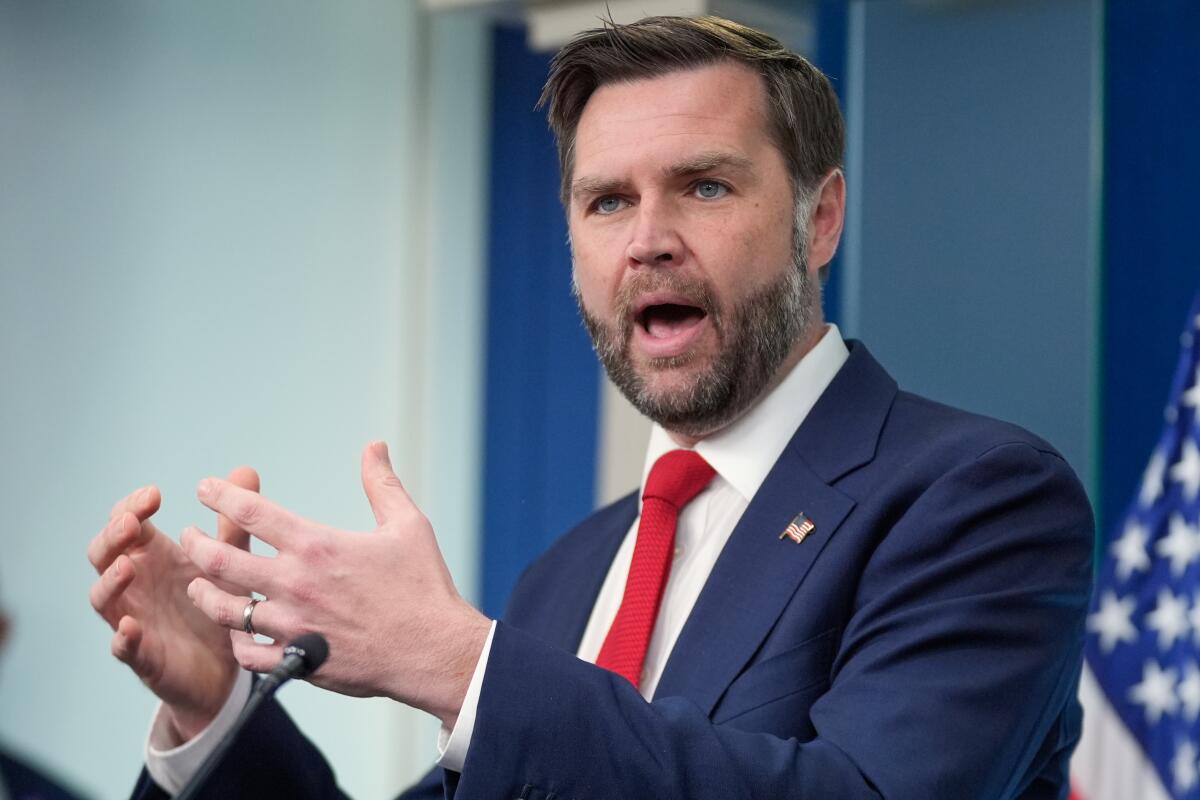
Vice President JD Vance, who helped negotiate the deal, told reporters Thursday that the deal was structured to reward Iran for good behavior. But the text of the agreement suggests otherwise.
The Trump administration agreed to release billions of dollars in Iranian assets that were frozen and restricted by the United States “upon the implementation” of the memorandum — before any further actions are taken or additional negotiations begin. The president will issue sanctions waivers on Iranian oil, allowing Tehran to resume trading its most valuable export and breaking with decades of policy. And to facilitate that trade, boosting Tehran’s revenues, Trump agreed to immediately end a U.S. naval blockade of Iranian ports.
Still more concessions were offered to the Iranians, including a commitment by the U.S. administration to establish a fund of “at least $300 billion for the reconstruction and economic development of the Islamic Republic” — in effect providing reparations for the war Trump started.
“All required licenses, waivers and permissions needed for the relevant financial transactions will be granted by the United States of America,” the memorandum reads.
Taken together, the document reads as a stunning reversal of U.S. policy toward Iran after decades of concern across administrations in Washington — including throughout Trump’s two terms — that the Islamic Republic represents the nation’s greatest security threats as the world’s largest state sponsor of terrorism.
Criticism from Republican senators, in particular, has been sharp and swift.
Sen. Roger Wicker (R-Miss.), chairman of the Senate Armed Services Committee, said the $300-billion fund “would make Iran’s payoff under President Obama’s 2015 deal look like a pittance by comparison.” And Sen. Ted Cruz (R-Texas) accused the Trump administration of giving Iran money it would use to kill Americans.
“History demonstrates that giving billions of dollars to theocratic lunatics who want to murder us is an exceptionally bad idea, and I think, unfortunately, the president is receiving some really bad advice on this deal,” Cruz said. “I don’t want to see us send a penny to the ayatollah. And I hope that we don’t.”
The Obama-era deal, known as the Joint Comprehensive Plan of Action, included structured sanctions relief for Iran in exchange for concrete and verifiable steps by Tehran to dismantle much of its nuclear program — a framework that Republicans broadly criticized at the time.
By contrast, Trump’s agreement commits the United States to pursuing economic relief for Iran while providing no clarity about the future of Iran’s nuclear program — the very issue Trump cited as the rationale for launching the war.
The memorandum includes a pledge by Iran to never purchase or construct nuclear weapons — a vow the Islamic Republic has made multiple times before, including by signing the Nuclear Non-Proliferation Treaty, in a religious edict issued by the late supreme leader and in the Obama-era nuclear accord.
Vice President JD Vance speaks to reporters at the White House on June 18, 2026.
(Manuel Balce Ceneta / Associated Press)
Detailed negotiations over Iran’s nuclear program — including whether Tehran could continue domestic uranium enrichment, at what level, and under what monitoring regime — were left for another day.
For more than a decade, the U.S. intelligence community has assessed that Iran sought a threshold nuclear capability, securing the strategic advantages of a nuclear power without incurring the costs of openly pursuing a bomb.
The agreement does include a commitment by Iran to do its “best” to bring commercial shipping traffic through the Strait of Hormuz, a vital international waterway, back to prewar levels. But critics of the president said he had to make deep, historic concessions just to secure a status quo ante upended by the war he started. And in the document, Tehran agreed to refrain from imposing a toll on ships transiting the strait for only a 60-day period.
“Unless you were homeschooled by a day drinker, no one’s confident that Iran is going to do anything,” Sen. John Kennedy, a Republican from Louisiana, told reporters this week.
Sen. Bill Cassidy, Kennedy’s Republican counterpart from Louisiana, called the deal “the worst foreign policy blunder in decades” that would have President Reagan “rolling over in his grave.”
“Iran’s nuclear ambitions were not curbed, and they have learned that threatening the Strait of Hormuz works and will undoubtedly leverage it in the future. Now, Iran gets to build brand-new infrastructure under this deal,” Cassidy said.
“Before the war, the strait was open, Iran was being crushed by sanctions, and 13 service members were still alive,” he added. “Now, 13 Americans are dead, families have paid billions at the pump, sanctions will be lifted, and the bombing has stopped.”
Despite mounting criticism, Trump put his signature to the memorandum on Wednesday night while attending a dinner with the French president in Versailles, a palace infamous for hosting a treaty signing that disgraced Germany at the end of the First World War.
He defended the agreement while in Europe and suggested further concessions might be forthcoming, including recognition of Iran’s claimed right to enrich uranium and a new willingness to tolerate its continued ballistic missile development — another program that Trump had vowed to eliminate as a central war aim.
“He took America to war — killing 13 soldiers, thousands of Iranian civilians and costing taxpayers $60 billion — to get rid of Iran’s missile program. And now that he’s lost the war, he pretends like it’s no big deal,” said Sen. Chris Murphy, a Democrat from Connecticut.
“Just unforgivable,” he added. “What a charlatan.”
Unprecedented sports feats and historical firsts are usually joyous affairs. Something to celebrate, fun trivia to tuck away for later.
On Monday in Inglewood, the history was much more fraught, and not at all trivial.
Iran’s national soccer team played on American soil — this time on SoFi Stadium’s natural turf — for the first time in 26 years. And for the first time, a country hosted a World Cup participant with which it is mired in an on-again, off-again war.
There was, in the days and hours leading up to the match, protest and pushback from portions of the large, local Iranian diaspora who didn’t think it was possible to support the country’s football team without supporting the oppressive regime.
But inside SoFi Stadium, thousands of L.A.’s Iranian supporters gave the team its full-throated support. So did many new Mexican fans who’ve adopted Team Melli, which has been staying and training in Tijuana between matches as it was barred from the United States except for game days.
Most of the near-sellout crowd of 70,108 were there cheering Iran, helping propel this team under so much pressure to an entertaining 2-2 tie with New Zealand.
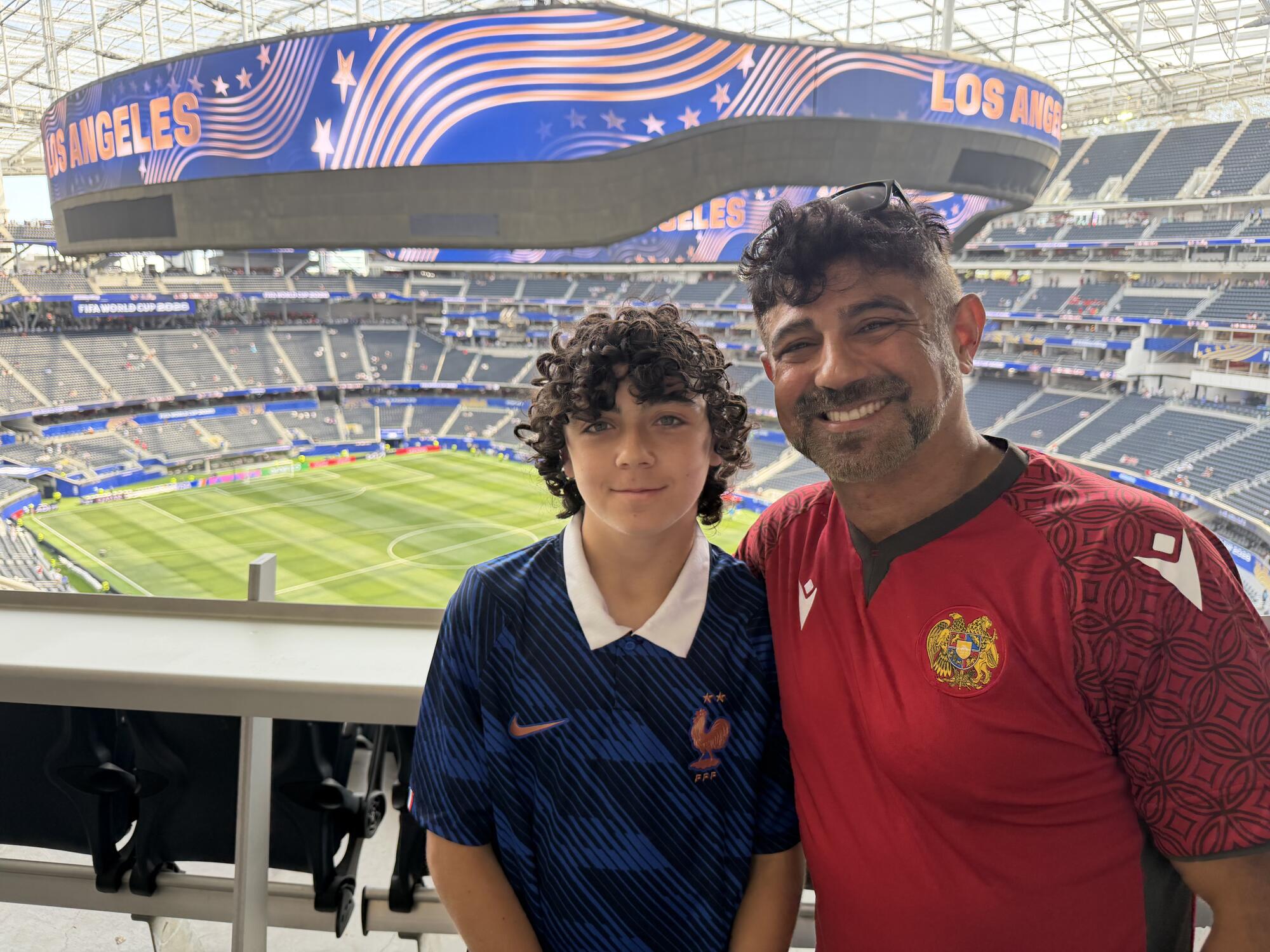
And there, among the thousands of enthusiastic Iran supporters swept up in the match, was my son’s favorite soccer coach, Narbé Mansourian, with his son, 13-year-old Daniel.
Narbé’s brother got his hands on a pair of nosebleed tickets and immediately handed them over to his soccer-loving relatives.
And Narbé — a fifth- and sixth-grade social studies teacher in Hollywood — had no qualms about backing these Iranian men. There were no second thoughts about separating the players from the politics in the country with the complicated geopolitical — and personal — history.
Now, know this: Mansourian is no fan of Iran’s Islamic regime. He was 7 in 1983 when his father, a political dissident, was executed in Evin Prison, nine months after he’d been apprehended.
Narbé remembers visiting his dad, Vazgen, at the notorious prison. He remembers the long drive to get there, the long wait to see him and the game he and his mom used to play: “Today you are 4 years old.”
Narbé Mansourian, right, and his son Daniel before Monday’s World Cup match between Iran and New Zealand at SoFi Stadium.
(Mirjam Swanson / Los Angeles Times)
What started as a way to avoid paying bus fares for 6-year-old Narbé became the way to fool guards at prison, where only the small children were allowed to physically touch their imprisoned loved ones.
He remembers being allowed behind the glass, where he’d wait for his dad to emerge, blind-folded.
When his dad was killed at 37, Narbé said his mother didn’t immediately find out. And when she did, she initially told Narbé that he’d been sick. There was no funeral and when they went to visit his father’s grave, they found a dirt field. There were no markers, Narbé recalls.
He has kept Vazgen’s Coke-bottle glasses, his watch and the still-intact little LEGO house they built together before his dad was taken to prison.
Narbé has held onto so many difficult memories, including the nighttime terrors associated with bombings during the Iran-Iraq war. But there are also happier recollections. Like the stories he would make up about good guys going against the greedy. And, yes, memories of going to soccer games with his dad.
So, “absolutely, I’m going to root for the Iranian national team,” Narbé said before Monday’s match, saying that, to him, equating the Iranian national team with the country’s regime is like rooting against the Knicks because you don’t like President Donald Trump, a native New Yorker.
“It’s not like a cartoon good guy, bad guy,” Narbé said. “There’s so much gray. Because they live there. My heart goes out to them. It can’t be easy, to kind of teeter-totter like that.”
A pre-revolutionary Iranian flag is displayed before the World Cup group stage match between Iran and New Zealand at SoFi Stadium.
(Allen J. Schaben / Los Angeles Times)
I should’ve expected this outstanding youth soccer coach would be most concerned with the players on the pitch.
Some fans got into SoFi on Monday with the Iranian Lion and Sun flag, a historic Iranian national and opposition flag that was banned from the stadium because FIFA desires to steer free of politics (unless it’s steering straight into them). It was a strange sight in Los Angeles, seeing stadium workers asking attendees to discard flags in an effort to censor the expression of people here.
Some of those fans turned their backs during the national anthem, which many in the stands jeered at its start. But then, once the game took hold, so did the support.
“There were many Iranians here,” Iran coach Amir Ghalenoei said through an interpreter. “They believe in different political affiliations, different beliefs, but they all wholeheartedly encouraged us, and I think that’s a victory for all of us.”
WASHINGTON — Independents have grown increasingly unhappy with President Trump during his second term, a new AP-NORC polling analysis finds, particularly those without a college degree.
The analysis from researchers at The Associated Press-NORC Center for Public Affairs Research shows that while about half of independents without a college education had a positive view of Trump around the 2024 election, his approval with that group fell to about one-quarter this spring. That shift has erased the large education gap that existed among independents in the months before Trump took office for his second term, with independents now holding similarly negative views of the president regardless of their level of education.
The analysis was conducted by aggregating nearly two dozen AP-NORC polls conducted between July 2024 and April 2026, allowing for a deeper look at how support for Trump changed during several distinct periods, including the last six months of 2024, the first 100 days of Trump’s presidency, the summer of 2025 when the One Big Beautiful Bill passed, last fall’s government shutdown and the beginning of the Iran war.
The compiled polling shows a steady decline among independents throughout Trump’s second term. His standing has also dropped among several small but important groups that moved toward him in the 2024 presidential election, including Black and Hispanic independents.
More Americans than ever consider themselves independents, and they are among the groups that shifted toward Trump in the 2024 presidential election. Any erosion in that support could signal trouble for Trump and Republicans headed into the midterm elections, which are often seen as reflection of how voters feel about their governing party.
Tafari Torres, a senior research associate at NORC who co-authored the analysis, noted that while Democrats’ and Republicans’ views of Trump have held largely steady in his second term, independents’ opinions are still moving.
“Independents are, broadly, the people who are reacting to the events and dropping in their support,” he said.
Dramatic declines during Trump’s first 100 days
Trump’s return to the White House was in part fueled by independent voters who saw him as the stronger candidate on key issues like the economy. The new analysis, which looks at Trump’s favorability and presidential approval ratings, shows that once he took the helm, their views quickly soured.
Independents without a college degree had a much more positive view of Trump than college-educated independents did during and shortly after the 2024 election, but that shifted in the first few months of his term. Positive views of Trump among independents without a college degree fell from 48% in the months before he returned to office to 31% in polling conducted during Trump’s first 100 days back in office. Those warm views declined even further, to about one-quarter, during the government shutdown and the early months of 2026.
Only about 3 in 10 college-educated independents, by contrast, had a positive view of Trump before he returned to office, making their drop to about one-quarter much less dramatic.
“The decline among no-college independents was steeper and it was greater than the slight decline in college independents,” said Sean Collins, a research associate at NORC who co-authored the analysis. “That was surprising, especially given, when you think of Trump’s coalitions, those without college degrees is usually one of the ones that that stands out.”
Hispanic, younger independents grow disenchanted
Americans without a college degree have long been a key part of Trump’s coalition. But Trump also won in 2024 by making gains among groups that tend to support Democrats, including Hispanic adults.
About 4 in 10 independent voters — 42% — voted for Trump in 2024, up from 37% in the 2020 presidential election. Independent voters without a college degree were a little more likely to back Trump over former Vice President Kamala Harris in the last election, according to AP VoteCast, and Hispanic independents were about evenly split between the two.
The picture looks much bleaker for the president now.
Nearly half of Hispanic independents — 46% — saw Trump favorably in the polling conducted around the presidential election. His approval among these adults dropped quickly in his second term, falling as low as 15% during last fall’s government shutdown before landing around one-quarter in the spring.
Younger independents also became less supportive of the president, while independents age 60 and older remained mostly stable. Other AP-NORC polling has pointed to Trump losing ground among younger Republicans over inflation concerns and Hispanic Americans growing increasingly discontented.
“The gains Trump appeared to make during the election, I don’t know if they’re sticking around. He’s experienced some significant shifts among those people,” Torres said. “From our research, they don’t appear to be permanent gains.”
The economy is frustrating many independents
Polling suggests that the economy is at the root of many Americans’ frustrations with Trump, including independents.
About half of independents who supported Trump in 2024 said inflation was the single most important factor for their vote, AP VoteCast found, and most expressed high levels of concern about the cost of food and gas.
More than a year into Trump’s second term, inflation remains high, fueled by gas prices that remain elevated as the Iran war continues. An AP-NORC poll conducted in April found that about 3 in 10 independents were “extremely” or “very” concerned about being able to afford groceries in the last few months, and a similar share were worried about being able to afford gas.
The analysis found that Americans’ views of the U.S. economy tend to align with their view of the president. Those with negative views of the country’s economy tended to have negative views of Trump, and about 8 in 10 independents described the U.S. economy this spring as poor.
The latest AP-NORC polling from May found that only about 3 in 10 independents approve of how Trump is handling the economy, in line with the roughly 3 in 10 who said that at the beginning of his second term. The April poll found only about 1 in 10 independents — 12% — approved of how Trump was handling the cost of living.
This AP-NORC analysis of 4,836 independents was conducted over 21 AP-NORC surveys, blocked into five time periods before and during President Donald Trump’s second term. Independents are classified as panelists who do not select that they identify with or lean toward either the Democratic or Republican Party.
“I’M still the same person as the 15-year-old me,” decides Blur guitarist Graham Coxon.
“Still a romantic idiot, still reasonably innocent — and I think that’s a healthy way to be,” he continues.
Sign up for the Showbiz newsletter
Thank you!
Blur’s Graham Coxon discusses his ‘lost’ solo album Castle Park, recorded in 2011 and named after his Colchester teenage stomping groundCredit: UnknownDamon Albarn and Graham at Wembley in 2023Credit: Getty
“I don’t want to be a cynical old bastard, so I’m lucky I still have a magical outlook on life.”
I’m talking to Coxon, 57, about his “lost” solo album, Castle Park, which is finally set to come blinking into the sunlight.
The product of sessions which took place in the winter of 2011, it is named after his teenage stomping ground in the centre of Colchester — an affirmation of that younger “same person” self.
In a wider sense, it serves as a nod to his Essex hometown — a city since 2022 — where he attended Stanway School, met Damon Albarn and where, in 1988, they formed Blur with Dave Rowntree and Alex James.
It was there, too, that his band leader and clarinet-playing dad introduced him to music, namely, “the Bs — Beethoven and The Beatles”.
The album cover resembles a classic picture postcard, divided into quarters and depicting scenes from the park with its vast Norman castle and an ornate Victorian bandstand.
Coxon says: “There were a few occasions when me and a group of friends would stay in the park rather too long, get locked in and have to climb over the fence.
“I remember being slightly inebriated and dancing around the bandstand — and then, of course, there was the statue.”
Graham is finally releasing his solo album Castle ParkCredit: James KellyThe guitarist performing with Blur at the Norwegian music festival Oyafestivalen 2023Credit: Alamy
He’s referring to the imposing bronze Angel Of Victory which stands atop the Colchester War Memorial at the southern entrance to Castle Park.
“I had some dangerous moments when I climbed up and gave that statue a kiss,” he admits. “I used to do it regularly — she was very beautiful.”
If that fearless act of youthful exuberance was an example of Coxon’s romantic nature, it’s clear that he carried it forward to the album that was shelved until now.
“It comes through,” he agrees, “even though there are songs about getting dumped.
“There’s a lot of processing my own romanticism on that album, but not in a heavy way.
“It’s reasonably light-hearted for the first half at least, even if it takes a tumble down to the most depressing song I’ve ever written [album closer All The Rage]. But that’s life, isn’t it?”
Looking back at ten tracks of “romance, break-ups, heartache and alienation”, he says: “When I was writing them, I was in a very problematic situation emotionally. Somehow, songs have a way of describing your situation more succinctly than whatever is going through your mind.”
In 2026, I’m happy to report that Coxon is in a much better place. It’s 10am when I’m connected via video call to the home he shares with partner and bandmate in The Waeve, Rose Elinor Dougall, and their daughter.
Blur with (L-R) Graham, Alex James, Damon Albarn and Dave Rowntree at the MTV Europe Music Awards in 1995Credit: GettyLooking back on his output, Coxon says: ‘I think it has had a lot to do with my development as a person’Credit: Unknown
“You’ve got me before my brains kick in,” he warns me, but he soon warms to the task of talking about his music outside of Blur.
Aside from the imminent release of Castle Park, this year sees reissues of Coxon’s back catalogue, beginning with his debut album The Sky Is Too High (1998) and its follow-up, The Golden D (2000).
He’s also working on the third Waeve album with Rose, which he describes as “a lot less hard-edged” than 2024’s City Lights.
“It’s more floaty and summery,” he reveals, before reaffirming his romantic credentials.
“Lyrically, there’s a lot more affection. Rose and I go through life together and, sometimes, saying things in lyrics is the nicest way to show affection away from our normal hectic lives.”
But it is his “lost” Castle Park, with lyricism and songcraft as assured as anything in his solo repertoire, that we are focusing on. So, how come the album joined a legendary list that includes The Who’s Lifehouse and The Beach Boys’ Smile by lying dormant for years?
Coxon casts his mind back to 2011 when he headed to The Pool studios in Bermondsey with Ben Hillier, co-producer of Blur’s 2003 album Think Tank (made without Graham except for one track) and engineer on The Golden D.
He says: “It was really odd because I recorded 20 songs and ten of them became A&E [released in 2012], which was based around improvised bass lines.
Aside from the imminent release of Castle Park, this year sees reissues of Coxon’s back catalogue, beginning with his debut album The Sky Is Too High…Credit: SuppliedThe Sky Is Too High follow-up, The Golden D (2000), is also being re-releasedCredit: Supplied
“The other ten were weirdly different — more trad indie, jingle-jangly, with a bit of Sixties influence.”
Those songs, you may have guessed, were earmarked for Castle Park.
Speaking of parks, Coxon had form thanks to Parklife, Blur’s immortal hit with lyrics by Damon Albarn and music by the whole band, not to mention a vocal masterclass from Phil Daniels.
Despite a widely held belief, the song wasn’t inspired by Castle Park but, as Albarn once explained, by London’s Hyde Park where he used “to watch people and pigeons”.
It seems as if the Britpop icons’ 2012 reunion, which included a momentous Hyde Park show to mark the end of the Olympics, is the chief reason why Coxon’s next album didn’t appear.
That rapturously received performance led to Blur’s run of festival shows in 2013 and a new album in 2015, The Magic Whip.
Then Coxon moved on to mastermind soundtracks for Channel Four comedy drama The End Of The F***ing World as well as embarking on a sci-fi music/graphic novel project in 2021 called Superstate.
In other words, while Castle Park gathered dust, Coxon kept himself busy.
He says: “I’m really not sure what happened. Maybe it was lack of confidence. Maybe I thought these songs weren’t fashionable and who would give a s**t?”
Over the years, however, his theory didn’t stand up as fans would repeatedly ask him to release Castle Park. “They even knew the name of the album.”
The clamour heightened when Coxon broke out some of the songs during live shows.
These include opening track Billy Says, a spiky three-minute slice of mod-pop, which finds him channelling his heroes, The Kinks and The Jam.
He says: “Ray Davies is the best songwriter we ever had, followed closely by Paul McCartney, and The Jam was a huge band for me. I thought that being a Jam fan elevated me as a person.”
Other tracks to receive a live airing were Alright, with its pithy putdowns of a love rival, a playful duet with Lucy Parnell called There’s A Little House, and gorgeous acoustic guitar-led Easy.
Of all the Castle Park songs, there’s one which Coxon is most proud of, the poised, richly atmospheric Isn’t It Funny.
“It came to me in the dream,” he says. “I had the chords and half of the chorus, I heard some words — and then I woke up. I thought, ‘My gosh, I need to make a quick note of this.’”
Isn’t It Funny contains the lines: “The sun made black her hair and the river her eyes. She needs no man, no sea, nor heather. She’ll change your mind and slip away.”
By way of explanation, Coxon says: “I realise that there’s always been this elusive feminine spirit or a goddess of nature in my work.
“I don’t write songs about this entity for my own excitement. They just come out.”
Then there’s the sublime Mélodie Pour Christine, a lyric-free classical piece for harp and strings with Lucy Parnell’s vocals serving as another instrument.
“That piece was important to me,” he says. “I devoted it to a French friend of mine — a wonderful person who I loved very much and is no longer with us.”
Another song that hits the mark is bleak All The Rage, which, he says, “communicates one’s despondency around the creative life — and that has got even worse 15 years later!”
If most of Castle Park is filled with distinctly English sensibilities, American influences arrive with a cover of When You Find Out by short-lived Seventies punk-pop trio The Nerves.
“It’s a great song, even Blondie would go, ‘Hey, this is a good one’. I just made it slightly less than perfect,” laughs Coxon.
Then there’s “an attempt at soul” with Forget Today which finds him employing his considerable saxophone skills and Ben Hillier providing Hammond organ. (Worth noting that Coxon played sax on Parklife.)
Dripping Soul ventures into territory occupied by Ennio Morricone’s spaghetti western soundtracks, “so it’s not exclusively weird south-east of England s**t”.
“I love westerns, particularly Sergio Leone films. A Fistful Of Dollars and all that,” says Coxon.
In the song, he is peering “beyond the veil” at the “souls of those cowboys who came from a place where life is cheap and death is taken for granted”.
With its galloping guitars, Coxon realised he couldn’t turn Dripping Soul into “a hanging out in Camden sort of thing”.
But he does believe that the house he shares with Rose in London is populated by the souls of dead people.
“I don’t even believe in ghosts, but I’ve seen them,” he reports. “So that’s a bit of a quandary.”
Coxon says he still likes to talk to dear departed loved ones: His mum, Christine, drummer Graham Fox, the Irish journalist who first wrote about Blur, Leo Finlay, and the head of Food Records, Andy Ross.
“I don’t really see them as gone,” he says. “I can still talk to them — they may have disappeared but they’re still fully alive in my mind.”
With that said, we return to 1998 when all those people were still with us — to the making of Coxon’s debut solo album The Sky Is Too High.
It was an unvarnished, largely acoustic affair featuring his own artwork and, as he explains: “It was recorded through really good gear but approach was quite raw.”
Sandwiched between Blur’s self-titled fifth album and its follow-up, 13, “It was done in a bit of a hurry — I wasn’t f***ing about.”
The project had begun when a neighbour asked Coxon to write a couple of songs for a film about Victorian bare-knuckle fighter Tom Sayers — setting wheels in motion that are still spinning.
He says: “That request turned into an addiction to writing songs and releasing them.”
So, how did his solo endeavours affect his relationship with his Blur bandmates. “They didn’t talk about it,” replies Coxon, “Though I did once catch Damon singing R U Lonely? He said, ‘That’s quite a catchy little tune’.
“Attempting to develop as a songwriter when Damon Albarn is your best mate is hard work. I mean, he’d already written some bloody good songs by then.”
Released in 2000, Coxon’s second effort, The Golden D, is very different — heavier, more abrasive and driven by searing electric guitars.
The mood changes with the funky Oochy Woochy, which tapped into Coxon’s fascination with Nineties’ fusion of hip-hop and jazz — a style developed by American rapper Guru called Jazzmatazz.
He says: “I’ve always liked that skinny beat stuff with James Brown loops or similar. Stuff like Public Enemy and 3rd Bass. Oochy Woochy is not a mickey take but a go at that.”
With physical releases of Coxon’s other albums still to come this year, there’s plenty more scope to revisit his solo journey.
Then, in November, he’s hitting the road for a UK tour, bringing the songs back to life still further.
Looking back on his output, Coxon says: “I think it has had a lot to do with my development as a person.
“You know, that anxiety-ridden creative weirdo who puts all this stuff out there.
“I guess that’s why I like Castle Park coming out — because now there are no secrets. You’ve got it all.”
GRAHAM COXON
Castle Park
4.5 STARS
Castle Park is out 19th JuneCredit: Supplied
Also released: The Sky Is Too High and The Golden D
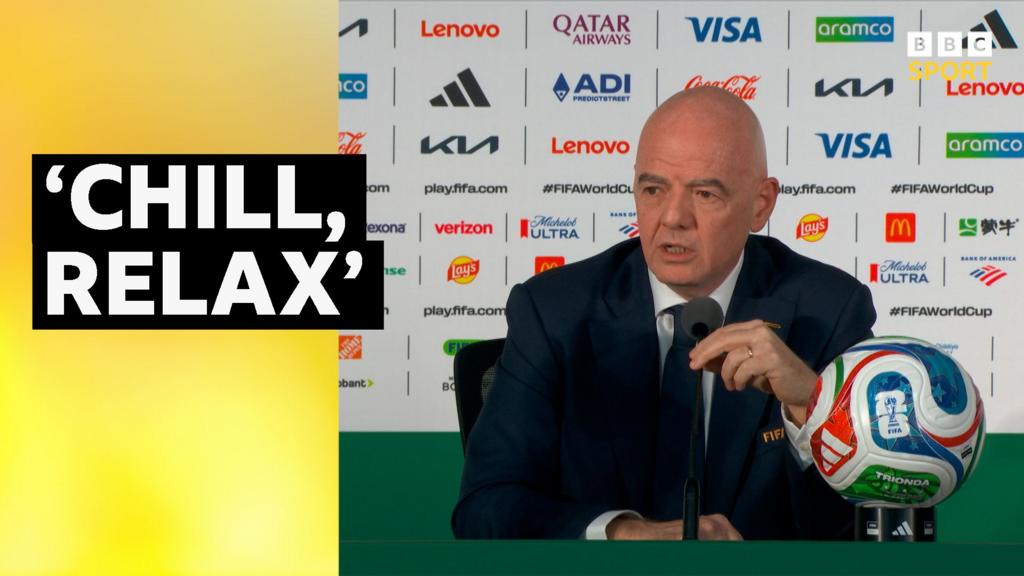
BBC sports editor Dan Roan quizzes Fifa president Gianni Infantino on the eve of the World Cup, after he told journalists to “chill” and “relax” over visa and ticketing issues.
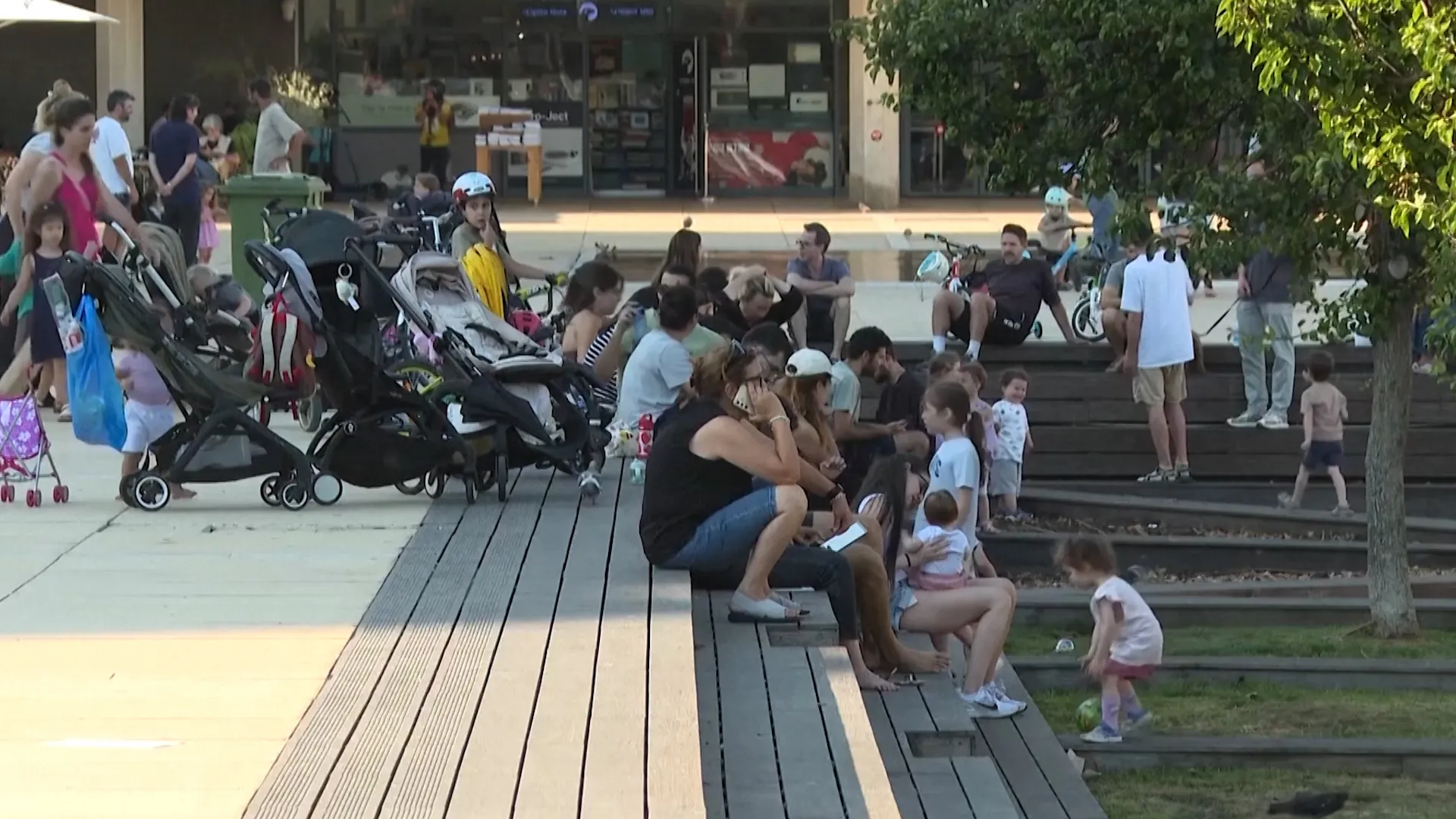
Residents in Tel Aviv voiced mixed reactions after Israel and Iran said they would halt strikes following a day of missile exchanges. While some wanted a stronger response against Iran, others said Israelis were ‘losing’, citing disruptions to daily life, schools and tourism.
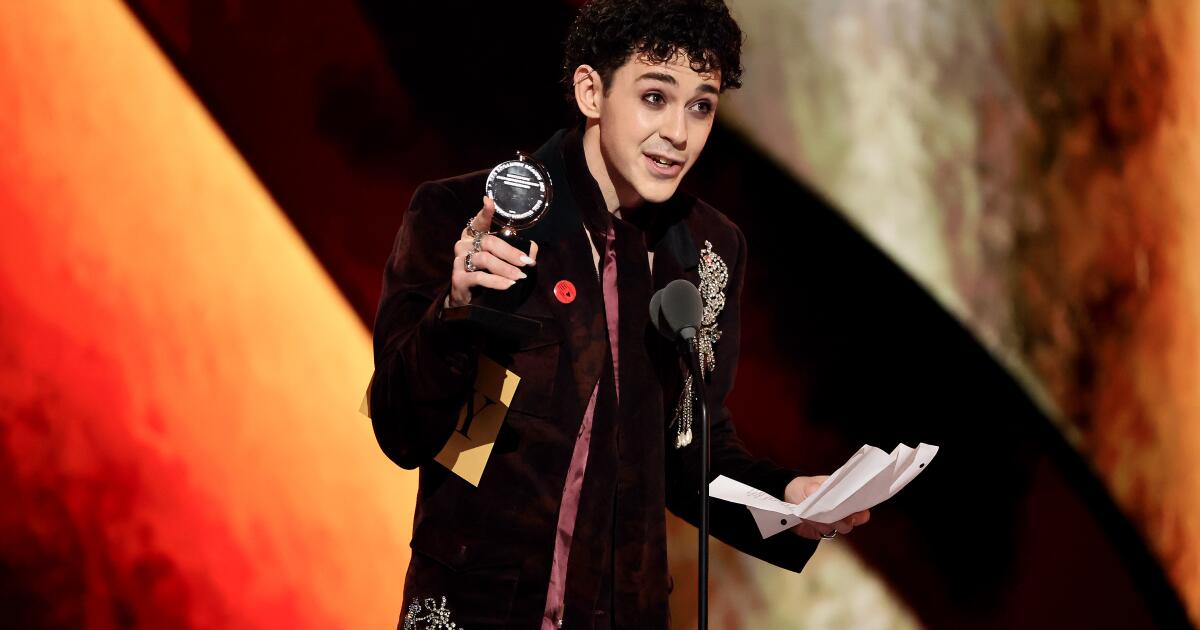
Ali Louis Bourzgui scored an upset win for performance by an actor in a featured role in a musical for originating the role of David in the musical adaptation of the cult vampire horror film, “The Lost Boys.”
As viewers scrambled to keep their score cards straight — André De Shields was favored to take the trophy for his work in “Cats: The Jellicle Ball” — the 26-year-old Bourzgui went on to deliver the night’s most impassioned, and pointedly political speech.
He began by noting that, “Vampires represent those who have shunned their own humanity in order to achieve a non-existent sense of superiority. The billionaires will never find happiness from their money. The colonizers will never find fulfillment from the land and lives they steal. The fascists will never find meaning from their conformity, not in this lifetime or eternity.”
Through the cheers of an invigorated audience, Bourzgui went on to talk about how “theater is one of the last places people can come to worship the power of true collective human presence.”
At its best, he said, theater helps us see ourselves in a stranger’s story.
“This is dedicated to the beautiful tapestry of immigrant families who make this country really special. May you one day not have to audition for the empathy that should be freely given by this country that benefits from your beauty, for the queer and trans communities who will exist, no matter what people in power try to take away from them.”
Bourzgui, whose father immigrated to America from Morocco, went on to pay tribute to Palestine and his own Arab heritage.
“For the people of Palestine, who deserve a free life, a full life without occupation, for Arabs and their makers and artists, may we continue to tell our stories and show our faces. Our humanity becomes undeniable, and our families can no longer be written off as merely collateral damage, may they know the beauty of our kisses upon his cheek and the romance of a language rooted in passion for love and life itself.”
He wrapped up this speech with a plea for love and empathy.
“If there’s one thing we can learn from vampires, it’s that life is short, but that’s it’s a gift. Find beauty in the ephemeral and gratitude in what is not promised, and always invest in the people that want to see you blossom into your truest self, and hold that space for them in return.”
A handout photo made available by Metta Tham Kalasin Rescue shows a Laotian survivor rescued from a flooded cave in a mountainous area in Xaisomboun province, Laos, on Friday. Photo by Metta Tham Kalasin Rescue/EPA
June 1 (UPI) — Rescue workers in Laos said they heard a knocking sound while searching flooded caves for villagers who went missing on May 19.
The search continues in the Xaisomboun province for two of seven villagers who descended into the caves searching for gold last month. The rescue workers said Monday they knocked on the cave walls and heard a “knocking response” from deep inside the cave system within the last 24 hours.
An eighth villager went into the cave with the group but was able to escape and alert of the seven others who were trapped.
“Yesterday, when we knocked, there was a signal responding back,” Kengkaj Bongkawong, head of Metta Tham Rescue Kalasin, a Thai rescue team, wrote on Facebook. “It was a knocking sound meant to be heard. Based on our initial assessment, this is considered not to be a reflection or an echo of the sound.”
The sound was discovered after the rescue team rappelled down a vertical shaft they had discovered. They report hearing a knocking response twice in the last 24 hours.
Flash flooding after the villagers went into the cave caused them to be trapped. Five of the villagers were rescued last week when a rescue team pumped water out of the cave to help them get out.
One of the villagers was trained to scuba dive and was able to swim out of the cave.
“Moving forward, it won’t just be a matter of sitting around waiting for water to be pumped out,” Bongkawong wrote.
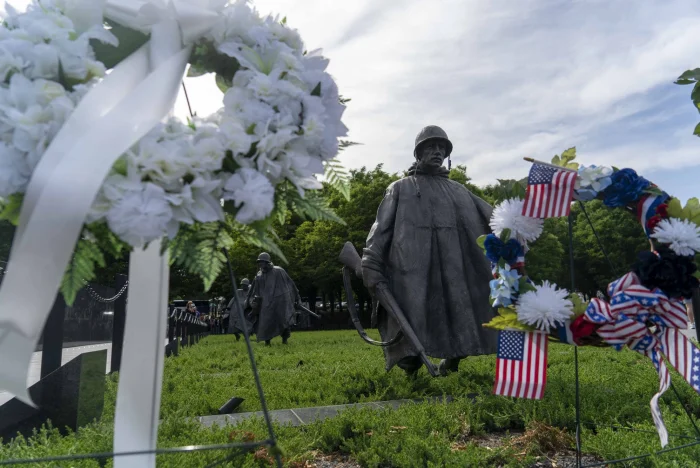
Wreathes are seen amongst the statues at the Korean War Veterans Memorial during Memorial Day weekend in Washington on May 27, 2023. Memorial Day, which honors U.S. military personnel who died while in service, is held on the last Monday of May. Photo by Bonnie Cash/UPI | License Photo
Hollywood has been waiting for Kane Parsons since the year he was born. The 20-year-old director is the same age as YouTube’s first videos and grew up with no barriers between his creativity and an audience. “Backrooms,” his debut feature, marks the start of a new new wave of filmmakers raised by internet feedback who are ready to reinvigorate the industry.
Young Steven Spielberg screened his 8mm reels for his neighborhood. Parsons uploaded his early shorts online where he could analyze the mass response. When one, an unsettling nine-minute experiment about a warren of dingy carpets, taffy-yellow walls and gridded drop ceilings clicked with 78 million viewers, he made sequels. A24 offered Parsons a deal before he finished high school. He’s graduating into multiplexes having spent his adolescence writing, directing, editing, composing and market-testing what people want to watch. I’d toast to that, but Parsons isn’t old enough for Champagne.
Given that backdrop, “Backrooms” would be one of the year’s most significant releases even if the movie itself was merely fine. But it’s better than fine — it’s a work of honest-to-goodness art. Working with screenwriter Will Soodik, Parsons has gone back into that banal maze to find an uncannily mature story about loss and stagnation, about how our self-serving narratives barricade us from emotional growth.
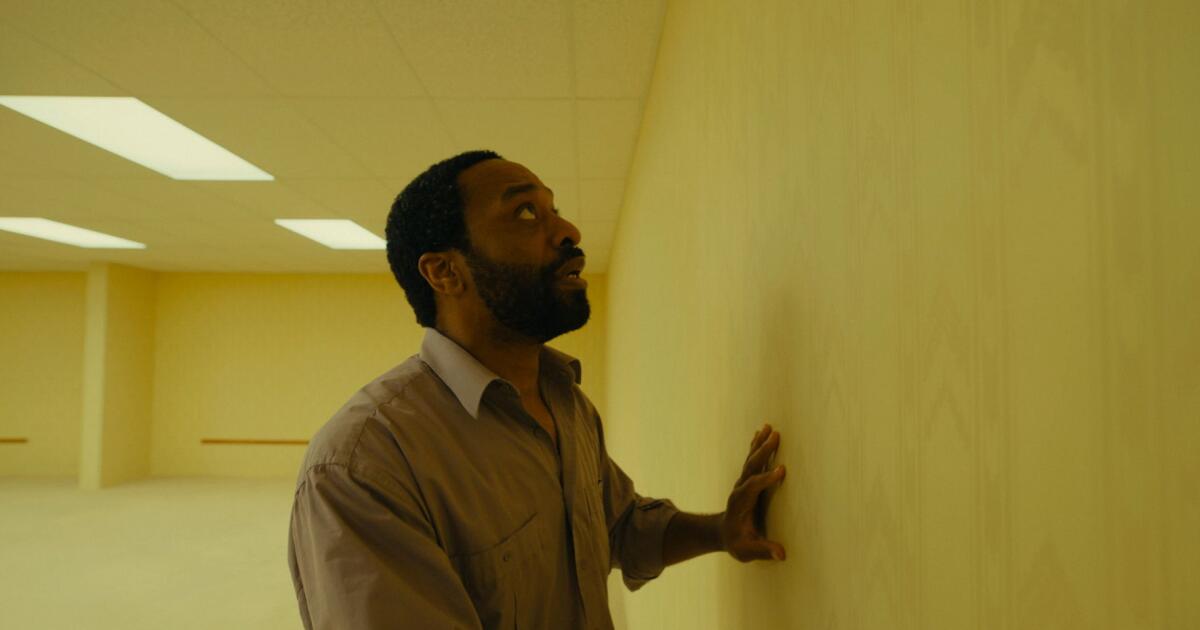
Set in 1990, “Backrooms” has the fritz of an old VHS tape. (Like so many other Gen Z kids, Parsons is nostalgic for a pre-smartphone era he never knew.) A failed architect-turned-furniture salesman named Clark (Chiwetel Ejiofor, superbly expressive) tumbles through a portal in his store’s basement to the backrooms of the title — less Alice in Wonderland, more Alice in Wonderbland.
“It’s like it was made by a bunch of construction workers on acid,” he muses. The hallways lead to more hallways, the overhead fluorescents whine like hornets. Someone — or something — has piled lamps and stools into the center of one room, scattered chairs in another and embedded shoes into the floor as though the ground were made of sand. The disorder looks like the wreckage of an unknown chaos. Aboveground, Clark is trapped in his own resentments, throwing temper tantrums like a toddler. Down here, frustration feels natural.
Should he be afraid? And if so, then what of?
Distant thuds warn that Clark isn’t alone. Soon after, three other characters follow Clark into this liminal space: his loud employees Bobby and Kat (Finn Bennett and Lukita Maxwell) and his exasperated therapist, Dr. Mary Kline (Renate Reinsve), who is haunted by flashbacks of her agoraphobic mother. There’s also a mysterious man in a lab coat (Mark Duplass) who works for a company that factors into the backrooms’ preexisting internet lore, but doesn’t have much purpose in this script. It’s fine just to see Duplass as a gesture toward corporate apathy. More beings will appear too and cinematographer Jeremy Cox’s deliberately low-fi look forces you to do triple and quadruple takes to comprehend what you’re even seeing.
How does a 20-year-old fathom adult-sized discontent? Lord knows, but Parsons does. One theory is that today’s 20-year-olds were just launching into teenhood when the pandemic teleported them from their classrooms to isolated computer screens. Meanwhile, they overheard their parents fret that society might be forever hollowed out. When a young person looks toward the future, what do they see? Probably not an office building bustling with entry-level jobs.
Think about how the act of buying a couch no longer involves interacting with a salesman like Clark, but peering at a pixelated living room that doesn’t actually exist with a couch that changes colors at a tap. Think about how lately the internet at large feels human-less. Then layer that emptiness over the images here.
Sparse yet gripping, “Backrooms” and its minimalist story accommodate the audience’s own free-ranging imagination. The infinite size of these drab catacombs triggers sense-memories of feeling small and confused in an ordinary place that feels all wrong. It’s a time travel trip back to childhood — mass entertainment made intimate — with Parsons tossing us scraps of Clark and Mary’s personal histories like a breadcrumb trail. I remembered what it felt like to get lost in a motel on a road trip with my grandparents. More recently, I tidied the home of a friend who was in the hospital, the pill bottles and crumpled blankets left in situ as evidence of someone else’s pain. “Backrooms” felt like that, too.
There’s an incredible special effects shot where the camera sinks through the floor of Mary’s living room to find a mutation of the same room — and then another and another — each replica deteriorating further from reality until it becomes a new room altogether that would fit right into the backrooms. This, we wordlessly understand, represents how memories of the past can be at once factually inaccurate and emotionally true. We’ve all been bewildered kids, Parsons more recently than most. Some of the most powerful people on Earth still behave like they’re stuck in that headspace.
Describing “Backrooms” as a horror film doesn’t feel exactly right. It’s a surrealist painting in motion, the equivalent of staring at Salvador Dali’s wasteland of melting clocks until it makes gut-sense. Dali made that famous masterpiece, “The Persistence of Memory,” in 1931, a breath-holding moment between wars when daily life looked normal enough but vibrated with the dread that no, things were definitely not OK. Kids don’t know that, but they vibe with Dali anyway because he keys into their suspicion that the world doesn’t really obey the rules.
That anxiety hums through “Backrooms.” It’s why millions of people watched and shared the original short. Yet as fraught as it sounds — and as abruptly as it ends — I left elated. A major new moviemaking talent has arrived and he’s the beginning of a movement. Other internet-honed young filmmakers will follow with their own fresh insights into genres like action, comedy and romance. Kane Parsons is just the first one through Hollywood’s labyrinth.
‘Backrooms’
Rated: R, for language and some violent content/bloody images