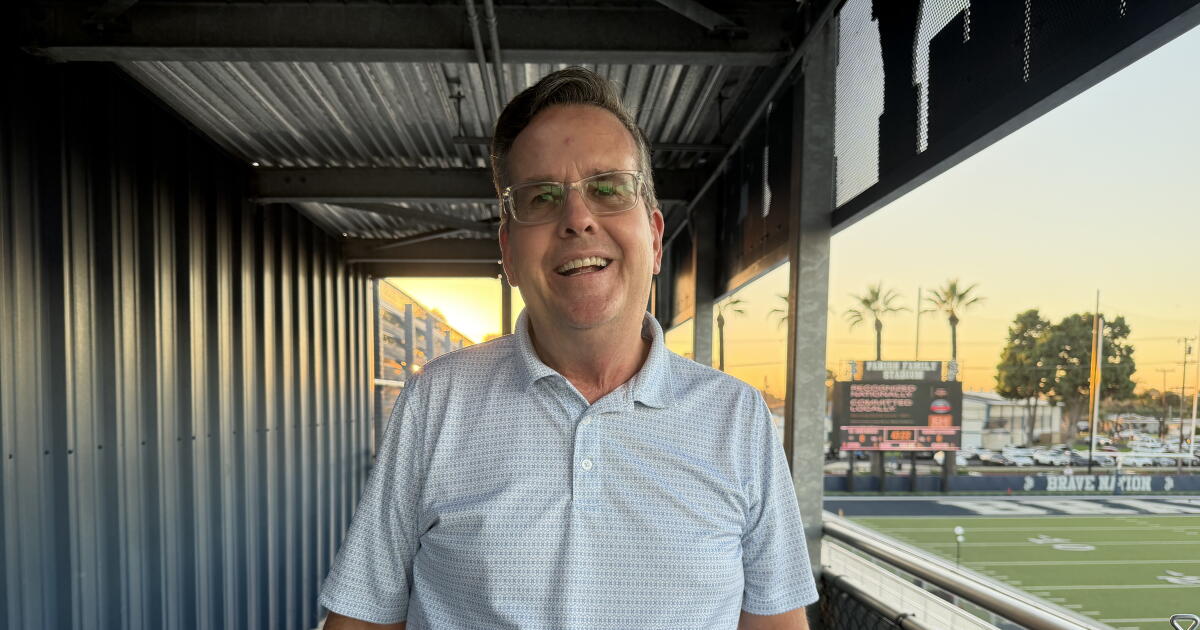
Jimmy Crowley, the son of former Southern Section commissioner Dean Crowley, had a Friday night off from officiating Big Sky Conference football games, so he went to St. John Bosco last week to evaluate the high school officials for a game against Orange Lutheran.
Southern California high school football games have been used as a proving ground for years and a first stop for officials wanting to move to college and the NFL.
It used to be that the commissioners in the City Section and Southern Section were high school or college officials. Jim Cheffers, a former City Section commissioner, used to officiate in the Pac-8. Now his son, Carl, is one of the top NFL referees and has worked three Super Bowls.
Tony Corrente, a former baseball coach at La Mirada who won a CIF title in 1988, made it to the NFL for 26 years as an official and was referee for Super Bowl XI. Former Hollywood High principal Jim Tunney was a long-time NFL referee.
While fans sometimes don’t appreciate officials, in Southern California high school football, you might be watching a future college or NFL referee.
This is a daily look at the positive happenings in high school sports. To submit any news, please email eric.sondheimer@latimes.com.
Skydance-owned Paramount Pictures has taken over the lease for the Bay Theater in Pacific Palisades and intends to reopen the cinema, which has been closed since the January 2025 Palisades fire last year.
Paramount plans to upgrade the theater with state-of-the-art projection systems and in-seat food and drink service, Rick Caruso, whose company owns the Palisades Village shopping center where the Bay Theater is located, said in an interview. Caruso is founder and executive chairman of the real estate firm Caruso.
Paramount plans to show first-run theatrical movies from all studios. The theater will be operated by The Lot, a La Jolla-based luxury dine-in theater chain with four locations in California. The theater is expected to reopen later this year, Caruso said.
“The comeback of this movie theater is a great signal for all of L.A.,” he said. “Los Angeles is resilient, and we’re going to show the country that Los Angeles can bounce back from a terrible, terrible disaster, and the comeback is going to be much greater than the setback.”
Palisades Village reopened in August after more than $100 million in renovations, including major infrastructure work. The upscale outdoor mall survived the Palisades fire, but needed refurbishment to eliminate any potential contaminants from the blaze.
Caruso declined to share terms of Paramount’s lease agreement, saying only that it was long-term. Paramount declined to comment on the size of its investment in the theater.
Caruso said he brought up the Bay Theater over lunch last year with David Ellison, chief executive of Skydance, who was then working to acquire Paramount. The two were discussing that deal and Ellison’s belief in the importance of the movie theater business to the industry.
“Together with Caruso, we are proud to help bring the Bay back to life as a place for the Pacific Palisades community to gather around the shared experience of cinema,” Ellison said in a statement. “This theater has always meant more than movies alone — it’s woven into the fabric of this neighborhood, and helping restore it is a privilege.”
The Bay Theater was previously leased by Netflix, which took it over in 2021. The company used the theater to host special events, screen classic films and showcase its own original theatrical movies.
Caruso described Netflix and company Chief Executive Ted Sarandos as “incredible stewards” of the theater, adding that Sarandos was “very much a gentleman” in having the discussion about Paramount stepping in at the theater.
Ellison has long extolled his love of movies and appeared at the CinemaCon movie theater owners convention earlier this year to reiterate his commitment to theatrical releases.
Studios were barred from owning theaters for decades under the Paramount consent decrees, which a federal judge terminated in 2020. Netflix has since operated the Egyptian Theatre in Hollywood and the Paris Theater in New York.
“Through our curated offering and dedicated hospitality, we look forward to welcoming the Pacific Palisades community back to the movies, the way they were intended to be shared,” Adolfo Fastlicht, founder and chief executive of The Lot, said in a statement.
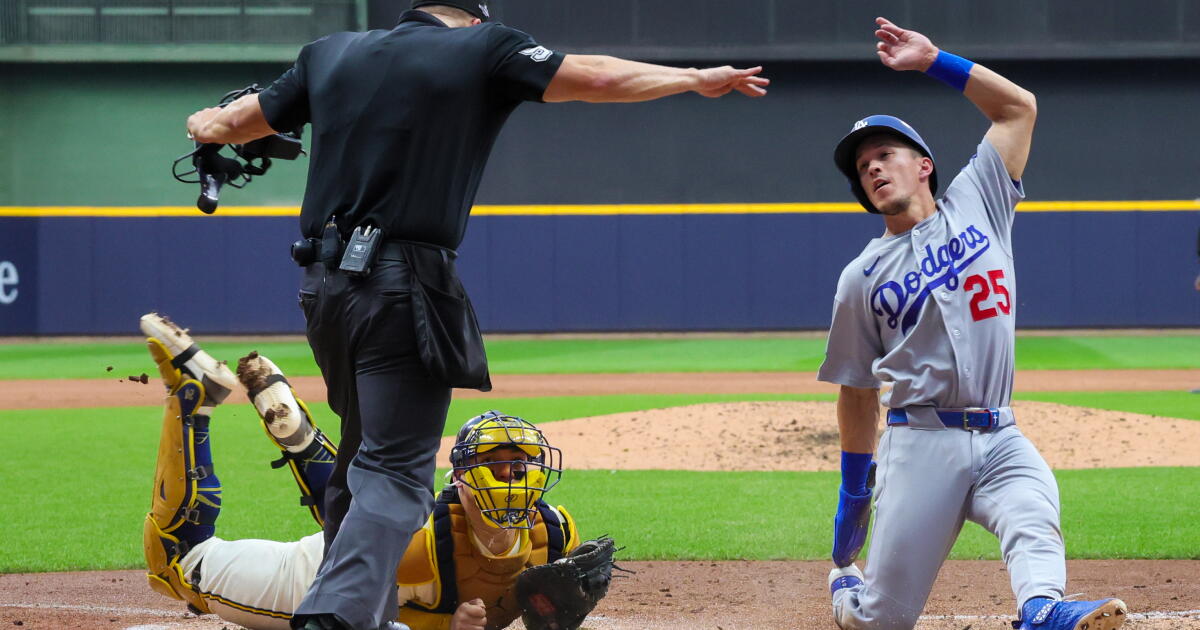
From Maddie Lee: Mookie Betts slapped his bat with his free hand after tipping a slider from Brewers right-hander Abner Uribe back into catcher William Contreras’ mitt.
Betts had been setting the tone for the Dodgers from the leadoff spot all postseason, taking good at-bats against some of MLB’s best starting pitchers. But there wasn’t much he could do against a sinker-slider mix like Uribe’s.
Uribe shuffled off the mound, and the crowd at American Family Field roared.
Then, with left-handed-hitting Freddie Freeman coming to the plate, Milwaukee had an answer for him too. Manager Pat Murphy signaled to the bullpen, left-hander Aaron Ashby emerged and struck out Freeman on four pitches, only one of which touched the strike zone.
“They all throw 100 [mph] from different angles,” Freeman said after the Dodgers’ 7-4 loss in Game 2 of the National League Championship Series on Monday.
The Dodgers’ performance against the Brewers bullpen on Monday magnified how much the star-powered lineup hasn’t been clicking with Shohei Ohtani struggling at the plate. He went 0-for-4 in the cleanup spot in Game 2, bringing his postseason total to three hits, all singles, in 20 at-bats.
Manager Dave Roberts told The Athletic after the game that he would “have a conversation” with Ohtani Tuesday to determine “what’s best for him, what’s best for [the team].”
Get the latest on L.A.’s teams in the daily Sports Report newsletter.
By continuing, you agree to our Terms of Service, which include arbitration and a class action waiver. You agree that we and our third-party vendors may collect and use your information, including through cookies, pixels and similar technologies, for the purposes set forth in our Privacy Policy such as personalizing your experience and ads.
Three-peat chance is looking weak
From Bill Plaschke: Once brimming with life, the Dodgers’ historic quest has curled up into a withered heap.
The three-peat is slowly, agonizingly having the life squeezed out of it by a collection of hardscrabble Midwesterners with no regard for stardom or status.
Two games into the National League Championship Series, the three-peat was formally placed on life support Monday after the mighty Dodgers lost a second consecutive game to those little giants known as Milwaukee Brewers.
This time the score was 7-4 after another devastating night at American Family Field, and now the Dodgers trail two games to none in a best-of-seven series that appears beyond their control.
For a second consecutive game, their ace was knocked out. For a second consecutive game, their powerful offense petered out.
For a second consecutive game, they looked like a weary, aging band of fallen stars that had stumbled into a surprisingly deep pothole and had no idea how to climb out.
No. 1 Milwaukee vs. No. 2 Dodgers at Milwaukee 2, Dodgers 1 (box score) at Milwaukee 7, Dodgers 4 (box score) Wednesday at Dodgers, 5 p.m., FS1/FOX Deportes/FOX One Thursday at Dodgers, 6 p.m., FS1/FOX Deportes/FOX One *Friday at Dodgers, 6 p.m., FS1/FOX Deportes/FOX One *Sunday at Milwaukee, 5 p.m., FS1/FOX Deportes/FOX One *Monday at Milwaukee, 5 p.m., FOX/FS1/FOX Deportes/FOX One
ALCS
No. 1 Tampa Bay vs. No. 2 Cleveland Cleveland 7, at Tampa Bay 3 (box score) Tuesday at Tampa Bay, 5 p.m., TBS/truTV/UniMas/HBO Max Thursday at Cleveland, 3 p.m., TBS/truTV/UniMas/HBO Max Friday at Cleveland, 3 p.m., TBS/truTV/UniMas/HBO Max *Saturday at Cleveland, 5 p.m., TBS/truTV/UniMas/HBO Max *Monday at Tampa Bay, 2 p.m., TBS/truTV/UniMas/HBO Max *Tuesday at Tampa Bay, 5 p.m., TBS/truTV/UniMas/HBO Max
Iamaleava is expected to miss the rest of this season with a knee injury, according to a person with knowledge of the injury not authorized to discuss it publicly.
Chesney said he is waiting for UCLA doctors to “make the final call on things.”
“He has a meeting later today, and he’ll have a whole lot more clarity on exactly where things are at,” Chesney said of Iamaleava during a news conference Monday. “Everything being reported is what’s being reported. There is a serious concern at this moment, but at the same point in time, there is nothing that has been fully ruled at this moment.”
The injury is a blow for the No. 12 Bruins, who are 5-0 during Chesney’s first season and have a favorable path to the College Football Playoff.
Chesney said that while Ty Dieffenbach and Madden Iamaleava, Nico’s younger brother, both earned the right to start, Chesney will start Dieffenbach going forward and see how it plays out.
1893 — The U.S. yacht Vigilant wins the America’s Cup with a three-race sweep over the British challenger Valkyrie II.
1947 — The NHL holds its first All-Star game with the All-Stars beating the Toronto Maple Leafs 4-3. Toronto’s Harry Watson scores the game’s first goal and assists on the other two goals. Trailing 3-2 after two periods, Montreal’s Maurice Richard and Chicago’s Doug Bentley each score to give the All-Stars the win.
1961 — Jacky Lee of the Houston Oilers passes for 457 yards and two touchdowns in a 31-31 tie with the Boston Patriots. Charley Hennigan of the Oilers catches 13 passes for 272 yards.
1963 — Mickey Wright wins her fourth LPGA championship in six years by beating Mary Lena Faulk, Mary Mills and Louise Suggs by two strokes.
1982 — IOC Executive Committee approves the reinstatement of Jim Thorpe’s gold medals from the 1912 Olympics.
1985 — Phil Simms of the New York Giants passes for 513 yards with an NFL-record 62 pass attempts in a 35-30 loss to the Cincinnati Bengals. Simms completes 40 passes with 29 for first downs, also an NFL record.
1998 — For the first time in NBA history, the league cancels regular season games after labor talks break off.
2001 — DeShaun Foster of UCLA runs for a school-record 301 yards and four touchdowns as the Bruins beat Washington 35-13.
2001 — Georgia Southern fullback Adrian Peterson is held to 71 yards rushing, snapping his NCAA-record streak of 36 straight regular-season games with at least 100 yards.
2011 — American Jordyn Wieber wins another gold medal, beating Russia’s Viktoria Komova for the all-around title at the world gymnastics championships in Tokyo. Wieber, who led the Americans to the team title two days earlier, finishes with 59.382 points, just 0.033 ahead of the Russian.
2013 — Kenya’s Dennis Kimetto, six weeks removed from a bout of malaria, breaks the course mark in capturing the Chicago Marathon. Kimetto finishes in 2 hours, 3 minutes, 45 seconds, leading a 1-2-3 finish for Kenyan men. He beats the mark of 2:04:38 set by Ethiopia’s Tsegaye Kebede last year.
2017 — Gustav Nyquist scores twice and Detroit has four goals in the third period to beat Vegas 6-3, handing the NHL’s newest franchise its first loss. Vegas is the first NHL expansion team to win its first three games.
2019 — Simone Biles becomes the most decorated gymnast in history when she wins record 25th medal at the World Championships in Stuttgart, Germany.
Compiled by the Associated Press
This day in baseball history
1903 — The Boston Pilgrims win the first World Series, 5 games to 3, with a 3-0 victory over the Pittsburgh Pirates.
1960 — Bill Mazeroski opens the bottom of the ninth with a home run off Ralph Terry of the New York Yankees to give the Pittsburgh Pirates a 10-9 victory and the World Series championship.
Compiled by the Associated Press
Until next time…
That concludes today’s newsletter. If you have any feedback, ideas for improvement or things you’d like to see, email me at houston.mitchell@latimes.com. To get this newsletter in your inbox, click here.
It marked the first time UCLA defeated Oregon since 2017. The win was the Bruins’ first at Autzen Stadium since 2004. And Bob Chesney became the first UCLA head coach to start his tenure 5-0.
Sunday came with one more breakthrough: The Bruins cracked the top 15 in the Associated Press’ Top 25 for the first time since 2022.
UCLA’s 17-15 victory over Oregon proved that the Bruins deserved a spot in the upper echelons of the Big Ten. Not only did UCLA leave Oregon with an undefeated record — one win away from being bowl eligible — but the Bruins also will returned to Los Angeles with three consecutive home games on the schedule, a stretch that could push them farther up the totem pole.
“It doesn’t matter. Now we have to get better,” Chesney told reporters after the win. “How do we get better? We go back and look at the things we need to fix. We evaluate our personnel and see where we stand once we figure out whether some of these guys are coming back next week. There’s a lot of football left to be played, so it doesn’t matter. Getting better is always the message when we turn the corner.”
Newsletter subscription change
Starting Sept. 21, this newsletter will be available to Los Angeles Times subscribers only. A free press isn’t free, and we depend on reader support to report on the stories that make a difference. If you’re already a subscriber, nothing will change. If you’re not, there’s never been a better time to sign up. Get started here.
Here are three takeaways from UCLA’s fifth win, which kept the Bruins among nine remaining undefeated Football Bowl Subdivision schools and avenged one of Chesney’s two losses last season when his magical run at James Madison ended against Oregon.
Colin Hitschler can bounce back with the best
The week leading up to defensive coordinator Colin Hitschler’s rematch against Oregon featured reminders about how the Ducks steamrolled his Dukes’ defense last season in the College Football Playoff, finishing with 51 points and 514 yards.
And Hitschler acknowledged that Ducks coach Dan Lanning’s offense got the best of him, leaving him with a chip on his shoulder.
His “Bruin Bullies” made their presence felt from the first whistle to the last, forcing seven turnovers — five fumble recoveries and two interceptions, categories in which UCLA now ranks first and second, respectively, in the nation.
And while Oregon quarterback Dante Moore remained sidelined because of a head injury, backup Dylan Raiola — who spent the previous two seasons as Nebraska’s starter — was a highly regarded talent and expected to challenge the UCLA defense, particularly after throwing for 289 yards and two scores against USC last month.
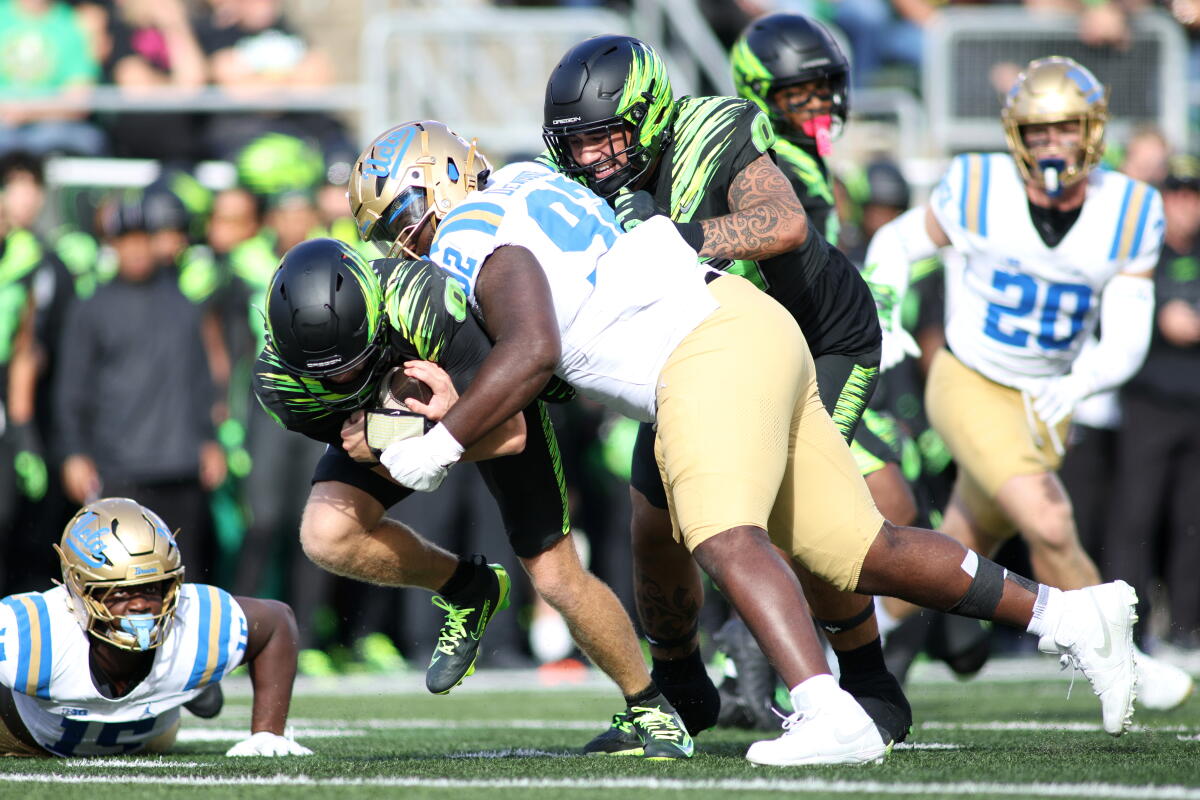
UCLA defensive lineman Darold DeNgohe tackles Oregon quarterback Brock Thomas on Saturday in Eugene.
(Lydia Ely / Associated Press)
The Bruins gave Raiola more headaches than anything else as he finished with 43 passing yards and three turnovers before he was benched for third-stringer Brock Thomas in the fourth quarter.
And even when Thomas entered for Raiola, the Ducks’ offensive weapons largely flatlined despite their perceived superior status.
Running back duo Dierre Hill Jr. and Jordon Davison — who combined for 238 all-purpose yards and three touchdowns against the Trojans — and tight end Jamari Johnson, who torched the USC defense for seven catches and 119 yards, were limited to a combined 111 all-purpose yards and just one score.
The Bruins’ defense was everywhere in Eugene, limiting the run game to 2.7 yards per carry, largely blanketing pass catchers in coverage downfield and forcing turnovers at every level.
“We don’t focus on outside chatter,” senior linebacker Sammy Omosigho said after the win. “That has no meaning to us, no focus to us, no value to us. We focus on ourselves.”
Bruins’ QB concerns aren’t going anywhere
Many observers who watched Saturday’s showdown will tell you the Bruins should have won more handily.
The Bruins almost doubled the Ducks in time of possession, yet there was a chance for Oregon to win on the last drive of the game.
UCLA had to overcome its own problems, with quarterback Nico Iamaleava battling Raiola for most turnovers and questionable decisions under pressure.
UCLA coach Bob Chesney calls to his players.
(Lydia Ely / Associated Press)
Iamaleava got off to a slow start this season as UCLA relied on its potent rushing attack. He rebounded against Purdue and Maryland, combining for 485 yards and four touchdowns with zero turnovers.
While Iamaleava went 10 for 17 for 162 yards in the first half, his mistakes came at especially costly times for the Bruins.
During UCLA’s second drive, the Bruins were pinned on their 10-yard line. With Oregon outside linebacker Nasir Wyatt blitzing, Iamaleava attempted to throw the ball away to the flat and instead fumbled, giving the Ducks the ball on the Bruins’ one-yard-line. Oregon scored one of its two touchdowns immediately after the turnover.
Later in the half, Iamaleava threw two interceptions, the first at midfield and the second coming at Oregon’s 22-yard line, wiping out a field-goal opportunity.
Iamaleava struggled with accuracy and timing, underthrowing a deep ball to wide receiver Aidan Mizell on the first play of the game — a pass that arguably could have been a touchdown if Mizell was hit in stride — and mistiming a pass to running back Jaivian Thomas, who was wide open in the end zone, on third and goal during the same drive.
Iamaleava was facing a formidable Ducks defense, the best unit the Bruins have played to date, and was injured during the second interception. He did not return to the field after sustaining a leg injury near the end of the first half, and it is unclear how long he will be sidelined.
Backup Ty Dieffenbach steered UCLA to a win, but the Bruins need better quarterback depth.
UCLA is a playoff contender
The Bruins celebrate their win over the Oregon Ducks.
(Tom Hauck / Getty Images)
Saturday was more than just a win. It was a bold announcement to the rest of the Big Ten and the nation that UCLA is a playoff contender.
Chesney told fans during a UCLA men’s basketball game shortly after he was hired that the football team is playing for banners. And Saturday’s win proved that his plan to pursue championships — something that seemed absurd amid a lost 2025 season — has a real possibility of paying off with one.
The Bruins have one of the easier schedules in the Big Ten with seven games remaining. UCLA will play five home games, including with 2-4 Michigan State, 2-3 Nevada of the Mountain West and 3-3 Illinois.
While UCLA still has road games at Michigan and Minnesota and competitive home games against Wisconsin and USC, the Bruins proved Saturday that they can hang in any environment, frustrating the Ducks at hostile Autzen Stadium.
Sign up for UCLA Unlocked
A weekly newsletter offering big game takeaways, recruiting buzz and everything you need to know about UCLA sports — exclusive to L.A. Times subscribers. Free Members receive a partial preview of each edition.
By continuing, you agree to our Terms of Service, which include arbitration and a class action waiver. You agree that we and our third-party vendors may collect and use your information, including through cookies, pixels and similar technologies, for the purposes set forth in our Privacy Policy such as personalizing your experience and ads.
Big Ten confirms a big mistake
The Big Ten released a statement Sunday announcing its officials placed the ball at the wrong spot during Oregon’s final failed two-point conversion attempt after a UCLA penalty. The ball should have been placed at the half-yard line instead of the 1½-yard line. The lead officially announced the correct placement, but the crew never moved the ball.
UCLA’s defense stuffed the two-point conversion attempt, and the Bruins went on to secure a 17-15 win.
The mistake has drawn limited outrage, with fans more concerned about the number of errors by Big Ten officials this season than about them potentially thwarting Oregon’s chance to tie the score. That probably has a lot to do with the number of mistakes the Ducks made and the perception the Bruins outplayed them.
Dieffenbach has long embraced change
Before Ty Dieffenbach was asked to lead UCLA’s offense in the second half at Oregon, he began his high school career in Southern California as a wide receiver.
The Times’ Eric Sondheimer spoke with Dieffenbach ahead of his senior season about his switch to playing quarterback for Agoura, a team that needed a signal-caller and quickly developed a prolific one.
Agoura coach Dustin Croick told Sondheimer he wouldn’t have asked Dieffenbach to play the position just because of the 6-foot-5 athlete’s arm strength. Croick detected something else.
“We can teach kids how to throw, how to read defenses, but the leadership has to be a natural thing,” Croick said.
The two have stayed in touch as Dieffenbach spent two seasons at Pittsburgh without playing before transferring to Cal Poly and starting for one season. Dieffenbach then joined UCLA during the offseason and prepared as though he could be asked to play at any time.
Dieffenbach celebrated with the high school coach who first believed in his quarterback skills via Facetime after UCLA’s win.
Agoura football coach Dustin Croick was busy with relatives in town. He turned off his phone. Then he saw 173 text messages. Then he faced timed with his former QB Ty Dieffenbach after UCLA beat Oregon. Emotional day. pic.twitter.com/eyn5YD6Uva
The Valkyries became the first WNBA expansion team to reach the playoffs in its first season and the Finals in its second.
“I told them that I was proud of our whole team, the whole 14, because I saw another level of fight tonight,” Nakase said after the clinching win. “And that’s what I was really proud of. We talked about leveling up one more as a team and I think that overtime proved strength in numbers. We really left it all out there on the floor. We really emptied the tank.”
Golden State hosts the Atlanta Dream at 12:30 p.m. Saturday to open the Finals. The Dream notably are led by UCLA alum Jordin Canada, the the starting point guard and ignition to their offense.
Bruins on deck
Wednesday, Oct. 14 Women’s basketball at California (exhibition)
Thursday, Oct. 15 Women’s tennis at ITA Regional Championships, all day Men’s tennis at ITA Regional Championships, all day
Friday, Oct. 16 Women’s tennis at ITA Regional Championships, all day Men’s tennis at ITA Regional Championships, all day Women’s golf at Stanford Intercollegiate, all day Men’s golf at Golf Club of Georgia Collegiate Invitational, all day Men’s soccer at Wisconsin, 5 p.m. Women’s volleyball vs. Penn State, 7 p.m. Women’s soccer vs. Washington, 8 p.m.
Saturday, Oct. 17 Women’s tennis at ITA Regional Championships, all day Men’s tennis at ITA Regional Championships, all day Cross country at UC Riverside, 8 a.m. Men’s water polo at USC, 1 p.m. Football vs. Wisconsin, 4:30 p.m.
Sunday, Oct. 18 Women’s tennis at ITA Regional Championships, all day Men’s tennis at ITA Regional Championships, all day Women’s volleyball vs. Ohio State, 3 p.m.
Do you have a comment or something you’d like to see in a future UCLA newsletter? Email newsletters editor Houston Mitchell at houston.mitchell@latimes.com. To get this newsletter in your inbox, click here.
Sports editor Iliana Limón Romero contributed to this report.
One word that could describe Aria Vega’s whirlwind 2026? Chévere.
The Colombian expression for “awesome” is also the name of the fast-rising star’s global smash hit. Released in January, the breezy tropical swing of “Chévere” — and the rest of her sun-kissed singles — embodies the spirit of Colombia’s Caribbean coast where she hails from.
Ahead of the Latin Grammys on Nov. 12, where Vega will be in the running for the best new artist award, Vega is taking what she calls her “Costeñita Core” pop movement on the road, with her first-ever U.S. tour.
“Looking back at all the dreams I’ve accomplished and made come true, it’s all blessings,” a wide-grinning Vega says over Zoom from Miami.
“I’ve been crying tears of joy with my family, my friends and my combo chévere, as I like to call my fandom. Every artist wishes and dreams of a Latin Grammy, and for me, just to be one of the nominees is like, ‘Yo, I’m a winner!’”
Vega was born Mariana Padilla Pérez in Barranquilla, where she lived the lifestyle of the costeños — or the people of Colombia’s Caribbean coastal region. She has been steadily chasing her dreams of superstardom since competing on “Idol Colombia” in 2014; but Vega finally started making waves last year when she integrated more costeño culture, rhythms and slang into her mellowed, Spanglish pop flow.
“Chévere” exploded in popularity after fellow Colombian singer Ryan Castro jumped on the remix in February. Since then, Vega has pushed “Costeñita Core” further into the mainstream with songs like the alluring “Cule Poco (Sirena_Besarico_Costeña),” and the sultry “Compa Coleto (Uy_Como),” offering unhurried takes on champeta and other Afro-Caribbean rhythms.
Vega just kicked off her U.S. Cariavales Tour, which includes a stop at the Roxy in Los Angeles on Oct. 13. Just a week before, she was handpicked by her pop foremother and icon from Barranquilla — Shakira — to perform as part of her 12-show residency in Madrid.
In an interview with The Times, Aria Vega opened up about her Latin Grammy nomination, representing costeños and getting a co-sign from Shakira.
How did the success of the song “Chévere” change your life? I didn’t expect to be on [so many] airplanes and flights. Right now, I’m starting to feel the weight of that. I’ve seen what it’s like to live on the road. The remix happened after Ryan [Castro] sent me a DM on Instagram saying, “‘Chévere’ is a banger!’” I was really excited to even get that message from him, because I’m a fan of his music. That was a really cool moment.
What can you tell us about your upcoming debut album? It’s Afro-Caribbean-inspired music. Right now, the album is really long. I have recorded more than 30 songs for it. I’m working on cutting it down to hopefully 15 songs that will touch your heart and soul … I want to make people vibe with my songs, feel cool, and feel chévere. That’s my goal with this album [I call] “Costeñita Core.”
What does “Costeñita Core” mean to you? It’s an energy that you either vibe with or you don’t. It’s like our food, our slang and experimental fashion. Caribbean maximalism and shifting [mainstream] culture. Overall, it’s about making bold choices and being rebellious.
How do you feel about representing costeño culture through your music and visuals? It’s a big responsibility. I feel really happy and excited when I see comments that say things like, “It’s an honor for you to represent us, and we love what you’re doing.” I get emotional because I don’t always get that response … There’s also people that say, “I feel that I’m not represented by her in any way.” It’s a mixture of feelings. What can I say? I’m doing this with a lot of love for Barranquilla, Colombia and Colombia’s Caribbean coast. I want to be a voice of the Caribbean coast.
What did it mean for you when Shakira selected you to perform for her residency in Madrid? As soon as my team told me about this opportunity with Shakira, I was going crazy because she’s so inspiring. She’s also from Barranquilla. Her music has been a part of [my] life. It has been like a companion for me. Since I was like 5 years old, there’s always been a Shakira song that I was vibing with. I’m really excited even about the possibility of meeting her.
How do you feel about performing in L.A. for the first time on your U.S. tour? I’ve been to Los Angeles before in meetings with my agents and stuff like that, and it felt like a movie. It’s Hollywood vibes and I’ve never felt that energy in my life. It’s really special getting to perform all my songs that are not just in Spanish, but in Costeñol [the costeño dialect of Spanish] at the Roxy. I’m going to wear outfits with cultural designs and perform traditional dances that have been part of my life, ever since I was literally in my mom’s belly. Los Angeles is a coastal city too, so there’s something that connects us.
What are your thoughts about being nominated in the category of best new artist at this year’s Latin Grammys? Everyone says it’s a really important category, because you can’t be nominated twice. You can only be nominated once in your career. Hopefully I’ll go to Las Vegas for that Latin Grammy and I’ll take it over to la costa.
What will you do if you win the award? Maybe I’ll do a concert at home. I want to do something that feels honest and authentic, because that’s what led me to being nominated. I dream of becoming a bearer of my culture. What better way to do it than being recognized in the eyes of the Latin Recording Academy?
What was the inspiration for your latest single “Compa Coleto (Uy_Como)”? My muse is always my tiburón, my shark. It’s no secret that I’m in love. It just makes sense to talk about him in these really loving and cool songs. It’s a song with flirtatious vibes. When you understand the song’s lyrics, it just makes sense to flirt that way and have fun with it.
Who do you want to collaborate with in the future? I would love to collaborate with Shakira and Beéle. I feel they do a lot for Barranquilla as well. I would love to collaborate with Bomba Estéreo from Santa Marta. Maybe I’ll do vallenato music with Silvestre Dangond. That would be really cool. Felipe Peláez has an amazing voice. It would be cool to bring these sounds of our own to the world.
Hi, and welcome to another edition of Prep Rally. I’m Eric Sondheimer. It’s looking like the game of the year this week in high school football: No. 1 Santa Margarita at No. 2 St. John Bosco.
Get our high school sports newsletter
Prep Rally is devoted to the SoCal high school sports experience, bringing you scores, stories and a behind-the-scenes look at what makes prep sports so popular.
By continuing, you agree to our Terms of Service, which include arbitration and a class action waiver. You agree that we and our third-party vendors may collect and use your information, including through cookies, pixels and similar technologies, for the purposes set forth in our Privacy Policy such as personalizing your experience and ads.
Assistants in spotlight
Kuika Moaalii, a 6-foot-5 sophomore, makes tough catch for St. John Bosco. He had four catches for 119 yards and one touchdown in 28-14 win over Orange Lutheran.
(Craig Weston / For The Times)
Santa Margarita (7-0) at St. John Bosco (6-1) on Friday night has all the makings of your typical Trinity League title decider. Great coaching, great players, great atmosphere.
While many will focus on the head coaching matchup of Santa Margarita’s Carson Palmer vs. St. John Bosco’s Jason Negro, the real spotlight should fall on the highly respected coordinators who will need to be smart, creative and be ready to improvise and adjust.
I had to put this in slow motion to try to understand how DJ Tubbs of St. John Bosco made four players from Orange Lutheran miss him like he was invisible. https://t.co/g8Ugv0UF96
For Santa Margarita, that will be offensive coordinator Lenny Vandermade and defensive coordinator Steve Fififa. For St. John Bosco, offensive coordinator Steve Lo and defensive coordinator Chris King have lots of respect for their counterparts. Don’t expect any to be dismissed in the middle of the game.
All need to figure ways to get the ball to their star athletes on offense and prevent big plays on defense.
It’s the defensive chess match that will be most interesting. Santa Margarita has been getting excellent production from a group of freshmen and recorded three shutouts. This will be their biggest game yet. St. John Bosco has fixed some secondary issues with the addition of Kingston Fatu, who has two interceptions in two games. This will come down to which defensive line can apply enough quarterback pressure without having to blitz.
The winner should be in good position to be the Trinity League champion.
Cleveland’s offensive line has been a strength, including right tackle Carlos Gomez (left), right guard Carter Fitzgerald, center Pedro Castaneda, center Adam Garbisch, left guard Jovanni Orellana and left tackle Josue Fonseca.
(Eric Sondheimer / Los Angeles Times )
In case you haven’t noticed, history is being made at Cleveland High, which is 7-0 and has the inside track to win the West Valley League title under 34-year-old third-year head coach Mario Guzman. It has been decades since a young coach at not one of the City Section power schools has guided his team to contention at the highest level in City football.
The surprise football teams keep winning: Cleveland (7-0), Sherman Oaks Notre Dame (7-0), Royal (7-0), Huntington Beach (7-0), St. Bernard (7-0), Bonita (7-0).
Franklin and Eagle Rock had their Northern League game postponed Friday because of continuing fallout dealing with the death of a Franklin student. The game will be played Monday night at L.A. Wilson.
23 unbeaten football teams remaining: Santa Margarita, Sierra Canyon, San Clemente, Corona del Mar, Sherman Oaks Notre Dame, San Jacinto, Huntington Beach, Cleveland, Orange, Charter Oak, Mary Star, Bonita, Desert Christian, Los Altos, Nordhoff, San Marino, Nogales, Viewpoint, Royal, St. Bernard, Rancho Alamitos, Marshall, Granada Hills Kennedy.
There’s a season-long competition to be the best running back in the City Section among Brandon Hernandez of Panorama, Ceasar Reyes of Garfield and Tru Warrior Casas of Fairfax. All are well past 1,000 yards rushing and closing in on 2,000.
Elisha Mueller of St. John Bosco shows off his blocking skills against Orange Lutheran.
(Craig Weston / For The Times)
St. John Bosco set up its showdown with Santa Margarita with a hard-fought 28-14 win over Orange Lutheran. Here’s the report.
Inglewood rallied to defeat Palos Verdes and move to win the Bay League title. Here’s the report.
El Modena knocked off Laguna Beach in the Delta League. Here’s the report.
Chase Curren is the new Crespi record holder for career TD passes after connecting with Blue McFarland for No. 54. Crespi up 35-0 over Harvard-Westlake. https://t.co/SLluu4mDfW
Crespi junior quarterback Chase Curren became the school’s all-time leader in touchdown passes with 54 by passing for three touchdowns in a 49-0 win over Harvard-Westlake. The old record was 53 held by his offensive coordinator, Bryan Bennett. His standout receiver Bru McFarland, called the record-breaking TD.
There are still 23 unbeaten teams left in the Southern Section and City Section. Here’s the report.
Harlem Bullock 18-yard TD catch. Crespi 21, Harvard-Westlake 0. Chase Curren ties school record for career TD passes. And he’s only a junior. https://t.co/8HefGAIiIe
Week eight in high school football has the chance to be one of the dramatic in the regular season with many big games.
Besides Santa Margarita at St. John Bosco, there’s Mission Viejo at San Clemente, Bishop Amat at Sherman Oaks Notre Dame, King/Drew at Crenshaw, Hamilton at Palisades, Bellflower at Paramount and Mater Dei vs. Servite at Cerritos College,
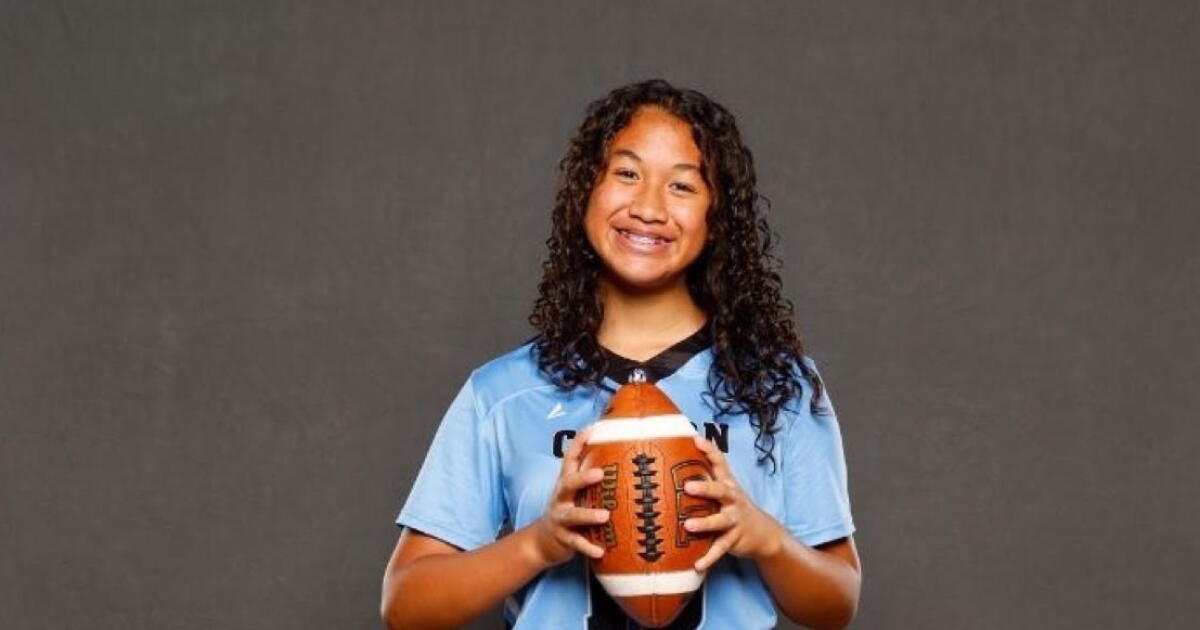
Pualani Olotoa-Le’au, a sophomore, has been contributing to Carson in flag football and softball.
(Courtesy Olotoa-Le’au family)
Last week’s heat wave caused lots of postponed flag football games in the City Section. The powerful Northern League needs to catch up. Wilson is 2-0 and Eagle Rock 1-0.
A big Monday showdown has Huntington Beach facing Newport Harbor.
Roommates at UCLA
Linebacker Scott Taylor (left) and receiver Shane Rosenthal, graduates of Loyola and Newbury Park, have become roommates and contributors for UCLA’s football team.
(Eric Sondheimer / Los Angeles Times)
Former Loyola High star Scott Taylor and former Newbury Park star Shane Rosenthal are roommates and teammates on UCLA’s football team.
They explain how important it is going off to college to explore and find someone with similar ideas and principles.
Harvard-Westlake made a big move in the water polo rankings this week with consecutive wins over JSerra and Santa Margarita.
Harry Siafaris was a key player with his scoring skills.
Newport Harbor had a big league win over rival Corona del Mar. Here’s the report.
Notes
Junior pitcher Carlos Acuna of Birmingham, the City Section player of the year, has committed to UC San Diego….
Dezi Delgado from Sherman Oaks Notre Dame has committed to CSUN baseball….
King Rachal of Sherman Oaks Notre Dame has committed to Utah State for basketball….
Standout guard Gene Roebuck of La Mirada has committed to Cal….
Former Monroe High and Cal State Northridge pitcher Lew Lernerhas died. He was 74. He was a first-round draft pick of the Twins and led CSUN to a national championship in 1970….
JSerra cross-country star Reese Holley has committed to North Carolina….
Bob Hitchcock, who built the Temple City High football program into a powerhouse, has died. He was 97. He won seven Southern Section championships in the 1970s….
Guard Omar Cuffie from Loyola has committed to play basketball at Navy….
Michael Scarince of South Pasadena won the cross-country invitational race at the Clovis Invitational in 15:01….
Track and field athlete Aidan Antonio of Woodbridge has committed to Georgetown….
Guard Pierce Thompson of Harvard-Westlake has committed to Utah….
The JSerra girls volleyball team claimed the Division 1&2 Diamond Bracket at the Southern California Volleyball Invitational at Alliant University in San Diego….
Cooper Barkate playing for Mater Dei in 2021. He’s now at Miami.
(Allen J. Schaben/Los Angeles Times)
In Cooper Barkate’s senior season in 2022 at Mater Dei, the team went 12-1 and he was a vey good receiver who chose academics and the Ivy League, attending Harvard for three years and graduating with a degree in economics. Then he transferred to Duke for one season and is now at Miami, where entered the national discussion after catching five passes for 98 yards and one touchdown against Clemson.
His father, Harold, was a punter for UCLA who grew up in the high desert.
From Indianapreps, a story on the changing landscape in covering high school sports.
From KGET in Bakersfield, a story on a private eye uncovering ineligible players.
From Oregonlive, a story on former Crenshaw running back De’Anthony Thomas turning to disc golf.
From Axios, a story on how youth sports is affecting Sunday worship.
Tweets you might have missed
The most interesting question for a high school athlete is: Do you know what high school your mom or dad attended? They go silent and can’t answer. If they only knew how good mom or dad were in high school sports.
This is the high school football season we’re seeing a resurgence of multiple-sport athletes. If only all coaches could learn to share their players and stop being selfish and so ambitious that they are preventing a better high school experience for their great athletes.
“I know more about the wet bulb than I would like.” Yes coaches and athletic directors have learned these days their sports lives revolve around the wet bulb that reveals if teams are allowed to practice outside. It’s a great way to protect safety of everyone in heat. Or you can practice at 6 am.
In this week’s episode of ‘Friday Night Live,’ @latsondheimer + @RandyRosenbloom talk to Paraclete quarterback Shawn Sanders about his versatility, his fearless playing style and the Spirits’ recent success. https://t.co/VS9eGA2oSd
I’m offering a warning to high school football coaches in Southern California: Start preparing for rain, especially if you have grass field. Playoffs will see rain. It’s coming. Players think it’s fun. Coaches think it’s terror. Underdogs suddenly have a chance.
Agoura football coach Dustin Croick was busy with relatives in town. He turned off his phone. Then he saw 173 text messages. Then he faced timed with his former QB Ty Dieffenbach after UCLA beat Oregon. Emotional day. https://t.co/eyn5YD6Uva
Have a question, comment or something you’d like to see in a future Prep Rally newsletter? Email me at eric.sondheimer@latimes.com, and follow me on Twitter at @latsondheimer.
Did you get this newsletter forwarded to you? To sign up and get it in your inbox, click here.
In rural Modoc County, in California’s remote northeast corner, Republican gubernatorial candidate Steve Hilton donned a beige cowboy hat and climbed atop a horse.
Riding through a grassy field, with his dress shoes in the stirrups, Hilton lamented to a camera that California was “completely being ruined by killjoy bureaucrats” who put too many rules on fun stuff like beach fire pits and bars that stay open extra late.
In coastal San Luis Obispo County, Hilton boarded a bright yellow dune buggy at the Oceano Dunes State Vehicular Recreation Area and called the California Coastal Commission “idiots” for trying to end off-road beach driving.
And in the Central Valley, he waved the ceremonial green flag at a stock car race at the Madera Speedway, where he was named grand marshal of the annual Harvest Classic. (The designation caused a minor uproar, prompting the operator of the racetrack to make a fake online concession menu that offered a hot dog and soda for $6 for Republicans and $17.50 for Democrats.)
If it seems like Hilton — the British immigrant and former Fox News talk show host — is just about everywhere, taking just about every media interview that comes his way, well, that’s the point, he says.
He has logged thousands of miles on the proverbial campaign trail, visiting all 58 counties in his quest to lead the nation’s most populous state, where no Republican has been elected to statewide office in 20 years.
Meanwhile, his heavily favored — and far more staid — opponent, Democrat Xavier Becerra, has kept a comparatively low profile, agreeing to just one debate with Hilton and holding few public events, mostly in urban areas.
In a phone interview while driving through Los Angeles, Hilton said: “Whether I’m in Humboldt or Del Norte or Siskiyou County, my joke is, when people say, ‘Where do you live?’ I say I live in the Hampton Inn somewhere in California because we’re basically in a different place every night.”
The odds are against him.
Sure, California produced GOP presidents Richard Nixon and Ronald Reagan. But today, Democrats outnumber Republicans nearly 2 to 1 in the state, and the current White House occupant shares a mutual disdain with the vast majority of Golden State voters.
Hilton was endorsed during the primary by President Trump, who suggested at a campaign rally this month that Iran could “take out” Los Angeles and San Diego, drawing swift outrage from both Democrats and Republicans.
Hilton has tried to walk a fine line, appealing to the 6 million Californians who voted for the president in 2024 while simultaneously downplaying Trump’s support.
This summer, Hilton took out full-page ads in The Times and the San Francisco Chronicle asking: “Can you be anti-Trump and still vote for me?”
“Yes, I’m the Republican,” it said. “The ‘Fox News guy.’ Endorsed by Trump. But this election is not about who you hate in Washington. It’s about what you love here.”
Corrin Rankin, chairwoman of the California Republican Party, said that 16 years after the state’s last Republican governor, Arnold Schwarzenegger, left office, “it’s safe to say Democrats own all the problems in California.”
“You can’t blame Trump for what’s going on here in California,” she said. “We feel really good about Steve Hilton’s campaign. He is working so hard, up and down the state.”
Hilton has blasted California Democrats as entitled, saying they assume Becerra will cruise to victory in the race to replace termed-out Gov. Gavin Newsom simply because he has a “D” beside his name on the Nov. 3 ballot.
Hilton frequently quotes a September podcast interview by Los Angeles’ Democratic mayor, Karen Bass, who mocked his British accent and said: “The governor’s race right now is over. Our governor’s name is Xavier Becerra. You don’t need an election on Nov. 3. A Republican cannot win in this state.”
Hilton told The Times that Democrats “feel they don’t have to earn your vote. … They can deliver results that are bad as ever, and they don’t need to work hard to deliver results for people or earn their support. And I think it’s that attitude that is going to be their downfall.”
Steve Hilton has the support of 33% of likely California voters, according to a recent poll, while rival Xavier Becerra has 58%.
(Jason Armond / Los Angeles Times)
Becerra is a former member of Congress who represented Los Angeles, and he was the California attorney general and U.S. Health and Human Services secretary under President Biden. He has the backing of 58% of likely California voters, compared with 33% who support Hilton, according to a poll released late last month by the UC Berkeley Institute of Governmental Studies and co-sponsored by The Times.
The poll showed that voters’ top concern was reducing the state’s high cost of living — followed by fighting Trump administration policies.
“Hilton is trying to win an election, so he tries to frame himself as someone who can appeal to the broader electorate,” Underland said. “But at the end of the day, he has the albatross around his neck, which is Trump, who is openly hostile to California.”
Hilton cuts a colorful and pugnacious figure on the campaign trail. He eschews ties and jackets, favoring T-shirts with punchy phrases like, “$ave With Steve” and “WAKE UP” superimposed on a California license plate — a reference to his proposal to eliminate the state’s Department of Motor Vehicles and slash vehicle registration fees, which would cut billions in state revenue.
He wears one bracelet with the name of slain right-wing activist Charlie Kirk, whom he called an “incredibly close friend.” Another reads, “Save Girls’ Sports,” calling back to this spring, when he traveled to the state high school track and field championship in Clovis to protest the participation of a transgender athlete.
Republican nominee Steve Hilton protests transgender athletes’ participation in girls’ sports during a May 29 news conference in Clovis, Calif.
(Tomas Ovalle / For The Times)
Hilton, 57, was born in London to parents who fled conflict in their native Hungary during the 1956 uprising against the Soviet-controlled communist government and later anglicized their surname, Hircsák, to Hilton.
He was a senior advisor to British Prime Minister David Cameron, a member of the Conservative Party, though the men’s once-close friendship never recovered from Brexit, Britain’s withdrawal from the European Union. Hilton supported it; Cameron did not.
Hilton earned a reputation as eccentric but savvy, pushing the Conservative Party to embrace same-sex marriage and more climate-friendly policies. Dubbed “the barefoot revolutionary” for his refusal to wear shoes, Hilton was satirized on the BBC political sitcom “The Thick of It” as Stewart Pearson, the Tories’ “eco-friendly, media-savvy, blue-sky-thinking” communications director.
He and his family moved to California in 2012 after his wife, Rachel Whetstone, was promoted to lead global communications at Google. For six years, he hosted “The Next Revolution,” a weekly Fox News show from which Trump regularly tweeted clips.
In 2015, the couple purchased their home in the Silicon Valley city of Atherton, one of the wealthiest ZIP Codes in the U.S., for $12.5 million, property records show.
Whetstone now leads communications for Sierra, an AI startup founded by OpenAI board Chairman Bret Taylor and Clay Bavor, who met while working at Google. Hilton and Whetstone’s 2024 tax returns show they had a combined household income of $7.5 million, which included his reported earnings of $250,000 from Fox News and her $6.7 million from her then-employer, Netflix.
Hilton became a U.S. citizen in 2021 and last year renounced his British citizenship.
He finished second in the June 2 primary behind Becerra. Under California’s top-two primary system, the first- and second-place finishers, regardless of party, advance to the general election.
The pack of Democratic candidates was so large that party leaders initially urged struggling candidates — including Becerra — to drop out to avoid splitting the vote. Becerra shot to the top of the polls when then-Rep. Eric Swalwell, a front-runner at the time, dropped out of the race after he was accused of sexual assault and misconduct.
Republicans coalesced around Hilton after the president endorsed him over his GOP rival, Riverside County Sheriff Chad Bianco, a staunch Trump supporter who later said the endorsement made Hilton unelectable.
Kim Nalder, director of the Project for an Informed Electorate at Sacramento State, said it is exceedingly difficult for Hilton to distance himself from Trump and the Fox News brand.
“If you had a different brand of Republican they might have a shot,” given the discontent in the state over myriad issues, she said. “But Trump is so politically radioactive in California right now that it is an effective technique to tie this particular candidate to him.”
California’s population growth is stagnant after years of pandemic-era losses, with immigration lagging amid the Trump administration’s crackdown and many residents leaving the state for more affordable parts of the country.
Greg Perrone, past president of the conservative Greater Bakersfield Republican Assembly, said he was impressed with Hilton’s policy knowledge and the amount of detail in his economic plans.
Steve Hilton, right, chats with Sir Richard Branson before a White House dinner with then-British Prime Minister Cameron and President Obama in 2012. Hilton was an advisor to Cameron.
(Susan Walsh / Associated Press)
“There’s a real concern that the current state of the economy is worse than people expected,” Perrone said. “A lot of people hung their hat on Donald Trump saying he was going to bring down prices, and that just has not happened. There’s a lot of angst.”
Perrone said he remains a Trump supporter, though he has been frustrated by the frenetic roll-out of tariffs that, he said, hurt many businesses. While he has been annoyed that Becerra, in his view, has focused more on the president than laying out his own detailed economic plans, he acknowledged that the strategy plays well in blue California.
Christopher Cole, former chairman of the Lassen County Republican Party, said that in his rural corner of the state, he has seen Trump banners that have hung since 2016 start to come down because people are angry about the Iran war, the high cost of fuel and the economy.
“When Trump stupidly endorsed Hilton, it was the kiss of death for any down-ticket Republican,” said Cole, whose county voted for Trump on 76% of the ballots in 2024, the highest percentage in the state, and was the only one to support Bianco in this year’s primary.
“Hilton is a carnival barker and a very wealthy man,” said Cole, who supported Bianco. “You can’t run a multimillionaire when people are struggling to put food on the table.”
Hilton has made a slew of campaign promises to lower the cost of living, including having no taxes on income below $150,000, lowering energy bills by slashing climate-friendly regulations imposed by Democrats, and having $3 gasoline (though governors cannot directly set the price at the pump, which is driven largely by global crude oil supply and demand).
He has tried to channel the state’s discontent into persuading voters to “try something different” by voting Republican.
During the gubernatorial race debate on CNN last month, Hilton quoted a former Biden domestic policy advisor who reportedly called Becerra a “bitch-ass,” and his campaign promptly launched a website, bitchassbecerra.com, outlining alleged failures of the politician known for his calm demeanor and decades of government experience.
“I think Hilton got dealt a bad card with Becerra making the runoff,” said Rob Stutzman, a Republican strategist who was Schwarzenegger’s spokesman. “It’s difficult to get anyone outraged about Becerra because he is perfectly boring. He worked for Joe Biden — maybe that upsets some people? — but you can’t associate him with any bizarre, woke policies like you could Kamala Harris or Gavin Newsom.”
Hilton’s campaign this month released a provocative, sexually suggestive ad titled “Just Try It!” in which two young women sit on a bed in a candlelit room. An LGBTQ+ pride flag hangs on the wall, and they’re seemingly talking through one’s first romantic encounter with another female.
In a recent poll, voters rated California’s high cost of living as their top concern, followed by fighting Trump administration policies. Above, people gather in North Hollywood to watch the Sept. 30 gubernatorial debate.
(Jason Armond / Los Angeles Times)
Wearing a T-shirt that says, “RESIST,” the anti-MAGA mantra, the first-timer nervously says: “I’ve just never done anything like this before. Like, what if my dad finds out?”
The other woman holds her hand as she fills out a ballot for Hilton then says, “Now lick it,” referring to the mail ballot envelope.
Some conservatives condemned the ad, saying it promoted lesbianism. Liberals criticized it, too, saying it was insensitive to the LGBTQ+ community.
The day the ad launched, he told The Times: “I think there’s a very strong sense that things aren’t working in California, and my argument is: ‘OK, let’s try something different.’”
Later, he said he never meant to offend anyone with the risqué ad, which did, after all, do its job in racking up millions of views online — coveted and invaluable publicity for a long-shot California Republican.
“I wanna rob.” Hip cocked, midriff bared, cigarette pressed between her lips, Emma Watson’s indelible plea to “visit” Paris (as in Hilton) encapsulates the perfect inside-baseball deadpan of Sofia Coppola’s crime saga — not least because Hilton opened up her Mulholland Estates home for scenes of the Bling Ring burglarizing it. No film crystallizes the shallow, amoral bluff of Hollywood’s high-tabloid era with such icy precision, from the flat affect of the teenage protagonists to the late Harris Savides’ minimalist digital photography. Largely misunderstood upon its release, “The Bling Ring” now registers as an incisive comedy of manners for a society of influencers just then being born.
It seems Chet Hanks, son of Tom Hanks and Rita Wilson, is still in his feels over Eric André’s recollection of his zany and “dangerous” appearance on “The Eric Andre Show.”
Hanks, who became an internet personality in recent years for boasting his Jamaican accent at the 2020 Golden Globes red carpet and unironically coining the phrase “White Boy Summer,” seemingly reignited his feud with André when he confronted the Emmy winner during ComplexCon in Los Angeles over the weekend. On Tuesday, Hanks posted video of himself approaching André and his security team at the event and exchanging some words with the comedian.
It’s unclear what the two men say to each other but Hanks appears to bring up an issue to André who seemingly shrugs it off at first. The conversation seems to turn tense when Hanks speaks face-to-face with André and security personnel block the view. The video concludes with André and his securtiy walking away from Hanks and his posse. In the caption to his video, Hanks said André “had NO MEMORY WHATSOEVER of trashing me to the media after I outshined him on his own show!!”
Representatives for André did not immediately respond on Wednesday to a request for comment.
“He stole a motorcycle and rode it around. He almost knocked a bunch of grips and gaffers off their ladders,” André recalled in 2023. “It was very dangerous. He tried to prank us back, but we edited out all his b—! He’s not well. How did Colin Hanks come out so good and Chet Hanks come out so bad?”
In 2023, Hanks called André a “straight b—.” The comedian swiftly fired back, calling Hanks a “f— liar” and dared Hanks to take a “DNA test and prove that Tom Hanks is his f— father.”
After the weekend confrontation, Hanks said that André ultimately “admitted” the feud began “because he had a problem with me ‘mocking Caribbean culture’ when I did my Jamaican accent all those years ago.” Hanks, who is white and was born in Los Angeles, resurfaced to public consciousness in 2020 when he — unprompted — introduced himself at the Golden Globes red carpet with his impression of Jamaican Patois. His father, the prolific actor beloved for roles in “Saving Private Ryan,” “Forrest Gump” and “Toy Story,” received the Globes’ Cecil B. Demille award later that evening.
“WHO KNEW that in addition to the brain rot and poop joke humor he is known for, Eric is also such a passionate cultural activist!!! Great running into you Eric!!!!,” Hanks, who has repeatedly used and defended the N-word on social media, sarcastically ended his caption.
André, who is Black, has long been a vocal social and cultural activist. The “Street Fighter” actor over the years has spoken out against Israel’s war in Gaza and has used his platform to address racism and police brutality.
This summer André, alongside fellow comedian Clayton English, settled a racial profiling suit against Clayton County police in Georgia. The comics were both allegedly racially profiled and subject to “unconstitutional” stops by Clayton County police at Hartsfield-Jackson International Airport in 2021. The stops were part of a police program intended to combat drug trafficking. The Associated Press reported that the settlement “does not include an admission of fault or liability on the county’s part but says the county has ended the program at issue and has no intention of reactivating it.”
You’re reading the Essential California newsletter
L.A. Times reporters guide you through the most important news, features and recommendations of the morning.
By continuing, you agree to our Terms of Service, which include arbitration and a class action waiver. You agree that we and our third-party vendors may collect and use your information, including through cookies, pixels and similar technologies, for the purposes set forth in our Privacy Policy such as personalizing your experience and ads.
Sunday morning, Oct. 9, 2022, around 8 a.m., I was about to take a shower when I decided to check my cellphone one more time. Thank God I did: If I hadn’t, I would’ve been half an hour late on assisting in one of the most explosive stories ever to hit L.A. politics.
Via Slack, Times assistant managing editor Steve Clow asked if I could serve as a second set of ears on audio that my colleagues had unearthed involving four of the most powerful L.A. políticos at the time: City Council President Nury Martinez, Councilmembers Gil Cedillo and Kevin de León, and L.A. County Federation of Labor President Ron Herrera. I was still in my birthday suit (sorry for the visual, gentle readers, but I’m sworn to report the facts on this job) when I played the snippet Clow shared: Martinez describing the Black son of then-Councilmember Mike Bonin as “su negrito” — his darky.
I put on my shorts and told my wife I wouldn’t be helping at her restaurant that day.
Clow sent me more clips over the next hour, each crasser than the other — I remember gasping audibly at the part when the four were laughing as Martinez referred to Oaxacans as “ugly.” That morning, my colleagues Benjamin Oreskes, Dakota Smith, Julia Wick and David Zahniser published their first story on the fiasco, which turned out to be a secretly recorded conversation from a year earlier that someone had posted on Reddit just the day before.
The scandal quickly became a national sensation, with even then-President Joe Biden weighing in. L.A. wretched in collective disgust and demanded action, which definitely came: Martinez and Herrera quickly resigned, while Cedillo — who had already lost his reelection bid — would stay on until his bitter end, and De León wouldn’t leave until challenger Ysabel Jurado destroyed him in his 2024 reelection bid. The electoral repercussions of the audio leak can still be felt four years later in this election, as Nithya Raman stages a strong challenge against incumbent Karen Bass — a sentence no one would’ve believed in the fall of 2022, when Bass was on the cusp of winning her first term, and Raman was the lone democratic socialist on the council.
I would’ve figured the anniversary of something as titanic as all of the above would’ve sparked more commemorations than just my columna this week. Nope! L.A. has moved on to the point that Cedillo wasn’t booted from a group photo that included current District 9 council candidate Jose Ugarte, former Assemblymember Wendy Carrillo, former Mayor Antonio Villaraigosa and current Assemblymember Mark Gonzalez — because even Chicanosauruses can survive a political asteroid, I guess?
Having political leaders spew racist, homophobic nonsense now seems like the good ol’ days in an era where infernos destroy or stink up swaths of L.A., immigration agents terrorize immigrants from Westwood to the Eastside, and a spokesperson for a sitting American president denies that the commander in chief suggested Iran bomb the City of Angels, even though he said it during a campaign rally.
I shouldn’t really be surprised, I guess: L.A. infamously loves to forget its own history. But I would urge all you readers to read the great, Pulitzer Prize-winning coverage my colleagues did in the aftermath of the audio leak scandal, because it captured the city at its worst — but also its finest as residents fought back and demanded politicians do better.
Four years later, we can only hope this upcoming election shows more of the same.
The week’s biggest stories
Domenic Hix looks back as a large wave crashes on the shoreline in Laguna Beach on Friday.
(Allen J. Schaben / Los Angeles Times)
Tropical Storm Rachel in SoCal
California real estate
California crime
In memoriam
More news
Editor’s pick
More picks
Things to do
(Illustrations by Lindsey Made This; photograph by Charles Phoenix)
Today’s recipe
(Rebecca Peloquin / For The Times)
This recipe makes apple butter that is less sweet than most; use more sugar if you like, but don’t use less or there won’t be enough to properly preserve the pureed apples.
Have a great day, from the Essential California team
Jack Dolan, investigative reporter Hugo Martín, assistant editor, fast break desk Kevinisha Walker, multiplatform editor Andrew Campa, weekend writer Karim Doumar, head of newsletters
Los Angeles Mayor Karen Bass and challenger Nithya Raman will be on the same stage Tuesday night for their final debate before the Nov. 3 election, but the two mayoral candidates are expected to come in with starkly different game plans.
With recent polls showing Raman in the lead, the councilmember will likely try to avoid making any kind of flub during the in-studio debate hosted by NBC4 and Telemundo52 in Universal City.
“A successful debate for Raman is one in which not very much happens,” said Dan Schnur, a professor of politics at USC, UC Berkeley and Pepperdine.
Raman floundered at the last NBC4/Telemundo debate during the mayoral primary, when Spencer Pratt was also on stage. She got better marks after a debate with Bass before the Sherman Oaks Homeowners Assn. in August.
Along with avoiding mistakes, Raman will need to paint a positive view of the city she hopes to lead, said Sara Sadhwani, a professor of politics at Pomona College.
“She needs to able to spell out a vision for the city of Los Angeles and inspire confidence that she would be able to deliver on such a vision,” she said.
For Bass, it’s a different task entirely. The mayor was the top vote-getter in the June 2 primary, but numerous several polls now show her trailing. The Berkeley IGS / L.A. Times poll, conducted Sept. 15-20, showed Raman with an 11-point lead over the incumbent.
To gain ground, Bass needs to go on the attack and convince voters that Raman isn’t fit to lead, Schnur said.
“Bass needs to explain to voters why voting for a relatively unproven candidate would be a dangerous risk to take,” he said. “I’m curious if it will go down the road of the nasty,” Sadhwani said. The debate, being conducted in partnership with Loyola Marymount University, will run from 7 p.m. to 8 p.m. and will be moderated by NBC4 news anchor Colleen Williams, NBC4 chief political reporter Conan Nolan and Telemundo 52 news anchor Alejandra Ortiz.
The Times will have live coverage.
You’re reading the L.A. on the Record newsletter
Sign up to make sense of the often unexplained world of L.A. politics.
By continuing, you agree to our Terms of Service, which include arbitration and a class action waiver. You agree that we and our third-party vendors may collect and use your information, including through cookies, pixels and similar technologies, for the purposes set forth in our Privacy Policy such as personalizing your experience and ads.
An influencer digs in on Bass
Social media creator Ed Choi made headlines this week, posting and then removing an Instagram video showing him and Raman declaring in unison: “Only you can stop fascist liars.”
The pair used that phrase as an image of Bass appeared on the video. Raman, facing criticism for her words, said she was referring to Trump and Immigration and Customs Enforcement raids, not the mayor or Los Angeles Police Chief Jim McDonnell, and had asked for the video to be taken down.
Choi defended his messaging, saying in a subsequent Instagram video that Bass is in fact a fascist, pointing to to Bass’ decision to appoint McDonnell, a former L.A. County sheriff. He also cited the Los Angeles Police Department’s treatment of anti-ICE demonstrators as evidence that the city is “descending into fascism.
Raman voted in 2024 to support Bass’ selection of McDonnell, even as her fellow Democratic Socialists of America colleagues on the council cast opposed his appointment. On the campaign trail, she has repeatedly criticized McDonnell, saying the LAPD should not have used tear gas on anti-ICE protesters exercising their First Amendment rights.
Choi also claims in his video that Raman is committed to defunding the police. But Raman no longer supports that idea, saying in February that LAPD staffing should not get any smaller.
Banned word lawsuit
When the Los Angeles City Council considered banning the use of the N-word and C-word at its meetings last year, Stacey Segarra-Bohlinger was in attendance to give the politicians a piece of her mind.
“This is going to bring lawsuits,” said Segarra-Bohlinger, who often sings parody songs at council meetings and has been a member of the Sherman Oaks Neighborhood Council.
Segarra-Bohlinger filed suit Tuesday, represented by lawyers with the Foundation for Individual Rights and Expression. The group contends that word bans — which can lead to people who use those words getting kicked out of meetings and potentially barred from future ones — violate First Amendment protections of free speech.
“The Council has weaponized the Word Ban and Meeting Ban to silence, remove, and prospectively exclude its critics,” asserts Segarra-Bohlinger’s lawsuit, filed in U.S. District Court in Los Angeles.
Segarra-Bohlinger filed the suit after her repeated use of the C-word at two council meetings last year, once while singing a parody song of the Ghostbusters theme song in which she repeated the line “Council is afraid of the word c—” four times.
Council President Marqueece Harris-Dawson is standing by the ban.
“In a moment of very serious attacks on our basic rights in this country, it’s especially absurd that some individuals would waste the court’s time defending the right of racists and misogynists to hurl invectives at the public simply to hear their own profanity,” he said in a statement to The Times.
State of play
—MONEY, MONEY, MONEY: Hedge fund manager Aaron Sosnick dropped another $3 million into Estamos Con Nithya, the pro-Raman independent expenditure committee sponsored by Western States Regional Council of Carpenters. Sosnick, who has been pushing for an expansion of the city’s bike lane network, has now put $6 million into the committee.
— UNION KERFUFFLE: The LAPD’s officer union said Tuesday it will oppose Measure FD, the half-cent sales tax measure on the Nov. 3 ballot pushed by the city firefighters’ union — setting up a bitter and expensive clash between two of the city’s most powerful unions.
— LEFT UNREAD: Citing lingering concerns about the potential misuse of police license plate readers, the Los Angeles City Council voted Tuesday to delay an agreement that would enable the deployment of hundreds of the controversial devices until officials are satisfied that the technology will be wielded responsibly.
— LAUSD WOES: The state’s school Fiscal Crisis and Management Assistance Team concluded that the Los Angeles Unified School District is at “high risk” of insolvency — and needs to move quickly to avoid losing control over budget decisions.
— HIT THE SKIDS: Federal authorities along with local partners like LAPD made more than a dozen arrests on Skid Row during a massive drug trafficking crackdown in the troubled Downtown neighborhood.
— LAPD’S LEGAL BILLS: The city of Los Angeles has shelled out nearly $480 million over the last five and a half years to end legal disputes involving the Police Department, including claims of excessive force, litigation over traffic accidents and cases filed by employees who allegedly faced retaliation after reporting misconduct.
— POLLING UPDATE: New polling from the pro-Nithya Raman independent expenditure group that was conducted between Oct. 2 and Oct. 7 found that Raman is leading the mayor 43% to 33% with 23% undecided. The poll’s margin of error is 3.5%.
— A separate poll sponsored by the United Firefighters of Los Angeles City, Local 112 and conducted between Sept. 25 and Oct. 5 found a tighter race, within the margin of error, with Raman leading 35% to 33% with 19% undecided. That poll’s margin of error was 4%.
— A third poll conducted for the Bass independent expenditure group Unidos con Bass of 602 likely Latino voters found the incumbent ahead by 12 points, 40% to 28% for Raman. The poll, conducted between Oct. 1 and Oct. 8, has a margin of error was 4%. That’s a 36-point swing from a UC Berkeley IGS/L.A. Times poll from September that found Raman ahead with Latinos by 24 points, 45% to 21%.
QUICK HITS
Where is Inside Safe? The mayor’s signature program went to Councilmember Ysabel Jurado‘s district on Santa Fe Avenue and 23rd Street and moved 35 people indoors.
On the docket next week: Bass and Raman will square off in a debate Tuesday night at 7:00 p.m. on NBC4/KNBC and Telemundo 52/KVEA.
Stay in touch
That’s it for this week! Send your questions, comments and gossip to LAontheRecord@latimes.com. Did a friend forward you this email? Sign up here to get it in your inbox every Saturday morning.
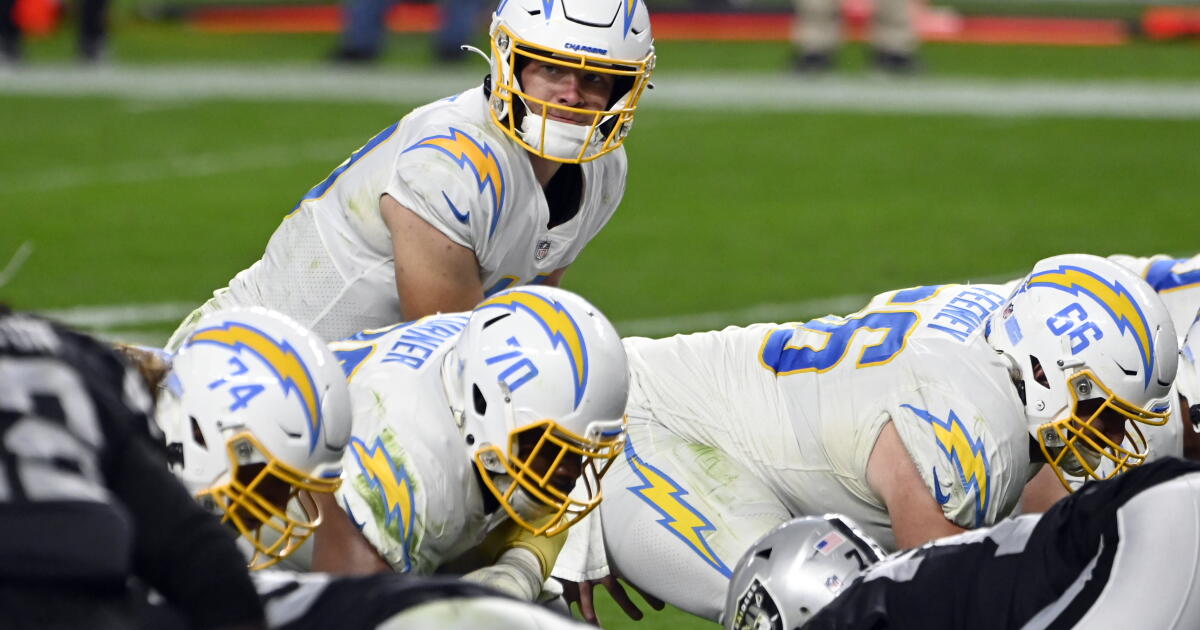
I’ve been a Justin Herbert fan since his days in Oregon. I kept believing he was going to lead the Chargers to new heights, even after all the leadership changes he’s been through. He’s talented, tough and all-in. I gave him every benefit of the doubt. But now, I can conclude only that Justin Herbert is the problem. Inconsistent, often slow to react, but mostly he’s unable to finish. He’s lost more games in the fourth quarter than he’s won.
So far this season the Chargers have the greatest negative point differential in the fourth quarter in the NFL. The pattern is consistent regardless of the coach. Is it all on Herbert? No. But he is the common denominator through all of this.
First, the fumbling. Thank you, Derius Davis. Your inability to simply complete a fair catch led directly to a Seahawks touchdown. How many points did your team lose by?
Next, the bumbling. Call it a banged up offensive line, (AGAIN!), a moderately skilled and depleted receiving core, or a lost, interception prone Justin Herbert, the Charger offense remains sketchy, inconsistent, and self-destructive.
Finally, the stumbling continues … as they cannot beat teams they should or pull out potential victories over the more challenging ones.
Good luck turning this around!
Rick Solomon Lake Balboa
I don’t care much about the Chargers. I rarely read stories about them and would be elated if they’d return to San Diego where they belong.
But, much like a car accident on the 405 that you instinctively know you shouldn’t stare, I just can’t seem to avert my eyes from the wreck the Chargers have become.
Ron Yukelson San Luis Obispo
Here is a modest proposal: Lincoln Riley and Jim Harbaugh waive their buyout clauses and swap jobs. It might be the rare trade that improves both organizations. It is difficult to see how it could make things worse.
It was only Adéla’s second headlining show in Los Angeles — and she was only about 20 minutes into it — but the ascendant pop star already had an apology she needed to get off her chest.
“The next song that I’m gonna sing is a little bit awkward,” she said Thursday night at the Fonda Theatre. “So I’m gonna need y’all to bear with me as I explain why I made a song called ‘The Baddest Bitches Ain’t in L.A.,’ OK?”
Added Adéla: “Please don’t boo.”
To be precise, the song in question is titled “Ain’t in L.A.” — a woozy banger from the 22-year-old’s buzzy debut album, “Prima.” But you took her point: Here she was in front of a hyped-up crowd that included Chappell Roan and members of the girl group Katseye, and what she was about to tell us is that true coolness lies elsewhere.
Based on her assertion that the Hollywood dream machine is “all a lie,” “Ain’t in L.A.” looks back with scorn at Adéla’s experience as a first-round flameout on “Dream Academy,” the build-a-band reality series that documented Katseye’s creation under the watchful eye of the K-pop kingpin Bang Si-hyuk. At the Fonda, Adéla recounted moving here from her native Slovakia and working alongside the show’s other contestants to “try to become pop stars together,” she said.
“And guess what? That didn’t work out for me. But it did for them.” She peered up at the venue’s balcony. “Shout out to y’all,” she said.
Except now it’s working out for Adéla too: Thursday’s show was the first of two at the Fonda behind last month’s release of “Prima,” whose title nods to the singer’s background as a ballet dancer; in addition to “Ain’t in L.A.,” which has more than 190 million streams on Spotify, the album has spun off a second hit in “Nicole Kidman,” which reached No. 1 on that platform’s U.S. singles chart thanks in part to the enthusiastic embrace of the Hollywood meme queen herself.
This week, Kidman appeared in a viral TikTok video showing her, Kristen Wiig, Pedro Pascal and Dua Lipa lip syncing to “Nicole Kidman” at a Chanel fashion show in Paris.
Adéla’s breakthrough comes amid a broader surge by a generation of young pop singers — think of Slayyyter and think of Tinashe — finding success with music that plays up rather than sands down its rough edges; each is working in the wake of Charli XCX’s influential “Brat,” which offered new ways to think about how pop balances polish and filth, swagger and confession.
Adéla made “Prima” with the producers Dylan Brady (of the duo 100 gecs) and Blake Slatkin (who’s scored hits with Lizzo and Justin Bieber); together the three get an appealingly scuzzy sound that puts chirpy vocal hooks over serrated club beats à la “Blackout”-era Britney Spears. What I’m saying, basically, is that the indie-sleaze revival is real.
At the Fonda, Adéla brought her songs to life on a stage that was bare except for a ballet barre, which she and a small crew of dancers used to execute choreography that grew raunchier and more elaborate as the show progressed. Both she and a guy danced en pointe; Adéla never went long without whipping her long pink hair, which was one style choice widely replicated throughout the room.
Before she closed with “Nicole Kidman,” the singer sat down at the front of the stage with her journal and told the crowd she wanted to “take a second and manifest a little bit.” She asked the universe to give her a long career, and she asked that her fans, after having gotten home safe, remember this night forever. She also asked — again — that L.A. not be mad at her for writing “Ain’t in L.A.”
“I really do feel bad,” she said, and not a boo could be heard.
We are weathering a truly apocalyptic heat wave in L.A., but that hasn’t stopped Halloween from sneaking up on us. For those who like to give themselves the creeps, the city has its fair share of spook shows, including Griffith Park’s Haunted Hayride and the Queen Mary’s Dark Harbor. These mainstays offer hardworking actors seasonal jobs, but usually don’t allow for any real narrative besides jump scares and chainsaws. Which is why I’m so jazzed about a new entry to the immersive Halloween show scene: “Hospital of Emotions After Dark,” with its specially ticketed basement creep-fest, “Below.”
For readers who haven’t been inundated with a million ads for “Hospital of Emotions” on your Instagram feeds, it’s an immersive art show that unspools in 80 discrete rooms over four floors of the shuttered St. Vincent’s Medical Center near downtown L.A. The 45,000-square-foot exhibition opened in late May and was supposed to close in late July, but has extended its run due to popular demand. This month that run includes an after-dark option, which features the regular show — only after-hours — with ambient lighting and roving actors who show up in the most unexpected places (I won’t spoil it, but I got one of the most serious jump scares of my life in one of the exhibit rooms).
A separate ticket (which can be purchased in a bundle with the main exhibition) gets you a ride in an elevator to the hospital’s long-abandoned basement where you are treated to an immersive theater show with a nun for a tour guide. My nun was played by Penny Wiggins, and I’m not sure I have ever witnessed such true commitment in a spook show. Wiggins sold her character — at one point with genuine tears.
I won’t give away the plot, but it’s harrowing, especially if you are someone familiar with the hospital, which opened in the late 1800s and was the first hospital in the city. I had my daughter there in 2016, so it was extra chilling to know that this basement of horrors was there even then. The show uses the building’s actual abandoned infrastructure as its framework, so guests are led through dank subterranean corridors, old examination rooms and specimen labs, as well as an autopsy room.
“Below” isn’t as viscerally gory as “Dark Harbor” or “Haunted Hayride,” but it’s more artistic. There is dancing and an actual script that features a “gotcha” twist — as well as an upsetting demon who appears out of nowhere. I applaud the commitment by the actors who, I imagine, must find it kind of scary just waiting down there for the next round of guests. Plus, it’s good fun to be in the “Hospital of Emotions” at night when everyone is a little wild and there’s a sense that something out of the ordinary might pop out at you at any minute.
I’m Arts editor Jessica Gelt begrudgingly wearing a tank top and shorts in early October. This is your arts and culture news for the week.
You’re reading Essential Arts
Our critics and reporters guide you through events and happenings in the SoCal arts scene. In your inbox every Friday.
By continuing, you agree to our Terms of Service, which include arbitration and a class action waiver. You agree that we and our third-party vendors may collect and use your information, including through cookies, pixels and similar technologies, for the purposes set forth in our Privacy Policy such as personalizing your experience and ads.
The week ahead: A curated calendar
FRIDAY
Felipe Dulzaides / Bradley Baboc Cuban-born artist Dulzaides uses photography, drawing, video, performance, sculpture and sound to capture the sublime nature of Havana knife sharpeners in the exhibition “Balance in Place.” L.A. painter Boboc drew on the Toy District as inspiration for a new series of paintings, “Shadoobie (Shattered).” Opening, 6-9 p.m. Friday; 10 a.m.-4 p.m. Thursday-Sunday, through Nov. 8. Arcane Space, 324 Sunset Ave., Unit G, Venice. arcanespacela.com
Ludovico Einaudi The popular Italian pianist and composer returns to Disney Hall for the first time since 2019 on this solo tour. 8 p.m. Friday. Walt Disney Concert Hall, 111 S. Grand Ave., downtown L.A. laphil.com
Mälkki Conducts Bartók Susanna Mälkki leads the Los Angeles Philharmonic in Béla Bartók’s “Concerto for Orchestra.” 11 a.m. Friday, 2 p.m. Sunday. Walt Disney Concert Hall, 111 S. Grand Ave., downtown L.A. laphil.com
Takács Quartet with Jeremy Denk The Grammy winning ensemble teams up with the MacArthur Grant-winning pianist for a program of chamber music featuring works by Haydn, Mendelssohn and Franck. 7:30 p.m. Broad Stage at Santa Monica College Performing Arts Center, 1310 11th Street, Santa Monica. broadstage.org
SATURDAY
Laura Andreson, 1979, Forrest L Merrill Collection, Photo by M. Lee Fatherree
(Photo by M. Lee Fatherree)
The Eternal Quality of Aesthetic Joy: Laura Andreson and Her Legacy The artist bristled at “superfluous” decoration, favoring distilled jar, box, bowl and vase forms influenced by her love for Scandinavian and Bauhaus design. She became a wizard with glazes, conjuring lustrous surfaces resonant with elements of the Southern California landscape. This show offers a rare opportunity to savor the gorgeous purity of her work, alongside that of several of her mentors and peers, such as Gertrud and Otto Natzler and Glen Lukens, as well as some of her students, including JB Blunk and Bernard Kester. (Leah Ollman) Noon-6 p.m. Tuesday-Saturday, Oct. 10-Jan. 9, 2027. Craft in America Center, 8415 W 3rd St. craftinamerica.org
Haunted Soiree: True Crime An immersive theater experience inspired by the 1928 Hex Hollow murder with cocktails and curious encounters. Selected nights through Oct. 31. Nocturne Theatre, 324 N. Orange St., Glendale. hauntedsoiree.com
Pacific Jazz Orchestra’s Benefit Concert Songwriter and producer David Foster, singers Katharine McPhee, Joanna “JoJo” Levesque, Veronica Swift, Adam “AeJaye” Jackson, violinist Anne Akiko Meyers and pianist Emmet Cohen are the headliners for a celebration of founding Artistic Director Chris Walden’s 60th birthday, which also includes a buffet reception and dancing under the stars. 7 p.m. Private estate in Toluca Lake, address to be provided upon confirmation of attendance. pacificjazz.org
Saint Megan Playwright Joy Gregory, inspired by the journey of the granddaughter of the founder of the controversial Westboro Baptist Church, examines the long history of American Christian zealotry. Opening, 8 p.m. Saturday, 8 p.m. Fridays, Saturdays and Mondays, 2 p.m. Sundays through Nov. 22 (no performance Oct. 12 or Oct. 31. Rogue Machine at the Matrix Theatre, 7657 Melrose Ave. roguemachinetheatre.org
SUNDAY
Akram Khan Company In the London-based dance troupe’s final touring production, “Thikra: Night of Remembering,” an international cast of women perform contemporary and Bharatanatyam dances. 8 p.m. UCLA, Royce Hall, 340 Royce Drive, Westwood, cap.ucla.edu
Camerata Pacifica The chamber ensemble opens its 37th Season with Rachmaninoff’s “Variations on a Theme of Chopin, Op. 22” and Schubert’s “B-Flat Major Trio.” 5 p.m. Sunday. Bank of America Performing Arts Center, Janet & Ray Scherr Forum Theatre, 2100 Thousand Oaks Blvd., Thousand Oaks; 7:30 p.m. Tuesday. The Huntington, Rothenberg Hall, 1151 Oxford Road, San Marino; 8 p.m. Wednesday. The Colburn School, Zipper Hall, 200 S. Grand Ave., downtown L.A.; and 7 p.m. Thursday. Music Academy of the West, Hahn Hall, 1070 Fairway Road, Santa Barbara. cameratapacifica.org
Heartbreak House The Antaeus Theatre Company launches its 35th season with George Bernard Shaw’s dark comedy. Directed by ATC Artistic Director Nike Doukas. The cast includes Elinor Gunn, Harry Groener, Arye Gross and Bernard Addison, Previews, 2 p.m. Sunday, 8 p.m. Tuesday-Oct. 16; opening, Oct. 17-Nov. 16. Kiki & David Gindler Performing Arts Center, 110 East Broadway, Glendale. antaeus.org
Musical Theater Guild members Valerie Larsen and Gabriel Navarro during a reading of “The Light in the Piazza” in 2024.
(Stan Chandler)
Here’s to Us! The Musical Theatre Guild marks its 30th anniversary with a benefit concert featuring show tunes from “Titanic,” “Fanny, “The Pajama Game” and “Sunday in the Park with George.” 7 p.m. Broad Stage at Santa Monica College Performing Arts Center, 1310 11th Street, Santa Monica. musicaltheatreguild.com
Untitled, n.d. Mavis Pusey
(Neil Lane Collection / Estate of Mavis Pusey)
Mavis Pusey Two exhibitions this fall will help familiarize audiences with this remarkable woman. “Mobile Images” at the Hammer is a full-scale survey co-organized by the Studio Museum in Harlem and the Institute of Contemporary Art at the University of Pennsylvania, and is accompanied by a rich and thorough catalog. “Restless” also adds a Pusey publication to the shelf. The Benton show focuses mostly on Pusey’s prints, drawing exclusively from the collection of Ian White, artist, educator and son of esteemed artist Charles White. (Leah Ollman) “Mobile Images,” through Feb. 28, 2027. UCLA Hammer Museum, 10899 Wilshire Blvd., Westwood. hammer.ucla.edu “Restless,” through Jan. 3, 2027. Benton Museum of Art, Pomona College, 120 W. Bonita Ave., Claremont. pomona.edu
MONDAY
Art Of Elan: In The Desert Inspired by a trip to Bryce Canyon, Olivier Messiaen wrote his percussion-rich chamber music masterpiece “From the Canyons to the Stars” as a 1976 U.S. Bicentennial commission from Alice Tully Hall in New York. Replete with Messiaen’s characteristic bird calls, it’s been done out of doors before, and memorably at the Ojai Music Festival. But the San Diego imaginative new music series Art of Elan is now taking it to the desert for a special performance led by percussionist Steven Schick at an outdoor theater in Borrego Springs. (Mark Swed) 6:30 p.m. Stargazing Theater, La Casa del Zorro Desert Resort & Spa, 3845 Yaqui Pass Road, Borrego Springs. artofelan.org
TUESDAY
Angela Hewitt The pianist performs an all-Mozart recital accompanied by Los Angeles Chamber Orchestra concertmaster and violinist Margaret Batjer for the first installment in LACO’s inaugural recital series. 7:30 p.m. Tuesday. The Colburn School, Zipper Hall, 200 S. Grand Ave., downtown L.A. laco.org
WEDNESDAY
Lisa Batiashvili/Gautier Capuçon/Jean-Yves Thibaudet The superstar violinist, cellist and pianist team up for an evening of Shostakovich, Debussy, and Dvořák. 8 p.m. Walt Disney Concert Hall, 111 S. Grand Ave., downtown L.A. laphil.com
Joey Soloway.
(Loshara Vova)
A 1 They/Them Show The Emmy and Golden Globe-winning creator of “Transparent” steps out from behind the camera to try out their stand-up routine in L.A. before hitting the road with a deeply personal solo comedy performance exploring family, Hollywood, gender, sex, Judaism, ambition and reinvention. A tour is expected to include a November stop in Chicago. 8 p.m. Wednesday and Oct. 28, doors open at 7 p.m.. The Virgil, 4519 Santa Monica Blvd. dice.fm
THURSDAY
Houston Ballet
(Quinn B. Wharton/Segerstrom Center for the Arts)
Houston Ballet The Texas dance troupe brings celebrated young pianist George Li for an ode to Frédéric Chopin. Making its West Coast debut, and created by Stanton Welch AM, artistic director of the Houston Ballet, the piece, “Sons de L’âme” (Sounds of the Soul), merges choreography with a live performance of Chopin’s famed piano pieces, showcasing the talents of the nation’s fourth-largest ballet company and a rising star of classical music. (Eloise Rollins-Fife) 7:30 p.m. Thursday-Friday, 2 and 7:30 p.m. Saturday, 1 p.m. Sunday. Segerstrom Center for the Arts, 600 Town Center Drive, Costa Mesa. scfta.org
Speaking In Tongues The world premiere of a Luis Alfaro play is always a welcome event. And his latest work, commissioned by Latino Theater Co. and developed at the theater’s Circle of Imaginistas playwriting group, resonates thematically with Alfaro’s 2023 play “The Travelers,” which LTC produced in 2023 and made my list of that year’s best theater productions. The new play, infused with Alfaro’s trademark Chicano humor, returns us to the world of California’s Central Valley and the stories of migrant farmworkers and their spiritual quests in a societal landscape transforming faster than anyone can keep up. (Charles McNulty) Previews, 8 p.m. Thursday-Friday; opening night, 8 p.m. Saturday; 8 p.m. Thursdays-Saturdays, 2 p.m. Sundays, through Nov.. 15. Los Angeles Theatre Center, 514 S. Spring Street, downtown L.A. latinotheaterco.org
The SoCal scene
Cuban-born artist Enrique Martinez Celaya paints the new curtain for the L.A. Opera at the Dorothy Chandler Pavilion.
(Carlin Stiehl / For The Times)
ICYMI, the best of this week’s L.A. Times arts coverage:
L.A. artist Enrique Martínez Celaya hand-painted a brand new 70-foot curtain for L.A. Opera’s new season.
A documentary about Asco, the revolutionary arts group founded in the 1970s, is streaming for the first time on PBS.
As 24th Street Theatre prepares to celebrate its 30th anniversary, it has announced that it raised $3 million to officially buy the converted 1928 carriage house it’s called home for the past 29 years. It also purchased properties next door and across the street in order to expand its mission and community programming, including plans for an outdoor garden and a black box theater, which is, according to a news release, “officially named the 24th Street Black Box Theatre in honor of longtime supporter Jack Black, who is also the new venue’s first donor.” Black is set to host the theater’s gala on Oct. 18.
Tesserae — Andrew McIntosh, left, Ian Pritchard and Joshua Rubin — perform “Bowling, Animals and the Ocean” at the Sierra Madre Playhouse.
(Dania Maxwell / Los Angeles Times)
The 99-seat Sierra Madre Playhouse announced it has received $2.5 million from the State of California for a slew of exciting upgrades to its 100-year-old building — marking the largest gift in the organization’s history. The funds were secured by Pasadena Assemblymember John Harabedian, and will be used toward making the historic venue ADA-compliant, as well as to renovate lobbies and other areas open to the public. It will also help with new programming and building infrastructure.
The LA Phil and Orchestre de Paris have announced the launch of a new opportunity: the Salonen International Conducting Fellowship, which is, according to a news release, “designed to nurture and accelerate the careers of the next generation of orchestral conductors … the fellowship will offer early-career conductors unparalleled access to artistic mentorship, practical podium experience, and professional development opportunities at Los Angeles’ Walt Disney Concert Hall and the Philharmonie de Paris.” The first yearlong program will start in the 2027-28 season, and will feature two to four fellows, who will spend about six weeks working with each orchestra.
The Hammer Museum at UCLA announced this week that Eric Esrailian is succeeding Marcy Carsey as the new chair of the museum’s board (after previously serving as vice chair). Karen Hillenburg will now serve as vice chair. The Hammer also named three new members to its board: philanthropist Leslie McMorrow, attorney Alicia Miñana de Lovelace and Joan Weinstein, vice president of program planning at the Getty.
And you probably figured Freddie Freeman would get it going. You had faith in playoff risers Max Muncy, Kiké Hernández and Teoscar Hernández — and in the Dodgers’ playoff-proven offense overall.
You were not, however, so bullish on the bullpen.
That was the proverbial, annual question mark entering the best-of-five National League Division Series against the Atlanta Braves, whom the Dodgers vanquished with a 4-1 victory Wednesday at Truist Park to set up an NL Championship Series rematch with the Milwaukee Brewers.
Get the latest on L.A.’s teams in the daily Sports Report newsletter.
By continuing, you agree to our Terms of Service, which include arbitration and a class action waiver. You agree that we and our third-party vendors may collect and use your information, including through cookies, pixels and similar technologies, for the purposes set forth in our Privacy Policy such as personalizing your experience and ads.
Dodgers: Reasons to believe, reasons to worry
From Bill Shaikin: As Dave Roberts delivered his victory address, dressed in a gray cap and a gray T-shirt that commemorate a triumph the Dodgers consider merely a speed bump on the road to the main event, the manager was not shy.
“There is no more talented team than the Los Angeles Dodgers,” Roberts told his players amid clubhouse floods of champagne and beer. “This is the best organization in sports, top to bottom. We’re smarter. We’re better. And we’re tougher.”
“This one is going to be special,” infielder Miguel Rojas said. “We have the motivation of winning three times in a row. That’s all we can think about right now. It’s never going to be easy in baseball. You have to go through tough things. But this team showed it before, and it showed it in this series.”
Nothing is guaranteed in October, not even the Dodgers in the World Series. For the Dodgers, here are four positive signs and four warning signs:
And though it was just a preseason game Thursday night, Doncic and Reaves showed why they form one of the most dynamic offensive backcourts in the NBA.
The Lakers duo linked up on the very first play against the Sacramento Kings, with Reaves passing to Doncic as he cut to the basket before scoring while being fouled.
Both played 25 minutes, with Doncic finishing with 23 points on six-for-16 shooting during the Lakers’ 114-110 win over the Kings at Crypto.com Arena. Reaves had eight points on two-for-seven shooting, eight assists and five
No. 2 Cleveland vs. No. 6 Chicago White Sox Chicago White Sox 3, at Cleveland 0 (box score) Chicago White Sox 4, at Cleveland 3 (box score) Cleveland 9, at Chicago 3 (box score) Cleveland 9, at Chicago 5 (box score) Saturday at Cleveland, 5 p.m., TBS/truTV/UniMas/HBO Max
NLCS
No. 1 Milwaukee vs. No. 2 Dodgers Sunday at Milwaukee, 5 p.m., FOX/FS1/FOX Deportes/FOX One Monday at Milwaukee, 2 p.m., FOX/FS1/FOX Deportes/FOX One Wednesday at Dodgers, 5 p.m., FOX/FS1/FOX Deportes/FOX One Thursday at Dodgers, 6 p.m., FOX/FS1/FOX Deportes/FOX One *Friday, Oct. 16 at Dodgers, 6 p.m., FOX/FS1/FOX Deportes/FOX One *Sunday, Oct. 18 at Milwaukee, 5 p.m., FOX/FS1/FOX Deportes/FOX One *Monday, Oct. 19 at Milwaukee, 5 p.m., FOX/FS1/FOX Deportes/FOX One
ALCS
No. 1 Tampa Bay vs. Cleveland/Chicago winner Monday, at Tampa Bay, 5 p.m., TBS/truTV/UniMas/HBO Max Tuesday at Tampa Bay, 5 p.m., TBS/truTV/UniMas/HBO Max Thursday at Chi/Cle, 3 p.m., TBS/truTV/UniMas/HBO Max Friday, Oct. 16 at Chi/Cle, 3 p.m., TBS/truTV/UniMas/HBO Max *Sat., Oct. 17 at Chi/Cle, 5 p.m., TBS/truTV/UniMas/HBO Max *Monday, Oct. 19 at Tampa Bay, 2 p.m., TBS/truTV/UniMas/HBO Max *Tuesday, Oct. 20 at Tampa Bay, 5 p.m., TBS/truTV/UniMas/HBO Max
* if necessary
World Series starts Friday, Oct. 23
Secret to Matthew Stafford’s success
From Sam Farmer: Both NFL most valuable players. Both bound for Canton. Both surgically precise with their passes.
Peyton Manning sat in the studio and cued the video. Stafford looked off a Philadelphia safety last Sunday to hold him in place. He froze a cornerback with a glance. Then he threw an out-and-up to Puka Nacua, absorbing a big hit as he released the ball.
“That’s a lot of looking off,” Manning said.
Hall of Fame linebacker Luke Kuechly, watching from his own home studio, agreed.
“The quarterback will lie to you,” Kuechly said. “He’s going to look you off. He’s going to pump you. But the one thing that never lies to you is the route.”
1943 — Bob Hoernschemeyer throws six touchdown passes, an NCAA record for a freshman, to lead Indiana past Nebraska 54-13.
1965 — The United States wins the Ryder Cup 19½-12½ at the Royal Birkdale Golf Club in Southport, England. Arnold Palmer clinches the title, beating Peter Butler 2 up. It’s the 13th victory for the Americans in this event, which began in 1927. Britain, a three-time winner, last won in 1957.
1974 — The Washington Capitals lose their first NHL game, 6-3 to the Rangers at New York’s Madison Square Garden.
1982 — Al Del Greco kicks six field goals for all of Auburn’s points in an 18-3 triumph over Kentucky.
1983 — Buffalo’s Joe Ferguson passes for 419 yards and five touchdowns in an 38-35 overtime win against Miami. Uwe Von Schamann of the Dolphins misses two field goals in the overtime and Joe Danelo ends the game with a 36-yard field goal.
1991 — The San Jose Sharks gain their first NHL victory, defeating the Calgary Flames 4-3.
1993 — Minnesota’s Scott Eckers passes for 402 yards and a school-record six touchdowns in his first college start, sending the Gophers past Purdue 59-56.
1993 — Carey Bender rushes 33 times for 417 yards, setting an NCAA all-division single-game rushing record, in Coe’s 69-7 Division III victory over Grinnell.
2004 — Texas Tech beats Nebraska 70-10, the worst lost in the Cornhuskers’ storied 114-year history.
2004 — Texas loses to Oklahoma 12-0, getting shut out for the first time in 282 games and ending the longest streak in the country.
2010 — Mike Brinkley passes for six touchdowns and Armond Smith runs for five scores to lead Union (Ky.) to an 84-55 victory over Bethel (Tenn.) in an NAIA game.
2010 — Derek Stepan becomes the fourth player to score three times in his NHL debut to lead the New York Rangers to a season-opening 6-3 win over the Buffalo Sabres.
2011 — Sebastian Janikowski kicks four field goals, including three from at least 50 yards (54, 55, 50), in Oakland’s 25-20 win over Houston. Houston’s Matt Schaub throws for 416 yards and two touchdowns.
2011 — The NHL returns to Winnipeg, but Carey Price stops 30 shots and the Montreal Canadiens dampen a city celebration with a 5-1 victory over the Jets.
2015 — Sepp Blatter, hoping to return to power as FIFA president, is banned for 90 days, essentially ending his 17-year reign as the leader of soccer’s governing body. UEFA President Michel Platini also gets a 90-day ban following an investigation of financial misconduct at FIFA in a Swiss criminal case.
2016 — Tom Brady returns from his four-game “Deflategate” suspension, passing for 406 yards and three touchdowns to Martellus Bennett in the New England Patriots’ 33-13 victory over the Cleveland Browns.
2022 — Dutch Red Bull driver Max Verstappen secures his second consecutive World F1 Drivers C’ship after finishing in front of Sergio Pérez and Charles Leclerc in the Japanese GP at Suzuka.
Compiled by the Associated Press
This day in baseball history
1928 — Baseball World Series: NY Yankees beat St. Louis Cardinals, 7-3 at Sportsman’s Park to become first to sweep consecutive World Series; Babe Ruth hits smashes three HRs for Yanks.
1934 — Baseball World Series: St Louis Cardinals rout Detroit Tigers, 11-0 at Navin Field to clinch 4 games to 3 series victory and third championship.
1966 — Baseball World Series: Baltimore Orioles claim first championship in franchise history; edge Dodgers, 1-0 at Memorial Stadium for 4-0 sweep; MVP: Orioles outfielder Frank Robinson.
1988 — Dennis Eckersley saves all four games in Oakland’s ALCS victory over Boston.
2005 — Chris Burke hits a home run in the bottom of the 18th inning and Roger Clemens pitches three scoreless innings of relief in Houston’s 7-6, series-ending victory over Atlanta in the NLDS. The longest postseason game in history takes 5 hours, 50 minutes.
Compiled by the Associated Press
Until next time…
That concludes today’s newsletter. If you have any feedback, ideas for improvement or things you’d like to see, email me at houston.mitchell@latimes.com. To get this newsletter in your inbox, click here.
“If you intend to come,” USC coach Lindsay Gottlieb said Wednesday at Big Ten media days, “you should probably get your tickets early.”
The success of the two West Coast schools has been a bigger problem for the rest of the Big Ten than Los Angeles basketball fans. In the two years since USC and UCLA left the Pac-12 for the Big Ten, each school has topped the standings once and the Bruins have won the conference tournament twice, going on to the Final Four two years ago and winning the championship last April.
UCLA has some holes to fill this season but is still expected to be top-25 caliber. Watkins returns after missing last season with a torn ACL and will join the country’s top recruiting class to try to help USC return to the nation’s elite and extend the rivals’ dominance over their new league.
“Honestly, for me, I’m just excited to be back and whatever comes with that will come,” Watkins said. “I know the team is excited. We’re preparing for a great season ahead. I’m ecstatic.”
The question that poses for the rest of the conference is whether any of the legacy Big Ten teams can mount a challenge to this newfound tilt from Midwest to West. Iowa and Michigan look like the strongest contenders to break the California grip on the league, but there could be as many as eight other Big Ten teams in the preseason Top 25 poll.
“Our league is stronger and tougher than it has ever been,” Michigan coach Kim Barnes Arico said. “Every night, you’re going to face a top-25 opponent in our league. It’s incredibly, incredibly challenging.”
The Big Ten has been through this before. When Maryland jumped from the ACC in the fall of 2014, the Terrapins claimed at least a share of first place in six of the next seven seasons. Either Ohio State or Indiana topped the standings in the three years prior to the latest expansion, but since then it’s been all UCLA and USC at the top.
UCLA forward Sienna Betts, right, drives to the basket under pressure from Indiana forward Maya Makalusky on Feb. 15 at Pauley Pavilion.
(Jessie Alcheh / Associated Press)
The Bruins have work to do after accounting for six of the first 18 picks in the WNBA draft, but have five returnees assuming larger roles, including sophomore Sienna Betts and junior Timea Gardiner.
“I think we’re not trying to repeat an outcome, we’re really just trying to repeat a process,” Gardiner said. “Really just giving everything we can to each and every day. We have such an amazing group that is committed to doing that, so we will let the cards fall where they may.”
USC, meanwhile, added the No. 1 and No. 5 recruits in the country and a pair of impact transfers to a Watkins-Jazzy Davidson backcourt after going 18-14 without the preseason Big Ten player of the year. The Trojans have loaded up the roster to make a run at the their first Final Four in 40 years. Gottlieb resisted when asked if she had built a super team, but didn’t exactly deflect the notion, either.
“I’ve never called it that,” Gottlieb said. “We’ve just tried to assemble a team that we think can have championship aspirations. We’ve got a lot of excellent players that are all going to play whatever role they’re asked to the best of their ability. If you do that at the highest level, it becomes a super team.”
Super team or not, the challenge the rest of the Big Ten continues to face has not changed.
“It’s great for our league,” Purdue coach Katie Gearlds said. “Obviously, UCLA winning the championship last year, USC as good as they’re going to be this year having Juju back healthy and the star power that they have, it just elevates and lifts our games and gets more eyeballs on us. I think if you talk to anybody that’s here, we all want to find a way to beat them, but it’s cool that we have them in our league and they are as good as they are.”
Midcentury pop culture expert Charles Phoenix thinks Long Beach gets a bad rap.
“It is very underrated in the grand scheme of all of Southern California, but there is a lot to see and do there,” says the Ontario native, who uses the word “time-honored” repeatedly when describing his favorite attractions in the seaside community. “I often refer to it — under my breath — as the New Jersey of Los Angeles. It doesn’t get much respect, yet it’s loaded with attractions.”
In Sunday Funday, L.A. people give us a play-by-play of their ideal Sunday around town. Find ideas and inspiration on where to go, what to eat and how to enjoy life on the weekends.
When he isn’t gushing over Long Beach, the humorist and author hosts nostalgic slideshows and double-decker open-air bus tours of Midcentury architecture during Modernism Week in Palm Springs. His next event, “LosAngelesland,” is a lively retro slideshow featuring vintage Kodachrome slides taken by Los Angeles locals and tourists in the 1950s and ’60s. The show is scheduled for Oct. 17 during Modernism Week’s October festival in Palm Springs and a Halloween-themed version on Oct. 24 at the Anaheim Fall Festival. Phoenix will also present “Disneyland: Live Retro Slide Show Celebrating the Original Magic Kingdom in the 1950s & ’60s!” at the Hilbert Museum in Orange on Oct. 18.
Phoenix lives in a Midcentury Modern home in Claremont, but he’s always happy to spend a day in Long Beach. His ideal Sunday includes eating clam chowder-topped biscuits at a floating restaurant, shopping for vintage treasures along 4th Street Retro Row, cruising around Naples in an electric Duffy boat and ending the day at a classic diner from 1939.
“There’s more to do in Long Beach,” he says. “I could keep going, but there’s only so much space in this column.”
This interview has been lightly edited and condensed for length and clarity.
8 a.m.: Wake up early and say thanks
When I wake up, I usually have nonfat yogurt, chopped walnuts and one or two types of fresh fruit. Then I walk through my house, and whatever room I walk in first — either the living room or the den and say, “I love you, house.” Those are the first words I speak out loud.
10 a.m.: Drive to the coast for lunch on a floating restaurant
We’re going to start at the only floating restaurant I know of in the Western United States, the Chowder Barge. It stands out on its own, although it’s a bit tricky to find, so it’s a good thing we have GPS or we might never get there. It’s a little bit tiki, a little bit pirate and a little bit seafarer. There’s always an old wizard-like man sitting in the corner with a long beard that reaches the floor. When you’re on the barge and a boat passes by, you can feel it. The best thing there is their fried clams and clam chowder, which you can eat in a bowl or use the chowder as gravy. For breakfast, you could have biscuits topped with clam chowder instead of gravy. It’s the best clam chowder ever. If you want fried clams on top of the biscuits, that’s incredibly delicious. They also have an open-faced hamburger covered with clam chowder and fried clams or just clam chowder.
The place has a deep soul, and everything there is unique and time-honored.
1 p.m.: Go vintage shopping on Retro Row
Next I would go shopping on 4th Street, a.k.a. Retro Row, which is absolutely, in no uncertain terms, the best vintage shopping street in the Western United States — probably the Eastern and Midwestern as well. There are three stores there that I concentrate heavily on. The first is Sneaky Tiki Boutique, which is the destination of all destinations for what I wear all spring and summer and fall — vintage Hawaiian shirts from the ’50s and ’60s. They’re not Hawaiian shirts unless they’re made in Hawaii. Nobody has a better supply than Sneaky Tiki. I mean nobody.
A couple of doors down is another world-class vintage store, Meow. Meow is an institution in the world of vintage clothing, shoes and accessories. And it’s absolutely a spectacular themed environmental extravaganza, as is Sneaky Tiki. There are all kinds of vintage in there. So it is a feast for the senses and your wardrobe and accessory needs.
And then for your Midcentury home decor needs, there’s Xcape Modern. They’ve been there for probably 30 years, and it’s a little mumbo jumbo as far as the way it’s all laid out. It’s a little messy, but they have incredible Midcentury furniture and home decor, including patio items. It’s a spectacular, well-curated collection.
3 p.m.: Explore Rancho Los Alamitos
After that, I’d take a quick late-afternoon scamper around Rancho Los Alamitos. It’s really special, and it’s free, F-R-E-E, free. It’s this gorgeous, time-honored place; basically, you’re walking back into time. The family started building it in 1790 and finished in 1834. I love to look around and walk through the layers of time. The house is beautiful. The barn is beautiful. There are animals there too. It reminds me a little bit of old-timey Knott’s Berry Berry Farm. Chickens walk around, and it just has, again, this deep soul, layers of time, mature garden. And it’s impeccably kept, impeccably groomed. You can spend 20 minutes walking around there or you could spend four hours. And of course, the garden is absolutely out of this world.
It’s its own little world. It doesn’t know the rest of the world exists, which is the kind of place that I really, really love — a place that’s true to itself, time-honored and lost in its own wonderland. You know, it’s just so special to be able to escape to such a rarefied environment.
5 p.m.: Go for a ride on a Duffy Boat in Naples
From there, get ready for my favorite thing to do in Southern California: taking a Duffy Boat ride around Naples. I always rent from Anchors Away. The boats remind me of the Jungle Cruise at Disneyland. Most are white and blue, but a couple of years ago, around the time of the Barbie movie, they added some bright pink ones. You can pay a little extra for the pink boats, but the blue and white ones are just as fun. The boats seat about eight to 10 people, and you rent them for two hours and just cruise around. The canals are much bigger than those in Venice. They give you a map and two hours to enjoy the water. I usually drive the boat while my friends bring drinks, cookies, snacks and whatever they want to drink. I had no experience before my first time, but it’s easy and relaxing. It’s never crowded, the homes are beautiful, and of course, I always wear a captain’s hat.
8 p.m.: Late–night snack at a 1939 diner
After that, even if we’ve already had plenty to eat and drink, we usually end up at one of my favorite diners, Harbor House Cafe, on Pacific Coast Highway in Sunset Beach. It’s been open since 1939. So we drive a couple of miles down PCH, pile into the Harbor House and finish the day with whatever we want — dessert, more dessert, onion rings or a milkshake. It’s our spot to unwind. The onion rings are especially good. It’s an easy, time-honored place, just like everywhere I love to go. I like to soak in the history. After we leave, everyone heads home, and I drive back up the 605 Freeway to Claremont.
Michael Kearns, a trailblazing AIDS activist and author credited as the first out gay actor, has died. He was 76.
Filmmaker and professor Roland Palencia confirmed the actor’s death on social media, writing that Kearns had died Monday evening after feeling unwell and calling the paramedics on Sunday. Palencia said that the actor had been in and out of emergency rooms more than five times in the last few months.
“Michael Kearns was a friend, mentor, neighbor, and my movie buddy,” Palencia wrote. “For the past year, we watched an average of a movie a month. Our favorite theater was the Vista Theater in Los Feliz, with a larger-than-life screen and within walking distance of where we both lived. Our favorite film this year was ‘The History of Sound.’
“It is a strange feeling to know we will not see the living Michael again, who spoke in hyperbolic, superlative tones. For him, nothing in life was small enough; everything had magnified significance. He himself and his legacy are larger than life,” he continued. “I will miss him deeply. Our next movie was going to be ‘La Bola Negra,’ a film based on Federico García Lorca’s first openly gay play, the Spanish playwright [was] killed in 1936 by the fascist Francisco Franco army. Michael was our Los Angeles García Lorca.”
Born Jan. 8, 1950, and raised in St. Louis, Kearns felt odd from an early age.
“I couldn’t throw a ball particularly well. I didn’t excel in sports,” he told talk show host Sheila Kuehl during a 1998 appearance on “Get Used to It.”
“But one day I was put in the school play, and I excelled. Suddenly I realized I could entertain, and from that moment on it was just like this realization, ‘Oh my God, here is something that I can do, I have found it,’ and I was only 8 years old. From that moment on, to this very moment, I’ve never ever veered from that path.”
Kearns realized along the way that his path to stardom wouldn’t be so simple. He had initially been drawn to the theater as a means to escape his home life, and himself, but he ultimately found the craft inspired the opposite: “As I got into my 20s, coinciding with an awakening of other areas of my life — spiritual, sexuality — I found that the theater and being an actor was more of a way to truly connect with who I was as a person,” he told Kuehl.
Around this time, Kearns made his way to Chicago, where he studied acting at the original Goodman School of Drama, which became the Theatre School at DePaul University, and graduated in 1972. It was here that Kearns got his first taste of casting bias, and realized that he was facing a real dilemma: Did he want to be gay or did he want to become a commercially successful actor?
“In spite of the fact that most of the teachers were gay or lesbian, they had that Hollywood philosophy that if they knew you to be a homosexual, you were not as eligible to play heterosexuals,” he continued. “By that point I was out, out, out. I mean, there was no way I was going to alter my offstage behavior to please anyone.”
Kearns acted across film and television from the 1970s through the aughts, including roles in “Body Double,” “Nine Lives,” “Street Asylum” and “Beverly Hills, 90210.” During an era when it could be dangerous to be queer, the actor was out, and in 1991, he made television history when he shared that he was HIV positive on NBC’s “A Closer Look,” and the next day, “Entertainment Tonight.” The following year, he appeared on a segment of ABC’s dramedy series “Life Goes On” and played a character with HIV.
In 1975, Kearns used his acting chops to pull off a literary stunt in which he posed, both in nude photographs and in extensive interviews, as author Grant Tracy Saxon, a pen name for TV writer Thom Racina who penned “The Happy Hustler,” a faux memoir (it was actually fictionalized erotica) about a high-priced male sex worker. Years later, Kearns became an author himself and published five theater books including “T-Cells & Sympathy” and “Acting = Life,” which were nominated for Lambda Literary Awards.
The actor’s first major theater role in Los Angeles was in Tom Eyen’s comedy “The Dirtiest Show in Town” in 1972. Perhaps his most celebrated performance was playing the title role in Charles Ludlam’s “Camille” at Highways Performance Space in 1993. He also acted in James Carroll Pickett’s “Dream Man,” in 1985 and toured with the production internationally.
Kearns, who considered himself “a political creature as well as an actor,” also garnered acclaim for his solo theater works, which were inspired by the AIDS epidemic and his grief surrounding the too-frequent death of his friends. “Intimacies” and “More Intimacies,” in which he played a dozen diverse characters with AIDS, as well as solo pieces “Rock” and “Going In: Once Upon a Time in South Africa,” made Kearns feel that he had found new purpose and depth in his work.
“Somewhere in that time, I became an artist,” Kearns told The Times in 1994. “Whatever that pain, that loss, that tragedy was, I managed to spin it like an alchemist into something passionate. And it’s been increasingly so since.”
In 1992, he married his husband, Philip Juwig, who died the same year. Bereft, Kearns spent three years thinking, “What now?” and kept coming back to the same thing: He wanted to be a dad. In 1995 he adopted a baby girl, Tia Katherine Kearns, whom he named after his grandmother.
In 2017, he interviewed his daughter for the summer issue of Honeysuckle Magazine about her identity as a Black woman, her work as an artist and her unique upbringing. She said that she attended a progressive school and didn’t feel judged, noting, “they doted on my dad because he had a skill set that other dads didn’t; for school fundraisers; he could climb a ladder and decorate with panache.”
Later in the interview, she revealed that she had her dad’s passion for political activism.
“I think my political consciousness was formed early on,” she said. “I think it would have been impossible for me not to have an awareness of the world and political climate with a dad who is an openly gay actor and activist. Your openness and courage forced me to be honest with myself and the world I live in.”
Kearns gushed in a 2015 interview that his dream creative collaboration would be directing a project written by his daughter that explored race.
In the last couple of decades, the social justice crusader worked with Angelenos to develop their own voices through writing workshops. He also served as an artistic associate at the Skylight Theatre in Los Angeles, artist-in-residence at Housing Works, and artistic director of QueerWise, a Spoken Word collective he founded in 2012.
Kearns was widely recognized for his work, including the Robert Chesley Playwrighting Award (2005), honoring lifetime achievement in LGBTQ+ theater, and a COLA Fellowship (2005) from the city of Los Angeles Cultural Affairs Department to fund major new creative works. His acting career was highlighted by a Drama-Logue Award and a Los Angeles Drama Critics Circle Award nomination for his lead role in “Camille.” Additionally, his national advocacy earned him the Victory Award (1999) from the Gay & Lesbian Victory Fund, alongside honors from the ACLU of Southern California (1987).
Minka Kelly and Dan Reynolds have ended their four-year relationship.
A source close to the couple confirmed the breakup, People first reported on Wednesday.
The “Friday Night Lights” actor and Imagine Dragons frontman first met in 2022 through a mutual friend — although their first month interacting was over phone calls as Kelly, 46, was in the U.K. for work and finishing her memoir, “Tell Me Everything,” which delved into her complex relationship with her mother.
Reynolds, 39, asked to read the book.
“You’ll either be terrified and run for the hills or you’ll see the beauty in all of it,” Kelly shared on “The Drew Barrymore Show” in November 2025. “He fortunately was the latter.”
The pair was first publicly spotted in November 2022 leaving Cafe Stella in Silver Lake; a month earlier, Reynolds announced his split from his wife, indie singer Aja Volkman, whom he married in 2011. His divorce from the Nico Vega vocalist was finalized in March 2024.
In July, Kelly shared an Instagram post of Reynolds featuring his four children (whom he shares with Volkman) at Disneyland, with the caption, “No place I’d rather be.”
In a 2024 interview with People, Reynolds shared that his kids had grown fond of Kelly.
“We view it as kind of bonuses to the family: more people to love, more people to help. We’ve just been really careful with that and slow with navigating how to bring Minka into that conversation,” he said. “She’s done a really incredible job of being sensitive and careful on her end as well.”
In 2025, Reynolds made a guest appearance on the first season of Netflix’s “Ransom Canyon,” which starred Kelly as Quinn O’Grady, a former concert pianist, opposite Josh Duhamel, who played rancher Staten Kirkland.
The show was canceled after two seasons this September.