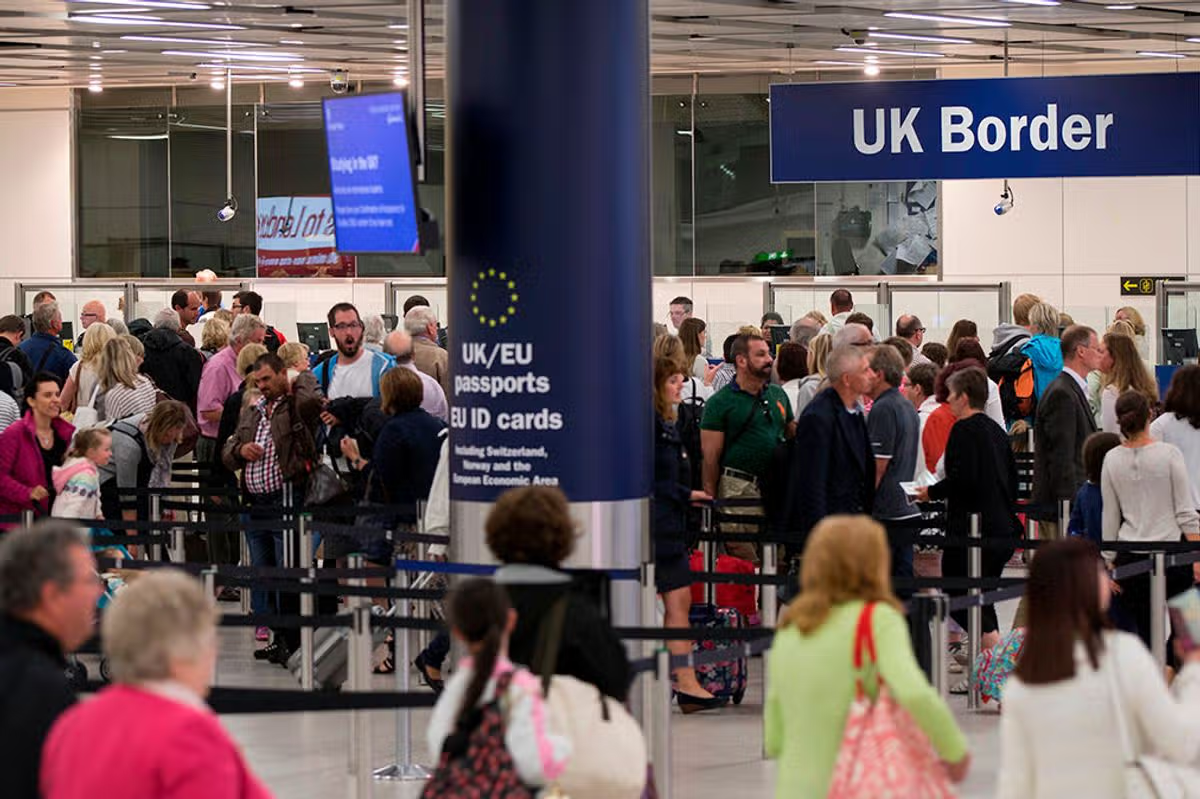
London Luton Airport Ltd.

Foreign Office air travel warning over ‘national emergency’ for EU destination

The advice is to check with your travel provider for the latest information

Families heading abroad on their summer holidays are urged to keep a close eye on travel updates. The Foreign Office has published fresh travel guidance for a popular sunny EU destination. The latest advice urges travellers to “check with your travel provider” for the latest information in light of a “national emergency”.

This comes as many flights were disrupted recently to the south of Italy, after eruptions from Mount Etna caused clouds of ash to be thrown into the air. The Foreign Office has since updated its guidance for Italy on Tuesday, August 11, with new information regarding ‘Volcanoes’ in the ‘Safety and security’ section. The latest guidance informs visitors: “There are several active volcanoes in southern Italy. National emergency planning is in place for the Phlegraean fields, an area that remains active experiencing regular tremors.”

People heading to the Mediterranean country are warned that “airspace can be affected during eruptions”. The Phlegraean fields (Campi Flegrei) is an area just west of Naples and so is close to Naples Airport.

‘Heightened activity’

The guidance includes a word of warning for another airport in the region. You may need to take action ahead of your trip: “If you are travelling to or from Catania, during a period of heightened activity, check with your travel provider or with Catania airport.”

State Pensioners to face major tax change

The Government body also advises: “Read what to do in the event of a volcanic eruption and follow the instructions of the local authorities.” The guidance includes a link to more information on the Civil Protection Department website of the Italian Government.

This information reminds visitors that Italy has “the greatest concentration of active volcanoes in Europe” along with Iceland. The guidance sets out that there is a “varying degree of hazard” for these volcanoes.

‘Wrong information’

People trying to find the latest guidance in the media are warned that “wrong information” can be sent out in times of crisis. The guidance urges: “For this reason it is important to follow the civil protection authorities’ instructions transmitted by radio, TV, in the daily press, on Internet and by the various toll-free numbers that will be set up.

“During eruptions, it is also important not heed the forbidden to enter signs at the areas involved by the eruption. It is dangerous to approach the crater area even if there is no eruptive activity as sudden explosive phenomena or gas emissions are always possible.”

You can read the full travel guidance for Italy on the Foreign Office website.

Source link

UK airport offering free ‘skip the queues’ perk

This may help reduce a lot of travel stress – especially for families

Some airports across the UK offer perks to passengers to make the start of their trip less stressful – but they often come at an extra cost.

With holidays already expensive, many people skip the add-ons. However, not everyone realises that travellers at London Luton Airport (LLA) can pre-book a security time slot and potentially avoid the worst of the queues for free.

The Airport explains that this option is called “Prebook Security”. It boasts that this is a “FREE service that allows you to skip the security queues by reserving a 30-minute slot ahead of your arrival.”

The service is currently only available to passengers arriving at security between 3am and 3pm. Travellers can book a 30-minute security slot in advance, then on the day follow the “Prebook Security” signs to the dedicated entry point, where a staff member will be on hand to help.

Airport officials further explain: “You can pre-book this service from 4 days before your arrival, right up until 60 minutes before you arrive at security (subject to availability). Booking this service is completely free, does not require any login or registration and is available to all guests.”

Prebook Security is first-come, first-served. You’ll go through the usual checks and will be processed in the order you arrive, along with other pre-booked passengers. If you use Prebook Security, LLA says they cannot guarantee how long it will take to complete security checks through the Airport Security area.

How does Prebook Security work?

  1. Book your appointment slot up to 4 days before your travel date.
  2. On arrival at the airport, make your way to the security area and scan your boarding card at one of the signposted “Prebook Security” gates.
  3. Upon entry to the security area, head to the left where you’ll find signs for “Prebook Security”. A member of our security team will be waiting to welcome you and scan your QR code.
  4. You will then be directed to the front of the line.

Children aged four and under don’t need to be included in your group size. Children aged five and over must be included when booking.

To change or cancel your Prebook Security booking, use the “change” or “cancel” option on your booking confirmation page. You can also do this via the links in your confirmation email.

What information is required to pre-book security?

There’s no need to create an account or log in. Passengers should enter their departure date and flight details (destination, airline and flight number), plus group size. People should also provide a name and email address to receive a confirmation email containing a QR code.

If you need to check-in bags, ensure you allow plenty of time for this. The Airport stresses: “Slots are limited and may book up fast, so we recommend booking up to 4 days before your flight.”

If you are late for your appointment, don’t panic too much. The Airport reassures passengers: “Please make sure to arrive 15 minutes before or after your booking time, the QR code will still be valid.”

You can read all about the Prebook Security Terms and Conditions here. You can also read the FAQ via the Airport website here.

Source link

UK airport drop off fees up by a third – full list of most expensive

The cost to drop friends and family off at the airport this summer has increased by a third at most airports across the UK – with some short stays costing a whopping £10

Dropping off family and friends at the airport this summer will cost you even more as new research has found that fees have increased by a third over the last year.

It was found that 16 out of 20 airports analysed had increased or introduced so-called “kiss and fly” fees since last summer, according to the RAC.

Some airports are now charging as much as £10 just to stop outside the terminal for a few minutes.

The most costly airports are still Gatwick and Stansted, with terminal drop-offs costing £10 at both.

The bigger shock comes as the only major airport that offered free terminal drop-offs, London City, now has one of the costliest fees charged on a per-minute basis.

Drivers dropping off relatives at London City are now charged £8 for five minutes, making it the highest charge per minute among airports included in the research.

The next most expensive drop off zones are outside of England’s capital.

One is in Scotland, as Edinburgh charges £8.50 for up to 10 minutes. Bristol also charges the same fees.

The RAC noted the average cost of airport drop-off fees has increased by around a third over the past year, despite many of the world’s busiest airports continuing to offer free terminal drop-offs.

The organisation highlighted that none of the busiest airports in the European Union charge drivers for dropping passengers off outside terminals.

In some of the world’s busiest hubs, including Dubai, these fees also do not exist.

Most UK airports do have alternative options that are free, however these are usually located in mid or long-stay car parks, with passengers needing to catch a shuttle bus to the terminal.

RAC senior policy officer Rod Dennis said: “It’s disappointing to see so many airports charging so much for what many regard as a simple act of kindness in dropping off family and friends.

“Having a captive audience should be no excuse for these farewell fees, especially when they’re completely at odds with how major airports around the world operate.

“Of course, airports need to manage the limited space they have carefully, but if free, convenient drop-off zones work at many other international airports, then why not here?”

Mr Dennis also warned drivers to take extra care when using airports with “park now, pay later” systems without barriers.

He said: “Those that drop off but miss the signage or forget to pay soon afterwards can face a parking charge notice as high as £100 – a fee that feels distinctly disproportionate to the contravention.”

There were only four airports in the study that had not increased their costs. Liverpool John Lennon, East Midlands, Belfast City and Southampton.

Most expensive airport drop-off charges:

  • £10: Gatwick and Stansted
  • £8.50: Bristol and Edinburgh
  • £8: Bournemouth, Leeds Bradford and London City
  • £7: Aberdeen, Birmingham, Glasgow, Heathrow, Luton and Southampton
  • £6: Liverpool John Lennon and Newcastle
  • £5.50: Manchester
  • £5: Belfast International and East Midlands
  • £4.50: Cardiff
  • £4: Belfast City

Source link

Viral kids’ toys could be confiscated at UK airport security – warning to parents

Airports have warned that kids could be forced to leave the items behind

Parents are being told to leave certain children’s toys at home. If kids bring them to the airport, they may be taken from them at security. There is a high chance that items like NeeDoh cubes and other popular ‘squishy’ toys could be flagged and confiscated.

Even at airports using advanced scanners, gel-filled toys look highly unusual on security screens. This frequently triggers a manual bag check, causing travel delays, and some staff will not take the risk with these items going any further into the airport.

Travel specialist Kate Donnelly (@Thedonnelllyedit) said: “From my own personal experience, [squishy toys] do tend to come under closer scrutiny when passing through airport security. My top tip for parents this summer, pack these items in your whole luggage.

“There is a high chance that if you put these in your hand luggage, they will get confiscated. There are absolutely no markings on them to let you know exactly how much liquid is contained within them, and therefore, they are very easily removed.

“This means that you have upset children and you will have to pay out for a whole new load of toys when you get to your destination.” She suggested that the best thing to do is to pack toys safely in your main suitcase that gets checked into the hold, as this allows more liquids than hand luggage does, helping you avoid delays and reduce the risk of them being confiscated.

Content cannot be displayed without consent

Posting online, Luton Airport confirms that any squishy toys, including NeeDoh cubes, that contain a gel or liquid must comply with the strict liquid rule when packed in hand luggage. The airport said: “As the quantity of gel contained within these items cannot be accurately verified during the screening process, they are not permitted through security in hand luggage.”

Manchester Airport also said: “Things like squishy toys contain liquid – this includes NeeDohs, which use malt syrup. Smaller versions of the toy are under 100mls, but larger versions are not.

“The problem is that, as they don’t have measurements printed on them, security staff have to estimate their size. Our advice is that all but very small squishy toys should be placed in hold baggage.”

As a result, kids could be forced to bin their favourite toys before going on holiday. The issue is that there is often no way to verify exactly how much ‘liquid’ is inside one of these objects.

Not all UK airports follow the same rules about liquids in 2026 due to a staggered rollout of new high-tech 3D CT security scanners that allow the 100ml rule to be relaxed. Different locations are at different stages of upgrading, with a pause currently in effect this summer to avoid disruption over peak travel times.

Below is a list of what airports are following the new (2000ml) rules. At the airports accepting two litres in hand luggage, the scanners also mean people do not need to empty their bags, as scanners are powerful enough to detect these items, as well as electronics:

  • Belfast City
  • Belfast International
  • Birmingham
  • Bristol
  • Edinburgh
  • London Gatwick
  • London Heathrow (All terminals)
  • Teesside International

These airports are still following the original (100ml) rule:

  • Aberdeen
  • Bournemouth
  • Cardiff
  • East Midlands
  • Glasgow International
  • Glasgow Prestwick
  • Inverness
  • Isle of Man
  • Leeds Bradford
  • Liverpool
  • London City
  • London Luton
  • London Stansted
  • Manchester
  • Newcastle
  • Norwich
  • Southampton

Source link

Packing innocent 35p item in bags or suitcases could see you stopped at airport

It might seem harmless at first glance, but it could lead to unnecessary delays

Packing for a holiday can feel like navigating a minefield, with a long list of rules on what can and can’t go in your luggage. While some banned items are obvious, others seem completely innocent at first glance – yet bringing them to the airport could still result in officials delaying your journey.

There is one everyday item that is allowed by all major airlines, including Ryanair, Jet2, TUI, easyJet and British Airways, but could still attract attention during security screening if officers are unable to identify it clearly on the scanner. To avoid unnecessary delays or having to unpack your luggage at the checkpoint, travellers are advised to pack toiletries in a way that makes them easy to inspect.

A simple bar of soap – buyable at Sainsbury’s for 35p, for example – might seem like one of the most harmless items you could take on holiday. However, it is not the soap itself that can cause concern – it is the way a solid item may appear when passing through security scanners.

Airport security staff do not routinely search luggage simply because it contains a bar of soap. However, dense items can sometimes make X-ray images harder to interpret, particularly when they are packed alongside electronics, cables or other bulky belongings. If officers cannot clearly identify an item, they may carry out additional checks before allowing passengers through.

The government information website GOV.UK says: “Airport security staff will not let anything through that they consider dangerous – even if it’s normally allowed in hand luggage.” While soap clearly is not dangerous, if a bar of soap raises an alert on the scanner, they are legally required to stop the passenger and inspect it.

The US Transport Security Agency (TSA), for instance, says passengers are often asked to separate dense items because they can “clutter bags and obstruct clear images on the X-ray machine.” When a solid block of soap, cheese, or other dense organic material blocks the scanner’s view or mimics a threat signature, protocol requires a physical bag search or chemical swab testing to clear the item.

According to GOV.UK, solid bars of soap are permitted in both hand luggage and checked baggage. Security officers can still manually inspect any item they are unable to identify clearly during the screening process, regardless of whether it is allowed.

To reduce the chances of your bag being opened, experts recommend keeping dense items easy to access and, if requested, placing them in a separate tray during screening. Avoid storing them inside thick metal tins or rigid plastic cases alongside items such as power banks, charging cables and other electronics, as this can make X-ray images harder to interpret.

It’s also important not to confuse solid soap with liquid toiletries. While bars of soap are exempt from liquid restrictions, liquid soaps, shower gels and similar products carried in hand luggage must normally be in containers holding no more than 100ml, unless you’re travelling through an airport that has introduced next-generation security scanners permitting larger liquids.

The rules apply regardless of which airline you’re flying with, as baggage screening is carried out by the airport rather than carriers such as Ryanair, Jet2, TUI, easyJet or British Airways. A manual inspection is simply a precaution and does not mean you’ve broken any rules or packed a prohibited item.

Taking a few moments to think about how you pack everyday toiletries could help make your journey through security a little smoother. Although a 35p bar of soap is perfectly legal to travel with, storing it sensibly could help avoid unnecessary delays before your holiday even begins.

Source link

New July 8 UK airport rule will affect British families – ‘get through quicker’

Travel could be about to get faster for some families this summer at dozens of UK airports

Families are being reminded that a major change to a key rule across more than a dozen UK airports will come into effect this summer. From next week, on July 8, a security rule will be eased for certain primary school-age children.

Back in May, the UK Government announced that up to 1.5 million more children would soon be able to use UK eGates, helping to speed up the process for them and their families during the summer holidays. Children aged eight and nine, who are at least 120cm (3ft 11in) tall and travelling with an adult, will become eligible under the new measures that come into force on Wednesday, July 8.

Officials say the change to the age threshold will be a welcome relief for families returning home from their holidays with young children in tow. The government claims that passing through an eGate typically takes just a matter of minutes.

With greater numbers of passengers making use of eGates, waiting times at passport control are also anticipated to fall. Prior to 8 July, eGates were generally available to those aged 10 and above, though children under 17 were required to (and must still be) accompanied by an adult, reports the Express.

Passengers are eligible to use an eGate if they have a biometric symbol on the front cover of their passport and are either:

  • a British citizen
  • a national of an EU country, Australia, Canada, Iceland, Japan, Liechtenstein, New Zealand, Norway, Singapore, South Korea, Switzerland or the USA
  • a member of the Registered Traveller Service
Content cannot be displayed without consent

Minister for Migration and Citizenship, Mike Tapp said: “Travel with young children can be stressful for parents. By expanding eGate access, more families can experience a swifter and smoother journey home – freeing up precious time this summer holiday season. We are delivering continued improvement to the passenger experience, while keeping our borders safe and secure.”

Border Force Director General, Phil Douglas said: “eGates are an essential part of keeping our border secure. Expanding access for families will deliver safe, smooth journeys whilst freeing up highly-skilled officers to focus on intercepting those who pose a threat to the UK.”

Karen Dee, Chief executive of AirportsUK, the trade body for UK airports, said: “This is a welcome development as it will give more families the ability to take advantage of this technology, speeding up the border process and reducing waiting times for many. Airports work very hard with border authorities to ensure the UK’s front door is both secure and welcoming, with those coming home and visiting enjoying a smooth experience.”

The UK first introduced ePassport gates at airports in 2008, with the very first gate going live at Manchester Airport. Initially, the automated gates were limited to UK, EU, and Swiss citizens but have since expanded to include eligible travellers from dozens of countries, including the US, Canada, Australia, and New Zealand.

Full list of UK airports with eGates (as of July 2026):

  1. London Heathrow
  2. London Gatwick
  3. London Stansted
  4. London Luton
  5. London City
  6. Manchester
  7. Birmingham
  8. Edinburgh
  9. Glasgow
  10. Bristol
  11. Newcastle
  12. Cardiff
  13. East Midlands
  14. Southampton
  15. Southend

Source link

EasyJet update for UK travellers as 13 new routes to launch from 10 airports

EasyJet has announced 13 new routes, including new city breaks for UK tourists

EasyJet has today revealed 13 brand-new UK routes set to launch this winter. Among them are flights and package holidays to a never-before-served destination in Germany.

This festive season, EasyJet will launch flights and packages to Nuremberg. Services will be departing from Manchester from 2 November on Mondays and Fridays, London Gatwick from 19 November on Thursdays and Sundays and London Luton from 23 November on Mondays, Wednesdays, and Fridays.

Nuremberg is home to one of Europe’s oldest and most celebrated Christmas markets. The iconic Christkindlesmarkt, which dates back to the 16th century, draws visitors from across the globe to soak up the festive atmosphere of one of Germany’s most beloved seasonal destinations.

EasyJet will also be expanding its offering from its London airports, with fresh routes launching to Morocco, France and Egypt. Flights from London Luton to Rabat get under way on 5 November, followed by London Southend to Lyon from 3 December, running on Thursdays and Sundays.

Completing the new additions, flights from London Southend to Sharm El Sheikh will kick off on 4 January, departing on Mondays and Fridays. The airline is also expanding its connections to Hungary, with fresh flights and package holidays to Budapest taking off from three UK airports.

Services from Bristol and Belfast International will commence on 17 November, operating on Tuesdays and Saturdays, while flights from Liverpool will get under way on 19 November, running twice weekly on Thursdays and Sundays – perfect for a festive weekend getaway.

In Scotland, a brand new service from Edinburgh to Tromsø in Norway will launch on 30 November, operating twice weekly on Mondays and Thursdays and providing passengers with the only direct route to the ‘Gateway to the Arctic’. Meanwhile, in time for the festive period, flights from Glasgow to Krakow in Poland will commence on 13 November, with departures twice weekly on Mondays and Fridays.

EasyJet will enhance its Manchester network with a fresh service to Vienna in Austria, launching on 19 November with departures up to twice a week on Mondays and Fridays. Additionally, EasyJet is introducing its first international route from the Isle of Man, with a new weekly service to Geneva starting on 19 December, operating on Saturdays. The route will offer the only direct link between the Isle of Man and Switzerland.

The new routes take the airline’s total number of winter services introduced over the past fortnight to 26. Last week’s announcement featured a new direct service from Manchester to Sphinx Airport, alongside the carrier’s first ever international route from Cornwall Airport Newquay to Geneva. The airline says that package holidays can be booked through EasyJet holidays on all new routes with the exception of Luton to Rabat. All packages include flights and hotel, plus 23kg luggage and transfers on beach destinations such as Sharm El Sheikh, they say.

Holidaymakers can reserve their winter getaway with a deposit of £60 per person and until 1 July 2026, can save money on new bookings using the code FOOTBALL26.

Kevin Doyle, EasyJet’s UK Country Manager, said: “We’re thrilled to be announcing a further 13 new routes this winter, bringing the number of new routes on sale over the past two weeks to a total of 26. A real statement of our commitment to giving customers across the UK more choice from their local airport.. From winter sun escapes to magical Christmas market breaks, there’s never been a better time to book a flight or package holiday with EasyJet. We look forward to welcoming even more customers on board for their winter holidays.”

EasyJet and EasyJet Holidays say they have introduced their Book with Confidence Promise to reassure customers on their travel plans. The airline says that the pledge guarantees that flight and package prices will not increase in price once booked and confirms that EasyJet intends to operate a full schedule across its network, despite competitors cutting routes, as EasyJet prepares to fly over 50 million passengers this summer.

Full list of new EasyJet routes and dates

  • London Gatwick to Nuremberg – 19 November
  • London Luton to Nuremberg – 23 November
  • London Luton to Rabat – 5 November
  • London Southend to Lyon – 3 December
  • London Southend to Sharm El Sheikh – 4 January
  • Bristol to Budapest – 17 November
  • Liverpool to Budapest – 19 November
  • Manchester to Nuremberg – 2 November
  • Manchester to Vienna – 19 November
  • Edinburgh to Tromso – 30 November
  • Glasgow to Krakow – 13 November
  • Belfast to Budapest – 17 November
  • Isle of Man to Geneva – 19 December

Source link

Wizz Air launches new direct £45 flights to ‘pink city’ that’s ditched visas for Brits

The UK’s only direct flight to a destination known as the ‘pink city’ has been launched by Wizz Air, and flights start from £45.99 with no visa required for Brits

Wizz Air has launched the UK’s only direct flight to a walkable destination dubbed the ‘pink city’, which has ditched visa requirements for Brits.

In an exciting addition for the budget airline, holidaymakers can now jet off from London Luton Airport to Yerevan, with flights starting from just £45.99. The Wizz Air route launched on Tuesday, 9 June and is the only direct flight available from the UK to Armenia.

Flights will operate from London Luton to Yerevan, Armenia, twice a week on Mondays and Fridays throughout the year. The direct route takes just over five hours, and after that time, travellers will be rewarded with the dramatic landscapes of mountains and historic architecture in a destination known as the ‘Pink City’.

The city earned its moniker due to the rose-hued stone that characterises its buildings, in addition to its tree-lined boulevards and lively public squares. There are historic monasteries, museums, galleries and markets, along with a thriving café culture.

On the UK’s first direct route to Armenia, Wizz Air pilot, Tom Copestake, exclusively told the Mirror: “I’m really excited about landing in Yerevan, Armenia. It’s a new destination for us, but it’s surrounded by big mountains, and it’ll be an interesting experience to fly around there.”

Adding to the appeal of a trip to Armenia in Asia, British holidaymakers can visit without a visa for up to 180 days a year. Whereas a list of Asian countries still requires Brits to obtain a visa at an additional cost.

Following the new flights, Yvonne Moynihan, Managing Director of Wizz Air UK, said: “Today [9 June] marks an exciting moment for Wizz Air as we launch the UK’s only direct route to Armenia, opening up a destination that remains largely undiscovered by British travellers. At Wizz Air, we’re committed to making travel more accessible and helping our customers explore beyond the obvious. Yerevan is a city rich in history, culture and character, offering an incredible experience for travellers looking for something different, all at an affordable price.

“The response to our Let’s Get Lost campaign showed there is real appetite among travellers to step outside their comfort zones and discover destinations they may never have previously considered. We’re proud to be making Armenia more accessible than ever before and can’t wait to welcome more passengers on board as they experience everything this remarkable country has to offer.”

Alberto Martin, Chief Executive Officer at London Luton Airport, said: “We are delighted to welcome Wizz Air’s new service to Yerevan, marking the UK’s first direct link to Armenia and further strengthening London Luton Airport’s increasingly diverse route network. This exciting new destination in the South Caucasus is a unique city that offers a fascinating cultural scene of contrasts to suit all tastes.

“As well as reinforcing our long-standing partnership with Wizz Air, the addition of Yerevan to our departure boards signals our commitment to offer even greater choice as part of our simple and friendly passenger experience.”

Do you have a travel story to share? Email webtravel@reachplc.com

Source link

The UK’s dirtiest airport named – and it’s not London or Manchester

An analysis of Google Reviews has shown which UK airports have the most cleanliness complaints — and the top spot may surprise you.

Airports are set to be busier than ever over the coming months as numbers of Brits prepare for their summer getaways. With greater numbers passing through the terminal, airports can become rather grubby in no time.

However, a fresh study has examined which UK airports have received the highest number of complaints regarding cleanliness. Private Tours England analysed Google Reviews of 50 UK airports and tallied how frequently travellers mentioned the word “dirty” in their feedback.

The rankings are determined by the proportion of total reviews featuring the term.

Remarkably, Leeds Bradford Airport came out as the dirtiest in the UK. In total, 2.46% of all its reviews include the word when describing their time at the terminal.

Leeds Bradford Airport operates flights to numerous destinations including Austria, Hungary, Romania, Iceland, Ireland, Spain, France, the Netherlands and Italy.

The airport itself holds a 3.2 Google rating, with one reviewer noting: “The airport is currently being renovated.

“However, there are very few seats, toilets are super dirty, and the WiFi does not function whatsoever.”

A second commented: “To say it’s been refurbished, it’s cheap, IKEA plastic plants everywhere and dirty and unclean. The public lounge is bad enough, but the Avro Lounge is an absolute disgrace.”

Another wrote: “Avoid this grubby, dirty little airport if you can. Completely unfit for purpose.”

Coming in second place was Manchester Airport, with 1.45% of reviews making reference to cleanliness issues. Belfast International Airport took third spot at 1.42%.

Followed by London Stansted in fourth place at 1.18%, with Birmingham Airport rounding off the top five at 1.13%.

Top 10 dirtiest airports in the UK:

1. Leeds Bradford Airport – 2.46%

2. Manchester Airport – 1.45%

3. Belfast International Airport – 1.42%

4. London Stansted – 1.18%

5. Birmingham Airport – 1.13%

6. Edinburgh Airport – 1.05%

7. London Luton Airport – 0.96%

8. Newcastle Airport – 0.84%

9. Bristol Airport – 0.80%

10. East Midlands Airport – 0.73%

Leeds Bradford Airport has been approached for a response.

Source link