Student protests in France are into their second month, escalating into demonstrations across Europe.
What began in September in France with pupils protesting against overcrowded classrooms and teacher shortages has grown into wider anger at the cost of living and planned cuts to public services.
Recommended Stories
list of 3 itemsend of list
Protesters in Albania, Belgium, Greece, Italy, Portugal and Spain have also taken to the streets over the lack of affordable housing, rising costs and failing public services – with many young people saying they no longer expect to be better off than their parents.
Facing their anger are leaders such as French President Emmanuel Macron, Italy’s Prime Minister Giorgia Meloni, Spain’s PM Pedro Sanchez and Portugal’s PM Luis Montenegro. Sanchez belongs to the left, Meloni to the right and Macron and Montenegro are conservative-leaning centrists. But while their politics vary, they all face mounting unrest because of soaring costs of living.
Are they out of touch with the experiences and sentiments of youth in their countries? Al Jazeera visualises how prices, wages, housing and education have changed in France, Italy, Spain and Portugal over the past 26 years, from when Macron, Meloni, Sanchez and Montenegro were in their 20s, much like many of the protesters angry with them.
How much more expensive is it compared to 2000?
The prices paid for everyday items such as food, energy, transport and bills have risen by between 59 and 78 percent since 2000 in France, Italy, Spain and Portugal, according to Eurostat – the European Union’s statistics agency. Its harmonised index of consumer prices (HICP) is the EU’s official measure of how much everyday goods and services cost.
Spain recorded the steepest increase at 78 percent, followed by Portugal at 71 percent, 68 percent in Italy and France at 59 percent.
That means goods and services that cost 100 euros ($112) in 2000 now cost about 178 euros ($200) in Spain, 171 euros ($192) in Portugal, 168 euros ($188) in Italy and 159 euros ($178) in France.
Prices rose by about 2 percent a year on average, but jumped in 2022, when annual inflation hit 8.7 percent in Italy, 8.3 percent in Spain, 8.1 percent in Portugal and 5.9 percent in France, the highest rate in all four countries since at least 2000.
The surge was driven mainly by energy costs, which soared after Russia’s invasion of Ukraine in February 2022. By October that year, eight months into the war, energy prices across the eurozone were almost 42 percent higher than a year earlier, and food prices were also rising sharply, according to Eurostat.
Between 2021 and 2023, prices increased by 12 to 15 per cent in the four countries. Wages failed to keep up, and because prices do not fall back once inflation eases, many households are still feeling the squeeze today.
(Al Jazeera)
How have salaries changed?
Once inflation is taken into account, the average full-time wage in Italy fell by almost 5 per cent between 2000 and 2025. Over the same period, real wages rose by 7 per cent in Spain, 11 per cent in France and 20 per cent in Portugal, according to OECD wage data adjusted with Eurostat’s price index.
In Spain most new jobs were in tourism and services, and were often seasonal and poorly paid, Jaime Velazquez, a journalist in Madrid, told Al Jazeera’s Inside Story.
Julius Fintelmann, cofounder and editor-in-chief of The European Correspondent, said ageing societies were squeezing out opportunities for younger workers, adding that the pay gap between older and younger workers has been widening across high-income economies for decades, so the promise that each generation would be better off than the last no longer holds.
How has the cost of housing changed?
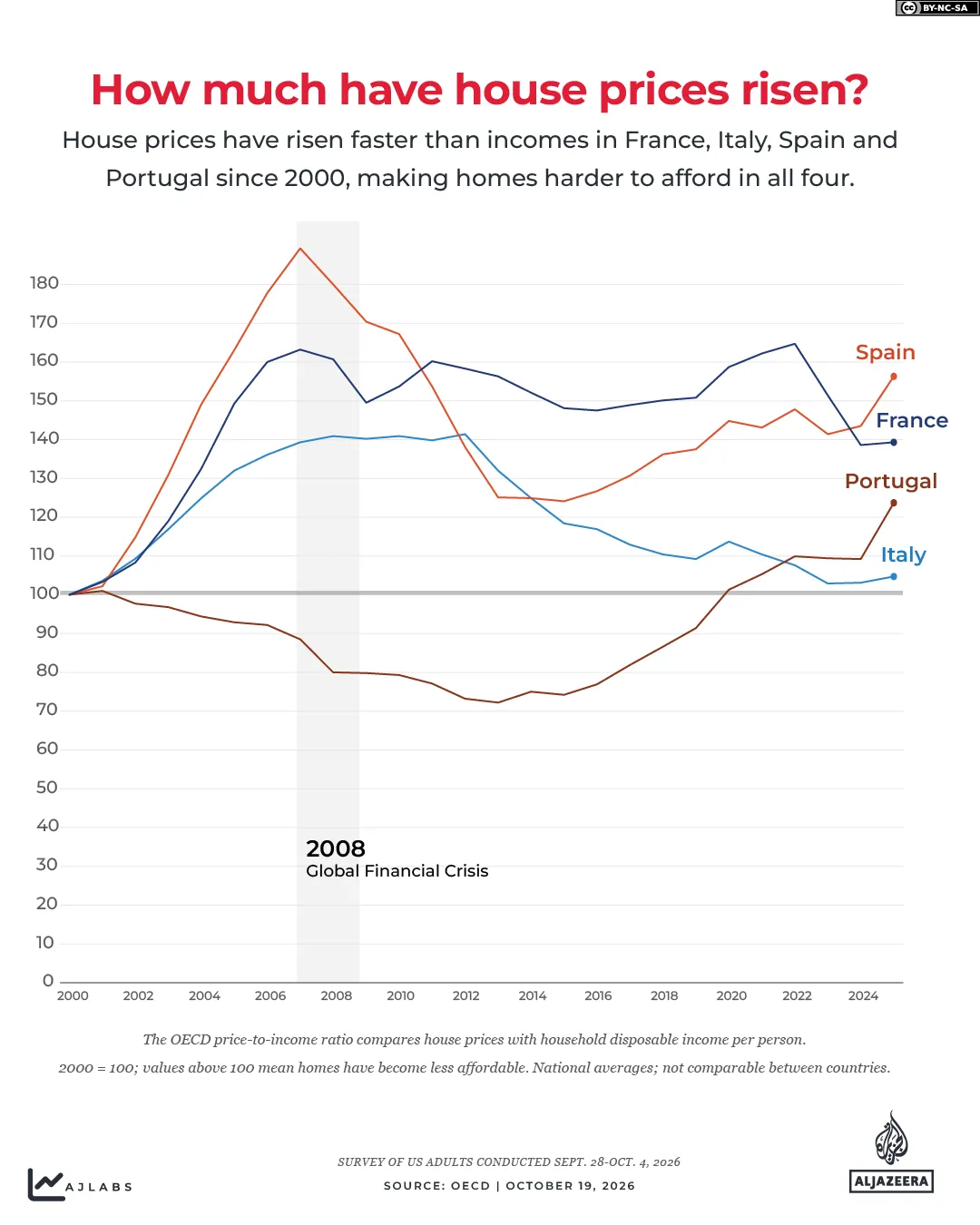
Housing has become harder to afford in all four countries since 2000, according to the OECD’s price-to-income ratio. It provides a broad picture of how house prices have changed relative to incomes over time. When prices rise faster than incomes, the ratio goes up, suggesting homes are becoming less affordable on average.
However, it doesn’t show which households or regions are hit hardest, does not account for mortgage and borrowing costs, and says nothing about the quality of the homes people are paying for.
Spain has seen the biggest change. Its price-to-income ratio is 56 per cent higher than in 2000, even after falling sharply following the 2008 financial crisis.
In France, the ratio is 39 per cent higher than in 2000, though it has eased slightly since peaking in 2022.
Italy is the exception where house prices have broadly kept pace with incomes, leaving the ratio just 5 per cent higher than in 2000.
Portugal has seen the sharpest change in recent years. Its price-to-income ratio fell steadily for 15 years after 2000, meaning homes became more affordable. But since 2015 the ratio has risen by 67 per cent.
The OECD publishes the price-to-income ratio with 2015 as its reference year. To compare it with the wage and price data in this article, which started in 2000, Al Jazeera has reset the figures so that 2000 = 100.
How has state expenditure on education changed?
Education has been at the heart of the unrest in France, where protests began because of overcrowded classrooms and teacher shortages. While in Belgium and Albania, demonstrators have rallied against the rising cost of education and access to universities.
According to the latest data from Eurostat, France’s public spending on education amounts to 5.1 per cent of its gross domestic product (GDP) compared to 5.6 per cent in 2000.
Italy spent 4.4 per cent of its GDP on education compared to 4 per cent in 2024, Spain spent 4.1 per cent in 2000 and the same in 2024. Portugal spent 4.8 per cent in 2000 and 4.3 per cent in 2024.
Hundreds of thousands of Europeans took to the streets for separate demonstrations putting pressure on governments across the EU.
Published On 17 Oct 202617 Oct 2026
Hundreds of thousands of Europeans have taken to the streets in separate, uncoordinated demonstrations to protest against the rising cost of living in their countries.
Saturday’s protests were in Belgium, France, Italy and Portugal in a wave of unrest that has put pressure on national governments across the European Union.
Recommended Stories
list of 3 itemsend of list
France experienced one of its most turbulent days of protests in decades, with over 550,000 people joining demonstrations and police facing off with protesters across the country – but it was not the only country to see significant demonstrations.
In Belgium’s capital Brussels – which has already seen weeks of protests by students against university registration fees – police fired tear gas and water cannon to disperse protesters, who they accused of launching missiles at them and setting fires.
In Liege, a smaller city east of Brussels, police also deployed water cannon to break up demonstrations. Police did not say how many people attended.
An estimated tens of thousands of protesters marched in Lisbon, the Portuguese capital, against the cost of living crisis, low wages and an inability to access housing in major cities. House prices in Portugal have more than doubled since 2017, while rents for new leases have increased nearly as much.
Portuguese Parliamentary Affairs Minister Carlos Abreu Amorim said on Friday that the “government will not yield to shouts from the street”.Protesters said their leaders are “out of touch” with the problem.
In Milan and Bologna, Italian police reported that, alongside peaceful cost of living rallies, protesters threw stones and clashed with officers.
Italian media reported several injuries and arrests.
Portuguese demonstrators in Lisbon set up tents to protest against the housing shortage, soaring rents and low wages [Filipe Amorim/AFP]
French protests spill over
None of the protests reached the same scale as the nationwide rallies in France but they may be a sign of spilling over into other European nations, according to Alberto Alemanno, Professor of EU Law & Policy at HEC Paris business school.
“France is the epicentre of this movement … and there are signs now that this is spreading beyond France,” Alemanno told Al Jazeera.
He said Saturday’s protests may not be the last in many of these countries and new hotspots could emerge.
In Greece, Germany, and Austria, the “early stages” of a movement is emerging, with mobilisation expected “in the coming week”, he said.
They are not a single movement, he explained, but several protests happening at the same time, with some “shared grievances”: underfunded education, rising costs and, for students, uncertain prospects after graduation.
The unrest comes at a crucial time for Europe, as the continent prepares for what Alemanno called an “unprecedented super-cycle of national elections” in the coming 12 months, with votes scheduled in Spain, France, Italy and Poland.
“Inevitably, all these protests, all these mobilisations, are going to be at the centre of the political conversation,” Alemanno said.
Riot police fire water cannon during a youth protest in Brussels [Nicolas Maeterlinck/AFP]
Protesters have set fire to cars and buildings in France as demonstrations against the cost of living and declining public services escalate. There is serious unrest in Paris and multiple locations across the country.
RJ Mitte was diagnosed with cerebral palsy at the age of threeCredit: AlamyHe was best known for playing Walter White Jr. in Breaking BadCredit: Alamy
His cause of death was not immediately disclosed, however, TMZ reported that he died by suicide.
The star’s reps told Deadline: “It is with profound sadness that we share the tragic passing of beloved actor, philanthropist, and passionate disability rights advocate RJ Mitte.
Sign up for the Showbiz newsletter
Thank you!
“Drawing from his own experience living with cerebral palsy, Mitte brought authenticity to the role and built a platform on disability awareness and inclusion.”
RJ became a leading voice for disability rights in film and TV following his rise to fame with Breaking Bad.
He was a leading voice for disability rights in film and TVCredit: AlamyBryan Cranston (L), Anna Gunn (C) and RJ Mitte (R) starring in Breaking Bad, 2008Credit: Alamy
When he was born in Louisiana, he was not breathing and suffered permanent brain damage as a result.
He was diagnosed with cerebral palsy – a neurological condition that affects movement, muscle tone, and motor skills – when he was three years old.
Doctors put his legs in casts to try to strengthen his feet and later he was fitted with leg braces.
RJ spent most of his childhood using crutches, but improved his ability to walk over his teenage years through sports and exercise.
Most read in Entertainment
RJ Mitte attends a screening of ‘Talking To Strangers’ at Fine Arts Theatre on September 30, 2026 in Beverly Hills, CaliforniaCredit: GettyRJ Mitte speaks live at BUILD Series London on January 24, 2017Credit: Getty
The actor previously opened up about his experiences undergoing physical, occupational and speech therapy, which he also started when he was three.
He told Future of Personal Health late last year about routines he used for managing his disability.
The star said: “Stretching has been one of the most important tools for me.
“I also rely on hot showers and baths to relax my muscles, especially to help manage spasticity.
He reportedly died by suicide, according to TMZCredit: AlamyRJ Mitte used crutches throughout most of his childhoodCredit: Shutterstock Editorial
“With my travel schedule, I’m not always near a gym, so I’ve learned to build small, sustainable routines that keep my body in balance.
“Finding what works for you, and blending those therapies into your daily life, can truly change everything.”
Giving advice to young people with disabilities, he said: “My hope is to inspire a ‘never give up’ mentality.
“If there is something you want in life, pursue it no matter how hard it may be.
RJ Mitte played Walter White Jr. in Breaking BadThe cast of Breaking Bad (L-R) RJ Mitte, Jonathan Banks, Bryan Cranston, Anna Gunn, Betsy Brandt, Dean Norris, Aaron Paul and Bob Odenkirk pictured in February 2024Credit: Getty
“Keep your dreams alive. Don’t lose sight of who you want to become.”
RJ, who got engaged last year to Kennedy Suarez, also credited his mum with his success in a 2009 interview.
Opening up about his early diagnosis, he told Ability Magazine: “They told me I was going to need a wheelchair because I couldn’t bend my legs.
“My mom stretched my legs and really pushed me to get to where I am today. Really, I owe my mom.”
He also said playing football helped him overcome his physical problems.
“What most helped me to get out of my braces was playing soccer,” he explained.
“I always wanted to play football… but because of my disability, my hand-eye coordination was off. I couldn’t do that. So I gradually started playing more and more soccer.”
RJ was a Screen Actors Guild spokesman for actors with disabilities, and a celebrity ambassador for United Cerebral Palsy.
In 2013, he received the SAG-AFTRA Harold Russell Award.
The TV star also featured in shows including “Switched at Birth”, and Netflix’s animated series “The Guardians of Justice”.
He starred in several films including the drama “Triumph” from 2021, which he also executive produced.
How to get help
EVERY 90 minutes in the UK a life is lost to suicide. It doesn’t discriminate, touching the lives of people in every corner of society – from the homeless and unemployed to builders and doctors, reality stars and footballers. It’s the biggest killer of people under the age of 35, more deadly than cancer and car crashes. And men are three times more likely to take their own life than women. Yet it’s rarely spoken of, a taboo that threatens to continue its deadly rampage unless we all stop and take notice, now. If you, or anyone you know, needs help dealing with mental health problems, the following organisations provide support: CALM, www.thecalmzone.net, 0800 585 858 Heads Together,www.headstogether.org.uk HUMEN www.wearehumen.org Mind, www.mind.org.uk, 0300 123 3393 Papyrus,www.papyrus-uk.org, 0800 068 41 41
If you or someone you know is affected by any of the issues raised in this story, call or text the 988 Suicide & Crisis Lifeline at 988, chat on 988lifeline.org, or text Crisis Text Line at 741741.
The beautiful spot is perfect for pensioners seeking a relaxed lifestyle
14:27, 12 Oct 2026Updated 14:35, 12 Oct 2026
Best town to retire in Spain as expats praise ‘affordable living’
New analysis from World Atlas has named the best Spanish towns to relocate to. They are all stunning, overlooked locations, ideal for retirees seeking a peaceful and authentic way of life away from well-known resorts such as Benidorm or the Costa del Sol.
The research highlighted seven picturesque towns with fewer than 50,000 inhabitants across Spain that feature “walkable, historic centres with accessible recreation, including coastal paths, mountain trails, canoeing rivers, and reservoirs a short drive from the front door”. On Reddit, expats praised the “affordable living” and the “amazing regional food” of some of these picture-perfect locations.
Trujillo, in Extremadura, was named the best small town to retire in, with the lowest housing prices of around €717 (£605) per month. Locals praised the town’s authenticity on social media, with one saying that “life is more or less affordable, with no uncontrolled tourism problems, and food is amazing”.
Trujillo was followed by Arcos de la Frontera, in Cádiz, which has an estimated population of 31,046. Experts at World Atlas noted: “For retirees who want a classic Spanish white town with water sports on the doorstep rather than just mountain views, Arcos is a rare combination.”
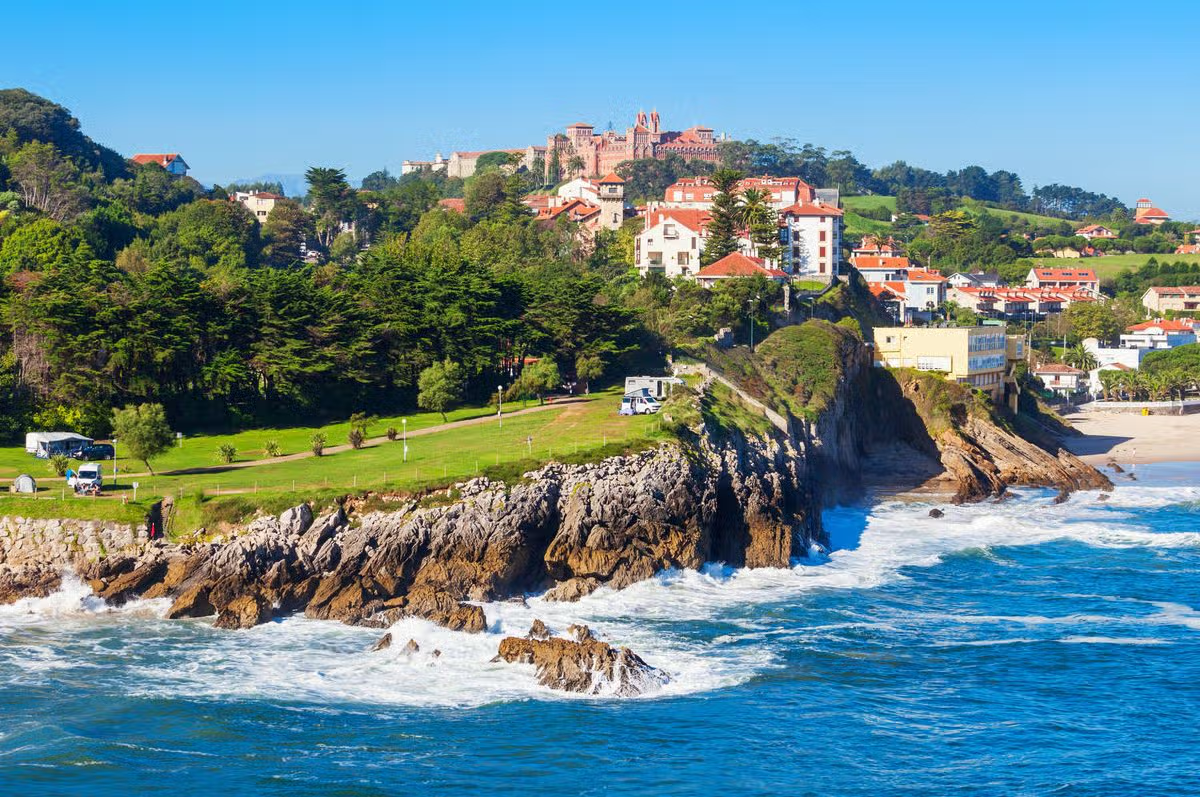
Baiona, in Galicia, was also named one of the best places to relocate to. The charming town in northern Spain has a population of 12,380. World Atlas stated: “Baiona offers a version of coastal Galicia that pairs history with a genuine beach-town feel, at a price most Mediterranean resort towns can’t match.”
Other places included the picturesque town of Sitges, just half an hour down the coast from Barcelona, and Cangas de Onís, best known as the historic gateway to the Picos de Europa National Park.
Sanaa, Aden and Marib, Yemen – As fighting intensifies across Yemen between the government and the Houthis, millions of people are confronting another battle far from the front lines: the deteriorating living and economic conditions in the country.
With salaries for large segments of the workforce either unpaid or irregularly disbursed – and the prices of goods and services rising – Yemen’s economic struggles have been compounded by a divided banking system that has made moving money between different parts of the country increasingly complicated.
Recommended Stories
list of 3 itemsend of list
From Aden’s struggling shoppers to displaced families in Marib and unpaid public-sector workers in Sanaa, Yemenis are being forced to make difficult choices about what they can afford, and what they must go without.
Aden: Food costs swallow salaries
In Aden, the internationally recognised Yemeni government’s interim capital in the south, the problem is not so much a shortage of goods in markets as people’s inability to afford them.
Salaries have failed to keep pace with the rising costs of food, rent, healthcare and transport, leaving workers with little money left over at the end of the month.
The consequences are evident in the smaller quantities and cheaper products that now make up shoppers’ baskets, and the decisions they are forced to make about what to cut back on.
Bushra Abdullah Abdulwarith is a government employee in Aden. She earns 78,000 Yemeni riyals ($50) a month at the black market exchange rate while typical household food costs in government-held areas run about 130,366 riyals ($83), according to estimates by the Yemen Economic Tracking Initiative. And that’s before she factors in the cost of rent, transport, healthcare and other household expenses.
The economic difficulties facing Yemenis like Bushra illustrate how more than a decade of war has devastated the economy. According to the World Bank, real GDP per capita has fallen by approximately 58 percent since 2015.
The fragmentation of Yemen’s monetary institutions between the government and the Houthis – who have operated their own institutions since seizing the capital, Sanaa, in 2014 – along with the disruption of oil exports, and declining international assistance have all contributed to the economic decline.
Bushra told Al Jazeera that rising prices have forced many households to give up almost all non-essential purchases and cut back on some expensive basics, particularly meat. Other families, she said, have resorted to buying food in smaller quantities, sometimes on credit or loans.
Reduced demand
The impact of rising prices is reflected not only in economic figures but also in the way people shop.
Ayman al-Maqtari, who works at a shopping centre in Aden’s Mansoura district, said that his customers now rarely buy non-essential items.
When it comes to the essentials such as rice, sugar, flour, and cooking oil, he has noticed that customers size up the price of each item before putting it in their baskets. They are also buying smaller quantities, for example, opting for a 5kg (11 pound) over a 40kg (90 pound) bag of rice.
“Many people have come to live day by day, or week by week,” Ayman told Al Jazeera, adding that more families are buying on credit when they run out of money before the end of the month.
The decline in purchasing power is also affecting commercial activity.
Across several streets and shopping centres in Aden, advertisements for discounts and special offers have become increasingly visible in shop windows and on retailers’ social media pages, as businesses attempt to attract customers and boost sales.
Weak demand, retailers say, is particularly evident for items that households can put off buying, such as clothing and household goods. A growing share of family income is spent on food, rent, healthcare and transport.
Limited pay increase
The Yemeni government approved a 20 percent cost-of-living allowance in May for public-sector employees in an attempt to ease the pressure of rising prices. But the amount is calculated based on each employee’s base salary, rather than their total pay, meaning the actual increase is relatively small for many workers.
Bushra, the government employee in Aden, said the increase has done little to improve her family’s financial circumstances. She described the allowance as “a temporary painkiller that does not reflect the scale of the actual pressure on people’s living standards”.
Her experience is far from isolated. In early October, the World Food Programme said its latest monitoring in accessible government-controlled areas showed that 74 percent of households were unable to meet their basic food needs.
One of the places where the crisis is evident is Marib, a government-controlled city east of Sanaa that is home to hundreds of thousands of displaced people. The sharp increase in the population over the war years, in what was previously a provincial backwater, has led to pressure on the city’s housing, employment and public services.
Government employees in Marib see their salaries disappear within the first few days after being paid, labourers struggle to find more than a few days of work and displaced families are forced to choose between buying water and milk.
Salah al-Zuhaifi works for a government institution in Marib. He said the war has separated him from his parents, who live in Houthi-controlled territory.
Alone in Marib, al-Zuhaifi said that inflation had eroded much of his salary’s purchasing power.
“No matter how much you earn, it will not be enough to meet your needs,” he said.
Abu Mohammed Nasser al-Asbahi, another government employee, described a similar struggle.
He told Al Jazeera that he earns 400,000 riyals ($250) a month, but more than half of that goes towards his rent, leaving little for his other expenses.
“We don’t even get to the first one-third of the month before the salary is gone,” he said, explaining that his family spends the rest of the month relying on loans and credit from local shops.
The healthcare sector in Marib has also been affected by widespread household spending cuts.
Pharmacist Khaled Mohsen told Al Jazeera that the rising price of medicines has prompted many patients to decline parts of their prescribed treatment and purchase only what they consider most essential.
People with chronic illnesses, meanwhile, have increasingly begun reducing their medication doses to make their supplies last longer before having to buy more, which creates serious health risks.
Houthi areas
Residents of Sanaa and other areas of Yemen’s populous northwest, controlled by the Houthis – an armed group also known as Ansar Allah (Arabic for Supporters of God) – since 2014, are also facing a worsening economic and cost-of-living crisis similar to that affecting Yemenis elsewhere in the country.
Several factors are driving the crisis, particularly unpaid public-sector salaries, declining purchasing power, rising prices for goods and services, and the continuing consequences of the division of Yemen’s currency and banking systems in the early years of the war.
Many public-sector employees in Houthi-controlled areas have gone years without receiving regular salaries, with some sectors only receiving limited payments or half-salaries at irregular intervals.
Even when payments are made, they cannot cover families’ basic needs amid the rising cost of living.
Meanwhile, private-sector workers and business owners face growing pressures as a result of declining economic activity, multiple fees and levies, and a shortage of employment opportunities. The conditions have undermined incomes and job security.
The Yemeni riyal’s exchange rate in Houthi-controlled Sanaa is more stable than in areas controlled by the government. The Houthis have imposed strict monetary controls, banning the circulation of newer banknotes printed by the Yemeni government, and have also enforced a largely fixed exchange rate.
However, that does not necessarily translate into stronger purchasing power. Markets face difficulties caused by cash shortages and the division between monetary and banking systems operating in different parts of the country, including increased costs for moving funds.
That directly affects the many households relying on domestic and international remittances.
For residents in Houthi-controlled areas, the result is an economy in which the currency may be relatively stable, but livelihoods are precarious. Years of unpaid salaries and limited employment opportunities have left many families struggling to afford basic necessities, with few options beyond borrowing, cutting spending or relying on support from relatives.
I SPEND most of my days scouring the web to track down the cheapest possible holiday deals – to share them all with Sun Club members.
Spending so much time filtering and flicking through holiday websites means I’ve gotten pretty good at seeking out a bargain.
Travel writer Jenna Stevens spends most of her days hunting down cheap holidays – here’s exactly how she finds the best dealsCredit: Jenna StevensWith my website trick I found a I found a week-long holiday to a four-star resort in Magaluf for £119ppCredit: Alamy
In fact, I’m often finding UK breaks for under £5pp, city breaks for £99 and under, and even family holidays abroad for £150pp or less.
So I’ve decided to reveal exactly how I find these cheap holidays: the very best websites to use, and how to use them to bag the best deals.
Holidays abroad
Loveholidays and On the Beach are two incredible companies when it comes to bagging the cheapest deals.
Both offer package holidays which bundle in your return flights, accommodation and board of your choice – so there’s no need to worry about having to book it all separately.
Loveholidays
With Loveholidays, it’s really easy to filter breaks by all inclusive, family friendly, short haul, long haul and more.
Their cheap holidays page lets you pick between cheap all-inclusives, beach holidays, city breaks and even family holidays with free child stays.
You can also filter by breaks under £500pp or even under £300pp. Drag the slider bar all the way down to the bottom, and you may even find hols for £120pp or under.
For example, under the ‘Cheap Beach Holidays’ tab, I found a week-long holiday to a four-star resort in Magaluf in October for £119pp.
On The Beach
You can book a four night break in The Algarve with On the Beach for £95ppCredit: Getty
On The Beach works in a similar fashion, and their cheap holidays page is regularly updated with ‘our cheapest deals of the week’, which often start from a super low £100pp to destinations like Portugal and Malta.
This page also currently has a ‘cheap holidays for autumn under £500′ section.
Some of the cheapest holidays they’re offering this autumn are week-long breaks to Turkey (from £135pp) and the Canary Islands (from £180pp).
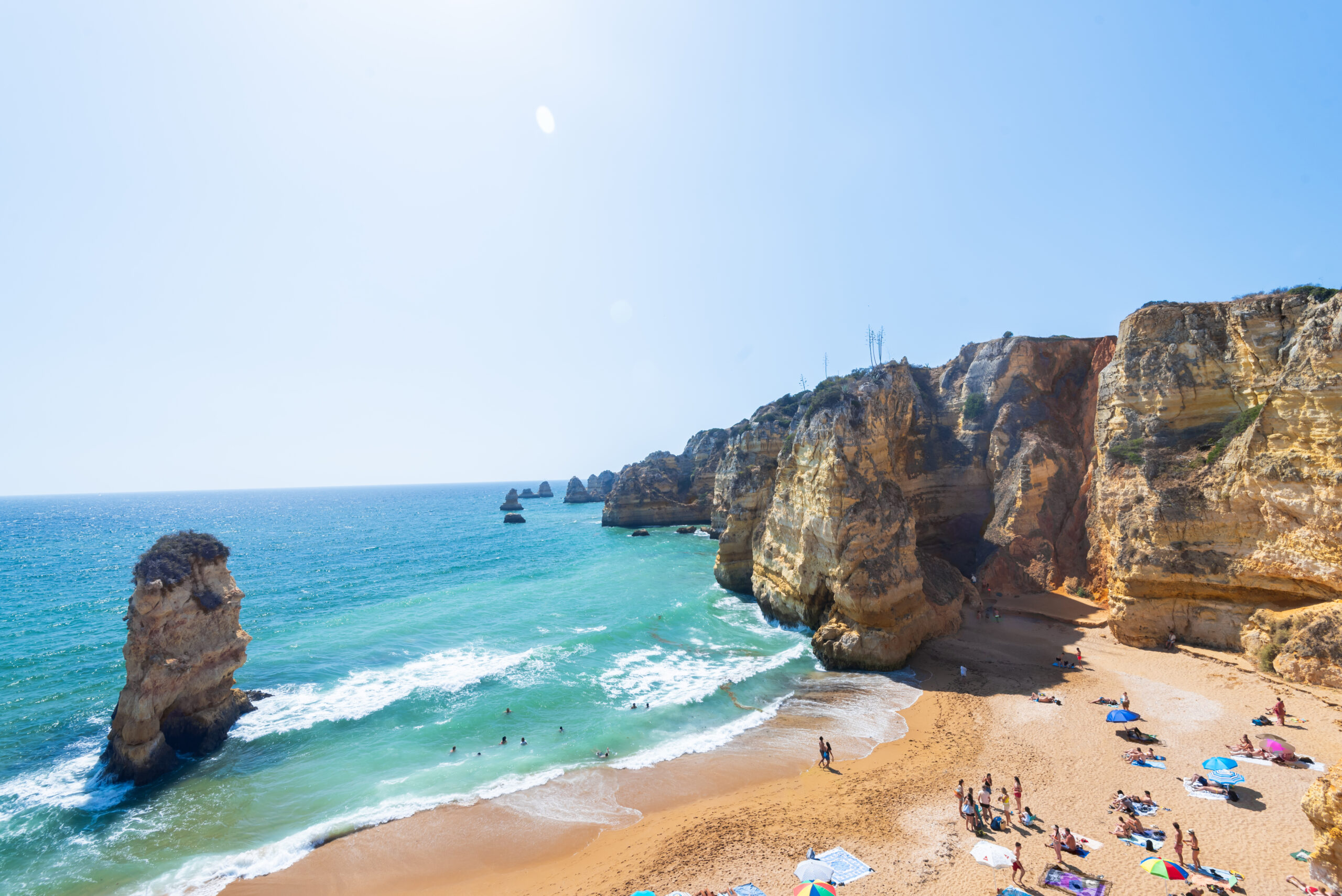
One of the best deals I found for autumn using the cheap holidays page to navigate the offers is for a four night break in The Algarve for £95pp.
Wowcher
As well as UK breaks, Wowcher is also great for booking holidays abroad.
Yes they have the classic £99 mystery holiday, but they also offer beach holidays, European city breaks, cruises and even long haul escapes.
These include a glamorous Lake Como getaway from £79pp, an all-inclusive Egypt holiday from £299, and even an incredible Las Vegas holiday with flights for £399.
Lastminute.com choose a deal of the week, with one recent bargain being a Tenerife hol for £484ppCredit: Alamy
Lastminute.com is another great site that does what it says on the tin – and more.
While the homepage often showcases some of the site’s best value deals, they also have specific pages rounding up cheap family holiday destinations as well as cheap adults-only resorts.
Plus the site is still king when it comes to bagging a last-minute break. This webpage rounds up the week’s best exclusive deal, plus an offer of the week and last chance bargains.
Offers of the week are certainly one to keep an eye open for – their most recent was for a trip to a 5* resort in Tenerife for four nights with flights for £484pp.
The site also has a loyalty programme which is completely free to join, and can bag you up to an extra 15 per cent off holidays and experiences.
The offers get better the more holidays you take, and as you climb the ranks you can unlock more and more perks.
These include free travel audioguides, 10 per cent off car hire and free lounge access if your flight is delayed.
Sundeals
Sundeals is the new kid on the block when it comes to cheap holiday deals, and is a new branch of familiar favourite holiday company TUI.
Here you can explore deals by budget (under £350, under £500, under £1,000) or by destination and more.
On their cheap holidays page, I’ve found all inclusive holidays from £234pp, beach holidays from £115pp and city breaks from £147pp.
Plus, the holiday company offers holidays with super low deposits from £30pp, so you can get your next break locked in for cheap.
Travelzoo
I found a Travelzoo deal for 11 nights in Egypt combining a Nile cruise and 5* hotel for only £549pp with flightsCredit: Alamy
This is the only site you’ll have to pay for on this list, but my goodness is your membership worth it.
A Travelzoo membership costs £30 a year, but you can also try out 30 days of membership for £1.
Signing up means you’ll get Travelzoo’s ‘Top 20 deals’ dropped into your inbox each week, so you can easily have a quick browse to see if anything takes your fancy.
Or you can head to the site to browse cheap holiday deals broken down into loads of specific categories, from Asia Pacific holiday deals to island holidays and safari deals.
The best value to be found for foreign holidays here is for long haul breaks. The first time I came across their long haul holiday deals, I couldn’t quite believe my eyes.
You can visit gorgeous hotels in New York for £653pp, the Dominican Republic for £690pp and Mexico for £860pp – all for a week-long break including flights.
I even found an 11-night Egypt holiday which packs in your flights, four nights at a 5* all inclusive resort – followed by a Nile cruise which stops at major historical sights – for an unbelievable £549pp.
To be able to view and book these deals, you have to be signed up as a member.
Where to look
Albania has been called ‘The Maldives of Europe’ due to the colour of its water and sandsCredit: Alamy
Where you’re looking for your holidays is equally as important as how you’re looking.
You might be tempted to hop online and look for the same familiar favourites you’ve been to before, such as cheap Spain or Greece holidays.
But if you’re open to trying somewhere new, I’d recommend not ticking the ‘destination’ box. Instead, go for ‘beach holidays’ and see what pops up.
That way, you’re opening up hundreds or even thousands of new holiday options – which massively increases your chances of finding something cheaper.
And if you know there’s somewhere you really don’t want to go to, you can just untick it from the left-hand column of the page. Easy peasy.
I’d recommend keeping an eye out for Bulgaria, Albania and Montenegro holidays specifically.
These three destinations are absolute powerhouses when it comes to an affordable beach holiday.
Bulgaria has all-inclusive getaways from £279 and flights from the UK under £15. Plus once you’re there, you can grab a meal out for under £9 and a cappuccino for just 88p.
Albania has been named the ‘Maldives of Europe‘ thanks to its beaches with bright white sand and electric blue seas, with holidays from £165pp.
Montenegro offers £255 holidays and even has been referred to as ‘St Tropez with Benidorm prices’ by one travel expert.
UK Holidays
Best Western GEM stays
Best Western package hotel stays with activities, like with their soft play family breakCredit: Best Western
Forget paying for just a bed for the night. Best Western’s GEM stays are hotel break packages with your room, food, and extra perks completely sorted for you.
The GEM packages stand for ‘Great Escapes, Memorable Stays’ and are centred around a huge variety of fun experiences.
The Somerset Family Escape package (from £123.38 per night) bundles in a family stay for two adults and one child with breakfast plus soft play access for the kids while parents can unwind in the spa.
Whereas the Ultimate Girls Night In package at Brackenborough Lakes & Resort reserves a hot tub lodge for two nights, breakfast each morning, three bottles of Prosecco and £15 takeaway credit per person from £44.50pp per night.
Wowcher
Head to Manchester for a swanky city break for £105 with Wowcher (41% off)Credit: Getty
The UK holidays section of Wowcher is hiding some serious bargains, from spa weekends, to city hotel stays, to rural retreats.
Look for any offers with the pink ‘Price Drop’ label to find the cheapest deals.
Some of the top offers for UK breaks on Wowcher right now include a 4* break in Manchester for two with breakfast for £105, shaving 41 per cent off full-price.
Another fantastic offer is for a wellness retreat to Woodford Bridge Country Club, where four people can escape for four nights from £79 (£4.94pp per night).
Travelzoo
Stay in Northumberland’s National Park for £59 with this Travelzoo bargainCredit: Getty
Travelzoo’s UK holiday deals are just as impressive as their deals for holidays abroad.
You can stay at one of the world’s oldest inns, The Olde Bell in Hurley, from £75 a night with breakfast. This saves you 48 per cent when compared to booking direct.
Another great deal is this two night break in Northumberland for £89pp, which puts you up in the Riverdale Hall Hotel which overlooks the Northumberland National Park.
And that super cheap £59 deal? It’s for a seafront stay in Eastbourne, with an overnight break for two at the The Lansdowne hotel, working out to only £29.50pp.
Remember, however, that you have to be a Travelzoo member to unlock these deals (£30 per year).
Holiday parks
If you opt for a cosy glamping pod instead of a caravan when booking you can save extraCredit: parkdeanresorts.co.uk
Whether you enjoy pitching up a tent, cosying up in a caravan or even splashing out on a hot tub lodge, holiday parks have stays to suit all budgets.
Choosing to stay in a holiday park can be a fantastic way to tick off a new UK destination without having to fork out on an expensive hotel.
You can often bag a three or four night family break at a holiday park for £90-£100 if you know where to look, which would typically only get you one night in a hotel!
£9.50 Holidays
If you’re looking for a super cheap getaway, The Sun’s £9.50 holidays offer some of the best rates out there, which are often significantly cheaper than booking with the same park direct.
The bargain holidays are released in stages throughout the year, with the biggest Hols from £9.50 drop taking place in January,
As a Sun Club member you can bag your break earlier than anyone else – so make use of this perk!
Make sure to check the Sun Club Offers Hub and club950.co.uk to keep updated with Hols from £9.50 releases.
Parkdean Resorts & Park Holidays
If the £9.50 holiday booking window is closed, Parkdean Resorts and Park Holidays offer some of the best rates among UK holiday parks.
Look out for Parkdean’s last minute breaks page where you can bag a three night stay in Norfolk from £99 or Cornwall from £109.
Park Holidays have 50+ award-winning parks across the UK – their short breaks page offers stays from £129.
Want to save even more? Go for a cosy wooden glamping pod instead of a caravan with Park Holidays, and you can stay from £50 for a two night break. These pods sleep four, so that’s only £6.25pp per night.
SACRAMENTO — As Californians prepare to elect a new governor in November, the concern they want to be his top priority is reducing the state’s entrenched high cost of living, according to a poll by the UC Berkeley Institute of Governmental Studies and co-sponsored by the Los Angeles Times.
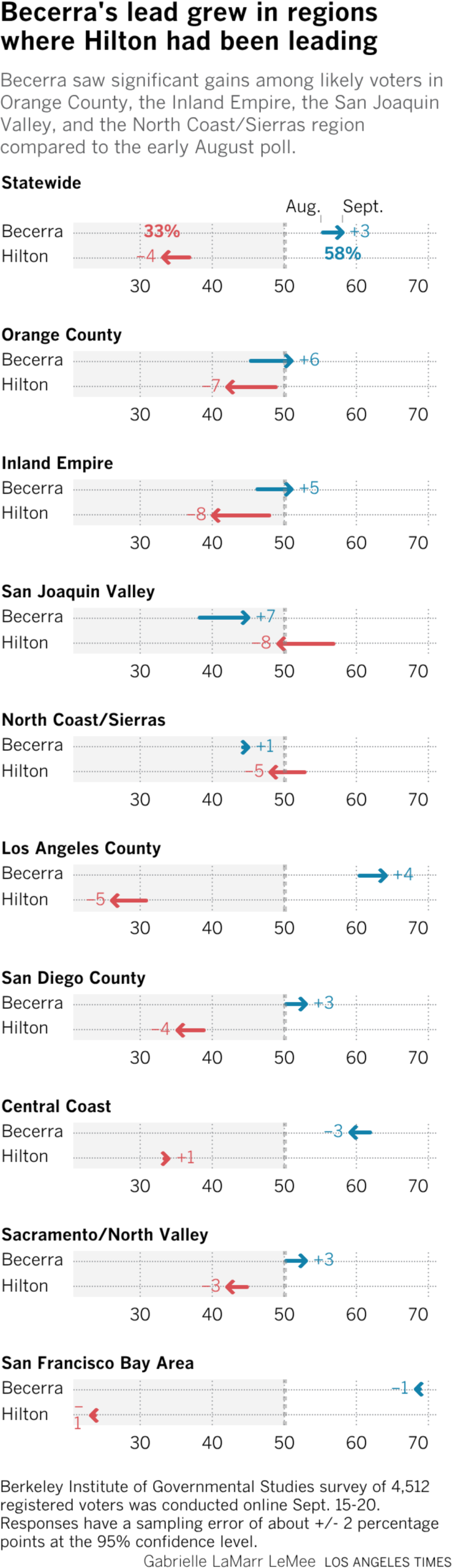
Not too far behind that is strong voter support for fighting the policies of the Trump administration. That may be among the many reasons 58% of likely voters surveyed support Democrat Xavier Becerra in the governor’s race compared to the 33% who back Republican Steve Hilton, whom the president endorsed.
“These results suggest that Becerra is in a commanding position heading to November,” said IGS co-director Eric Schickler. “With 2026 shaping up to be a strong Democratic year nationally, the headwinds facing Hilton in Democratic-leaning California are even stronger than usual.”
The poll found that Becerra’s lead over Hilton had increased slightly since an August IGS poll, and the Democrat now holds a 25-percentage-point advantage.
Despite an effort to reach out to Democrats and independent voters and making California’s high housing costs, top-in-the-nation gasoline prices and other increasing daily living expenses a central focus of his campaign, Hilton is struggling to gain ground in the race to replace Gov. Gavin Newsom, the poll found.
“The difficult thing is that Steve Hilton’s a Republican in California,” said Tim Rosales, a Republican strategist who previously advised GOP gubernatorial candidate John Cox in the 2018 race against Newsom. “On the scale of what’s more important to voters, the cost of living certainly is there, but those Democrats really aren’t willing to cast a vote or cross party lines to vote for a Republican.”
Asked to name one or two of their top concerns heading into the Nov. 3 election, 44% of likely voters cited the cost of living, 37% said it was important to push back against policies from the Trump administration and 30% said they wanted to help their political party win or maintain control of Congress.
“The November elections are being held at a time when the economic backdrop is worsening not only in California but across the nation, as prices are rising on most major household purchases, including groceries, gasoline, electricity and healthcare,” said IGS poll director Mark DiCamillo. “Pocketbook issues have traditionally played a big role in election politics and this year is no exception.”
“Independent voters are a little bit different. They aren’t partisan but they are ideological and there is some opportunity there.” But Hilton would “need a whole lot of them in California in order to have a chance on a statewide level,” he said.
More than half of likely voters not registered with either the Democratic or Republican parties — most of whom declare themselves as “no party preference” — said they supported Becerra in the governor’s race, while 30% favored Hilton. The remaining 14% were undecided.
Hilton has made a slew of campaign promises to lower the cost of living, including $3 gasoline, no taxes on income below $150,000 and lowering energy bills by slashing climate-friendly regulations imposed by Democrats.
Both Rosales and DiCamillo agreed that while voters list affordability as a top issue, Democrats in particular are more motivated by the opportunity to push back on President Trump in the midterm elections.
“When you look at the Becerra voters on the issues or concerns that are important to them, it’s really framed by fighting Trump administration policies. I think that’s an indication of what’s happening in this election cycle,” DiCamillo said. “You’re seeing it across the country as well.”
The poll showed that 59% of Becerra supporters said fighting the Trump administration was a top priority, while 62% of Hilton supporters said reducing taxes was their main concern. More than 60% of undecided voters listed the cost of living as a top item.
Trump, who remains extremely unpopular among most Californians, endorsed Hilton for governor in April. Though the president’s backing helped the former Fox News host consolidate enough Republican support to finish second in the June primary, allowing him to advance to the November election, it may hurt his chance in the general election. A recent Public Policy Institute of California poll showed Trump with a 27% approval rating in the state, a record low across both of his terms.
Hilton has tried to court voters, especially Latinos and independents, who dislike Trump but are also dissatisfied with California’s Democratic leadership and its failure to alleviate some of California’s most incessant problems. The British-born Republican has also declined to criticize the president on issues including immigration enforcement or the Iran war.
Becerra’s wide lead is also boosted by his favorability rating — 48% of likely voters have a favorable opinion of him while 40% view him unfavorably and 11% have no opinion. Hilton’s rating is underwater; 51% of likely voters have an unfavorable opinion compared to 35% favorable and 13% with no opinion.
The Republican has criticized his opponent for doing few public events since the primary election and challenged Becerra to accept debate invitations from roughly a half-dozen news outlets around the state.
The poll was conducted online in English and Spanish from Sept. 15 to 20. Responses for the governor’s race poll came from a weighted sample of 4,512 respondents considered likely to vote in the November election, from a larger group of 6,989 registered voters throughout California. It has a margin of error of 2 percentage points in either direction.
Mourinho brought printouts of screenshots to the post-match news conference, claiming Atletico should have been given two red cards in the first half.
Writing in response to an article in the Spanish media which claimed there is a “conspiracy” against Real, Tebes dismissed the allegations.
“Claiming that referees are directed against Real Madrid is living in another galaxy,” Tebas said on social media.
“That narrative serves as an excuse to cover up other shortcomings that are plain to see in these first matches of the season.
“It’s more comfortable to point to a conspiracy than to explain what’s happening on the pitch.”
Real are fourth in La Liga, six points behind Barcelona who top the table on 21 points after winning all seven of their league games this season.
After defeat by Atletico, where Real went down to 10 men in a feisty encounter after defender Dean Huijsen was sent off, Mourinho blamed the officiating.
“We can skip the press conference because the story of the match is right here,” Mourinho said as he showed media the printed images.
“Those were two clear red cards. Given the difficulties we faced afterwards playing 11 against 10, we can only imagine what 50 minutes of 11 against nine would have been like.”
Frankie Muniz had a vulnerable moment on social media Friday, revealing he’s hit rock bottom following the announcement of his split from wife Paige Price.
The “Malcolm in the Middle” star announced he and Price were calling it quits after seven years of marriage in July, and now the actor is revealing he’s experienced some painful introspection in recent weeks.
“The last 6 weeks of my life have been a nightmare I’m praying to wake up from,” he wrote on Instagram. “Everything felt heavy, unclear, and like it was falling apart at the same time. I wouldn’t wish this season on anyone.”
He continued that despite the painful experience, “the unexpected gift in the middle of it is that I’ve had nowhere to hide.”
The actor-turned-race car driver said he’s spent the last several weeks reflecting and can now see the areas of his life where he thinks he can improve.
“I want to become a better version of me. Not the polished version I show the world … the actual one,” he wrote.
“I read that sometimes hitting rock bottom is the thing that wakes you up. It forces the changes you needed to make all along so you can live the best life possible. That idea has been sitting with me. In five years I believe I’ll look back at this exact low point and feel grateful for it, because the high I’ll be standing on then only exists because I went through this.”
He told his followers that this period isn’t the end of the story, but the catalyst for change.
“It’s the part where I start doing the work … the uncomfortable, unglamorous, necessary work. I’m choosing to treat this season as the foundation, not the finish line.”
Shortly after Muniz’s post, Price posted an Instagram story with a message that some followers speculated may be a response to the actor’s admission.
“Life is all about perspective. If you ask the grass, the zebra is the monster and the lion is the protector,” Price wrote.
Muniz is best known for his titular starring role in the beloved Fox sitcom “Malcolm in the Middle,” which ran for seven seasons in the early aughts. In April, the series returned for a four-episode reunion arc on Hulu starring returning fan favorites Bryan Cranston as Hal, Jane Kaczmarek as Lois and a couple of Malcolm’s TV siblings.
In 2006, when “Malcolm in the Middle” wrapped, Muniz transitioned away from acting and pursued race car driving.
The Labour Party chair has said Sir Jim Ratcliffe loses “the moral high ground” by making statements about the UK while living in tax exile.
Speaking to Sunday with Laura Kuenssberg, Bridget Phillipson said she would take the billionaire businessman’s comments that the UK was “on the slide” with a “pinch of salt”.
Sir Jim, the founder of petrochemical giant Ineos and Manchester United’s co-owner, told the BBC he has lost confidence in the UK due to a combination of high taxes and high immigration.
He has been a tax resident in Monaco since 2020 and said “things would have to get better” in the UK for him to return.
When questioned over the remarks, Phillipson said Sir Jim loses “the moral high ground” by “making these kinds of pronouncements while choosing to make decisions, that he is within his rights to make, to become a tax exile”.
Pushed on whether it bothers her that people who create jobs and pay a lot of tax were leaving the UK, the minister said she was “optimistic about our country’s prospects”.
Other high profile billionaires have left the UK, including including steel tycoon Lakshmi Mittal and most recently the UK’s third biggest taxpayer, hedge-fund boss Chris Rokos.
But, Philipson argued the country was in a good position ahead of the Budget next month, and Andy Burnham has shown a “sense of hope and optimism whilst recognising that many families are still struggling and there is more to do.”
“Of course, there are challenges, including big international headwinds, but I fundamentally believe that we are in a strong position going into this budget because of the decisions taken over the last two years, and I believe our country’s best days lie ahead of us,” she said.
Philipson declined to speculate over whether there would be tax rises in the Budget on 28 October, and said the government remained committed to being disciplined about its spending rules.


![Demonstrators sit amid 40 tents set up to protest against housing shortage, soaring rents and low wages on Rossio square in central Lisbon on October 17, 2026. Thousands of people marched on October 17, 2026 through the centre of Lisbon at the call of the CGTP trade union to protest against increasingly difficult living conditions. The slogans and demands focus mainly on higher wages and pensions, as well as protests against the rising cost of housing and fuel. [Filipe Amorim/AFP]](https://i0.wp.com/occasionaldigest.com/wp-content/uploads/2026/10/AFP__20261017__D3LK2MC__v1__HighRes__PortugalPoliticsHousingDemo-1792267175.jpg?w=640&ssl=1)
![Riot police uses a water cannon against demonstrators in Brussels during a youth protest [Nicolas Maeterlinck/AFP]](https://i0.wp.com/occasionaldigest.com/wp-content/uploads/2026/10/afp_6ad3d52b2c56-1792267563.jpg?w=640&ssl=1)