“I’ve been doing that before because, like the story said, that’s legal in Puerto Rico,” Díaz said.
USA Today published a story in May highlighting social media posts advertising cockfighting tournaments that picture Díaz in his Dodgers uniform. The story also referenced a story in El Nuevo Día, the largest circulating newspaper in Puerto Rico, quoting Díaz.
No one from Major League Baseball has reached out to Díaz about a possible suspension, he said.
“They didn’t reach out to me because I wasn’t doing anything illegal,” Díaz said.
In 2019, a federal law banning cockfighting took effect in Puerto Rico. Before the law, the blood sport had been made illegal in all 50 states, but not U.S. territories. Many Puerto Ricans saw the ban as an attack on their culture and vowed to defy the law.
Puerto Rico responded by passing a law saying that it’s legal to host cockfights as long as people don’t export or import the animals or any goods or services related to cockfighting. The U.S. Supreme Court in 2021 declined to hear a challenge to the federal law brought by a group that argued Congress exceeded its power by applying the ban to Puerto Rico.
Anyone found guilty of taking part in cockfighting faces up to five years in prison and a $250,000 fine. Spectators could receive a one-year prison sentence.
Still, some Puerto Ricans such as Díaz view the topic as part of the island’s history, initially brought to the Caribbean by 16th-century Spaniards when the island was first colonized.
“It’s a pastime I’ve followed since I was a child,” Díaz told El Nuevo Día in March. “It’s legal in Puerto Rico, thank God. Otherwise, I wouldn’t be here.”
Diaz is on track to return to the Dodgers after the All-Star break, although his exact return date remains unclear. His fastball felt good, so locating his slider was the next step toward his return.
Times staff writer Hannah Fry contributed to this report.
Many might remember the days of visiting this water park that was renowned for its lagoon and dome ceiling, but today it paints a different picture as its left to rot away
10:58, 01 Jul 2026Updated 10:59, 01 Jul 2026
This once-thriving UK water park has been closed for more than five years(Image: Jamierob2/SWNS)
When most of us are dreaming about cooling down in an outdoor lido or planning trips to the beach over the weekend amid the blistering UK heatwave, there’s one water park that lies eerily abandoned, without a visitor in sight.
Having opened in 1976, the Oasis Leisure Centre in Swindon, or known simply as Swindon Oasis, became a standout attraction as a swimming pool, sports complex and entertainment venue all rolled into one. The Grade II-listed indoor water park boasted a lagoon, a wave machine, and colourful waterslides underneath its domed roof, providing hours of fun for the kids.
The area was decorated with artificial rocks and foliage, with smaller slides for the little ones and even an Egyptian statue in one corner. It was once a colourful, vibrant space that has now become a haunting, neglected site.
But back in the day, for those eager for a night out, there was the concert hall that could seat up to 1,620 people, or hold around 3,000 people standing. It famously hosted the rock band Inspiral Carpets in the early 1990s and even inspired the name of the band Oasis.
Liam Gallagher is said to have latched onto the name Oasis after seeing the Swindon leisure centre listed as the venue on the Inspiral Carpets tour poster. Noel had worked with Inspiral Carpets and later joined the band Rain with his brother, Noel Gallagher, and they went on to call themselves Oasis. All thanks to the iconic dome attraction.
While Oasis never performed at the venue, Liam did appear at the Oasis Leisure Centre in 2011 with his band, Beady Eye. Alongside its high-profile links, the complex welcomed thousands of visitors during its heyday and was one of Wiltshire’s most beloved attractions.
Yet, all good things come to an end, and after 44 years, the Swindon Oasis closed its doors forever. Its permanent closure in October 2020 followed five months without visitors due to the 2020 lockdowns, which required leisure facilities to halt operations.
At the time, operator GLL said: “As a charitable social enterprise, we are not in a position to continue operating a facility that requires capital investment and is losing money, while accruing significant rent liabilities.”
Today, after five years left untouched, it remains eerily neglected. Photos released earlier this year show the inside of the water park rotting away, with its surfaces covered in grime and the remnants of shallow water a murky green.
With rotting slides, rusty rails and faded tiles, it’s hard to imagine that just over five years ago, it was the first port of call for families looking for a day out or a dip in its iconic lagoon pool.
In 2025, plans were made to replace the sports hall with 700 flats while keeping the swimming pool and dome. While the latter were approved, the council rejected plans for the flats. There were then hopes that it could reopen this year, but its future still remains uncertain.
Do you have a travel story to share? Email webtravel@reachplc.com
From left, People Power Party lawmaker Song Seok-jun, Committee for Ten Million Separated Families Chairman Jang Man-soon and Kenneth Bae, president of New Korea Foundation International, attend a news conference opposing the South Korean government’s two-state approach to inter-Korean relations at the National Assembly in Seoul on Thursday. A sign-language interpreter is at far right. /Citizens’ Solidarity for ONE KOREA
June 25 (Asia Today) — A South Korean civic leader proposed creating a satellite communications network modeled on SpaceX’s Starlink to provide outside information to people in North Korea.
Jang Man-soon, chairman of the Committee for Ten Million Separated Families and a co-chair of Citizens’ Solidarity for ONE KOREA, called the proposed system “Korea Link.”
“If we place a system similar to Starlink over North Korea, we could inform North Koreans who have access to approximately 8.5 million mobile phones about the realities and conditions in South Korea,” Jang said during an interview Thursday at the National Assembly in Seoul.
The figure was Jang’s estimate and could not be independently confirmed.
Jang said the network could communicate the importance of freedom to North Korean residents and correct historical accounts and information distorted by the North Korean government.
He said it could also help North Koreans develop pride in the goal of Korean unification.
Jang argued that a new means of communication is necessary because traditional methods of reaching North Koreans, including radio broadcasts and border loudspeakers, have become increasingly restricted.
He said North Korean leader Kim Jong Un’s “two hostile states” policy is partly intended to isolate residents from outside information.
“North Korea is at a disadvantage in politics, economics, culture and military power, so the government is trying to block outside information from reaching its people,” Jang said.
Jang also discussed the declining prospects for families separated by the division of the Korean Peninsula and the 1950-53 Korean War.
“The wish of separated families is no longer simply to reunite with relatives,” he said. “It is to set foot in their hometowns.”
Many first-generation separated family members are now in their 90s, and few still have living parents in North Korea, he said.
“Their greatest wish is to visit their hometowns before they die,” Jang said.
He warned that public awareness of separated families is fading with each generation.
Jang called for expanded unification education for young people, opportunities to hear testimony from first-generation separated family members and educational visits to areas near the inter-Korean border.
“The reality is that only about half of the public now believes unification is necessary,” he said. “We are preparing various activities, including youth education, testimony from first-generation separated families and visits to border regions.”
Jang urged the South Korean government to participate in practical projects intended to support North Korean residents and preserve awareness of freedom and unification.
“If we view the people of North Korea as members of the same nation, I hope the government will participate in the practical plans we are pursuing,” he said.
“We must work together to establish a foundation that will allow future generations to understand the meaning of genuine freedom in the Republic of Korea.”
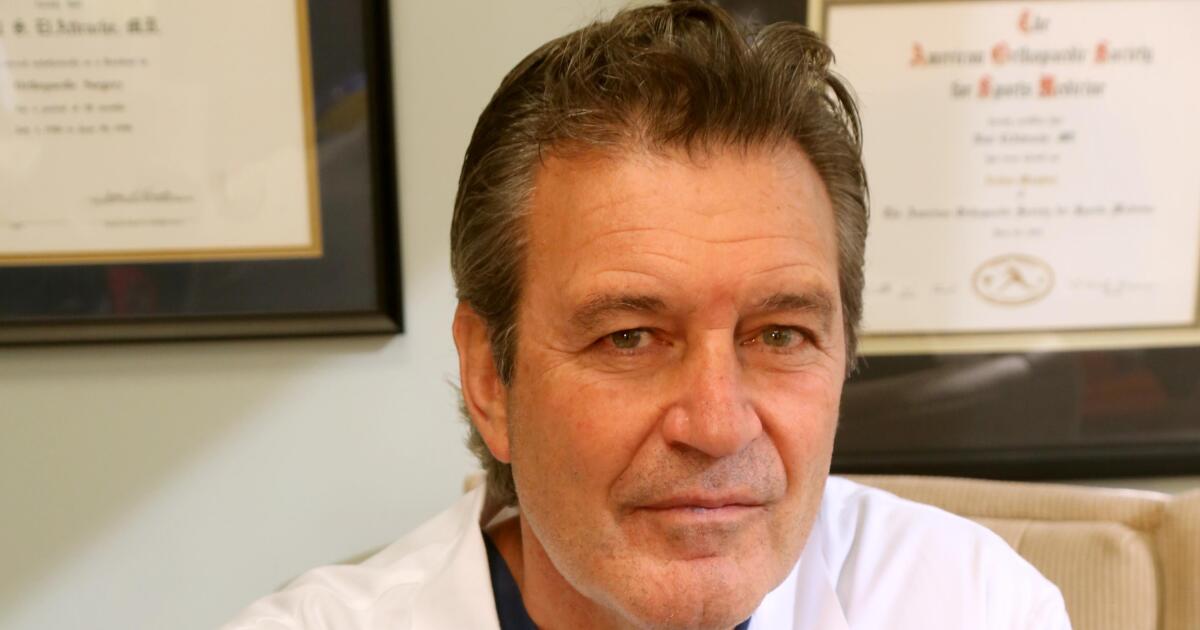
Major League Baseball says it has no concerns about Dodgers and Rams head team physician Dr. Neal ElAttrache working with players.
ElAttrache was questioned by MLB on June 12 following a detailed report by the New York Times that the renowned surgeon and sports medicine expert supported the therapeutic use of performance-enhancing drugs by UFC star Conor McGregor.
“MLB took our responsibility to conduct due diligence in this matter seriously. We interviewed Dr. Neal ElAttrache last week, covering multiple topics, and he answered our questions thoroughly,” MLB said in a statement obtained by The Times Tuesday night.
“Based on our interview, the review of relevant records, Dr. ElAttrache’s long history of support for and cooperation with the Joint Drug Program and the fact that no Therapeutic Use Exemption requests of this nature have been submitted by Dr. ElAttrache or anyone else, we do not have any concerns regarding Dr. ElAttrache’s treatment of MLB players, or his adherence to the Joint Drug Programs and related rules.
“We consider this matter closed.”
ElAttrache performed surgery on McGregor in July 2021, inserting a rod, plates and screws into his left leg after the fighter broke his tibia and fibula during a mixed martial arts bout against Dustin Poirier in Las Vegas.
McGregor’s recovery was lengthy and arduous. ElAttrache told the New York Times that while he did not prescribe steroids for McGregor, he referred him to a specialist who did. Furthermore, ElAttrache wrote a letter supporting McGregor’s request for a therapeutic use exemption from UFC drug policies.
“I felt it would be appropriate to consult other physicians with expertise in bone healing/bone metabolism,” ElAttrache told the New York Times via text. “I recommended the consultations but not the course of treatment.”
ElAttrache said he told McGregor to check with UFC drug testers about prescriptions the consultant gave him. “I purposely wasn’t involved with his evaluation by the consultant nor with prescribing medication,” ElAttrache said.
The exemption request was denied by the U.S. Anti-Doping Agency, the drug testing organization the UFC used at the time, triggering a split between the two organizations. McGregor withdrew from the UFC anti-doping program shortly thereafter and no longer was required to undergo testing for banned substances.
The report prompted MLB to talk with ElAttrache about his approach to treating players.
ElAttrache, operating primarily out of the Cedars-Sinai Kerlan-Jobe Orthopaedic Clinic in Los Angeles, has performed elbow or shoulder surgeries on prominent Dodgers past and present, including Shohei Ohtani, Clayton Kershaw, Tony Gonsolin and Walker Buehler as well as former Rams stars Cooper Kupp and Cam Akers.
Among the hundreds of surgeries performed over three decades by ElAttrache, his patients include the four 2024 MLB most valuable player and Cy Young Award winners — Ohtani, Aaron Judge, Chris Sale and Tarik Skubal. ElAttrache’s patients include 18 of 29 players who won the MVP or Cy Young awards over the past 10 years.
“I have spoken with MLB and I am very comfortable with the process that the league and I will complete to assure the public that I have followed every rule and regulation in my medical treatment of athletes without exception,” ElAttrache said in a statement to the Los Angeles Times earlier this month. “My record is completely clean, including in this case.”
Times staff writers Steve Henson, Bill Shaikin, Sam Farmer and Gary Klein contributed to this report.
The historic abandoned village is steeped in history and is said to have inspired an iconic novel Jane Eyre
There is a 13th century packhorse bridge(Image: Khrizmo via Getty Images)
Just four miles from Colne sits the historic village of Wycoller, providing a remarkable glimpse into a long-forgotten era, boasting ancient ruins and a compelling literary heritage.
This abandoned village is particularly celebrated for its ties to the legendary Brontë sisters, who made their home in nearby Haworth.
In her seminal novel Jane Eyre, English author Charlotte Brontë created a fictional setting, Ferndean Manor, widely believed to have been inspired by the present-day ruins of Wycoller Hall.
From the 16th through to the 18th century, the hall stood as the village’s centrepiece, dominating the surrounding landscape and almost certainly catching the eye of the author during her travels through the region.
The novelist was known to visit Gawthorpe Hall as a guest of the Kay-Shuttleworth family, and it is widely thought that on these journeys, this striking structure fired her imagination.
The telling clue lies in her depiction within the novel of the approach to the Manor along the old coach road, which bears a striking resemblance to Wycoller Hall. Sadly, today only rubble and remnants remain of what was once a vibrant and picturesque community, reports Lancs Live.
After years of abandonment, local volunteers stepped in to save the village during the 1940s, with Lancashire County Council later taking ownership of the site. Now forming part of Wycoller Country Park, the site is open to all those who wish to explore and wander amongst its historic remains.
Among the heritage highlights, visitors can discover several bridges spanning the peaceful beck that winds through its heart.
Clam Bridge stands proudly amongst these ancient structures, regularly crossed by park visitors, with origins stretching far beyond the 19th century and the era of the Brontës. This bridge is believed to be an ancient monument, over 1,000 years old – and it’s not the only testament to the area’s deeply-rooted history.
Another equally impressive bridge in Wycoller is Sally’s Bridge, which earned its fame by featuring in the film The Railway Children. It has stood the test of time, with origins traced back to the 13th-15th century.
Clapper Bridge likewise comprises substantial gritstone slabs resting on piers, thought to date from as early as the 16th century.
Artefacts unearthed amongst the remnants of this deserted village reveal evidence of human settlement stretching back to the Stone Age.
The site continues to draw visitors today, who come to explore the ruins and uncover the stories of those who once called it home.
Preservation measures are firmly in place to protect its unspoilt charm, keeping modern intrusions well away. This includes a car-free zone, meaning no accessible roads reach the village, which can only be approached on foot, unless you are a resident holding a permit.
One visitor documented their trip on TripAdvisor, writing: “Wycoller is such a cute, picturesque little place. It has a lovely stream for sitting by or paddling in. There’s plenty of shade in summer, from the huge trees.
“There was also a small exhibition, some ruins and well preserved stone bridges. It’s not a long walk but it’s perfect for a picnic and/or for the kids to paddle in the stream.”
Another added: “Beautiful place to go with amazing sights and a lovely shop for snacks and a warm drink. There are also different little trails and bridges to go over and plenty of ducks to feed. I recommend this to anyone who fancies going out for the day to be in touch with nature.”
To understand the gravitational pull toward golf, consider the sport as a sequence of problems. Aaron Singleton, a skilled player in the Dads Link Golf Club, is playing particularly well today at Palos Verdes Golf Course, having just hit two back-to-back birdies. But even on the shots that fly into a grassy oblivion, he smiles.
Share via
“Golf is 18 different holes. 18 different chances to solve a problem,” he says. “Each hole presents a different problem. Each shot is a different problem.” According to Singleton, this wisdom that players inherit on the golf course — especially resilience and patience — translates to fatherhood.
Singleton, who has a 3-year-old son, is part of a growing group of fathers who participate in the Dads Link Golf Club. The club is part of the region’s golf boom; Southern California Golf Assn. is estimated to have one of the largest memberships in the country, with over 200,000 golfers.
Ian Davis, the founder of Dads Link and Golf Club, watches his drive.
Ian Davis is the founder of Los Angeles’ Dads Link Golf Club. Each month, he invites fathers to enjoy golf together to focus on fellowship, fatherhood and their well-being.
“This has grown in a way that I couldn’t have imagined,” says Davis, who works as a wellness coach with an emphasis in mindfulness and meditation. He started the club in 2023 on the East Coast before relocating it to Los Angeles in January 2024, where the club hosts an annual Father’s Day tournament and various golf clinics.
At the driving range, Davis leads the group through “a grounding practice” that involves stretching and deep breathing. Member Ose Akhile, a personal trainer, follows up with stretching and other warm-up exercises. For many of the men, golf has become a rediscovered hobby. Singleton returned to the sport after playing it as a teenager. “I’m looking forward to getting better,” he says.
Club member Darius Ingram, father of 3-year-old daughter, says that reconnecting with the game has allowed him to prioritize his own well-being.
“I used to play golf recreationally. Now, I do it for mental stability,” he says.
Ian Davis greets Ose Akhile as Darius Ingram stands nearby.
Ian Monteilh, who is new to the group and has two daughters ages 11 and 15, says the outing provides camaraderie that was missing from his life.
“It’s a community that I didn’t have. I’m blessed to be around like-minded men with no pressure,” he says. “Even if we’re having a rough day on a golf course, there’s camaraderie.”
Once considered a predominantly white sport, golf is now being reshaped by a new generation of Black players and other players of color, including many of the fathers in Dads Link Golf Club. In 2024, 25% of golfers across courses nationally were Black, Asian and Latino, marking the most diverse era in the sport’s history, according to the National Golf Foundation.
Darius Ingram reacts to barely missing a putt on the 18th green as Ian Davis watches.
Ingram partly attributes Black men’s interest in golf to renewed interest from other professional athletes. Star athletes like Michael Jordan and Steph Curry — who also happen to be dads — are skilled golfers.
“There are a lot of people who play their main sport, and they play golf when they retire,” says Ingram.
Ose Akhile smiles before teeing off.
Rappers like Schoolboy Q and DJ Khalid have also become interested in the sport, adding to its cachet.
The benefits of the groups are apparent, explains Akhile, who has three daughters, ages 6, 7 and 9.
“I’m outside — fresh air, sunshine, a break for my family. I get to decompress,” he says. Describing himself as a “Caribbean baby,” he explains that the ocean waves have a hypnotic effect on him. As the golfers move along the Palos Verdes course, the ocean stretches beyond them.
“Nature helps a lot with stress relief. There’s a lot of green grass and quiet out here. I love my child, but it’s hard to hear her yell, ‘Dad!’ every three seconds,” says Singleton. During the game, he stays calm while a squirrel approaches him. “Me and nature are one with each other,” he says. Behind him, a baby coyote prances into the fog.
Singleton adds that in the chaos of fatherhood, friendships occasionally fall to the wayside.
“There’s so much to do. Everyone separated. It’s beneficial to have a group text, a fellowship like this, where you can hear someone going through the same thing as you,” Singleton says.
Akhile agrees. “These are probably the only guys that understand the day-to-day stressors and pressures of my life,” he says.
Ose Akhile, Darius Ingram, Ian Monteilh, Ian Davis, Aaron Singleton and other Dads Link and Golf members have breakfast together.
After finishing nine holes, the men enjoy breakfast burritos. They joke that they will begin ranking the golf courses in the L.A. area by the quality of their breakfast burritos. Meanwhile, Davis leads the group through a conversation about fatherhood. Each month he chooses one dad to be the focus. This morning that’s Ingram. He speaks on being a father and how it relates to golf.
“I’m not as good as I want to be, so there’s frustration there,” Ingram says, referring to the challenges of parenting. He adds that to “right things” he doesn’t like about himself, he focuses on how his efforts could result in his daughter becoming a better version of him. The men offer encouragement as birds circle above. The sun pierces through the fog.
Monteilh looks up and jokes: “The only birdies I saw today were in the sky.”
A federal judge sided with California and other Democratic states on Friday in a preliminary injunction that blocked the Trump administration’s attempt to condition food benefits on compliance with the president’s policies on gender and immigration.
Twenty states and the District of Columbia filed a lawsuit in March against the Trump administration in U.S. District Court in Massachusetts, arguing that the “unlawful” and “unconstitutional” funding requirements are vague and designed to force policies on states.
Billions in federal funding are ultimately at stake, including money for school lunch programs that provide meals to 30 million children nationwide and food stamps that support about 40 million Americans living in low-income households.
“As the Trump Administration tries to use essential programs and billions in funding as leverage to advance their hateful, discriminatory agenda, California continues to fight to uphold the law and ensure that our communities can continue to access the funding they need to thrive,” said California Atty. Gen. Rob Bonta in a statement.
The policy shift from the United States Department of Agriculture marks another effort by the president to force left-leaning states to submit to his positions on hot-button political and cultural issues to receive government funding. California’s current budget relies on $174.5 billion in federal dollars, or roughly one-third of the overall state budget funds.
The funding conditions from the USDA relate to gender ideology, women and girls’ sports and immigration, according to the lawsuit.
States argue that the conditions do not explain what activities are prohibited for entities that receive grants. The USDA did not cite any law allowing the organization to impose anti-discrimination policies that go beyond federal law, the suit states.
The states that joined the lawsuit contend that they are left with the “unlawful” choice of adhering to the conditions or risk losing up to $74 billion in collective federal assistance from the USDA.
U.S. District Judge Myong Joun approved a preliminary injunction Friday and is expected to issue a memorandum later explaining the decision, according to the Associated Press.
Reuters first reported on the price increase to connect the datalinks on LUCAS drones to SpaceX’s space-based networks earlier today. The story cites anonymous sources, as well as Pentagon documents the outlet says it reviewed. This follows the recent announcement that the Pentagon is working to make LUCAS more autonomous with new artificial intelligence (AI) driven swarming capabilities, which could impact future connectivity demands.
In the video in the social media post below, the satellite communications terminal can be seen hanging from a cord on a LUCAS drone said to have been recovered largely intact in Iraq.
Local Iraqi residents are taking the newly deployed, nearly intact American LUCAS drone for themselves. pic.twitter.com/fbx411iAYU
— Special Kherson Cat 🐈🇺🇦 (@bayraktar_1love) March 2, 2026
What we know about SpaceX’s reported upcharge for LUCAS
“Within weeks of the United States launching its bombing campaign, SpaceX executives met Pentagon officials and argued the military had been paying about $5,000 for connection per terminal while effectively using a higher tier of service worth closer to $25,000,” according to Reuters. “SpaceX argued the LUCAS drones were operating under conditions that aligned more closely with its aviation tier subscription rather than a lower priced land or mobility service. Pentagon officials argued that the $25,000 price tag – a monthly fee – was designed for aircraft, not kamikaze drones that used Starlink connection for a matter of minutes or hours.”
“The Pentagon, which was ramping up strikes on Iran, ultimately agreed to pay SpaceX’s proposed price increase,” Reuters‘ report added.
The story also said this reflected broader “tensions” between the Pentagon and SpaceX that have been growing recently over Starlink fees.
“The Fake News media has the story wrong, again,” top Pentagon spokesperson Sean Parnell subsequently wrote in a post on X. “The claims in this article are simply not based in reality and do not reflect the close, effective collaboration between our teams.”
The Fake News media has the story wrong, again. @SpaceX remains a strong and valued partner to the Department of War.
The claims in this article are simply not based in reality and do not reflect the close, effective collaboration between our teams. https://t.co/872Maa5FX2
When reached for comment by TWZ earlier today before Parnell’s post, the Pentagon did not directly address Reuters‘ report.
“The Department of War is committed to fostering a competitive environment for commercial satellite communications and is conducting comprehensive market research to continuously monitor commercial offerings that align with government requirements,” a Pentagon official told us. “We are actively engaging with industry to identify innovative solutions and new entrants, ensuring acquisitions are inclusive of a diverse range of capable vendors.”
“The Commercial Satellite Communications Office is working on additional options with other proliferated low earth orbit partners as part of its strategy to leverage the unprecedented capabilities provided by the commercial SATCOM industry,” that same official added. “The U.S. Space Force is operating in accordance with the terms and conditions of its contracts.”
TWZ has also reached out to SpaceX for more information.
“It is a violation of commercial Starlink terms of service to use the terminal for weapon systems. This applies to all users and is shut down when discovered,” Elon Musk, who is the founder and CEO of SpaceX among his other endeavors, had written on X on March 1 in response to a post about LUCAS making use of Starlink. “There is a separate network called Starshield, which is operated by the US government. This is not under SpaceX control.”
It is a violation of commercial Starlink terms of service to use the terminal for weapon systems. This applies to all users and is shut down when discovered.
There is a separate network called Starshield, which is operated by the US government. This is not under SpaceX control.
Though described as a “monthly fee,” Reuters‘ report indicates that the U.S. military pays the $25,000 only once to employ a LUCAS drone. As the piece points out, the Pentagon reportedly argued that it should get to pay the lower $5,000 rate because it was only using the network to support LUCAS in timeframes measured in “minutes or hours.” This is also in line with Reuters describing the added cost as effectively approaching doubling the LUCAS drone’s $35,000 unit price.
The entire point of these one-way-attack drones is to offer a lower-cost complement to traditional exquisite long-range strike munitions. The Tomahawk cruise missile, the unit cost of a current-generation version of which is generally said to be in the $2 to $2.5 million range, is often used as a point of comparison, although they are far from equal in many ways. The underlying argument for LUCAS also relies on the drone being relatively cheap and easy to produce, as well as employ in large volumes. TWZ laid all of this out in a detailed case for the Pentagon acquiring exactly these kinds of drones in mass, which we published just three months before LUCAS was confirmed to be in operational service.
A combined price tag of some $60,000 (the unit cost plus one month’s fee to connect to Starshield, as reported by Reuters) would still be far less expensive than the cost of a single Tomahawk. Using Starlink/Starshield terminals to begin with, beyond their connectivity advantages, offers the benefit of miniaturized high-bandwidth hardware that is being produced at a commercial scale.
A close-up look at a LUCAS drone, with its square-shaped satellite communications antenna seen at the rear of the main body. CENTCOM
Plans to make LUCAS more autonomous through the addition of new swarming capabilities could affect future network connectivity requirements for the drones. This will be enabled by the integration of Shield AI’s Hivemind autonomy software, as you can read more about here.
Shield AI flies Hivemind AI Pilot on 6th Aircraft
As TWZ recently wrote:
“For the time being, the U.S. military demands a human operator is ‘in or on the loop’ for kinetic or otherwise potentially deadly actions, as opposed to letting autonomous weapons choose what targets to attack on their own without any extra authorization. While less controversial morally, this can also be a tactical hindrance, slowing the swarm’s potential and adding complexity and vulnerabilities to its operations. The debate around this choice will only get more heated as adversaries bypass this elected restriction in order to get an upper hand in future combat scenarios.”
“As we pointed out in our initial reporting on LUCAS’s emergence, the fact that some of the LUCAS drones already include miniature SATCOM terminals is very noteworthy. After all, ‘human in the loop’ swarming would not be possible without this form of communications at the beyond line-of-sight ranges these drones fly. At the same time, an entire swarm can be controlled in this manner, even if just a handful are equipped with SATCOM terminals. While a swarm can be mesh networked within line-of-sight, it has to relay all the important information back to an operator. By using some of the drones as SATCOM relay nodes, the entire swarm can be controlled remotely from most places on the planet.”
“Regardless, the Hivemind AI pilot will allow appropriately equipped LUCAS drones to perceive their environment, make decisions, and act autonomously without continuous human input. Unlike conventional autopilots tied to fixed flight paths, Hivemind is designed to dynamically adjust mission plans, react to unforeseen conditions, avoid obstacles, and carry out complex tasks with minimal operator oversight.”
A LUCAS drone seen being tested at the Yuma Proving Ground in Arizona. Mark Schauer/US Army
An increase in fees to connect individual SATCOM terminals to SpaceX’s networks, as well as cost savings on hardware, might further push the Pentagon toward a hub-and-spoke mesh-like networking arrangement like the one described above. LUCAS drones could also be employed in other contexts where satellite connectivity throughout the course of a mission might not be required, including if used essentially as fire-and-forget missiles aimed at fixed target coordinates. A SATCOM terminal would not be necessary at all for this kind of mission set, although it would be beneficial.
There is also a question about the total bandwidth that might be required to support swarms of LUCAS drones. From Reuters‘ reporting today, the increased load on its networks was a central factor in SpaceX’s demands for higher fees after strikes on Iran began. That being said, as already mentioned, Starlink/Starshield terminals are already designed with relatively high bandwidth use in mind.
These same considerations will apply to current and future programs that rely heavily on SpaceX’s satellite communications networks.
Dependence on SpaceX and U.S. national security
Specific cost figures aside, the LUCAS drone’s reliance on Starlink/Starshield underscores SpaceX’s dominance in the satellite communications market globally. It also highlights how essential the company’s space-based networks have already become for the U.S. military. TWZ explored this reality in detail amid open feuding between President Donald Trump and Elon Musk last year. The relationship between Trump and Musk has since rebounded, with the latter accompanying the President on his recent state visit to China.
Reuters reported today that there are some 10,000 satellites in SpaceX’s constellation supporting Starlink and Starshield, and that this represents more than 60 percent of all satellites currently in orbit. The company’s space-based networks, far and away, dominate the commercial satellite communications space globally. Offerings from competitors like OneWeb and Amazon Leo are more limited in scale and scope.
Watch SpaceX deploy Starlink satellites into space
This is reflected in the U.S. government’s ever-growing use of Starlink/Starshield on aircraft, ships, and in settings on land. This includes integration on some very high-value assets, including the U.S. Marine Corps’ VH-92 Patriot presidential helicopters and U.S. Navy aircraft carriers. There has also been a steadily growing push to use these networks to support tactical operations, as now highlighted by the link to LUCAS. The U.S. military had first demonstrated the ability to use Starlink to transmit targeting data years ago.
The U.S. government’s increasing use of Starlink/Starshield has already prompted operational security questions, even just in the context of supporting day-to-day peacetime operations, as you can read more about here. Starshield is designed to be more secure to help address these concerns for government customers.
At the same time, heavy use of Starlink on both sides of the conflict in Ukraine, including as a means of guiding one-way attackers in the air and at sea, has further underscored potential risks associated with the use of the networks in tactical scenarios. SpaceX and CEO Musk have faced particularly significant criticism in the past over limiting some Ukrainian use of the network. Actions SpaceX took earlier this year to block unregistered Starlink terminals also had major consequences for Russian forces, which were sent scrambling to find alternatives to fill the massive resulting communications gaps.
The very first Ukrainian kamikaze uncrewed surface vessel to emerge in 2022, seen here, very prominently had a Starlink antenna mounted toward the stern. via X
What SpaceX might have been prepared to do if the Pentagon did not agree to pay increased fees to support LUCAS is unknown. We also do not know what kind of protections are currently baked into U.S. contracts with SpaceX to prevent government users from being suddenly disconnected without warning. Regardless, as noted earlier, the Pentagon could deploy LUCAS swarms with just a handful of drones equipped with terminals to relay the critical info needed to control the rest of the formation, and LUCAS can still be used as a fire-and-forget weapon without any beyond line-of-sight connectivity, although this would greatly curtail its flexibility and, in some cases, its efficacy.
A LUCAS drone is prepared for launch from the Independence class Littoral Combat Ship (LCS) USS Santa Barbara during a test. Courtesy photo/Naval Air Warfare Center Weapons Division
As the Pentagon official noted to TWZ today, there is a push to explore commercial alternatives to Starlink/Starshield and promote further competition in this space. At the same time, part of the attractiveness of Starlink/Starshield for the U.S. government has been the relatively low costs and other benefits associated with leveraging such well-established networks, as well as the knowledge base that comes along with that pedigree. Just today, the U.S. Space Force announced it had finalized a new Other Transaction Authority (OTA) agreement with SpaceX, valued at $2.29 billion, for work on the Space Data Network (SDN) Backbone program. The SDN is tied to work on new space-based sensing and targeting capabilities, particularly for missile defense, which could now feed into the Golden Dome initiative.
On top of all this, SpaceX is also by far the top provider of space launch services globally, as well as other space-related services, including for the U.S. government. The core elements of Golden Dome, including the sustainment of planned batteries of space-based interceptors, require reliable, routine access to space at a frequency that only SpaceX can provide within budget constraints.
SpaceX looks set to remain a dominant force in this market space worldwide for the foreseeable future, and it continues to expand its presence, driven heavily by commercial demand. The company’s government contracts, though substantial, only account for around a fifth of its annual revenue, according to Reuters.
Despite the Pentagon’s response to the particulars of Reuters’ story today, being so heavily reliant on one provider for critical technologies still raises important questions not just for LUCAS, but for other efforts across the U.S. military that rely on robust and secure satellite communications connectivity.
Two years after Rivals exploded onto our screens, the raunchy Disney Plus drama is back for more with the first three episodes of Rivals dropping today, Friday, May 15.
As fans eagerly await for the rest of the series to become available, many are only just discovering This Morning star Dermot O’Leary has a close tie with the 1980s phenomenon.
He is married to Norwegian-British television and film producer and director Dee Koppang O’Leary who has worked behind the scenes on both seasons of Rivals.
She is also well known for her work on other major shows such as The Split, Bridgerton and The Crown, just to name a few.
Get Disney+ for £3.99 for three months
This article contains affiliate links, we will receive a commission on any sales we generate from it. Learn more
Disney+ is offering a discounted subscription at £3.99 per month for three months when signing up by May 6. This provides cheaper access to hit series like Rivals, Only Murders in the Building and The Bear, plus countless titles from Marvel, Star Wars, Pixar and more.
Dermot and Dee have been married since September 2012, having met at a TV production company where they were both working. They dated for nine years before getting engaged in New York in 2011 and married the following year.
The pair now share one son together, Kasper, who was born in June 2020. While the famous couple tend to keep their marriage out of the spotlight, Dermot did show his support on Rivals season two by hosting an “in conversation” event with its cast and producers earlier this month.
Following the success of the first series, Dermot also posted that he was “proud as punch” of his wife after winning two Broadcast Awards.
Dermot previously spoke to Fabulous magazine about the secret to having a happy marriage.
“We don’t have the recipe, but it’s going well.
“It’s a work in progress, isn’t it? The key for me is giving each other space, not giving each other a hard time and actually having fun together. And we do.”
He added: “It’s about the neighbourhood you live in.
“If you embrace the greengrocers, the local store, the dry cleaners, you just become a face and part of a community. And that’s how you have a normal life.”
Rivals Season 2 will continue to air weekly every Friday on Disney Plus.
Travellers to the continent may soon be able to board a new direct route to Europe on Eurostar, removing the need to change trains and cutting the journey time by around two hours overall
A new Eurostar route could connect Brits to three European cities(Image: Getty Images)
Eurostar could soon offer a new direct route from London St Pancras to three European cities, offering a faster and easier way to get to central Europe.
The plans were unveiled in a press release by Eurostar, confirming that a memorandum of understanding (MoU) had been signed between Eurostar, SBB (Swiss Federal Railways), and French-operator SNCF Voyageurs to potentially offer a direct connection between London and Switzerland.
The move was described as “an important milestone” in the planning of the new route, which could see services from London to Zurich offered direct with a six hour travel time, direct trains to Basel taking five hours, and a route to Geneva which would take around five-and-a-half hours.
Currently, passengers can book London to Switzerland trains with Eurostar, although this currently necessitates a change at Paris Gare du Nord, and means travelling across the city to Paris Gare De Lyon to get a connecting TGV train. Not only is this less convenient, as it means taking your luggage on the metro, it also adds an hour or more to most journey times between London and Switzerland.
Eurostar’s press release explained: “The signed MoU is an important milestone. The next step is to analyse potential timetables and operational concepts. Based on this, the key steps and milestones for the potential introduction of such a direct connection from London to Switzerland.
“The three partners aim to offer the potential direct connection to London as soon as possible and are continuously driving the project forward.”, adding: “Implementation would be feasible at the earliest sometime in the course of the 2030s.”
Eurostar currently offers direct trains from London St. Pancras to five destinations: Paris, Brussels, Lille, Rotterdam, and Amsterdam. However, passengers can book connecting trains to more than 20 destinations, including cities in Germany, Belgium, France, and the Netherlands.
Eurostar has previously raised the possibility of running longer direct routes from London, with Marseille in the south of France and Milan in Italy mentioned among potential expansions of its rail routes.
It’s also announced that it has ordered up to 50 Celestia double-decker trains, which will be introduced onto its routes from May 2031, allowing it to offer increased capacity along popular routes. Eurostar also unveiled ambitious expansion plans last year for St Pancras International. The plans could allow the station to handle 5,000 passengers per hour by 2028.
By 2030, it’s expected that arrivals will be moved upstairs to increase capacity. At the time, Richard Thorp, chief operating officer at London St. Pancras Highspeed, said the station was ‘delighted’ to be joining forces with Eurostar to expand its capacity. “With growing passenger demand for international train travel, it is important that St. Pancras International station is future-proofed and optimised to accommodate this.”
Have a story you want to share? Email us at webtravel@reachplc.com
A FAMOUS seaside town is getting a £50million rail link as part of a major upgrade.
Described as the “best service since the steam days”, the change will make it easier for tourists to visit “Britain’s Magaluf”.
Sign up for the Travel newsletter
Thank you!
The Mid Cornwall Metro will launch its newly-improved service on May 17Credit: AlamyThe Cornish town of Newquay has received refurbished tracks and a newly-built platformCredit: Alamy
New and improved rail services will launch in Newquay on May 17, enhancing travel links for the Cornish coastal town.
Locals have hailed this project as “the best service since the steam days”, making rail transport a genuine option for commuting around the area.
The Mid Cornwall Metro, operated by Great Western Rail, has transformed every aspect of their service.
This comes after they received a £56.8million investment from the government, Cornwall Council and the rail sector.
Now, an hourly train will run between Newquay and Par, locations which are over 20 miles apart.
The journey will also extend to popular destinations such as St Austell, Truro, Penryn and Falmouth.
A convenient “tap in, tap out” system has been extended to cover the whole of Cornwall, letting passengers use a pay as you go scheme.
Trains will run seven days a week and all year round, with Mid Cornwall Metro hoping to offer 700,000 seats each way for passengers travelling between Newquay and Par.
The improvements have come in multiple forms, such as building new passing loops, replacing metres of tracks and installing new signal boxes.
Back in November, a second platform opened at Newquay station for the first time in 40 years, having shut due to a signal box closure in 1987.
As part of the £50million investment, the station was transformed with a completely rebuilt platform and brand-new track.
Now, commuters will be able to travel all around Cornwall in just over a week’s time.