lincoln riley

USC’s Gary Patterson out to prove college football critics wrong

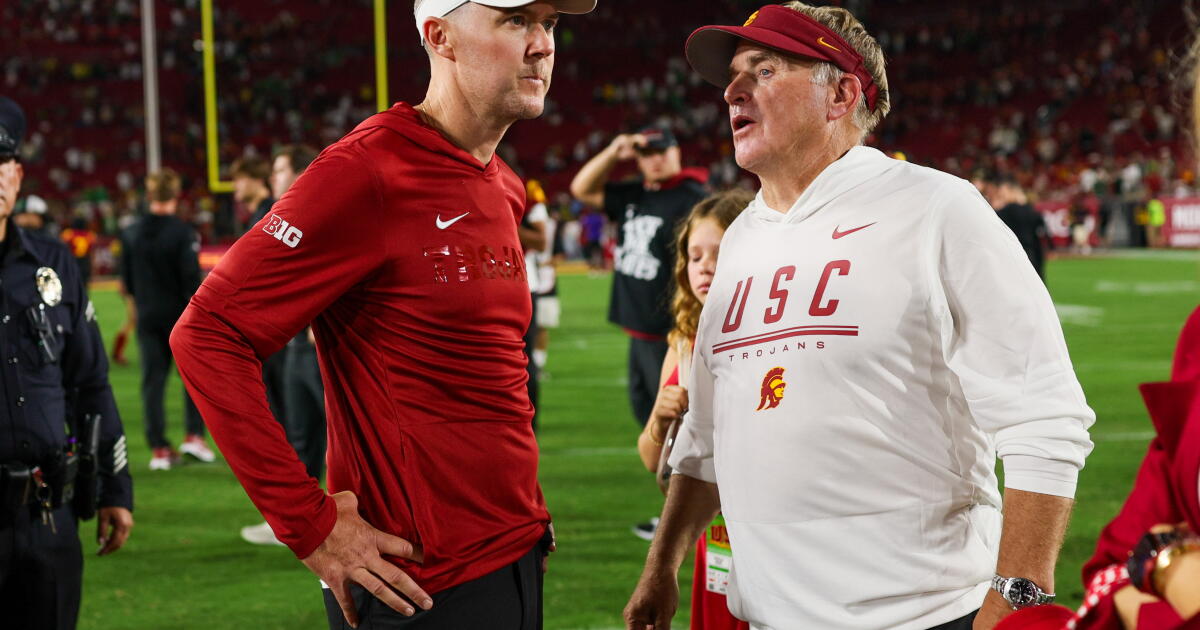
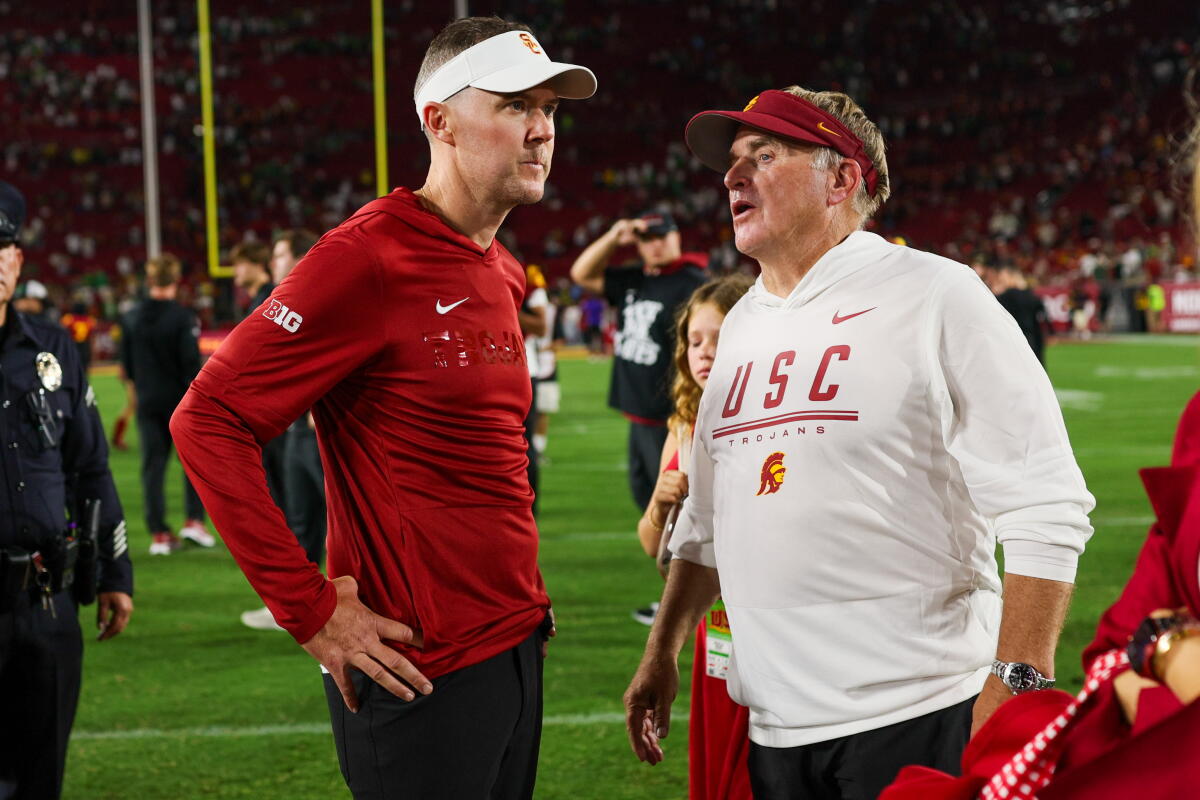
As an aspiring young quarterback at Muleshoe High in the early 2000s, Lincoln Riley attended a football camp at Texas Christian University, run by a coach known even then as a mastermind of defense, a man whose ideas and 4-2-5 scheme would one day be disseminated across college football.

Gary Patterson had just been elevated from defensive coordinator to head coach at TCU, a job he would occupy for the next two decades. Around the same time, his staff saw something in Riley. They talked briefly about giving him a shot at safety on Patterson’s vaunted TCU defense.

“Needless to say,” Riley told The Oklahoman in 2018, “it didn’t turn out.”

But a quarter-century after first crossing paths at that camp, it’s now the young quarterback giving the old ball coach a chance to prove himself.

When USC announced it was hiring Patterson as Riley’s defensive coordinator in January, ears perked up across college football. On one hand, Patterson, 66, is a freshly minted College Football Hall of Famer and one of the great defensive minds of the modern era. On the other hand, he hasn’t led a college football team since 2021, when he was forced out at TCU, and a lot has changed in the sport since. Not to mention it’s been more than 25 years since Patterson last served as a coordinator.

Those were fair concerns, considering all that’s riding on Riley getting it right with Patterson, his third defensive coordinator in five seasons. But after seven months with him on the job, you won’t find anyone at USC — players, coaches or administrators alike — with an ounce of distress over Patterson’s stamina.

“I think I would have had more reservations had I not known him,” Riley said. “But that fire still burns very, very hot.”

That much was obvious in the spring when Patterson jumped into the middle of a tackling circuit to teach proper technique, and ended up running through the whole drill. He even delivered a blow at the end.

“He knocked the guy back,” said safeties coach Paul Gonzales, who coached with Patterson for a decade at TCU. “For a 60-year old guy, he still got some pop.”

USC defensive coordinator Gary Patterson watches practice in March.

USC defensive coordinator Gary Patterson watches practice in March.

(Robert Gauthier / Los Angeles Times)

Riley is betting big on that translating to the Trojans’ defense this fall. Over his four seasons as USC’s coach, there’s no mistaking what’s held Riley back from reaching the same heights at USC as he had at Oklahoma. The Trojans finished 124th, 104th, 87th and 65th in yards allowed per play during those years.

At TCU, Patterson’s defenses finished No. 1 in yards allowed five times during a 10-year stretch. Yet in the second half of his tenure at TCU, there was a noticeable decline, as his defenses finished in the top 25 of that same category just twice.

It was during that time that Riley’s offense went toe-to-toe with Patterson’s defense on numerous occasions. Riley, who was in his first head coaching job at Oklahoma, got the better of Patterson in each of their four meetings, piling up at least 498 total yards each time out.

“There was never anyone who was more of a pain to gameplan for or try to move the ball against than this guy,” Riley said.

During his five years away from coaching, Patterson said he actually spent more time studying the game than he had at TCU, where he was often consumed with other responsibilities. After consulting briefly at Texas and Baylor, Patterson took a job with an Amazon college football show, he says, primarily for the subscription service that came with it. Every Sunday morning, he’d watch whatever college game he wanted, just to stay fresh.

When he did return to coaching, Patterson didn’t just want to install the same scheme he used at TCU. So he closely studied Ohio State and Indiana’s defenses, which gave up a combined 32 touchdowns last season — seven fewer than USC’s defense (39). He took cues on how both clamped down better than anyone else in the red zone, where they each allowed opponents to convert touchdowns just 37% of the time.

“All I did was do football,” Patterson said. “I mean, it’s like getting married. I mean, it’s like I got nothing else. I wasn’t doing anything else.”

Those habits haven’t changed at USC. When other assistants took time for vacation this summer, Patterson stayed in the facility. He wanted to hone in on how to install his defense for a second time this fall. So he came in every day before 7 a.m., in a mostly empty office — just to beat the traffic.

“You want to change things, it’s a full-time job,” Patterson said. “It’s not one of those things that you do 70 or 80% of your time.”

It also gave him time to get to know his new players, each of whom have been summarily stunned by their veteran coach’s vitality.

“I don’t know how old he is, but he‘s out there like he’s 30,” linebacker Desman Stephens said. “He‘s still being active with us. He’s showing us drills. Like, if he want it done right, he gonna show you the exact way how to do it.”

So far, at USC, Patterson has had his hands on just about every detail of the defense. Which is precisely what Riley envisioned after watching him coach at TCU — and why he wasn’t worried about the game passing Patterson by.

“He was such a hands-on head coach,” Riley said. “He wasn’t a head coach just kind of doing a practice schedule, doing the speech, getting out early. He didn’t just straight CEO this thing, right? He was still calling defense, still game planning. He was very involved in every aspect of that program through all those years.”

USC defensive coordinator Gary Patterson fist bumps linebacker Desman Stephens during practice on Aug. 5.

USC defensive coordinator Gary Patterson fist bumps linebacker Desman Stephens during practice on Aug. 5.

(Eric Thayer / Los Angeles Times)

He won’t have to do that at USC. And Patterson seems perfectly fine with that.

But while others still wonder if he can make a successful return to college football, with a scheme that hasn’t been tested since 2021, Patterson is pretty confident his decades of experience count for something, too.

“It’s an advantage for me compared to somebody that’s 30 years old and doesn’t have kids, never been married, doesn’t know what it’s like to grow somebody up and raise a family and do things,” Patterson said.

“This is, I think, my 45th season. … “There’s not a lot of guys in this profession of the age where you can go back to all the things that I’ve learned through all the years.”

Source link

From napkin to crown jewel: Inside USC’s football training center

The initial concept for USC’s Bloom Football Performance Center was first born on the back of a napkin. It was late November 2021, and Lincoln Riley was on a plane to Los Angeles, where he was slated to be introduced as USC’s coach.

The then-hypothetical facility had been a critical contingency for Riley, who never toured USC’s facilities, but knew — like most people around college football — that the Trojans were seriously lacking in that department. For years, USC officials had resisted doing anything about it. The John McKay Center hadn’t even been around a decade, they’d inevitably say. Plus, there was the not-so-insignificant problem of where to build a new facility on campus.

Riley knew that. And he asked anyway.

“That was a little bit, in that moment, my way to test how committed SC was,” Riley said Thursday. “This honestly was probably the biggest test of commitment for, ‘How invested are we to get this program back?’ When that was met with no hesitations, that was a pivotal part of me taking this job. I think it’s fair to say, if that commitment hadn’t been made, I probably wouldn’t be here.”

The Bloom Football Performance Center on the campus of USC.

The Bloom Football Performance Center on the campus of USC.

Almost five years later, the plans Riley sketched out that morning have been brought to life in one of college football’s finest facilities, the towering jewel of a $225-million capital project at USC that also includes a new baseball stadium (Dedeaux Field) and a women’s soccer and lacrosse field (Rawlinson Stadium).

The three-story, 163,000-square-foot football-only facility opened Wednesday night, with Riley reflecting back on that napkin and marveling at how far the program had come since. But this gleaming building and its array of amenities had far exceeded his initial expectations, he said.

He called it “magical.”

“You can say or promise that you’re gonna build a facility, and then you can halfway do it or you can do it right and just go over the top and just really not hold back in any way, and that’s what our university has done,” Riley said. “I’m proud and thankful for the university for making this happen.”

1

Bronze plaques of previous USC players adorn the wall of the Mark and Mary Stevens Trojan Legacy Wall at the USC Bloom Football Performance Center.

2

The weight room of the USC Bloom Football Performance Center.

3

A wall of USC players drafted by NFL teams at the Bloom Football Performance Center.

4

Trophies won by the USC football program on display at the Bloom Football Performance Center.

1. Bronze plaques of previous USC players adorn the wall of the Mark and Mary Stevens Trojan Legacy Wall at the USC Bloom Football Performance Center. 2. The weight room of the USC Bloom Football Performance Center. 3. A wall of USC players drafted by NFL teams at the Bloom Football Performance Center. 4. Trophies won by the USC football program on display at the Bloom Football Performance Center.

The real magic was that it happened at all, considering all that changed or had gone awry. The athletic director who first agreed to Riley’s facility request, Mike Bohn, resigned. The university president who signed off on it, Carol Folt, retired.

The cost of doing business in college football also went up exponentially with the advent of revenue sharing, all while the university was going through a financial crisis. None of which helped when it came to asking for $200 million in private donations.

Then there was the matter of physical space. The only option to build the facility was to demolish the Trojans’ longtime baseball field and displace the program for multiple seasons.

Hot tubs at the USC Bloom Football Performance Center.

Hot tubs at the USC Bloom Football Performance Center.

“Think of what Coach Stank and the baseball team, what they had to give up to make this work,” Riley said. “The importance of just getting everybody together and on the same page and pushing in the same direction, this building is one of the first real signs of that. Because this took everybody.”

Riley, in particular, proved to be “very influential” in the process, according to Jeff Fucci, USC’s senior associate athletic director for capital projects.

“Coach was tireless in making sure that this was something that was not going to just be a vision and something that was talked about and not followed through on,” Fucci said.

It also took endowing just about every physical space in the facility to raise the necessary $200 million to build it, from the “Peets Family Atrium” to the “Al Cowlings Defensive Tackles Room” to a hallway labeled as the “Mark and Mary Stevens Legacy Walk.” Even some of the bathrooms bear plaques from donors eager to get their name somewhere in the building.

The locker room at the USC Bloom Football Performance Center,.

The locker room at the USC Bloom Football Performance Center,.

“This has been a huge, huge investment from the university,” Fucci said.

The result is a facility that stands in stark difference from the John McKay Center, which cost $70 million when it opened in 2012. That building was “80% subterranean”, according to Fucci — with not nearly enough space to contain the football program, let alone the other sports programs that used it.

Natural light pours into Bloom Center, by contrast. Thirty-foot glass doors open up onto the Trojans’ practice field from a 12,000-square-foot weight room with towering vaulted ceilings. From above, an outdoor terrace is outfitted especially for hosting recruits or other luminaries, complete, for the time being, with basketball courts and pickleball.

“I love coming to the weight room in the morning,” said offensive lineman Tobias Raymond. “The sun is coming up, and you can see it, and you open the doors and you get the fresh air blowing in.”

1

 Jeff Fucci, USC senior associate athletic director, leads the media on a tour of the Bloom Football Performance Center.

2

USC players make their way to the locker room.

3

Mannequins on display with USC football uniforms outside of the on-site cafeteria at the Bloom Football Performance Center.

4

The cafeteria at the Bloom Football Performance Center.

5

The weight room opens near the practice field.

1. Jeff Fucci, USC senior associate athletic director, leads the media on a tour of the Bloom Football Performance Center on Thursday. 2. USC players make their way to the locker room. 3. Mannequins on display with USC football uniforms outside of the on-site cafeteria at the Bloom Football Performance Center. 4. The cafeteria at the Bloom Football Performance Center. 5. The weight room opens near the practice field.

Riley wanted the facility to put a special emphasis on recovery. So now, players have access to infrared beds, sensory deprivation tanks and AI-led massage chairs. There are hot tubs and cold tubs and a players-only sauna, while every locker is outfitted with a leather zero gravity chair. There’s even a barbershop.

“It’s hard to get our players out of here,” Fucci said.

Riley has been no different. Shortly after moving in, with his family out of town, the coach said he hunkered down for five straight days in the facility.

Before, that would’ve meant barely seeing the sun. But now, as the sun poured through the third-floor atrium of the Bloom Center, Riley couldn’t help but point out the symbolism of such an ambitious undertaking actually coming to life.

“They said it couldn’t be done,” Riley said. “But here we are.”

1

The football practice fields next to the Bloom Football Performance Center.

2

The rooftop deck, an event-ready space at Bloom Football Performance Center.

3

USC football coach Lincoln Riley, left, speaks to the media in the team room.

4

The lobby of the Bloom Football Performance Center.

1. The football practice fields next to the Bloom Football Performance Center. 2. The rooftop deck, an event-ready space at Bloom Football Performance Center. 3. USC football coach Lincoln Riley, left, speaks to the media in the team room at the Bloom Football Performance Center on Thursday. 4. The lobby of the Bloom Football Performance Center.

Injury update

Projected starting center Kilian O’Connor suffered a non-contact injury during USC’s camp practice Wednesday and will be out for the rest of the season, Riley announced.

“Tough one for the guys to see,” Riley said. “A great reminder for all of our guys just how nothing in this game is ever guaranteed. We’re fortunate to have enough depth on the O-line that we’ve been working on to continue to push forward.”

Source link

New NCAA eligibility rules boost USC, its top recruiting class

During his eight seasons as a head college football coach, Lincoln Riley often faced a frustrating conundrum when it came to playing freshmen: Were a handful of plays at the end of a blowout really worth burning a whole year of eligibility?

“I can remember at times going to a player in the game,” Riley said Tuesday. “‘We can probably play you like five to 10 plays at the end of the game. But if you do that, we can’t play you anymore, or we’re going to have to take your redshirt.’ We’re having to talk about that in-game. … You had to be ready to adjust on the fly.”

But after years of meticulously monitoring that playing time, those adjustments will no longer be necessary, after the NCAA adopted new eligibility rules in June. The new model gives athletes a blanket five years to compete, effectively eliminating the need for redshirts or special waivers. It also could alter how rosters are constructed.

Riley has been calling for the rule change since shortly after he became USC’s head coach. And it is now being implemented at the best possible time for his Trojans.

With so many highly touted freshmen from USC’s No. 1 recruiting class sure to see the field this season, there’s no need now for Riley or his staff to look four years into their future while deciding when and how to give them game-day snaps.

“Now you can just make the best decision in the moment,” Riley said. “I think that’s great for the player. … Just play the guys who deserve to play.”

For USC, it means that a fleet of first-year players are sure to see the field, not just during the nonconference slate but beyond, as Riley and his staff feel out which members of the Trojans’ 2026 class could contribute when the schedule suddenly stiffens in late September.

“Any opportunity that we get a chance to play these guys, however it comes out,” Riley said, “you love the fact to be able to do it.”

Some schools could land veteran roster reinforcements as a result of the rule change after a judge granted an injunction allowing anyone in the class of 2022 who would’ve used the fifth year of eligibility to return to claim it. The decision is being appealed by the NCAA. Former USC wideout Jay Fair has indicated on social media that he intends to pursue that route, but as of Tuesday, Fair hadn’t rejoined the program.

The Trojans stand to benefit more than most from the new eligibility rules this season. But Riley does have one issue with the new rule. It currently stipulates that a player’s eligibility clock begins with either their full-time enrollment or the academic year following their 19th birthday, whichever occurs first.

Trent Mosley smiles while leading Santa Margarita to a Division 1 title.

Trent Mosley smiles while leading Santa Margarita to a Division 1 title. Mosley is among the freshmen at USC who will benefit from new eligibility rules.

(Craig Weston)

So as it stands, any freshman with a birthday prior to Sept. 1, 2006, is left with one fewer year to play than their freshmen counterparts.

At USC, that affects two members of the 2026 recruiting class — wide receiver Trent Mosley and safety Madden Riordan.

For Mosley, a former Rancho Santa Margarita star, a fifth year may not ultimately matter. He’s already 20 years old and on track to potentially start in the slot as a freshman.

But USC’s coaches were quick this week to note that the Trojans’ freshmen, no matter how talented, still had some acclimating to do.

“Age is really just a number,” inside receivers coach Chad Savage said of Mosley. “When you’re a freshman and you come into college, there’s a big learning curve, right? Whether it’s playbook, whether it’s everyday life, whether it’s the weight room, whatever it may be, um, I think from a maturity standpoint, he is very mature, but it’s just one step in front of the other, every single day with Trent.”

Tanook Hines, USC’s top returning receiver, was a bit less restrained in his evaluation.

“Trent Mosley definitely stands out,” Hines said. “He seem like a vet, like he’s already been here.”

Riordan, meanwhile, is older than some of the vets on USC’s defense, including junior starting linebacker Desman Stephens, who already has 26 games under his belt at USC. It follows then that Riordan’s football IQ has made an impression with coaches early on.

He’s one of the several freshmen who might have been on the brink of a redshirt, given his weight. But Riordan added almost 15 pounds during the summer to hit 180 and could push for a place in USC’s defensive back rotation.

Riley said he believes Mosley and Riordan — and any other freshmen, for that matter — should get the chance to play all five seasons. No matter how old they are when their college careers start.

“We have a few guys that we are in the process of seeking some clarification and potentially getting some relief on that,” Riley said of the age restrictions. “Our belief is if they’re five for five coming out of high school, they should be five for five. We should keep it simple.

“Hopefully we get to that point.”

Source link

Lincoln Riley says Trojans are ‘well-equipped’ to win consistently

The stage was set this past summer, and Lincoln Riley was a ball of nerves.

The USC coach should’ve been used to weathering pressure by that point. After all, his previous four seasons spent coaching the Trojans had been nothing short of a powder keg, filled with ups and downs, as well as a constant undercurrent of tension and uncertainty. But in this particular case, success was out of Riley’s control. He wasn’t even near a football field.

Rather, he was sitting in the audience of a local dance recital, waiting on his two young daughters, Sloan and Stella, who were each making their solo dancing debut with their company.

“This was the first year, stepping out on their own, no one else to rely on,” Riley said. “But they told me, ‘Dad, we’ve got it.’”

Entering his fifth and most pivotal season yet at USC, their father can relate to that sentiment. While the spotlight burns brighter than ever and the collective college football world is spinning 2026 as a make-or-break moment for Riley, the coach had never sounded so confident that his Trojans had turned a corner than he did Tuesday.

“I’ve felt the pressure to win every single year here,” Riley said during Big Ten media days. “What does feel different is that I think our opportunity to do that is greater than what it has been. It just flat out is. The things you need to win, we have more of than we had in the first four years.”

Riley, of course, has made that case before. After each of the last two seasons, in fact. But it’s never been quite as compelling as it is now.

As the coach sees it, USC now boasts more depth on both sides of the ball than at any point in his tenure, in large part because of bringing in the No. 1 recruiting class in the nation in January. Riley also added a Hall of Fame coach at defensive coordinator in hopes of stabilizing matters on that side of the ball. And 10 days earlier, the program moved into its new, state-of-the-art football facility, with all the amenities anyone could ask for.

“It’s just a culmination of all of it, you know?” Riley said. “It is just so much more well-equipped to win consistently right now. It’s so different.”

That’s never been a question for Riley’s offenses at USC, and this year should be no different, with third-year starter Jayden Maiava returning at quarterback and a two-pronged backfield in Waymond Jordan and King Miller leading the way in the run game. The offensive line also looks like Riley’s strongest unit yet in five seasons.

The doubts, per usual, are on defense, where the Trojans are not the most seasoned group.

“The entire defense is just very young compared to last year,” defensive tackle Jide Abasiri said.

Riley is also now working with his third defensive coordinator in five seasons. And one who hasn’t coached in five years, at that.

Gary Patterson does have an impressive resume, with years of top-tier defenses at Texas Christian. And he continues to get rave reviews from Riley, who called the Hall of Famer “one of one” on Tuesday.

“You really have somebody that is like a head coach in that room,” Riley said. “The guy’s one of the most experienced, accomplished coaches in the game. Like, it just is what it is.

“I think just my confidence level and, you know, what’s being handled, how it’s being handled, how we’re developing, how we’re using our roster … is just really, really high right now.”

It better be at this point, considering all that USC has invested in Riley and his total teardown and rebuild of the Trojan football program. Across the city, billboards declaring “THE TIME IS NOW” make abundantly clear just how urgent this season will be at USC.

At the start of his fifth season, Riley is convinced the Trojans are right on schedule.

“All the things that help you win are better,” Riley said. “And that’s gonna give us more chances to win. That’s where my optimism comes from.”

Source link

USC paid Lincoln Riley nearly $12 million in lackluster 2024 season

His 7-6 record at USC in 2024 would go down as the worst mark of Lincoln Riley’s career as a head football coach. But in his third and rockiest year at the helm of the Trojans, Riley was still compensated like one of the kings of the sport.

Riley was paid more than $11.8 million in total compensation during the fiscal year 2024, according to USC’s latest federal tax returns, which were obtained by The Times. That total includes a $100,000 bonus and $10.4 million in base pay, believed to be more than all but three college football coaches that season: Georgia’s Kirby Smart, Clemson’s Dabo Swinney and Ohio State’s Ryan Day. All three have won a national title.

For Riley, his pay in 2024 marks just a slight increase from the 2023 season, when USC paid Riley more than $11.5 million in total compensation. The coach’s base pay increased by $145,143 between fiscal years 2023 and 2024, slightly less than it rose following his debut season in 2022 ($168,000).

At least in 2024, USC only had to pay one football coach, after paying Clay Helton a combined $9 million not to coach over the two previous years.

The school would, however, have to pay up a bit to bring in a new men’s basketball coach.

After Andy Enfield left to coach Southern Methodist after the 2023-24 season, USC shelled out more than $6.1 million total in 2024 to lure coach Eric Musselman from Arkansas, according to the university’s latest federal tax records. One million of that was paid to Arkansas to buy out Musselman’s contract.

That puts Musselman at a reported $5.1 million in total pay and benefits from the school in 2024, according to the school’s tax records. That total likely includes additional costs unique to a coaching change. But altogether, it would have ranked Musselman among the highest-paid coaches in the Big Ten for the 2024-25 season.

Musselman didn’t exactly deliver on that investment during the 2024-25 season, as USC bottomed out during its first Big Ten men’s basketball slate. The Trojans finished 17-18 and 7-13 in the Big Ten.

After including her information in tax forms from the previous year, the university did not disclose compensation figures from 2024 for USC athletic director Jennifer Cohen. Federal tax returns filed last May had credited Cohen with more than $3 million in reportable compensation in her first year on the job, $1 million of which was used to buy out Cohen from her Washington contract.

Source link