limits

How big of a tent do Democrats want? Michigan’s Senate primary is testing the limits

By the time Hasan Piker takes the microphone at two campaign events with a Senate candidate in Michigan on Tuesday, the popular but controversial online streamer will have already generated plenty of noise inside the Democratic Party.

Some have pitched him as a gateway to young people — particularly young men — who have drifted to the right in recent years. Others fear he is a sign of the party beholden to its extremes, pointing to inflammatory rhetoric like “Hamas is a thousand times better” than Israel, describing some Orthodox Jews as “inbred” and that “America deserved 9/11.”

Piker’s scheduled appearances with Abdul El-Sayed, a progressive candidate in the Democratic primary for U.S. Senate in Michigan, have catalyzed questions of how big a tent the party wants to build as it works to regain power in the midterm elections and win back the White House.

In an interview with the Associated Press, Piker cast the reaction as part of a broader fight for the party’s future.

“There is definitely, I think, a battle right now for who gets to be more representative of the national Democratic Party,” he said.

Piker remains largely unapologetic for his past remarks, although he’s said some were poorly worded. He called the renewed focus on them “totally ridiculous, especially considering that there are far more consequential things happening in the world right now.”

“The super wealthy are picking apart the scraps of the American carcass like a bunch of vultures, and some of the Democrats are talking about their affiliations with a Twitch streamer,” Piker said. “I think Americans understand that this is totally ridiculous.”

The 34-year-old Turkish American streamer has 3.1 million followers on Twitch and 1.8 million on YouTube, making him an influential voice in a shifting media landscape where mainstream outlets are losing clout. Unlike traditional podcasts, his livestreams are often unscripted and interactive. He has hosted prominent Democrats, including Rep. Alexandria Ocasio-Cortez and New York City Mayor Zohran Mamdani.

Piker said he is a “megaphone” for an angry electorate, and he believes the criticism that he faces is less about him personally and more about what he represents — a younger, more populist wing of the party.

“I think they find me to be a more appropriate target than to just actively disparage the voters,” he said.

El-Sayed, who has been backed by progressive Sen. Bernie Sanders, is attempting to channel that appeal in appearances at Michigan State University and the University of Michigan on Tuesday. A physician and former county health official, he is locked in a competitive Senate primary with U.S. Rep. Haley Stevens and state Sen. Mallory McMorrow. It’s a critical race for a seat being vacated by Democratic Sen. Gary Peters and the winner of the primary will likely face former Republican Rep. Mike Rogers.

The three candidates have differing views on U.S. foreign policy toward Israel. Both El-Sayed and McMorrow have described the war in Gaza as a genocide. El-Sayed wants to stop all military assistance while McMorrow has pushed for a two-state solution. Stevens has described herself as a “proud pro-Israel Democrat.”

McMorrow told Jewish Insider that Piker was someone who “says extremely offensive things in order to generate clicks and views and followers,” and she compared him to white supremacist Nick Fuentes. Trump’s decision to dine with Fuentes between his presidencies ignited a firestorm of controversy over his association with extreme voices on the right. Stevens said El-Sayed is “choosing to campaign with someone who has a history of antisemitic rhetoric.”

El-Sayed responded to the backlash over Piker by saying “if we want to have a conversation where we’re actually bringing people together about the things that we need and deserve, we’re gonna have to go to unlikely and uncommon places.”

Not everyone in the party wants to go to those places. Rep. Brad Schneider of Illinois, who chairs the moderate New Democratic Coalition and co-chairs the Congressional Jewish Caucus, called Piker “an unapologetic antisemite.”

“We are deeply disappointed by the decision to host a speaker at the University of Michigan with a documented record of antisemitic rhetoric,” said Rabbi Davey Rosen, the CEO of Michigan Hillel. “Such invitations normalize hate and contribute to a hostile environment for Jewish students.”

Piker said he is not antisemitic and describes himself as anti-Zionist. Hostility toward Israel has risen across the political spectrum and became a fault line within the Democratic Party during the war in Gaza.

Criticism has centered on Piker’s past remarks. After the Oct. 7 attack on Israel, Piker argued that whether reports of sexual violence are accurate “doesn’t change the dynamic” of the conflict. He has repeatedly said the core issue is Israel’s conduct in Gaza.

Piker has drawn backlash for a comment in which he said “America deserved 9/11,” made during a 2019 livestream while discussing U.S. foreign policy. Piker has said the remark was poorly worded and added in the AP interview that he “didn’t mean that Americans deserved to die.”

Cappelletti writes for the Associated Press.

Source link

Two dozen Democrat-led states sue Trump over mail-in ballot limits | Donald Trump News

Rights groups have raised concerns about Trump’s efforts to change election administration before November’s midterms.

About two dozen Democrat-led states have filed a lawsuit against the administration of United States President Donald Trump to block an executive order setting new limits on mail-in ballots.

Friday’s lawsuit comes as voting rights groups charge that Trump is seeking to make it more difficult to vote before the consequential midterm elections in November.

Recommended Stories

list of 3 itemsend of list

Trump, meanwhile, has argued that his efforts are meant to counter rampant voter fraud in US elections.

That opinion runs counter to the findings of independent election monitors, including the conservative Heritage Foundation, whose decades-spanning database has found an exceedingly low rate of election fraud.

New ‌York Attorney General Letitia James was among the attorneys general in 23 states and the District of Columbia who filed Friday’s suit, alongside the governor of Pennsylvania.

In a statement, she argued that Trump’s executive order exceeded his presidential power.

“Free and fair elections are the cornerstone of our democracy, and no president has the power to rewrite the rules on his own,” James said.

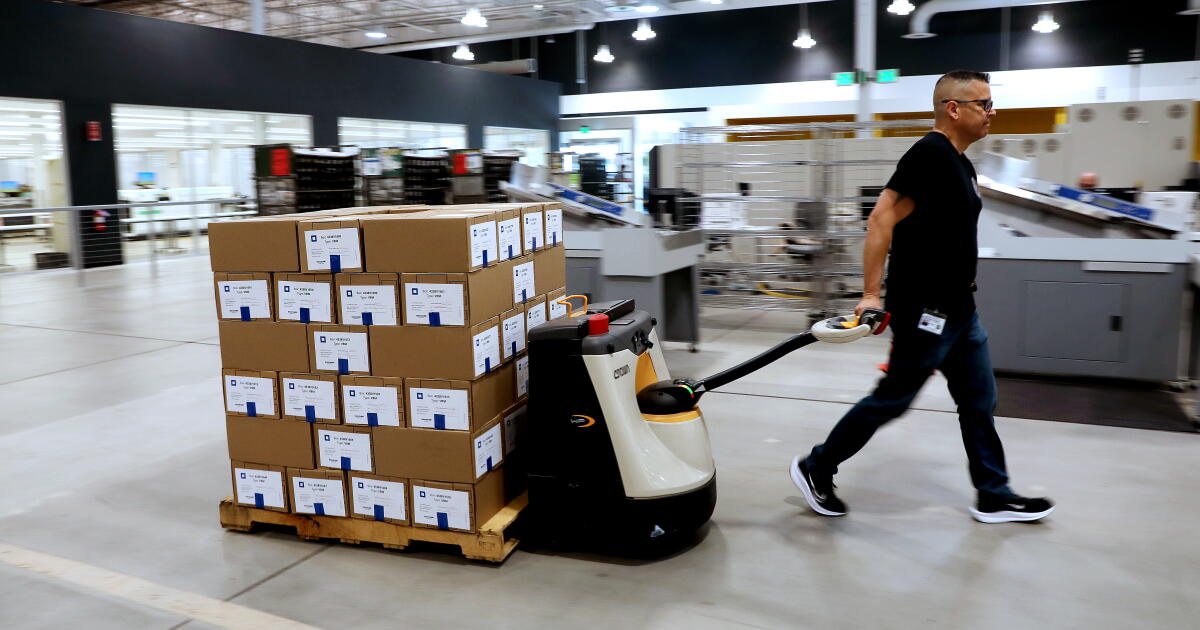
Trump’s latest executive order, signed on Tuesday, calls on the Department of Homeland Security to “compile and transmit” a list of United States citizens who are eligible to vote in each state.

It then requires the United States Postal Service (USPS) to “transmit ballots only to individuals enrolled on a State-specific Mail-in and Absentee Participation List, ensuring that only eligible absentee or mail-in voters receive absentee or mail-in ballots”.

Voting rights groups have said the measures would likely rely on an incomplete federal list of US citizens and would heap too much responsibility on USPS.

Mail-in voting has increased across the US, in states that lean both Republican and Democratic, particularly after the COVID-19 pandemic. In the 2024 elections, a third of all ballots were cast by mail.

In Friday’s lawsuit, the states argue that Trump’s order violates the US Constitution, which says that state officials decide the “times, places and manner” of elections.

The states further maintain that only Congress can pass new restrictions related to how elections are conducted. Forcing a change to election administration so close to the November elections will also create chaos, according to the lawsuit.

The midterm elections will determine which party controls the US House of Representatives and Senate.

Trump has previously voiced concern that he may face impeachment proceedings, should the Republican Party see its majorities in both chambers disappear.

For years, Trump has maintained, without evidence, that his 2020 election loss was the result of widespread fraud, and he has pledged reforms to the voting system.

He previously signed executive orders seeking to overhaul US election administration, although they have been mostly blocked by the court system.

The Department of Justice has also sued several states in an attempt to gain access to voter information, and the FBI seized ballots from the 2020 election during a raid last January in Fulton County, Georgia, further stoking concerns.

Trump, meanwhile, has been pushing lawmakers to pass the “SAVE America Act”, which would require increased proof of US citizenship when registering to vote, including a birth certificate or a passport, as well as a photo ID to cast a ballot.

Rights groups have warned the measures could disenfranchise many voters, including women who changed their last name upon marrying.

Source link

EPA moves to roll back recent limits on ethyene oxide, a carcinogen

The Trump administration on Friday moved to roll back Biden-era limits on emissions of ethylene oxide, a cancer-causing chemical often used in the sterilization of medical devices.

The Environmental Protection Agency said repealing the rules, which fall under the National Emission Standards for Hazardous Air Pollutants, would “safeguard the supply of essential medical equipment” — saving approximately $630 million for companies over 20 years. California is home to about a dozen such facilities.

The government said the emissions are part and parcel of protecting people from “lethal or significantly debilitating infections that would result without properly sterilized medical equipment.”

“The Trump EPA is committed to ensuring life-saving medical devices remain available for the critical care of America’s children, elderly, and all patients without unnecessary exposure to communities,” EPA Administrator Lee Zeldin said in a statement.

An estimated 50% of sterile medical devices in the U.S. are treated with ethylene oxide, or EtO, particularly those that can’t be cleaned using steam or radiation. The colorless gas is also used to make chemicals found in products such as antifreeze, detergents, plastics and adhesives.

But EtO poses health risks. Short-term exposure by inhalation can cause headaches, dizziness, nausea, fatigue respiratory irritation and other adverse health effects, according to the federal Agency for Toxic Substances and Disease Registry.

Longer-term exposure increases the risk of cancers of the white blood cells, such as non-Hodgkin’s lymphoma, as well as breast cancer. A now-deleted page from the EPA’s website stated, “EtO is a human carcinogen. It causes cancer in humans.”

Friday’s proposal specifically targets updated rules for EtO emissions that were passed by the Biden administration in 2024 following pressure from environmental justice groups, particularly those in Louisiana’s heavily industrialized “Cancer Alley.” The change sought to reduce the amount of EtO released from commercial sterilizers by 90% and lessen the hazards for nearby communities.

The tighter rules were in part based on EPA’s own scientific study that found it to be 60 times more carcinogenic than previously thought, which the agency now says should be reassessed.

If finalized, the plan would give facilities the choice between installing continuous real-time monitoring systems for EtO emissions or complying with modified pollution control requirements at facilities that emit more than 10 tons a year, the EPA said.

The proposal follows other moves by the Trump administration to rescind regulations that it says are burdensome and costly for industries, such as those governing emissions from coal power plants. Last month, the EPA repealed the endangerment finding, which affirmed the dangers of greenhouse gas emissions and underpinned the agency’s ability to regulate those emissions from vehicles.

The action around ethylene oxide would affect about 90 commercial sterilization facilities owned and operated by approximately 50 companies. Three California companies applied for and received presidential exemptions for their EtO emissions in July.

An aerial view of an industrial park

The Sterigenics facility, center, in Vernon is pictured in 2022.

(Myung J. Chun / Los Angeles Times)

They are located in Ontario and Vernon and operated by the company Sterigenics, which provides industrial sterilization technology for medical devices and other commercial products.

In January, a coalition of environmental and community groups challenged the EtO exemptions in federal court. The lawsuit from the Southern Environmental Law Center and the Natural Resources Defense Council argues that technology exists for facilities to comply with the tighter Biden-era standards without raising costs, and many facilities are already using it.

“EPA’s 2024 rule was an important and overdue step to reduce toxic ethylene oxide pollution and protect communities,” said Irena Como, senior attorney at the Southern Environmental Law Center, in a statement Friday. “Repealing this rule that is proven to significantly lower pollution exposure and cancer risks will subject even more people who work, live, and send their children to schools located near these facilities to harm that is entirely preventable.”

Sterilization and chemical industry groups support the plan.

“The EPA rule concerning ethylene oxide use in commercial sterilizers threatens to severely restrict access to vital medical products nationwide,” the American Chemistry Council said in a statement. “We commend the EPA for their commitment to reevaluating these policies.”

The EPA will hold a 45-day comment period about the proposal after it is published in the federal register. A final decision is expected sometime this year.

Source link