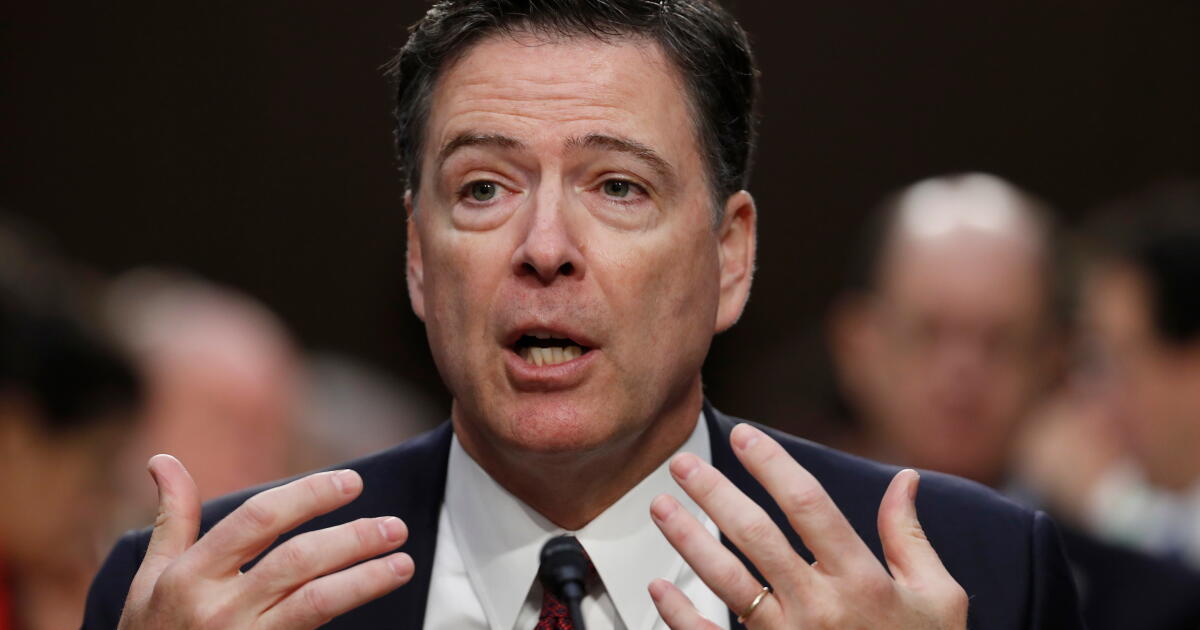
Trump administration attempting to prosecute former FBI Director James Comey again
WASHINGTON — The Trump administration is attempting to prosecute James Comey for what it calls a decade-old leak of classified information, an effort the former FBI director’s lawyers immediately dismissed as legally invalid and outside the legal time limit for when the Justice Department can file a criminal indictment.
The allegations from the Justice Department were revealed Monday in newly unsealed court documents that shed light on a closed-door fight that represents an unmistakable escalation in the administration’s targeting of Comey, a longtime critic and foe of President Trump who has faced two other criminal cases since the Republican returned to the White House last year.
The effort to prosecute Comey is also part of a series of politically charged investigative actions the department has undertaken in the run-up to next week’s midterm elections.
“Well, they’re back — again,” Comey said in a video statement Monday. “It would almost be funny if it weren’t such an appalling abuse of the Department of Justice — one that we cannot become numb to. Nothing’s changed with me; I’m still innocent, I’m still not afraid of these people — and I still believe in the independent federal judiciary.”
The Justice Department said it had filed what’s known as a “criminal information” to extend the statute of limitations for charges in the case.
“Filing a criminal information to toll the statute of limitations is a widely recognized practice in federal court and has been approved by multiple Circuit Courts of Appeals. This is an ongoing criminal investigation, and we will not comment further,” a department spokesperson said.
Asked about the Comey case, Trump told reporters upon arriving back to Joint Base Andrews in Maryland late Monday following his rally in Mississippi that “I don’t know much about it. I just heard about it.”
He added, “He’s a dirty cop, James Comey. But I know nothing about it.”
An information can be filed without the approval of a judge or a grand jury’s finding of probable cause to a court. Comey’s lawyers made clear that they intend to fight the charges as invalid because the Justice Department did not file an indictment, which must be voted on by a grand jury, inside the 10-year statute of limitations required under the law.
“For the third time in little more than one year, the Department of Justice has attempted to charge Mr. Comey with a federal crime. Mr. Comey steadfastly maintains his innocence,” his attorney, Patrick Fitzgerald, said in a statement.
The allegation was previously investigated
The latest allegation concerns an October 2016 New York Times story related to a secret court order that required Yahoo to scan emails for messages potentially linked to a foreign terrorist organization. The story cited two government officials who spoke on the condition of anonymity about the order from a judge on the Foreign Intelligence Surveillance Court that Yahoo was barred from publicly disclosing.
Federal authorities, including prosecutor John Durham, began investigating the disclosure in early 2017. Durham, who later investigated the FBI’s conduct as it scrutinized potential ties between Russia and Trump’s 2016 presidential campaign, wrote a classified memo in December 2018 recommending no criminal charges against anyone in connection with the disclosure, Comey’s attorneys said in a recent court filing.
In January 2019, the U.S. Attorney’s office for the District of Columbia opened a second investigation of the same matter under the code name “Tropical Vortex.” But that investigation was closed without any charges filed in February 2020.
“Both times the Government determined that no charges should be brought against anyone. Now, ten years after the article was published, the Government filed an “Information” against Mr. Comey that was not approved by a judge nor issued by a grand jury. It purports to charge Mr. Comey with crimes that he did not commit,” Fitzgerald said.
Prosecutors in a newly unsealed filing said investigators found evidence that Comey “sought to correct misinformation which had appeared in the press by way of Reuters the day before” that New York Times story was published, directed his staff to speak to a journalist at the newspaper related to accuracy concerns “and thereby illegally transferred classified information.”
The criminal information was filed under seal on Oct. 5, 10 years after the 2016 story was published. “But,” Comey’s lawyers said, “the applicable statute of limitations explicitly demands an indictment within 10 years of the offense; an information does not suffice.”
They have asked a judge to dismiss the information, a request that is still pending.
Trump and Comey have a long and uneasy history
The first criminal case against Comey, filed in federal court in Virginia, accused him of having lied to Congress in 2020 but was dismissed by a judge who concluded that the prosecutor who brought the charges was illegally appointed. A separate pending indictment charges the former FBI director with threatening Trump through an Instagram photo of seashells in the numerical arrangement of “86 47,” a case Comey has sought to dismiss.
The prosecutions are part of a Trump retribution campaign that has even extended to Comey’s daughter, Maurene, who was fired from her job as a Justice Department prosecutor in New York last year in a termination that a federal judge on Monday ruled was illegal.
Comey was the FBI director when Trump took office in 2017, having been appointed by then-President Barack Obama, a Democrat, and serving before that as a senior Justice Department official in President George W. Bush’s Republican administration.
But the relationship was strained from the start, including after Comey resisted a request by Trump at a private dinner to pledge his personal loyalty to the president — an overture that so unnerved the FBI director that he documented it in a contemporaneous memorandum.
Trump fired Comey in May 2017 amid an FBI investigation into potential ties between Russia and Trump’s campaign. That inquiry, later taken over by special counsel Robert Mueller, found that while Russia interfered in the 2016 election and the Trump team welcomed the help, there was insufficient evidence to prove a criminal collaboration.
The two men have been bitterly at odds ever since Comey’s firing.
Comey in 2018 published a memoir, “A Higher Loyalty,” that painted Trump in deeply unflattering ways, likening him to a mafia don and characterizing him as “untethered to truth.” Trump, for his part, has repeatedly claimed that Comey should face charges for “treason” — an accusation Comey dismissed as “dumb lies” — and called him an “untruthful slime ball.”
The Justice Department has made a series of splashy moves in recent weeks , including a criminal complaint last Friday charging two former FBI officials with lying to Congress about their participation in investigations concerning Hunter Biden, and the search by federal agents of the Washington home of Democratic congresswoman Ilhan Omar of Minnesota.
Tucker, Richer and Kunzelman write for the Associated Press. AP writer Will Weissert contributed to this report.