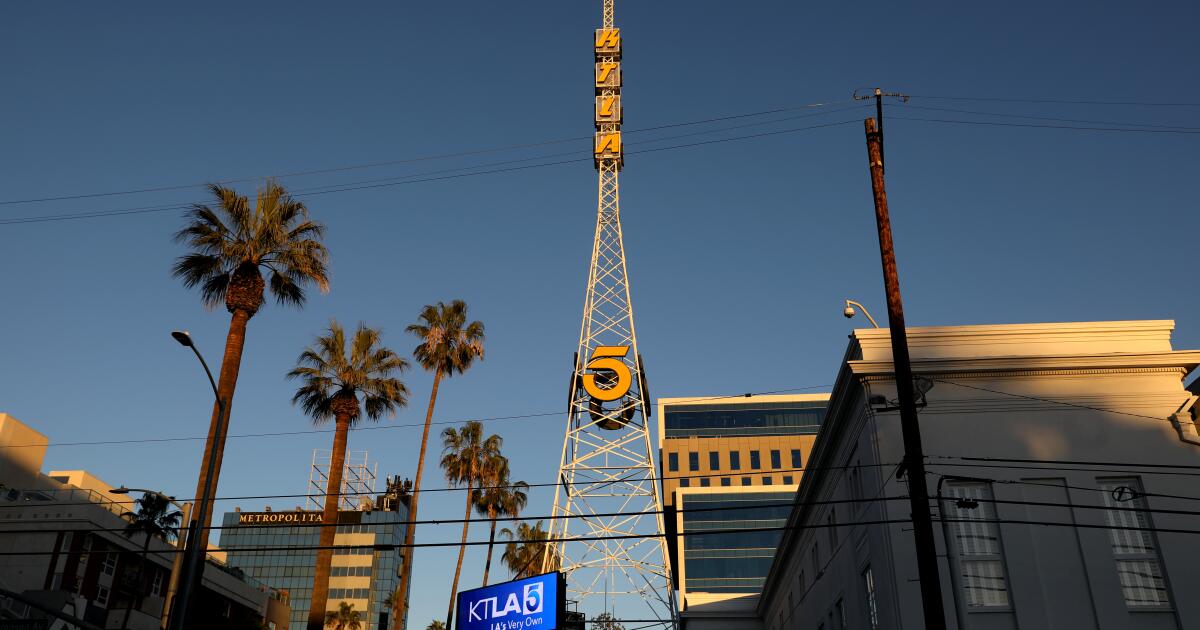
The Federal Communications Commission voted 2-1 in favor of allowing TV station ownership groups to own more outlets, easing the way for more consolidation.
The Thursday vote that favored the change means companies can own local stations that cover more than 39% of the U.S. They could also own more than two stations in a single market.
The measure supported by FCC Chairman Brendan Carr will allow the agency to approve deals that put station ownership groups over the cap if the agency determines that they are promoting the public interest. Carr has said the agency would consider such issues as commitment to local journalism and “viewpoint diversity.”
“In my view, if you care about trusted sources of local news and information, you have to care about the future of local TV stations,” Carr said. “They are the economic engines that produce the paychecks for so many of the local journalists that remain in the business. So how can the FCC maximize the odds that those institutions continue to survive and hopefully thrive into the future? To start, we should stop hamstringing this one segment of the broader market with outdated restrictions.”
The station groups say the ability of tech companies such as Google and Netflix to reach every consumer in the U.S. puts them at a disadvantage. At the same time, streaming now accounts for more than 40% of all viewing, according to Nielsen, pulling consumers away from traditional TV. Television stations are also seeing their share of carriage fees from cable and satellite companies shrink due to cord-cutting.
Declining viewership and revenue have also made it more challenging to sustain multiple local TV news operations in a single market.
Anna Gomez, the lone Democrat on the commission, opposed the measure, saying the rule change will only help big firms get bigger and more powerful.
“Eliminating the cap does not free local broadcasters from economic pressure, it just changes who is doing the squeezing,” Gomez said in a statement issued ahead of the vote. “The large station groups positioned to grow even larger under this decision are not local broadcasters, they are national companies that own local stations and increasingly dictate what airs on them.”
The measure ending the cap limits also faced push back from consumer groups and state government officials who believe station consolidation will result in journalist layoffs and fewer voices for the communities they serve.
TV station owners and its lobbying group the National Assn. of Broadcasters have been clamoring for a change in the rule, citing the changes in technology that have occurred since the ownership limit. The 39% threshold was set in 2004 when streaming video was still a nascent business.
Jeff McCall, a professor of communications at DePaux University, agrees the current limit is outdated in the current media environment. “Local broadcasters are struggling in terms of audience and revenue, and this plan could give them some needed relief,” he said.
But McCall added that having the FCC decide who benefits from the rule change will face resistance. “it will give the FCC wide discretionary powers and open up any decisions to second-guessing and, of course, court challenges,” he said.
There are also likely to be questions on how even-handed Carr will be when faced with a proposal that puts a station owner over the caps. The chairman has made his name by threatening to pull the broadcast licenses of TV stations that irritate President Trump with their coverage and commentary. Even Trump-supporting Republicans such as Sen. John Kennedy, R- La., have raised concerns the FCC’s scrutiny of broadcast content could be violating the right to free speech.
Carr also questioned whether ABC’s daytime show “The View,” where negative Trump commentary occurs often, should qualify as a bona fide news program that is exempt from giving equal time to qualified candidates.
Carr also believes large media companies such as Disney and NBCUniversal parent Comcast hold too much sway over the stations affiliated with their networks.
“New York and Hollywood interests have steamrolled those local TV stations and the broader media market in recent years in ways that run directly counter to the regulatory framework that Congress and the FCC put in place,” he wrote. “Their national programs naturally reflect the values of the New York and Hollywood executives that produce them. This power imbalance has contributed to a steady decline in locally produced news — and with it, a weakening of the public’s trust in the media.”
Earlier this year, a group of attorneys general filed suit to block Nexstar Media Group’s proposed $6.2-billion acquisition of Tegna, arguing it violates a 112-year-old U.S. antitrust law by knocking out a major competitor. The deal would give Irving, Texas-based Nexstar control of 265 television stations across the country, up from 164. And, in dozens of markets, including San Diego and Sacramento, Nexstar would own multiple TV network affiliates.
U.S. District Judge Troy L. Nunley issued a preliminary injunction in April that forbids Nexstar — which owns KTLA-TV Channel 5 in Los Angeles — and Tegna, from combining operations. Nexstar is appealing.
Earnings Call Insights: Simpson Manufacturing Co., Inc. (SSD) Q2 2026
Management View
CEO Michael Olosky framed Q2 around execution through mixed construction conditions, saying, “Despite ongoing market challenges, we are making solid progress advancing our strategic priorities.”
On Q2 drivers, CEO
Seeking Alpha’s Disclaimer:This article was automatically generated by an AI tool based on content available on the Seeking Alpha website, and has not been curated or reviewed by humans. Due to inherent limitations in using AI-based tools, the accuracy, completeness, or timeliness of such articles cannot be guaranteed. This article is intended for informational purposes only. Seeking Alpha does not take account of your objectives or your financial situation and does not offer any personalized investment advice. Seeking Alpha is not a licensed securities dealer, broker or US investment adviser or investment bank.
TV station ownership groups may finally get their wish to own more outlets.
Federal Communications Commission Chairman Brendan Carr announced Wednesday that the agency will vote next month to end the rule that allows companies to own no more than two TV stations in a single market. The cap also limits the national coverage of any station owner to 39% limit of the U.S.
Carr said the agency will consider a “case by case” review on station merger and acquisition deals that would result in exceeding the current limits. The commission, which has two Republicans and one Democrat, will vote on Aug. 6.
“Previously, the cap operated as a blanket prohibition on any and all deals that would combine stations in [excess] of the 39% limit — regardless of whether it was a good deal or bad deal for the country,” Carr wrote on the right-wing website Breitbart. “Our new proposal would allow the FCC to approve deals that exceed the 39% cap, but only if doing so would promote the public interest.”
TV station owners and its lobbying group the National Assn. of Broadcasters have been clamoring for a change in the rule, citing the changes in technology that have occurred since the ownership limit. The 39% threshold was set in 2004 when streaming video was still a nascent business.
The station groups say the ability of tech companies such as Google and Netflix to reach every consumer in the U.S. puts them at a disadvantage. At the same time, streaming now accounts for more than 40% of all viewing, according to Nielsen, pulling consumers away from traditional TV. TV stations are also seeing their share of carriage fees from cable and satellite companies shrink due to cord-cutting.
But proposed changes to the cap limits have been met with push back from consumer groups and state government officials. They have said station consolidation will result in journalist layoffs and fewer voices for the communities they serve.
Earlier this year, a group of attorneys general filed suit to block Nexstar Media Group’s proposed $6.2-billion acquisition of Tegna, arguing it violates a 112-year-old U.S. antitrust law by knocking out a major competitor. The deal would give Irving, Texas-based Nexstar control of 265 television stations across the country, up from 164. And, in dozens of markets, including San Diego and Sacramento, Nexstar would own multiple TV network affiliates.
U.S. District Court Chief Judge Troy L. Nunley issued a preliminary injunction in April that forbids Nexstar — which owns KTLA-TV Channel 5 in Los Angeles — and Tegna, from combining operations. Nexstar is appealing.
Carr’s proposal would largely put the FCC in charge of picking winners and losers on a case-by-case basis.
When faced with a merger proposal, Carr said the commission would consider such issues as commitment to local journalism and “viewpoint diversity.”
Carr also questioned whether ABC’s daytime show “The View,” where negative Trump commentary is rampant, should qualify as a bona fide news program that is exempt from giving equal time to qualified candidates.
Carr’s Breitbart column also reiterated his view that large media companies such as Disney and NBCUniversal parent Comcast hold too much sway over their affiliates.
“New York and Hollywood interests have steamrolled those local TV stations and the broader media market in recent years in ways that run directly counter to the regulatory framework that Congress and the FCC put in place,” he wrote. “Their national programs naturally reflect the values of the New York and Hollywood executives that produce them. This power imbalance has contributed to a steady decline in locally produced news — and with it, a weakening of the public’s trust in the media.”
How owning more stations would give groups leverage in their dealings with networks is unclear. The networks control the rights to the NFL — the No. 1 TV ratings attraction for broadcast television by a mile. Stations pay the networks compensation for those games, which they use when negotiating the carriage fees they receive from cable and satellite companies.
Times staff writer Meg James contributed to this report.
“Ships caught in the Strait due to our amazing and unprecedented Naval Blockade, which will now be lifted, may start the process of ‘heading home!’” Trump proclaimed on Truth Social, referring to the Strait of Hormuz. The strategic chokepoint has been largely closed to most traffic by Iran since not long after the launch of Epic Fury on Feb. 28.
Trump’s comments may reflect a still unsigned Memorandum of Agreement with Iran that paves the way for reopening the Strait and is designed to create negotiating space to deal with the larger issues of Iran’s nuclear ambitions.
“Iran must agree that they will never have a Nuclear Weapon or Bomb,” the U.S. leader added. “The Hormuz Strait must be immediately open, no tolls, for unrestricted shipping traffic, in both directions. All water mines (bombs), if any, will be terminated (we have removed, through detonation, numerous such mines with our great underwater mine sweepers. Iran will complete the immediate removal and/or detonation of any mines that are left, which will not be many!).”
Last month, the head of U.S. Central Command stated that he was deploying uncrewed underwater vehicles (UUVs) to the region for the counter-mine effort. UUVs are a critical part of modern minesweeping operations.
“The Strait of Hormuz is an international sea passage and an essential trade corridor that supports regional and global economic prosperity,” Admiral Brad Cooper said in an April 11 media release. “Additional U.S. forces, including underwater drones, will join the clearance effort in the coming days.”
The Navy has various types of uncrewed undersea vehicles, remotely operated vehicles and an airborne mine neutralization system to perform mine sweeping operations. You can read more about these systems and how they work in our story about minesweepers here.
Trump ordered the blockade on April 13 to create economic pressure on Iran by limiting its ability to export oil or import needed weapons or other materiel.
“As of May 29, 115 commercial vessels have been redirected to ensure no commerce enters or leaves Iranian ports,” CENTCOM said in a post Friday morning about an hour before Trump made his announcement about the blockade.
U.S. forces continue to enforce the blockade against Iran. As of May 29, 115 commercial vessels have been redirected to ensure no commerce enters or leaves Iranian ports. pic.twitter.com/ioKe4A6p7T
Trump did not spell out the mechanics for ending the blockade and CENTCOM declined to say what Trump’s announcement means for the assets arrayed around the region to enforce it. The command referred us to the White House, which did not immediately respond to a request for comment.
It is also unclear why Trump would lift the blockade at such a critical time, before any agreement is signed. According to various media reports, such a move would have been in conjunction with Iran easing its restrictions on Strait shipping. However, Iranian officials have insisted that has yet to happen. In essence, the U.S. lifting the blockade on Iran would do nothing for mariners trapped in the Persian Gulf unless Iran also lifts its threats to attack ships transiting the waterway without its permission.
According to Axios, the memorandum between Iran and the U.S. calls for the following:
The U.S. naval blockade will also be lifted, but that will happen in proportion to the restoration of commercial shipping, a U.S. official said. The U.S. would also issue some sanctions waivers to allow Iran to sell oil freely.
The MOU will include an Iranian commitment not to pursue a nuclear weapon, the officials said. It will also state that the first issues to be negotiated during the 60-day window will be how to dispose of Iran’s highly enriched uranium and how to address Iranian enrichment.
The U.S. will commit to discuss sanctions relief and the release of frozen Iranian funds as part of the negotiations, the publication added.
The MOU will also include a discussion of a mechanism to help Iran start receiving goods and humanitarian aid.
The MOU would also state that the war between Israel and Hezbollah in Lebanon would end — an issue on which Trump and Israeli Prime Minister Benjamin Netanyahu have had at least one tense discussion.
In addition to stating that he lifted the blockade, Trump also claimed in his Truth Social post that the U.S. and Iran reached an understanding on Tehran’s supply of highly enriched uranium.
“The enriched material, sometimes referred to as ‘Nuclear Dust,’ which is buried deep underground with virtually collapsed mountains, caused by our powerful B2 Bomber attack 11 months ago, sitting on top of it, will be unearthed by the United States (which, it is agreed, is the only Country, along with China, with the mechanical capability of doing so!), in close coordination and conjunction with the Islamic Republic of Iran, plus the International Atomic Energy Agency, and DESTROYED. No money will be exchanged, until further notice,” Trump asserted. “Other items, of far less importance, have been agreed to.”
Iranian officials have rejected Trump’s claims.
“No final understanding has been reached between Iran and the US so far,” according to the Islamic Revolutionary Guard Corps (IRGC)-connectedTasnim News Agency.
“Trump’s post follows his usual pattern of one-sided, self-aggrandizing statements,” the outlet added. “His claims about lifting the naval blockade should be viewed with skepticism—and even if implemented, it would merely mark the cessation of one ceasefire violation, as the blockade should never have been imposed in the first place.”
“Trump’s nuclear claims are baseless, as no details on that issue have been discussed,” Tasnim posited. “His insistence on not releasing Iran’s blocked funds only deepens Tehran’s doubts about Washington’s seriousness.”
No final understanding has been reached between Iran and the US so far, according to Tasnim News Agency.
According to the report, Trump’s post follows his usual pattern of one-sided, self-aggrandizing statements. pic.twitter.com/bRDZfjGT7K
In his post, Trump said that he “will be meeting now, in the Situation Room, to make a final determination,” on the agreement with Iran.
This is a developing story.
UPDATE: 2:36 PM EDT –
Trump “left a two-hour meeting on a possible deal with Iran without making a decision,” The New York Times reported, citing a senior administration official.
The administration “believes it is close to an agreement but there are still certain matters being debated including the unfreezing of funds for the Iranians,” the newspaper added.
NYT: “President Trump’s meeting in the Situation Room lasted about two hours, but the president did not reach a decision on any new deal with #Iran, according to a senior administration official who spoke on condition of anonymity to speak about internal deliberations.
In the wake of Trump’s claims and media reports about negotiations with Iran, some positive economic news is emerging
“Stocks rose in afternoon trading on Wall Street Friday, adding to the all-time highs they set a day earlier,” CBS News reported. “The S&P 500 rose 0.2% Friday. The index is coming off six gains in a row and is headed for a ninth straight winning week, which would be the longest such streak since 2023.”
The Dow Jones Industrial Average “rose 382 points, or 0.8%, as of 12:01 p.m. Eastern,” the outlet added. “The Nasdaq composite rose 0.2%. Every major index is on track for records and to close out May with solid gains.”
Of course, all that could change should talks break down and major hostilities resume.
“U.S. stock markets are surging toward new records as of May 29, 2026, driven by breakthrough reports of a potential $300 billion peace and reconstruction framework between the U.S. and Iran”
The United Arab Emirates “carried out dozens of airstrikes against Iran beginning in the early days of the war and continuing through the day after the April cease-fire was announced,” The Wall Street Journal reported, citing people familiar with the matter. This represents a “deeper involvement than was previously known in the air campaign led by the U.S. and Israel,” the publication added.
The attacks were conducted in coordination with the U.S. and Israel, both of which provided intelligence, the people said. “They included targets on Qeshm and Abu Musa islands in the Strait of Hormuz; Bandar Abbas; the oil refinery on Lavan island in the Persian Gulf; and the Asaluyeh petrochemical complex” the Journal continued.
During the Iran War, the United Arab Emirates (UAE) carried out dozens of airstrikes against Iran in coordination with Israel and the United States, beginning in the early days of the war and continuing through the day after the ongoing ceasefire was announced, targeting both… pic.twitter.com/FvyIYVw2qk
Iranian Parliament Speaker Mohammad Bagher Ghalibaf says “Tehran secures its diplomatic advantages through missiles rather than talks,” according to the official Iranian Press TV news outlet.