levels

Oil prices fall to levels not seen since start of US-Israel war on Iran | US-Israel war on Iran News

Brent falls below $71 a barrel amid reports of progress in talks to end the war.

Oil prices have fallen to levels not seen since the start of the US-Israel war on Iran amid rising hopes for a breakthrough in negotiations aimed at sealing a permanent peace deal.

Brent crude fell more than 1 percent on Thursday to below $71 a barrel, returning the international benchmark to pre-war prices.

Recommended Stories

list of 4 itemsend of list

Brent futures for August delivery stood at $70.82 per barrel as of 04:30 GMT, lower than at any point since February 27.

Following the latest drop, Brent prices are down more than 38 percent from their post-war peak of more than $126 a barrel on April 30.

The slide came after Qatar, a key mediator between Washington and Tehran, said that US and Iranian officials had made “positive progress” in indirect talks aimed at resolving issues related to their memorandum of understanding (MoU) on ending the war.

US President Donald Trump also cast a positive light on the talks on Wednesday, saying the “denuclearisation of Iran is moving along well”.

Vandana Hari, the founder of the Singapore-based oil market analysis provider Vanda Insights, said a steady uptick in oil flows out of the Gulf and “cautiously optimistic geopolitical sentiment” had driven prices lower.

“Several key issues in the MoU remain unresolved, but the two sides appear to have backed off confrontation on the issue of the interim Hormuz transit regime, at least for the time being,” Hari told Al Jazeera.

“I expect crude to continue grinding lower until the backlog of stranded barrels has cleared, and prices could even swing into oversold territory,” she said.

“The real test of normalisation of Persian Gulf supply will come after that, necessitating fresh supply-demand balance recalibration.”

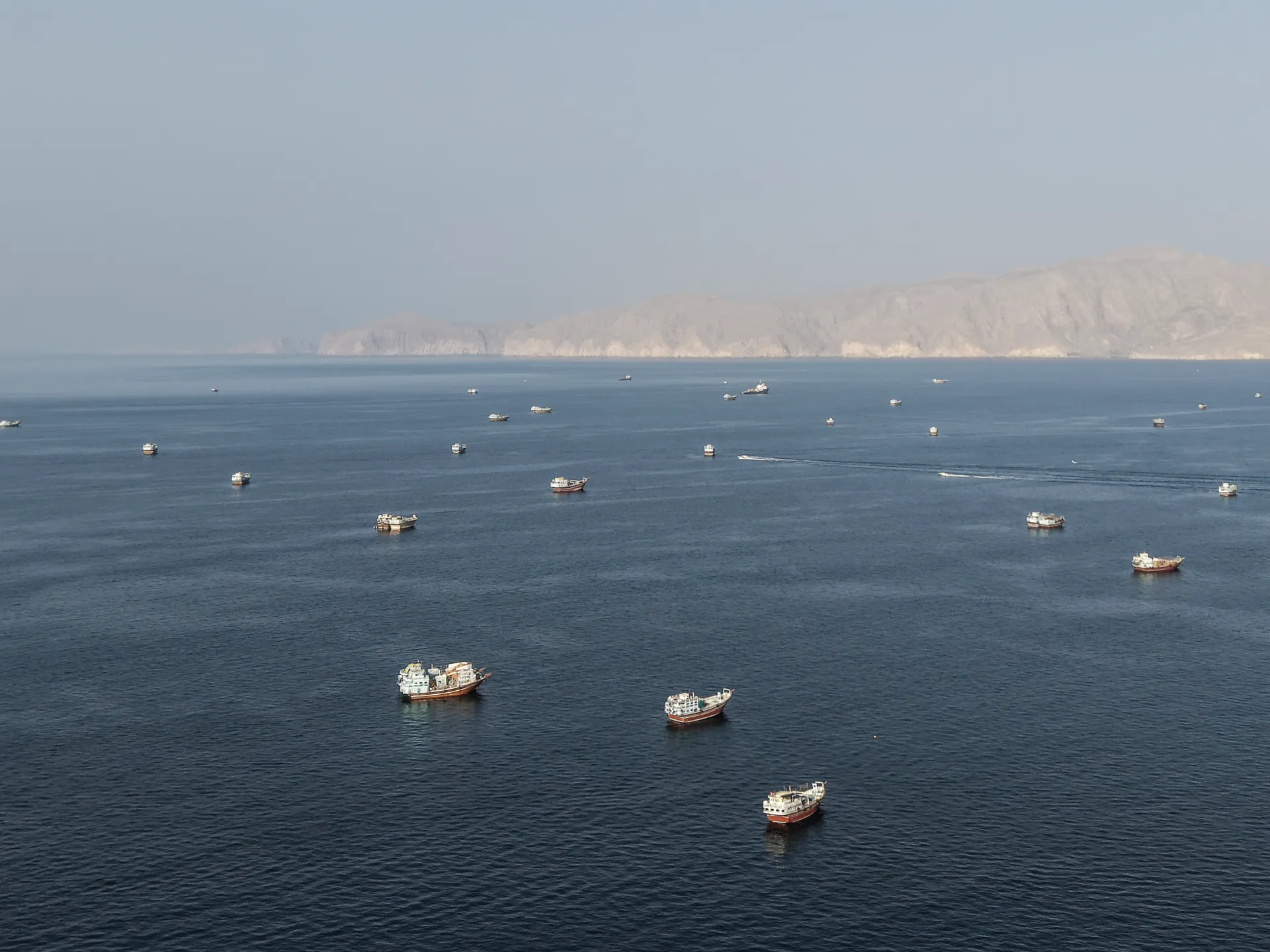
Shipping in the Strait of Hormuz, a conduit for one-fifth of the global trade in oil and liquefied natural gas in peacetime, has shown tentative signs of recovery in recent days after a sharp decline following attacks on two commercial vessels in the waterway on Thursday and Saturday.

At least 40 vessels transited the strait on Tuesday, according to data from MarineTraffic, up from 27 crossings on Monday and 22 on Sunday.

Maritime traffic nonetheless remains far below its pre-war level of roughly 130 daily crossings amid persistent concerns about safety in the waterway.

While Iran agreed to make its “best efforts” to arrange the safe passage of vessels in the MoU it signed with the US on June 17, Tehran has since repeatedly claimed the sole right to control movement through the strait.

At least 49 attacks on commercial vessels have been recorded in the strait since the start of the war, according to MarineTraffic, most of which were claimed by Tehran or blamed on its forces.

Source link

Oil prices back to pre-war levels on rising Middle East supply | Business and Economy News

The price of Brent crude has reached its lowest since February 27, before the war started.

Oil prices have extended their decline to levels last seen before the start of the Iran war, as expectations of rising supply from the Middle East outweighed demand concerns.

Prompt-month Brent crude futures for August delivery fell $1.06 (1.44 percent) to $72.68 a barrel by 06:39 GMT, while US West Texas Intermediate (WTI) lost 76 cents (1.08 percent) to $69.58 a barrel.

Recommended Stories

list of 4 itemsend of list

Both contracts hit their lowest since February 27.

August Brent was trading lower than September, which was priced at $73.59, signalling ample short-term supply.

Brent had fallen by more than $3 on Wednesday as supply concerns eased, while WTI settled down nearly $3.

US Energy Secretary Chris Wright told a forum that flows through the Strait of Hormuz were close to those before the start of the Iran war, with at least 20 million barrels having exited the strait in the past 24 hours.

A return to complete normality would take a few weeks, however, because the strait needs to be cleared of mines, he added.

Rising Middle East supply, together with Iran set to boost sales after a temporary reprieve from US sanctions, drove down prices of physical crude oil cargoes around the world.

New routes

An initial accord last week to end the US-Israeli war with Iran, which began on February 28, has allowed the resumption of traffic through the strait.

The accord set up a 60-day period of negotiations to tackle tougher issues, such as Iran’s nuclear programme.

Wright said oil would continue to flow through the strait even if the deal did not hold, and that Iran would not be able to close it again.

Tehran has said it plans to impose what it calls maritime service fees, as opposed to tolls, while the United States argues it is an international waterway and therefore should not be charged.

Oman opened temporary routes on Wednesday to ease tanker departures from the strait, with the International Maritime Organization and Omani authorities coordinating movements.

On Thursday, Iran’s Revolutionary Guards warned against any crossings of the Strait of Hormuz without authorisation, saying vessels not complying “will be dealt with” and condemning the new routes.

Source link

‘Sugar’ review: Colin Farrell neo-noir levels up for Season 2

For whatever reason, I never reviewed the first season of “Sugar,” which I’d stopped watching before its late-season big reveal — the detective (Colin Farrell as John Sugar) is an alien. Had that happened earlier in the story I might have hung on, but strictly as a production, I’d found its brand of neo-noir to be mannered, gimmicky, obvious, overdirected (by Fernando Meirelles, the Brazilian director of the fine “City of Men”) and, as you may have surmised, off-putting.

This is by way of announcing that the second season arrives Friday on Apple TV and that I like it very much. The stylistic eccentricities have been dialed back, including the use of old Hollywood film clips to reflect the action and possibly the thoughts of its main character, a cinephile from space, who is both practicing and enacting the work of a private detective. He reads American Cinematographer; he takes the Paramount studio tour, then takes it again.

One might navigate the new season without having watched the first, though at least reading an online synopsis. Sam Catlin (“Preacher”) has taken over as showrunner from series creator Mark Protosevich; the tone is lighter, the plot less perverse. Under new director of photography Marshall Adams, the camerawork, formerly too quirky by half — a mishmash of lenses and film stocks and canted angles — has settled down, as has the editing, enhancing the story by letting it breathe and staying out of the way of Farrell’s singular performance — the series’ distinguishing feature and warm heart.

For all his influences, Det. Sugar is the one character who can’t easily be traced back to an earlier model. As detectives go, he’s unusually sweet, optimistic, diplomatic, willing to give a villain a way out, closer to the Man Who Fell to Earth than to Sam Spade. He loves animals, and they love him.

Farrell, who also narrates in a soft voice, often wears a look of shy incomprehension, as if a beat behind in translating the world around him, a stranger in a strange land.

A man makes a tennis ball float in the air, to the delight of six dogs

Using his mild telekinetic powers, Det. John Sugar (Colin Farrell) makes a tennis ball float in the air, to the delight of some dogs in “Sugar.”

(Apple TV)

As aliens go, he is also something of a lightweight, demonstrating some mild telekinetic abilities (making a tennis ball float to entertain a pack of dogs, stirring the ice cubes in his drink) and the ability to speak any language, which underscores his empathetic nature. He makes friends with cab drivers, tour guides and security guards; as an “immigrant,” he appreciates immigrants. He’ll do the dishes for a woman too grief-stricken to attend to them, explain to a man who hates his own name that it’s a reference to Bogart’s character in “Casablanca” and a sign of his mother’s love. He can drink as much alcohol as he likes — his metabolism keeps him from getting drunk — which makes him indefatigable company in a bar, but he is horribly allergic to cinnamon. Remember that, if you’re ever forced to defend yourself from an ET.

Where classic noir detectives tend to be middle-class sorts a job or two ahead of losing their office, Sugar has a lot of money, whether saved up from earlier high-priced cases — his Season 1 client is a rich old man ripped from “The Big Sleep” — or piped down from space. He wears expensive suits, lives in a bungalow in a high-end Los Angeles hotel but also buys a house in the Hollywood Hills because its view allows him to spy on a dodgy character from Season 1; and drives a Nassau Blue 1966 convertible Corvette that he blithely parks in bad neighborhoods with the top down. When the car actually is stolen in this season’s opening episode, it brings him into contact with Val (Sasha Calle, Supergirl in “The Flash” movie), a spunky, punky petty criminal who negotiates its return and whom Sugar makes his assistant; I wouldn’t say Calle is underused, but I would have liked to see more of her.

Sugar came to Earth as part of a group of “thousands,” mixing among humans incognito just to observe them, for benign alien reasons, like Starship Enterprise on its five-year mission. (We get a flashback to Sugar’s first days on Earth, before he acquired the suits and the car and settled on a profession.) At the end of Season 1, their cover being blown, and humans being famously weird when it comes to extraterrestrials — you’ve seen the movies — they return home en masse, except for Sugar. He’s still working a missing persons case of his own, looking for his sister, hopefully alive, somewhere on the planet. And he’s becoming more of an Earthman — the dangers of assimilation are a specific Season 1 plot point. On top of that, like a lot of people, he just loves L.A.

Laura Donnelly as flirtatious Charlotte in "Sugar."

Laura Donnelly as flirtatious Charlotte in “Sugar.”

(Jason LaVeris / Apple TV)

And then there’s Charlotte (Laura Donnelly), whom he meets in the bar of his hotel; it doesn’t take a degree in postwar genre fiction to recognize that there may be something fishy, perhaps “fatale,” about her. But like Sugar, we’re content to put that question off as long as possible, in the hopes that maybe this relationship will be as uncomplicated as we’d like it to be, and a tonic for Sugar’s loneliness. (He no longer has his dog, even.) He regularly gets on the subspace shortwave looking for any others of his kind left on Earth.

The new season will get around to that question, though the alien and earthly plot lines are kept on separate tracks. Most of the time “Sugar” functions as a straightforward compelling detective story, as the protagonist hunts for Ji Moon (Raymond Lee), the missing junkie brother of Danny Moon (Jin Ha), a talented young Korean American prizefighter on the first rung of the ladder to success. (Sugar is working pro bono, not needing the money but very much needing something to do.) It brings him into the orbit of drug dealers and crooked police officers and through an array of Southland locations, including the Beverly Center — finally, a good use for that place — Koreatown, the Vista Theater and the Huntington Gardens.

While there’s nothing particularly novel about that plot, it pulls you along, and the series as a whole is orchestrated to make one care about the characters and worry over their fates. Vivid minor characters — there are pro turns from Shea Whigham, Laura San Giacomo and Mireille Enos — make the story live. All in all, a good meal that leaves no bitter aftertaste.

Source link

Drop-in improv classes in Los Angeles for all levels

Buckle in because the training wheels are OFF for this improv drop-in. So Much Improv, created and led by comic Joe Fahey, focuses on getting in your reps by doing back-to-back improvised scenes. Classes are held at Kingsley Studios, which can be difficult to spot. The two-level complex is located right in front of a liquor store, and the studio is on the second floor behind gated doors. The studio looks like a cute living room, with a couch against one wall and plants across another.

The class size tends to be small (my class included five people), but that allows more time to improvise per person. The class is mostly regulars, so there is already a good rapport between Fahey and the students. That means he can give more specific feedback. After completing other beginner courses, this one felt the scariest, but I leaned in. After a few reps, I felt more confident in my ability to improvise and develop tactics to work with my scene partner. By implementing his feedback, I was able to fine-tune my improv skills.

This class is perfect for those who want more practice. The type of reps can differ each class, but the week I went centered on UCB auditions (it was that time of year). Since the class is small, you get a more catered experience.

Best for: Back-to-back practice on intermediate or advanced drills
Cost: $20
Time commitment: Two hours
Parking: Street parking
Pro tip: Bring water because you will be talking a lot, and something caffeinated to beat the late-night crash for this evening class that requires your full attention.

Source link

4 hospitalized as gas explosion levels Dallas apartment building

May 28 (UPI) — At least four people were hospitalized Thursday when a gas leak at a Dallas apartment building triggered a massive explosion and a five-alarm fire, city officials and witnesses said.

The building in the city’s Oak Cliff neighborhood located just south of downtown was in flames when firefighters arrived at 12:49 p.m. CDT, 2 minutes after receiving calls about a gas leak, Dallas Fire Rescue Assistant Chief James Russ told reporters.

The intensity of the fire quickly necessitated a second alarm, he said.

“Shortly after it continued to escalate and upgrade, and at this time we are at a five-alarm fire,” the assistant chief said in an update delivered shortly before 4 p.m. “The fire is contained but our members are still working on the scene to do primary searches.”

Russ and firefighters launched a drone to canvas the area to “see if we have any victims around. At this time, it’s unknown how many possible fatalities we may have.”

Dallas Mayor Eric Johnson said the city is “going to do every single thing we have to do and that we need to do make sure that every affected family by this tragedy gets what they need.

“You have my commitment that we will do whatever we have to do to make sure that these folks are okay. But the most important thing right now is that we come together as a community and that we pray for everyone’s well-being.”

A family assistance center has been established at nearby high school, the mayor said.

Police urged residents to not go to near the fire scene as thick plumes of black smoke visible for miles rose above downtown Dallas.

Video from the scene showed a smoldering ruin where the apartment complex once stood.

Witnesses said they felt an explosion that shook the entire neighborhood.

“We live right here in the corner house, and we were inside, and then when we heard it, it was like a boom!” a nearby resident told KXAS-TV. “And at first I thought the tree fell on my house or something, or somebody hit my house because I live in the corner.

“So we came out here, and we’re just looking around, then we saw the smoke and the apartments have blew up.”

KXAS reported cited unnamed sources confirming that a contractor was working at the building and struck a gas line, triggering the explosion.

Some 11 residents remained unaccounted for in the hours after the explosion, the station reported.

Source link