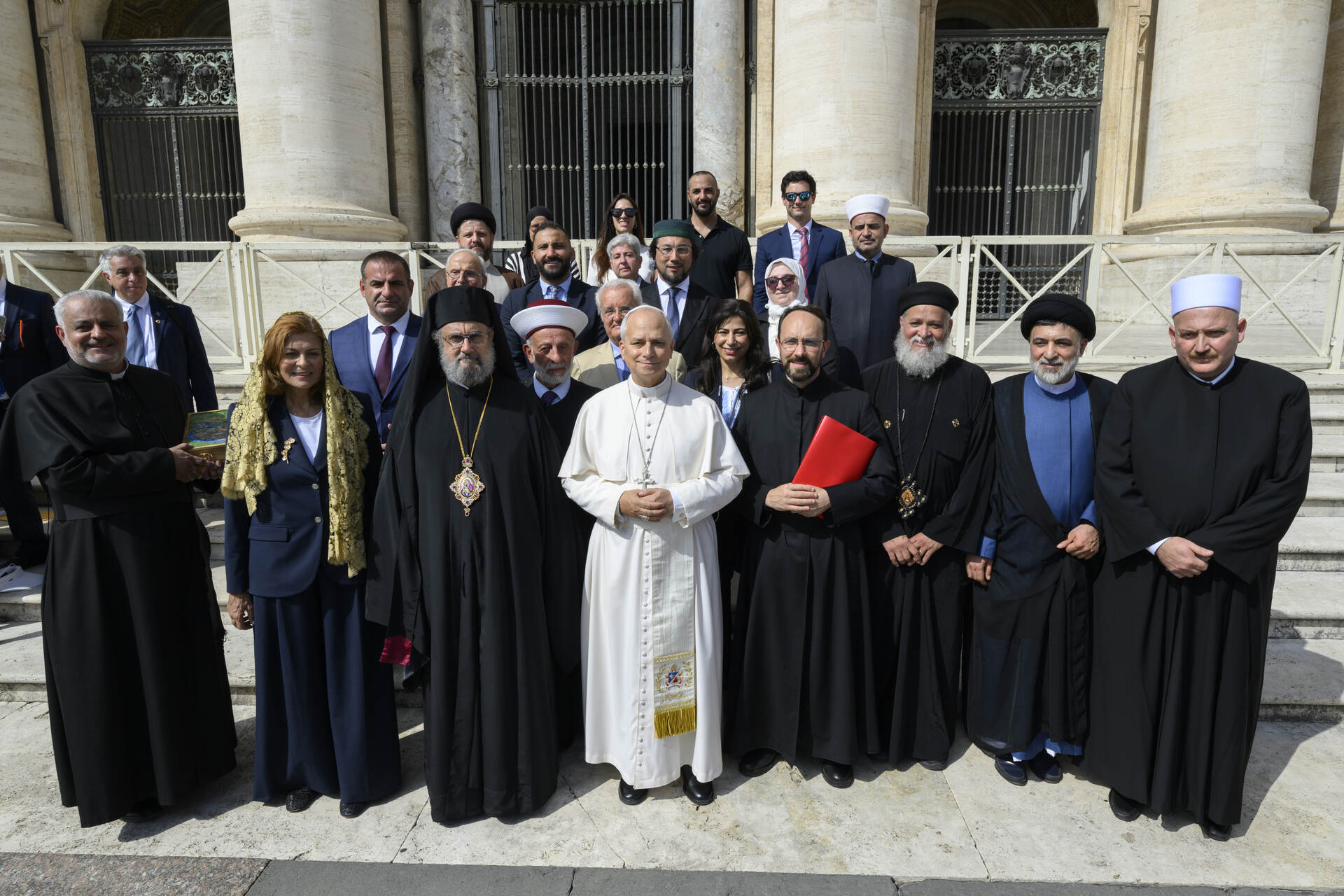
Leo

Pope Leo XIV flies to Angola, says he is not debating Trump

1 of 2 | Pope Leo XIV waves during a welcome ceremony at Quatro de Fevereiro International Airport in Luanda, Angola, Saturday. The Pope is on an 11-day trip to Africa, with stops in Algeria, Cameroon, Angola and Equatorial Guinea. Photo by Jose Sena Goulao/EPA

April 18 (UPI) — Pope Leo XIV said he has no interest in debating President Donald Trump as he flew to Angola for the third leg of his 11-day trip to Africa.

In Cameroon on Thursday, Leo told attendees at a prayer meeting that the world was being “ravaged by a handful of tyrants.”

“The masters of war pretend not to know that it takes only a moment to destroy, yet often a lifetime is not enough to rebuild,” he said.

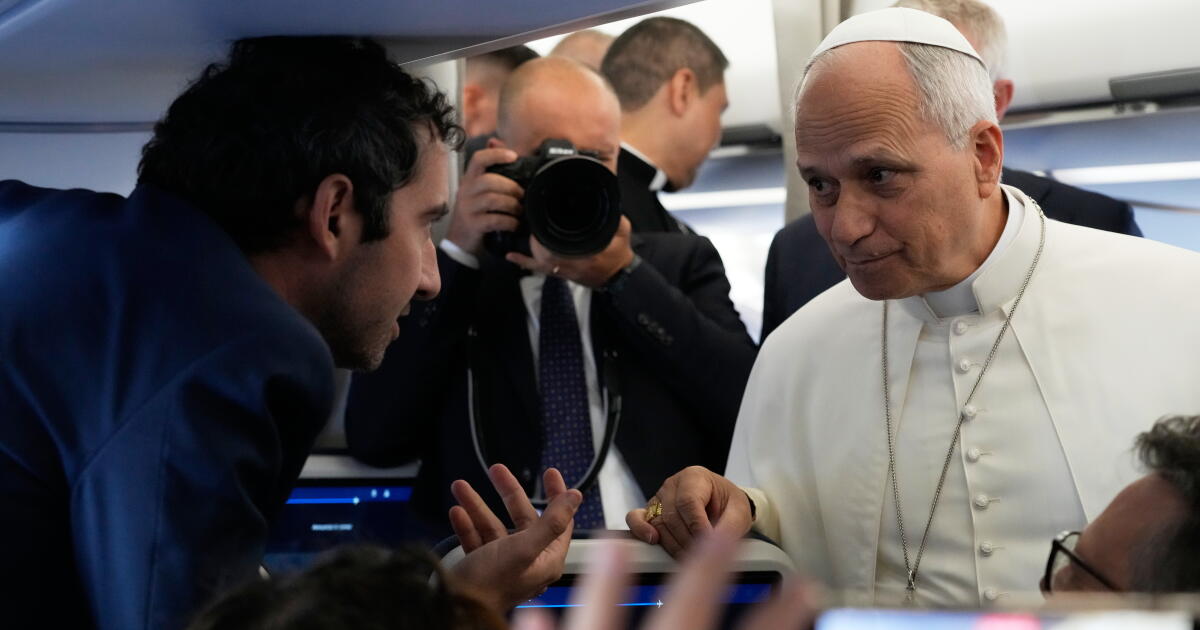
While traveling on the papal plane from Cameroon to Angola Saturday, Leo said his words were not an attack on Trump or his actions in Iran.

He told reporters that his speech was written “weeks ago, well before the president ever commented on myself, and on the message of peace I am promoting,” NBC News reported. “It looked like I was trying to debate the president, which is not my interest at all.”

Last Sunday, Trump lashed out at Leo over his criticism of the war in Iran, claiming a reason the American was named pontiff was because the Catholic Church was trying to curry favor with his administration.

Leo responded saying, “I have no fear of the Trump administration or of speaking out loudly about the message of the Gospel, which is what the Church works for.”

Aboard the plane Saturday, Leo vowed to “promote peace in our world,” and said that his Africa trip is to “be with, to celebrate with, to encourage and accompany all of the Catholics throughout Africa.”

Leo landed in Luanda, Angola, around 3 p.m. WAT Saturday and was welcomed by President João Manuel Gonçalves Lourenço.

The pope met with Angola’s authorities and others at the Presidential Palace in Luanda Saturday. In his speech, he acknowledged those who were affected by recent flooding in the Benguela Province, a coastal area south of Luanda. More than 30 people were killed.

He said he is praying for the victims and noted the national response, that Angolans are “united in a great chain of solidarity in support of those affected.”

Leo said the country’s most important resources are not material but human. “Your people possess treasures that cannot be sold or stolen. There is within them a joy that not even the most adverse circumstances have been able to extinguish,” he said.

The pope is scheduled to celebrate mass at Kilamba, a Luanda suburb, before travelling to the Shrine of Muxima. On Monday, he will travel to Saurimo, where he will visit the elderly and celebrate mass, before returning to Luanda. Tuesday morning, he travels to Equatorial Guinea for his final stop on the trip.

Source link

Pope Leo heads to Angola in landmark Africa visit amid Trump clash | Religion News

Leo is the third pontiff to visit the fossil fuel-rich country after John Paul II in 1992 and Benedict XVI in 2009.

Pope Leo XIV is set to arrive in Angola on the third leg of a landmark African tour that has unfolded alongside an escalating war of words with United States President Donald Trump over the Middle East conflict.

Leo, the third pontiff to visit the fossil fuel-rich country after John Paul II in 1992 and Benedict XVI in 2009, is expected to arrive at 3pm local time (14:00 GMT) on Saturday in the capital, Luanda, where billboards bearing his image have been erected to welcome him.

Recommended Stories

list of 4 itemsend of list

The pope, who visited Cameroon for three days before flying to Luanda, is also slated to meet Angola’s President Joao Lourenco and deliver a speech in the country, where about 44 percent of the population identifies as Catholic.

Leo’s increasingly forceful calls for world peace are likely to resonate in Angola, which emerged in 2002 from a 27-year civil war that erupted after independence from Portugal in 1975.

Throughout his Africa visit, the first pope from the US has issued pointed warnings about corruption, the exploitation of the continent’s vast resources and the dangers of artificial intelligence.

‘Stick to matters of morality’

The pope’s Africa visit has also been marked by a clash with Trump, who has called the 70-year-old head of the Catholic Church “weak on crime” and “terrible for foreign policy”. Trump had also shared what appeared to be an AI-generated image of himself as Jesus, prompting a backlash from leaders across the religious spectrum.

The pope had responded by saying he was not afraid of Trump and that he would continue to speak out against war, marking a rare public clash between a pontiff and a sitting US president.

Speaking to reporters on Thursday, Trump said he had the right to disagree with the pontiff. “I have no disagreement with the fact the pope can say what he wants, and I want him to say what he wants, but I can disagree,” he said.

After US Vice President JD Vance urged the Vatican to “stick to matters of morality”, Leo said on Thursday that the world was “being ravaged by a handful of tyrants” and intensified criticism of those using religion to justify war.

During his stop in Cameroon, Leo also urged the country’s leaders to tackle corruption and condemned “those who, in the name of profit, continue to seize the African continent to exploit and plunder it”.

Leo’s warnings against corruption and exploitation may resonate in Angola, where one-third of the population lives below the poverty line despite vast fossil fuel reserves.

On Sunday, he will celebrate an open-air Mass in Kilamba, outside Luanda, before travelling by helicopter to Muxima, home to a 16th-century church and major pilgrimage site.

On Monday, Leo is due to travel to Saurimo to visit a retirement home and hold another Mass. He will then fly to Equatorial Guinea, the final stop of his 18,000km (11,185-mile) African tour.

Source link

Pope Leo Emerges as a Forceful Global Voice, Clashing with Trump

Pope Leo XIV has stepped into a more assertive global role, adopting a sharper and more direct tone on international issues during his recent Africa tour. After maintaining a relatively cautious profile in the early months of his papacy, Leo has begun openly criticising war, inequality, and global power imbalances. His remarks have drawn repeated criticism from Donald Trump, particularly over his condemnation of the U.S.-Israeli war involving Iran.

Shift in Tone and Leadership Style:
Leo’s recent speeches mark a clear departure from traditional Vatican restraint. Speaking in African देशों such as Cameroon and Algeria, he has issued strong warnings about global injustice, accusing powerful actors of undermining peace and violating international norms. This more confrontational approach reflects a deliberate effort to position the papacy as an active moral voice in global affairs.

Clash with Political Power:
The pope’s remarks have brought him into direct conflict with Trump, who has publicly criticised Leo’s views on foreign policy. This exchange underscores a broader tension between moral authority and political leadership, particularly as the pope challenges the conduct of powerful nations in ongoing conflicts.

Moral Authority on the Global Stage:
Observers suggest Leo is consciously embracing a more visible and influential role, using his platform to highlight the human cost of war and inequality. His decision to deliver strong messages while visiting regions affected by poverty and conflict adds weight and immediacy to his statements, reinforcing his image as a global moral leader.

Breaking with Vatican Convention:
Traditionally, the Vatican has balanced moral advocacy with diplomatic neutrality to preserve its role as a mediator. Leo’s more direct criticism signals a shift in that balance, prioritising clarity and urgency over cautious diplomacy. This approach echoes, but may exceed, the tone of predecessors such as Pope Francis, who also spoke out on global injustices but often with more measured language.

Personal Experience and Perspective:
Before becoming pope, Leo formerly Robert Prevost spent decades in Peru, where he witnessed conflict, poverty, and political instability firsthand. These experiences appear to inform his willingness to speak bluntly about violence, corruption, and the failures of global leadership.

Analysis:
Pope Leo’s emergence as a more forceful voice reflects a strategic and moral recalibration of the papacy’s role in global politics. By speaking more directly, he aims to assert the Church’s relevance in an increasingly volatile world, particularly at a time when traditional diplomatic mechanisms appear strained.

However, this approach carries risks. Greater outspokenness may enhance moral clarity but could also limit the Vatican’s ability to act as a neutral mediator in conflicts. The public clash with Trump highlights how easily moral interventions can become entangled in political disputes.

Ultimately, Leo’s leadership signals a shift toward a more activist papacy, one that prioritises direct engagement with global crises over cautious neutrality. Whether this strengthens the Church’s influence or complicates its diplomatic role will depend on how effectively he balances moral authority with geopolitical realities.

With information from Reuters.

Source link

Pope Leo XIV holds mass with estimated 120,000 in Cameroon

1 of 2 | A handout picture provided by the Vatican Media shows Pope Leo XIV and Cameroonian President Paul Biya shaking hands during a meeting at the Presidential Palace in Yaounde, Cameroon, on Wednesday. Pope Leo XIV held a mass Friday in Douala, Cameroon in a stadium with an estimated 120,000 people. Handout Photo courtesy of Vatican Media/EPA

April 17 (UPI) — Pope Leo XIV held a mass on Friday in Douala, Cameroon, in a stadium with an estimated 120,000 people, marking Catholicism’s growth in Africa.

The pope discussed poverty, violence and corruption in his address to the people of Cameroon, where about 30% of the population is Catholic.

About 20% of the world’s Catholic population lives in Africa.

“Do not give in to distrust and discouragement,” the pope said. “Reject every form of abuse or violence, which deceives by promising easy gains but hardens the heart and makes it insensitive. Do not forget that your people are even richer than this land, for your treasure lies in your values: faith, family, hospitality and work.”

More than 37.7 million people live in poverty in Cameroon. The pope shared the story of Jesus multiplying loaves and fish, saying the “miracle” happened when they were shared.

“Yet this alone is not enough,” he said. “The food that sustains the body must be accompanied, with equal charity, by nourishment for the soul. A nourishment that sustains our conscience and steadies us in dark hours of fear and amid the shadows of suffering.”

The mass was held at Japoma Stadium on the third day of the pope’s 10-day tour of Africa. He will next visit Angola and later Equatorial Guinea during his trip.

Pope Leo spent Thursday in Bamenda, Cameroon, the epicenter of the Anglophone Crisis or Ambazonia War, an armed conflict between the government and separatist groups that has waged for nearly a decade.

Children race to push colored eggs across the grass during the annual Easter Egg Roll event on the South Lawn of the White House in Washington on April 21, 2025. Easter this year takes place on April 5. Photo by Samuel Corum/UPI | License Photo

Source link

Huge crowds greet Pope Leo in Cameroon 20 years after outreach trip | Religion

NewsFeed

Huge crowds have greeted Pope Leo in Cameroon, returning to a country he visited 20 years ago as ‘Father Bob’. Al Jazeera’s Nicolas Haque was there, and explains how the Roman Catholic leader is transforming the church as congregations shrink in Europe but expand in Africa.

Source link

As Vance rallies with Turning Point, some supporters bristle at Trump’s war, memes and feuds

Fresh from a marathon trip to Pakistan that failed to reach a deal for ending the war with Iran, Vice President JD Vance jetted to this Georgia college town for a campus tour organized by the conservative powerhouse Turning Point USA.

But instead of showcasing the youthful energy that the organization harnessed to return President Trump to the White House less than two years ago, there was a mostly empty arena, awkward questions and unusually sharp criticism.

The event affirmed Trump’s difficulty selling the war and how much he’s complicated his own political fortunes by assailing Pope Leo XIV and posting a social media meme that depicted himself as Jesus.

“I did vote for Trump. I am not a Trump supporter anymore,” said Joseph Bercher, a Catholic who said he was glad that Leo has expressed opposition to the war with Iran.

Bercher said the Jesus meme, which the president took down Monday after a rare conservative backlash, was a “red flag” indicating Trump’s true character.

“He sees himself as like a demagogue or someone to be worshipped,” Bercher said.

C.J. Santini, a recent graduate of Liberty University, an evangelical school in Virginia, said he didn’t have an opinion on whether Iran was truly close to manufacturing a nuclear weapon and thus needed to be attacked. But he laughed and shook his head when asked about Trump attacking Leo.

“It’s just stupid. Stupid,” he said, calling it a “distraction” from Trump’s agenda in Iran and at home.

Mostly empty arena contrasts with 2024 rallies

Many of the college-age attendees donned Turning Point attire, Trump hats and red-white-and-blue paraphernalia for the event. Yet they were outnumbered more than 2-to-1 by empty seats in what is not even the largest arena on this sprawling campus that sits about a 90-minute drive from downtown Atlanta.

A Marine veteran who served in Iraq, Vance acknowledged that not all young conservatives are enamored with another U.S. war in the Middle East.

“I’m not saying you have to agree with me on every issue,” Vance told the young crowd. “What I’m saying,” he added, “is don’t get disengaged.”

The vice president took questions from Turning Point executive Andrew Kolvet instead of Erika Kirk, who began leading the organization after the assassination of her husband Charlie Kirk. Kolvet said Erika Kirk canceled her plans to be on stage because of unspecified threats she had received.

Vance, whose presence ensured significant Secret Service and other law enforcement protection around the venue, said he’d been worried that the event would be canceled altogether.

Kolvet asked Vance directly about the war and Trump’s back-and-forth with Leo. Audience questions were more aggressive. Vance jousted with at least one heckler over the war in Gaza, and he was pressed by another person over the administration’s handling of the Jeffrey Epstein case files.

In the audience, even some of Vance’s sympathetic listeners offered caveats and critiques.

“The pope needs to stay out of politics,” said Jessie Williams, a Methodist. But he noted his mother is Catholic, and he said he understands why Catholics recoil at Trump calling the pope “weak” and suggesting that the first U.S.-born pontiff was chosen only as a counter to Trump.

Williams called Trump’s meme distasteful.

“I don’t like it, but it’s — what can we do?” Williams said. “He’s a grown man, he’s gonna do what he wants.”

Blake McCluggage, a Baptist, said he did not approve of the meme or Trump’s profane Easter Sunday message that threatened widespread destruction of Iran’s civilian infrastructure.

The threat, plus Trump’s follow up message that a “whole civilization” would die, prompted escalating criticism from Leo, with the pope calling the president’s comments “truly unacceptable.”

However, McCluggage said, “you can still be a Republican” despite disagreeing with Trump.

A day before coming to Georgia, Vance tried to laugh off the meme as a joke that “a lot of people weren’t understanding.” The vice president also seemed to echo Trump’s assertion that Leo should concentrate less on global affairs.

“It would be best for the Vatican to stick to matters of morality, to stick to matters of what’s going on in the Catholic church and let the president of the United States stick to dictating American public policy,” Vance said in a Fox News interview.

On stage in Athens, he shifted his arguments, saying he welcomes Leo’s comments even if he disagrees with them.

“At the very least, it invites conversation,” said Vance, who converted to Catholicism as an adult.

Still, Vance questioned Leo anew, pushing back specifically at the pope’s Palm Sunday assertion that God does not hear the prayers of those who make war. Leo was quoting scripture from the Old Testament book of Isaiah. Vance asked whether God was on the side of Allied forces in World War II as they liberated Jewish survivors of Nazi extermination camps.

“I certainly think the answer is yes,” Vance said. When Leo mixes global affairs and complex theology, Vance said, “it’s very important for the pope to be careful.”

Barrow and Megnien write for the Associated Press.

Source link

Pope Leo isn’t afraid of President Trump. We shouldn’t be, either

“I’m not afraid.”

With these three words Sunday morning, Pope Leo XIV offered as powerful a rebuke of President Trump and everything he has wrought on the world as anyone ever has.

Three words that mocked Trump for being the bully that he is.

Three words that undercut Trump’s self-hyped aura of invincibility.

Three words to inspire all good people to fight against Trump — because if a mild-mannered man of God such as Leo isn’t afraid, no one should be.

Pope Leo’s words thrilled me as an American but especially as a Catholic. His quiet, confident witness since becoming pontiff in May had already reignited a spiritual light in me to adhere closer to the faith I was brought up in.

Trump’s actions during his second term — war, deportations, nasty rhetoric and a love of himself above all else — have been like fuel to that fire. They stand against everything I was ever taught was good and holy.

Hearing Leo’s simple smackdown of the president, at a time when too many people insist we must sink to Trump’s lows to beat him, is like receiving a sacrament I never knew I needed.

Leo spoke a few hours after Trump trashed him on social media, calling him “WEAK on Crime, and terrible for Foreign Policy” — all because of the pope’s critiques of perpetual wars and this country’s vile treatment of undocumented immigrants, while never mentioning anyone by name.

Until now.

“I’m not afraid of the Trump administration or of speaking out loudly about the message of the Gospel, which is what the church works for,” he told reporters while traveling to Algeria to kick off a 10-day African mission. He repeated the message later, stating: “I have no fear.”

In response, Trump melted down like the Nazis at the end of “Raiders of the Lost Ark,” critiquing the pope to reporters and then posting an image on social media of himself as a robed savior healing a sick man, light emanating from his hands.

This pathetic fusillade offended even Catholic League President Bill Donohue, who has made a career of trashing liberal Catholics and who defended Trump last year after the president shared an image of himself in papal robes and mitre after the death of Pope Francis. This time, Donohue deemed Trump’s Christ-like imagery “offensive and immature.”

Donald Trump waving to reporters

President Trump waves as he returns to the White House on Sunday. During a short interaction with reporters, he blasted Pope Leo XI as “very liberal.”

(Jose Luis Magana / Associated Press)

The president has a lot to fear these days, and not just because he violated most of the Ten Commandments with his bonkers Jesus post, which quickly disappeared. One of the few sane adults left in his administration must have reminded him that antagonizing Catholics is a terrible political move. About 55% of them voted for him in the 2024 election, many in swing states such as Nevada, Pennsylvania and Wisconsin that had sided with Joe Biden — a Catholic — four years before.

A Fox News poll released last week found that only 48% of Catholics nationwide approve of Trump’s overall performance. While 57% of white Catholics still support Trump, a majority of them aren’t happy with his actions in Iran — the issue that’s turning out to be a millstone around his neck.

Trump’s second term has been a nightmare that seems to worsen every day. Yet not only is this country still standing, but more and more people are waking up to the mockery he’s made of American values. One of the new warriors is Leo, who told reporters he spoke out not to sway politics in his home country, but to offer, in his role as head of the world’s 1.4 billion Catholics, a reminder of what Jesus practiced and preached.

No wonder Trump, who wants to erect idols to himself like a Canaanite king, is so upset.

May Leo’s words wake up more good people, regardless of their faith, to rise against Trump — and especially stir lapsed Catholics to return to Mother Church.

U.S. Catholics have long served as a barometer of acceptance for newcomers and the working class. But only about 20% of Americans identify as Catholic, per a Pew Research Center study released last year. And only 30% of those Catholics attend Mass weekly. Many more leave the faith than adopt it, at rates that far exceed other Christian denominations. This collapse has allowed the Catholic church’s conservative wing to take over, departing from the historic mission and instead leading us to Trump.

My lifelong commitment to social justice and my eternal skepticism of power and avarice comes from what I learned growing up at St. Boniface in Anaheim. I even had aspirations to become a priest, because I find few things more noble than dedicating your life to helping others.

I stopped attending Mass once I began covering the church’s sex abuse scandals as a journalist. I was outraged that men who held themselves up to be the custodians of God on Earth not only allowed such crimes to happen but usually covered them up and shunted off the offenders to poor parishes like mine.

I never stopped praying or considering myself a Catholic — but I couldn’t bring myself to support institutions headed by men such as L.A. Archbishop José H. Gómez and Diocese of Orange Bishop Kevin Vann, who always seem to have sharp words for progressives but never for Trump.

It’s been a long road back for me to openly write about my faith with pride — but Trump’s continued heresies have made it necessary. I still don’t know when or if I’ll start attending Mass again regularly, but the fact that I’m even thinking about it shows Leo’s impact on me.

Recently, someone I was interviewing noticed my scapular of the Santo Niño de Atocha with the word “Amor” on the other side. Last year, I tucked this simple necklace that’s a sign of devotion inside the plastic sleeve holding my Los Angeles Times badge, along with a few religious medals.

Pope Leo caused that. Trump caused that. Any chance to talk about my Catholic faith and why Trump is bad, I’m going to take.

I’m not afraid.

Source link

Trump slams Pope Leo as ‘weak,’ but the U.S.-born pontiff stands firm on peace

President Trump was propelled into office in large part by support from evangelicals and Catholics, at times framing his political rise in divine terms.

But that relationship is now fraying, and, in some corners of the Catholic Church, breaking, after Trump spent the weekend maligning Pope Leo XIV — “Leo is WEAK on Crime” — and circulating a widely condemned social media post depicting himself as Jesus Christ.

Leo, meanwhile, on Monday repeated his calls for an end of hostilities between the U.S. and Iran. “I have no fear of neither the Trump administration nor of speaking out loudly about the message of the Gospel,” Leo told reporters. “Blessed are the peacemakers.”

Trump had lashed out at the pontiff in a Truth Social post on Sunday night and repeated those criticisms Monday. “I’m not a big fan of Pope Leo,” he said. “He’s a very liberal person, and he’s a man that doesn’t believe in stopping crime. He’s a man that doesn’t think we should be toying with a country that wants a nuclear weapon so they can blow up the world.”

The tirade drew swift backlash from Catholic leaders and rank-and-file believers alike, who have increasingly withdrawn support from the president since he and Israel launched attacks on Iran, according to recent polls.

Also fueling backlash was the artificial-intelligence-generated image of Trump, in a white robe and a red stole, placing his hand on the forehead of a man in a hospital bed. Trump confirmed he had posted the image but insisted he thought it portrayed him as a doctor, not Jesus healing the sick.

That’s not how many people viewed it.

“In the Christian faith, this is considered blasphemy: depicting yourself as Christ, elevating yourself to the level of Christ,” conservative commentator Alyssa Farah Griffin said on “The View.” “Our faith is bigger than our politics. That is one thing that will always trump politics for people who are practicing in their faith. He clearly doesn’t understand that.”

The Rev. Thomas Reese, who also works as an analyst at Religious News Service, called Trump’s AI-generated image “an absolute disaster and blasphemous,” adding that it appeared to unsettle even some of the president’s religious supporters. The post was later removed from Truth Social.

More broadly, Reese said the war itself, and the way it has been framed, is colliding with core church teaching.

“To invoke God for a war of choice is just wrong,” he said, noting that Catholic leaders have increasingly emphasized diplomacy and reconciliation over military action.

“The Catholics who voted for him feel betrayed,” Reese said. “I think they’re beginning to say, ‘This is not what we voted for,’ especially when you tie the war to higher gasoline prices, higher food prices.”

In his Truth Social post, Trump also took some credit for Leo’s election as pontiff last year after the death of Pope Francis, writing that Leo was chosen “because he was an American, and they thought that would be the best way to deal with President Donald J. Trump. If I wasn’t in the White House, Leo wouldn’t be in the Vatican.”

Tensions had been simmering between the two leaders for months, but boiled over after Trump issued a threat to use the U.S. military to wipe out all of Iranian civilization.

At a peace vigil at St. Peter’s Basilica on Saturday, Leo said that a “delusion of omnipotence” is fueling the war that has left thousands dead. Though he did not name Trump, the pope has repeatedly cautioned against invoking religion to justify violence.

Many Trump supporters have claimed he had a divine mandate, and Trump himself has repeatedly asserted that God saved him in the July 2024 assassination attempt so that he could lead the United States.

His administration has undertaken extraordinary efforts to infuse Christianity into government functions — establishing a White House Faith Office and holding prayer services at the Pentagon and the Labor Department.

After Iran shot down a U.S. fighter jet on April 3, Defense Secretary Pete Hegseth compared the rescue of one of the aviators to Jesus’ crucifixion and resurrection: “Shot down on a Friday, Good Friday. Hidden in a cave, a crevice, all of Saturday and rescued on Sunday. Flown out of Iran as the sun was rising on Easter Sunday. A pilot reborn, all home and accounted for, a nation rejoicing.”

A military watchdog group last month said it had received more than 200 complaints from U.S. service members reporting that military commanders were telling troops that the Iran war was part of a divine plan by God to trigger Armageddon. A group of Democratic lawmakers called for an investigation into whether military operations were being guided by “end-times prophecy.”

Catholics rallied for Trump in 2024, when 55% of voting Catholics cast their ballots for Trump, clocking in at 12 points higher than his Democratic opponent, Kamala Harris.

But he’s steadily lost their support since the onset of the war, according to new bipartisan polling. Some 52% of Catholics say they disapprove of the president’s job performance, according to one survey by Republican pollster Shaw & Co. Research and Democratic pollster Beacon Research. Another 23% say they strongly approve of the job he is doing and another 25% somewhat approve.

Consisting of about a quarter of the U.S. population, the Catholic voting bloc has long been regarded as the bellwether demographic, having historically chosen the winner of the popular vote in nearly every presidential election for the last 50 years.

Since ascending to the throne of St. Peter, Leo has frequently clashed with the administration on issues ranging from immigration to foreign policy, emphasizing humanitarian concerns and diplomacy over force.

That attitude appears to be resonating in the pews. Reese, the commentator and priest, pointed to growing frustration among Catholic voters, including some who backed Trump in 2024 expecting an end to prolonged Middle East conflicts.

Reflecting on church history, he said: “The papacy survived Attila the Hun. They survived Napoleon, they survived Mussolini and they survived Hitler. They will survive Trump.”

In AD 452, when Attila the Hun sacked city after city in his conquest of the known world, it was the Catholic Church, not the Roman military, that met him in a show of diplomacy. The pontiff of the time, who persuaded Attila to turn his army back and spare Rome, was called Pope Leo I.

Source link

Trump lashes out at Pope Leo over Iran war criticism

April 13 (UPI) — President Donald Trump lashed out at Pope LeoXIV over his criticism of the war in Iran, claiming a reason the American was named pontiff was because the Church was trying to curry favor with his administration.

Since being elected the first American head of the Catholic Church in May, Pope Leo has criticized the Trump administration’s policies, particularly its aggressive immigration crackdown and military campaigns. As the war in Iran has continued, the Chicago native has ramped up his criticism of the New York real estate mogul and his administration.

Seemingly in response, Trump on Sunday called the pope “WEAK on Crime and Terrible for Foreign Policy.”

“Leo should be thankful because, as everyone knows, he was a shocking surprise. He wasn’t on any list to be Pope, and was only put there by the Church because he was an American, and they thought that would be the best way to deal with President Donald J. Trump,” Trump said in a statement on his Truth Social platform. “If I wasn’t in the White House, Leo wouldn’t be in the Vatican.”

Amid the conflict, Pope Leo has repeatedly called for an end to the war in Iran and other conflicts, most often without mentioning the warring parties or their leaders by name.

In seemingly pointed remarks in late March, the pope said God “does not listen to the prayers of those who wage war, but rejects them.” Then early this month, the pontiff, speaking in Italian, described Trump’s threat to destroy “the whole Iranian civilization,” as “truly unacceptable!”

In his late Sunday statement, Trump said he preferred Leo’s eldest brother Louis Prevost, a noted supporter of the president’s far-right nationalist Make America Again movement.

“Leo should get his act together as Pope, use Common Sense, stop catering to the Radical Left and focus on being a Great Pope, not a politician,” Trump said.

“It’s hurting him very badly and, more importantly, it’s hurting the Catholic Church!”

Catholic Americans constituted a major electoral bloc in Trump’s 2024 election victory. According to the Pew Research Center, about 55% of Catholic voters cast ballots for Trump compared to 43% for his Democratic challenger, former Vice President Kamala Harris.

The statement comes as pressure mounts on Trump over the war in Iran, which was launched jointly with Israel on Feb. 28. During the current two-week cease-fire, U.S. efforts to secure a permanent end to the war are ongoing as calls from Democrats and critics for his ouster grow louder.

“The deranged and disgusting post from Trump attacking Pope Leo should certainly help him appeal to the more than 50 million Americans who identify as Catholics. Perhaps this will convince JD Vance to invoke the 25th Amendment to remove Trump from office,” Rep. Pramila Jayapal, D-Wash., said in a statement referring to the vice president, who is Catholic, and his ability to invoke a constitutional mechanism that could lead to Trump’s removal from the White House.

Source link

‘Terrible for foreign policy’: Trump attacks Pope Leo after peace appeal | Donald Trump News

Leo, ​who last year became the first US-born pope, has emerged as an outspoken critic of the US-Israeli ⁠war on Iran.

United States President Donald Trump has unleashed a storm of criticism at Pope Leo XIV, calling him “weak on crime” and “terrible for foreign policy”.

Trump delivered the unusual criticism of the head of the Catholic Church in a Sunday night post on social media, saying he does not “want a Pope who criticises the President of the United States”.

Recommended Stories

list of 3 itemsend of list

Trump’s outburst appeared to be triggered by recent remarks from Pope Leo critical of the US-Israel war on Iran.

Last week, Leo issued a rare direct rebuke of Trump’s threat to destroy Iranian civilisation, calling it “truly unacceptable“. And then, on Sunday, the 70-year-old pontiff implored leaders to end ongoing bloodshed, condemning what he described as a “delusion of omnipotence” fuelling war – comments that appeared directed at Trump.

The pope has also previously questioned the Trump administration’s hardline immigration policies, saying, “I don’t know if that’s ⁠pro-life.”

Taking to Truth Social, Trump wrote: “I don’t want a Pope who thinks it’s OK for Iran to have a Nuclear Weapon. I don’t want a Pope who thinks it’s terrible that America attacked Venezuela.”

“Leo should get his act together as Pope, use Common Sense, stop catering to the Radical Left, and focus on being a Great Pope, not a Politician,” said the US president.

Trump also claimed credit for Leo’s leadership in the Catholic Church, suggesting the Vatican picked the first US-born pontiff – elected last year – to curry favour with the White House. “If I wasn’t in the White House, Leo wouldn’t be in the Vatican,” Trump said.

Asked about the comments later on Sunday, Trump reiterated that he is “not a big fan” of Leo, who he said “is not doing a very good job”.

“He likes crime, I guess,” said Trump. “He’s a very liberal person.”

Trump also had a rocky relationship with Leo’s predecessor, Pope Francis, who criticised Trump’s ‌immigration ‌policy proposals when he first ran for president and suggested Trump was “not a Christian“. Trump had called Francis “disgraceful” in early 2016.

Leo is set to begin an 11-day trip to Africa on Monday, starting with a historic visit to Muslim-majority Algeria.

Source link

A president and a pope: The world’s most influential Americans are at odds over Iran

Donald Trump is accustomed to criticism from coast to coast — Democrats, disaffected Republicans, late-night comedians, massive protests. Yet in his second presidency, Trump’s most influential American critic doesn’t live in the country but at the Vatican.

It’s an unprecedented situation, with the first American pope directly assailing the American president over the war in Iran, where a fragile ceasefire took hold this week. The announcement came after Pope Leo XIV declared that Trump’s belligerence was “truly unacceptable.”

Never before has the relationship between Washington and the Vatican revolved around two Americans — specifically, a 79-year-old politician from Queens and a 70-year-old pontiff from Chicago. They come from the same generation and share some common cultural roots yet bring jarringly distinct approaches to their positions of vast power. And the relationship comes with risks for both sides.

“They’re two white guy boomers but they could not be any more different in their life experiences, in their values, in the way they have chosen to live those values,” said theology professor Natalia Imperatori-Lee of Fordham University. “This is a very stark contrast, and I think an inflection point for American Christianity.”

Polar positions on Iran among U.S. Christians

Experts on the Catholic Church emphasized that Leo’s opposition to the war reflects established church teachings, not the reflexive politics of the moment.

“For the last five centuries, the church has been involved in a project of helping develop strong international norms,” including the Geneva Conventions in recent centuries, said Catholic University professor William Barbieri. “It is a very long-standing tradition rooted in Scripture and theology and philosophy.”

Yet the U.S. administration, which has close ties to conservative evangelical Protestant leaders, has claimed heavenly endorsement for Trump’s war on Iran.

Defense Secretary Pete Hegseth urged Americans to pray for victory “in the name of Jesus Christ.” When Trump was asked whether he thought God approved of the war, he said, “I do, because God is good — because God is good and God wants to see people taken care of.”

The Rev. Franklin Graham, son of iconic Baptist evangelist Billy Graham, said of Trump that God “raised him up for such a time as this.” And Graham prayed for victory so Iranians can “be set free from these Islamic lunatics.”

Leo countered in his Palm Sunday message that God “does not listen to the prayers of those who wage war, but rejects them.” He referenced an Old Testament passage from Isaiah, saying that “even though you make many prayers, I will not listen — your hands are full of blood.”

While it’s not unusual for popes and presidents to be at cross purposes, it’s exceedingly rare for the leader of the Catholic Church to directly criticize a U.S. leader, and Leo later named Trump directly and expressed optimism that the president would seek “an off-ramp” in Iran.

An even stronger condemnation came after Trump warned of mass strikes against Iranian power plants and infrastructure, writing on social media that “an entire civilization will die tonight.” Leo described that as a “threat against the entire people of Iran” and said it was “truly unacceptable.”

Experts: Leo doesn’t see himself as a Trump rival

Imperatori-Lee said Leo’s direct criticism stands out from the church’s more general critiques of political and social systems. For example, Pope Francis urged U.S. bishops to defend migrants without specifically mentioning Trump or his deportation agenda. Leo also previously called for humane treatment of migrants.

“Popes have critiqued unfettered capitalism before, very robustly. The popes have critiqued the Industrial Revolution, right? Things that the U.S. has been at the forefront of,” Imperatori-Lee said, “but it’s never been this specific and localized.”

She said Leo’s commentary resonates in the U.S. — with Catholics and non-Catholics — because he is a native English speaker.

“There’s no question about his inflection and meaning,” she said. “It removes any ambiguities.”

Trump welcomed Leo’s election last May as a “great honor” for the country, and he hasn’t responded to the latest criticisms. The White House did not respond to a request for comment.

“What Pope Leo and Donald Trump have in common is they both lived through the post-war polarization,” including the political upheaval of the Civil Rights Movement and Vietnam War, said Steven Millies, a professor at Chicago’s Catholic Theological Union, one of the pope’s alma maters.

He noted that Leo is a subscriber to The New York Times, plays the “Wordle” game, keeps up with U.S. sports and talks regularly with his brothers, including an avowed Trump supporter.

“In some ways he’s just like us,” Millies said, someone “who understands where our domestic political crisis came from,” unlike the Argentinian Francis, “who did not fully understand the peculiarities of the United States” even as he offered implicit criticism.

Barbieri said Leo’s American savvy still does not change an underappreciated reality of Catholicism and the papacy. “The Catholic Church doesn’t neatly fit into either right or left boxes as they’re understood in U.S. politics,” he said.

Leo’s global focus vs. Trump’s ‘transactional’ politics

Leo spent much of his pre-papal ministry, including all his time as a bishop and cardinal, outside the U.S.

He was educated in Rome as a canon lawyer within the church. He was a bishop in poor, rural swaths of Peru. He led the Augustinian order and served as Francis’ prefect for recommending bishop appointees around the world.

Imperatori-Lee said that global reach gave him a first-hand perspective on how Washington’s economic and military policies — including backing dictators in Latin America — have negatively affected less powerful nations and their citizens.

His varied experiences made then-Cardinal Robert Prevost uniquely suited to be elected pope despite the College of Cardinals’ traditional skepticism toward the U.S. and its superpower status. Millies argued that Trump and his advisers, even Vice President JD Vance, a Catholic convert, may not appreciate those distinctions.

“This is an administration that seems to think only in terms of transactional politics — who’s for us and who’s against us,” he said.

Polarization poses risks for Leo and Trump

Relations between Washington and the Vatican have become so strained that a report of an allegedly contentious meeting involving Pentagon and Catholic Church officials sent shockwaves through both cities.

According to the report in The Free Press, a member of Trump’s administration warned the church in January not to stand in the way of U.S. military might.

The Vatican on Friday issued a statement rejecting the report’s characterization of the meeting, saying it “does not correspond to the truth in any way.”

The U.S. Embassy to the Holy See also pushed back, writing on social media that “deliberate misrepresentation of these routine meetings sows unfounded division and misunderstanding.”

Millies, meanwhile, questioned whether anything the pope or U.S. bishops say can sway individual Catholics. Trump is likely to lose support among Catholics as he loses support across the broader electorate, Millies said, but that’s not necessarily because members of Leo’s flock are applying church doctrine.

“Partisan preferences always trump the religious commitments,” Millies said, describing a “disconnect” between church leaders and many parishioners who look to other sources, politicians included, when shaping their views of faith and politics.

“The icon of Catholicism in American politics now is JD Vance, and it’s more about winning an argument,” he said. “It’s a very different emphasis, but it’s one that may suit the Trump administration very well.”

Barrow writes for the Associated Press. AP reporters Nicole Winfield in Rome and Konstantin Toropin in Washington contributed to this report.
Source link

Pope Leo beseeches warring nations to lay down arms in Easter address

Pope Leo XIV waves to the crowd from the popemobile after he presided over the Holy Mass on Easter Sunday at Saint Peter’s Square in Vatican City on Sunday. It is Pope Leo’s first Holy Week as pontiff. Photo by Riccardo Antimiani/EPA

April 5 (UPI) — Pope Leo XIV on Sunday beseeched world leaders to “lay down” the weapons of war and use “dialogue” rather than force as the means to bring about peace.

In the annual Urbi et Orbi address delivered by the presiding Catholic pontiff each Easter Sunday in St. Peter’s Square at the Vatican, Leo said the holy day can provide a light from Christ allowing hearts “to be transformed by his immense love for us.

“Let those who have weapons lay them down. Let those who have the power to unleash wars choose peace. Not a peace imposed by force, but through dialogue. Not with the desire to dominate others, but to encounter them,” Leo said in his first Easter address as pontiff.

An estimated 50,000 people jammed the Roman square to hear Leo’s Urbi et Orbi Easter Mass homily, or “To the City and the World,” in which he warned against allowing “indifference” to blunt the impact of war’s devastation as conflicts raged in Iran, Lebanon, Gaza, Ukraine and elsewhere in the world.

“We are growing accustomed to violence, resigning ourselves to it, and becoming indifferent,” he said. “Indifferent to the deaths of thousands of people. Indifferent to the repercussions of hatred and division that conflicts sow. Indifferent to the economic and social consequences they produce, which we all feel.”

Instead, he declared, “We cannot continue to be indifferent! And we cannot resign ourselves to evil!”

Leo, the first American pope, has been a frequent critic of U.S. President Donald Trump, but did not specifically mention him or any other leader or country during the Easter homily. Rather, he anti-war remarks were universal.

“On this day of celebration, let us abandon every desire for conflict, domination, and power, and implore the Lord to grant his peace to a world ravaged by wars and marked by a hatred and indifference that make us feel powerless in the face of evil,” Leo urged.

In his time as pope, Leo has established a track record of issuing unambiguous calls for peace.

Last month, for instance, he voiced a direct demand for an end to the U.S.-Israeli war in Iran as the conflict entered its third week.

“On behalf of the Christians of the Middle East, and of all women and men of good will, I appeal to those responsible for this conflict: Cease fire!,” the pope said during the Angelus in St. Peter’s Square on March 15.

Pope Leo XIV celebrates the Christmas vigil Mass on Christmas eve on Wednesday in St. Peter’s Basilica in Vatican City, Vatican. Photo by Stefano Spaziani/UPI | License Photo

Source link

SXSW 2026: Hermanos Espinoza, Vanita Leo headline De Los showcase

For the third year in a row, De Los, the Latino-centric vertical of the Los Angeles Times, will be returning to South by Southwest in Austin, Texas, and things are a little different this time around. While the music portion of the festival has typically been given its own weekend to shine, in 2026, it’ll be “folded into” a week-long event alongside film, TV and interactive programming.

But despite these changes, one thing is clear: After a banner year for Latin music at SXSW in 2025, it seems like everyone’s doubled down in 2026, with the festival welcoming a historic number of Latin artists to Austin. That includes the De Los showcase.

If our 2024 event was more of an intimate kickback, 2025 was an all-out party. Thanks to energetic sets from acts like trap corrido pioneers Arsenal Efectivo and the clashing cumbia punk stylings of Sultanes del Yonke, the crowd was up on their feet dancing, twirling and even forming a mosh pit at one point — all into the early hours of the morning. We hope to bring those same vibes back to SXSW this year.

If you’re in Austin for the festival, join us at Mala Fama, located at 422 E. 6th St., Austin, on Sunday, March 15 starting at 8 p.m. As always, the festival is a great opportunity to discover new artists and exciting new sounds, so whether or not you’ll be joining us in Texas, we hope this lineup might inspire you to find a new favorite artist, song or band.

Here’s who’s playing at the 2026 De Los showcase.

Hermanos Espinoza

With their South Texas upbringing (Puro 956!), it shouldn’t come as a surprise that this duo’s Norteño sound has plenty of Tejano flair too. Hailing from Edinburg, brothers Joel and Leonel Espinoza broke out not long after making their debut in 2022, when their song “Prueba de Fuego” hit more than 100 million streams. Their lively, accordion-rich music feels classic enough to be right at home on the playlist for your next carne asada.

Noteworthy track: “Dios por Delante”

Vanita Leo

Music is in Vanita Leo’s DNA. Born and raised in San Antonio, the singer’s father and aunt are both Tejano musicians who inspired Leo to take up the family mantle and put her own spin on the genre. With a love for the old-school sound of the 1990s, Leo manages to weave together her flirty, unserious humor with vintage romance, writing songs that’ll either validate your heartbreak over a bad ex or have you ready to dance it off and forget they ever existed.

Noteworthy track: “Caballito”

Tropa Magica

The second sibling duo on our lineup, Tropa Magica is the brainchild of brothers David and Rene Pacheco. Their signature sound, much like the East L.A. neighborhood they grew up in, is a melting pot of influences, combining old-school cumbias, ’90s grunge, and psychedelic rock into something completely unique to them. Since coming onto the scene in 2018, the band has gotten the stamp of approval from established acts like Bomba Estéreo, Los Tigres Del Norte and Chicano Batman.

Noteworthy track: “Ojos de Lágrimas”

Eddy

This is set to be Eddy’s year. Born Eduardo Hernández Payán, Eddy first made waves when he was discovered by corridos singer-songwriter Diego Millán (Calle 24) and signed to his Ondeados Mafia label. Last year, he built up a reputation for being an artist to watch in the Regional Mexican space thanks to collaborations with Gabito Ballesteros and Ed Maverick. Now, Eddy is prepping for the release of his debut album, “Náufrago,” later this month.

Noteworthy track: “Ultimo Cigarro”

Nezza

Many of you might know Nezza from her viral moment last summer, when she went viral for singing the national anthem in Spanish at Dodger Stadium — her form of protest against the immigration raids that had been taking place all over L.A. But just take a listen to the Dominican-Colombian singer’s original music, and you’ll see that she’s much more than a viral moment. With her Spanglish lyrics, soulful vocals and glittery production, Nezza has her sights set on international pop stardom.

Noteworthy track: “Tasty”

Source link