lay

Scott Lay dies: Chronicler of California politics was 48

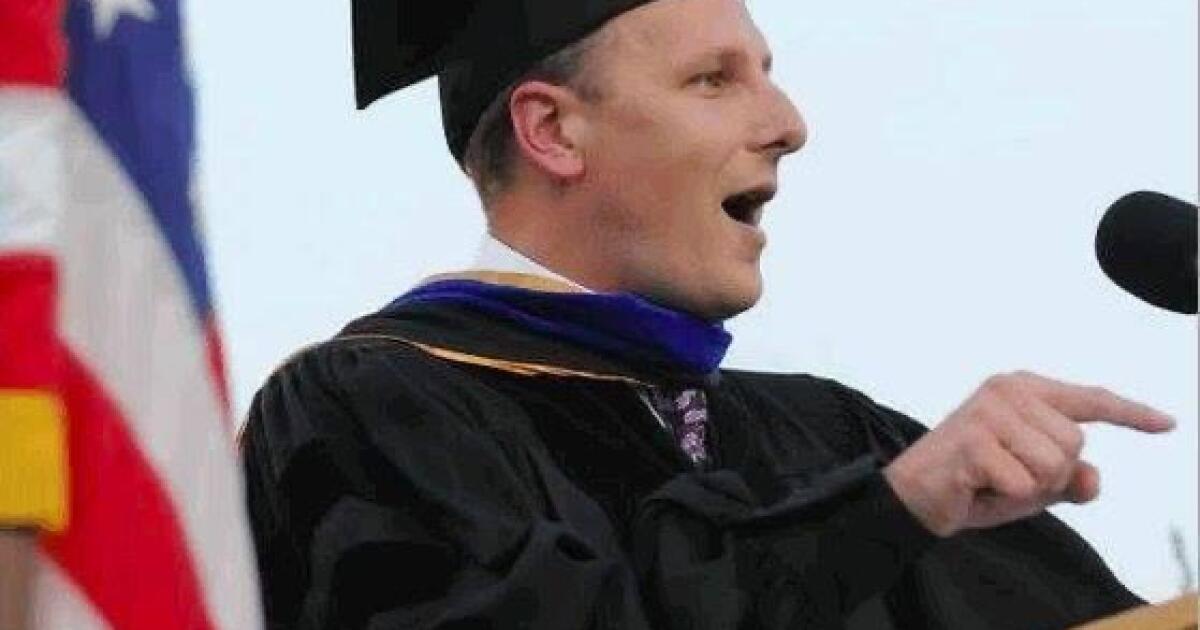
Scott Lay, an attorney by training, a fierce advocate for community colleges and the author of a must-read newsletter in the state Capitol, has died at 48.

His death prompted an outpouring of grief in Sacramento, from those who knew Lay as a lobbyist to subscribers of the Nooner, Lay’s daily email roundup of political news, legislative activity, job openings and policy, all laced with insider gossip and observations.

For the record:

1:44 p.m. Sept. 22, 2021An earlier version of this story identified Scott Lays’ father as Ron Lay. His name is Roy Lay.

“He was so committed to his community, whether that was his neighborhood, whether that was the community college world, whether it was a political party,” said Lisa Ortega, Lay’s sister. “He was always trying to build bridges and make the world better.”

Lay’s final newsletter was sent on Sept. 8; he was found dead at his Sacramento home on Sept. 13. The coroner has not determined a cause of death.

Born in Portland, Ore., Lay grew up in Placentia. His family frequently talked politics at the dinner table, and the extended family had lively political debates at gatherings.

Lay had severe asthma as a child, which led to frequent hospitalizations at the Children’s Hospital of Orange County. His health issues prevented him from graduating from high school, but Lay earned his GED at 17 and enrolled at Orange Coast College in Costa Mesa.

That’s where in 1991 Lay met Paul Mitchell, now a Democratic redistricting expert. They were in a speech class together; Lay would sometimes show up in scrubs after volunteer shifts at the children’s hospital. They cofounded a College Democrats chapter and served in student government and on the California Student Assn. of Community Colleges together.

“Getting into student government and getting into politics gave him a mission outside of himself,” Mitchell said, noting that when they first met, Lay volunteered escorting women into abortion clinics in the face of protesters. “Having that drive made him able to overcome a lot of his earlier health problems because he just had this focus and mission.”

Lay would go onto get a law degree from UC Davis, but his experience at Orange Coast was pivotal. He started working for the Community College League of California in 1995 and became its president and CEO in 2006.

“He was really passionate about the system and the access community colleges provided,” Mitchell said. “He saw in the system his story — a kid who doesn’t graduate high school growing up to become a CEO.”

Lay started working in Sacramento at a time of great turnover in the state Capitol because of term limits. Lay was among the new young lobbyists when he met Anthony York, then a cub reporter who now works in political communications, mostly for the California Medical Assn.

York and Lay became friends, and in 2004 the pair cofounded a daily email newsletter about politics called the Roundup, a precursor of the Nooner.

“Stuff like this was popping up in Washington. There was nothing like that in Sacramento,” York said. “Scott had the technical ability to make this stuff happen. He hand-coded it.”

(Lay also used his tech skills to create a legislative tracking and a campaign contribution database.)

The other blogs and emails at the time were largely simple aggregators of news stories; the Roundup and later the Nooner had personality, gossip, observations and quips. It was Politico before Politico. That’s why Lay’s loss was being mourned by many, said York, who worked for the Los Angeles Times from 2010 to 2014.

“Through his email, he had a very specific voice and type of coverage you normally don’t get. I think it really bred a familiarity with this kind of niche audience,” York said. “It’s written about insidery stuff for insidery types with a very personal tone and touch. I think it’s reflected in the reaction to the news of his death. You can sense a real void without that voice.”

Lay’s relationships crossed party lines. Another of his close friends going back to his college days is GOP strategist Mike Madrid, who was at Moorpark College at the time Lay was at Orange Coast.

“The band of us met and we differed a lot on policies, but we fell in love like brothers, and just kind of came up through the system together,” Madrid said.

Lay put on a sunny face on social media, posting about his latest haul from the farmers market and his trips to his favorite taco stand. But he also acknowledged struggles with alcoholism, and was in failing health in recent years.

His friends say that while he was publicly forging relations with so many people through his newsletter and on social media, he began isolating himself from his personal relationships.

“He was the first of our generation to go, and to go that way, and to have him slip through our fingers is just heartbreaking,” Madrid said. “He was extremely talented, not just on policy, not just on politics, but on both. And he loved being part of the Capitol community.”

In addition to Ortega, Lay is survived by his father, Roy Lay, and his mother, Linda James.

Lay and Mehta both served on the board of directors for the nonprofit Open California.

Source link

TikTok to close Nashville office, lay off 250 employees

TikTok said Wednesday it will close its Nashville office in October, laying off 250 workers.

The move is a retrenchment from the social video company’s expansion into Nashville in 2024 and comes as many tech companies are reevaluating their workforce amid the growth of artificial intelligence.

“We have decided to close our Nashville office to streamline our operations and better align our teams for long-term growth,” said TikTok USDS Joint Venture LLC, which oversees TikTok’s U.S. operations. “We remain fully committed to providing secure, safe and positive experiences for the 200 million Americans that create, discover and connect with what they love on TikTok.”

The decision was specific to the Nashville office to bring its teams closer together, according to a TikTok USDS Joint Venture spokesperson.

TikTok‘s U.S. operator notified the State of Tennessee Department of Labor and Workforce Development about the number of layoffs and the office closure on Wednesday. The WARN notice did not detail what roles were at the office, but some jobs were related to content moderation, according to Nashville Metro Councilmember Terry Vo.

“I’m disappointed for all the Nashvillians who are waking up to this reality,” Vo said.

TikTok did not respond to questions on what types of roles were at the Nashville office or whether artificial intelligence was a factor for the layoffs.

TikTok in 2024 signed a 143,610 square foot lease at the Moore Building in the Music Row area, having spent several million dollars to build out the space, according to the Tennessean. The lease also roughly tripled its office space in Nashville, the Tennessean reported.

The social media company has its U.S. headquarters in Culver City.

In 2024, Sen. Marsha Blackburn (R-Tenn.) expressed disapproval of the TikTok office opening in Nashville because at that time, TikTok’s parent company was Chinese tech giant ByteDance.

“When TikTok’s CEO was in Washington, I made it clear to him that Tennesseans are extremely concerned about China’s influence,” Blackburn said in a statement in 2024, adding there were concerns about how the company would handle U.S. user data and whether it would push for the Chinese government’s interests.

Since then, the U.S. government, TikTok and ByteDance came to an agreement last year to establish a separate entity called TikTok USDS Joint Venture overseeing TikTok’s operations and data protection in the U.S. that is majority American owned.

A spokesperson for Blackburn did not immediately return a request for comment on TikTok’s office closure in Nashville.

Rob Enderle, principal analyst at Oregon-based Enderle Group, said he expects more layoffs at other TikTok U.S. office locations due to the new ownership.

“When a new ownership takes over a company, they make adjustments to the staffing levels,” Enderle said.


Source link

Airport terminal lay abandoned for 18 years – now it’s an incredible £200m hotel

The TWA Hotel at New York’s JFK Airport is a luxury plane-themed hotel that was once a disused airport terminal – transformed into a stunning hotel after a $265million (£200m) renovation

A former airport terminal that sat abandoned for years has been transformed into a stunning aviation-themed luxury hotel — following a jaw-dropping $265million (approximately £200m) restoration to revive it to its former glory.

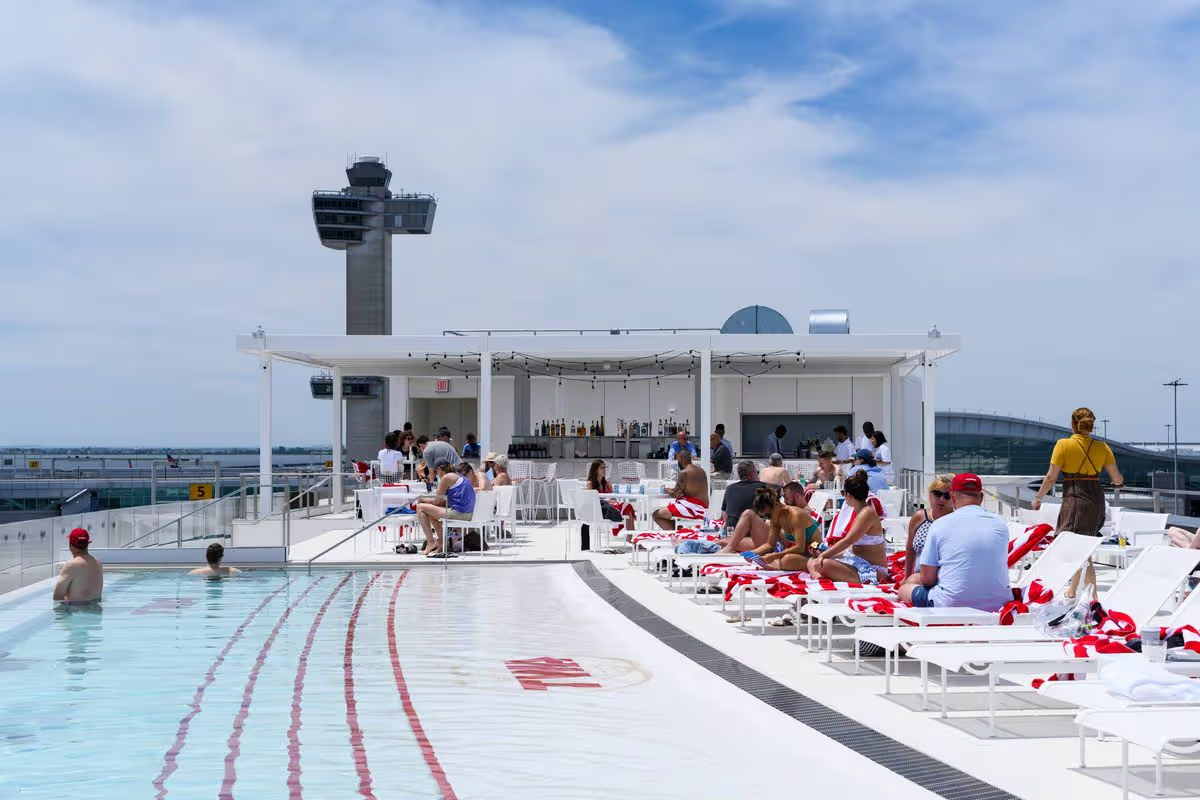
The TWA Hotel flung open its doors in 2019, boasting a rooftop infinity pool with breathtaking views over an active runway at New York’s JFK International Airport. Originally serving as a TWA flight terminal, the iconic building was designed by renowned architect Eero Saarinen before it closed its doors in 2001, only to be reborn 18 years later.

The hotel, which occupies the TWA Flight Center, now comprises two buildings at each end of the former terminal, offering 512 rooms for guests to choose from.

Designers painstakingly worked to recreate its appearance when it first opened back in 1962, hailed by the Landmarks Preservation Commission as “one of the great masterpieces of expressionistic modern design”.

Earlier this year, it was recognised as one of the top five best airport hotels on the planet at the prestigious Skytrax World Airport Awards.

The original terminal now serves as the lobby for the four-star hotel, which also features a round-the-clock 10,000 square feet gym — claiming the title of the world’s largest hotel gym — alongside a selection of restaurants.

One of the most striking highlights is a 1958 Lockheed Constellation aircraft that has been cleverly converted into a cocktail lounge, with an aviation history museum also housed within the hotel.

Time magazine previously featured it on their coveted list of “The World’s Greatest Places of 2019”, and one recent visitor was British travel YouTuber Hannah Ricketts.

She explained that she was keen to visit the hotel to get a taste of what the golden era of air travel felt like during the 1950s and 60s.

Upon reaching the lobby, she told her 489,000 subscribers that it was one of the “coolest entrances” she had ever seen.

Spotting a vintage Coca Cola machine, she remarked that it felt like stepping back in time, before adding that the place was far more impressive than she had anticipated.

She went on to reveal that she paid around $400 (approx £300) for a room with a deluxe runway view. Hannah confirmed this included taxes, with standard rooms starting at roughly $200.

Gazing out from her room, she exclaimed: “This looks so much better in person. I feel like the camera isn’t going to do it justice.”

She said it felt like being on the set of Mad Men, describing the building as “utterly stunning”, packed with period details that truly transported you back to the 1960s.

“I’ve never been anywhere like this in my life,” she added. “And it’s obviously pristine where it’s been refurbed. It’s almost surreal. Wow.”

The travel vlogger described the swimming pool as “insane”, though pointed out that it cost $25 (approx £19) to use, even as a guest.

She then savoured a Mile-High Margarita aboard the converted cocktail lounge plane, telling her audience: “Maybe you’re a Brit watching this and you’re going to come back from JFK, back to the UK, back to reality, back to work. If you want to plan this, it’s a really positive end to a trip.”

Her sole gripe was with the food, which she rated a 5/10, though she described the overall experience as immersive and one she would happily repeat.

Summing up her one-night stay, she said: “This is a four-star hotel, I would say this is literally better than quite a lot of the five-star hotels we’ve been looking at.”

Source link