High winds propelled the blaze across the army base in Wainwright, killing four soldiers and injuring dozens more.
Published On 23 Oct 202623 Oct 2026
A fire that killed four soldiers at a western Canadian military base was sparked by an exercise using live grenades, a military official said.
The deadly fire broke out on a grenade launcher range during military exercises on Saturday, with high winds propelling it across the base, Brigadier-General Vanessa Hanrahan, commander of the Canadian Forces Military Police Group, told reporters on Thursday.
“A subsequent change in wind direction and velocity significantly increased the fire’s intensity,” she added, with the flames spreading to a training area at the Wainwright military base in Alberta.
Due to the blaze being in the “permanent danger area” of the range, firefighters were unable to directly combat it, Hanrahan added.
The fire spread on Saturday afternoon during high-intensity combat training involving Charlie Company of the 3rd Battalion, Princess Patricia’s Canadian Light Infantry.
The military base lies in the prairies, a landscape of wide, open grasslands, rolling plains and scattered groves of trees.
About 84 soldiers were split between a grenade range and an area where they practised attacks on simulated enemy positions. The fire swept into the second training area.
Four soldiers died and 39 were injured, with 27 requiring hospitalisation. The incident was one of the worst peacetime tragedies for Canada’s military.
The soldiers and reserve members were participating in exercises ahead of a planned deployment to Latvia, where Canadian forces have their largest international military operation.
The Wainwright base is one of the largest bases operated by the Canadian Armed Forces. It regularly hosts training exercises involving military personnel from NATO countries.
During the final months of World War II and for several months in 1946, the base was used as an internment centre for German prisoners of war.
PADDLING kayaks through the serene 8,000-year-old bog, we’re about to enter the “second maze”, according to our guide Elina.
Locals call it this because the small islands of shrubs, moss and reeds we’re navigating are constantly shifting above the mineral-rich water, making the route through ever-changing.
The cobbled streets and colourful art nouveau buildings of Latvia’s capital, RigaCredit: Shutterstock / Altug GalipYou’ll find lush landscapes at Kemeri National ParkCredit: Alamy Stock Photo
If you want a moment to really pause, Latvia’s the place.
Over half of the country, which is a quarter of the UK’s size, is covered in forest, and with a population of fewer than 2 million, it’s not hard to find a stunning spot all to yourself – even in the height of summer.
Sign up for the Travel newsletter
Thank you!
We return to the shore to find Elina’s mother-in-law cooking up a feast on a portable stove.
Slices of ham and bread are served alongside a huge flask of coffee, helpings of traditional grey pea and bacon broth, and piles of fresh pancakes, both savoury potato and apple, which are demolished by my kids Poppy, seven, and Raffy, five.
It’s a brunch made from simple ingredients, but it is utterly delicious, especially when devoured in the vivid green landscape of Kemeri National Park.
Kayaking tours cost from £21.50 per person (Boardsyou.lv).
Ravishing Riga
Suite digs at Hotel Grand Poet By SemarahCredit: Supplied
The starting point for our trip is the cobbled streets and colourful art nouveau buildings of Latvia’s capital.
Riga sits little more than half an hour from the white sandy beaches of the Baltic coast (with a sea warmer than Cornwall’s come summer, FYI) and an abundance of nature, like those ancient bogs.
We arrive during celebrations for the city’s 825th anniversary and to streets alive with brass bands and artistic performances.
Even at its busiest, though, Riga still feels gloriously uncrowded, despite striking architecture and sculptures at every turn – the black felines perched on the turrets of Cat House and the Bremmen Town Musicians Statue of four animals balancing upon each other (said to bring luck if you rub their noses) our favourites.
Hotel Grand Poet By Semarah, with its flamboyant interiors, lies opposite pretty Bastejkalna Park, just a short stroll from the beautifully kept Old Town.
Its spa – where kids are welcome throughout the day – is home to a swimming pool, whirlpool, steam room and two saunas, and we even spot TV chef Prue Leith at the breakfast buffet one morning.
The black felines perched on the turrets of Cat House are said to bring luck if you rub their noseCredit: Alamy Stock Photo
One of Riga’s most popular weekend spots, Mežaparks, is set on alluring Lake Kišezers, where pedalos, rowing boats and SUPs are for hire, and swimming from its sandy shore is a breeze.
Cabo, with its hammocks and swinging seats, is an idyllic spot for sipping a rhubarb spritz, £7.70, while the kids splash about, and we hire a four-seater pedal kart to whizz around the forest trails, £17 per hour (Cabo.lv).
It would be easy to while away a whole day shoreside, but with Riga Zoo also here, we soon find ourselves giggling at the swaggering chief gelada (similar to a baboon), then wide-eyed at the glow-in-the-dark scorpions in the tropical house.
Another morning well spent is at Marupe Wake Park – its inflatable water obstacle course is one of Europe’s largest, with slides, swings, zip wires and climbing challenges.
As we hop across a giant panda and unicorn, the kids’ confidence grows with each leap, before we all revive ourselves in the sauna overlooking the lake, chuckling about our most spectacular splash landings.
Later, among vibrant Mediterranean-inspired wall murals, we find a meal worthy of any great city.
We’re at Italissimo, where the little ones tuck into proper lasagne, £4, and pasta in butter broth with parmesan, £3, glugging down home-made berry lemonades, £3.70, while I dig into sublime truffled burrata with parma ham and wine-poached pear, £13.50, and tiger prawn ravioli with asparagus and a creamy bisque sauce, £14.50.
Cocktails, such as the Malfy Sour – a limoncello and citrus gin blend, £9 – are also excellent.
We soon clock children disappearing downstairs and discover a pastel playroom with a giant ball pit and interactive games screen, much to the kids’ glee (Facebook.com/restaurant.italissimo).
Going medieval
Turaida Castle towers over Gauja National ParkCredit: Alamy Stock Photo
Restaurant Rozengrals, meanwhile, is a celebration of Riga’s medieval roots.
One lunchtime, we descend the steep steps and follow torch-lit tunnels to an underground dining hall for a huge platter of oven-baked duck with cherry-onion jam on a bed of pulses, £25, and pastry parcels stuffed with spinach and cheese, £7.20.
Sea buckthorn with honey, £4, is quickly declared a hit by all and we finish off by sharing Countess Amelia’s Caprice – tiny iced cakes encased in filo pastry, made from another 15th-century recipe, £6 (Rozengrals.lv).
Nearby, we discover GunsnLasers, an entertainment arcade tucked away in Galerija Centrs shopping centre, where e-karting proves to be a blast for kids and we all tear around the interactive Pixels Room, trying to avoid stepping on the ever-moving red squares of a giant light-up grid.
Donning VR headsets for family challenges is also a lot of fun for everyone.
Expect al dente deliciousness at ItalissimoCredit: Italissimo Restaurant/Instagram
Still, we’re here to explore Latvia’s stunning landscapes, and an hour’s drive from Riga is Gauja National Park, the home of Turaida Castle – a reconstructed medieval fortress in lush grounds dotted with sculptures.
The kids love spotting ancient weapons and climbing the main tower with its views of the Gauja river.
Later, after venison stew with figs, £17.50, at quaint Kungu Riga (Kungurija.lv), we check out adventure park Tarzans.
Here, alongside the thrills of high-rope obstacle courses, tubing and bungee trampolining, there are activities such as a downhill hamster wheel, giant catapult and a toboggan track that hurtles us through the trees.
Packages cost £26 per child, £30 per adult (Tarzans.lv).
It all makes for a cracking afternoon – just as Latvia makes for a cracking summer adventure.
Latvia is not expected to shift its pro-Europe and pro-Ukraine trajectory, but coalition negotiations could be complex.
Published On 3 Oct 20263 Oct 2026
Polls have opened in Latvia for an election taking place against the backdrop of perceived security threats from Russia and a nationwide cost-of-living squeeze.
Saturday’s vote is the first electoral test for Prime Minister Andris Kulbergs after coming to power in May this year when his predecessor resigned due to a backlash from stray drone incursions from Ukraine.
Recommended Stories
list of 3 itemsend of list
Kulbergs, whose right-wing United List party is currently polling at about 20 percent, is expected to hold onto his position, but the decline of two allies in his current coalition means he is set for a complicated negotiation over the makeup of any future government.
Polls opened at 05:00 GMT and will close at 17:00 GMT. The results are not expected to change Latvia’s pro-European and pro-Ukrainian course.
A woman holds an election campaign leaflet of the Latvia First party with a picture of the party’s leader, Ainars Slesers, before the general election [File: Ints Kalnins/Reuters]
About 1.5 million people are eligible to vote in the country’s 11th parliamentary election since independence from the Soviet Union in 1991.
Latvian politics are highly fragmented, with parties rarely seeing above 20 percent vote share and coalitions being the norm.
This year, 14 electoral lists are contesting the election, but polls indicate only seven are likely to enter parliament, with the rest expected to fail to meet the minimum 5 percent vote threshold.
Rising living costs, low wages, strains on the healthcare system and long-term population decline have all featured prominently in campaign debates.
Fragmented political parties
Most parties in Latvia are pro-Ukraine; however, the populist Sovereign Power party – which says it wants Ukraine to win but argues money spent supporting Kyiv would be better spent at home – looks likely to become the country’s second-biggest party, with more than 9 percent of the vote. Most other parties have ruled out forming a coalition with Sovereign Power.
Latvia First, a pro-Ukraine and populist nationalist party currently polling at about 9 percent, could be a potential coalition partner for PM Kulbergs.
The Progressives, a pro-European social democratic party, are polling at 6 percent.
Ethnic Russians make up roughly one in four Latvian citizens, but their vote, which has traditionally been cast along identity-based lines, looks set to be made according to economic and social issues.
Latvia is the poorest of the Baltic states, and it has sharply increased its defence spending since Russia invaded Ukraine, now allocating nearly 5 percent of its gross domestic product (GDP) to defence.
NATO member Latvia is moving toward acquiring Anduril Industries’ Barracuda family of long-range strike missiles, with Latvian President Edgars Rinkēvičs highlighting the effort during a visit to the U.S. defense technology company and a series of new defense-industry cooperation agreements involving Latvia. If the acquisition goes through, Latvia would be the first of the Baltic states to field a strike weapon in this category.
“It was great to visit Anduril to meet with Palmer Luckey and to witness signing of memoranda of cooperation with MOD of Latvia and Origin Robotics,” Rinkēvičs said in a post on X. “Looking forward to complete acquisition of Barracuda long-range missiles and [Latvian-U.S.] defense industry cooperation.”
The statement does not specify the precise Barracuda variant involved, the number of missiles Latvia intends to acquire, the expected delivery schedule, or the value of the prospective purchase. We have reached out to Anduril for more details.
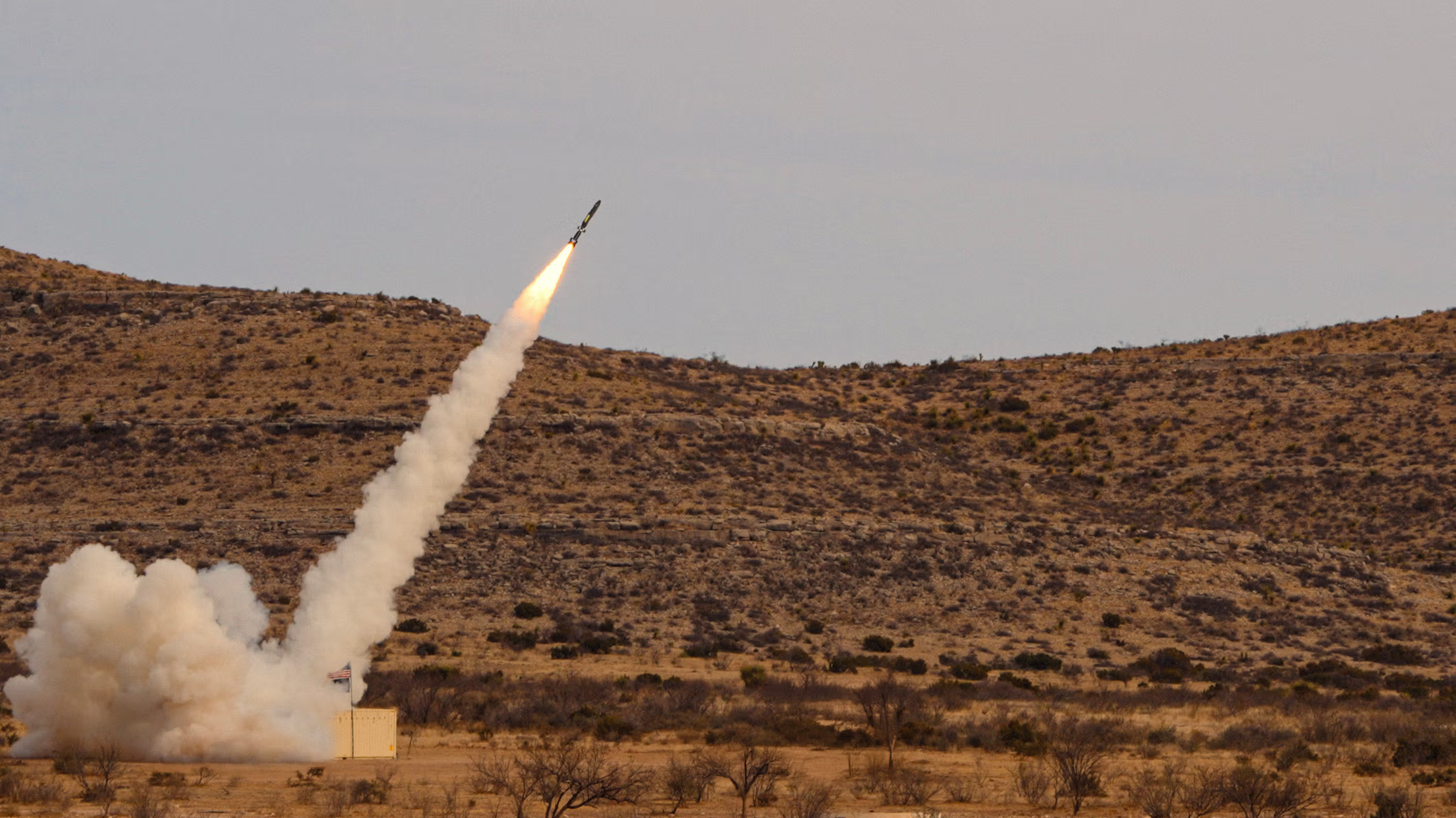
A likely candidate weapon is the Barracuda-500M, one member of Anduril’s family of autonomous, jet-powered cruise missiles, alongside the Barracuda-100M and -250M variants. Official descriptions put its range at more than 500 nautical miles, with a stated speed range of approximately 190 to 500 knots. The missile can be air-launched, for which it has received the official U.S. military designation AGM-189A. But with only a handful of utility biplanes and helicopters in its inventory, Latvia would acquire the surface-launched version, designated SLB-500M.
Introducing: Barracuda-M Family of Cruise Missiles
The announcement points to a potentially significant expansion of Latvia’s precision-strike capabilities as NATO’s eastern flank continues to build out longer-range conventional fires.
Latvia has already ordered the U.S.-made Army Tactical Missile System, or ATACMS, which will be fired from M142 HIMARS launchers. The system is expected to enter Latvian service in 2027 and has a maximum range of about 186 miles.
A U.S. Army M142 HIMARS launcher involved in an exercise at at Spilve Airfield and Liepāja Airport in Latvia. Latvian Armed Forces Eriks Kukutis
Latvia’s ATACMS capability will give the country a foundation for ground-launched precision fires, but the broader European trend is toward significantly greater reach.
Ground- and sea-launched cruise and ballistic missile systems capable of hitting targets at between 1,000 and 2,000 kilometers (620 and 1,242 miles) or more are an emerging target for several European NATO members. France, Germany, Poland, Italy, Sweden and the United Kingdom are pursuing combinations of indigenous development and foreign procurement to address this requirement.
Latvia’s neighbor Poland, for example, has been building a layered long-range strike architecture combining JASSM/JASSM-ER air-launched cruise missiles with HIMARS and ATACMS. Warsaw’s ambitions are extending toward ground-launched weapons with ranges potentially reaching 3,000 kilometers (1,864 miles) and the country has previously expressed openness to hosting U.S.-owned nuclear weapons on its territory, too.
A M142 HIMARS launcher is seen during Poland’s Armed Forces Day parade in 2025. Photo by Artur Widak/NurPhoto/Getty Artur Widak
Latvian interest in Barracuda fits into the same larger transformation in European conventional strike capabilities.
For NATO’s Baltic members, the logic is particularly straightforward, with mobile, ground-launched weapons providing an additional means of striking military targets at depth without requiring control of the air over the launch area.
Dragon’s teeth obstacles are among the anti-mobility measures on Latvia’s eastern border with Russia. Latvian Armed Forces
The potential Barracuda acquisition would represent another step in a broader European shift toward deep precision strike, a term increasingly used to describe conventional weapons capable of holding targets hundreds or thousands of miles away at risk.
Deep precision strike is widely acknowledged as an increasingly important European capability gap. European NATO members have historically relied heavily on air-launched cruise missiles and other aircraft-delivered weapons, while ground-launched long-range systems have been comparatively scarce.
The deterioration of the European security environment following Russia’s full-scale invasion of Ukraine, together with the 2019 collapse of the Intermediate-Range Nuclear Forces Treaty, are important factors behind renewed European interest in long-range conventional strike.
A key driver behind Europe’s push for longer-range conventional strike is the desire to build a credible deterrent capable of holding targets deep inside Russia at risk, potentially including Moscow. Ukraine’s long-range strike campaign has demonstrated the strategic value of being able to impose costs at significant distances, while also underscoring the importance of having sufficient stocks of precision weapons. For NATO’s eastern flank, systems such as the ground-launched Barracuda could therefore provide not just another fires capability, but an additional means of imposing costs on an adversary without relying exclusively on airpower.
Importantly for Latvia, the emerging European approach is not limited to large air forces. NATO’s prospective deep-strike requirements are likely to place significant emphasis on mobile ground-launched systems because they can be dispersed and offer survivability advantages while avoiding the cost and vulnerability associated with relying exclusively on aircraft or ships as launch platforms.
An Anduril Barracuda 500, top, and a Barracuda 100, displayed during Modern Day Marine 2026 in Washington, D.C. U.S. Marine Corps photo by Cpl. Abigail Hutcheson Cpl. Abigail Hutcheson
That makes systems such as the surface-launched Barracuda particularly relevant to countries on NATO’s eastern flank.
Anduril has positioned Barracuda as part of an effort to address what it describes as a shortfall in affordable, producible long-range precision weapons. A prototype surface-launched Barracuda-500 successfully demonstrated its launcher, missile, and booster concept in testing in 2025. Anduril has emphasized that the family is intended to be more producible and affordable than many existing “exquisite” long-range weapons.
European governments are increasingly wrestling with the same issue. However, there is a fundamental tension between rapidly filling capability gaps through off-the-shelf purchases and developing indigenous European weapons that can strengthen the continent’s defense-industrial base, which is also a critical political consideration.
Latvia’s emerging relationship with Anduril appears to combine elements of both approaches, by acquiring an American-developed strike capability while simultaneously pursuing industrial cooperation with U.S. defense companies.
Ground launch of Anduril’s Barracuda-500M. Anduril
There is also a recent European precedent for combining Barracuda procurement with local industrial participation.
In July 2026, Anduril signed a strategic agreement with Polish national maintenance, repair and overhaul provider Wojskowe Zakłady Lotnicze Nr 2 (WZL-2) to establish production of the Barracuda-500M at WZL-2 facilities in Bydgoszcz, Poland. Polish state-owned defence group Polska Grupa Zbrojeniowa said Poland was the first European country to sign such an agreement with Anduril.
Bezpieczeństwo zaczyna się od silnych sojuszy.
💥🖊️ Dziś została podpisana umowa o współpracy @PGZ_pl i WZL-2 z firmą Anduril Industries, która umożliwi utworzenie w Polsce miejsc montażu i produkcji autonomicznych rakietowych pocisków manewrujących dalekiego zasięgu… pic.twitter.com/JnmM6lQZ7L
— Ministerstwo Aktywów Państwowych 🇵🇱 (@MAPGOVPL) July 6, 2026
Polish officials have also emphasized the missile’s intended low production cost relative to higher-end U.S. cruise missiles. The planned Polish program is expected to progressively increase Polish content and eventually incorporate broader European elements, including software solutions from Anduril.
Latvia has not publicly detailed whether any Barracuda-related production, assembly, or other industrial work would be conducted in the country.
However, Latvia’s Investment and Development Agency says the country’s defense-technology delegation in the United States is seeking opportunities involving joint development, testing, manufacturing, system integration and supply chains. Origin Robotics is among the Latvian companies participating in that effort.
The broader Latvian delegation includes companies working across unmanned and counter-unmanned systems, communications, electronics, sensors, software, artificial intelligence, cybersecurity, and manufacturing.
A Latvian Army soldier shows drone video footage to U.S. Marines during a HIMARS live-fire exercise at Adazi Training Area, Latvia. U.S. Marine Corps photo by Cpl. Niles Lee Sgt. Niles Lee
Exactly how Latvia intends to employ Barracuda, how many missiles it plans to acquire, and whether any portion of the system will eventually be produced or integrated in Latvia remain unclear from the president’s announcement.
For now, the development marks another indication that long-range precision fires are moving from a capability concentrated among Europe’s largest military powers toward a broader requirement across NATO’s highly strategic eastern flank.