Xavier Becerra makes history as California’s first elected Latino governor
Xavier Becerra, who grew up in a 685-square-foot house with his parents and three sisters in working-class Sacramento before ascending to Stanford University, Congress and the White House Cabinet, will become California’s first directly elected Latino governor.
The historic victory thrusts the unassuming Democrat into the forefront of California’s scathing fight with the Trump administration over immigration enforcement, healthcare funding, environmental protections and social issues.
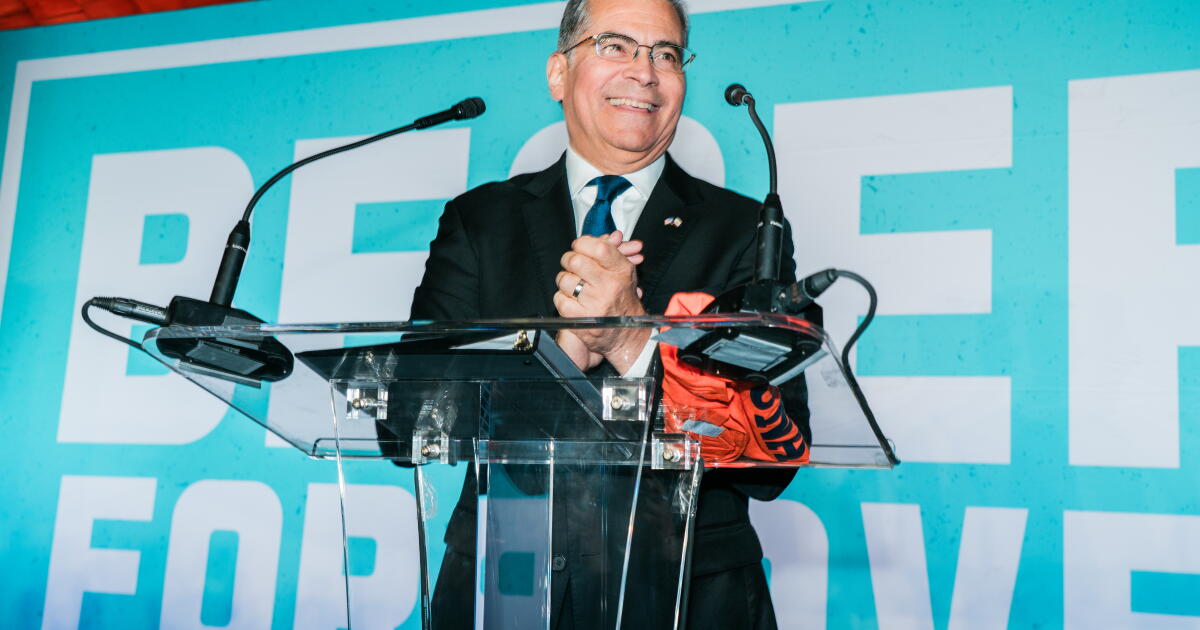
“I didn’t run to make history,” Becerra told supporters at his election night party in West Sacramento. “I ran to make a difference for anyone and everyone who calls California home — whether you voted for me or not.”
He paid tribute to his parents and late labor icon Dolores Huerta before stating his “straightforward” mission: “Deliver a California we can afford and defend a California we can’t afford to lose.”
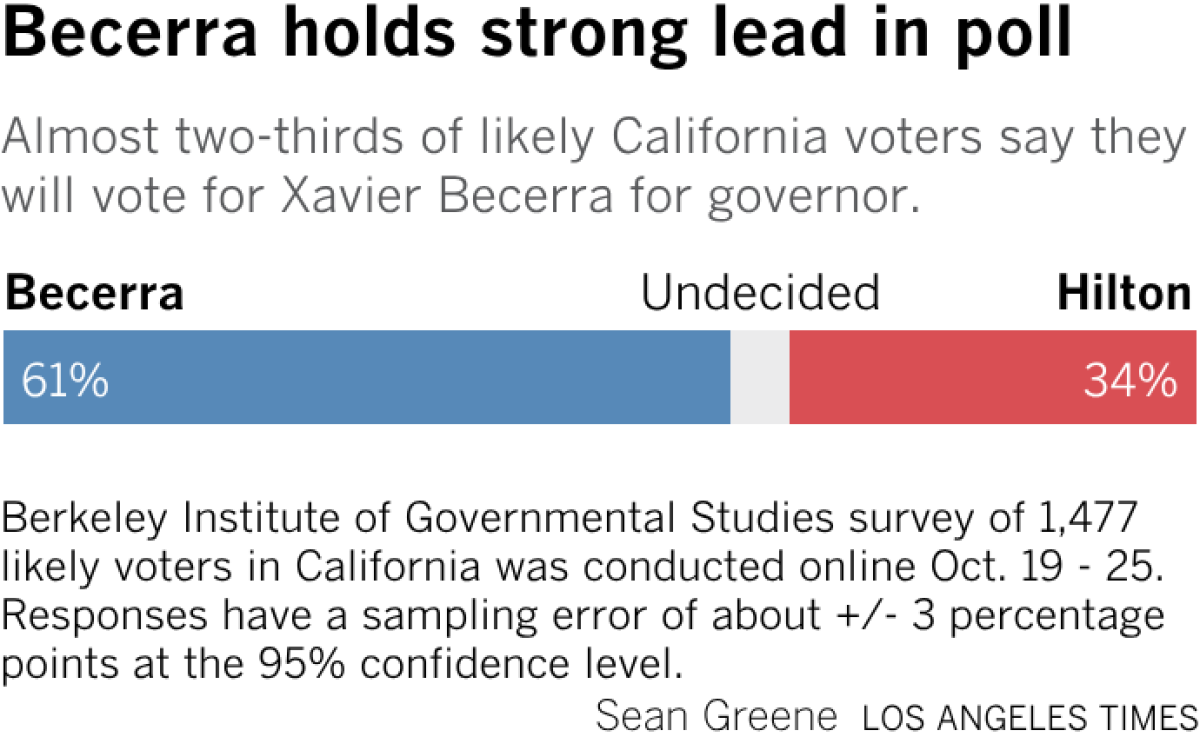
The Associated Press declared Becerra the winner at 8 p.m. Tuesday. He beat Republican Steve Hilton, a conservative commentator and former British political strategist backed by President Trump. Hilton conceded defeat a little before 9:15 p.m.
“We have a new governor of California,” he told about 800 supporters at his election night party in Garden Grove. “I know it’s not the one you wished for but I do wish Xavier Becerra well.”
Though the mood at his event was mostly one of defeat, Hilton stirred the crowd with a promise to help Republicans break the Democratic supermajority in the state Legislature in 2028.
“We love California and we’re going to fight for California,” he said. “The fight goes on. We have a plan.”
Becerra, 68, will take the helm with a slate of potential economic opportunity: luring back Hollywood production, drawing international visitors to the 2028 Olympic Games and responsibly growing the artificial intelligence industry.
But there are also a long list of challenges: grappling with worst-in-the-nation unemployment, solving the housing crisis, and preparing for and responding to seemingly endless natural disasters.
Becerra spent more than 25 years in Congress before he was appointed California attorney general and, later, secretary of Health and Human Services in the Biden administration. His long resume, as he often argued during the campaign, positions him to enter the governor’s office without “training wheels.”
“It’s groundbreaking,” Anna Sampaio, a professor of ethnic studies and political science at Santa Clara University, said of Becerra’s win. “It’s particularly important in this moment when Latinos are under siege, when they’re targeted by the federal government, and you have a Latino not only being elected, but a Latino who is consistently delivering this message that he is going to stand in opposition to a Trump agenda.”
Despite his long-standing presence in California politics, the modest Becerra initially struggled to energize support for his gubernatorial campaign. When explosive sexual assault allegations pushed a front-running Democrat out of the race, Becerra, a staid and experienced candidate with a clean reputation, leaped to the top of the crowded field and finished first in the top-two June primary.
The state has had one Latino governor, Romualdo Pacheco, who assumed office in 1875 when Gov. Newton Booth stepped down after winning a U.S. Senate seat.
Becoming the first Latino directly elected to California’s highest office is a distinction Becerra was reluctant to promote on the campaign trail, preferring instead to focus on his humble roots. His father, born in Sacramento and raised in Mexico, labored on farms and construction sites; his Mexico-born mother was a clerical worker.
The largest ethnic group in California, Latinos make up more than 40% of the state’s population and roughly a third of its voters.
Though noteworthy, polling suggests Latino voters care more about results than his history-making win.
“We’re moving from an era that has defined Xavier Becerra’s career as focused almost entirely on representation to one where the voters are demanding results far more,” said Mike Madrid, a Republican strategist who studies Latino voters. “When the housing situation for Latinos is getting worse, when affordability is getting worse, when school performance measures are not getting better, what difference does it make who’s holding office when we should be focused on results?”
Though he offered few specifics, Becerra discussed his priorities throughout the campaign. He plans to declare a housing emergency and speed up construction.
He will take Gov. Gavin Newsom’s baton on the thorny question of who should pay when megafires burn. And he wants to ensure there are no disruptions to Medi-Cal coverage, even for undocumented workers — a herculean task with as much as $30 billion in federal cuts looming.
“Hopefully he uses an overwhelming victory to achieve what he wants to get done in 100 days,” said Steven Maviglio, who served as a spokesman for former Gov. Gray Davis. “That’s when you’re most powerful: when you assume office with an agenda, so hopefully he’ll detail that within days of being elected.”
Becerra’s victory ushers in a new era of Latino political power in California. For the first time, all members of the “big three” who negotiate the state’s behemoth budget — the governor, Assembly speaker and state Senate president — come from working-class, immigrant backgrounds.
“When you’ve watched your parents and grandparents struggle to make ends meet, you bring a different perspective,” said Assembly Speaker Robert Rivas (D-Hollister). “If we do this right, history won’t remember us simply because we were the first. History is going to remember us because we made a difference. We want California to work for everybody.”
Times staff writer Andrew Campa contributed to this report.