last-minute guide

2026 California general election: Last-minute guide to in-person voting

Voter ballots were mailed to all registered California voters starting Oct. 5. But if you prefer to vote in person, here’s what you need to know about casting your ballot ahead of and on election day, Nov. 3.

How can I vote in person now?

The first vote centers opened for early in-person voting on Oct. 24 but only in Voter’s Choice Act counties. L.A. County is among the 30 VCA counties where you can vote in person early.

But in-person early voting expands significantly Saturday, with locations open across the state.

To find your polling location, you can visit your county elections official’s website or the secretary of state’s website here.

Now through Nov. 2, in-person voting centers are open from 10 a.m. to 7 p.m., according to the office of the Los Angeles County registrar-recorder/county clerk.

I like to vote in person on election day. Where do I go?

You can find your polling place here or by calling (800) 345-8683 — both provide information from the California secretary of state’s office.

You also can use the Los Angeles County registrar-recorder/county clerk website here to find polling locations within the county.

All polling locations are open on election day, Nov. 3, from 7 a.m. to 8 p.m.

How do I make sure my ballot was counted?

Once cast, your ballot can be tracked here.

Where do I track election results?

The Los Angeles Times will be covering election night.

County elections officials begin reporting results at 8 p.m. and update throughout the night and in the days and weeks that follow.

More election news

Source link

Your last-minute guide to Proposition 44: Health center spending

There are about 2,000 safety-net clinics in California that deliver primary care to underserved populations. Proposition 44 would set limits on how these federally qualified health centers spend their money.

The basics

Proposition 44 asks voters to require federally funded community health centers to spend at least 90% of their total annual revenue on “program services advancing their charitable purpose.”

The impact

If the proposition passes, the state attorney general will be responsible for determining what services fall into that category. If spending on administrative or non-healthcare functions exceeded 10% of total revenue, a clinic would have to pay a penalty equal to the amount it overspent.

Dig deeper

Proposition 44 was backed by the Service Employees International Union-United Healthcare Workers West, the same union that is pushing Proposition 40, the controversial billionaire tax. The union appears to be the main supporter of the proposal and says the restrictions would prevent excessive spending on executive salaries, fundraisers and other administrative expenses.

There is a diverse array of opponents, including the California Medical Assn., the California Teachers Assn., the Planned Parenthood Affiliates of California, the state Democratic Party and the state Chamber of Commerce. They say the proposition’s vague wording could result in vital services being excluded from the list of program expenses permitted. A study commissioned by the California Primary Care Assn. found that clinics could face up to $1.7 billion in collective penalties in the first year of the measure’s implementation.

More reading

What to know about Prop. 44 (L.A. Times)

An analysis of Prop. 44 (California Legislative Analyst’s Office)

More on the measure, spending (CalMatters)

Union involved in Prop. 44 faces questions (L.A. Times)

Source link

California Prop. 38 last-minute guide: Immunology, immunotherapy research funding

The Trump administration has frozen, terminated or delayed billions in congressionally approved research grants since last year. Proposition 38 aims to backfill some of that loss by creating a stable source of money to fund immunology and immunotherapy research.

The basics

Proposition 38 would authorize the state to issue $8.4 billion in bonds to fund immunology and immunotherapy research to uncover treatments that help the immune system fight diseases such as cancer and Alzheimer’s disease more efficiently.

The impact

The measure would require at least $4.2 billion of the funds to be used for immunology research on cancer, heart disease and Alzheimer’s. It also would authorize the state to enter a partnership with an immunology and immunotherapy research institute selected by the California Department of Public Health and allocate half of the bond revenue to it. The remaining funds would be used for competitive grants that focus solely on immunology and immunotherapy research.

Californians would take on an increased cost of $500 million to $600 million annually to repay the bond for about 20 years, according to the Legislative Analyst’s Office.

The Yes on 38 campaign says the proposition pays for itself: 10% of all proceeds from the licensing of immunotherapies must be returned to the state to offset the total cost of the bond measure, including interest.

However, it’s difficult to predict whether any research projects will lead to marketable treatments.

Dig deeper

Proposition 38 is backed by organizations including the Michael J. Fox Foundation for Parkinson’s Research and the ALS Assn., as well as a majority of local chapters of Democratic organizations across the state. Supporters say the proposed funding could give those afflicted with chronic illness hope and potentially more options for treatment.

Its opponents have said the proposed criteria for awarding the grant funding would appear to create an extremely small pool of qualified recipients. Only the California Institute for Immunology and Immunotherapy, co-founded by billionaire Gary K. Michelson, would qualify under the proposed criteria, according to No on 38, the campaign against the proposition.

Robin Swanson, spokesperson for the Yes on 38 campaign, said “lots of institutions would qualify for funds under this measure.”

But she said at a virtual news conference in mid-September that it was “very likely” that the California Institute for Immunology and Immunotherapy “will qualify for half of the funds under the current criteria.”

Ultimately, Swanson said, the decision lies with the California Department of Public Health.

More reading

Your guide to Proposition 38: Immunology and immunotherapy research funding (L.A. Times)

An analysis of Prop. 38 (California Legislative Analyst’s Office)

This CA proposition will send $4 billion to a single nonprofit. Who’s behind it? (Cal Matters)

This institute could get $4 billion from a ballot measure. With just three workers, is it ready? (Cal Matters)

Source link

California Propositions 40, 41, 42 last-minute guide: The billionaire battle

The so-called billionaire tax has become one of the most contested California propositions in years, generating national interest and massive spending by opponents. It also has spawned two rival ballot measures.

Here’s a cheat sheet for sorting it all out.

Proposition 40

The basics

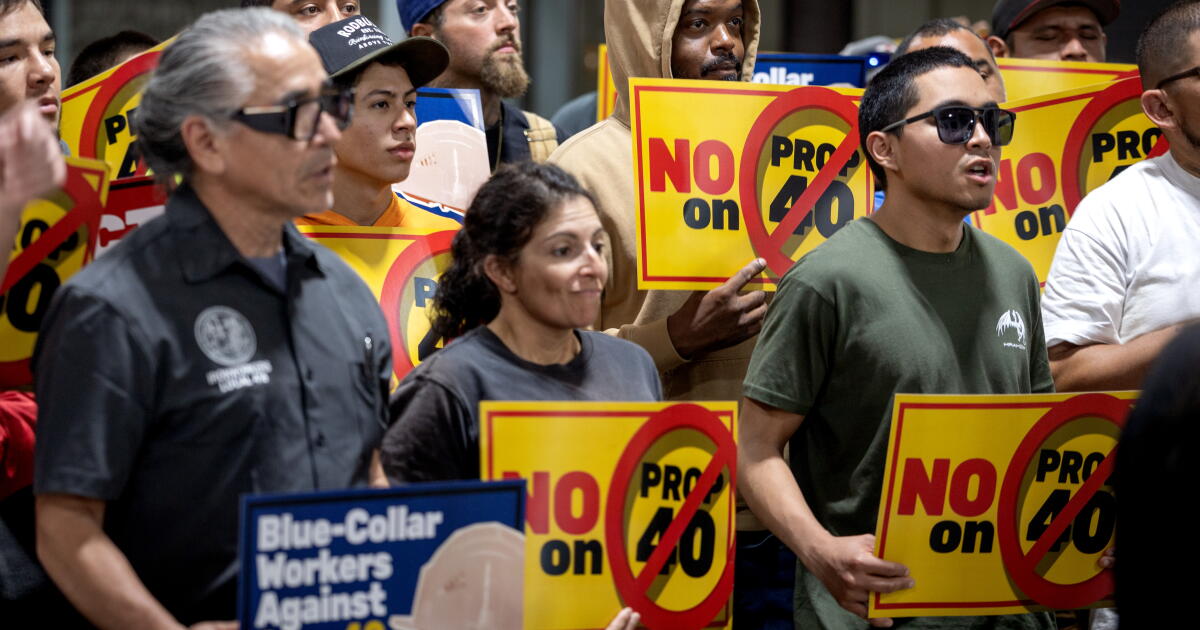
Proposition 40 would impose a one-time 5% tax on California billionaires’ assets. The tax applies to people with a net worth of at least $1 billion who resided in California on Jan. 1.

Impact

Ninety percent of the tax would fund healthcare, and 10% would go toward education and food assistance.

The tax would affect hundreds of billionaires whose net worth includes assets such as their businesses, stocks and other investments. Real property, pensions and retirement accounts generally would be excluded.

Proposition 41

It’s called the Improving Transparency, Effectiveness and Efficiency in California Government Act. But it is deeply connected to Proposition 40 and is funded by foes of the billionaire tax.

The basics

Proposition 41 requires the state auditor to review programs funded by proposed special taxes before they appear on the ballot. More importantly, it also prohibits new state taxes from being exempted from a voter-approved state spending limit.

Impact

The Legislative Analyst’s Office says passage of Proposition 41 could prevent Proposition 40, the proposed billionaire tax, from becoming law even if voters approve it. This could happen if Proposition 41 receives more “yes” votes than Proposition 40.

Proposition 42

Proposition 42 would limit the state’s ability to impose certain new taxes. But it’s more complicated and far-reaching than that description might sound. And, yes, it’s also backed by opponents of Proposition 40.

The basics

Proposition 42 would prohibit new taxes on “retirement holdings, individually owned assets, and other forms of personal savings” that take effect after Jan. 1, 2026. It also would bar retroactive taxes on past earnings unless the state is using revenue from the tax to respond to emergencies such as a fire or a flood.

Impact

The Legislative Analyst’s Office says Proposition 42 could nullify Proposition 40 because the two measures conflict with each other. If voters approve both, the one with the most “yes” votes generally would become law, the office says.

Dig deeper

The billionaire tax was pushed by the Service Employees International Union-United Healthcare Workers West and has some labor and progressive support, including from Sen. Bernie Sanders (I-Vt.) and the state Democratic Party. They say the tax is needed to help the less fortunate and that the super-rich can afford it. But key Democrats and some key unions are not supporting it.

Critics include some of California’s richest people, and they are spending a fortune to defeat it. They say it will hurt innovation and drive the wealthy out of the state, hurting the treasury.

More reading

A powerful union and the birth of the billionaire tax (L.A. Times)

Why unions are divided over Prop. 40 (L.A. Times)

The Google co-founder fighting the billionaire tax (L.A. Times)

Inside the massive spending to defeat Prop. 40 (L.A. Times)

How the billionaire tax could spark national movement (The New Yorker)

The academics behind Prop. 40 (Sacramento Bee)

Will Prop. 40 reallly bring an exodus? (L.A. Times)

Why healthcare is divided by Prop. 40 (Bloomberg)

Taxing the “ultrarich,” a guide (New York Times)

Source link

California Proposition 5 last-minute guide: Recall election changes

Two California governors faced recall in the last 30 years.

In 2021, Gavin Newsom survived an effort to recall him amid the COVID-19 pandemic. But in 2003, Gray Davis was ousted from office and replaced by Arnold Schwarzenegger.

Now, voters will consider significant changes to recall rules for elected state officials.

The basics

Under current law, when an elected official is recalled in California, the election for their replacement occurs at the same time. Proposition 5 breaks up that process into two parts, prioritizing the voters’ right to oust an official before selecting a replacement.

The impact

This ballot measure would amend the state constitution to change the current recall system. Under the proposed changes, voters would first be asked to choose whether or not to oust an official. Then, in the event of a recall, the official would be replaced by appointment, succession or special election at a later date. In the case of a special election, the former officeholder could run again.

The measure also would designate California’s lieutenant governor as the de facto replacement for a recalled governor until the next term.

Dig deeper

California’s rules for recalling politicians date to the Progressive era and were seen at the time as a way to give more power to voters.

But there have been concerns in recent years that the process needs reform, especially after the 2021 recall that Newsom overwhelmingly beat back; it cost local and state governments more than $200 million.

After the Newsom recall failed, the Legislature began a bipartisan task force to suggest changes.

More reading

California’s costly, confusing recall sparks an effort to rethink the rules (L.A. Times, 2021)

The history of recalls in California (L.A. Times)

The Little Hoover Commission on recall reform (State of California)

Source link

California Prop. 3 last-minute guide: The other tax-the-rich measure

There has been much debate about efforts in California to tax the rich. But almost all of it centers around Proposition 40, the heavily contested billionaire tax, and two countermeasures, Propositions 41 and 42.

But there is another ballot measure that also would tax California’s wealthiest citizens that is getting far less attention — and has even garnered support from some billionaires who oppose Proposition 40.

The basics

Proposition 3 would make an expiring state income tax on high earners permanent.

The impact

Tax rates for the top 2% of earners would remain as they are. Income brackets rise with inflation, but last year the top 2% of taxpayers earned at least $371,000 for single filers and $743,000 for joint filers. Money generated by Proposition 3, like the current tax, would flow to education, with 89% going to K-12 schools and 11% to community colleges.

Dig deeper

In 2012, California voters approved a temporary increase in the income tax rate for the top 2% of California earners. In 2016, voters approved another extension through 2030. Proposition 3 would make the additional levy permanent.

Backers say the measure is crucial to maintain education funding levels and predict there would be grave problems if the measure is not approved. The state could expect to lose $5 billion to $15 billion annually in tax revenue starting in 2031, according to estimates from the Legislative Analyst’s Office.

Opponents say taxes are already too high and the state should focus on cutting waste.

More reading

What to know about Prop. 3 (L.A. Times)

How Prop. 3 fared in Berkeley poll (L.A. Times)

Prop. 3 ballot language (California secretary of state)

Inside the Prop. 3 campaign (EdSource)

Source link

California Proposition 45 last-minute guide: CEQA and data centers

The California Environmental Quality Act is one of the most consequential and controversial laws on the books.

CEQA, which dates to the 1970s, requires state and local agencies to consider the environmental effects of many proposed projects before approving them. If a project could cause significant environmental harm that can’t easily be avoided, it undergoes a more detailed environmental review to examine its potential effects and alternatives.

Backers say CEQA is a vital tool for environmental review and gives the community a voice in development. But critics say CEQA is too often used to slow down needed housing and has been exploited as a bureaucratic weapon.

Enter Proposition 45.

The basics

Proposition 45 would impose stricter deadlines on environmental reviews, permits and court challenges. Agencies would have to spell out application requirements up-front and could not make repeated requests for more information or project changes. The measure caps public comment periods, while current law only sets minimum lengths. It also limits what courts may consider in CEQA lawsuits.

The impact

The law clearly would change the CEQA process; whether that would be for better or worse is the subject of debate. Backers say it would make the process faster and easier. Critics say it would roll back important environmental protections.

Dig deeper

The fight over Proposition 45 comes as California struggles to build enough housing to meet demand, causing prices to skyrocket. Housing prices, polls show, are a major issue for California voters.

But the proposition also is touching on another hot-button issue: data centers. Supporters and foes are battling over whether the measure would make it easier to build more of those controversial facilities.

More reading

California’s Prop. 45 aims to speed construction projects. Opponents say data centers will benefit (L.A. Times)

CEQA overhaul outrages environmentalists (L.A. Times)

The history of CEQA and its future (L.A. Times)

Could Embracing Sprawl Ease California’s Housing Crunch? (New York Times)

Source link