Route 66 landmark Mel’s Drive-In faces demolition. Can it be saved?
For decades, the bold, mid-century building at Lincoln and Olympics boulevards in Santa Monica has been the end of the line — the last address on the 2,400-mile westward journey of Route 66. Once home to the Penguin Coffee Shop, today it holds Mel’s Drive-In. But now its future is in doubt.
The owners of the property have filed early paperwork to level the structure and replace it with an eight-story apartment building. Preservationists are pushing for a historic designation that might protect it.
The groups appear headed toward a showdown Dec. 14, when the Santa Monica Landmarks Commission will hold a hearing on the site’s nomination for protected status by the Santa Monica Conservancy and the Los Angeles Conservancy. The allied conservancies contend that the building is “the most significant representation of its style and period in architecture and design in Santa Monica.”

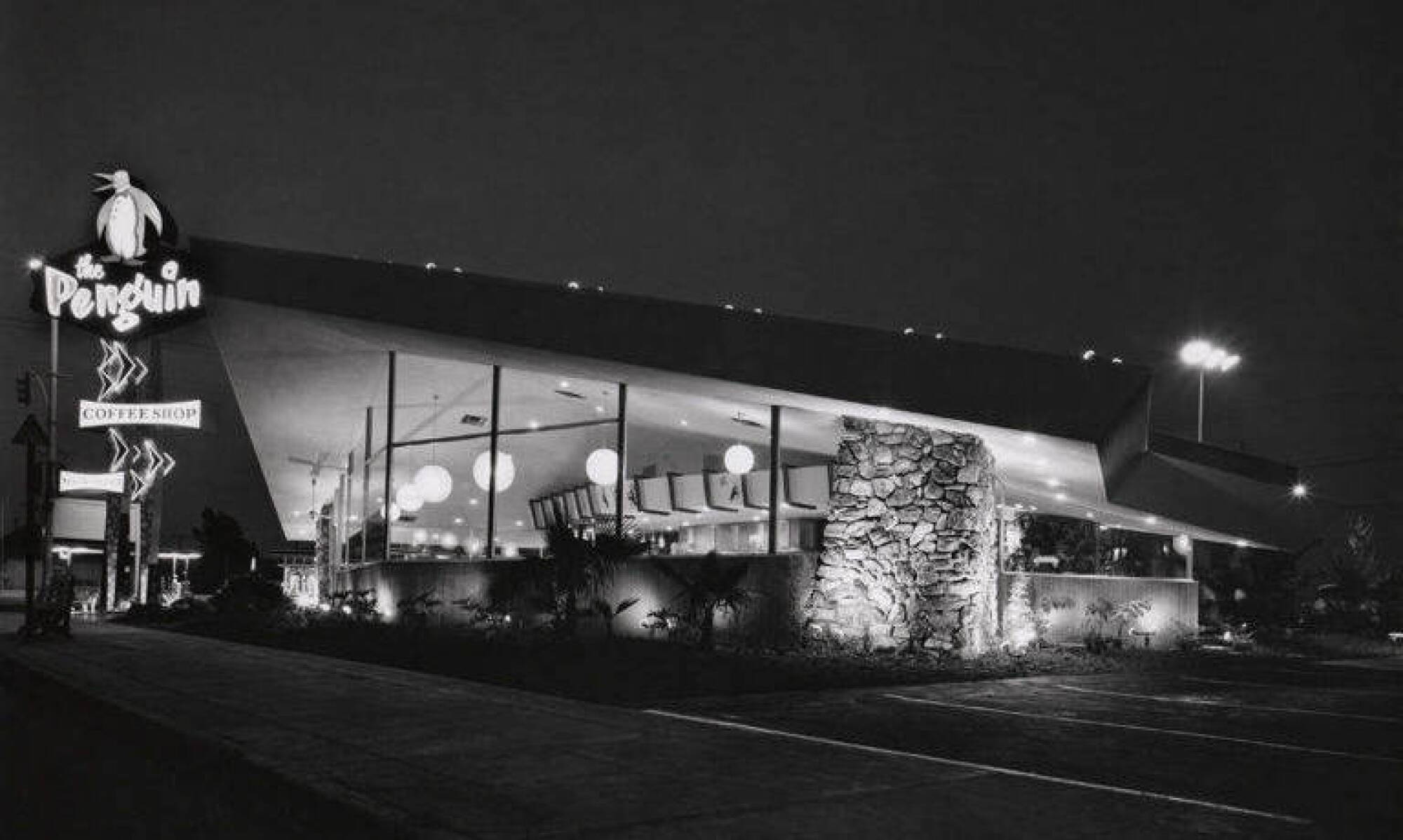
Designed by famed mid-century architects Armet & Davis, the building held the Penguin Coffee Shop from 1959 through 1991.
(Architects Armet Davis / Santa Monica Public Library Image Archives)
“This isn’t about saving a modern restaurant. It’s about preserving some really important Googie architecture,” said Nina Fresco, vice president of Santa Monica Conservancy. She added that “there’s no reason why housing and historic preservation can’t be partners.”
Irvine-based firm ValueRock Realty bought the half-acre Mel’s property for $6.2 million in 2020, and in 2025 began offering the property for sale, asking $26 million through brokers Newmark Pacific.
Soon after learning that the building was for sale, the Santa Monica and L.A. conservancies nominated Mel’s for a landmark designation, which can protect buildings from demolition, Fresco said. As part of the effort, Santa Monica Conservancy leaders raised $6,800, the cost of a Santa Monica landmark nomination, and enlisted the L.A. Conservancy as an ally.
Then on Sept. 18, ValueRock filed a preliminary application with the city (also known as an SB330 application) to replace the 1959 building with an eight-story apartment building, including 138 apartments, 123 parking spaces and first-floor retail space.

The sign of Mel’s Drive-In features a penguin, homage to the coffee shop of yesteryear.
(David Fouts / For The Times)
When it bought the property in 2020, ValueRock announced that it “is considered to be a historical landmark within the community.” But in its September filing for the apartment project, ValueRock management checked a box indicating that no historic or cultural resources are known to exist on the property.
“We didn’t know they would be quite this aggressive, but it’s not a huge surprise,” Fresco said.
Under city law, Fresco said, if a property is more than 40 years old, the owner must wait at least 75 days after seeking a demolition permit before any demolition can happen. “So we’re OK at least until that hearing” in December, Fresco said.
If the Landmark Commission agrees to confer landmark status on the building, Fresco said, it may be shielded from demolition — but the owner can appeal the decision to the City Council.
Management at ValueRock Realty did not immediately respond to requests for comment.
The restaurant remains open, receiving a steady stream of locals and Route 66 travelers. “We’re going to be here until 2029,” said Marilina Borchio, manager of Mel’s, citing a lease that runs through June of that year. As she spoke, the breakfast crowd was trickling in on Sunday morning. Borchio said she’s spending a lot of time reassuring customers who “think we are going to be demolished tomorrow night.”
The Googie-style building, designed by famed mid-century architects Armet & Davis, held the Penguin Coffee Shop from 1959 through 1991, catching the eyes of passing drivers with its dramatically slanted roof, oversize windows and a long counter inside for diners in a hurry. Architectural historians describe Googie style as a bold strain of Mid-Century Modernism, notable for big neon signs and swooping roofs, especially popular among restaurants, bowling alleys and car washes, now increasingly rare. Rae’s Diner, a 1958 building on Pico Boulevard, is another Santa Monica example.
The coffee shop never earned a Michelin star (nor has Mel’s) but its workaday American fare won a following. “The Penguin gets my vote for the best diner around,” wrote Times restaurant critic Charles Perry in 1989.
But two years later, the Penguin was gone. By 1992, the building had been converted into a dentist’s office. Eventually it fell idle, until the San Francisco-based Mel’s chain arrived in 2016 and began a renovation aimed at bringing back the restaurant’s ’50s atmosphere.

Mel’s Drive-In now occupies the old Penguin Coffee Shop building at the official end of Route 66 in Santa Monica.
(Christopher Reynolds / Los Angeles Times)
The renewed restaurant opened in 2018, with a penguin atop its sign, in homage to years gone by.
“A lot of the neon elements are gone, but the main elements are still there,” said the Santa Monica Conservancy’s Fresco, who is also a Santa Monica planning commissioner and former landmarks commissioner.
The renovation and restoration effort included removing layers of paint and tile that had been added over decades, revealing interior stone cladding that had been covered and replicating the counter and stools, vinyl cushioned booths, tables of plastic and metal, terrazzo floor, and light fixtures. The work was “to the letter of the Secretary of the Interior’s standards” for the treatment of historic properties, Fresco said.
The building is not mentioned in “An Architectural Guidebook to Los Angeles,” by David Gebhard and Robert Winter, which is a prime source for many preservationists. But Mel’s won a $10,000 grant from the National Trust for Historic Preservation in 2025 to pay for Route 66 centennial signage project.

Route 66 memorabilia at Mel’s Drive-in.
(David Fouts / For The Times)
“This site, like Route 66 itself, represents something greater than itself,” said Rhys Martin, manager of the National Trust’s Preserve Route 66 initiative, in an email. “It’s a connection to a journey through time and space that will be forever lost if this remarkable Googie structure is demolished.”
Fresco said she’d love to see the building continue to operate as Mel’s, but in the big picture, “we can’t stop them from building housing.” Still, Fresco said, she is hoping that the owner can come up with a project that retains the existing building while adding housing around it, as several other developers in Santa Monica have done. At 829 Broadway, developers agreed to preserve a World War II era Quonset hut while building a five-story apartment building around it. (The Quonset hut was occupied by Pono Burger from 2013 to 2025.) And the old Rapp Saloon — an 1875 brick building at 1436 2nd Street — was reborn in the late 1980s as a meeting space within a four-story hostel, now known as Hostelling International’s HI Los Angeles Santa Monica Hostel. The Santa Monica Conservancy begins its walking tours there.
If the allied conservancies win landmark status for the Penguin/Mel’s building, Fresco said, the owners “will be able to do exactly what they want to do now. They will just have to do it differently.”
Route 66, which was born and officially named U.S. Highway 66 on Nov. 11, 1926, was extended to Santa Monica in 1935. Though many travelers think of the Santa Monica Pier as the end of the route, its official terminus from 1935 on was at the intersection of Lincoln and Olympic boulevards, where Mel’s now stands.
Though Route 66 was decommissioned in the 1980s, its popularity as an Americana-rich driving route has grown in recent years, especially during this year’s centennial celebration of the road.
By the time the coffee shop building was going up at the end of the route in 1959, Fresco said, interstate freeways were already beginning to usurp Route 66’s role and the Santa Monica route of Interstate 10 had been plotted. By putting their eye-catching building on a spot along Route 66 and next to the path of the freeway, Fresco said, the people behind the Penguin were catering to motorists on roads rooted in two different eras.
“The Catholic Church shaped Rome. Commerce shaped Manhattan. It is popular culture that has shaped L.A.,” architecture critic Alan Hess told a Times reporter in 1993. “We should see these buildings in that context and take them seriously.”