Next year, the Los Angeles Chamber Orchestra — an intimate, 42-player group compared with the more than 100-member Los Angeles Philharmonic — will warm its new home, the highly anticipated, Frank Gehry-designed Terri and Jerry Kohl Hall. And it will do so with the help of a little light music: fanfares commissioned from half a dozen preeminent film composers — John Williams, Ludwig Göransson, Joel McNeely, Thomas Newman, James Newton Howard and John Powell — curated by none other than Seth MacFarlane (best known as the creator and star of “Family Guy”).
The buzzwords are lighting up, but this is far from a game of performing arts Mad Libs; it’s actually quite intentional. “We really thought about … ‘What statement can we make to Los Angeles and to the performing arts world that really shows who we are?’” said LACO Executive Director Ben Cadwallader. “Who is the Los Angeles Chamber Orchestra, specifically? And it really was this tie to Hollywood, to Los Angeles, to our musicians themselves.”
MacFarlane was a natural fit.
“I loved movies and I loved movie music,” MacFarlane said of his childhood in a recent interview. “I would go to the record store and buy the latest John Williams soundtrack, which was usually out before the movie was released. I remember buying the ‘Jurassic Park’ soundtrack not having seen the movie, and it didn’t matter. It was just great music. It was just great, symphonic music.”
LACO was founded by an assemblage of musicians and civic leaders in 1968, including the cellist James Arkatov. After emigrating from Russia as a child, Arkatov became the principal cellist at the Pittsburgh and San Francisco symphonies before landing in L.A. He arrived as a Hollywood studio musician, played on movie soundtracks and did backing for Ella Fitzgerald.
From the beginning, LACO served as “the artistic outlet of studio players … these incredibly gifted musicians who bring our movies and TV shows to life,” said Cadwallader, a situation that remains true to this day. LACO’s musicians know it’s “a place where they can play … Bach and Mozart, and make music at a really high level in a performance environment, not a studio environment.”
This is why the christening of LACO’s new home is also a homage to its roots: film composers. These giants of their fields will each write a spry, five- to seven-minute-long fanfare as openers for select LACO concerts throughout the season. (The works will also be performed at the Wallis Annenberg Center for the Performing Arts, with John Williams’ piece arriving first, in fall 2027.)
MacFarlane knew just what to do, thanks to his long history with music. The actor, animator, filmmaker and comedian has released 10 studio albums, received five Grammy Award nominations and performed as a vocalist at the Hollywood Bowl and Carnegie Hall. (He also just released a 14-track album called “Seth MacFarlane Sings the Muppets.”) Plus, his parents raised him steeped in music.
Nothing has changed here — throughout his career, MacFarlane has been relentlessly committed to including live music in his projects. The musical numbers on “Family Guy” simply couldn’t (and wouldn’t) exist without an orchestra.
“It would somehow feel thin and hollow, and people may not know why their attention is drifting, but it would drift,” MacFarlane said. “I really think you need the muscular sound of 60 musicians in a room, and in the case of ‘The Orville,’ sometimes 90. … Hollywood has been doing it since pictures went to sound, and I hope they continue to do it for as long as we make film and television.”
MacFarlane noted that the only time many people actually hear a live orchestra is in film or television.
“I don’t know how many people go to the symphony,” MacFarlane said. “So that’s certainly a component. When I was a kid, even the syndicated afternoon cartoon shows used a live orchestra, and when you go back and you listen to them, oftentimes it’s pretty legit composing. And I think that was important to have heard. I think it’s just good for the brain to hear complex symphonic music.”
Composer, conductor and longtime MacFarlane collaborator Joel McNeely (whose wife, Margaret Batjer, is LACO’s concertmaster) got MacFarlane involved in this commissioning initiative. Then MacFarlane selected the participating composers (and supported the initiative financially). One final Mad Lib to solve: What exactly, you may be wondering, is a fanfare?
“The perfect example … is the beginning of ‘Star Wars,’” Cadwallader said, then hummed the intro. “There’s big, loud brass. You cannot help but pay attention. … It puts a smile on your face. It maybe gets your heart racing a little bit. It’s usually very rhythmic, very bright. It’s like a big warm smile, or like a popping of a Champagne cork, to start a concert. … A bursting, effervescent moment of music to get things started. An amuse-bouche, if you like.”
Los Angeles County officials aim to break ground on the new Eaton Canyon Nature Center before 2028, with plans to construct a facility that can withstand the region’s changing climate and future disasters.
The previous nature center, which replaced the original Robert M. McCurdy Nature Center that burned down in 1993, was destroyed in the Eaton fire last January. The fire not only destroyed the structure but also a large library and several decades’ worth of archives, and it also killed the reptiles that lived inside the center.
It took about five years to rebuild and open the last nature center. L.A. County Parks Director Norma Edith García-Gonzalez said after the design phase is completed, which could be soon, the county and the architect firm hired for the project will plan out the construction phase.
“We modeled 100-year patterns of wind, fire and flood so that when we build back, we are building back with resistance, and that is able to guide how we plant [and] what type of plants, and how we build, [including] how we build back trails,” García-Gonzalez said.
Norma Edith García-Gonzalez, director of L.A. County Department of Parks and Recreation, speaks during an Eaton Canyon design meeting in mid-September.
(Kayla Bartkowski / Los Angeles Times)
The biggest impediment to rebuilding, though, is funding. The county has about $16.2 million in state money, about half of what county officials think is needed to build a new nature center, she said. García-Gonzalez said she hopes the philanthropic community will step up to fill the gaps, but county leaders have noticed that “philanthropy goes from one hot issue to another,” and interest to donate to fire recovery is cooling.
In this week’s edition of The Wild, our weekly outdoors newsletter, I will provide an update on the design plans for the new nature center and when we can expect to hike again in Eaton Canyon — and how you can help with the canyon’s restoration too.
You are reading The Wild newsletter
Sign up to get expert tips on the best of Southern California’s beaches, trails, parks, deserts, forests and mountains in your inbox every Thursday.
By continuing, you agree to our Terms of Service, which include arbitration and a class action waiver. You agree that we and our third-party vendors may collect and use your information, including through cookies, pixels and similar technologies, for the purposes set forth in our Privacy Policy such as personalizing your experience and ads.
First, let’s discuss a little bit of the history of the area.
The Eaton Canyon Natural Area, managed by L.A. County Parks and Recreation, is a 190(ish)-acre swath of land at the foothills of the San Gabriel Mountains near Altadena.
“Originally called ‘El Precipicio’ by the Spanish settlers because of its steep gorges, it is now named after Judge Benjamin Eaton, who built the first Fair Oaks Ranch House in 1865 not far from Eaton Creek,” according to the Eaton Canyon Nature Center Associates, a volunteer-run education and stewardship group. “Judge Eaton was the first to use irrigation from the creek to grow grapes on the slopes.”
The canyon has long been a fascination of adventuresome L.A. residents.
The hike to Eaton Canyon Falls in the San Gabriel Mountains before the Eaton fire last January.
(Myung J. Chun / Los Angeles Times)
In 1921, writer Frances Mathilda Purdy wrote for The Times that few people knew of the “hidden, but very easily accessible waterfall” in Eaton Canyon. Purdy outlined a few ways to access the canyon and reach the falls, including a shorter route where visitors “after alighting from motor, or stage,” could take a small flight of stone steps near the Mt. Wilson Toll Road bridge.
I chuckled when I read Purdy’s suggestion that this particular route was “perfectly comfortable for those who have arrived on the scene in city garb.” Apparently, underprepared hikers have been coming to Eaton Canyon for more than 100 years. What do you think was the 1920s version of hiking in flip-flops?
For the more rugged adventurer, Purdy laid out a “serpentine trail” that leads to “such lovely possibilities for the pleasure-seeking jaded worker, who, from only one afternoon spent in this quietly entrancing corner of the great outdoors, will return, refreshed and invigorated to meet the daily grind with a mind stored full of the charm of Lower Eaton Canyon.”
Architect Anne Mooney of Sparano + Mooney Architecture speaks about a site plan for the next Eaton Canyon Nature Center.
(Kayla Bartkowski / Los Angeles Times)
It wasn’t until 1930 that Pasadena set aside property that the city owned for a bird and game sanctuary in Eaton Canyon and Eaton Wash, preserving the land from development, according to a historical record compiled by the nature center associates.
There was interest in doing more.
Pasadena Park Superintendent Gilbert Skutt, who served from 1923 to 1936, wanted to see a large scenic public park in Eaton Canyon similar to what the city had built along the Arroyo Seco, according to city records. “He sought to correct the imbalance in the distribution of park space in Pasadena, which favored the west side of town,” according to a historical document. “During the Depression, however, the city could not afford to purchase the land.”
Over time, the city started working with county officials on Eaton Canyon Regional Park, eventually giving the entire project to the county.
In 1931, the L.A. County Board of Supervisors considered financing a 1,000-acre “gigantic regional park system” for the area, according to The Times’ archives, but that idea apparently never fully came to fruition.
Thankfully, in 1950, landowner Mary Beatrice Fox sold the canyon portion of her property to L.A. County to use for a park, “with a provision that mammals are not to be kept in cages,” according to a park history compiled by the Eaton Canyon Nature Center Associates.
A hiker slips in a creek in Eaton Canyon after a 2023 storm.
(Wally Skalij / Los Angeles Times)
Then, in 1958, naturalist Louise A. Luckan moved her “nature appreciation operation from the Eaton Canyon Golf Course to Eaton Canyon Park,” according to the organization’s history.
Soon, L.A. County officials set aside $154,797 — about $1.7 million in today’s dollars — for the Robert M. McCurdy Nature Center. They had big plans for the facility, which was to include two classrooms, an office, museum, library, display area, gift shop, laboratory and an auditorium that could seat 200.
“This park will be an outstanding facility — the only one of its kind in magnitude this side of Chicago,” Supervisor Warren Dorn said in a 1962 Times story.
The nature center opened in 1963, and became popular among scouting and school groups, to whom naturalists taught about the local flora and fauna. By the early 1970s, more than 2,000 school children were regularly attending lectures at the nature center, according to Times archives. The students wrote thank-you notes to the park staff, including one that read, “I think it was nice of you to buy this park instead of someone buying it for houses and factories. Because if they did, it would ruin this beautiful land.”
L.A. County sustainability policy director Rebecca Ferdman talks with community stewards about how to educate and engage the public about the goldspotted oak borer, a pernicious invasive beetle that destroys oak trees, during a meeting at Eaton Canyon Nature Center in 2024.
(Brian van der Brug / Los Angeles Times)
But, in 1993, the canyon’s first nature center was destroyed by the Kinneloa fire. The next nature center didn’t reopen until 1998.
Karen Mateer, vice president of the Eaton Canyon Nature Center Associates, said for more than 25 years, that nature center served as a meeting place and an educational hub for the millions who visited the canyon over the years.
Mateer, who started volunteering in 1998, said many local schoolchildren first experienced the concept of “nature” at Eaton Canyon on field trips. Volunteers would regularly hear from adults, who pursued recreation- or nature-focused careers, that the first place they ever hiked or learned about their natural habitat was at Eaton Canyon.
“Eaton Canyon also, for the community, for those of us up here who lost so much, it is familiar and is a place you often go for recreation, for solace,” Mateer said. “It means a lot.”
At a presentation last week, architect Anne Mooney said her firm analyzed where to best place the new nature center, and not wanting to destroy any existing habitat or take down any of the area’s oaks or other trees, recommended the new building be placed east of the previous site.
It was easy for visitors to miss the previous nature center, because it was situated in a thick stand of oaks, and the new location will allow the nature center to serve as a gateway to the park, as it will be near the canyon’s trailhead.
“The nature center has always been more than just a building,” Mooney said. “It’s really been a gateway to an experience of learning about nature, experiencing a connection to the wildlands and developing stewardship of the canyon. We want to continue that tradition.”
A diagram of the wind analysis conducted by architects as they assessed where to place Eaton Canyon’s new nature center.
(Kayla Bartkowski / Los Angeles Times)
The new nature center, as shown in the current design plan, is horseshoe-shaped with a covered entryway. It will be constructed using durable, fire-resistant materials, including stone and steel. Builders would also construct curved walls to serve as windbreaks, which would not only slow gusts but also divert airborne embers during a fire.
The proposed designs also include roof and eave sprinklers that could pre-wet the building and nearby surrounding area with a specialized firefighting foam during a wildfire.
“We recognize that the fire is a recurring part of the ecology, and we will have another fire,” Mooney said. “We’re working to design something that allows us to be more prepared in the future.”
The Eaton Canyon Nature Center, a 7,600-square-foot building, was destroyed in the Eaton fire. It housed live animals, exhibits, classrooms, a gift shop and more.
(Jaclyn Cosgrove / Los Angeles Times)
The design also includes a research lab, a learning lab or classroom, a large multipurpose space that can fit an estimated 150 people when seated (or 300 people when standing), an exhibit space, a gift shop and a large courtyard in the center with shade, seating and live animal enclosures.
Officials stressed that the design is preliminary and dependent on funding. Anyone who wants to see the design for themselves and provide their feedback can attend the next public meeting, From Ashes to Action: Reimagining Eaton Canyon, from 5 to 7 p.m. Oct. 7 at the L.A. County Arboretum.
Kevin Singleton, center, points to the Eaton Canyon Nature Center design during a recent county event where officials discussed the future of Eaton Canyon.
(Kayla Bartkowski / Los Angeles Times)
In terms of when hikers will return to the canyon’s trails, García-Gonzalez said the county needs an estimated $8 million to reestablish the trail system. The county has fundraised and received only $900,000 of that.
“We already put that money to work,” García-Gonzalez said, partnering with L.A. Conservation Corps to start rebuilding trails. “But there are some [trails] that really need significant and heavy engineering.”
The county also has to plan its work around the strong winter storms forecasted as a result of El Niño, she said. “We are bracing ourselves for even more damage,” García-Gonzalez said.
A map of the proposed courtyard of the new Eaton Canyon Nature Center.
(Kayla Bartkowski / Los Angeles Times)
Since the fire, volunteers have donated hundreds of hours to work on restoring the canyon’s habitat.
You can join them. Volunteers meet from 8 to 11:30 a.m. every Friday and the second and fourth Saturday of every month. Participants remove invasive plants that zap up resources for native plants trying to reestablish themselves. Training and tools are provided. You can sign up by visiting signupgenius.com.
“The love, the care, the stewardship, the commitment, the hope, the inspiration of the volunteers is unparalleled,” García-Gonzalez said. “They’re driving us to build back because they’re so committed. They’re all in.”
3 things to do
“MASH,” a military dramedy that aired on CBS from 1972 to 1983, is one of several Hollywood productions filmed at Malibu Creek State Park.
(Courtesy of California State Parks, 2026.)
1. Celebrate 50 years of public land in Calabasas Malibu Creek State Park will celebrate its past 50 years from 4:30 p.m. to 10 p.m. Saturday at 1925 Las Virgenes Road in Calabasas. Attendees can touch fossils, explore the park‘s trees and make art, all while listening to music and eating from local food trucks. At Stories Under the Stars at 6:30 p.m., a diverse cast of storytellers will teach visitors about the park’s history, culture and science. The L.A. Astronomical Society will host a star party at 8 p.m. Guests are encouraged to carpool or use the free shuttle from Juan Bautista de Anza Park to the park. The event is free, but parking is not. Register at eventbrite.com.
2. Repair the river near Azusa Volunteers are needed from 8 a.m. to noon Saturday, which is National Public Lands Day, at the Oaks Picnic Area near the San Gabriel River for a cleanup effort. Organized by five community conservation corps groups, including San Gabriel Valley Conservation Corps, volunteers will pick up trash and help clean the river. Register at docs.google.com.
3. Cast a line under a full moon in Castaic Friends of Castaic Lake will host the organization’s final Moonlight Madness event of the year from 6 p.m. to 12:30 a.m. Saturday at Castaic Lake. Guests can fish from the shore, from a boat or not fish at all as they enjoy an evening in the outdoors. Tickets start at $23. Glow sticks required for each participant. Register at givebutter.com.
The must-read
Jim Crouch stands in a field with Englemann oaks at the Santa Ysabel Open Space Preserve.
(Sandy Huffaker / For The Times)
Jim Crouch, a retired science teacher near San Diego, noticed how the oak trees around him were disappearing, succumbing to disease, drought and development. Times contributor Jessie Schiewe wrote that Crouch, moved to action, collected acorns and gave away the resulting potted seedlings to others. Now, after planting 10,000 acorns, he dreams of the day he completes his 20,000th seedling. “I’ve never been so ambitious,” he says, “and I’ve never done a project with as much love in it and as little ego.”
Happy adventuring,
P.S.
Torrey Pines State Natural Reserve will be closed until March as construction workers upgrade gas, water, wastewater and communication lines. They also will install new accessible parking stalls and an accessible pedestrian path from the upper parking lot to the restroom and park’s lodge. Times staff writer Christopher Reynolds wrote that the park’s 1,750-acre Torrey Pines reserve attracts about 4 million visitors each year (about the same number as visit Yosemite National Park). Torrey Pines State Beach will remain open through the closure. If you’d hoped to visit this particular park in the fall, consider instead one of 13 places in California that Reynolds recently wrote are ideal to check out in autumn. Warning: As I read the piece, I felt the immediate urge to book campsites at several spots around our state! I am so ready for cozy season.
For more insider tips on Southern California’s beaches, trails and parks, check out past editions of The Wild. And to view this newsletter in your browser, click here.
HOME Improvement star Jonathan Taylor Thomas has been arrested and jailed in Los Angeles, The U.S. Sun can confirm.
A spokesperson for the Malibu/Lost Hills Sheriff’s Station told The U.S. Sun that the former actor, 45, was a passenger in a vehicle that was pulled over by police on September 21 around 12:30 am.
Jonathan Taylor Thomas, here in 2013, rose to fame as a child star in the 1990s on sitcom Home ImprovementCredit: FilmMagicJonathan stepped out in 1995, when he was a household name in the U.S.Credit: Getty Images
According to the police spokesperson, a DUI investigation was conducted.
“During the investigation, [Jonathan] stepped out of the vehicle and became uncooperative and resistant, and was subsequently arrested for [being] drunk in public,” the spokesperson said.
Sign up for the Showbiz newsletter
Thank you!
He was charged with being drunk in public and resisting or deterring an executive officer.
Jonathan has not yet spoken out about the incident.
Jonathan rose to fame in the 90s as a main cast member on Home Improvement opposite superstar Tim Allen.
He played middle son Randy for eight seasons, and soon jumped to bigger Hollywood projects.
He took on the role of Tom Sawyer in Tom and Huck in 1995, and voiced a young Simba in The Lion King in 1994.
Most read in Entertainment
Jonathan reunited with Home Improvement mom Patricia Richardson and brother Taran Noah Smith in July 2026Credit: Instagram/prichardsonlaJonathan played middle brother Randy on Home Improvement. He posed with the cast in 1992Credit: Getty
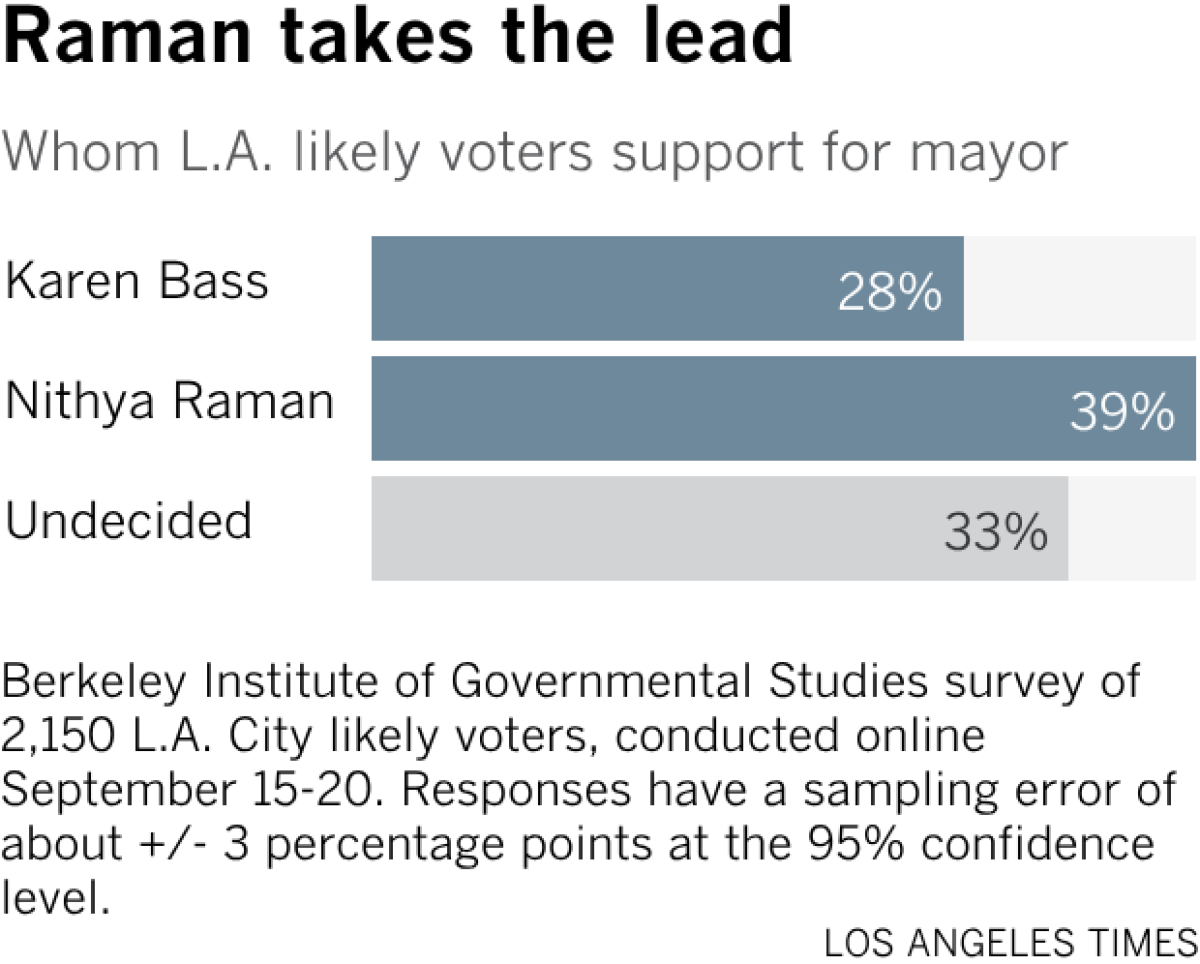
Los Angeles Councilmember Nithya Raman has taken a wide lead over incumbent Karen Bass in the L.A. mayor’s race, according to a new poll released Wednesday, although a high percentage of voters remain undecided less than two weeks before mail-in ballots are sent out for the Nov. 3 election.
Raman is favored by 39% of likely L.A. voters, compared with 28% for Bass, according to the poll by the UC Berkeley Institute of Governmental Studies, which was co-sponsored by The Times. The poll found that 33% of voters were undecided.
“Raman clearly has the advantage. Her task is a little less onerous than Bass’,” said Mark DiCamillo, the director of the Berkeley IGS Poll.
Adding to Bass’ low poll numbers are high unfavorability ratings.
The mayor had 63% unfavorable ratings, the poll found, with 28% favorable and 9% having no opinion. By comparison, 40% had a favorable view of Raman, according to the poll, while 39% said they had an unfavorable view of her and 21% had no opinion.
The survey released Wednesday was conducted online with a sample of 2,150 likely city voters between Sept. 15 and Sept. 20. It has a margin of error of about 3 percentage points.
The poll represented the strongest showing yet for Raman, who trailed Bass in almost every poll during the primary campaign and who came in second to Bass in the primary election, with 29% of the vote compared with Bass’ 34%.
Mayoral candidate and Councilmember Nithya Raman, center, enjoys a light moment with Alliance of Californians for Community Empowerment (ACCE) Action members at La Cita Bar in downtown Los Angeles.
(Genaro Molina / Los Angeles Times)
Even so, DiCamillo said the large number of undecided voters means the race is far from over.
“It’s extraordinarily unusual to see this many undecided voters at this point in the race,” he said. Mail-in ballots will be sent out beginning Oct. 1, local elections officials say.
The large number of undecided voters can be linked to the elimination of mayoral candidate Spencer Pratt in the June 2 primary, according to DiCamillo. The former reality TV star received 26% of the vote in the primary, and most of the voters who cast ballots for him — 63% — say they haven’t decided whom to vote for in the runoff, the poll found.
Among those Pratt voters who have decided, 22% favored Bass compared with 16% for Raman.
One of the most significant findings in the poll was a massive “generational divide” among L.A. voters, DiCamillo said.
Raman, 45, dominated the 72-year-old Bass among younger voters, with 66% of likely voters ages 18 to 29 choosing the council member while just 4% chose Bass, according to the poll.
Raman also had 64% of likely voters ages 30 to 39 compared with Bass’ 12%, and the council member had 50% of likely voters ages 40 to 49 compared with Bass’ 18%. Raman also was leading among voters 50 to 64 years old by a slim margin of 35% to 33%.
Bass, meanwhile, led among the oldest set of voters — those 65 and up — but not by the same margins. Bass had 41% of likely voters in that group compared with Raman’s 21%.
According to the poll, 56% of likely voters thought Bass did a poor or very poor job responding to the disaster, which killed 12 people and destroyed more than 4,000 homes, including Pratt’s.
Fourteen percent of the likely voters thought Bass had done either an excellent or a good job and 17% thought she had done a fair job.
Mayor Karen Bass campaigns at Ernest E. Debs Regional Park on Sunday.
(Kayla Bartkowski / Los Angeles Times)
The most important issues to likely voters were fixing city infrastructure, moving homeless people indoors, crime and public safety, and building more affordable housing, the poll found.
The poll shows Raman leading in nearly every geographic area of the city. Bass was leading in South Los Angeles and the Harbor region, 37% to 34%, but central Los Angeles as well as northeast and the east side of Los Angeles broke strongly for Raman.
The San Fernando Valley went 34% to Raman and 26% to Bass with 40% still undecided. The Westside favored Raman by a single percentage point, at 35% to 34%.
Raman has led in other polls recently, though none by as wide a margin as in the Berkeley IGS/L.A. Times poll. Shortly before the primary, a separate Berkeley IGS/L.A. Times poll showed Raman leading Bass in a potential head-to-head matchup by just four percentage points, with 32% support compared with the mayor’s 28%.
On the negative side, Raman was booted from her position in the council as chair of the Housing and Homelessness Committee, a move she said was politically motivated.
Normally when a telephone rings inside a bar, it’s the duty of the staff to pick it up. But when an old-timey rotary dial phone suddenly springs to life at the Last Canteen, it’s up to guests to decide what to do next.
Answer it — or attempt to make a call from it — and you’ll encounter one of dozens of pre-recorded messages. They’re calls from an imagined future, one when a war-torn America is on the mend from some sort of apocalyptic catastrophe. They’re messages, perhaps, for the bar’s fictional founder, a shotgun-carrying mysterious woman known for her mean bartering skills, or maybe if you’re lucky, you will dial into what sounds like an early 20th century party line and hear from those looking for a date in the Valley, now a neutral zone among warring factions.
You’re reading Mr. Todd’s Wild Ride newsletter
Todd Martens’ newsletter delivers news and commentary on the past, present and future of theme parks, right from the theme park capital of the world — Southern California.
By continuing, you agree to our Terms of Service, which include arbitration and a class action waiver. You agree that we and our third-party vendors may collect and use your information, including through cookies, pixels and similar technologies, for the purposes set forth in our Privacy Policy such as personalizing your experience and ads.
The Last Canteen, situated on a stretch of Ventura Boulevard that’s just a short walk from the Universal City metro and minutes from Universal Studios Hollywood, is a new restaurant and bar that looks lifted from a theme park. It also feels like a throwback to an earlier time, when Los Angeles was an epicenter of the themed restaurant.
Southern California has a storied history when it comes to themed establishments. There’s our penchant for food-shaped eateries, of course — see our giant doughnuts or the Tail o’ the Pup — but dinner with a side of story is a Los Angeles-area staple that predates any corporate chains such as Rainforest Cafe or Chuck E. Cheese. From the long-forgotten Jail Cafe in the 1920s to our region’s birth of the tiki bar to the themed restaurant explosion of the ‘80s and ‘90s, when even Steven Spielberg got into the action with the submarine-focused DIVE! in Century City, the themed restaurant has long found a receptive audience in Southern California.
And the Last Canteen feels especially built for our moment.
The Last Canteen’s three founders were going for a lived-in feel.
(Eric Thayer / Los Angeles Times)
Taking influence from the likes of “Mad Max,” “Fallout” and a host of other dystopian, postapocalyptic media, the Last Canteen is a bar for an era — and a city — when the future seems especially uncertain. Whether it’s AI, corporate consolidation, inflation or the struggles of Hollywood that’s got you down, the Last Canteen wants to be your “Cheers” of sorts.
“It’s not the brightest of times, I would say for most of the world, but certainly younger generations are feeling like we got the rug pulled over us — the state of the economy and corporate overreach,” says Jimmy Clements, 32, who founded the Last Canteen with two other friends from the hospitality industry.
“We always joke that the world is ending, but there’s some charm in fully embodying what that would mean, and realizing there’s something on the other side,” he adds. “That’s what attracts me to the genre. OK, the worst thing possible happened, but there’s still people on the other side. We still need community and a place to eat and drink.”
A grenade fashioned out of a baseball is one of the items hidden in the Last Canteen.
(Eric Thayer / Los Angeles Times)
Or as Clements’ partner TJ Lewis says, “Who doesn’t watch ‘Mad Max’ and dream of riding on top of a crazy car with a spike in your hand?”
Despite a potentially bleak concept, the Last Canteen is open and welcoming. The color palette is soft, leaning heavily on dust-like sandy vibes, the cocktail menu takes influence from the fruity, complex world of tiki bars, and a sense of humor permeates the main dining room.
Yes, a demolition bomb, which is actually a movie prop from Angelina Jolie’s “Unbroken,” hangs from the ceiling, but take a moment to explore the venue and you’ll find grenades colorfully fashioned out of baseballs, or rewritten maps of the Valley in its new “Wasteland” era. Universal Studios’ famed minion still stands, but the Ikea is now a “hall of justice.”
Newspapers dot the walls. They’re filled with fiction that tell of the bar’s new reality, giving the place a sense of history and lore. One article, for instance, speaks of a battle that broke out near the remnants of US-101 next to the old “sidewalk stars site.” Another tells of how the bar’s founder took over the land where the establishment now stands. By force, of course. And don’t miss the beer taps, fashioned out of bullets, guns and baseball bats.
The Last Canteen is a themed bar that feels ripe for our era, one in which the future is filled with uncertainty.
(Eric Thayer / Los Angeles Times)
“It’s the difference for us between immersive and themed,” says Lewis. “Like the Hard Rock Cafe is themed. It’s got music on the wall, but you don’t feel like you’re at a concert when you’re there. It’s not immersive. What we were really going for is a lived-in space. We didn’t cover this in ‘Max Max’ posters. It is in the world of. It’s really open-ended. All the details on the wall help paint a picture.”
Of course there were limits. The team jokes that if they really wanted to exploit the dystopian theme, then drinks should likely be served in red plastic cups. Instead, the Last Canteen has proper drinkware, but each type of glass does come from a different set, as the owners wanted to give it a found materials vibe. The menu doesn’t stray too heavily from bar fare, and there are bowls of bison chili ($18), a burger ($18), a charcuterie plate ($21) and, of course, a “Last Meal,” which is a half grilled cheese, a cup of chili and a glass of sarsaparilla ($25).
The cocktail program, however, is extensive. The blackberry-infused Blackthumb or the spiced A Torch or Rosemary feel like darker twists on brighter, lively tiki fare. For those craving the latter, there is currently a frozen version of a Zombie. Bar founders Clements, Lewis and Drew Aloe say the menu, both cocktails and food, will change seasonally.
The Last Canteen founders Jimmy Clements, from left, TJ Lewis and Drew Aloe.
(Eric Thayer / Los Angeles Times)
And the tiki influence is no accident. The three cite the Disneyland Hotel’s Trader Sam’s as the Last Canteen’s primary influence. Also an inspiration? Oga’s Cantina at Disneyland’s Star Wars: Galaxy’s Edge. Theme parks were on their mind as much as the apocalypse.
“What they do so well is they feel really lived in,” Clements says of Trader Sam’s and Oga’s. “It doesn’t feel like a cute homage. You walk in the door and you’re somewhere else.”
And guests are noticing.
“We had someone opening weekend tell me that this feels like an end-of-the-world Trader Sam’s. Thank you. That’s all we want,” Lewis says.
This week in SoCal theme parks
Fast & Furious: Hollywood Drift is now in daily operations at Universal Studios Hollywood.
(Ronaldo Bolaños / Los Angeles Times)
New coaster. New accolades. New noise complaints. Universal Studios Hollywood officially opened its Fast & Furious: Hollywood Drift last week after months of running the thrill ride in a soft open phase. Fans were happy, with some even calling it the “best” coaster in SoCal. But nearby neighbors in Toluca Lake still want change, arguing that the sound of rider screams from the coaster is disrupting their lives.
Calling all Disney film buffs. Starting this Sunday, Santa Ana’s Frida Cinema will begin hosting a weekly “Walt Disney Studios” film series hosted by historian/educator Jeff Kurtti. First up is “20,000 Leagues Under the Sea,” which will also feature a presentation from artist/designer Kevin Kidney, who over the years has contributed to many a Disney parks project. Other Sunday screenings will include “Alice in Wonderland,” “Disneyland Handcrafted,” “Swiss Family Robinson” and more. Check out the full series here.
And speaking of “Disneyland Handcrafted.” It’s the last call for tickets to a stellar Disneyland history and charity event at Santa Ana’s Bowers Museum, which on Sunday will screen the Leslie Iwerks documentary as well as host a reception and panel. Historian and author Tim O’Day will moderate a talk that includes the film’s producer, Mark Catalena, former Imagineer-turned-historian Tom Morris and current Imagineer Emily “Emo” O’Brien, who oversees creative at Disneyland and is leading the team behind the just-announced makeover of Tomorrowland. Tickets start at $125 and are on sale now.
Ride report
The concluding, trippy scene in Inked, a new maze from Knott’s Scary Farm.
(Todd Martens / Los Angeles Times)
As we get deeper into Halloween season, I wanted to highlight another haunted maze, this one being the best one at this year’s Knott’s Scary Farm event. Inked is the maze, and it’s set in a 1930s cartoon studio. While of course having the requisite number of scare actors who will pounce on guests after they turn any corner, the maze also charms as it features original animation in the style of Disney’s classic “Silly Symphony” cartoons. Nearly every room in the haunted house boasts a cartoon scene starring a cutesy ghost, a little cat and an often sad pumpkin man.
The story is the drawn figures have come to life and are now murderous, but you’ll wish you could stop and watch a graveyard short or hang with a jazzy skeleton band. Giant pumpkin heads are animated with cartoon eyes and a mirror-heavy psychedelic scene, pictured above, brings the maze to a fiery conclusion. Knott’s is perhaps relying too heavily on returning mazes of late, but Inked is a winner.
Tell us your stories. Ask us your questions.
Have a theme park tale to share? Whether it was a good day or less-than-perfect day, I would love to hear about it. Have a question? A tip? A fun photo from the parks to share? Email me at todd.martens@latimes.com. I may feature your note in an upcoming newsletter.
Ride on,
Todd Martens
P.S.
Magic Mountain’s currently shuttered X2 coaster has been in the news of late.
The X2 ride has for years been the Valencia park’s crown jewel, the first roller coaster in the world that spun riders 360 degrees in their seats. It even topped my ranking of thrill rides at the park. I wrote that it was a risky choice, as the coaster is not for the faint of heart. Its seats extend off the track, giving you a sensation of flight at its most chaotic, with an assortment of loops that suddenly shift direction and segue into drops. Due to the constantly changing direction of its seats, the path of the track can be hard to discern.
But X2 has come under close inspection after several lawsuits allege people were injured on the ride. Six Flags shut down X2 in July amid a state investigation into the coaster. The Times’ Fedor Zarkhin has the story.
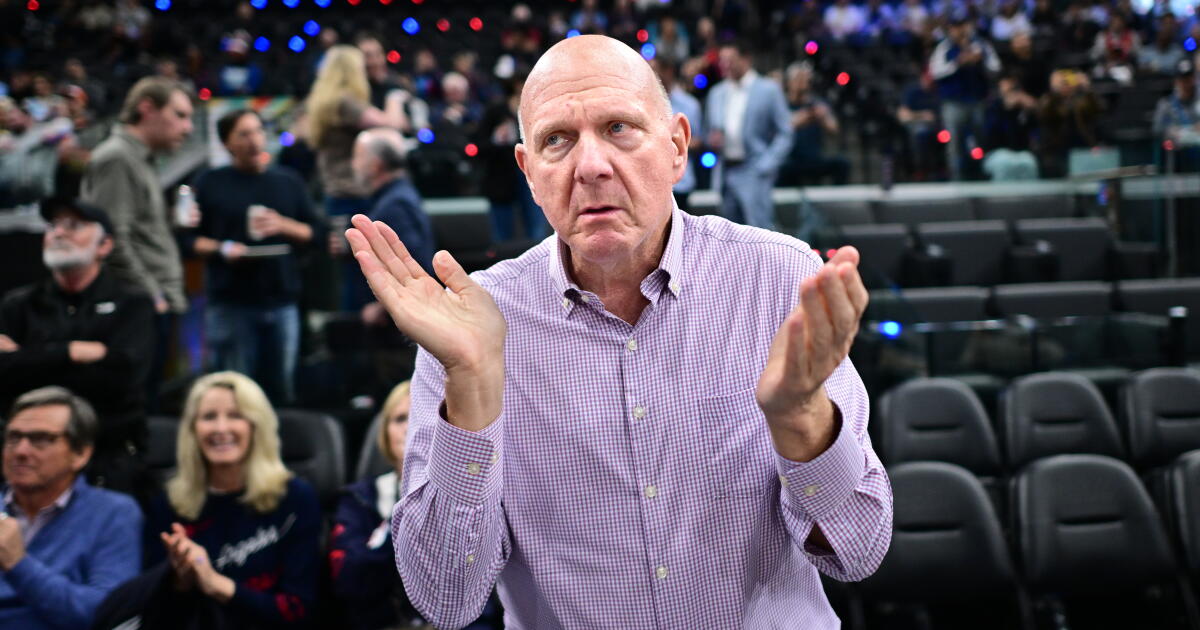
The Clippers hired John S. Gibson as interim CEO and governor on Monday, taking over the roles previously held by team owner Steve Ballmer, who is serving a one-year ban by the NBA.
Ballmer recently said he won’t fight the league’s salary-cap circumvention punishment in a reversal of the team’s initial defiance and vow to fight against what it called “a heavily biased investigation.”
The league suspended Ballmer for one year, fined the team $30 million and forced it to forfeit five first-round draft picks. Ballmer said the team has paid the fine.
Gibson will immediately oversee the team’s basketball and business operations and represent the Clippers in league voting matters. He’s a long-time Clippers season ticketholder.
“I am honored to take on this responsibility and grateful for the opportunity to serve an organization I have supported for many years,” Gibson said in a statement. “My focus will be on supporting our people, providing steady leadership, and helping the organization continue moving forward.”
Gibson spent the last six years as a trial lawyer and litigation partner at DLA Piper in Los Angeles, where he co-chaired the firm’s U.S. Business & Commercial Litigation practice. He previously advised and represented major corporations, technology and health care companies, pro sports organizations and business leaders.
Every so often, an aspiring screenwriter wanders into the dim red glow of Jumbo’s Clown Room hoping to interview one of the dancers. “They’re like: ‘I’m writing a screenplay. Can I interview you?” says Cecilia Fairchild, one of the longtime dancers at the renowned East Hollywood bikini bar.
Her response is usually some version of this: “I’m like, ‘Why are you writing about that? Don’t you know we are all writing that too? Leave us alone,’” Fairchild says with a mischievous laugh. What bothers Fairchild is the assumption behind it — that the dancers are voiceless and helpless. Worst of all, they’re presumed to have stories worth mining but not the ability to produce literature themselves.
Jumbo’s has a longstanding reputation of being part of L.A.’s literary lore.
In the 1970s and 1980s, Charles Bukowski — L.A. nightlife’s debaucherous poet laureate — was rumored to haunt the bikini bar in its early days. David Lynch wrote his classic screenplay “Blue Velvet” at the bar. (According to local legends, the iconic opening shot of “Blue Velvet” came to Lynch when he spotted a dancer with only one ear.) Writer and director Quentin Tarantino reputedly wrote at the bar. But while Jumbo’s has garnered a mythology as a magnet for filmmakers, writers and musicians who collect impressions, the dive’s dancers have shifted from being the subject to the artists.
Many of Jumbo’s dancers write fiction and memoir, host literary salons across Los Angeles and find ways to tell their own stories rather than serve as muses. “It’s funny because I wish that male auteurs would tell the story of customers. I want a sniffer’s memoir. I think that’s a real point of view,” Fairchild says. (Speaking of alienation and horniness, the dancer has been meaning to crack the Marcel Proust canon.)
Honey Ryder (Claudia Musikul) types on the bar inside Jumbo’s Clown Room.(Carlin Stiehl / For The Times)
Fairchild is a playwright, poet and memoirist. Her recently completed memoir, “The Poison + The Spit,” traces a life of tumultuous love affairs and a stint dancing in New Orleans, rendered in prose that is whimsical, surreal and deeply emotional. The dancer also hosts the Downpour, a popular monthly literary salon at Bar Covell, and recently directed “Fool in the Pool,” a play that premiered at El Condor in Silver Lake this summer.
Her writing style mirrors her dancing: kinetic, wild and unpredictable. She sometimes takes the stage in roller skates, dancing to David Bowie. Her memoir achieves that same sense of hypnotic motion. “The memoir is so heavy,” she says. “Everything was so sad that I needed some lens to look at it that was fun, zippy and crazy.”
For Fairchild, dancing and writing possess the same need to expose oneself. “Vulnerability is one of the most interesting things about dancing,” she says. “There really is the potential to look into people, and they look into you, and you wordlessly share something with them that is half sexual and half this other thing.”
Meanwhile, Danielle Henderson — another dancer and aspiring novelist at Jumbo’s who writes under the pen name D.M. Faulk — has been working on a science-fiction novel titled “Meridian.” The book imagines a dystopian American wasteland where pregnant women are surveilled and controlled. She has been a longtime science-fiction fan since she and her father watched “Jurassic Park” and “Planet of the Apes” when she was a child.
Long treated as passive muses by visiting writers, Jumbo’s dancers — from left, Caroline Blaike (Caroline Moyer), Honey Ryder (Claudia Musikul), and Cecilia Fairchild — are reclaiming the narrative as active poets, memoirists and screenwriters.
(Carlin Stiehl / For The Times)
Unexpectedly, the Jumbo’s comically tiny dressing room became the inspiration for her novel. In 2022, when Roe v. Wade was overturned, conversations between dancers about reproductive rights ignited in the dressing room, which in turn informed her novel.
“A lot of those conversations happen in the dressing room. I’m incredibly inspired by the women I’m with who are incredibly sex positive and strong.” That ethos informed Henderson’s protagonist, Zayla.
In recent years, the bar has become a local author hangout. Allie Rowbottom, the author of the recent buzzy adult film novel “Lovers XXX,” discovered the bar in 2011 on the occasion of writer Elizabeth Hall’s birthday party. “I recall sitting front row on novelist Jon Lindsey’s lap, raining dollar bills on dancers performing intricate, beautiful athletic feats,” Rowbottom says. “I spent more than I could afford that night and have been back often since.”
Increasingly, Jumbo’s has cemented itself as a watering hole to the local writing scene. “Two years ago, I rented out a few tables for Jon Lindsey’s birthday, attended by Los Angeles literati like Tea Hacic-Vlahovic, Sammy Loren, Morgan Krantz, Tex Gresham and Nada Alic,” she adds.
According to Rowbottom, Jumbo’s is rife for literary inspiration. “To me, Jumbo’s feels uniquely dedicated, as a venue, to intersecting sex and art, despite the obvious dissonance of selling either,” she says. “I suspect such is what has historically made it a rich spot for writers, dissonance and tension being of utmost importance to good literary work.”
From left, Caroline Blaike (Caroline Moyer), Honey Ryder (Claudia Musikul), Cecilia Fairchild and Stephen (Aaron Laughton) inside Jumbo’s Clown Room.
(Carlin Stiehl / For The Times)
A charged scene in L.A. writer Aiden Arata’s critically-acclaimed 2025 essay collection, “You Have a New Memory,” features a night out at Jumbo’s Clown Room. “The dancers are starlets, athletes, artists; the theme is clown, and also longing — longing is a high form of physical comedy,” says Arata. “It possesses that heady mix of scuzz and glamour that can trick you into thinking your life is about to change.”
Jumbo’s burgeoning literary interest revives a hotly debated question: Who gets to tell the stories of sex work? For decades, the club has inspired celebrated writers and filmmakers, but Claudia Musikul — a dancer at Jumbo’s and a screenwriter herself — hopes its literary legacy will increasingly belong to the people at its core: the dancers.
“I hope that everybody can actually get their work out there because I feel it’s much deserved,” says Musikul. “You’ve probably heard about Bukowski, David Lynch doing ‘Blue Velvet’, or Anthony Bourdain. That’s all really cool, but in a way, it’s the actual dancers’ turn to have that kind of recognition.”
Musikul primarily writes screenplays about strippers, a subject she believes is seldom represented authentically. She has been in writing partnerships and workshops while developing scripts centered on dancers. In a sea of films depicting sex work, she cites Paul Verhoeven’s “Showgirls” as a film that resonates with her experience.
“‘Showgirls’ is my very favorite movie,” she says. “It’s my very special place in my heart movie.”
For Caroline Blaike, a poet and dancer at Jumbo’s, the connection between dancing and writing lies in observation. Years of performing have made her acutely attentive to the people who pass through the club, a voyeuristic habit that carries over into her poetry.
“When you’re a dancer, you’re very observant. You watch every person that walks in,” she says. “I feel like the way dancing makes you observe people helps you write from a perspective that other people can then relate to.”
Blaike has been working on a poetry collection that explores love, queerness, desire and personhood. “It’s gotten a little sexier over time, which is kind of fun,” she says. “I also just write about love, being gay, just existing. It can be a little aggressive, but people seem to like it, so that’s good.” She writes these poems from her prized typewriter — a “1951 Olympia typewriter that is my child.”
Among Blaike’s earliest literary touchstones was Maya Angelou. She still remembers encountering Angelou’s line in her poem “Still I Rise,” “I dance like I have diamonds at the meeting of my thighs,” and being stunned by it.
“I was like, ‘Oh, you can write that? That’s amazing,’” she says.
The literary ambitions at Jumbo’s extend well beyond the stage. Stephen Laughton, one of the club’s security guards, jokes that he leads a double life. By night, he keeps watch at the door; by day, he is an award-winning playwright. He’s recently been named the new associate artistic director of the Echo Theater in Atwater Village, and Laughton’s served as the writer-in-residence in the astrophysics department at the Natural History Museum in New York. Last November, his latest play became the first in the world to be staged in a planetarium.
“It’s this crazy, beautiful science play about two guys who meet in a club that explores mental health in the LGBT community, human interaction, time and astrophysics,” Laughton says.
Like many of his co-workers, Laughton has found himself turning Jumbo’s into copy. The club, he suggests, has a way of compelling everyone who works there to write about it.
“I think that probably what we’re all going to realize is that we’re all writing a version of the exact same story,” Laughton jokes.
Blaike argues that the dancers’ diverse talents are a key reason why Jumbo’s Clown Room has become such a beloved institution in the city. “It attracts confident, creative women who work there,” says Blaike. “Our community of women is supportive of each other and each other’s endeavors. … It really does facilitate that.”
To attract patrons, the Los Angeles County Library turned to some of the most familiar faces on earth: Hello Kitty and her friends.
The bet seemed to be paying off Friday, as thousands of adults flocked to local branches to snag library cards featuring the adorable anthropomorphic gang on launch day.
The county’s library director, Skye Patrick, told The Times Thursday evening that they were bracing for “complete mayhem.”
A library spokesperson said they were still tallying the number of card sign-ups, but at least 4,400 had been issued as of Friday afternoon.
One of them went to Mar Vista resident Sisa Salazar.
“I thought it was super cute,” the 22-year-old said as she waited in line at the Marina del Rey branch Friday afternoon.
The florist used to frequent the library in high school, checking out books and watching shows. But she lost her card in recent years.
So when she came across the special Hello Kitty-themed card on Instagram, she took the opportunity to get a replacement.
Shortly after 2 p.m. Friday, the line for Hello Kitty library cards at the Marina del Rey branch stretched out the door.
(Iris Kwok / Los Angeles Times)
The Marina del Rey library remained busy throughout the afternoon, with a steady line of more than 50 people stretching out the door. Across town, dozens of people lined up outside the South Whittier Library before its 10 a.m. opening, hoping to be among the first to snag the card.
The West Hollywood, Carson, West Covina, La Mirada, Marina del Rey and Alondra branches ran out of cards on the first day, library spokesperson Jessica Lee wrote in an email. She noted the cards can still be found at other locations and roving bookmobiles.
In addition to Hello Kitty, the card depicts several other recognizable characters produced by the Japanese company Sanrio: My Melody, Kuromi, Pompompurin, Keroppi, Cinnamoroll, Chococat and Pochacco.
Many people in line in Marina del Rey chatted about their favorite Sanrio characters and exchanged childhood memories.
Playa del Rey resident Rebecca Leach, 43, already has an L.A. County Library card, which she often uses to read e-books on the Libby app.
Playa del Rey resident Rebecca Leach said she wanted to get the Hello Kitty library card because she grew up with the character and finds it nostalgic.
(Iris Kwok / Los Angeles Times)
But for the registered nurse, who dons a Hello Kitty badge reel at work, nostalgia was part of the card’s appeal. She has fond childhood memories of playing with a color-changing Hello Kitty plush toy. Leach visited several branches Friday before finding a manageable line in Marina del Rey.
“I think it’s great that they’re promoting the library more and doing outreach,” said Jolyne Jimenez, 51, a library assistant at the Santa Monica Public Library and fan of My Melody.
She spent her day off at the Marina del Rey library waiting for the card. (The Santa Monica Public Library is independent of the L.A. County Library system.)
Limited-edition library cards aren’t new in L.A. County. Previous popular designs have included cards commemorating the centennial of the 19th Amendment and the FIFA World Cup, Patrick said.
“What is uncommon is this amount of buzz,” Patrick said, adding that she hoped the heavy interest in the card would translate to increased awareness of the library’s offerings — not just books and e-books, but streaming content, household tools, musical instruments and podcast equipment.
The Hello Kitty card is available through Oct. 18, Patrick said. The library has permission to use Sanrio’s characters for one month for free and plans to restock the cards before the collaboration period ends.
Whether it’s a brush fire, a mass shooting, a car chase or the aftermath of a major storm, viewers in Los Angeles are used to getting the news from above.
Television news helicopter coverage has become one of the most important elements of any local newscast, with the high-flying helicopters roaring overhead a common fixture of breaking news scenes.
These images are so ubiquitous, it’s easy to take them for granted, until Tuesday, when an NBC4 helicopter carrying reporter Eliana Moreno and pilot George Marciniw crashed while covering breaking news in Chatsworth. Both died, along with a bystander on the ground.
Pilots describe a high-stakes race in the skies of Los Angeles, with the TV stations battling to get breaking news on the air first. The air space easily becomes crowded and in the case of moving stories like car chases, a bit unpredictable and chaotic. The crews who take to the air in Los Angeles must not only navigate each other, but air traffic to three regional airports and smaller, local air strips across the Southland when doing their job.
They say safety is always the top priority and that everyone in the air works together to avoid problems.
The NBC4 crash marks the most serious incident involving an L.A. news chopper crew since 2000, when a Fox 11 helicopter covering the Academy Awards crashed and burst into flames at Van Nuys Airport.
Nationally, National Transportation Safety Board data show that 16 people have died in eight fatal crashes involving news helicopters in the United States since 2000. A cause of Tuesday’s crash has not been determined, but some experts have said they believe mechanical failure might be the cause.
“It crushed us all,” said Tim Lynn, a now-retired helicopter pilot and reporter who flew for 16 years for KTLA-TV. Lynn worked with Moreno and knew how much she cherished her job.
“She loved the job so much that she put her all into it,” he said.
Camaraderie, competition in the air
For all the camaraderie in the air, there is also some competition.
Stations want to be first to get to the scene of breaking news.
Kurt Deetz, a former news helicopter pilot who retired five years ago, said it’s a difficult business to be in.
“It’s very competitive, and at what cost?” Deetz said.
News pilots tend to have plenty of experience, former pilots said, and dangerous incidents are rare. But Deetz said pilots are pushed to be out in the air first, get to the scene, and remain on scene for extended periods of time.
“If you can be the first on the scene, you’re a hero,” Deetz said. “I think about that now and think, that is so dumb.”
Deetz started his career with KMEX in 1995, and worked for nearly every station in the area while working with Helinet, he said.
In the sky, reporters and pilots keep an eye out for one another, warning when one is drifting too close to another or if there is something else to keep an eye on.
“We all know each other,” Lynn said. “Maybe we never met, but we’ve all talked on the radio and know the names.”
There are unspoken rules that news helicopter pilots learn once they join, Lynn said.
During a police chase, for example, the first helicopter on the scene immediately takes the front position left of the fleeing vehicle, he said. The next helicopter takes a position behind that helicopter. The third helicopter takes a spot in the front right side of the chase, and the fourth sits behind it. All four maintain those spots throughout the chase, regardless of the turns and twists throughout the area.
And when the pursued begins to circle a residential area — a common occurrence during police pursuits — all news helicopters are expected to stop and hover in place, even if their shots are temporarily blocked by trees and buildings.
That’s because the tight turns and circles could result in a crash if all helicopters remain in pursuit.
“You never move unless you say something,” Lynn said. “It’s a well-coordinated operation.”
Lynn remembers at least once when a new pilot joined in a pursuit.
“We were all stopped and he’s just chasing the guy like he’s the police,” Lynn said.
Lynn got on the radio and, as the other three choppers kept their position, Lynn asked him to stick to “one of the corners.”
“That was a learning curve for that guy,” Lynn said.
But Lynn said there’s respect for new staff and veterans in the field. Regardless of what station they work for, reporters and pilots are constantly helping each other, abiding by unspoken rules to keep each other safe.
‘A dangerous place to be’
There is one maneuver that pilots say brings them particular anxiety.
Jack Cress, a former helicopter pilot for the U.S. Marine Corps and a helicopter accident investigation instructor for USC’s Aviation Safety and Security Program, said news helicopters will often spend time hovering over an incident, sometimes at a low altitude.
“That is a dangerous place to be,” Cress said.
For Deetz, he said he’d often say that he wouldn’t hover low for extended periods of time, especially if he didn’t see a place he could land in case of an emergency.
“You set up, get your shot, and then you move on,” he said. “I made a point of saying, ‘I’m not going to hover here for hours.’ ”
He knows the practice is still popular among current pilots, which he thinks needs to be rethought.
“In this day and age, there’s no need to hover,” he said. “Those cameras are so powerful. There’s no need to be so low.”
Helicopter pilots are trained to stay away from those conditions because, in case of trouble like engine failure, the lack of altitude and forward momentum gives the pilot little recourse. If the engine were to fail, for example, a pilot can sometimes perform an “autorotation” procedure to use altitude and forward momentum to force the rotors to turn, easing their descent.
The procedure is one that Lynn is familiar with. In 2012, Lynn was covering an incident in Hollywood for KTLA when his helicopter started to smoke heavily. He had no idea until one of the other choppers radioed him to tell him.
“As soon as I turn it, he said, ‘You need to put it on the ground now,’ ” Lynn said.
Lynn headed down and started getting the helicopter ready for an autorotation, as heavy smoke started to shoot from the engine. Lynn looked toward the ground and was eyeing Highland or Los Feliz for a makeshift landing spot. He gripped the controls and expected the engine to give out at any second, until he spotted a parking lot. He watched for the wires, watched for the trees and set it down. The motor never gave out.
Pilots will constantly eye one another in the formation.
News helicopter pilots will normally stay around 1,200 to 1,500 feet above the ground, Lynn said. That is to stay above police helicopters, under commercial flights, and still have enough space in case they need to perform an emergency autorotation procedure.
For the record:
1:38 p.m. Sept. 19, 2026An earlier version of this article stated KCAL’s helicopter is owned by Angel City Air. It is owned by Helicopters Inc.
Although news helicopters are touted as a cornerstone of local news broadcasts, the aircraft are owned and operated by third-party companies. KTLA and NBC4’s helicopters, for example, are owned and operated by Angel City Air, part of Welk Aviation. ABC 7’s helicopter is operated by Helinet, and KCAL’s helicopter is owned by Helicopters Inc.
Many of them are flying the same kind of helicopter that crashed Tuesday, the AS350 B2, which aviation experts said is a popular helicopter for news stations and police departments.
Deetz said he flew that helicopter for his entire career in news, and never once had a dangerous mechanical issue.
‘We all know each other’
It took minutes for word of the NBC4 crash to spread across the world of Los Angeles news chopper pilots and journalists.
“I immediately wondered who. We all know each other,” Lynn said.
One of Lynn’s former colleagues told him they saw a tail rotor on the ground, and Lynn quickly learned it was Moreno and Marciniw who were onboard.
A former police pilot for Huntington Beach and a retired news helicopter pilot after 16 years, Lynn said pilots have established rules in the air to keep each other safe.
He and others have shared several of those rules for new pilots and reporters who joined the business over the years, including Moreno, whom Lynn said he helped train when she first joined Angel City Air as a reporter.
Lynn remembers when she joined the company, he said. She picked up quickly on the equipment she had to use and eagerly sought advice to get better at the job.
The National Transportation Safety Board, which is investigating the crash, is expected to release a preliminary report on the incident in the coming days. A complete report on the incident is expected to take up to 18 months to be completed.
The advertising blitzkrieg of L.A.’s mayoral campaign is here.
Mayor Karen Bass and her opponent, City Councilmember Nithya Raman, dropped new campaign commercials over the last week, buying time on television, streaming channels and other platforms. Supporters of both candidates released ads as well.
The two candidates relied heavily on free media for most of the summer, putting videos on Instagram and inviting the news media to cover their appearances.
The dam effectively burst on Monday, with Raman touting her new Hollywood-themed ad “For Your Consideration,” timed to coincide with the Emmy Awards.
You’re reading the L.A. on the Record newsletter
Sign up to make sense of the often unexplained world of L.A. politics.
By continuing, you agree to our Terms of Service, which include arbitration and a class action waiver. You agree that we and our third-party vendors may collect and use your information, including through cookies, pixels and similar technologies, for the purposes set forth in our Privacy Policy such as personalizing your experience and ads.
The 30-second spot starts with Raman stepping out on the town, then shifts to some standard L.A. imagery: freeways, palm trees, Echo Park Lake and, of course, the Hollywood sign.
“L.A. shows the world what it means to be a star,” declares the ad’s narrator, actor and screenwriter Bob Odenkirk. “And every Angeleno deserves the chance to reach for their own.”
After Raman has stopped off at a taco stand and hugged a dog, Odenkirk delivers the ad’s final message: “Change. Affordability. An L.A. that loves you back.”
That ad ran on television a few times before being cycled onto social media, per the Raman campaign.
Three days later, Bass went up with a 30-second spot — on digital platforms for now — centered on President Trump’s immigration raids.
The ad offers footage from the day in July 2025 when Bass confronted federal immigration agents in MacArthur Park. The video features images of gun-toting federal agents in military uniforms and Bass hopping out of a car in an aquamarine pant suit to face them.
“When someone comes after your family, you don’t hesitate,” Bass says. “You stand up. You fight.”
One of Bass’ most formidable allies — the Los Angeles Police Protective League — went hard negative with its first ad of the runoff campaign, offering the message that Raman “Doesn’t Get It.”
The commercial, released Friday, follows a young girl as she walks past a homeless encampment, juxtaposed against video of Raman talking about her opposition to a law that prohibits encampments near schools.
“I don’t think a kid’s gonna be safer because a tent is 500 feet away from a school,” Raman said in the clip, which was taken from a 2024 candidate forum in Sherman Oaks.
The backpack-wearing child speaks to the camera and says: “Walking to school shouldn’t be scary.”
“I’m just a kid,” she says. “But even I know I’d be safer if this was 500 feet away.”
The police union says the ad will start running on television this weekend and already is on social media platforms.
Meanwhile, Raman’s backers have an assortment of attack ads running on Facebook and Instagram.
Streets For All, a group that wants to expand the city’s bus and bike lane network, pulled video footage from a different Sherman Oaks candidate forum — this one featuring Bass and Raman last month.
At that event, Bass told the audience that Raman is unresponsive to her constituents, forcing many in Sherman Oaks to contact the mayor’s office directly.
“Many of you have my cellphone, you have called me,” Bass says in the ad. “You called on me specifically for help.”
Streets For All contends those remarks show that Bass gives wealthy homeowners her number while “regular Angelenos get ignored.”
“L.A. deserves a mayor who doesn’t just listen to the rich and powerful,” the ad says.
By Friday, Streets For All had nearly two dozen different video spots opposing Bass over such issues as homelessness, transparency and the Palisades fire, according to Ethics Commission filings.
The biggest backer of the group’s political action committee is hedge fund manager Aaron Sosnick. Of the $1.2 million that the group plans to spend in the mayor’s race, Sosnick has provided $1 million, said Michael Schneider, who heads the group.
Schneider said the committee also has financial support from retired real estate developer Yuval Bar-Zemer — known for his work in the Arts District — and Todd Wexman, chief principal of 4SITE Real Estate, a real estate development company.
Raman pollster says she’s in the lead
The Raman campaign shared the results of a new internal poll that showed their candidate with a five-point lead over Bass.
Of the 600 likely voters who were surveyed, 44% supported Raman and 39% backed Bass, with 17% undecided, according to a memo provided to the campaign and viewed by The Times. The survey, conducted by Hart Research Associates in early September, had a margin of error of 4 percentage points.
“In the initial trial heat for Los Angeles mayor, Councilmember Nithya Raman is in the rare position for a challenger of already LEADING the incumbent,” the polling firm wrote.
Another poll, commissioned by an independent expenditure group supporting Raman, portrayed the race as a statistical tie, at least initially. Estamos con Nithya for Mayor of LA 2026, sponsored by the Western States Regional Council of Carpenters, said its poll showed Bass with 38% and Raman at 37%.
However, when voters received more information on the candidates, Raman took a 7-percentage-point lead, with 41% supporting her and 34% supporting Bass, according to a memo prepared by the group’s pollster.
The margin of error was 3.7 percentage points.
The Bass campaign declined to share its internal polling when contacted by The Times.
However, Neighborhoods for a Better L.A., an independent expenditure group supporting the mayor, said a survey it commissioned in early August showed the mayor with an edge over Raman of 41% to 35%, with 24% of the electorate undecided.
That poll, conducted by Tulchin Research, surveyed 1,200 likely Los Angeles voters and has a 2.8-percentage-point margin of error, the group said.
The poll also found that when given “balanced biographies” about both candidates, Bass’ support grew to 45% while Raman went down to 33%.
“Communications focused on Raman’s record can both reduce her support and consolidate voters behind Bass,” the pollsters wrote.
Giving back El Grito cash
Los Angeles City Councilmember Imelda Padilla locked down sponsorships for the city’s celebration of El Grito, which marks Mexico’s independence.
Tuesday’s event, which featured an evening of musical performances, was sponsored by an assortment of city contractors and government agencies, including waste hauler Athens Services and the Department of Water and Power.
Still, Padilla decided she didn’t want to partner with one particular business, announcing at the last minute that organizers no longer would accept a $5,000 sponsorship from Home Depot.
On the day of the celebration, Padilla issued an apology on Instagram, saying she had heard from community members upset over the event’s affiliation with Home Depot, whose parking lots have been the site of many federal immigration raids.
“We have rescinded their partnership for this event,” Padilla said in her post. “The spirit of El Grito is rooted in celebrating our Latino heritage and creating a space where our families feel welcomed, safe, and celebrated.”
In an email, a Home Depot spokesperson said the company is not involved in immigration enforcement activities and doesn’t coordinate with Immigration and Customs Enforcement or U.S. Border Patrol. The company also doesn’t receive advance warning about enforcement actions, the representative said.
“We cannot legally interfere with federal enforcement agencies, including preventing them from coming into our stores and parking lots,” Home Depot spokesperson Evelyn Fornes said.
State of play
— COZY WITH CARUSO: Billionaire developer Rick Caruso, who was defeated by Bass in 2022, appeared alongside the mayor at a groundbreaking for the Palisades Recreation Center. Caruso praised her for her work on the project but stopped short of endorsing, saying he intends to meet with Raman in the coming weeks.
— LIFE AFTER PRATT: The voters who picked reality TV personality Spencer Pratt in the June 2 primary election are now up for grabs. But will they stay home instead of picking a mayoral candidate?
— BASS BAILS: The mayor skipped a congressional hearing on waste and fraud in homeless spending this week, calling the session politically motivated. Rep. Tim Burchett, the Republican who chaired the subcommittee meeting, accused her of dodging accountability.
— FINDING FRAUD: Federal authorities arrested three people who were working in Los Angeles-area homeless nonprofits this week, accusing one of them of misappropriating more than $7.5 million in taxpayer funds. Scott Turner, secretary of the Department of Housing and Urban Development, said the Los Angeles Homeless Services Authority, which provided the funding, had allowed fraud to “run rampant.”
— WE’RE IN THE MONEY: The 2028 Summer Olympic Games in Los Angeles will generate up to $40.6 billion in increased economic output and add as many as 224,000 jobs, according to an upbeat economic forecast released this week. Another, more tempered estimate put the increase at $20.5 billion to $25.4 billion.
— SEETHING OVER SKID ROW: Some activists want dogs taken away from homeless residents living in Skid Row, saying those animals are living in an unsafe environment. A Bass aide responded by cautioning that it is “neither humane nor legal to remove animals from their human companions without appropriate cause.”
QUICK HITS
Where is Inside Safe? The mayor’s signature program to combat homelessness went to Avalon Boulevard and 64th Street in South L.A., an area represented by Councilmember Curren Price.
On the docket next week: The council’s Public Works Committee meets Tuesday to discuss ways of cleaning, safeguarding or demolishing nuisance properties.
Stay in touch
That’s it for this week! Send your questions, comments and gossip to LAontheRecord@latimes.com. Did a friend forward you this email? Sign up here to get it in your inbox every Saturday morning.
Known as MEHKOs, microenterprise home kitchen operations come in many shapes and sizes. They are coffee shops, barbecue joints, supper clubs, backyard tea parties, pickup-only pizzerias and everything in between. For some of these operators, it’s a passion project, and for others, it’s their only source of income.
MEHKOs were first legalized by state lawmakers in 2019, spurred by advocacy from nonprofit organization the COOK Alliance. Riverside County was the first in the state to adopt the program in 2019. MEHKOs were greenlighted in L.A. County in May 2024, and since then over 400 licenses have been approved. While informal backyard restaurants are nothing new in L.A., the program offers a legal, health-department-approved pathway for many existing home kitchens to thrive.
MEHKOs can only sell up to 30 meals per day and no more than 90 meals per week. They’re also not allowed to advertise with signs on their homes or front lawns. And unlike commercial restaurants, where line cooks will often prep ingredients for the rest of the week, MEHKOs can only serve food that was prepared the same day.
“A home kitchen is not designed or required to have the same commercial infrastructure, such as ventilation systems, grease interceptors, specialized wastewater systems,” said James Dragan, who oversees initiatives including the MEHKO program at the L.A. County Department of Public Health. “The limits are important because of the food safety perspective.”
When dining at a MEHKO, be flexible. It might not be as easy as just placing an order. These home businesses are often open just a few days per week with limited hours, and might only accept orders placed in advance. For example, Palestinian home kitchen Mid East Eats — one of L.A.’s first MEHKOs — currently only offers private dinners and monthly supper clubs. It was previously open for walk-ins with a larger menu, but the format was difficult to sustain and would often create food waste.
“I want to continue doing my private dinners because that’s my favorite thing to do,” said Mid East Eats founder Sumer Durkee. “It’s satisfying to me and feels like home, and people leave feeling so happy.”
MEHKOs can serve as a relatively low-cost stepping stone toward opening a brick-and-mortar and offer one-of-a-kind food experiences, even in a city with as rich a culinary vocabulary as L.A. These eight home kitchens, all of which offer dine-in service, are a great starting place to discover the city’s burgeoning MEHKO scene.
WASHINGTON — Los Angeles Mayor Karen Bass declined to testify Tuesday before a House subcommittee investigating alleged fraud and mismanagement in the region’s homelessness system, but that did not stop her from going after Republican leaders on the panel.
As the hearing began, Bass’ reelection campaign accused “extremist Republicans in Congress” of staging a politically motivated attack on Los Angeles and its efforts to address homelessness, months after the Trump administration attempted to suspend federal funding for the city.
“Los Angeles will not be bullied,” Bass wrote. “Not by this President, and not by this Congress. I’m going to keep doing my job — cleaning up encampments, getting Angelenos inside, and making LA safer.”
Bass had notified Rep. Tim Burchett (R-Tenn.), the chair of the Subcommittee on Delivering on Government Efficiency, on Sept. 4 that she would not be available to testify, but her absence still drew criticism from Burchett, who told The Times he was willing to use the “fullest extent of the law” and possibly issue subpoenas to compel her to testify.
“I’d like to get her in,” he said after the hearing. “I realize that we have elections coming up and she knows that as well as anybody … but I would hope that she would come up here and answer questions.”
Burchett added that there are “legitimate questions” about how federal homelessness funds were used in Los Angeles and what he believes was their mismanagement. In his opening remarks, Burchett said he was concerned about how the city spent federal funds given the ongoing homelessness issue in the area.
“Los Angeles is at the center of American homelessness,” Burchett said, and specifically pointed to Skid Row as an example of the “abject failure” of the city’s approach to homelessness. “Under Mayor Karen Bass, law and order in the neighborhood has collapsed.”
Burchett added that the Los Angeles Homeless Services Authority was “ripe for corruption and financial mismanagement,” and raised concerns about contracts that have been doled out to nonprofits in Los Angeles and the surrounding areas.
Bass had served on LAHSA’s 10-member board since 2023 but stepped down last week, in part citing scheduling issues. Burchett suggested she “suddenly removed herself” from the board to dodge accountability after being asked to testify.
In a letter sent this month, Burchett noted that he wanted to scrutinize how homelessness has gotten worse during her tenure as mayor. David Michaelson, the mayor’s attorney at City Hall, pushed back on Burchett’s assertions, saying unsheltered homelessness in L.A. — the number of people living outside or in their vehicles — has dropped by 11% since Bass took office in 2022.
“She has achieved these results by focusing on interim housing, not ‘Housing First,’ and has also challenged certain ‘Harm Reduction’ strategies that are ineffective,” Michaelson wrote. “For example, Mayor Bass ordered that City contractors no longer provide needles to drug users and instead focus on services that encourage rehabilitation and protection of human life.”
Burchett’s effort to force Bass to testify over concerns about “potential misallocation of federal dollars” by LAHSA is the latest example of congressional Republican leaders trying to examine California’s handling of regional issues and finances. In the last year, Republican have launched investigations into the Palisades wildfire preparations as well as the distribution of charity funds for the victims of the Palisades and Eaton fires.
Rep. Melanie Stansbury (D-N.M.), the top Democrat on the subcommittee, said Tuesday’s hearing was an “unserious and political show targeting” the most vulnerable Americans and the services they need.
“Housing is a human right, and we’re not going to sit here while you use the housing and homeless crisis of this country to try to cough up whatever you’re trying to do politically before the midterms,” Stansbury said.
During the hearing, Burchett showed a short video of Skid Row, filmed by Jonathan Choe, a MAGA-aligned news influencer, who offered testimony during the hearing as well. Choe mostly focused his testimony on his concerns about substance abuse not being enough of a priority in addressing homelessness.
Paul Webster, a senior fellow at the Cicero Institute and executive director of the L.A. Alliance for Human Rights, also testified. Prior to the hearing, he testified in writing that LAHSA — the region’s primary Continuum of Care administrator — has been marked by financial mismanagement and fraud even as its federal funding has grown.
“Los Angeles and its utilization of federal homeless assistance policy is not an outlier,” Webster wrote. “It is the leading edge of a system that lacks accountability, effective monitoring, and prioritizes inputs rather than outcomes.”
Burchett said the panel will continue to take a “good hard look” at homelessness in Los Angeles and other “leftists” cities. He added that he intends to file legislation to require federally funded housing services to offer substance abuse treatment.
Also Tuesday, the LAHSA board voted not to compete with the city and county to keep carrying out many of its core duties, such as operating a homeless database and applying for federal funds on behalf of other agencies.
With L.A. city and county agencies preparing their own applications, a decision to compete with them “would only fracture regional collaboration during an already complex time,” LAHSA said in a statement.
The decision comes a few months after the Trump administration sought to suspend LAHSA from applying for and receiving federal funds. The agency sued to block that effort, winning a partial victory in federal court. The 9th Circuit Court of Appeals stayed that decision on appeal.
In response to the suspension and the ongoing legal battle, the federally mandated board that contracted with LAHSA for those functions put next year’s contract out to bid, forcing the agency to compete.
LAHSA, already diminished by the county’s decision last year to divert its homelessness funds to a new county homelessness department, now retains contracts for programs in the city. But Bass has said the city needs to take over those as well.
Ceballos reported from Washington, Smith from Los Angeles.
For Orville Peck, the best Sundays are basically all the same. And they are pretty similar to every other day of the week too. The masked country singer (and now actor) got sober three years ago and has figured out a routine that helps him stay clear-minded and present with the people in his life whom he cares about.
In Sunday Funday, L.A. people give us a play-by-play of their ideal Sunday around town. Find ideas and inspiration on where to go, what to eat and how to enjoy life on the weekends.
“If I don’t keep up that routine, especially on a day like a Sunday, it quickly falls into no day feeling fun,” he says. “[The routine], which to some people is like, ‘Oh God, that looks like hell,’ is fun for me because it is fun for me to show up for myself.”
Peck’s latest album, “Mule,” which details his sobriety journey, is out Friday. That same day, he’s headlining the Hollywood Bowl, one of his favorite venues in the city.
Peck currently lives in the Hollywood Hills and has been in Los Angeles, on and off, for 18 years. “It’s definitely home to me,” he says. “I met my partner there. I’ve had some of the most important moments of my life in Los Angeles. I will always love this city.”
It’s also particularly conducive to his new lifestyle. “There’s a ton of other crazy people going to the gym and swimming and going to [12-step] meetings every single day,” Peck says. “So I’m in appropriately obsessive company for sure.”
This interview has been lightly edited and condensed for length and clarity.
5 a.m.: Early to rise
I wake up painfully early. I’ve been doing that since I was a toddler. I used to hold my mother’s eyelids open in the morning to get her to wake up.
When I wake up, the first thing I will do is meditation. I do transcendental meditation. I find every other form of meditation impossible. I’ll do TM for 20 minutes. My partner started doing it and I saw how much he was benefiting from it, so I decided to go and take the course and just loved it.
And then I’m an avid journaler, so I usually journal for probably about half an hour in the morning.
7 a.m.: Caffeination and hydration
I will make a very large iced coffee. I’m not snobbish about coffee, I’ll drink whatever.
I also fill up a massively obnoxious water bottle that has times on it that I carry everywhere. It looks like performative hydration, but it’s literally because if I don’t challenge myself to drink water, I just won’t drink water at all. It’s basically to shame myself into drinking water.
8 a.m.: Pool time, Part 1
I get to a public pool and I do laps. I grew up in South Africa and you’re forced to play every sport known to mankind. I always excelled at swimming, so it’s the one thing I still love to do. I just started up [again] within the last year.
I work out a lot, but when I’m at the gym, I don’t do any cardio. I’m never going to be on a treadmill or anything like that. Swimming feels like a fun way to keep me engaged.
10 a.m.: Meal prep
Then I go meet back up at home with my partner. We’ll go take our dog for a walk or we’ll go to a farmers market to get some produce for the week.
Then we’ll go grocery shopping because I love to cook. I will go to whatever is easiest. I’ll frequent a Gelson’s or a Ralphs or a Whole Foods. If I’m going to Whole Foods, I’m not doing regular grocery shopping. I want brands. I like a Coca-Cola.
I’d say I’m cooking usually about five or six nights a week. I’m very organized — I’m a Capricorn, if you can’t tell. I usually have a whole menu of what I’m going to do for the week, so I’ll get everything I need for that.
I will read a recipe or see a recipe I like, and then I will just freestyle it. I used to work in restaurants, so I feel pretty confident about it. But in terms of the style [of cooking], I’m best at recipes that take a long time, so anything that requires lengthy flavor building, like stews or curries.
Noon: Pool time, Part 2
Back at the house, we’ll have some lunch, something easy by the pool. So more swimming.
2 p.m.: Gym time
I’ll work out either at the house or go out to the gym. I’ve been sticking with a weight training routine for a couple of years now, but I try to evolve the exercises all the time because I get bored really easily.
Sometimes I work with a trainer. I filmed “Street Fighter” last year in Australia, so I did a ton of different training and martial arts training for months. It opened up my horizons to a lot of different forms of working out that I just didn’t know before. I’ve got a pretty big encyclopedia to pull from at this point.
4 p.m.: Recovery
I’ll usually head to a 12-step meeting, I’ll either catch one online or try to find one in person because there’s a lot around L.A.
6 p.m.: Not cooking tonight
On the weekend is where we will typically order in or eat out, maybe with some friends. Some places I love to order in from are the Sisters Cafe, which is Vietnamese, and Jon and Vinny’s.
9 p.m.: Early to bed
Both my partner and I are 80 years old at heart. We always have grand plans about watching a movie or whatever, and then we’re both inevitably snoring by 10 p.m. at the latest.
I used to live my life like a psycho maniac doing everything unhealthy. It definitely didn’t involve going to 12-step meetings and swimming laps at seven in the morning. It was whatever the opposite of that is.
When I went through the first two years of my sobriety, I went through a lot of trial and error in terms of overdoing it with things like therapy and mindfulness, and then also underdoing it as well. It took me a couple of years to really find what are the things that make me feel good about myself, make me feel grounded, make me feel accountable, and still feel like I’m living a happy life and not just white-knuckling 12 hours of, essentially, therapy every day. So I’ve found the things that really work for me.
There’s days where I will totally not do every one of those things. There’s days where I’m too lazy to go swimming and there are days where I’m like, “I don’t want to go to the gym.” I’m not militant about it. The other thing I’ve learned is to be easy with myself.
Paramount Skydance Chief Executive David Ellison faces a pivotal decision: Should he uproot his Hollywood studio — the birthplace of such film classics as “Sunset Boulevard,” “The Godfather” and “Beverly Hills Cop”?
Paramount floated shifting its home base to Tennessee or Texas in July, hoping to deter California Atty. Gen. Rob Bonta from waging a legal battle to block Paramount’s $111-billion acquisition of Warner Bros. Discovery.
Bonta rejected the tactic, calling it “blackmail.” His antitrust lawsuit, filed in collaboration with 11 other Democratic state attorneys general, has since stalled the largest Hollywood merger in decades and put Ellison in a jam.
The 43-year-old tech scion — a film aficionado who has spent two decades building his career in Hollywood — has told associates he doesn’t want to leave L.A. But he has signaled that he’s prepared to sell the historic studio lots and move Paramount’s and Warner Bros.’ operations from California if the merger isn’t finalized by next month, according to people familiar with the situation who were not authorized to comment.
“It would be devastating,” Assemblymember Rick Chavez Zbur, who represents a district that includes the Melrose Avenue movie lot and neighborhoods near Warner Bros. in Burbank, said of a Paramount move. “We need to do everything we can to protect these important jobs in California’s iconic industry.”
Paramount declined to comment.
Ellison is frustrated after securing approvals from more than 65 regulators worldwide for the mammoth merger that would bring HBO, CNN, CBS, Comedy Central, MTV and TBS under the same roof.
“California is the fourth-largest economy in the world and the best place to do business,” a spokesman from Bonta’s office said. “Strong antitrust enforcement is essential so everyone can benefit from a vibrant economy.”
A federal judge in Oakland temporarily blocked the deal, prompting Paramount to agree not to finalize the acquisition until after a trial or June 1, whichever comes first. Settlement talks collapsed in late August after Bonta accused Paramount of leaking and misrepresenting their discussions.
Paramount has plenty at stake. U.S. District Judge Araceli Martínez-Olguín set the trial for March, but the company urgently needs the valuable Warner assets to better compete against tech behemoths. And beginning Oct. 1, Paramount must increase its payout to Warner Bros. Discovery shareholders by $7 million a day, so-called ticking fees that will heap more debt onto the highly leveraged transaction.
Paramount asked the judge to require California and other plaintiff states, including Nevada, Oregon and New York, along with the Writers Guild of America (which also sued) to post a $1.88-billion bond that could compensate Paramount for ticking fee costs. A hearing is set for Sept. 24.
For weeks, Paramount’s most potent weapon has been its in-the-works plan to leave L.A.
Lobbying has been intense, prompting a parade of politicians led by Gov. Gavin Newsom, L.A. Mayor Karen Bass and gubernatorial nominee Xavier Becerra to urge the two sides to settle the lawsuit.
“It’s a game of chicken,” Kevin Klowden, an economist and managing director at the Melcene Advisory firm, said in an interview. “But I’m not dismissing the threat because it is very real.”
Relocating from Los Angeles would allow Ellison’s cash-hungry media company to qualify for lucrative tax incentives offered by another state. Ellison’s short list includes Tennessee, Texas and Georgia. But leaving its longtime home would be costly for Paramount too, given how much of the talent and deal-making remains concentrated around L.A.
Tennessee’s Department of Economic and Community Development declined to discuss its negotiations with Paramount, but in a statement a spokesperson said the state “remains committed to working with companies across a wide range of industries that are exploring opportunities to invest and grow in Tennessee.”
Early this month, a pro-merger group was set to hold a news conference outside Paramount, but it moved its gathering to a warehouse a few blocks away after anti-merger activists planned a counterprotest.
The pro-merger organization, Neighbors for Strong Communities, was incorporated in Washington, D.C., in June and has lobbed text messages to Californians urging them to press Bonta to drop the case.
Speakers were concerned with just one issue: What would happen should Paramount pull out?
“What are we going to do with all these people who have invested their lives and many generations into building something here?” asked Keyla Wood, who moved from Mexico to L.A. about a decade ago after getting her start in Spanish-language soap operas.
“It’s been one thing after the other: The pandemic, the strikes and then it was the fires,” said Wood, who has worked as a stand-in for Eva Longoria and Salma Hayek. “So many people never work again.”
David Ellison is deciding whether to leave Hollywood.
(Bloomberg via Getty Images)
L.A.’s very identity is at stake, added Daniela Kelly, an actor and dancer who arrived from Brazil two decades ago.
“Everyone in the world sees Los Angeles and Hollywood as the platform for their dreams,” Kelly said. “Imagine if a huge studio with 100 years of history here just leaves? What will we be?”
Businesses like Kelly’s small Kreashen Studios USA, which provides video and podcasting space in Marina del Rey, depends on the region’s entertainment economy.
“It’s difficult financially right now to keep open,” she said. “So I’m pro having Paramount stay because this is the center, the heart of Hollywood.”
But deal opponents and some experts say the merger would actually worsen L.A.’s already bleak production picture.
Paramount has promised to cut $6 billion in expenses — a figure that doesn’t factor in the cost of ticking fees, which would add $650 million each quarter to the $81 billion that Paramount had anticipated paying Warner shareholders.
“We’ve seen from previous mergers that jobs have been lost,” L.A. City Councilmember Adrin Nazarian said at a City Hall event recently.
“When you look at the economic impact, it’s pretty staggering,” Kelly LoBianco, the department director, said in a recent interview. “An estimated $4 billion in economic output lost, and another $550 million lost in tax revenue at the local, state and federal level.”
The merger also could erase $79 million in tax revenue to Los Angeles County even if Paramount stays in L.A., she said.
But state and county tax revenue would plummet further should Paramount dispatch hundreds of its workers to Tennessee or some other state, Klowden said.
“If Ellison moves all the management out and all of the productions out, you’re talking about potentially tens of thousands of jobs,” Klowden said. “That, bluntly, isn’t just devastating to L.A. That becomes devastating to everybody.”
A report commissioned by Paramount from Los Angeles Economic Development Corp. predicted even steeper losses of at least 28,000 jobs should the studio move its entire operation out of state, according to a draft report given to Politico.
Under a less dire scenario, Paramount could shift its corporate headquarters to another state to qualify for incentives but still maintain large staffs in the creative hubs of Los Angeles and New York, where the company has its legal headquarters.
When the Ellison family acquired Paramount from the Sumner Redstone family last year, Ellison shifted operations to L.A., where he and other key executives work on the Melrose Avenue lot.
The threat to pull up stakes has created a disconnect after Ellison has spent more than a year touting how his family’s growing collection of media properties would strengthen traditional Hollywood.
The relocation campaign echoes a tactic used by software giant Oracle Corp., co-founded by Ellison’s billionaire father, Larry Ellison. For three decades, Oracle thrived in Redwood City, Calif., but in 2020, the company moved its headquarters to Austin, Texas, joining other California tech firms leaving in protest of the state’s high taxes.
The elder Ellison announced in 2024 that Oracle would be moving again, this time to Nashville, although that relocation hasn’t been finalized.
Paramount would risk leaving behind a skilled talent pool filled with experienced production workers and entertainment executives, Klowden said.
Fleeing L.A. could prompt “a talent bleed-out,” Klowden said. “Creative types are like: ‘Would I feel comfortable moving there?’ And, ‘What if I move there and something goes wrong? There would be nowhere else for me to go.’”
He pointed to Nissan’s 2006 U.S. headquarters move to the Nashville area from Gardena in L.A.’s South Bay, which dramatically reset the automaker’s workforce as fewer than half of its Southern California employees made the trek to Tennessee.
On Friday, a magistrate judge told both sides to identify dates in late October to meet for court-ordered settlement talks.
Each has motivations to settle — including avoiding a years-long court fight. Bonta has said Paramount must be willing to part with assets to alleviate market concentration, which could lead to a sale of Warner’s New Line Cinema, which has rights to “The Lord of the Rings” and “The Conjuring” franchises, and potentially cable channels such as CNN, Food Network or Cartoon Network.
Paramount, as part of a settlement, could abandon plans to leave L.A.
“All of the parties need to understand what this [issue] means to workers and small businesses,” Zbur, the local Assembly member, said. “I’m hopeful for a settlement that assures that Paramount and Warner Bros. will maintain their operations and remain a significant economic and employment force in Los Angeles.”
Times staff writer Cerys Davies contributed to this report.
Labor Day is behind us, election day is less than two months away, and the question before Los Angeles voters is this:
Can anyone run this city?
Two fires at abandoned properties, one in Studio City and the other on the eastern edge of Larchmont, offer windows into City Hall dysfunction as Mayor Karen Bass defends her job against a challenge by City Councilmember Nithya Raman.
Let’s start on Babcock Avenue, just south of Moorpark Street, where, for roughly five years, neighbors of a vacant house begged City Hall for attention to what had been a dumping ground, a fire hazard and a homeless hangout.
To no avail.
When they received any response at all, they got the runaround.
Resident Jon Manzanares told me he has supported Bass and Raman in the past. But in a spring 2025 email to City Hall, he said both “should be ashamed and resign in disgrace.”
“Nithya Raman wants to lead the whole city,” said a Bass campaign social media post, but after six years in office “she can’t even get a single lot cleaned up in her own district.”
Raman shot back, saying she had alerted the mayor’s office about the nuisance property 10 months earlier.
“I cannot call her about the 200-plus issues that we’re dealing with that are at this level of risk,” Raman snapped.
The finger-pointing doesn’t inspire confidence, does it?
At least, said Manzanares, a retired lawyer, L.A. found out what it takes to get a response from the two mayoral candidates.
“The news crews showed up” to cover the fire, Manzanares told me, “and it finally got some attention because of the election.”
But festering eyesores are everywhere, as Bass herself indicated when she called in to KTLA-TV.
Fire damage is seen at an abandoned Studio City property following a overnight blaze on Aug. 26.
(KTLA-TV)
“You know,” she said, “this is a situation that unfortunately exists all over the city.”
A for honesty. F for failing to clean up all those messes, regardless of whether the problem is departmental failure or communications breakdowns with council members.
The fire in Studio City spread to a neighboring property and damaged a structure that Kayt Miranda uses for storage and as a home office. I spoke to Miranda on the front porch of her home, and she said she had filed multiple complaints about the nuisance property over a five-year period.
Five years.
“And we never heard back,” Miranda said, telling me she had seen people set up camp at the property, bringing in mattresses, book shelves and clothing racks. “Then we went to Raman’s office … They would send responses, but … we never saw any action.”
Manzanares showed me an email from a Raman staffer last month that said, “unfortunately, there is not a clear and expeditious path forward on this case.”
Why not? Was it going to take another five years?
Miranda said exasperated neighbors had banded together to put up more lighting and cameras to protect their properties, “but it really did feel like this is forever, because nothing was going to happen.”
When I was done in Studio City, I drove across town to meet with construction worker and pastor Juan Galicia, whose house was torched in March when fire jumped from an adjacent abandoned property.
I had first heard about Galicia in April, when I toured a nearby Hollywood neighborhood for a column about a homeowner who had hired her housekeeper to report illegal dumping, help bag up the daily mess and try to reduce the fire risk around encampments. The city wasn’t doing its job, Stefanie Keenan had told me, so she was spending her own money to protect herself and neighbors. And she still is.
Galicia didn’t get the protection he needed, despite multiple contacts with police and city offices — by him, relatives and neighbors —regarding the empty dwelling next door to his on North St. Andrews Place. Galicia said squatters were in and out of the house, with periodic fighting and drug use. Police would come, he said, but when they left, the trouble would return.
Galicia was preaching at his church in South L.A. when flames engulfed his home, where he lived with an extended family of 10.
“Eighteen years,” he said of his time in the house. “And in 10 minutes, you have nothing.”
I followed him into the house, with its charred walls, ceiling and flooring. Galicia wore a somber expression, as if still suffering from the shock, and he saw new evidence of trespassers, along with some fresh graffiti.
Galicia told me, as he told The Times’ Seamus Bozeman in July, that he intends to rebuild. But his insurance settlement won’t cover the cost of rebuilding, and he’s still paying $2,000 a month on the mortgage, plus $6,200 for temporary lodging in a rented house.
Meanwhile, as he struggles with a crushing financial problem he did not create, he’s aware that millions are being spent on homelessness without significant progress.
Aerial view of Larchmont home belonging to Pastor Juan Galicia that was destroyed by a fire that began at a vacant property next door.
(Robert Gauthier/Los Angeles Times)
“I don’t understand,” Galicia said.
A spokesperson for City Councilmember Hugo Soto-Martínez told me his office became aware of Galicia’s issue in January, but because of paperwork and the complexity of legal records, could not track down the owner of the adjacent property before the fire.
In L.A., people trip and fall in droves and successfully sue the city for millions. I wondered if Galicia might have a liability case against the city, but two attorneys told me going after the next-door property owner could be more fruitful.
In a Sept. 5 press release, Bass said she was directing city crews to clean and secure nuisance properties citywide. OK, fine, but what took her so long?
Bass also said she had earlier signed legislation initiated by Councilmember Monica Rodriguez to speed the process of cracking down on negligent property owners and to hit them with stiffer penalties.
Those fines ought to go into a fund to assist Juan Galicia and others like him.
Between 2018 and 2024, according to the L.A. Fire Department, homelessness was a factor in about one-third of all fires in the city.
“I feel for these people, I really do. I’m not unsympathetic,” Jon Manzanares told me in Studio City. “But by the same token, we need to do something constructive and not have these encampments that start fires.”
With less than two months to go before the election, it’s on Bass and Raman to convince voters they can make a difference.
Good morning, and welcome to L.A. on the Record — our City Hall newsletter. It’s David Zahniser, giving you the latest on city and county government.
It wasn’t that long ago that the Los Angeles Homeless Services Authority was the place to be — at least, if you were a local politician.
L.A. Mayor Karen Bass put herself on the agency’s 10-member board in 2023, saying direct oversight would help her confront the region’s homelessness crisis. L.A. County Supervisors Lindsey Horvath and Kathryn Barger joined that year as well.
Those who follow local politics — and the travails of the region’s beleaguered homeless agency — know what happened next.
Barger left the board, comprised of city and county representatives, after a single year. Horvath lasted two. Both spearheaded the effort to shift more than $300 million out of LAHSA and into a new county homelessness department, saying they had lost confidence in the agency.
On Wednesday, Bass finally stepped down too, offering the latest and perhaps most crucial sign that LAHSA’s days could be numbered.
You’re reading the L.A. on the Record newsletter
Sign up to make sense of the often unexplained world of L.A. politics.
By continuing, you agree to our Terms of Service, which include arbitration and a class action waiver. You agree that we and our third-party vendors may collect and use your information, including through cookies, pixels and similar technologies, for the purposes set forth in our Privacy Policy such as personalizing your experience and ads.
Bass, now in a tough reelection fight, portrayed her resignation partly as a scheduling issue, saying she recently became chair of the board that oversees the Metropolitan Transportation Authority.
But Bass also said she has concluded that the city needs direct control over homeless services, replacing the joint city-county governance structure that has existed for three decades.
“To me, it is not functional at this point,” the mayor told reporters on Wednesday.
Bass was in fact Metro’s board chair when she joined LAHSA three years ago, juggling the two roles. But things are different now. LAHSA, long a subject of criticism, is under attack from all sides.
Paul Rubenstein, a LAHSA spokesperson, said the agency remains focused on its work — moving unhoused Angelenos indoors, managing public funds and “ensuring transparency and accountability across our rehousing system.”
Bass and her opponent in the mayor’s race, City Councilmember Nithya Raman, tried without success last year to dissuade county officials from pulling their funding out of LAHSA. At the time, they sent a letter telling the supervisors they were “going backwards into a silo.”
Now, LAHSA’s core responsibilities are up for grabs. County officials plan to compete for those duties, including management of the homeless count.
Bass and Raman want the city to compete as well. Asked this week if that process spells the end of the homeless agency, Raman hedged a bit.
“I don’t know what moment will be the death knell of LAHSA,” Raman said. “What I am saying right now is that the city … should be able to take greater control over the dollars that we are investing.”
Bass said Friday that she can envision a scenario where LAHSA continues to exist but is much, much smaller.
“Our $300 million would stay within the city,” she said.
Traci Park unloads on Raman
Raman has been taking her campaign to Pacific Palisades, talking to residents about her recovery plan for the community, which was devastated by the January 2025 wildfire. During one recent appearance, she told an audience that the city has let them down.
“I don’t want to let you down. I feel an urgency to show up,” she said.
That appearance — and Raman’s social media posts on the issue — drew a testy response last week from Councilmember Traci Park, who represents the Palisades. Appearing on KFI’s The John Kobylt Show, Park said Raman never spoke with her one on one about the disaster or what her constituents needed in the aftermath.
Park said she had council members tour the burn area with her early on, to help them understand what would be required during the recovery. Although most of her colleagues took her up on that offer, Raman did not, Park said.
“The Palisades have been through enough,” Park said. “They don’t need politicians discovering their suffering, and the challenges they’re dealing with, only when it becomes politically useful.”
Raman, through a campaign spokesperson, said she did tour the Palisades both before and after launching her mayoral bid — and signed on to multiple council motions dealing with wildfire prevention and disaster recovery.
In a statement, Raman also offered praise for Park, saying she has “worked tirelessly to support the rebuilding of the Palisades.”
“As mayor, I’ll be the strongest partner to her and Palisades residents to help them rebuild and return home as quickly as possible,” Raman said.
Park remains the only council member who has not endorsed in the mayor’s race. Thirteen others are backing Bass.
Dueling controllers unite for Raman
Raman has picked up endorsements from something of a political odd couple: two city controllers who have not always had kind things to say about each other.
City Controller Kenneth Mejia, who recently won reelection, stood with Raman in Chinatown on Wednesday as she called for L.A.’s nonprofit homeless providers to be paid based on their success rates.
A day later, Raman appeared in the San Fernando Valley with former City Controller Laura Chick as the two spoke out against the city’s $2.6-billion upgrade of the Convention Center.
The back-to-back appearances brought back memories. Chick had tough words for Mejia back in 2022, calling him “unfit for public office.” She pointed to his tweets calling then-President Joe Biden a rapist and a racist, and his decision to pose for a photo with a poster of Hillary Clinton photoshopped to look like she was behind bars in an orange prison jumpsuit.
Mejia responded by blasting Chick, a former City Council member, as a career politician who recycled lies and “exaggerated attacks.”
Chick, who served as controller from 2001 to 2009, went after Mejia again this year, endorsing his opponent, real estate executive Zach Sokoloff, in the run-up to the June 2 primary. This time, she said Mejia was not producing enough reports to fulfill his office’s watchdog role.
In many ways, Chick was the Mejia of her day, railing against the status quo and turning a spotlight on the city’s shortcomings, drawing the ire of other elected officials.
So could the Raman campaign bring about a detente between the two?
Chick, in an interview, said she hasn’t spoken with Mejia but would gladly take his call. She said she wishes him well now that he has another four years in office.
“I think she’s trying to get us together,” Chick said, referring to Raman.
Chick said she’s hoping that Raman, as mayor, will receive “lots of vigorous audits” from the controller and then implement the findings.
“I yearned for a mayor, as city controller, that I could turn to and say, ‘Here. Here are the findings of my audit. Please do something about it.’ She’ll have that with Mejia,” Chick said.
We should point out that Bass has picked up support from at least two former city controllers: Rick Tuttle, who served from 1985 to 2001, and Wendy Greuel, a former city councilmember who succeeded Chick in 2009.
State of play
— STICKER SHOCK: A long-promised makeover of the Veteran Administration’s historic Building 13 in West L.A. will create 24 units of housing for homeless veterans, at an estimated cost of $1.25 million per apartment. “It must be one of the most unaffordable projects ever undertaken,” said Bobby Shriver, the former Santa Monica mayor.
— LINEAGE LAWSUIT: Lineage, whose cold storage warehouse recently burned down in Boyle Heights, leaving behind the stench of rotting meat, said in a new lawsuit that a company that operated a solar array on the building’s roof is to blame for the fire. Altus Power, the solar company, said it would fight the allegations in court.
— BOTHERED BY BUSES: Business owners in Eagle Rock are worried about a dedicated bus lane coming to Colorado Boulevard — and the potential impact on customer visits.
— SETTING A SCHEDULE: The City Council voted this week to draft legal language that would require fast-food restaurants to give employees notice of their work schedules at least two weeks in advance. The move would build on an existing city ordinance that currently applies to retail employees at large companies.
— BACKING A BILL: Hollywood film and TV post production workers stood with Bass and Assemblymember Nick Schultz (D-Burbank) on Thursday, urging Gov. Gavin Newsom to sign a bill that would create the state’s first standalone post-production tax incentive.
— LIFE AFTER PRATT: Bass or Raman for mayor? In Spencer Pratt’s Pacific Palisades, some say that’s no choice at all.
QUICK HITS
Where is Inside Safe? The mayor’s signature program to address homelessness went to Skid Row, an area represented by Councilmember Ysabel Jurado.
On the docket next week: A House subcommittee holds a hearing Tuesday to discuss waste and fraud in L.A. County’s homelessness response system — one that won’t be attended by Bass.
Stay in touch
That’s it for this week! Send your questions, comments and gossip to LAontheRecord@latimes.com. Did a friend forward you this email? Sign up here to get it in your inbox every Saturday morning.
Stars and directors visit the L.A. Times Studio at RBC House during opening weekend at the 2026 Toronto International Film Festival. Check back regularly for new additions.
Imagine Paris in the 1920s, only it’s Los Feliz today — the Figaro Bistro patio humming with literary gossip from mercurial poets through clouds of cigarette smoke. It’s a proposition that Sammy Ginsberg is willing to explore.
A longtime writer and former high school English teacher, Ginsberg found writer gatherings to be inaccessible — either too large in scope or too exclusive. Luckily, Vermont and Hillhurst avenues are just right. The Los Feliz Writer Festival was born.
“Los Feliz is super artsy and filled with writers. It’s fun to organize one in the neighborhood,” says Ginsberg.
Ginsberg is weary of the well-trodden conversations about the New York literary scene, steeped in endless mythology. We may not have the New Yorker or the Paris Review, but we have each other: “There are 40 million people who live in L.A. County. I’m like, ‘We don’t need New York. We have people.’ ”
Willa Lane writes in a notebook at the closing Los Feliz Writers Festival event that featured journaling and meditation in Barnsdall Art Park.
(Samahra Litte )
That scrappy DIY quality can make Los Angeles’ literary community feel mysterious, even to the people living in it. A San Fernando Valley native, Ginsberg knows there’s plenty happening around the city — you just have to know where to look.
“There’s a lot of things going on, but you have to be in the know,” she says. “It’s happening in someone’s living room because it costs so much money to book a venue.”
In late August, Ginsberg organized the second annual Los Feliz Writer Festival, a sprawling collection of readings, workshops, parties and other literary miscellany. “Last year we did it, and it went really well,” she says. “This year, it’s even bigger and crazier and magical.”
The festival is, in some ways, an extension of the community Ginsberg has been quietly building all year. Since October, she’s hosted a weekly “Shut Up & Write” at Los Feliz watering hole the Big Bar at Alcove. “We have dinner and then write next to each other quietly,” says Ginsberg. “You can see each other every week, and it’s a natural, slow way to get to know people.”
The Los Feliz Writer Festival kicked off with Poets Are the New Popstars, a reading-meets-house-party at a private home in Los Feliz. Over the course of the festival’s 13 events, writers could attend personal essay workshops, receive tarot readings, and celebrate the 100th birthdays of Frank O’Hara, Allen Ginsberg and Harper Lee at East Hollywood bar Tabula Rasa. “I made these limited-edition official after-party zines with a poem and quote from the authors,” says Ginsberg.
Alex Moreno reads from her poetry collection “Sticky Time” at Poets Are the New Popstars.
(Toby Shapiro)
Ginsberg imagines the literary scene as a collaborative project. “For me, this is kind of like hipster ‘Dungeons & Dragons.’ I’m playing with my friends,” she says of the festival, which she plans to organize annually. In the future, the festival hopes to include more diverse voices. “In the second year, we’re trying to open up the conversation,” she says. “We, too, believe that L.A. is for everyone and want it to be a writers festival for everyone.”
Christina Catherine Martinez, a critic, writer and comedian, has a more pointed take on the Los Angeles literary world.
“A lot of parties and readings, but not a lot of bylines,” she muses. “Substack IRL but still gunning for the traditional publishing deal — kind of an old world is dying, a new world is not yet born.”
Yet, Martinez welcomes the proliferation of readings that have emerged throughout the city. “I love that there are so many readings,” she says. “Fifteen years ago the only time I mingled with other writers was at the yearly Artforum dinner, when the lit scene was barnacled to the art scene.”
This fall, Los Angeles will host an eclectic mix of literary events, from readings by acclaimed novelists to intimate gatherings for emerging writers and readers. For those looking to immerse themselves in the city’s burgeoning literary scene, here are 16 readings and literary events taking place across Los Angeles.
Harry Styles isn’t ready to end his Together Together tour just quite yet.
The three-time Grammy winner and One Direction alum announced on Thursday that he will extend his tour well into 2027. The newest leg will include additional stops across several locations including Los Angeles, where he will take over the Rose Bowl in Pasadena on April 23 and 24 with some assistance from Kylie Minogue.
Styles begins his tour extension in April with Tinashe in Phoenix before later hitting the road with additional guests including LCD Soundsystem, the Womack Sisters and Caroline Polachek. His stateside shows include stops in Dallas, Atlanta and Chicago. The “As It Was” and “Watermelon Sugar” singer will also take his music back across the Atlantic for concerts in Berlin, Paris, Madrid and London, where he will close out the tour in late August.
The 32-year-old musician launched his Together Together tour in May and is currently in the second month of his marathon 30-night residency at Madison Square Garden. He obviously knows a thing or two about going the distance.
Styles announced his Together Together tour in January, with some help from NBC’s Steve Kornacki, ahead of the release of his latest album “Kiss All The Time. Disco, Occasionally.” This year’s album marked Styles’ fourth solo release, following 2022’s “Harry’s House,” which earned the singer two Grammy awards including album of the year in 2023.
Los Angeles County launched a probe into Farmers Insurance Company’s handling of claims by policyholders impacted by last year’s devastating Eaton and Palisades wildfires, after a growing number of residents complained of delays, denials and underpayments.
In a letter sent to Farmers on Wednesday, the county’s lawyers said if the company is engaging in any unlawful or unfair business practices, it must immediately stop.
“Eaton Fire survivors did everything right—responsibly paying their premiums year after year—but when disaster hit, Farmers left them with a contaminated home and refused to pay for testing and cleanup,” said Los Angeles County Supervisor Kathryn Barger, who represents Altadena, in a statement.
“My constituents shouldn’t have to walk back into homes with lead and asbestos because an insurance company won’t pay for the test that would prove it’s there,” she added.
Farmers disputed the county’s claims.
“As always, we operate in accordance with applicable laws and regulations,” the insurer said in a Thursday statement. “We do not believe the inquiry accurately characterizes our actions or practices and will cooperate through the appropriate process.”
“Serving our customers during difficult times is at the heart of what we do, which is why each claim is reviewed individually, taking into account the specific circumstances of the loss and the coverage provided under the policy,” the company said. “We remain focused on handling claims with care, consistency and attention to each customer’s unique situation.”
County officials said that at a recent meeting with Eaton fire survivors, those with Farmers policies said the insurer had been slow or resistant to pay for toxin testing by qualified industrial hygienists, forcing residents to pay for it themselves.
The testing revealed that many homes were contaminated with unsafe levels of lead, asbestos, chromium, and other toxic substances, the county said.
The residents also told the county that Farmers has refused to pay for adequate remediation of the contaminants and declined to cover ongoing living expenses.
“After paying millions of dollars in premiums, policyholders deserve the benefits and support they paid for,” said Supervisor Lindsey Horvath, whose district includes Pacific Palisades. “Families whose homes survived the Palisades and Eaton Fires but remain damaged or contaminated should not be forced to choose between returning to an unsafe home and financial devastation.”
The new investigation comes after the county filed a lawsuit against State Farm on Aug. 31 for its handling of Eaton and Palisades fire claims. The county claims State Farm engaged in illegal and deceptive business practices that kept victims from receiving what they were entitled to under their policies. State Farm denied the county’s claims.
As a kid growing up in rural Oklahoma, I feared what lurked beneath the lake water.
I’d listen as my family spun yarns about the massive catfish they’d discovered while noodling. I was terrified that, despite their docile nature that not a single adult told me about, an alligator gar would eat me while I bobbed in the lake. Old timers would recount finding a water moccasin in their boat. And I’ve still never recovered from the concept of a “breeding ball,” which a friend’s cousin’s cousin claimed to have run into while water skiing.
Despite the fact that nothing bad ever happened to me in a lake, my fear stayed with me into adulthood. I’ve met several Californians who hold fears similar to mine, but rather than lakes, their outsized anxieties lie within the ocean. It not only keeps them from swimming at our local beaches but also from venturing beyond the shallow shoreline.
An underwater view near Terranea Resort on the Palos Verdes Peninsula.
(Allen J. Schaben / Los Angeles Times)
In this week’s edition of The Wild, our weekly outdoors newsletter, I will discuss how to safely tackle those fears and start exploring with a snorkeling kit. Get ready to learn about the incredibly diverse and colorful world that lives beneath our local waters — you’re about to feel like Ariel exploring a whole new world! Let’s dive in.
You are reading The Wild newsletter
Sign up to get expert tips on the best of Southern California’s beaches, trails, parks, deserts, forests and mountains in your inbox every Thursday.
By continuing, you agree to our Terms of Service, which include arbitration and a class action waiver. You agree that we and our third-party vendors may collect and use your information, including through cookies, pixels and similar technologies, for the purposes set forth in our Privacy Policy such as personalizing your experience and ads.
I spoke to Ralph Buck, who founded Barnacle Busters, an L.A.-based LGBTQ scuba club, with two others almost 40 years ago. Buck’s passion for helping others learn how to safely explore the ocean was so infectious that by the time we ended our call, I was seriously considering whether I should get my scuba certification (which is a story for another day).
Here’s what Buck advised regarding snorkeling.
The Wild writer Jaclyn Cosgrove snorkels among what appear to be grunion or topsmelt near the coastline of the Palos Verdes Peninsula.
(Allen J. Schaben / Los Angeles Times)
1. Get the right gear
Generally you will need the following gear to get started:
A wetsuit (with booties, as a bonus, to protect your feet): Generally, 7 mm is a great thickness for Southern California, although our water is warmer because of our El Niño season (and climate change).
A life jacket or flotation device: This is considered optional, as the wetsuit will help you float, but there’s absolutely no shame in being extra safe! (And if you don’t have a wetsuit, please do wear a life jacket.)
Fins: It might be too strong to suggest they’re “optional,” but they can be awkward for those new to snorkeling and not necessary if you’re in calm enough waters or an overall strong swimmer.
Camera: Very, very optional. While out at Santa Cruz Island two weeks ago, I took some terrible underwater photos with my iPhone and wished I’d just left it on the shore.
Weight belt: If you want to dive, you might need a weight belt to help you go under. That said, this is a more advanced tool, and it’s good to just focus on the basics as you get more comfortable in the water.
One thing new snorkelers might not realize is the level of buoyancy that a wetsuit gives you. Both times I’ve been in the past month, I wore a 7-mm suit and loved how easy it was to float above the eel grass at Santa Cruz Island and the kelp on the coast of Palos Verdes. I love a sport that includes just lying around.
Kelp, sea grass and various algae grow beneath the water at Terranea Beach Cove in Rancho Palos Verdes.
(Allen J. Schaben / Los Angeles Times)
2. Plan for getting your wetsuit on
For anyone on the shore of Prisoners Harbor two weeks ago, they got the pleasure of watching me groan (and curse) as I maneuvered into a thick wetsuit without anything but my swimsuit on. I told my friend I knew what sausage felt like as it’s shoved into its casing.
Zach Cantrell, owner of Ventura Dive and Sport, gave me a tip I will be eternally grateful for: Bring a plastic bag or something else that will help you slide into your wetsuit, as it helps reduce the friction between your body and the wetsuit. I brought one with me when my colleague, Allen J. Schaben, and I went out last week, and getting my wetsuit on was a breeze. No human sausage vibes (or cursing).
Buck suggested other options might be pantyhose or a long-sleeved unitard. Anything to help you slide into your wetsuit!
3. Before going out, practice in a pool
“I would suggest before hitting the open water, go hop in a pool and maybe find an experienced snorkeler to go with you simply because there are some subtle little pieces to the puzzle, which are” easy to miss for a new snorkeler, Buck said.
That includes the direction to point your snorkel. If it’s pointing too far forward, you will likely find yourself breathing straight saltwater as the waves hit you. But if you point it straight up or tilt it a bit backward, it’ll help your breathing apparatus stay clear.
A variety of marine life living around the rocky bottom of Terranea Beach Cove in Rancho Palos Verdes.
(Allen J. Schaben / Los Angeles Times)
4. Never snorkel alone
You look out at the ocean and see calm waters. You hear the siren’s call. You are alone. Resist.
Despite looking like a fairly chill activity, snorkeling still comes with significant risks that will be exacerbated if swimming alone. While out with my colleague off the coast of Rancho Palos Verdes, he pointed out a massive rock that I thought I could maneuver around. I timed my movements wrong and whacked right into it. I was fine, but also glad someone had my back if I wasn’t.
5. Assess the day’s conditions
Check the weather. If it is a particularly windy day, it’s likely not a good day for snorkeling, not only for safety reasons but also visibility.
Before entering, scan the shore to assess the movement of the water.
Learn how to spot rip currents. Rip currents “most commonly form at low spots or breaks in sandbars and near structures such as groins, jetties, and piers,” according to the National Oceanic and Atmospheric Administration.
“If you’re a beginner, and the waves are higher than knee high, I would just go to brunch,” Buck said. “If the surf’s too big, your visibility is going to suck anyway.”
I do love any excuse to have waffles.
The Wild writer Jaclyn Cosgrove carefully enters the water at Terranea Cove Beach in Rancho Palos Verdes.
(Allen J. Schaben / Los Angeles Times)
6. Choose an area that’s easy to enter and exit
This includes sandy beaches, where you can easily wade into the water without losing your balance. At Prisoners Harbor, I fell over several times because the shore is covered in various fist-sized rocks. (I need to work on my balance.) Snorkeling off the Palos Verdes Peninsula, I took my time, watched the waves and slowly moved into the water as the waves allowed. I found that, when there are rocks around, walking into the water like I’m navigating a balance beam is a good approach.
Also, in terms of looking for the best spots to snorkel, look for kelp forests and rock reefs. And because you’re newer, I would stick to spotsknown for snorkeling.
7. Plan for fog
Buck said before the COVID-19 pandemic, the Barnacle Busters, like most diver clubs, would recommend a simple solution to fog in your goggles: Spit. They still recommend using your spit in bodies of water where your germs won’t immediately affect other swimmers like in the ocean.
You can also buy an anti-fogging agent for your goggles. If you take your goggles off at any point as you snorkel, you’ll need to reapply either spit or anti-fog spray.
While I was out snorkeling, I was amazed at how well spit worked. (And if you want to understand the science behind why this works, check out this blog post from Scuba.com.)
A garibaldi, California’s state fish, at Casino Point Dive Park on Catalina Island in 2016.
(Allen J. Schaben / Los Angeles Times)
8. Check in with yourself and your partner
You should check in with your partner every 30 seconds. That might feel like it’s way too frequent, but you’ll be amazed at how far apart you can float from your friend in that time frame. It can be as simple as making sure you see them and they see you.
9. Keep an eye out for hazards
When entering the water, you’ll want to do the “stingray shuffle” to ensure you alert any nearby rays of your presence. Around L.A. County, you’ll also want to watch out for sea urchins because their spines can prick your skin, which will require treatment if you bump into them.
As our county lifeguards point out, L.A. beaches aren’t typically places you’ll find the most dangerous jellyfish. “Jellyfish in Southern California are usually smaller in scale and have a more mild sting than other species found around the world,” according to the agency’s website.
(And don’t worry. Electric eels don’t live in the ocean.)
I asked Buck how often he and his fellow divers check for hazards like sharks.
He told me that outside of rocks, high surf and going out too deep for one’s skill level, he and his diving partners don’t think too much about hazards in our local waters.
Purple sea urchins grow on a rock near the shore of Prisoners Harbor on Santa Cruz Island in the Channel Islands National Park.
(Jaclyn Cosgrove / Los Angeles Times)
“Well, we don’t consider sharks to be a hazard at all. My husband and I blame Steven Spielberg for the irrational fear of sharks,” Buck said, referencing Spielberg’s 1975 film “Jaws” and the adverse effects the film had on white sharks.
Buck said he and his husband rarely see sharks. He does give some weight to the argument that divers in wetsuits can resemble seals and sea lions when floating on the surface.
“But in areas where you’ll probably be snorkeling, you’ll probably be snorkeling on shallow rocky reefs or shallow kelp. It’s not even a consideration for us,” he said.
Lastly, if you or your partner start to shiver, get out.
The Wild writer Jaclyn Cosgrove snorkels at Terranea Cove Beach in Rancho Palos Verdes.
(Allen J. Schaben / Los Angeles Times)
10. Don’t touch anything
Practice Leave No Trace in the ocean too. “That’s our philosophy for diving too,” Buck said. “Look, but don’t touch.”
And never feed the marine life.
11. Have fun!
Since learning to snorkel, I’ve already found two friends who also enjoy it, and I plan to ping them to go out soon. If you don’t have anyone in your circle who snorkels yet, consider joining a local club.
In a world that feels hard right now, I felt like I had a two-hour vacation as I floated above the bright green sea grass and golden yellow kelp, watching garibaldi and what appeared to be grunion or topsmelt bob and dive around me. I came out refreshed and grateful to live here.
3 things to do
The hike to Eaton Canyon Falls in the San Gabriel Mountains before the 2025 Eaton fire.
(Myung J. Chun / Los Angeles Times)
1. Learn about Eaton Canyon’s future in Arcadia L.A. County Parks and Recreation will host From Ashes to Action: Reimagining Eaton Canyon from 5 to 7 p.m. Wednesday at the L.A. County Arboretum’s Ayres Hall (301 N. Baldwin Ave. in Arcadia). Attendees will learn about design concepts for the next Eaton Canyon nature center along with the latest work completed in the natural area. The event is free, but registration is required. Register at arboretum.org.
2. Service sage in San Pedro Cabrillo Marine Aquarium (3720 Stephen M. White Drive) needs volunteers from 9 to 10:30 a.m. Saturday to work on its native plant garden. Participants will learn about plants as they work. All ages welcome. Learn more at cma.recreation.parks.lacity.gov.
3. Launch into Latino Conservation Week in L.A. The Audubon Center at Debs Park will kick off Latino Conservation Week from noon to 6 p.m. Sunday at Metabolic Studio (1745 N. Spring St.). Activities include a bachata class, panel discussion and guided nature hike. Learn more at act.aubudon.org.
The must-read
Burn damage to the Torrey pine grove at Santa Rosa Island, as seen from a ferry on June 8.
(Kayla Bartkowski / Los Angeles Times)
Last week, the National Park Service announced that up to 80% of the rare Torrey pines on Santa Rosa Island in the Channel Islands National Park could die after being harmed by a wildfire in May. Times staff writer Corinne Purtill wrote that initially park officials were hopeful that because the fire, which charred through 40% of the 18,000-acre island, burned at low intensity through the grove, the trees could recover. Research found the fire hurt the mature trees’ exposed root systems. However, I am holding onto hope — for a few reasons. “Park staff have also collected more than 14,000 seeds released from the pine cones. Viable seeds will be planted and raised in a nursery until the seedlings can be planted in the grove,” Purtill wrote.
Another reason is that volunteers are already actively working to save these trees. You can help with that. The California Institute of Environmental Studies needs volunteers to help with recovery as well as with Channel Islands Restoration. You can also donate to the Channel Islands Park Foundation’s Santa Rosa fire resilience fund.
Now more than ever, it’s on us to protect our public lands.
Happy adventuring,
P.S.
While out kayaking off the coast of Santa Cruz Island last month, I yanked a plastic wrapper out of the ocean. I frequently pick up plastic snack wrappers and corners of wrappers that people have accidentally dropped on the trail. And not infrequently have I found thick plastic bags — those said to be reusable — floating in shallow water near the beach. In recent years, California lawmakers have passed laws to address our state’s plastic consumption, including the Plastic Pollution Prevention and Packaging Producer Responsibility Act, or Senate Bill 54. Starting in 2027, the state will receive $500 million every year for 10 years to address plastic pollution, and state leaders want to hear from you how to best spend that money. You can submit your thoughts through Sept. 30 using this form or send your message using the email listed on the form’s webpage. Times staff writer Susanne Rust recently wrote about how there’s a secretive multimillion-dollar campaign to crush California’s landmark plastics law. If the battle over single-use plastic in California is something you’re passionate about, consider subscribing to Boiling Point, where my Times colleagues explore what’s happening to our climate-changed world. They’ll definitely keep you posted!
For more insider tips on Southern California’s beaches, trails and parks, check out past editions of The Wild. And to view this newsletter in your browser, click here.
Throughout his 40 years in Los Angeles, one piece of advice on where to live still rings true for Jimmy Smits, known for starring in “L.A. Law,” “NYPD Blue” and “Sons of Anarchy.” Long ago, producer Steven Bochco, who helped launch Smits’ TV career, encouraged the native New Yorker to stick around.
“He said, ‘I think you’re going to be working at Fox or around here for a while,’” Smits recalls. “‘Don’t be a schmuck. Stay near, so you can get to work on time. Get the s— house in the best ZIP Code you can.’”
In Sunday Funday, L.A. people give us a play-by-play of their ideal Sunday around town. Find ideas and inspiration on where to go, what to eat and how to enjoy life on the weekends.
And so, from West Los Angeles to Santa Monica to Brentwood, Smits and his wife, actor Wanda De Jesus, have made the Westside their home base.
“Even when I lived in Brooklyn, we were near water,” Smits says. “It’s not Coney Island, but it’s the Santa Monica Pier. We have this New York-L.A. thing.”
When he’s not working, Smits prioritizes relaxation and his spiritual life. Most Saturday evenings, there’s a Mass to attend. All physical activities are done near water.
Beyond acting, the Emmy and Golden Globe winner is an advocate for education and the arts. This year is the 30th anniversary of the National Hispanic Foundation for the Arts, which he co-founded to support emerging talent in the performing arts.
Here’s a look at his ideal Sunday, with a bit of a New York-L.A. state of mind.
This interview was edited for length and clarity.
6:30 a.m.: First, the news
I still love reading the newspaper, tactile-wise. I keep the entertainment sections for weeks at a time for both the L.A. Times and New York Times. I recently had to go digital with the New York Times because my wife was like, “we can’t have all these newspapers around here!”
8 a.m.: People watching over breakfast
We’re not real foodies. Food is more like fuel for me. I love to experiment with different types of cuisines, but going to restaurants is more about the atmosphere. For breakfast, we’ll go to the Brentwood Farmers Market off San Vicente or the Coast Beach Café at Shutters on the Beach. You can people watch there. Or, they have an enclosure in the back that’s more chill. You can feel the ocean breeze on the water. If I’m really hungry, I’ll have the brioche French toast with some scrambled eggs and turkey bacon. But most of the time, it’s a pressed juice, English breakfast tea with warm milk and honey and a blueberry muffin.
9:30 a.m.: Beachside workouts
Part of the day will always have some kind of physical thing, and it’ll always relate to the water. Biking, brisk walking or wogging on the beach is ideal. If we’re biking, we’ll go up to where Will Rogers State Park is. It’s much quieter around there. We’ll start there and go towards the Santa Monica Pier and do laps back and forth. We’ll make stops along the way, at the Annenberg Community Beach House in Santa Monica or the bluffs at Palisades Park in Santa Monica, where they have a rose garden, [the California Incline roadway] and a lot of ways to get physical activity.
11:30 a.m.: What’s for lunch? Pasta
For lunch, it’s Divino, which is an Italian place in Brentwood. I’d order a light pasta and salad.
1 p.m.: Head to the playhouse for a matinee
My main go-to theaters are the Geffen Playhouse, which is close to us on the Westside; the Center Theatre Group, with the Ahmanson Theatre or the Mark Taper Forum, the Pasadena Playhouse or the Latino Theater Company Center at the Los Angeles Theatre Center, which specializes in Latino and multicultural productions. I get my New York theater fix by going to see plays at one of those places.
4 p.m.: Family time
At some point in the day, there would always be an East Coast call that winds up lasting way too long. With FaceTime, wherever we’re at, we can talk with the family, who are mostly in New York.
6 p.m.: Longtime faves for dinner
One of our favorite restaurants is Carlitos Gardel Argentine Steakhouse on Melrose Avenue, which has been around since the ‘90s. Italy plays big in Argentinian food, so you can get wonderful pastas there. I’ll usually have the entraña, which is a wood-grilled skirt steak, and the gnocchi is off the hook. The place reminds me of my college buddy-celebrity chef Michael Lomonaco, and his [former] restaurant Porter House in New York, where we’d go after the theater.
If not there, we’ll go to the restaurant we’ve been going to since I first got here. One of my first jobs was at then-MGM, which is now Sony, in Culver City. In ’86, I was working on “L.A. Law” and had a lunch break. I just wanted to walk around and found a Cuban restaurant called Versailles. I thought it was the closest I was going to get to the way Mom cooked. I developed a great relationship with the owners, the Garcia family. They have great Cuban food. I’ll have their arroz con pollo, which is chicken and rice.
8:30 p.m.: TV catch-up time
After dinner, we’d go home and get ready for the week. Depending on whether we go to a matinee or evening play, we would DVR stuff, like whatever sports that were on during the day that I missed. We’d definitely watch “60 Minutes,” “John Oliver” and pop in a movie or watch a stand-up comedy show. If we’re shooting something, I have to study for the next day. If not, we just relax, watch TV and go to bed between 10 p.m. and 11 p.m.