l.a. mayor

A second offering to Spencer Pratt, and 5 points about the L.A. mayor’s race

Well, I gave him a chance, offering my services.

I was willing to give the young novice a primer on what a mayor can and can’t do, and let him know City Hall is a reality show like no other he’s been on. But Spencer Pratt didn’t call me in response to my column last week.

I did, however, hear from a slew of his most ardent supporters.

Steven C. had this to say: “You’re a left-wing idiot, and … it’s time for you to retire. You’re a joke!!! You always have been!!! God bless Spencer Pratt and the 45th and 47th President of the United States Donald Trump!!!!!”

You may be onto something, Steven!!! I’ve been thinking about retiring!!!! But then a former reality TV star like Pratt comes along and tells Vanity Fair he had a chat with God, who told him He wants Pratt to be mayor of L.A!!!!! With people like this running for office, how can I retire?!!!!!

R.W. wrote to say: “You say Spencer has never done anything in his life…What credentials do you have? From what I’ve read about you, you are a lousy commie journalist who has never accomplished anything in your life!!”

Just recently, R.W., I replaced a broken toilet tank flush valve and I learned two Willie Nelson songs on the guitar. That’s not nothing.

Peter did not mince words: “Your piece on Pratt is a hit piece filled with bull— . You should go f— yourself before someone takes you out, which is the appropriate response to a s—bag like yourself. So please f— off and drop dead, which is exactly what you deserve.”

Peter, I did drop dead once. Cardiac arrest. While on the other side, I saw God, who told me to snap out of it because He was going to tell Spencer Pratt to run for mayor. Who knew God had a defibrillator?

All of these, by the way, were actual emails, and there were many more just like them. But it’s only fair to note that despite the fulminating knucklehead wing of Pratt’s posse, he’s tapped into a justifiable sense of frustration with City Hall, given homelessness, the Palisades inferno and budget issues that squeeze all manner of basic city services.

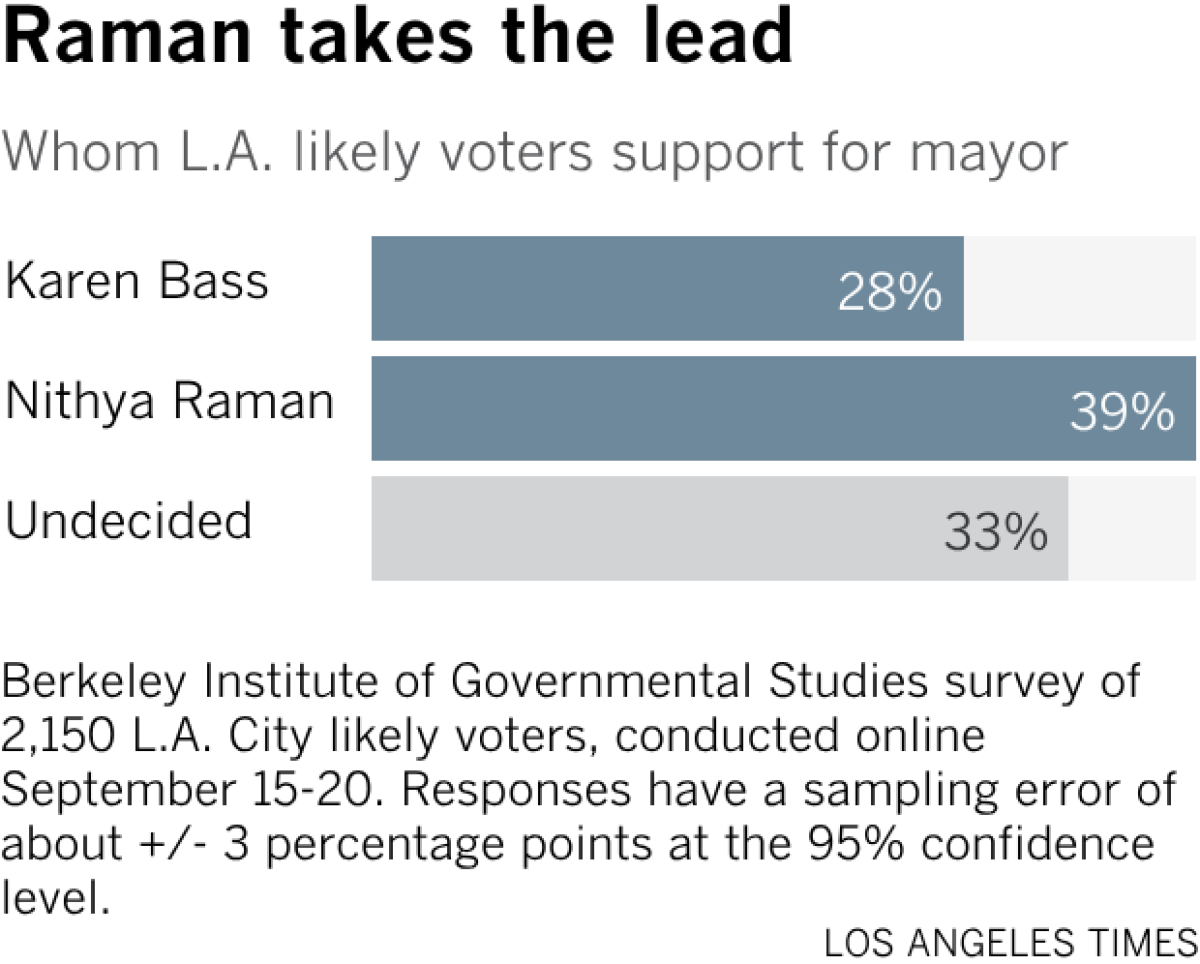
That’s why Mayor Karen Bass is paddling furiously, trying to keep her political career afloat. In the latest UC Berkeley-L.A. Times poll, Bass is at 26%, Nithya Raman at 25% and Pratt at 22%. That’s so tight, it appears that no one will get the 50% needed to win outright, and if we get a top-two runoff, it’s not clear who will go to the dance.

So as we close out the primary, with the election on Tuesday, five talking points come to mind.

Which candidate knows the city best?

Los Angeles has 114 distinct neighborhoods spread across 470 square miles (that’s 10 times the size of San Francisco), with an estimated 220 languages spoken. Diversity is a defining characteristic, and roughly half the population is Latino, which makes it a shame there’s no Latino candidate for mayor, especially given the raids and roundups by President Trump.

A mayor doesn’t have to speak six languages and know every corner of the city, but residents want to be seen and heard, and feel like they’re understood and represented.

Raman is well-versed on homelessness policy, and she’s spot-on about the need for greater urgency in problem-solving, but as my colleague Noah Goldberg reported, constituents in her district complain that they haven’t seen enough of her.

As I said, Pratt has wisely targeted municipal failure. But in the realm of outsider candidates with Republican credentials, Rick Caruso, who ran against Bass last time, was comfortable whether he was in the Valley, South L.A. or anywhere in between. And he easily connected with people. Would Pratt be a tourist in his own city?

By virtue of her job the last four years, Bass — who raised a blended Black and Latino family — knows the city best, although her unfavorability rating is a big problem.

What about the other candidates?

In the aforementioned poll, minister and housing activist Rae Huang had 9% and former educational technology businessman Adam Miller had 5%. Virtual unknowns, neither had a legit chance of winning, but they could be spoilers for one of the top three candidates.

I spoke to both, and if you’re undecided, you should read up on them before voting. On Huang’s website, the first words are “Homes are for people, not profit.” Miller wants to bring his success in the business world to City Hall, and when you consider his policy agenda along with his nonprofit work with veterans and homelessness, he’s a better candidate than Pratt.

But he wasn’t on a reality TV show.

Democrats ruined L.A. and California, right?

If only I had a nickel for every time a reader suggested that.

By 101 measures, Los Angeles is one of the great cities of the world and California has built the world’s fourth-largest economy while leading on climate change, so apocalyptic diagnoses are a bit off the mark.

Also, local elections are nonpartisan. You don’t run for mayor as a D or an R.

And yet it’s true that Democrats and their policies and sensibilities rule the day, and they have a lot to answer for in Los Angeles and in California.

But would the same critics suggest that in conservative cities like Fresno and Bakersfield, which have their own homelessness and other problems, Republicans are to blame?

When it comes to housing, poverty, healthcare and streets occupied by people who are addicted or mentally ill, the failures go back decades, touch all levels of government, and cross party lines.

Have I given up on Los Angeles?

When I pointed out that Pratt seemed unaware of these complexities, and of the structural limits of mayoral power, readers suggested he was rising to the challenge while I was giving up on L.A.

Not at all. I care about L.A. enough to hold its leaders to a higher accountability, and to scrutinize posers and pretenders who think they can do a better job.

My advice for the next mayor.

Fix what’s broken, celebrate what works and take responsibility for what doesn’t.

Now let me try one more time:

Spencer, give me a call.

You can’t tell us you had a conversation with God about running for mayor and not share more details.

Did God scold you for referring to the mayor as Karen “Basura,” which means trash in Spanish?

Did He say we should pull out of the ‘28 Olympics, or have any advice on how to fill potholes and fix sidewalks?

If you’re having regular conversations about City Hall with the Father, the Son and the Holy Spirit, we’re dying to know:

On homelessness, what would Jesus do?

steve.lopez@latimes.com

Source link

Steve Hilton and Spencer Pratt need Latinos, not Trump

With less than two weeks before the primary election, Steve Hilton is leading in the polls for governor, and Los Angeles mayoral hopeful Spencer Pratt is making the city’s progressive class sweat.

If the former Fox News commentator and the reality television bad boy move on to November’s general election, they’ll be running as conservatives in a super-blue state and city where most voters loathe President Trump.

The president endorsed Hilton last month, posting on social media that he “is a truly fine man, one who has watched as this once great State has gone to Hell.” On Wednesday, Trump said he wants Pratt to “do well … I heard he’s a big MAGA person,” before claiming that California elections are rigged and that he would have won the state two years ago “if we had Jesus Christ come down and count the votes” because “I do great with Hispanics.”

Trump was right about one thing — the importance of Latino voters. If Hilton and Pratt are to pull off historic upsets, they’ll need this bloc, which has emerged as a mercurial swing vote in local, state and national elections — but only if stirred into action by anger. And if ever there was a year for Latino anger, 2026 is it.

In recent years, Latinos in California have drifted rightward as they tire of Democratic policies, from L.A. City Hall to Sacramento. Rick Caruso captured a majority of the Latino vote in his unsuccessful bid for L.A. mayor four years ago, and there are more Latino Republicans in the state legislature than ever. Some of the most Latino areas in Southern California saw the biggest shifts toward Trump from 2020 to 2024.

Hilton has held town halls in small, Latino-majority cities across a state that’s about 41% Latino. He frequently appears alongside lieutenant governor candidate Gloria Romero, a pioneer in challenging disaffected Latinos to not always vote Democrat.

Pratt has shared AI-generated salsa and merengue songs that hail him as a savior and uses Spanglish when referring to Mayor Karen Bass as “Basura” — trash. He’s starting to roll out endorsements from Latino business groups and held a block party in South L.A. this week for which a Instagram post tried to draw supporters with the promise of a taco truck.

So if the candidates know that Latinos are essential to their long-shot campaigns, why the hell aren’t they running as far and fast from Trump as possible?

Two years ago, Trump — the most anti-Latino president since James Polkgrabbed a larger share of the Latino electorate than any Republican presidential candidate ever had. GOP leaders predicted that Latinos were finally theirs. But Trump annihilated that advantage by launching his deportation deluge. Now, he has turned off even some die-hard supporters by starting a war in Iran, which has further strained an already shaky economy.

President Donald Trump

Trump annihilated the advantage the GOP had with Latinos by launching his deportation deluge.

(Manuel Balce Ceneta / Associated Press)

A New York Times/Siena poll released this month found that only 20% of Latinos support Trump — the lowest during his two terms. A Pew Research Center survey, meanwhile, found that only 66% of Latinos who voted for Trump now approve of him, compared to 81% of white Trump supporters.

Instead of running away, Hilton and Pratt seem fine with hitching their prospects to this political Titanic.

Hilton sought and received Trump’s endorsement, arguing that it’s better to have a friendly relationship with the White House than the antagonistic path California’s elected leaders have chosen.

But most voters want no part of Hilton’s kumbaya. Proposition 50, a direct rebuke of Trump’s gerrymandering efforts in other states, passed with more than two-thirds of the vote last fall. A CalMatters analysis found that Latino-majority precincts voted in bigger numbers for the ballot initiative than for Kamala Harris two years earlier.

Hilton can promise Latinos his “Califordable” agenda and eat all the tacos he wants. But our economic malaise was caused in large part by Trump, who recently said he thinks about Americans’ financial struggles “not even a little bit.”

For Hilton not to decry such cluelessness is almost as ridiculous as his recent boasts that he — the British son of Hungarian refugees who became a U.S. citizen just five years ago — is the candidate of “legal” immigrants. That’s a callback to the days of Proposition 187, when Republicans obsessed with the state’s changing demographics turned off my generation of Latinos by demonizing our undocumented friends and family. The GOP was finally starting to emerge from the political wilderness with Latinos, but Hilton cozying up to Trump will drag the party back into that weak salsa place.

Pratt has been coyer on his thoughts about Trump, but at least he seems to realize that the president might be a liability. The Republican said his party affiliation doesn’t since the mayor’s race is nonpartisan. He has portrayed himself as focused solely on improving Los Angeles, telling CBS News, “I don’t do national politics. I don’t do tribal politics.”

But for someone who says he wants to make L.A. a world-class city, Pratt seems unconcerned about Trump’s assault on us, including last summer’s unchecked immigration raids and temporary occupation by the Marines and the National Guard. Rather than denounce those moves, Pratt has instead denounced L.A.’s sanctuary city ordinance and vowed to work with ICE and other federal immigration agencies to target bad hombres if he becomes mayor, even though a majority of those rounded up in the raids had no criminal history.

It’s as if Pratt’s understanding of Latino L.A. ends with an Erewhon burrito. He continually platforms supporters who portray L.A. as a multicultural wasteland. And when another mayoral candidate, City Councilmember Nithya Raman, posted Trump’s praise of Pratt on social media, he responded with a snippet of himself making a dismissive face during a debate.

But this is nothing to dismiss. For Pratt and Hilton to win, they need Latinos to believe in them. And why would we believe anyone who hitches their wagon, even a little, to Trump?

Source link

How Hollywood’s production crisis became a key issue in the L.A. mayor’s race

Los Angeles City Councilmember Nithya Raman, who serves the 4th District, makes her way across an empty, unnamed backlot, presenting her case to be the city’s next mayor.

“Studio lots like this one used to be filled with people, costumers, electricians, set medics, caterers, thousands of Angelenos making a living,” she says in the video posted on social media. “Now these lots are quiet. Since 2018, shooting days in the city have fallen by half.”

After telling voters this issue is “personal” (her husband is a TV writer and producer), criticizing Mayor Karen Bass’ leadership on the matter and outlining her own plans, Raman proclaims, “I’m running for mayor to make sure Los Angeles stays the film and TV capital of the world.”

Placing the concerns of the entertainment industry at the center of the city’s mayoral race would have been unthinkable even in the last election cycle. But the production crisis, which has rocked Hollywood and pummeled its workforce, has reached a critical juncture. The state of L.A.’s signature industry is now a political flashpoint alongside affordability, crime and homelessness in the upcoming election.

A person films an interaction with mayoral candidate Spencer Pratt

A person films an interaction between mayoral candidate Spencer Pratt and another person on his cellphone during a “Community Meet and Greet” event out of a house for sale on Long Ridge Avenue in a residential neighborhood of Sherman Oaks on Saturday.

(Etienne Laurent/For The Times)

In campaign ads, interviews and the recent televised debate, the top three contenders: incumbent Mayor Bass, former reality TV villain Spencer Pratt and Raman, have made the ongoing production slump a pivotal topic, highlighting their plans to revitalize the industry while deploying the issue to undercut one another.

For decades, elected officials have not had to focus on the film and TV business, let alone turn it into a campaign issue. It was simply a given that local production would continue to play a dominant role in the city’s economy as it has for more than a century.

But the cumulative effects of consolidation, runaway production to tax-friendly states and countries and the end of the streaming boom has caused Los Angeles to lose billions in economic activity, shed some 57,000 jobs over the last four years and led to the closing of more than 80 film and television production service businesses across the city since 2022.

“For us, ‘save Hollywood’ is more than a slogan and more than headline. It is what needs to be done,” said Pamala Buzick Kim, one of the co-founders of Stay in LA, a grassroots campaign aimed at increasing film and television production in Los Angeles.

To be sure, the biggest driver of where studios and producers film are state and federal tax credits, over which the city has no control.

But Buzick Kim and others argue that “there is lots the mayor can do, hand-in-hand with the City Council.”

Mayor Karen Bass walks with Nilza Serrano during Avance's politics and tacos event

Mayor Karen Bass, center, walks with Avance Democratic Club President Nilza Serrano, to the right of Bass, during Avance’s politics and tacos event at Ernest E. Debs Regional Park in Los Angeles on Saturday.

(Christina House/Los Angeles Times)

For starters, say filmmakers and advocates, much can be done to tackle the city’s sclerotic bureaucracy, onerous regulations and a slow and costly permitting process that has pushed filmmakers to flee to friendlier and cheaper locales.

While steps have been put in place recently, including a pilot program offering reduced-cost filming permits for shoots that demonstrate a “low impact” to the surrounding community, many complain such steps have come too little and too late.

A man examines woodwork in a shop

Scott Niner, president and owner of Dangling Carrot Creative, checks on woodwork being produced at his shop in North Hollywood.

(Jason Armond/Los Angeles Times)

“The industry is in collapse and people have been talking about fixing things for years, but all we get are incremental little changes,” said Ed Lippman, a location manager of 34 years who lives in Sherman Oaks and has worked on such shows as “ER” and “The X-Files” and movies including “Galaxy Quest.” “And if the city is not being business-friendly, the business will go elsewhere.”

Compounding the problem, the Los Angeles area has more than 100 jurisdictions, many of which have their own set of rules and regulations regarding filming.

“There needs to be universal standards,” said Travis Beck, a location manager for commercials, small films and music videos. “Burbank is different from Glendale, which is different from Pasadena.”

The recent kerfuffle over filming “Baywatch,” the lifeguard reboot at Venice Beach, underscored both the efforts to bring production back to L.A. — enticed by a $21-million tax credit — and the complex, baffling red tape required to film here.

When shooting began in March, the production encountered a number of hiccups, including that it needed nearly double the parking space it had received a permit for, which was not part of the original approvals.

An anonymous crew member claimed on Facebook that government restrictions had forced production to relocate from Venice Beach. Production staff denied they had relocated. However, the incident prompted a backlash, becoming a rallying cry over L.A.’s burdensome filming bureaucracy.

The “Baywatch” team quickly met with city and county officials and resolved the issue, securing an agreement for a 20% parking discount from the city, and the mayoral candidates used it as an opportunity to score political points.

Pratt slammed the city’s permitting problems.

“LA turned its back on Hollywood — now the golden goose needs CPR,” he wrote on his Substack.

Bass highlighted her administration’s leadership on the matter.

“The City of Los Angeles will always clear bureaucratic barriers, making it easier and more affordable to film in the entertainment capital of the world,” she wrote on X last month.

On April 21, the mayor unveiled programs to offer productions 20% discounts on city-owned parking lots and other equipment, reduced filming fees at places like the Griffith Observatory and reopened the Central Library for filming. Last August, she appointed Steve Kang, president of the Los Angeles Board of Public Works, as the city’s film liaison.

Raman has pledged her support for expanding the state’s $750-million tax incentive program, streamlining permitting and lowering fees and eliminating those for small productions. She has also said she will establish a dedicated city film office with a liaison who understands production.

Nithya Raman speaks to a crowd outdoors behind Nithya for Mayor chalk message on ground

Councilmember and mayoral candidate Nithya Raman speaks to a crowd at the “Families for Nithya” event at Vineyard Recreation Center in Los Angeles on Saturday.

(Myung J. Chun/Los Angeles Times)

“Los Angeles is losing Hollywood,” Raman said in a statement. “Not because productions want to leave, but because we’ve made it too hard for them to stay.”

On his Substack and various podcast interviews, Pratt has promised to slash location fees in half, speed up permit approvals, reduce on-set city staff for the majority of productions and waive all fees for shoots with budgets under $2 million.

All three candidates have attacked one another over their approach to Hollywood.

Pratt and Raman have said Bass moved too slowly to address spiraling production and retain film jobs, saying she enacted measures only recently as the mayoral race was heating up.

Speaking on the Monks & Merrill podcast, Pratt criticized Bass’ moves to cut costs to film at the Griffith Observatory, saying, “Who needs that shot right now with the homeless poop all around it?”

The incumbent mayor has defended her administration’s record with the entertainment industry.

Bass and Pratt have taken Raman to task, calling her out for what they say is her lack of advocacy during her time on the City Council.

“She feels very strongly about it. But never offered one motion on the industry, and when motions came up on the industry she either recused herself, or got up and walked out,” said Bass during a debate this month.

Citing a potential conflict of interest over her husband’s work in television, Raman refrained from voting on several motions related to Hollywood.

Many working in the industry would like to see full-throttled support coming from the mayor’s office that will get results. They note how New York City has successfully promoted itself as a leading film destination over the years. (Kang, the city’s chief film liaison, said the city is working on a similar marketing campaign to promote filming that will launch by early fall.)

“For all the talk about, ‘We need to support and bring back filming,’ if they just did basics like lowering the fees and simplifying the process … that would actually help people and get things produced,” said Chris Fuentes, 66, who worked for 30 years as a location manager until he retired last year.

“We’ve heard a lot of great things, but not all things are possible in the mayor’s remit,” said Buzick Kim, noting that tax incentives are a state and federal issue.

Still, she said, “the mayor must understand that Hollywood needs to be made a priority and to find and create inspired thinking to make things easier and cheaper.”

Kang agrees, but says there are limits to what the mayor can achieve.

“We definitely can do a lot to really open up the entertainment industry, but at the same time, we recognize the larger impact needs to come from Sacramento and Washington, D.C., because L.A. just does not have the resources to compete with other jurisdictions in providing millions of dollars in tax incentives,” he said.

For most working in the industry, they just want city leadership that will execute on more than just talking points.

“This is the birthplace of cinema,” Beck said. “It shouldn’t be so hard to film here.”

Source link