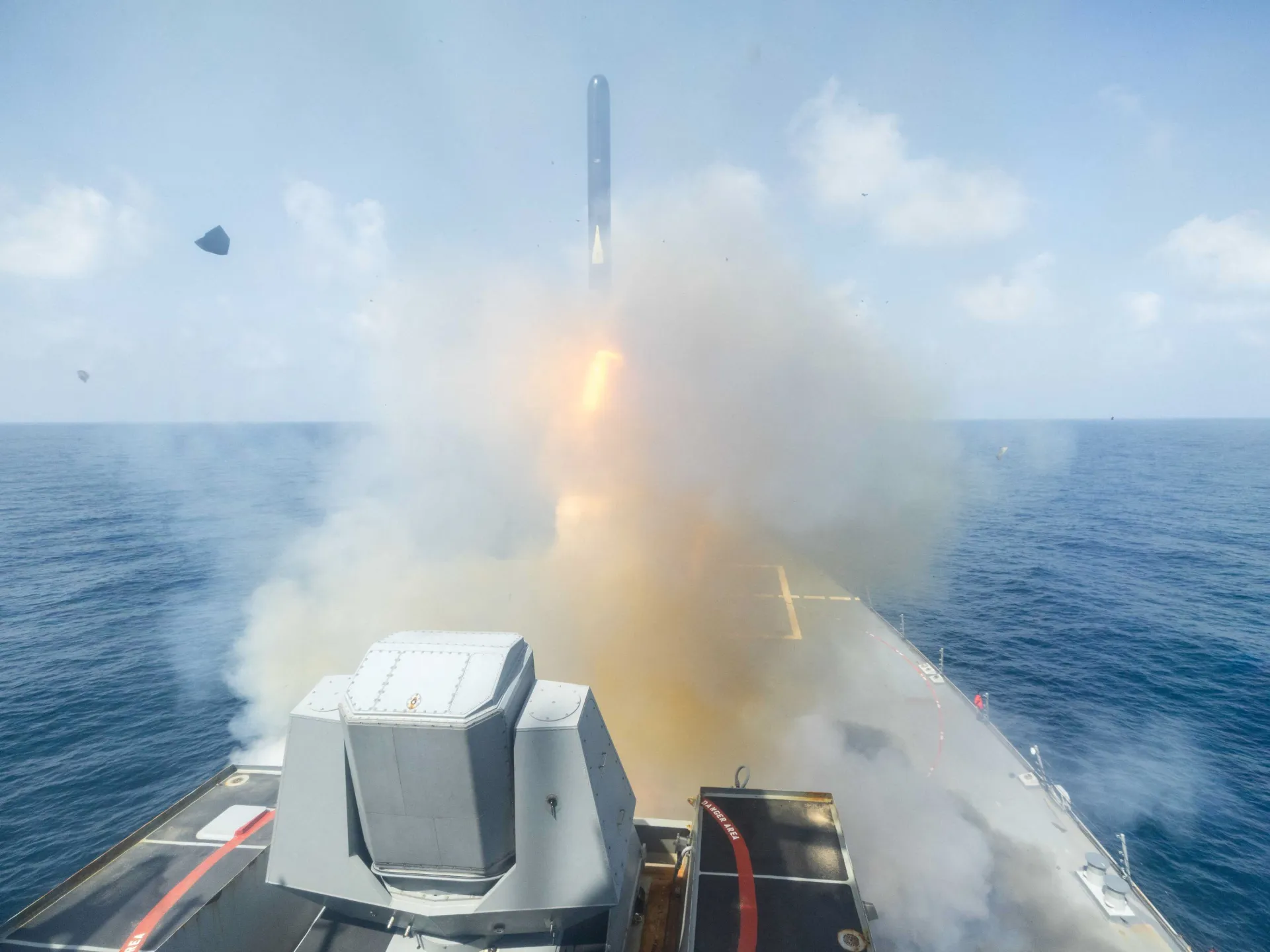
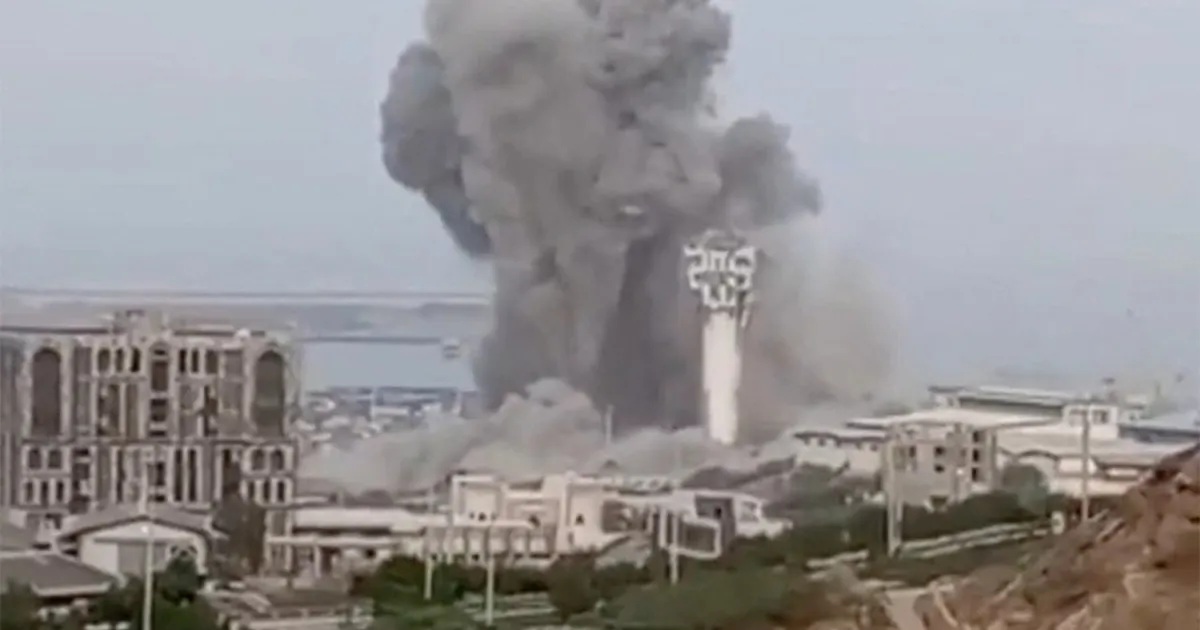
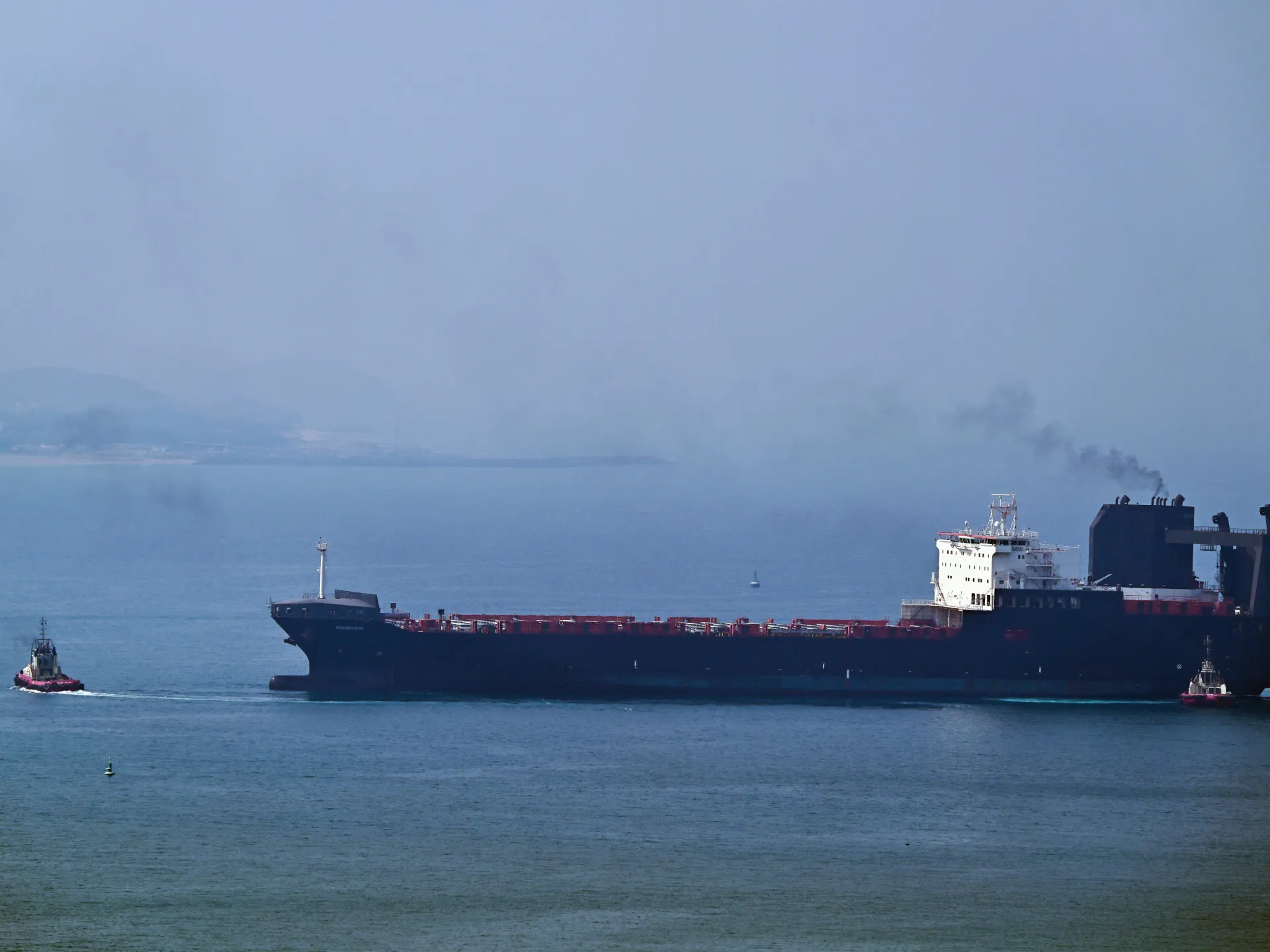
US says its forces ‘successfully’ completed a wave of strikes against Iranian targets, accusing the IRGC of attempted attacks on shipping and US service members.
Six months into the war on Iran, the largest US oil companies have posted their biggest profits since 2022, selling less oil at far higher prices. But the conflict is also putting their longstanding Gulf investments at risk, exposing the industry’s uneasy balance between wartime gains and mounting geopolitical vulnerability for investors worldwide.
Since the war began on February 28, Brent crude has risen about 22 percent, from $72 to $88 a barrel.
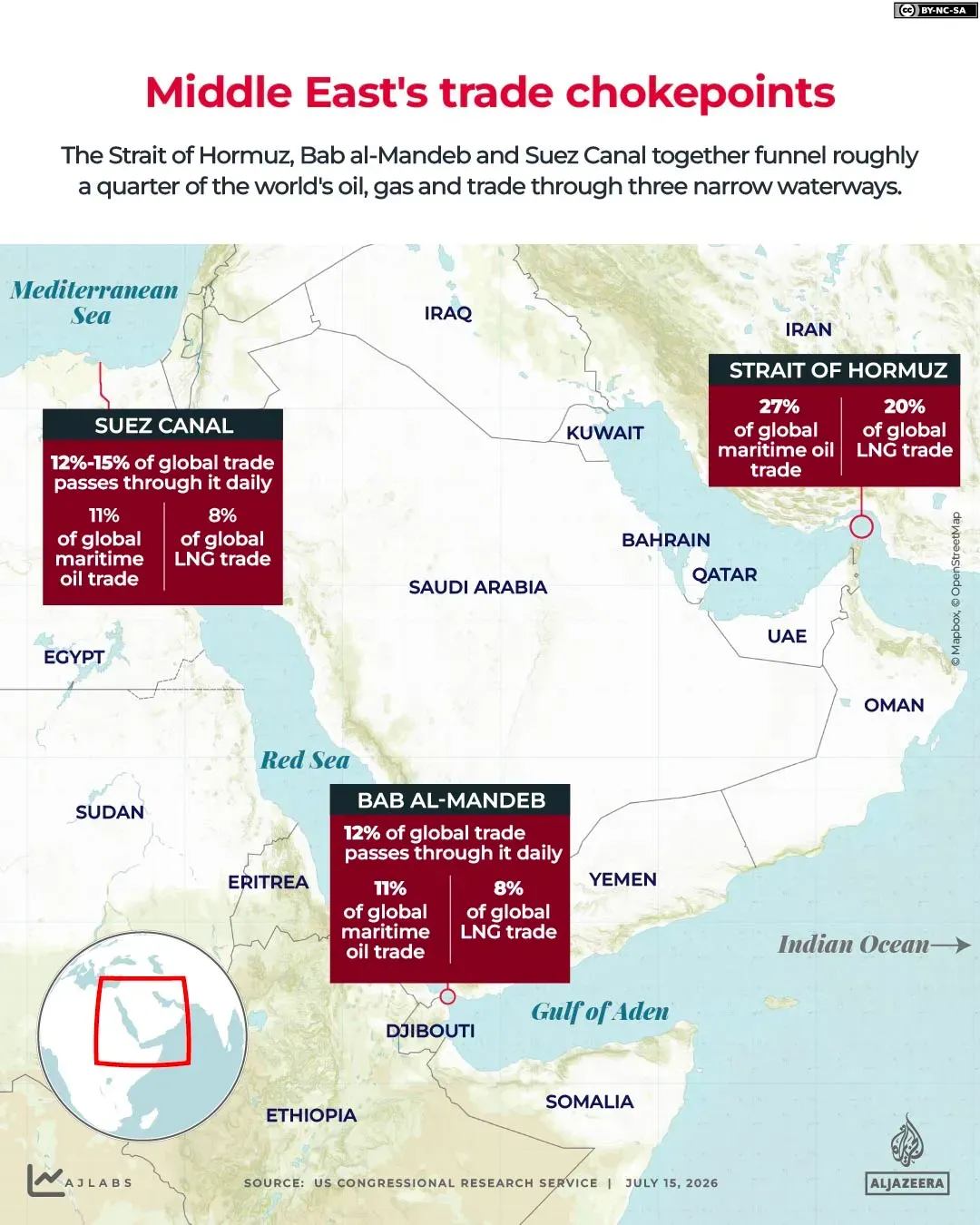
The Strait of Hormuz – through which one-fifth of the world’s oil and natural gas was shipped before the war – remains largely closed to commercial traffic, though Iran and Oman agreed last week on a temporary maritime route. Iran says the strait will not fully reopen until the United States fulfils its commitments under a lapsed interim peace deal, leaving longer-term security and management arrangements unresolved.
In the absence of a lasting resolution, the disruption is likely to continue supporting higher energy prices and creating windfalls for producers, despite placing energy companies’ regional assets and future projects at greater risk.
Rahul Choudhary, vice president of Upstream Research at Rystad Energy, an independent energy research company, said the conflict has already reduced the amount of oil and gas US energy firms are drawing from the Gulf region.
“Overall we expect US companies’ share of gas supplies [from the region] to fall by around 40 percent this year compared to last year [and] the share of oil supplies to drop by 30-35 percent,” he told Al Jazeera.
While higher commodity prices have helped offset the immediate financial impact, Choudhary said prolonged disruption is likely to delay major projects and weigh on the future growth plans of US oil and gas companies with a presence in the region.
Who has profited?
The surge in the oil price since early March, when Iran first closed the Strait of Hormuz, has delivered a windfall for oil companies, but gains have been tempered by challenges in the Gulf.
Chevron has limited exposure to Arab Gulf supply disruptions, with the region accounting for just 5 percent of its total global output. The group reported its highest quarterly profit in six years of $12bn in adjusted earnings on July 31.
Gas prices at a Chevron station in downtown Los Angeles, California, US [File: Kirby Lee-Imagn Images/Reuters]
ExxonMobil, by contrast, has been far more exposed to disruption in the Middle East, with the closure of the Strait of Hormuz and Iranian attacks on US-linked infrastructure in the region affecting its operations in Qatar and the United Arab Emirates (UAE), which together account for 20 percent of its global equity upstream supply, according to Choudhary.
“We already saw in H1 [the first half of] 2026, the company’s upstream earnings dropped by around $1.3bn compared to H1 2025, due to lower upstream volumes from the Middle East. However, the shortfall was covered well by higher commodity prices,” Choudhary said.
The contrast highlights a broader divide between those US energy companies which have benefitted from tighter global supply – and the corresponding rise in the oil price – and those with assets, partnerships or operations in the Gulf at greater risk of disruption caused by recent attacks on energy facilities.
Where are US energy companies exposed in the Gulf?
The Gulf’s energy sector is dominated by state-owned giants such as Saudi Aramco, Abu Dhabi National Oil Company (ADNOC) and QatarEnergy.
Although these national oil and gas companies retain control over the region’s reserves and core infrastructure, US energy firms have carved out strategic positions across the region.
US companies generate revenue through stakes in production assets, joint ventures, production agreements, refining and petrochemical projects, as well as through long-term contracts to provide equipment, engineering and operational expertise.
ExxonMobil has some of the largest US commercial interests in the Gulf.
The company has been a major partner in Qatar’s LNG sector for decades, holding stakes in several QatarEnergy LNG joint ventures linked to the expansion of the North Field. The field is the Qatari section of the North Field-South Pars structure, the world’s largest natural gas field, which Qatar shares with Iran, where it is known as South Pars. ExxonMobil also holds an interest in the UAE’s Upper Zakum offshore oilfield alongside ADNOC.
(Al Jazeera)
Similarly, ConocoPhillips joined the North Field East (NFE) and North Field South (NFS) expansion projects with QatarEnergy in 2022 to increase export capacity at Ras Laffan.
The US group, Occidental Petroleum, has become one of the largest foreign producers in Oman, operating the Mukhaizna heavy oilfield, the country’s biggest producing oilfield. It also holds interests in UAE gas and pipeline projects.
Chevron maintains a smaller but strategically important Gulf footprint. Through Saudi Arabian Chevron, the company operates oil assets in the Saudi-Kuwait Partitioned Zone, including the Wafra field. In July, it said it was exploring potential routes to move Iraqi crude to Mediterranean export terminals, which could reduce reliance on the Strait of Hormuz.
Where have attacks on energy facilities taken place?
According to the Armed Conflict Location and Event Data (ACLED), a US-registered independent conflict monitor, Iran and Iran-backed groups in the region have carried out at least 172 attacks on nonmilitary infrastructure across the six Gulf Cooperation Council (GCC) countries since the US and Israel launched their war on February 28.
Energy infrastructure has been hit hardest, with oil and gas facilities, along with power plants and desalination plants, accounting for nearly half (48 percent) of all strikes on nonmilitary targets.
The UAE, Kuwait and Bahrain have suffered the highest number of successful strikes, with the majority aimed at oil and gas facilities.
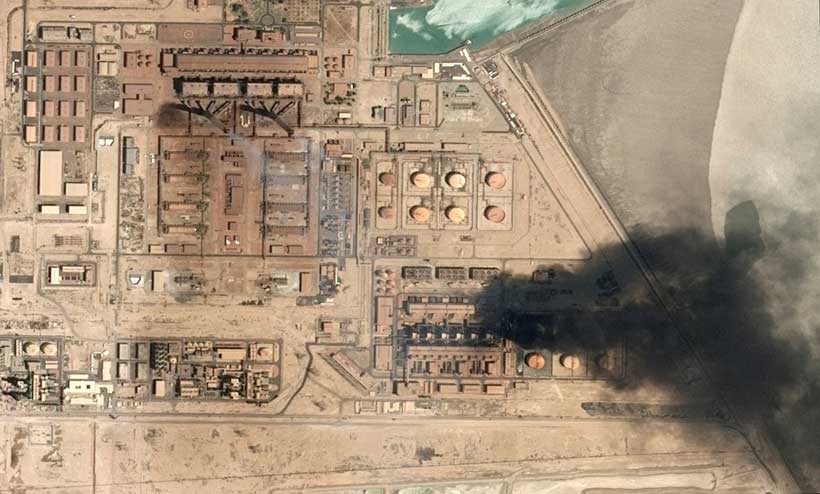
Among the sites that have been struck are Kuwait’s Mina Abdullah and Mina al-Ahmadi refineries, the Bahrain Petroleum Company oil refinery, and ADNOC’s al-Ruwais Industrial City and the Habshan gas complex.
There have also been several strikes on Saudi Aramco facilities, most recently a drone strike on July 27 on the Abqaiq processing complex, one of the most critical nodes in Saudi Arabia’s oil infrastructure, processing more than seven million barrels of oil per day.
Nasser Khdour, Middle East assistant research manager at ACLED, said: “Oil and gas facilities, power plants and water desalination plants are likely to remain key targets for Iran because disruption to these sectors can increase economic pressure on Gulf states, while disruption to global energy supplies increases prices and pressure on the US during periods of escalation.”
In March, a drone attack close to the Saudi Aramco-ExxonMobil SAMREF refinery in Yanbu disrupted oil loading at the city’s Red Sea port. While the attack had only minimal operational impact, it highlighted the vulnerability of US-linked energy assets in the region.
Qatar’s Ras Laffan Industrial City, the world’s largest LNG export hub, which hosts major joint ventures between QatarEnergy, ExxonMobil and ConocoPhillips, also came under repeated attack in March, at one point forcing the plant to halt production entirely. In June, an explosion as a result of a “technical malfunction” on Qatar’s Barzan gas project, where ExxonMobil holds a stake, killed at least 13 people.
“In terms of gas assets being impacted, major blows have been [dealt to] companies [that are] part of LNG projects in Qatar: ExxonMobil and ConocoPhillips,” Choudhary said.
He added that ExxonMobil’s share of LNG supply from Qatar is expected to fall significantly this year to about four million tonnes compared with 13 million tonnes last year, while ConocoPhillips has also experienced reduced volumes to one million tonnes this year compared with 2.5 million tonnes last year.
The attacks on Qatar’s LNG infrastructure could have longer-term consequences. Damage to LNG trains at Ras Laffan could take years to repair, according to QatarEnergy, while delays to Qatar’s North Field expansion projects could push back planned supply growth.
“The attack on LNG trains 4 and 6 at Rasgas damaged roughly 13 million tonnes of capacity, which will take anywhere between three to five years to come back online with a total repair cost estimate of around $3bn,” said Choudhary.
He added that the second most impacted gas project has been the Shah gas project in the UAE, in which Occidental Petroleum has a 40-percent stake and where drone attacks in March caused a fire at the gas plant that halted operations.
The conflict has also affected ExxonMobil’s oil interests in the UAE, Choudhary said. Production from Upper Zakum, where ExxonMobil has a 28 percent stake, was reduced between March and May when export routes were disrupted, limiting the ability to move offshore crude.
Beyond the UAE, the most significant impact on US companies’ oilfield operations played out in Iraq. A drone attack hit the Sarsang oilfield in March, followed by an explosion at one of its storage facilities in April, together causing damage to the field.
Looking ahead, Choudhary said higher prices could support cash flows, but prolonged conflict risks could threaten future growth. ExxonMobil’s $10bn Upper Zakum and Qatar LNG expansions could face delays, while ConocoPhillips remains exposed through investments in higher-risk markets, including its planned 42-percent stake in BP’s Kirkuk operations in Iraq.
“For companies like Chevron and Occidental Petroleum, whose presence are in less volatile countries like Israel and Oman respectively, the impact of escalations will not be as severe, as we have not seen significant disruption in these countries,” said Choudhary.
US oilfield service companies in the Gulf
Oilfield service giants, including US firms SLB (formerly Schlumberger), Halliburton and Baker Hughes, provide drilling technologies, equipment and operational expertise across the Gulf, supporting Saudi Aramco, ADNOC and QatarEnergy.
For oilfield service companies, the outlook is mixed, according to Chinmayi Teggi, energy research analyst at Rystad Energy, a research group. While higher oil prices and energy security concerns could lift demand over time, near-term margins remain under pressure from higher logistical costs, supply-chain disruptions and delayed projects.
“For the Big Three (SLB, Baker Hughes and Halliburton), the conflict continues to weigh on regional revenues,” Teggi told Al Jazeera, adding that second-quarter Middle East revenues were down 8-10 percent compared with the previous year across the three companies, while higher oil prices meant revenues were higher in other geographies.
However, a recovery in suspended operations and production could help drive growth into 2027.
For US companies, therefore, the Gulf remains both an opportunity and a risk.
“The impact on US companies will depend on the extent of exposure and countries in which these companies are present,” Choudhary said.
Their investments have secured US access to some of the world’s most important oil and LNG projects, but the conflict has exposed the risk of operating in a region where energy infrastructure has become increasingly vulnerable to geopolitical conflict.
US President Donald Trump has repeatedly warned Iran against restricting access to the Strait of Hormuz, arguing that the waterway must remain open to global commerce.
But for companies with billions of dollars invested across the Gulf, the challenge isn’t just about keeping shipments moving – it is ensuring the infrastructure remains secure, they say.
Trump says all mines have been cleared from Strait of Hormuz’s international waters and that Tehran received warnings that ships laying new mines will be ‘destroyed’.
US Treasury Secretary Scott Bessent announces new sanctions on Tehran to sever financial support for the regime, urging US allies to support the measures.
Omani and Iranian foreign ministers hold a call as Washington prepares economic sanctions amid ongoing shipping disruptions in the Strait of Hormuz.
Published On 22 Aug 202622 Aug 2026
Iranian President Masoud Pezeshkian has called for an end to the months-long war with the United States, stating that Tehran holds a position of strength as diplomatic talks remain stalled.
“It is better that we bring the war to an end now as we are in a position of power and dignity,” Pezeshkian said in a meeting with doctors on Friday. “The whole world acknowledges our victory and emphasises that America has attacked our schools, hospitals and infrastructure in violation of all regulations and is hated around the world.”
Recommended Stories
list of 3 itemsend of list
Pezeshkian – whose authority as president is ultimately subordinate to Iran’s Supreme Leader Mojtaba Khamenei – also defended the June memorandum of understanding agreed with Washington against hardline domestic critics in parliament, who accused his administration of giving concessions to the US.
“They cannot find even a single clause in this agreement that indicates capitulation. All the commitments concern the other side,” he said.
However, days after the memorandum of understanding expired, Iran’s military leadership has warned that the country remains ready to strike back against any new threats.
“With preparedness across land, sea, air, air defence and cyberspace, Iran’s armed forces will respond to the enemy’s new threats with crushing, punishing and devastating responses,” Major-General Ali Abdollahi, chief of staff of Iran’s armed forces, was quoted as saying by Iranian media.
Strait of Hormuz
Meanwhile, Omani and Iranian foreign ministers discussed in a phone call on Friday ways to create suitable conditions for resuming dialogue and negotiations, as well as developments affecting navigation in the Strait of Hormuz, according to Oman’s state news agency.
Tehran continues to keep the key waterway partially shut while Washington persists with a naval counterblockade. Reports in US media indicate the US navy has been organising and protecting secret convoys of tankers through the southern sector of the strait, enabling between five and 10 million barrels a day of oil to be exported.
In Washington, President Donald Trump expressed scepticism over Tehran’s willingness to negotiate, telling reporters when asked if US military options with Iran were limited: “It just means that we’re seeing what happens.”
“We have total control of that entire region having to do with the Strait of Hormuz, and that means well into it, the land areas. So, they would love to make a deal, but they’re not ready to make the right deal, in my opinion,” Trump added.
He has also warned of economic consequences against any country that provides “any type of lifeline to Iran”.
The comments came as US Treasury Secretary Scott Bessent warned that Washington would “collapse” the Iranian government with a sanctions campaign.
Bessent will hold a news conference at the Department of the Treasury on Monday, where he is expected to outline planned sanctions against Iran, marking a shift by the Trump administration towards economic rather than military pressure as the war nears the six-month mark.
Iran’s Ministry of Foreign Affairs has already condemned the US plan, accusing Washington of “economic terrorism” and stating that “the instigators of these sanctions are deserving of trial and punishment”.
China’s Ministry of Foreign Affairs spokesman Lin Jian also criticised the US measures, stating that “sanctions and pressure will not help resolve the issue” and urging all parties to “take responsible measures and resolve the problem through political and diplomatic means”.
US Treasury Secretary Scott Bessent says Washington will impose its ‘toughest sanctions in history’ to ‘collapse’ Iran’s government, warning of consequences for countries that maintain economic ties with Tehran.
Weekly insights and analysis on the latest developments in military technology, strategy, and foreign policy.
“I want to talk a little bit about forward [forces] and air base defense. Let’s be clear, we got our rear-end handed to us from drones and other vehicles, aerospace vehicles, if you will, including three F-5s that took off in Iran and flew low level and dropped bombs on an airbase,” retired U.S. Air Force Gen. Glen VanHerck just declared during a panel discussion today centered on counter-drone defenses at the annual Space & Missile Defense (SMD) Symposium in Huntsville, Alabama, at which TWZ is in attendance. Before his retirement in 2024, VanHerck served as head of U.S. Northern Command (NORTHCOM) and the U.S.-Canadian North American Aerospace Defense Command (NORAD).
“That’s embarrassing as an airman to me to say that happened,” VanHerck added, noting that this was the first time in decades U.S. forces had been subjected to an aerial attack of this kind.
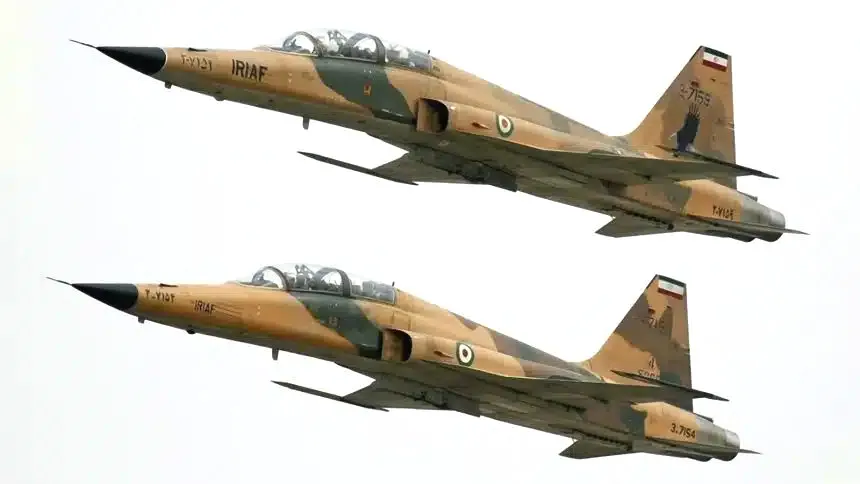
A series of reports, as well as unconfirmed claims from Tehran, state that Iranian F-5s targeted Camp Buehring in Kuwait on an extremely dangerous low-level bombing mission. The attack reportedly came on or around March 1, just three days after U.S. and Israeli forces began launching combined strikes on Iran.
A stock picture of a pair of Iranian F-5s. Iranian quasi-state media
At the time of writing, the U.S. government still does not appear to have officially confirmed the Iranian F-5 strikes on Camp Buehring. TWZ has reached out to U.S. Central Command (CENTCOM) in light of VanHerck’s remarks today, and the command declined to comment.
NBC News was first to report on this attack in a story in April, citing anonymous U.S. officials. At that time, the outlet also said only that a single Iranian F-5 had struck Camp Buehring. American forces have been present at this base continuously since the lead-up to the invasion of Iraq in 2003.
In June, Iranian state media outlet PressTV aired a segment with additional claimed details about the operation, as well as interviews with what were said to be the pilots who took part. That report said that a trio of heavily refurbished Iranian F-5s, known locally as Kowsars, had been sent on the mission. Iran acquired a fleet of 166 F-5E/Fs from the United States in the 1970s under the regime of the Shah. How many of those jets were still operational to any degree when the latest conflict broke out on February 28 is unclear. The Iranian Air Force was heavily targeted by U.S. and Israeli forces from the start.
According to PressTV, the F-5s flew to Kuwait from Iran at extremely low altitudes, at times below 50 feet, and at high speed to evade detection, including by E-3 Sentry Airborne Warning and Control System (AWACS) jets flying above. The pilots maintained radio silence the entire time.
Iranian Pilots Shocking Revelation:
– During recent Iran-US war, Iranian Pilots used decads old F-5 aircraft to bomb US Base in Kuwait.
– F-5 flew about 15m above the surface to avoid detection and the pilots already had done homework regarding the engagement envelope of US… pic.twitter.com/EYsqxz9iHA
The PressTV report also claimed that pilots followed a route specifically designed to avoid Patriot surface-to-air missile batteries and other air defenses at Camp Buehring. Though this remains unconfirmed, it is worth noting that Patriot has known limitations when it comes to its engagement envelope. New capabilities are being developed for the system now to expand its flexibility to address targets approaching from different vectors, as well as ones that have already passed overhead. Without the aid of some type of look-down sensor capability, ground-based air defense systems more broadly cannot see through the horizon or topography, either.
Many questions remain about how Iranian F-5s would have been able to ingress and egress from Kuwait unscathed, and successfully drop unguided bombs on Camp Buehring in the process. It’s unclear where the jets launched from, and it is very possible they needed to carry significant extra fuel in external tanks just to have made the trip to and from Iran in the first place. This would also have impacted their top speed and capacity to carry ordnance.
As an aside, a pair of Iranian Su-24 Fencer swing-wing combat jets also attempted to strike targets in Qatar on March 2, but that would have been a much shorter trip across the Persian Gulf. Those jets were also shot down by Qatari F-15s before they could reach their destination.
Qatari MoD released statement noting that the QEAF downed two Iranian Su-24MK strike aircraft. Would be interesting to know which asset(s) shot them down.
In addition to the sensors associated with Patriot and other air defense systems on the ground, as well as E-3s in the air, the U.S. military has spent years developing a more integrated air and missile defense network with allies and partners across the Middle East. It is also worth noting here that Iran very actively targeted air and missile defense radars in the region early in the conflict, something we noted was its own separate wake-up call, as you can read more about here. This raises a question of what else Iran may have brought to bear in support of this operation. Iranian forces could have launched additional missile and/or drone strikes against sensors, command-and-control nodes, and other sites to help clear the way. Electronic warfare, cyber attacks, and/or deception of various kinds could have been employed, as well.
During the panel today, VanHerck said he did not believe any of this should have come as a surprise, and that it speaks to larger issues surrounding base defense facing the U.S. military today.
“People are like, ‘How come that happened? We got surprised.’ No, we didn’t get surprised,” he said. “What happened was we had two services pointing fingers at each other, and nobody made a decision on whose mission and role responsibility that was, candidly.”
Whether VanHerck’s comments here reflect his specific understanding of what happened during the attack on Camp Buehring in March, or if he was speaking more generally, is unclear. The two services he refers to here are the U.S. Air Force and the U.S. Army. As part of the delineation of official roles and responsibilities after the Air Force was split from the Army in 1947, the latter service was given the lead role in defending both services’ bases against aerial attacks. Today, the Army has a broader responsibility for ground-based air and missile defense across the joint force, abroad and at home, as well.
“The department needed to say it is this service or that service’s responsibility moving forward,” VanHerck continued today. “I’m not taking sides in that. The bottom line is, we didn’t make the decision, we accepted risk, and now we’re paying the price of that risk that we accepted, candidly.”
Now, “the Air Force chief has stood up and said, ‘Okay, I’m going to take that mission on,’” VanHerck also noted. “What we can’t have happen in the next year is a bifurcated solution where you have Patriots and THAADs [Terminal High Altitude Area Defense systems] operating up here, and you have counter-drone … down here, and they’re not fusing data and sharing C2 [command and control] and collaboration. That can’t happen, and we’ve got to make sure we get together and don’t allow that to happen.”
When it comes to Iran’s reported F-5 attacks on Kuwait earlier this year, much remains unknown and unconfirmed. However, it is certainly the opinion of retired Gen. VanHerck that it should be taken seriously and speaks to the urgency with which much bigger problems with the U.S. air and missile ecosystem need to be addressed.
Kuwait has since the beginning of the Iran War in February been targeted by Iranian drones and missiles1,400 times. Why has this state—smaller than the US state of New Jersey—beentargeted more than any of its larger neighbors including Bahrain, Qatar, and the United Arab Emirates?
A military node
This question takes us all the way back to1991 when the US intervenes when Iraq under Saddam Hussein invades Kuwait. In return, Kuwait has since hosted one of the the largest US armies in the Middle East of13,000 troops, and has thefourth biggest deployment of the US military globally. Furthermore, Kuwait is one of five U.S. Army Prepositioned Stocks (APS) sites across the world— a cornerstone of the US’ global military strategy as it allows for rapid deployment and display of influence. And not only does Kuwaitnot charge the US for its land use, or restrict US troop movements on its territory—unlike most other host countries—but indeed pays the US for its troop presence, and subsidies energy and water costs for the military bases.
A geostrategic asset
Stay ahead of the geopolitical week.
MD Briefing delivers expert analysis across five global fronts — the Indo-Pacific, energy, geoeconomics, European security, and the Middle East — every Monday morning. Free.
In exchange, Kuwait’sgeostrategic location on the Arabian peninsula and along the air corridor between Asia and Europe makes the country an important location for the US to secure its interests and exert influence in the region and beyond. Indeed, the US has designated Kuwait as aMajor Non-Nato Ally since 2004, and has located its biggest air logistics facility in the Middle East in conjunction with Kuwait international airport. Thus, Kuwait has proven a key logistical hub for US military operations in the region including against the Islamic State and during the withdrawal from Afghanistan in 2021.
Furthermore, Kuwait holds7% of the world’s oil reserves, reinforcing its importance for the US and other oil consuming countries, while also making it strategically vulnerable to Iranian attacks onenergy plants in late July, as this adds to the ongoing energy insecurity created by the closure of the key oil trade route through the Strait of Hormuz.
The end of diplomatic balancing?
Despite these far-reaching strategic links with the US, Kuwait has long maintained a diplomatic balancing act, refusing to normalise relations with Israel while simultaneously refraining from condemning the Iranian regime. Moreover, Kuwait has often assumed the role ofneutral mediator in the Middle East. For example, Kuwait mediated the 2021rapprochement between Qatar, Saudi Arabia, Bahrain, the United Arab Emirates and Egypt, and has contributed to peace efforts inYemen. In addition, Kuwait has been muchmore cautious in its statements concerning the Iranian regime, unlike its vocally critical, yet less targeted neighbors such as the United Arab Emirates, and has even refused to allow the US to use military bases in Kuwait forlaunching attacks on Iran.
Geographic liabilities
Even so, Kuwait has fallen prey to its geography. For one, its geographical proximity to Iran makes Kuwait a comparativelycheap and easy target for Iranian missiles, while its lack of naturally occurring fresh water and consequentreliance on desalination provides Teheran an additional pressure point, as illustrated by Iranian attacks ondesalination plants in late July. Furthermore, its proximity to Iraq has exposed it to attacks byIraqi Shia militias, allied with Teheran.
And the risk of further attacks in the future is high. On1 August, Iranian Foreign Minister Abbas Araghchi declared that it would react ”decisively” against any US strikes, and warned Gulf states against permitting the US and Israel to use bases on their territories to launch attacks against Iran. Similarly,Iraq announced that its military forces stood ready to ‘thwart any attempts at targeting neighbouring countries within our regional sphere.’ Thus, recent developments suggest that Kuwait might no longer be able to remain an independent diplomatically oriented actor that can stay out of the conflicts in the Middle East.
Ideology
While Iran’s official rationale for the attacks has been to target US military targets and assets, the attacks on energy and desalination plants are neither; these are civilian infrastructures. Hence it is Kuwaiti civilians—not the US military capacity—that bear the brunt of the attacks. This suggests that Iranian attacks have not only immediate military objectives in context of the current war, but also underlying psychological and ideological motives, as these attacks can be seen as a way of scaring countries that go against Iran’s exhortations—reiterated since 1979–to its Gulf neighbors to cut ties with the US. In addition, the attacks expose the limitations of US security guarantee, and undermine the credibility of the US promises of stability and protection to its allies.
A change of strategy
Consequently, Kuwait may pivot toward building up more national military defence capabilities, as thedeterrence guarantee that the well-accommodated US presence was supposed to provide has ostensibly failed, while Kuwait’slack of domestic military resources to retaliate further enticed Iranian attacks.
Hence, it appears that the security order in the Middle East is set to become even more fragile, with the US increasingly proving incapable or unwilling to ensure what has long been considered a stabilising presence, and with regional actors increasingly divided and polarized, making neutral mediation harder.
BRITS have now been advised against travelling to two countries in the Middle East.
It comes one month after the travel ban was lifted, but an escalation of conflict between the US and Iran means the rules have been put back in place.
Travel advice to two countries in the Middle East has been changed by the FCDOCredit: Getty The FDCO advises against ‘all but essential’ travel to Bahrain and KuwaitCredit: trabantos
The Foreign, Commonwealth & Development Office (FCDO) has advised “against all but essential travel” to both Bahrain and Kuwait.
The travel warning for travel to Bahrain was lifted on June 18 after being in place since March.
Sign up for the Travel newsletter
Thank you!
But the FCDO has since changed the advice due to a “risk of more attacks and unforeseen escalation in the region”.
It added: “On 20 July, the US Embassy Manama issued an advisory that Iran may seek to target unspecified locations in central Manama.
“Before the ceasefire, the Iranian regime had stated its intention to target locations associated with the US and Israel, including organisations, businesses, facilities, and institutions.”
The FCDO has advised against travel to Kuwait as well.
“There is a risk of more attacks and unforeseen escalation in the region.
“British nationals currently in the Middle East should be prepared for possible flight cancellations, periodic airspace closures, and potential travel disruptions.”
Non-essential travel is considered to include holidays, and while Brits can choose to go against the advice, this invalidates your travel insurance.
The FCDO has told Brits booked onto flights to check details with their airline before travelling.
Brits currently in the Middle East should expect cancellations and delays to their travelsCredit: Getty
The US president’s threat comes after another day of Iranian attacks on Bahrain, Kuwait and Jordan.
Published On 23 Jul 202623 Jul 2026
United States President Donald Trump says he may launch the largest strikes on Iran yet after Tehran carried out another wave of retaliatory attacks on US allies in the Gulf, including hitting a telecommunications tower in Kuwait.
In remarks to US news website Axios on Thursday, Trump said he was “considering a massive attack” that would be “bigger than ever before”.
Recommended Stories
list of 4 itemsend of list
“I am close to making a decision. We are all set for it,” Trump said.
The threat raises the stakes yet again in a weeks-long military confrontation in which the US has attacked Iran for 12 straight nights, including hitting bridges and tunnels, according to Iranian media reports.
Iran’s retaliatory attacks have rippled throughout much of the Gulf, sparking fears of a worsening energy crisis.
The spiralling conflict has all but destroyed an interim peace deal signed by the US and Iran last month.
‘Eye for an eye’
Iranian Minister of Foreign Affairs Abbas Araghchi warned on Wednesday that Tehran would retaliate “an eye for an eye” against any future attacks, including those on Iran’s infrastructure.
After another night of US attacks on Wednesday, Iran responded with missile and drone attacks on Jordan, Bahrain and Kuwait on Thursday.
The IRGC also acknowledged attacking a telecommunications tower in Kuwait, saying it was in retaliation for US attacks on telecommunications towers in Iran.
In a statement addressing the Kuwaiti people directly, the IRGC insisted that the US, not Iran, had breached the Gulf state’s “territorial integrity and sovereignty”.
Later on Thursday, Kuwait said that its Abdali border crossing with Iraq had also come under attack by “hostile drones”.
“The armed forces’ retaliatory attacks will continue as long as the US attacks on the country’s infrastructure and coastal areas continue,” said the Iranian army’s spokesperson, Mohammad Akraminia.
Houthis attack Saudi tankers
Meanwhile, Yemen’s Houthi rebels further expanded the confrontation on Thursday by firing at two Saudi tankers in the Red Sea, leading to broad international condemnation and a spike in global oil prices.
“The situation is getting out of control. It is teetering on the edge of the unimaginable,” United Nations Secretary-General Antonio Guterres told a meeting of the Security Council. “One crisis feeds another. One escalation triggers the next.”
The Houthis have declared a blockade of Saudi Arabian ports, destabilising a second key global shipping route: the Bab al-Mandeb Strait.
The Strait of Hormuz has been effectively shut since the US and Israel launched the war on Iran in late February.
Reporting from Sanaa, Yemen, Al Jazeera’s Yousef Mawry cited Houthi sources as saying that the facilities of Saudi Arabia’s national oil company Aramco “could become a future target” of the Houthis if Riyadh does not lift its own blockade on Houthi-controlled ports.
The international oil benchmark Brent crude surged past $100 a barrel on Thursday for the first time in May, in what analysts said could have an even greater impact on the global economy.
“Much of the world’s spare production capacity has already been used, while strategic and commercial oil inventories are lower than when the war began, leaving the market with fewer buffers against a prolonged supply disruption,” said Janiv Shah, vice president of the Rystad Energy consultancy.
Washington vows revenge for US military casualties, while Iran claims attacks on US sites across the region.
Published On 21 Jul 202621 Jul 2026
The United States is carrying out its 10th consecutive night of attacks against Iran, with Iranian media reporting explosions in Sirik, Bandar Abbas, Qeshm Island, and Isfahan.
US Central Command (CENTCOM) announced the operation on Monday evening, claiming that the strikes are “designed to further degrade Iranian military capabilities used to attack commercial shipping in the Strait of Hormuz”.
The Islamic Revolutionary Guard Corps (IRGC) issued a statement claiming to have retaliated by launching ground-to-ground missiles at “US HIMARS missile systems” stationed at Camp Arifjan in Kuwait.
Recommended Stories
list of 3 itemsend of list
Two Greek-owned oil tankers in the Strait of Hormuz were struck earlier on Monday, while the United Kingdom Maritime Trade Operations, which monitors attacks on ships, reports that another tanker has been hit off the coast of Oman’s port city of Limah.
Shortly before the night’s bombing began, US President Donald Trump took to social media to warn that Iranian attacks on US military personnel would be paid back “many times over”. On Friday, two US soldiers were killed, and a third was reported missing when an Iranian missile struck a military site in Jordan, while another US service member was killed in northern Iraq.
Trump also reiterated earlier warnings that continued Iranian attacks on commercial vessels in the Strait of Hormuz would be met with a stronger response.
Meanwhile, Yemen’s pro-Iranian Houthis have declared a blockade on Saudi Arabia, escalating tensions and sparking fears that the Yemeni conflict, which had been relatively quiet for four years, may be about to reignite and threaten shipping in the Red Sea.
Iranian strikes have targeted Kuwait’s power and water desalination plant. Al Jazeera’s Victoria Gatenby explains what that means for Kuwait and the rest of the Gulf Cooperation Council countries.
Mojtaba Khamenei says Trump’s signature is ‘worthless’ and that ‘bullying’ is a core element of US foreign policy.
Published On 18 Jul 202618 Jul 2026
Iran’s supreme leader has warned that the United States will suffer “unforgettable lessons” at the hands of Tehran and its regional allies, accusing the US of repeatedly violating the memorandum of understanding (MoU) between the two countries.
A written statement attributed to Mojtaba Khamenei was read out on state television on Saturday, in which the supreme leader said Washington’s breaches of last month’s MoU showed that President Donald Trump’s signature was “utterly worthless and invalid”.
Recommended Stories
list of 3 itemsend of list
“The repeated breach of agreements by the Great Satan vis-a-vis the accord has once again proven to all that the signature of the President of America is now utterly worthless and invalid, and that bullying, hegemonism and savagery are inseparable components of the American creed and doctrine,” the statement read.
“Now that the American enemy is seeking to foment war and suffer heavier costs and further humiliation, it should know that the dear nation of Iran and the Resistance Front hold unforgettable lessons for it,” it added.
The US dramatically escalated its attacks on Iran this week by targeting civilian infrastructure, including bridges, railway lines and water desalination plants.
Tehran has responded by successfully striking civilian infrastructure in Kuwait, with authorities there urging everyone to ration electricity.
The US-Israeli war on Iran, which began in February, is seen as existential by the country’s senior leadership.
Tehran has shown no sign of caving to the increasing demands from the Trump administration, as regional countries continue to push for an end to the conflict behind the scenes.
Khamenei said the US has “revealed its true face,” exposing its “deceitfulness, irrationality, unreliability and wickedness”.
He called on Iranians to trust the leadership to protect the country, urging people to remain “vigilant” and “active” as the fighting grinds on.
Reports have surfaced in recent days that the Houthis in Yemen could close the Bab al-Mandeb gateway to the Red Sea in support of their crucial ally Iran. That would further destabilise global energy markets, increase inflation and apply additional pressure on Trump to halt attacks.
The war is deeply unpopular in the US and has inflicted economic harm on Americans.
The MoU mediated by Qatar and Pakistan and signed last month aimed to create the conditions to bring the war to a permanent end.
However, Tehran and Washington have since declared the accord “over” after accusing each other of violating it.
The US blockade on Iran was first imposed in mid-April and remained for over nine weeks. It was only lifted after the two sides signed a Memorandum of Understanding (MoU) in June to end four months of fighting and reopen the Strait of Hormuz.
Iran immediately began exporting tens of millions of barrels of crude oil, much of it stored on supertankers anchored close to its oil terminals. However, after the recent resurgence in military strikes over control of the Strait of Hormuz, Washington rescinded oil and banking waivers issued as part of the MoU and prevented vessels linked to Iran from returning to port to load more Iranian oil.
Since the MoU effectively fell apart due to recent strikes, US Central Command (CENTCOM) has redirected several ships operating in the Strait of Hormuz. It also launched a strike to disable the Curacao-flagged supertanker Belma, which had allegedly been transporting Iranian crude during the war.
Iran has also been accused of striking ships in the waterway, leading to the US bombing Iranian coastal areas.
Iranian authorities have acknowledged the previous blockade drastically reduced Iranian crude exports. Iran’s parliament speaker and chief negotiator, Mohammad Bagher Ghalibaf, said in a TV interview at the end of June that “we did not export even one barrel” during the blockade.
Energy analyst Hamidreza Shokouhi told Al Jazeera that the new US siege means that at least 1.5 million barrels per day of Iranian oil exports will be taken off the market. That has contributed to pushing oil prices up to around $90 per barrel and sustained conflict could cause further increases.
“That means more pressure on global strategic reserves, which have already been tapped during the war and are facing unprecedented pressure,” he said.
Shokouhi noted that Iran responded to the siege by trying to ensure that no other regional country could export their oil via the strait, piling pressure on the US and its allies.
“When the US acts this way, Iran also moves in the direction of not prioritising the economy and using the leverage at its disposal,” Shokouhi said.
A broadening conflict
Seven nights of tit-for-tat strikes between the US and Iran have quickly escalated and intensified as the week progressed.
The attacks left a trail of destruction in both Iran and countries across the region, with Kuwait and Bahrain heavily targeted by Iranian missiles and drones in recent days.
The US military has also heavily targeted provinces across Iran, particularly areas in the south closer to the strait.
Civilian infrastructure – including bridges and tunnels, ports and dock facilities, power stations and water plants – have been systematically hit, along with military sites. Some have speculated that could be in preparation for a ground invasion of Iranian coastal regions.
The Aq Tekeh railway bridge in the northern Iranian province of Golestan was among the first targets to be struck by US forces last week after the fighting re-erupted.
Iranian authorities said damage to the bridge was quickly repaired, but the strike signalled US willingness to attack potential import-export routes to exacerbate the impact of the naval blockade.
Aq Tekeh is on the Gorgan-Incheh Borun line, which connects Iran to the east, including Turkmenistan, Russia and China. It is where food and other essentials are imported from Central Asia and Iranian goods are exported, such as iron ore and polyethylene.
Rising inflation
The previous US naval blockade had also significantly impacted goods and markets in Iran, making everyday life for over 90 million people more difficult.
Although there were no widespread shortages of staples, Iran’s inflation rate – already one of the world’s highest – surged. The price of some basic foodstuffs, such as eggs, chicken and cooking oil, has more than tripled compared to a year ago.
Price increases have also damaged other sectors of the Iranian economy and industries.
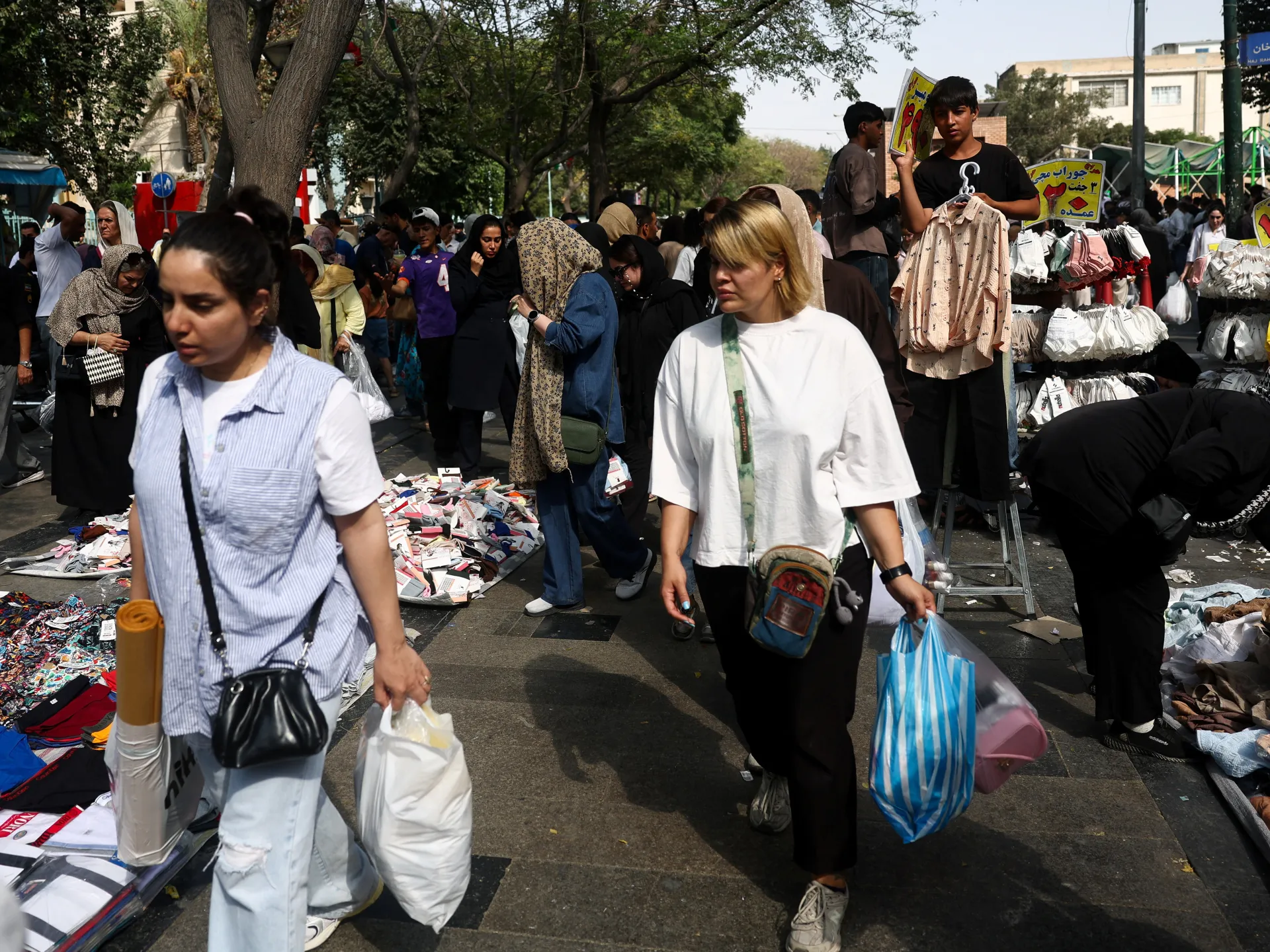
Iranian shoppers in the Tajrish bazaar in Tehran, 25 April 2026 [Abedin Taherkenareh/EPA]
“Our sales are very inconsistent. The market is struggling to find prices, there’s too much instability and uncertainty about the future,” said Borzou, a merchant dealing in industrial motors and equipment at Tehran’s Grand Bazaar.
“It looks like most distributors here are still tapping into imported inventories from before, we don’t know what to expect in a few months since many of these goods came through China and the UAE and not all can be imported through inland routes,” he told Al Jazeera.
Rial hits all-time low
There has also been intense pressure on the Iranian rial from the renewed military escalation and reimposition of the naval blockade.
The rial changed hands for over 1.93 million against the US dollar in Tehran’s open market on Saturday, the first day of the Iranian week, registering a new all-time low.
The Tehran Stock Exchange continued its downward trend over the past week, with its main index losing another 120,000 points or 2.4 percent on Saturday to stand at 4.77 million.
Iran’s armed forces have warned they will retaliate against any US strikes on Iran’s civilian infrastructure by attacking similar targets in regional countries hosting US military bases.
“Let’s not forget that the US and Israel started attacks against infrastructure, when they hit South Pars gas fields, Tehran’s oil depots and the petrochemicals in Mahshahr,” said energy analyst Shokouhi.
Utilising help from the Houthi group in Yemen, Tehran could also cause significant disruptions to shipping in the strategically important Bab al-Mandab strait off Yemen’s coast – if US President Donald Trump realises his threat to hit more civilian infrastructure in Iran such as power plants and bridges.
“Trump’s actions over recent months, and particularly over recent days, have only made the situation more intractable and the outlook more uncertain. The current situation cannot continue for much longer, but it is broadening the scope of the conflict and that is concerning,” Shokouhi said.
Tehran launched strikes against several countries across the Gulf and wider region overnight as the United States military raised its attacks on Iran.
Reports on Friday morning said that Bahrain, Iraq, Kuwait, Oman and Qatar, as well as Jordan and Syria, had been forced to take defensive action against Iranian missiles and drones, amid a sixth night of US strikes on Iran.
Recommended Stories
list of 3 itemsend of list
The escalating US air campaign targeted civilian infrastructure in the south of the country, including telecommunications networks, railway systems, and the Bandar-e Khamir bridge in Hormozgan province, where local media reported on Thursday night that at least seven people were killed.
Tehran has justified its strikes against Gulf and other states by saying it is targeting US facilities in the region, insisting that Washington has used its bases there as launchpads to strike Iran.
In Qatar, which hosts major US military facilities, the security threat level was elevated as loud explosions were heard across parts of the capital, Doha, early on Friday morning.
Warning sirens sounded as residents received security alerts on their mobile phones. Qatar’s security threat level was raised again after the initial alert, but the situation later returned to “normal” after the threats were cleared.
The Qatari Ministry of Interior confirmed on Friday morning that a child who was injured by falling shrapnel during the assault is now receiving medical care. Earlier, Qatar rejected Israeli reports that it was planning to join military action against Iran.
Iran’s army said it targeted US helicopters and reconnaissance aircraft at the Sakhir airbase in Bahrain, according to a report from the country’s semi-official Tasnim news agency.
The Islamic Revolutionary Guard Corps (IRGC) claimed early on Friday to have successfully targeted US monitoring assets in Oman.
In a statement, the military said it destroyed a US air control radar in the northern Ghanim region and a maritime surveillance radar positioned on rocks in the Strait of Hormuz.
The IRGC declared that the critical shipping waterway – which has become the key issue in the latest outburst of conflict between the US and Iran – “remains in the hands of the IRGC Navy’s admirals”.
The IRGC also reported that it hit a US military base in Kuwait early on Friday. It said that the attack targeted a missile defence radar, several key weapons depots and two HIMARS surface-to-surface missile launchers.
In northern Iraq, Kurdish counterterrorism forces reported that US coalition forces shot down eight explosive drones over the city of Erbil, according to the Iraqi News Agency (INA). No casualties were reported.
The Jordanian army announced its air defence systems shot down three Iranian missiles transiting its airspace on Friday morning. No casualties were reported as engineering teams dealt with falling debris.
The IRGC also claimed to have attacked a US special operations command centre at the al-Tanf military base in Syria, according to a Tasnim news agency report.
Call to return to ‘hard-won’ deal
As hostilities between the US and Iran continue to escalate, threatening to spread across the region and curb the global economy, efforts to convince Washington and Tehran to return to negotiations are accelerating.
China’s Foreign Minister Wang Yi and Pakistani counterpart Ishaq Dar called on Friday for an immediate ceasefire and the resumption of dialogue, hoping to save the tentative ceasefire agreed upon last month.
Both countries have sought to mediate in the months-long conflict, which rekindled with renewed fighting over the Strait of Hormuz a month after the signing of a preliminary deal aiming to end the war.
That agreement was “hard-won”, Wang said, adding: “Peace is before our eyes, [we] cannot fall at the last hurdle and even more so cannot lose what we have gained.”
Iran has said 38 people have been killed, and more than 400 injured, in the US attacks since the two sides met in Switzerland on June 22 for talks to end the war through a 60-day negotiation period, the AFP news agency reported.
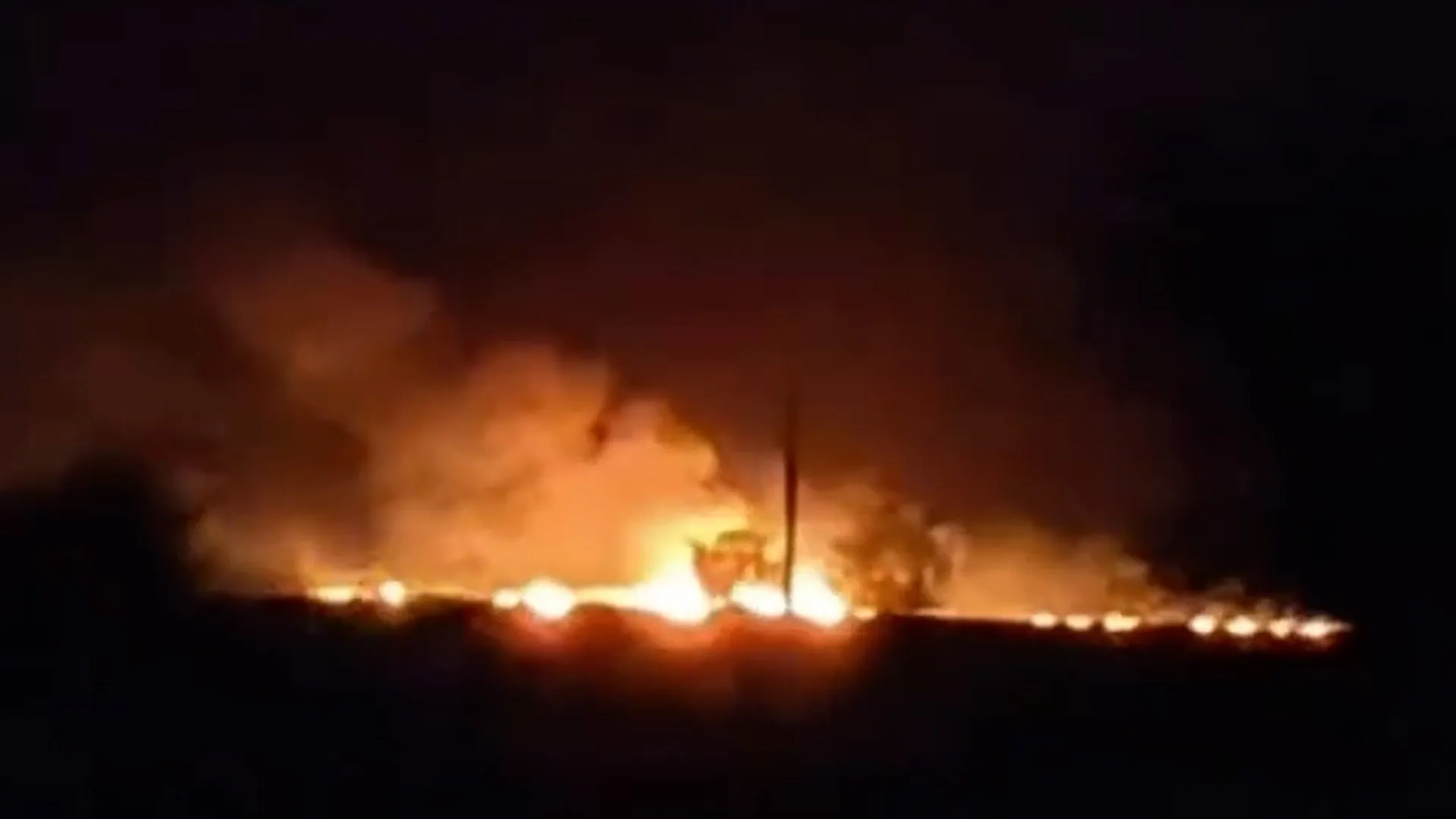
Moment a projectile struck a border area between Kuwait and Iraq, sparking a fire and sending thick smoke into the sky. The scenes emerged after Kuwait said it intercepted 32 hostile drones since dawn as Iran announced strikes targeting US assets in the country.
The US military has continued strikes against Iran, hitting targets further to the country’s north as well as close to capital Tehran for the first time in the latest round of violence.
US Central Command (CENTCOM) said early on Thursday it struck several military sites and assets in a bid to “further degrade Iran’s ability to threaten innocent mariners” in the Strait of Hormuz. The unit also said it disabled an oil tanker in the passageway.
Recommended Stories
list of 4 itemsend of list
At least 35 people have died, and more than 300 have been wounded in the latest wave of attacks that began last Wednesday after CENTCOM launched strikes on Iranian port cities close to the Strait of Hormuz. The US says the attacks are in retaliation for Iran hitting three commercial ships in the Strait.
Iran’s Islamic Revolutionary Guard Corps (IRGC) said it targeted US military assets in neighbouring Gulf countries.
Here’s what has happened in Iran and the US on Wednesday and Thursday and what both sides are saying:
Where did the US hit?
CENTCOM said in a statement early on Thursday that US air strikes targeted Iranian command centres, air defence sites, missile and drone capabilities as well as coastal surveillance facilities.
Multiple locations were hit, CENTCOM said, including Bandar Abbas on Thursday.
An earlier wave of strikes late on Wednesday hit coastal defence and cruise missile sites on Greater Tunb Island in a 90-minute bombing wave, CENTCOM added. The small, strategically located island sits near the Strait of Hormuz and is believed to hold a naval base, although details are not publicly available. It is also believed to be a point from which the Iranian military has disrupted shipping routes.
Meanwhile, Iranian media reported attacks in Bandar Abbas, Qeshm Island, Sirik, Chabahar, Konarak, Rask, Khondab, Khorramabad and Semnan.
A hospital in Ahvaz was forced to evacuate 211 patients after reportedly being hit in the strikes.
Air defences were activated in Tehran and neighbouring Pakdasht and Parchin on Thursday. The Iranian military said an MQ-9 drone was downed over the city of Andimeshk.
CENTCOM, in a separate statement on Thursday, said it was enforcing a naval blockade reimposed on Tuesday by disabling a “non-compliant” oil tanker that was attempting to sail towards Iran’s Kharg Island using Hellfire missiles.
How has Iran responded?
Iran’s army claimed retaliatory attacks on US military assets in Kuwait and Bahrain on Thursday.
Kuwait: The Iranian army said in a statement it targeted radar systems, the Patriot defence system and fuel tanks belonging to US forces at the Ali Al Salem airbase in Kuwait. In an earlier statement, it said it hit a radar and gathering point for US soldiers in Kuwait, as well as US communications systems and fuel depots in Jordan’s al-Azraq airbase.
Bahrain: Drones also targeted US Super Hawk radars and Patriot defence systems at the Sheikh Isa airbase in Bahrain, the army added.
Jordan: Meanwhile, Jordan said it intercepted eight Iranian missiles on Thursday.
Iraq: Iraqi authorities said five drones attacked the city of Erbil, with two crashing near a US base and one shot down near the US consulate. Iran’s army has not claimed the attacks.
What are both sides saying?
Iran’s parliament speaker and lead negotiator, Mohammad Ghalibaf, said on Wednesday Iran is prepared for a fuller military confrontation if the US does not live up to the terms of the interim deal. The country is fighting an “existential” battle, he added.
The IRGC has, meanwhile, threatened to halt all energy exports from the Middle East over the US’s naval blockade, which was reimposed on Tuesday.
“The export of oil and gas from the region will be either for everyone or for no one,” it said in a statement.
Speaking at the US Army War College in Pennsylvania on Wednesday, President Donald Trump reiterated his claims that Iran was pushing to strike a peace deal behind the scenes but did not provide details.
“They don’t like what we’re doing, and they do want to settle. We’ll find out whether or not we settle with them, or we just finish it off,” he said.
However, in a rare show of gratitude on Wednesday, Trump thanked Iran via his Truth Social platform for the release of Dena Karari, an American citizen the US says was “wrongfully” jailed in the country since 2024.
Meanwhile, US Vice President JD Vance, in an interview with podcaster Joe Rogan released on Wednesday, defended the war on Iran but added that an agreement was needed between the two sides to end the conflict.
Iran’s Islamic Revolutionary Guard Corps (IRGC) has targeted US military facilities in Bahrain, claimed it has destroyed radar systems in Oman and hit Jordan and Kuwait in its latest round of overnight retaliatory strikes against the United States.
Tehran’s attacks on Monday came as a response to Washington’s escalating strikes as prospects of peace between the two countries recede.
Here is a recap of the latest attacks:
Where were the latest Iran attacks?
Oman: The IRGC said it attacked Oman as part of its latest phase of retaliation. It said it targeted “the FPS long-range aerial radar and the vessel detection radar in Oman”, adding that these radar systems were destroyed.
Bahrain: The IRGC also said it launched missile and drone attacks targeting “installations and infrastructure of the aggressive US army” in Juffair, Bahrain.
Bahrain’s Ministry of Interior said on Monday that sirens had been sounded in the country as it warned people to remain calm and head to the nearest safe place.
The IRGC earlier said it targeted several facilities at the Sheikh Isa Air Base in Bahrain.
Jordan: Jordan’s military said on Monday that it intercepted and downed “four missiles that entered Jordanian airspace” and came from Iranian territory.
Earlier, the IRGC said it targeted Jordan’s Prince Hassan Air Base with missiles and drones and set fire to several fuel depots and ammunition storage facilities.
Kuwait: The IRGC said on Monday that it also targeted a US surface-to-surface missile base in Kuwait, “setting fire to two HIMARS missile launchers and missile-packed warehouses, completely destroying them”.
HIMARS stands for high mobility artillery rocket systems, which are mobile rocket launchers manufactured by the US.
Earlier, the General Staff of Kuwait’s Army said air defence systems were engaging “hostile aerial targets” inside the country’s airspace.
It said any explosions heard were the result of air defence systems intercepting the attacks and urged the public to follow safety and security instructions.
Where was Iran hit?
The US military’s Central Command (CENTCOM) earlier said it hit “dozens of targets at multiple locations with precision munitions to degrade Iran’s ability to continue attacking international shipping flowing through the Strait of Hormuz”.
These targets included “Iranian military air-defense systems, coastal radar sites, missile and drone capabilities, and small boats”, it said.
CENTCOM said it deployed “US fighter aircraft, naval vessels, one-way attack aerial drones, and one-way attack sea drones for the first time”.
Valiollah Hayati, the deputy governor for security and law enforcement in western Iran’s Khuzestan province, told the semiofficial ISNA news agency on Monday that US forces attacked at least eight locations across Khuzestan overnight.
Hayati also said one person was killed and four were injured when a projectile hit an agricultural water-pumping station in Mahshahr, according to the IRNA news agency.
Iran’s Tasnim News Agency reported on Monday that a US-manufactured LUCAS (low-cost uncrewed combat attack system) suicide drone was “accurately hit and shot down” in Bandar Abbas, a city on the Strait of Hormuz.
What has each side said?
The Iranian Ministry of Foreign Affairs released a statement on Monday condemning the US strikes on targets in Iran.
US President Donald Trump insisted that the Strait of Hormuz was open during an appearance on the NBC TV network’s Meet the Press programme on Sunday.
“They’re very, very evil and sick people. We had meetings with them. They agreed to a deal yesterday, a perfect deal for us. No nuclear, no this, no that, no nothing. They gave up everything. And then after that, they left the room. And then within an hour, they launched a drone at a ship,” Trump said.
When did the conflict reignite?
On July 6, the IRGC struck three commercial vessels, including a Qatari liquefied natural gas tanker, off Oman. Iran accused the ships of trying to pass through the Strait of Hormuz without its permission. Tehran’s interpretation of a key clause in the June memorandum of understanding (MoU) with the US gives it the authority to manage traffic through the waterway.
The following day, the US said it carried out strikes on Iranian military targets. Tehran in turn responded with missile and drone attacks on military bases across the Gulf where US forces are deployed.
On Wednesday, Trump told reporters the MoU was over, and on Saturday, the IRGC said the Strait of Hormuz was closed yet again.
How has this impacted the Strait of Hormuz and shipping?
The number of vessels transiting the Strait of Hormuz has fallen to its lowest level in five weeks, according to shipping data.
Six ships sailed through the strait on Sunday, according to data from the trade intelligence firm Kpler, including the Humanity and the Capetan Andreas, transporting 2 million barrels of Iranian oil and 500,000 barrels of Kuwaiti petroleum products, respectively.
Three empty tankers also entered the Gulf to load oil, according to the data.