Korean

Starbucks’ Korean sales fall after backlash to ‘Tank Day’ ad campaign | Protests

Coffee chain has seen ‘very significant’ drop in sales after campaign that evoked deadly crackdown, local operator says.

Starbucks Korea has suffered a “very significant” drop in sales after a marketing campaign that evoked a brutal 1980 military crackdown on pro-democracy protesters triggered a public outcry, according to the coffee chain’s local operator.

Shinsegae Group, whose subsidiary E-Mart owns the coffee chain in South Korea, has faced mounting criticism over its so-called “Tank Day” campaign, launched on the anniversary of the May 18 Gwangju Uprising, when the military government deployed troops and tanks to suppress pro-democracy demonstrations.

Recommended Stories

list of 4 itemsend of list

In a news conference on Tuesday, Shinsegae Group chairman Chung Yong-jin made a public apology and asked people not to take out any anger on Starbucks Korea employees and front-line staff.

“I take it very seriously, the fact that many people felt deep pain and anger because of Starbucks Korea’s inappropriate marketing campaign,” Chung said.

“I will take all responsibility for the incident.”

Chung also asked people not to take out their frustration on staff at Starbucks shops, saying the responsibility lies with management. There were no immediate reports of major incidents at stores.

Chung issued his first apology on May 19, saying in a statement that the campaign caused “deep pain to the victims and bereaved families of the May 18 Democratization Movement as well as to the public”.

Shinsegae fired the head of Starbucks Korea last week after apologising over the campaign. Starbucks Global also apologised and said that an investigation had begun.

A Shinsegae official said sales had fallen sharply since the marketing controversy.

“While sales are not our main concern at the moment, we have seen a very significant drop,” said the official.

At Tuesday’s news conference, Jeon Sangjin, a senior Shinsegae Group executive, said the company had yet to find conclusive evidence that Starbucks Korea marketing employees intended to mock the pro-democracy movement, an accusation the employees have denied.

However, he said some employees refused management requests to hand over their smartphones during a weeklong internal review.

Jeon said the company would look at the results from the police inquiry, and any employee found to have intended to ridicule protesters would be fired.

The anger over the campaign has triggered public calls for boycotts, amplified by government officials, including Interior and Safety Minister Yoon Ho-jung, who said Starbucks products will no longer be used at government events and lamented the chain’s “anti-historical behaviour”.

The country’s president, Lee Jae Myung, said on X last week that the campaign displayed “inhumane and disgraceful behaviour by cheap profiteers who deny the values of the South Korean community, basic human rights and democracy”.

Hundreds of people are estimated to have died ⁠or gone missing when Chun Doo-hwan’s military government cracked down on the protests in Gwangju.

Many details remain unconfirmed, including who gave the order to open fire.

Source link

South Korean AI power diagnostics system heads to Germany

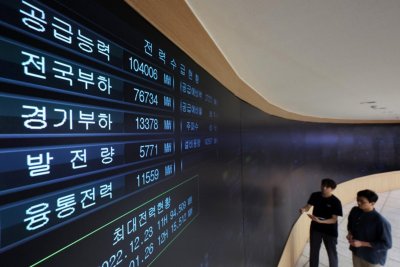
Employees check power demand and supply at the regional office of the Korea Electric Power Corp. in Suwon, 30 kilometers south of Seoul, South Korea. Photo by YONHAP / EPA

May 21 (Asia Today) — Korea Electric Power Corp.’s AI-based preventive diagnostics technology will be introduced to Germany’s power equipment market under the company’s largest-ever single technology transfer deal.

Korea Electric Power said Wednesday it signed a $1.34 million, or about 2 billion won, contract with German power equipment company Maschinenfabrik Reinhausen in Berlin on Tuesday. The South Korean utility will receive technology transfer fees from the German company over seven years.

The technology, called SEDA, analyzes about 100,000 pieces of substation equipment data a day. The system uses AI to detect abnormalities in power facilities by linking data from Internet of Things sensors, facility specifications and maintenance records.

Maschinenfabrik Reinhausen, founded in 1868, specializes in transformer load tap changers, sensors and digital solutions. The company has annual revenue of about 19 trillion won, or $12.6 billion.

The German company plans to apply SEDA to its TESSA 2.0 power equipment asset management platform. The platform monitors the condition of transformers, switchgear and other power equipment.

Korea Electric Power began using SEDA in South Korea in 2021. The system has been applied to 359 of the country’s 925 substations, or about 40%, and the company is gradually expanding its use.

The company said SEDA has detected an average of 15 abnormal signs per year over the past five years. Last year, the system helped prevent equipment damage worth 36.6 billion won, or about $24.3 million.

“This technology transfer is highly significant because it gives Korea Electric Power a key foothold for entering global markets, including Europe and North America,” said Yeo Geun-taek, head of the company’s transmission and substation operation office.

— Reported by Asia Today; translated by UPI

© Asia Today. Unauthorized reproduction or redistribution prohibited.

Original Korean report: https://www.asiatoday.co.kr/kn/view.php?key=20260521010006459

Source link

Korean Americans have his back, but Robert Lee Ahn will need more to become L.A.’s next congressman

The race for the 34th Congressional District in the core of Los Angeles was supposed to be a battle for the soul of the Democratic Party. The two dozen hopefuls vying for a spot in the top-two primary were full of self-proclaimed fighters ready to oppose President Trump and establishment Democrats.

Instead, it’s shaping up to be a contest between the powerful group of Latinos who make up a majority of the district’s voters and the small but politically potent Korean American community, as Assemblyman Jimmy Gomez and former city planning Commissioner Robert Lee Ahn grabbed the runoff spots that will determine L.A.’s next member of Congress.

“This is really ethnic politics 101,” said Matt Barreto, a UCLA professor of political science who helps run the polling firm Latino Decisions.

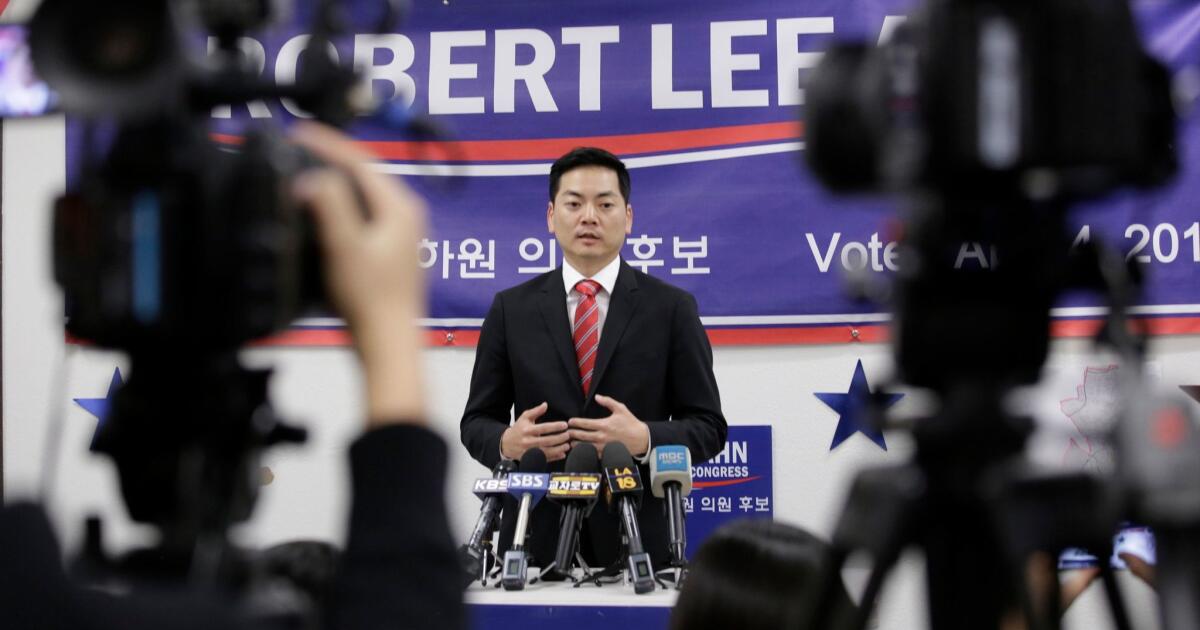
Ahn, an attorney and a relative unknown in the crowded primary field, surprised many with a victory that vaulted him ahead of multiple Latino candidates in a district where more than half the voters are Latino. If elected in the June 6 runoff, he would be the only Korean American member of Congress and the first in nearly 20 years.

But it wasn’t surprising to anyone who studies the intricacies of identity politics in Los Angeles, or to those who had been paying attention to Ahn’s aggressive focus on Korean American voters.

Ahn’s campaign staff spent dozens of hours registering voters at malls and outside restaurants in Koreatown, signing up hundreds of new voters. Ahn made his pitch at multiple Korean churches in the district, and a large portion of his donor base was from the Korean American community, which helped him raise more money than Gomez in the latter part of the campaign despite a deluge of cash Gomez received from political committees.

And when Virginia state legislator Mark Keam, also a Korean American, flew to Los Angeles to endorse Ahn, a bank of TV cameras from Korean American news stations was there.

Robert Lee Ahn raised the most money by far in latest campaign finance reports »

Daniel Hong, a 38-year-old who works in the film industry, voted for the first time Tuesday even though he’s been a citizen for about 20 years. Hong, who is Korean American, said he read numerous articles about Ahn and received multiple phone calls from his campaign.

“That was the first time anybody has ever reached out to me for my vote,” said Hong as he stood outside a polling place set up in a Korean Presbyterian church.

Deborah Choi, 62, said she voted for Ahn so “he can speak for Korean Americans here.” The first wave of Koreans immigrated to the U.S. “so many years ago,” Choi said, but their representation in the highest elected offices remains low. She hopes her 36-year-old son will one day run for office too.

Though county election officials have yet to process more than 13,000 ballots, the 41-year-old Ahn remains thousands of votes ahead of the third-place candidate, fellow former planning Commissioner Maria Cabildo.

With turnout expected to hover around 15% of registered voters, preliminary returns show Ahn’s strategy paid off big. The biggest strongholds of votes for Ahn centered on Koreatown, Westlake and Chinatown, while the 42-year-old Gomez was ahead in neighborhoods throughout the northeast part of the district.

In early absentee ballot returns headed into primary election day, Korean Americans made up nearly a quarter of votes even though they comprise just 6% of registered voters.

Few Korean Americans have come this close to winning a seat in Congress since 1998, when Republican Jay Kim of Diamond Bar lost to a primary challenger after three terms in office. (David Min, a UC Irvine professor, announced a challenge to GOP Rep. Mimi Walters of Orange County this week.)

“Korean Americans in Southern California have been hungry for political representation for a very long time,” said Taeku Lee, a professor of politics and law at UC Berkeley. Lee said the recent campaign that helped propel David Ryu, the first Korean American elected to the L.A. City Council, may have also helped the community learn on-the-ground skills that mobilized voters in the congressional race.

The symbolism of Ahn’s win was not lost on his supporters Tuesday night.

“It’s very significant,” said Jinha Park, a radiologist who attended Ahn’s election night party at a Mexican restaurant in Westlake. “The Korean American community has always felt voiceless at the federal level.”

The question now, as the two Democrats ready for what could be a costly runoff, is whether Ahn, the son of Korean immigrants, can broaden his appeal beyond the Korean American voters who are motivated to send him to Washington.

He faces a fierce challenge: While progressive candidates to his left spoke passionately about fighting for “sanctuary cities” that protect undocumented immigrants and single-payer healthcare, Ahn emphasized the “business sensibility” he would bring to the office and argued there was room to negotiate with Republicans on certain issues, an idea that could prove unpopular in a district where just 9% of voters are Republican, and where Bernie Sanders beat Hillary Clinton in last year’s presidential primary.

Ahn will also have to make a case to Latino voters, who make up more than half of registered voters in the district, why they should choose him over Gomez. The three-term assemblyman is the son of Mexican immigrants, has amassed dozens of establishment endorsements from Democratic elected officials, labor unions and environmental groups, and touted his progressive record in the Legislature.

Among his backers is Xavier Becerra, who rose to become the highest-ranking Latino U.S. congressman and vacated the seat to become California’s attorney general.

Votes that went to the remaining Latino candidates in the primary made up more than 38% of voters at last count, and the district has sent a Latino to Congress for more than half a century.

“When [Ahn is] running against a guy named Gomez, as good as his outreach might be in the Latino community, Latinos’ gut and heart is going to be more with Gomez,” said UCLA professor Barreto.

Ahn dismissed the idea. “The notion that Latinos will only vote for a Latino … I think we’re really going to transcend that with our campaign,” Ahn said in an interview Wednesday. He appears to be positioning himself as an outsider, which would be similar to the campaign Ryu ran when he made his successful council run in 2015. Ahn called Gomez a “professional politician that is powered by special interests.”

Gomez’s camp shot back, saying voters will see through Ahn’s formidable fundraising and realize his credentials don’t match with the district.

“More than anything, he’s ideologically out of step with the district,” said Parke Skelton, a campaign consultant for Gomez. Skelton said Ahn, who changed his registration from Republican to Democrat in 2012, “has taken positions that really put him out of the mainstream Democratic base in this district.”

christine.maiduc@latimes.com

For more on California politics, follow @cmaiduc.

ALSO

Half the candidates in L.A.’s latest congressional race have their own immigrant story. With Trump, this contest is personal.

Results from L.A.’s congressional primary

Updates on California politics

Sign up for our free Essential Politics newsletter



Source link

South Korean defense firms face growing pressure from U.S. cyber rules

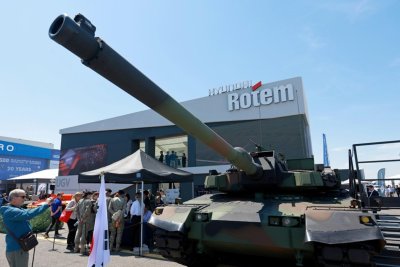
A visitor inspects a K2 Black Panther, a South Korean fourth-generation main battle tank, during the final day of the Black Sea Defense and Aerospace Exhibition 2026 in Bucharest, Romania, 15 May 2026. Photo by ROBERT GHEMENT / EPA

May 19 (Asia Today) — South Korea’s fast-growing defense industry is confronting a major new obstacle in the U.S. market as the Pentagon fully implements strict cybersecurity certification requirements across its global supply chain.

The U.S. Department of Defense has begun enforcing the final version of the Cybersecurity Maturity Model Certification, or CMMC, program, requiring all companies participating in U.S. defense contracts to meet specific cybersecurity standards.

Industry officials warn that Korean defense firms unable to obtain certification could be excluded not only from exports to the United States but also from ship maintenance, repair and overhaul projects and future joint weapons development programs.

The certification system applies not only to primary contractors but also to subcontractors supplying parts and components.

Even companies with advanced technology and competitive pricing can be blocked from bidding if they fail to meet required cybersecurity levels.

For many South Korean defense firms, the most critical threshold is CMMC Level 2, which is required for handling Controlled Unclassified Information, or CUI, tied to U.S. military programs.

The requirement is considered especially important for South Korea’s ambitions to participate in U.S. Navy ship maintenance and repair projects, as well as broader bilateral defense cooperation initiatives.

Defense analysts say the new rules are becoming a de facto trade barrier across Western defense markets.

“Losing access to the U.S. market effectively means being pushed out of the global defense supply chain,” one industry expert said.

Defense Acquisition Program Administration has launched information sessions and consulting support programs in response to growing industry concerns.

The agency is working with regional defense innovation clusters, the Korea Defense Industry Association and the Defense Agency for Technology and Quality to help companies prepare for certification.

But smaller suppliers say the burden remains overwhelming.

Industry estimates suggest that achieving Level 2 certification can cost companies from hundreds of thousands to several million dollars due to infrastructure upgrades, consulting fees and final audits. Preparation alone can take more than a year.

Large defense contractors have already formed dedicated task forces, but many second- and third-tier suppliers lack both funding and cybersecurity specialists.

Because the CMMC system requires certification across the entire supply chain, failure by even a single subcontractor could jeopardize broader export opportunities involving larger Korean defense firms.

Additional complications stem from differences between U.S. and South Korean encryption standards.

One key CMMC requirement involves use of cryptographic modules certified under U.S. National Institute of Standards and Technology guidelines known as FIPS standards.

Many South Korean defense companies, however, rely on domestic encryption systems validated under the country’s K-CMVP framework overseen by intelligence and defense authorities.

Industry experts are calling for government-level negotiations between Seoul and Washington to seek mutual recognition or equivalency between Korean and U.S. encryption standards.

Some officials argue such talks could be linked to ongoing negotiations over a Reciprocal Defense Procurement Agreement between the two allies.

Concerns are also growing over South Korea’s lack of domestically accredited third-party CMMC assessment organizations, forcing companies to rely on U.S.-based auditors and raising concerns about defense technology exposure.

Analysts say South Korea’s defense industry must now treat cybersecurity as strategically important as weapons performance itself if it hopes to become a top-tier global arms exporter.

— Reported by Asia Today; translated by UPI

© Asia Today. Unauthorized reproduction or redistribution prohibited.

Original Korean report: https://www.asiatoday.co.kr/kn/view.php?key=20260519010005245

Source link

South Korean SK group to merge strategy meeting, Icheon Forum

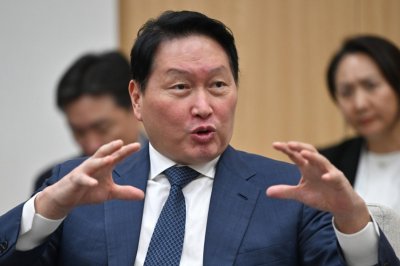
SK Group Chairman Chey Tae-won speaks during a meeting with South Korean President Lee Jae Myung and Nvidia founder and CEO Jensen Huang on the sidelines of the Asia-Pacific Economic Cooperation (APEC) summit in Gyeongju, South Korea. Photo by JUNG YEON-JE / EPA

May 15 (Asia Today) — SK Group will merge its annual strategy meeting with the Icheon Forum, its knowledge management platform, industry officials said Friday.

The group plans to hold the New Icheon Forum from June 11-13 at the SKMS Research Institute in Icheon, Gyeonggi Province.

The event combines SK’s management strategy meeting, usually held in June, with the Icheon Forum, which has been held in August. The company plans to hold the New Icheon Forum every June.

The move is aimed at strengthening execution by bringing strategic discussions into a single forum.

This year’s forum is expected to focus on accelerating artificial intelligence.

SK Group Chairman Chey Tae-won and chief executives from major affiliates including SK Innovation, SK Telecom and SK hynix are expected to attend.

Participants plan to discuss specific measures for each affiliate to secure leadership in the AI industry and strategies to create groupwide synergy.

— Reported by Asia Today; translated by UPI

© Asia Today. Unauthorized reproduction or redistribution prohibited.

Original Korean report: https://www.asiatoday.co.kr/kn/view.php?key=20260515010004232

Source link

U.S. to consider Korean drones for online defense platform

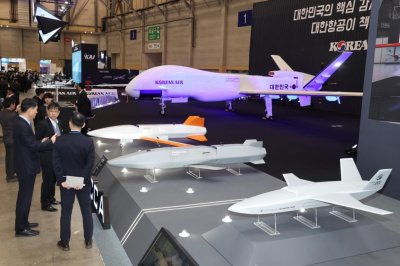
Visitors look at artificial intelligence-based unmanned aerial vehicles at the booth of Korean Air Co. during Drone Show Korea, the biggest drone exhibition in Asia, at the BEXCO convention center in Busan, South Korea. Photo by YONHAP / EPA

May 15 (Asia Today) — South Korea and the United States signed a letter of intent Friday to cooperate on drone and counter-drone systems, South Korea’s Defense Ministry said.

The agreement was signed at the ministry’s headquarters in Seoul by Jun Joon-beom, director general of the Defense Artificial Intelligence Planning Bureau, and Patrick Mason, deputy assistant secretary of the U.S. Army for defense exports and cooperation.

Under the agreement, the two sides will work to build a joint supply chain for drone and counter-drone systems and strengthen cooperation on standardization.

The U.S. Defense Department plans to consider registering Korean-made products on an online platform for drone and counter-drone transactions that it aims to establish this year.

South Korean officials said the platform could allow both countries to purchase and operate Korean-made systems, improving interoperability and reducing logistics costs.

The two countries also plan to cooperate on common standards for drone and counter-drone systems to improve the efficiency and compatibility of combined South Korea-U.S. operations.

In the near term, they will seek to adopt a common battery standard for small drones. They will also exchange information and conduct joint research toward a shared standards system.

“We hope the signing of this letter of intent will accelerate the establishment of common standards and certification systems for drone and counter-drone systems,” Jun said.

Mason said allies such as South Korea could overcome existing acquisition barriers and quickly field efficient and interoperable drone systems.

“We will ensure that the best available technologies are provided to South Korean and U.S. combined warfighters,” Mason said.

Before the signing ceremony, Won Jong-dae, South Korea’s deputy defense minister, met U.S. officials and said the agreement marks the beginning of the South Korea-U.S. alliance evolving into a “drone alliance.”

Won said the ministry would work with related agencies, including the Industry Ministry and the Transport Ministry, to build a stable joint supply chain between the two countries.

Jang Ji-hyung, head of the technical research division at the Defense Agency for Technology and Quality, said the agency would play a central role in producing practical results from drone and counter-drone cooperation.

The two defense authorities plan to form a working-level consultative body to continue cooperation.

— Reported by Asia Today; translated by UPI

© Asia Today. Unauthorized reproduction or redistribution prohibited.

Original Korean report: https://www.asiatoday.co.kr/kn/view.php?key=20260515010004281

Source link