Korea

Experts urge South Korea to hold Iran accountable over HMM ship attack

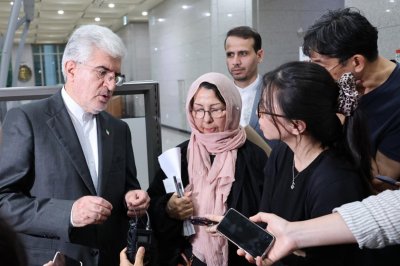
Iranian Ambassador to South Korea Saeed Koozechi (L) speaks to reporters as he exits the foreign ministry building in Seoul, South Korea, 27 May 2026. The ministry summoned Koozechi to lodge a protest over a 04 May attack on the HMM Namu, a South Korean-operated vessel, in the Strait of Hormuz. The ministry said Iranian-developed anti-ship missiles were likely used in the attack earlier this month. Photo by YONHAP / EPA

May 29 (Asia Today) — South Korean defense experts said the government should take a tougher position toward Iran after investigators concluded that an Iranian-developed anti-ship missile was likely used in an attack on the HMM Namu.

Experts said Thursday that Seoul needs a firm diplomatic response to the results of the government investigation into the unidentified aerial objects that struck the HMM-operated vessel.

The government said Wednesday that the objects were highly likely to have been Noor-series anti-ship missiles developed by Iran. Technical analysis found the engine resembled an Iranian-made turbojet engine, and some components carried markings believed to be from an Iranian manufacturer.

South Korean officials said the evidence points toward Iran but stopped short of making a final judgment on who carried out the attack or whether it was intentional. The government summoned Saeed Koozechi, Iran’s ambassador to South Korea, but Koozechi denied that Iran was involved.

“If it was actually confirmed to be an Iranian missile, it should be viewed as an act by the Iranian government,” said Kwon Yong-soo, professor emeritus at Korea National Defense University. “The missile’s maximum range is short, and because of the flame at launch, it would have been visible where it came from.”

Kwon said the government should be able to explain whether the missile was fired from land, a ship or a fast boat.

“If it was not Iran’s act, Iran itself should present evidence,” he said.

Yang Uk, a research fellow at the Asan Institute for Policy Studies, said the evidence points to an Iranian-made anti-ship missile.

“Even if Iran denies it, that denial is not persuasive,” Yang said. “Anti-ship missiles are weapons that only states, governments and militaries can operate.”

Yang said Iran may have provided missiles to an armed group, such as the Houthi rebels, but the distance would have been too far for such a launch.

“If the Islamic Revolutionary Guard Corps fired it and the Iranian government pretends not to know, that would prove Iran’s own command and control is inadequate,” he said.

Some experts said the South Korean government’s response has been too weak, even though it summoned Koozechi immediately after announcing the investigation results.

A Foreign Ministry official said summoning Iran’s ambassador was a serious diplomatic measure.

“Summoning the Iranian ambassador to South Korea is by no means meaningless,” the official said. “The measure itself shows our firm position.”

The official said Seoul had sent investigation teams twice, collected debris, reached its conclusion through analysis by expert agencies, publicly announced the findings and explained them to the other country.

“That itself is a serious diplomatic step,” the official said.

Yang said some may argue South Korea does not need to create unnecessary conflict with Iran. But he said Seoul should at least secure something from the Iranian government if it takes that position.

“Given that the evidence points to Iran, we should at least apply pressure to ensure our ships are allowed to return safely,” Yang said. “If we do not even do that, then we are refusing to do what a state should do.”

— Reported by Asia Today; translated by UPI

© Asia Today. Unauthorized reproduction or redistribution prohibited.

Original Korean report: https://www.asiatoday.co.kr/kn/view.php?key=20260528010008578
Source link

South Korea, U.S. to open security talks on nuclear subs

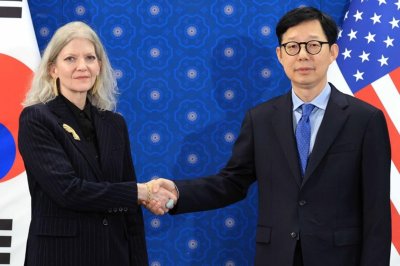
South Korean Vice Foreign Minister Park Yoon-joo (R) shakes hand with his US counterpart, Allison Hooker, at the foreign ministry in Seoul, South Korea. Photo by YONHAP / EPA

May 29 (Asia Today) — South Korea and the United States will hold their first meeting in Seoul next week to discuss security issues agreed to at last year’s bilateral summit, including South Korea’s acquisition of nuclear-powered submarines.

South Korea’s Foreign Ministry said Friday the two sides will hold a launch meeting June 2-3 in Seoul for follow-up consultations on the security provisions of the joint fact sheet issued after the summit.

The meeting will come eight months after the two leaders announced agreements in the security section of the joint fact sheet in October.

The two sides are expected to discuss specific measures related to South Korea’s construction of nuclear-powered submarines, as well as expanded authority over uranium enrichment and spent nuclear fuel reprocessing.

With U.S. midterm elections scheduled for November, negotiations in individual areas are expected to gain momentum.

South Korea will send an interagency delegation led by First Vice Foreign Minister Park Yoon-joo. Officials from the presidential National Security Office, Foreign Ministry, Defense Ministry, Ministry of Climate and Energy, Ministry of Science and ICT, Ministry of Trade, Industry and Resources and Nuclear Safety and Security Commission will also attend.

The U.S. delegation will be led by Allison Hooker, under secretary of state for political affairs. Officials from the White House National Security Council, State Department, Energy Department and War Department are expected to travel to Seoul for the talks.

— Reported by Asia Today; translated by UPI

© Asia Today. Unauthorized reproduction or redistribution prohibited.

Original Korean report: https://www.asiatoday.co.kr/kn/view.php?key=20260529010008720

Source link

South Korea party leaders split on early voting strategy

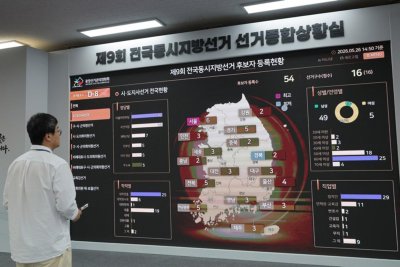
Election-related information is displayed on an electronic board at the National Election Commission’s situation room in Gwacheon, south of Seoul, South Korea, 26 May 2026, eight days ahead of the 03 June local elections. Photo by YONHAP / EPA

May 29 (Asia Today) — Leaders of South Korea’s rival political parties urged voters to cast ballots Friday, the first day of early voting for the June 3 local elections, but their strategies showed different approaches.

Chung Chung-rae, leader of the Democratic Party, and Han Byung-do, the party’s floor leader, both voted on the first day of early voting. People Power Party leader Chang Dong-hyeok and floor leader Song Eon-seok divided their roles, with Chang choosing to vote on Election Day and Song planning to vote early.

Chung began his schedule Friday by casting an early ballot at the Seongsan 2-dong Community Service Center in Mapo District, Seoul. After voting, he attended a meeting of the party’s central election committee in Seoul and urged voters to participate.

“Voting is stronger than bullets,” Chung said. “Power does not come from the barrel of a gun. It comes from the polling place.”

Han also visited an early voting station before heading to campaign events in Namwon, North Jeolla Province.

“Early voting will be held for two days starting today,” Han said. “Please exercise your precious vote for the future of South Korea.”

The major opposition People Power Party took a different approach. Chang plans to vote on Election Day, while Song is scheduled to cast an early ballot Saturday.

The move is seen as a strategy to appeal both to the party’s hard-line conservative base and more moderate conservative voters. Chang and Song have also divided campaign duties during the election period, focusing on separate schedules.

Chang campaigned Friday in Sejong and western Gyeonggi Province.

“The atmosphere is changing as we lead this election, but if we lose by even one vote, there is no future for South Korea,” Chang said. “Everything depends on your one vote. Please do not leave yourself with regret by failing to go to the polling place.”

Song said he plans to vote early Saturday in Gimcheon, North Gyeongsang Province, his electoral district.

At a news conference at the National Assembly earlier Friday, Song acknowledged that some political figures have argued against early voting.

“It is true that there are some movements in political circles saying people should not vote early, but I will not say that is our party,” Song said. “There is a big difference between holding voting over three days and holding it for only one day.”

“In reality, the number of votes cast during the two days of early voting and on Election Day is close to half and half,” he said. “I think voters should vote over the three days, including early voting, according to their circumstances and schedules.”

Park Sung-hoon, chief spokesperson for the People Power Party, said both early voting and Election Day voting are important exercises of political rights.

“To strategically encourage both early voting and Election Day voting, we decided that the floor leader would vote early and the party leader would participate in Election Day voting, taking his schedule into account,” Park said.

— Reported by Asia Today; translated by UPI

© Asia Today. Unauthorized reproduction or redistribution prohibited.

Original Korean report: https://www.asiatoday.co.kr/kn/view.php?key=20260529010008858

Source link

S. Korea kicks off 2-day early voting for June 3 local elections

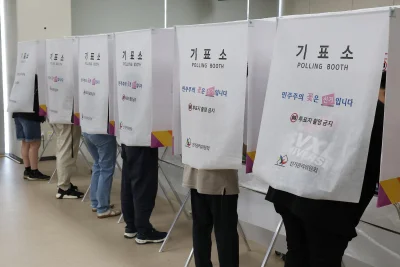
Voters cast ballots on the first day of early voting for nationwide local elections at a polling station in the Eulji Nuri Center in Seoul on Friday. Photo by Yonhap

Many South Koreans headed to the polls Friday in early voting for next week’s local elections and parliamentary by-elections, widely seen as a referendum on President Lee Jae Myung’s first year in office.

Eligible voters can cast ballots at 3,571 polling stations nationwide from 6 a.m. to 6 p.m. until Saturday, according to the National Election Commission (NEC).

As of 11 a.m., turnout for the local elections came to 3.81 percent, according to the NEC. The rate was higher than the 3.59 percent recorded at the same time on the first day of early voting for the 2022 local elections.

More than 44.6 million people are eligible to vote in this year’s local elections.

Up for grabs are 16 mayoral and gubernatorial posts, along with 227 heads of local governments and some 4,000 members of local councils.

Eyes are also on the parliamentary by-elections that will fill 14 vacant Assembly seats, with political heavyweights, such as Han Dong-hoon, former leader of the main opposition People Power Party (PPP), vying for seats.

In a poll released by the NEC last Thursday, 73.6 percent of respondents said they will definitely vote in the upcoming elections. Of them, 39.4 percent said they intended to cast ballots during the early voting period.

The upcoming elections are widely viewed as the first major nationwide vote for the Lee administration since it took office last June after former President Yoon Suk Yeol was ousted over his failed martial law bid.

Both the ruling Democratic Party (DP) and the PPP have been rallying voters to hit the polls this week, with the former urging the public to make a stern judgment on what it calls the “remnants” of Yoon’s insurrectionist forces.

Recent polls, however, indicate that races are tightening in more regions than earlier expected, despite the DP’s hopes for a landslide victory.

While the DP, which controls a majority in the National Assembly, seeks to extend the momentum for the Lee administration to push forward with its key policies, the PPP hopes to gain the footing needed to rebuild the conservative bloc amid deepening internal rifts in the aftermath of the martial law declaration.

Both parties view the capital area, where half of the country’s population resides, as a key battleground.

The Seoul mayoral election has shaped up to be a fierce two-horse race between incumbent Oh Se-hoon of the PPP and ruling party candidate Chong Won-o.

A Hankook Research poll released Monday showed Chong leading with 42 percent against Oh’s 36 percent.

Also closely watched is the parliamentary by-election in the Buk-A constituency in the southeastern city of Busan, where Ha Jung-woo, former presidential secretary for artificial intelligence policy and future planning, is competing against independent Han Dong-hoon and former PPP lawmaker Park Min-shik

Copyright (c) Yonhap News Agency prohibits its content from being redistributed or reprinted without consent, and forbids the content from being learned and used by artificial intelligence systems.

Source link

Korea rises to global No. 2 cosmetics exporter after France

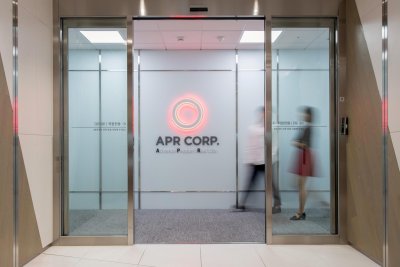
The head office of APR in Seoul. The South Korean beauty company has emerged as a new powerhouse in the country’s cosmetics industry. Photo by APR

May 28 (UPI) — South Korea overtook the United States in 2025 to become the world’s second-largest exporter of cosmetics, according to the Ministry of Food and Drug Safety (MFDS) earlier this month.

The ministry noted that the East Asian country’s cosmetics exports amounted to $11.4 billion in 2025, up 11.8% from a year before, trailing only runaway leader France with $24.3 billion.

The United States ranked third with $10.8 billion, followed by Germany with $9.9 billion, Spain with $9.2 billion, Italy with $9 billion, China with $7.3 billion, and Japan with $3.9 billion.

Meanwhile, South Korea’s 2025 cosmetics imports declined 2.3% year-on-year to $1.29 billion, resulting in a trade surplus of $10.1 billion. It marked the first time Asia’s fourth-largest economy topped $10 billion in the annual cosmetics trade surplus.

By destination, the United States has emerged as the largest overseas market for Korean cosmetics last year as exports jumped 15% year-over-year to $2.2 billion. In contrast, shipments to China plunged 19% to $2 billion.

Demand for Korean cosmetics, widely known as K-beauty products, also increased sharply in Europe and the Middle East. Exports to Poland, in particular, more than doubled from a year earlier to $282 million.

To further beef up the competitiveness of the K-beauty industry, the MFDS pledged to pursue a range of policy initiatives, including expanded regulatory support programs.

“As countries such as the United States and China have recently introduced cosmetic safety assessment systems, we are preparing to implement our own safety evaluation framework in phases,” the MFDS said in a statement.

“To help domestic companies comply smoothly with the new system, the government plans to establish guidelines, provide consulting services, and train professional evaluators,” it added.

New players fueling K-beauty boom

In the past, South Korea’s cosmetics giants relied heavily on China as their primary offshore market. Traditional behemoths, including AmorePacific and LG Household and Health Care, resorted to such a business model for years.

However, a new wave of entrepreneurs has come to the fore with a different approach, reducing dependence on China while tapping aggressively into the United States, Europe, and Southeast Asia.

Leading the shift is APR, which was founded in 2014 and built its growth around online sales channels and beauty devices aimed at international customers.

Last year, APR almost tripled its operating profit to $240 million, which is almost equivalent to that of AmorePacific and well above $113 million of LG Household & Health Care.

APR continued its strong momentum this year as its first-quarter operating profit stood at $101 million, up 173.7% from a year ago, based on robust performance in such major markets as the United States and Japan.

According to U.S. business tracker Navigo Marketing, APR came in third place in Amazon’s beauty category last year with a 7.1% market share. The firm doubled it to 14.1% in the first quarter to claim the top position.

APR has also strengthened its offline presence by entering more than 1,500 Target stores across the United States last month. It plans to expand further into about 3,000 Walmart stores in June.

Meanwhile, first-quarter operating incomes of AmorePacific and LG Household and Health Care fell short of APR with $84 million and $72 million, respectively.

The strong earnings have prompted investors to pile into APR shares on the Seoul bourse.

As a result, APR’s market capitalization jumped 73.59% this year to reach $10 billion as of Thursday. Those of AmorePacific and LG Household & Health Care were $4.49 billion and $2.52 billion, respectively.

“Considering the expansion of offline channels in the United States and accelerating sales growth in Europe, APR’s stock is likely to maintain a medium- to long-term upward trajectory,” Yuanta Securities Korea analyst Lee Seung-eun said in a report.

HMC Investment Securities analyst Ha Hee-ji shared a similar view.

“APR’s growing brand recognition in the United States appears to be spreading across global markets, thus creating a virtuous cycle,” Ha said. “Business-to-business sales in Europe, Latin America, and the Middle East are also showing steep growth trends.”

Source link

OpenAI names South Korea key partner for AI cyber defense

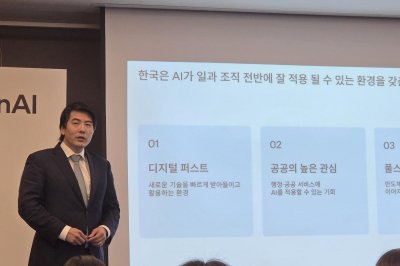
OpenAI Chief Strategy Officer Jason Kwon speaks during a press conference on the Korea Cyber Action Plan in Seoul on Wednesday. Photo by Asia Today

May 27 (Asia Today) — OpenAI said Wednesday it will expand artificial intelligence-based cyber defense cooperation with the South Korean government, public agencies and companies in key industries.

The company announced its Korea Cyber Action Plan during a press conference at the JW Marriott Hotel in Seoul’s Seocho District. The plan is designed to give government agencies, public institutions and companies broader access to OpenAI’s advanced AI cyber models.

Jason Kwon, OpenAI’s chief strategy officer, said AI has entered a third stage as an “intelligence utility,” becoming core infrastructure for the economy and society after earlier phases focused on capability breakthroughs and broader access.

Kwon said South Korea is well positioned to adopt AI because it is a digital-first society that quickly embraces new technologies and has a “full-stack economy” with global semiconductor companies including Samsung Electronics and SK hynix.

“Advanced cyber AI capabilities should not remain in the hands of only a few,” Kwon said. “Korea’s key defenders should be able to use them to strengthen collective security and public safety.”

“Korea is a very important country for OpenAI,” he said. “We hope to become an important partner in Korea’s AI transformation and in strengthening national resilience.”

The Korea Cyber Action Plan is part of Daybreak, OpenAI’s global cybersecurity initiative that aims to build security into systems from the earliest stages of development. OpenAI says Daybreak is designed to help cyber defenders identify threats, generate patches and verify fixes across code and systems.

A key part of the plan is expanding Trusted Access for Cyber, a program that gives verified defensive users access to specialized cyber AI models. OpenAI said in April it was scaling the program to thousands of verified individual defenders and hundreds of teams responsible for protecting critical software.

Kwon said access for the South Korean government to the government version of the program is in its final stage. He said OpenAI is also discussing adoption of the private-sector program with several Korean companies.

Asked about potential misuse of cyber models and data leakage risks, Kwon said OpenAI is controlling risk by granting access only to “trusted defenders” who go through strict verification.

He also said OpenAI supports data residency in South Korea, allowing data to be processed on domestic servers. Public agencies and companies may also choose an option in which data is not stored at all, he said.

Kwon said OpenAI has begun talks with the Korea AI Safety Institute under the Ministry of Science and ICT. He said the company will draw on its experience working with AI safety institutes in the United States and Britain to help South Korea build its own model evaluation capabilities.

Before Wednesday’s announcement, OpenAI had been deepening cooperation with South Korea’s public sector. On May 18, Sasha Baker, OpenAI’s head of national security policy, visited South Korea and demonstrated the company’s latest cyber-focused models to major agencies including the science ministry, the Foreign Ministry, the Interior Ministry, the Financial Services Commission and the National AI Strategy Committee.

On Tuesday, Kwon met with Ryu Je-myung, second vice minister of science and ICT, to discuss AI security cooperation. OpenAI also signed memorandums of understanding with Korea Water Resources Corp. and Korea Technology Finance Corp.

Kwon emphasized the company’s expectations for the Korean market.

“Korea is a country with very favorable conditions to turn AI into national competitiveness,” he said. “Based on ChatGPT, Korea is already one of the top 10 markets globally, and the speed of AI adoption is very fast.”

OpenAI said use of Codex in South Korea is also growing quickly. Weekly active users of ChatGPT Codex in the country have increased tenfold since the beginning of the year, placing South Korea among the top five countries by usage.

More than half of the requests come from non-development work such as document writing, analysis, research and operations, showing the potential for wider enterprise use, the company said.

Kwon said changes in OpenAI’s partnership with Microsoft have made it possible to provide OpenAI API services through a wider range of cloud providers, including Amazon Web Services, and that enterprise growth is expected to accelerate.

On pricing for enterprise services, Kwon said consumer subscriptions and corporate services are different, and that business customers already use contract-based pricing. Over the long term, he said OpenAI aims to provide stronger AI performance at the same cost or lower unit prices so more users can benefit.

— Reported by Asia Today; translated by UPI

© Asia Today. Unauthorized reproduction or redistribution prohibited.

Original Korean report: https://www.asiatoday.co.kr/kn/view.php?key=20260527010008011

Source link