Khamenei

Iran’s IRGC backs Mojtaba Khamenei as new supreme leader | Islamic Revolutionary Guard Corps

NewsFeed

Iran’s Islamic Revolutionary Guard Corps has pledged allegiance to Mojtaba Khamenei, the country’s newly-elected supreme leader. While some Iranians have celebrated, many are dismayed the 56-year-old cleric, accused of human rights abuses, has ascended to the country’s highest office.

Source link

Iranian Supreme Leader Khamenei Killed In Strikes, Trump Declares

U.S. President Donald Trump says that Iran’s Supreme Leader Ayatollah Ali Khamenei has been killed. Khamenei was among a number of senior Iranian officials targeted in the initial wave of U.S.-Israeli strikes earlier today.

Readers can first get caught up on the ongoing conflict in our previous rolling coverage here.

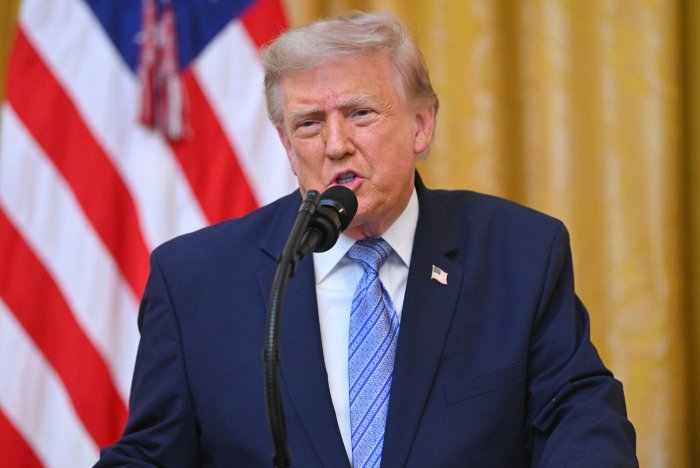
“Khamenei, one of the most evil people in History, is dead. This is not only Justice for the people of Iran, but for all Great Americans, and those people from many Countries throughout the World, that have been killed or mutilated by Khamenei and his gang of bloodthirsty THUGS,” Trump wrote in a post on his Truth Social social media network. “He was unable to avoid our Intelligence and Highly Sophisticated Tracking Systems and, working closely with Israel, there was not a thing he, or the other leaders that have been killed along with him, could do.”

“This is the single greatest chance for the Iranian people to take back their Country. We are hearing that many of their IRGC, Military, and other Security and Police Forces, no longer want to fight, and are looking for Immunity from us,” Trump added. “As I said last night, ‘Now they can have Immunity, later they only get Death!’ Hopefully, the IRGC and Police will peacefully merge with the Iranian Patriots, and work together as a unit to bring back the Country to the Greatness it deserves.”

Israeli Prime Minister Benjamin Netanyahu had said earlier today that, “this morning, in a powerful surprise strike, the compound of the tyrant Ali Khamenei was destroyed in the heart of Tehran… and there are many signs that this tyrant is no longer alive.”

Trump’s comment that Khamenei was “unable to avoid our Intelligence and Highly Sophisticated Tracking Systems” is notable.

“Getting asked a lot why this kicked off mid day and not at night. I don’t know for certain, but everything points to moving up a timeline based on time sensitive intelligence,” our own Tyler Rogoway highlighted earlier in a post on X. “Limitations to doing this for a large bi-national operation, but yeah, that’s where I would place my bet.”

Use your imagination on what would be worth doing that…

— Tyler Rogoway (@Aviation_Intel) February 28, 2026

Exactly how this will impact the course of the conflict and especially the future of Iran is unclear, but as it sits now there is likely a gaping power vacuum in Iran.

Contact the author: joe@twz.com

Joseph has been a member of The War Zone team since early 2017. Prior to that, he was an Associate Editor at War Is Boring, and his byline has appeared in other publications, including Small Arms Review, Small Arms Defense Journal, Reuters, We Are the Mighty, and Task & Purpose.


Source link

Nigerians mourn killing of Iran’s Ayatollah Ali Khamenei | Israel-Iran conflict

NewsFeed

Members of Nigeria’s Shia Muslim community are mourning Iran’s Supreme Leader Ayatollah Ali Khamenei who was killed by a US-Israeli attack in Tehran. Demonstrators carried his portrait and waved Iranian flags while they dragged American and Israeli flags along the ground.

Source link

Hezbollah promises to confront US, Israel over Khamenei killing | Israel-Iran conflict News

The Lebanese armed group has not taken action against Israel or US assets since the attacks on Iran began on Saturday.

The Lebanese armed group Hezbollah has pledged to fulfil its duty in “confronting aggression” after attacks by Israel and the United States killed Iranian Supreme Leader Ayatollah Ali Khamenei.

In a statement on Sunday, the Iran-aligned group offered condolences for Khamenei, who was killed along with other Iranian leaders in a joint US-Israeli attack on Iran early on Saturday.

Recommended Stories

list of 3 itemsend of list

“That the criminal American and Zionist [Israeli] aggression targeted our guardian, our leader, the leader of the Nation, Imam Khamenei (may his soul be sanctified), along with a group of leaders, officials, and innocent sons of the Iranian people, represents the height of criminality,” the group said.

“We will fulfill our duty in confronting aggression, confident in Allah’s victory, guidance, and support… No matter how great the sacrifices, we will not abandon the field of honour and resistance, nor the confrontation against American tyranny and Zionist criminality, in defence of our land, our dignity, and our independent choices,” it added.

So far, Hezbollah, which operates as a largely independent armed force within Lebanon, has not taken action against Israel or US assets since the attacks began on Saturday.

Lebanese President Joseph Aoun said on Sunday that “the decision of war and peace rests solely with the Lebanese state”, after an emergency meeting of the country’s Higher Defence Council.

On Saturday, Lebanese Prime Minister Nawaf Salam said he would not accept anyone “dragging the country into adventures that threaten its security and unity”.

“In light of the serious developments unfolding in the region, I once again call on all Lebanese to act with wisdom and patriotism, placing Lebanon and the Lebanese people’s interests above any other consideration,” Salam said in a statement sent to the Reuters news agency.

Lebanon is continuing its attempts to recover after a yearlong war between Hezbollah and Israel that ended after the November 2024 ceasefire. However, Israel has continued to target Lebanon in violation of the agreement and has maintained several military outposts within Lebanese territory.

Thousands mourn in Beirut

On Sunday, Hezbollah organised a gathering of thousands of supporters in the capital, Beirut, to mourn Khamenei, as they chanted, “Death to America, death to Israel”.

Zainab al-Moussawi, a 23-year-old teacher, told the AFP news agency that the death of Khamenei was “very painful. It is a tragedy.”

“It felt just like the martyrdom of the Sayyed,” she added, referring to Israel’s killing of former Hezbollah leader Hassan Nasrallah in 2024.

Hezbollah also called on mosques to recite the Quran and organise other mourning ceremonies in different parts of the country where the group holds influence to mark Khamenei’s death.

Source link

Who could succeed Ayatollah Ali Khamenei to lead Iran? | Explainer News

The assassination of Iran’s Supreme Leader Ayatollah Ali Khamenei, 86, in the US-Israeli air attacks has thrust Tehran to a pivotal crossroads as the clergy looks to pick the late ayatollah’s successor.

With Iran on a war footing, several senior leaders close to Khamenei were killed in the attack as well, including his top security adviser Ali Shamkani and Islamic Revolutionary Guard Corps (IRGC) commander-in-chief Mohammad Pakpour.

Tehran has vowed to avenge the killing of Khamenei. The US President Donald Trump warned against the retaliatory attacks and suggested that the strikes on Iran would continue.

The US-Israeli attacks hit Iran on Saturday, when Tehran’s top diplomats were waiting for the next round of talks on upcoming Monday to lock a deal with Trump, including laying down nuclear ambitions, and avoiding an armed conflict.

After 36 years in power, the late ayatollah’s killing has left Iran’s top clerics to prepare for the transfer of power to the next Supreme Leader. That’s something that they have only done once before, four decades ago.

So, who will be the next Supreme Leader of Iran? And how will he be chosen?

TEHRAN, IRAN - MARCH 1: A woman wails and holds a poster as thousands of people gather in Enghelab Square for a pro-government demonstration after Iranian state media confirmed the death of Ayatollah Ali Khamenei on March 1, 2026 in Tehran, Iran. Iran's Supreme Leader, Ayatollah Ali Khamenei, was confirmed killed after the United States and Israel launched a joint attack on Iran on February 28. Iran retaliated by firing waves of missiles and drones at Israel, and targeting U.S. allies in the region. (Photo by Majid Saeedi/Getty Images)
A woman wails and holds a poster as thousands of people gather in Enghelab Square for a pro-government demonstration after Iranian state media confirmed the death of Ayatollah Ali Khamenei on March 1, 2026 in Tehran, Iran. (Photo by Majid Saeedi/Getty Images) (Getty)

How is the Supreme Leader selected?

Iran’s Supreme Leader is selected by the Assembly of Experts, an 88-member clerical body elected by the public every eight years.

Candidates who run for the Assembly must first be vetted and approved by the Guardian Council, a powerful oversight body whose members are partly appointed by the Supreme Leader himself.

When the position becomes vacant, due to death or resignation, the Assembly of Experts convenes to choose a successor. A simple majority is sufficient to appoint the new Supreme Leader.

As per Iran’s constitution, the candidate must be a senior jurist with deep knowledge of Shi’a jurisprudence, as well as qualities such as political judgment, courage, and administrative capability.

Earlier, there had been only one other transfer of power in the office of the Supreme Leader of Iran, when Grand Ayatollah Ruhollah Khomeini, the leader of the Islamic Revolution, died at age 86 in 1989.

Iran
Emergency personnel stand at the site of an Iranian missile strike on a residential building, after Iran launched missile barrages following attacks by the U.S. and Israel on Saturday, in Tel Aviv, Israel March 1, 2026. REUTERS/Ronen Zvulun (Reuters)

What happens in Iran during a leadership vacuum?

Article 111 of Iran’s constitution mandates that a temporary council handle duties until a new supreme leader is elected.

That council will have: President Masoud Pezeshkian, Supreme Court Chief Justice Gholam-Hossein Mohseni-Ejei, and a cleric from the Guardian Council, according to Iranian media.

They will lead the country until the assembly formally picks the new supreme leader.

Iran’s security chief and a close confidante of the late Khamenei, Ali Larijani, said on Sunday that the transition process is underway.

Luciano Zaccara, a research associate professor in Gulf Politics at Qatar University, told Al Jazeera that Iran’s political system has been prepared for the current situation, knowing that Khamenei’s assassination was a real possibility.

“Trump wants to get the best deal possible, but the method he’s using to get that deal is to annihilate or destroy as much as he can,” Zaccara said. “This is the way to impose conditions, not to negotiate anything. Trump wants a surrender of the regime, not a change.”

The late Ayatollah made sure to put in a structure, he added, to avoid a vacuum of power and kept replacements for all the officials eliminated in the last few months ready. “The structures remain, the line of power [and] the line of command remain in place,” Zaccara told Al Jazeera.

INTERACTIVE-Iran’s government structure-jan 12, 2026 2-EDIT-1768237547
(Al Jazeera)

What is the Supreme Leader of Iran?

The Supreme Leader is the top position in the Islamic Republic’s political and religious hierarchy.

He is essentially the commander-in-chief of the armed forces and the final word in the country – and appoints key judicial, military, and media officials.

He also leads the mighty Revolutionary Guard, a paramilitary force that leads the so-called Axis of Resistance.

Here are the contenders for the top job in Tehran

iran
Mojtaba Khamenei, the second son of Iran’s Supreme Leader Ayatollah Ali Khamenei, visits Hezbollah’s office in Tehran, Iran, October 1, 2024. Office of the Iranian Supreme Leader/WANA (West Asia News Agency)/Handout via REUTERS ATTENTION EDITORS – THIS PICTURE WAS PROVIDED BY A THIRD PARTY.

Mojtaba Khamenei

Khamenei’s second son, Mojtaba Khamenei, is among the top contenders to succeed his father in Iran.

He is known to wield significant influence among the administrators and the Islamic Revolutionary Guard Corps (IRGC), the most powerful military body.

However, Khamenei’s lineage is also among the biggest barriers he faces.

Khamenei was reportedly opposed to the father-to-son succession. It is frowned upon in Iran, particularly after the US-backed Shah Mohammad Reza Pahlavi monarchy was toppled in 1979.

Iran
Pope Francis is shown a gift as he receives Ayatollah Alireza Arafi, president of Islamic Seminaries of Iran, and entourage in a private audience at the Vatican May 30, 2022. Vatican Media/Handout via REUTERS

Alireza Arafi

Arafi, a 67-year-old cleric, is an influential figure in the Islamic Republic’s religious establishment, but not a widely accepted political actor.

He serves as the deputy chairman of the Assembly of Experts, the body responsible for overseeing the selection of the Supreme Leader, and has been a member of the Guardian Council, which vets election candidates and laws passed by parliament.

Arafi was appointed as ⁠the jurist member of ⁠Iran’s Leadership Council, the body tasked with fulfilling the ‌Supreme Leader’s role until the Assembly of Experts elects a new leader, Iran’s state media reported on Sunday.

Arafi is also the Friday prayer leader of Qom — Iran’s most important religious center — and heads the country’s seminary system, overseeing clerical education nationwide.

Mohammad Mehdi Mirbagheri

Mirbagheri is an ultra-hardline clerical voice in the establishment and a member of the Assembly of Experts.

He is widely known for his unrelenting anti-Western worldview — and currently heads the Islamic Sciences Academy in the northern city of Qom.

Gholam-Hossein Mohseni-Ejei

Mohseni-Ejei is a senior Iranian cleric and currently heads the judiciary of the Islamic Republic, appointed to the role in July 2021 by the late Khamenei.

He previously served as Minister of Intelligence from 2005 to 2009 and later as Prosecutor-General and First Deputy Chief Justice. He is regarded as a hardline figure aligned with the conservative wing of the regime.

Iran
Ayatollah Ruhollah Khomeini’s grandson, Hassan Khomeini stands next to Iran’s Supreme Leader Ayatollah Ali Khamenei during the 36th anniversary of the death of the leader of Iran’s 1979 Islamic Revolution, Ayatollah Ruhollah Khomeini, at Khomeini’s shrine in southern Tehran, Iran June 4, 2025. Office of the Iranian Supreme Leader/WANA (West Asia News Agency)/Handout via REUTERS

Hassan Khomeini

Khomeini, 54, is among the most discussed names in succession talks for the next Supreme Leader.

He is the grandson of Ayatollah Ruhollah Khomeini, the founder of the Islamic Republic, and also the custodian of his grandfather’s mausoleum in Tehran.

While he has not held a public office, Khomeini is a reformist figure known for his rather moderate views on public life and policy. He attempted to run for the Assembly of Experts in 2016, but the vetting council disqualified him.

Source link

Analysis: Will Iran’s establishment collapse after the killing of Khamenei? | Islamic Revolutionary Guard Corps

The assassination of Iran’s Supreme Leader Ayatollah Ali Khamenei in joint US-Israeli air attacks has caused one of the most significant blows to the country’s leadership since the 1979 Islamic revolution, triggering protests by his supporters.

Khamenei assumed Iran’s supreme leadership in 1989 after the death of Ayatollah Ruhollah Khomeini, who had led the Islamic revolution against the pro-United States Shah Mohammad Reza Pahlavi.

Recommended Stories

list of 4 itemsend of list

On Sunday, Iranian President Masoud Pezeshkian said seeking revenge for the killing of Khamenei and other senior Iranian officials is the country’s “duty and legitimate right”.

President Donald Trump has framed the operation as a “liberation” moment, predicting that the removal of the “head” will lead to the swift collapse of the body. However, in Iran, the reality suggests a far more complex situation.

Interviews with insiders, military experts and political sociologists suggest that the decapitation of Iran’s top leadership may not go the way the West envisions. Instead, it risks birthing a “garrison state” – a paranoid, militarised system fighting for its existence with no political red lines left to cross.

The limits of ‘decapitation’

The central premise of the US operation is that Iran is too brittle to survive the death of its supreme leader. In a phone interview with CBS News, Trump claimed he “knows exactly” who is calling the shots in Tehran, adding that “there are some good candidates” to replace the supreme leader. He did not elaborate on his claims.

However, military analysts warn against the assumption that air strikes alone can trigger “regime change”. Michael Mulroy, a former US deputy assistant secretary of defence, told Al Jazeera Arabic that without “boots on the ground” or a fully armed organic uprising, the state’s deep security apparatus can survive simply by maintaining cohesion.

“You cannot facilitate regime change through air strikes alone,” Mulroy said. “If anyone is left alive to speak, the regime is still there.”

This resilience is rooted in Iran’s dual military structure. The government is protected not just by a regular army (Artesh), but also by the Islamic Revolutionary Guard Corps (IRGC) – a powerful parallel military force constitutionally tasked with protecting the velayat-e faqih system – the principle of the guardianship of the Islamic jurist.

Supporting them is the Basij, a vast paramilitary volunteer militia embedded in every neighbourhood, specifically trained to crush internal dissent and mobilise ideological loyalists.

INTERACTIVE-Iran’s military structure-Jan 12, 2026-EDIT-1768237546

That cohesion is already being tested.

Hossein Royvaran, a political analyst based in Tehran, confirmed that the strikes wiped out the country’s top security tier, including Khamenei’s adviser and secretary of the newly-formed Supreme Defence Council, Ali Shamkhani.

The secretary of Iran’s Supreme National Security Council, Ali Larijani, said the leadership transition will begin on Sunday.

“An interim leadership council will soon be formed. The president, the head of the judiciary and a jurist from the Guardian Council will assume responsibility until the election of the next leader,” said Larijani.

“This council will be established as soon as possible. We are working to form it as early as today,” he said in an interview broadcast by state TV.

The rapid formation of an interim leadership council – comprising the president, judiciary chief, and a Guardian Council religious leader – indicates that the system’s “survival protocols” have been activated.

According to Royvaran, the system is designed to be “institutional, not personal”, capable of functioning on “autopilot” even when the political leadership is severed.

But a Tehran-based analyst said direction of Iran is still unclear as officials try to ‘project stability’.

“Officials here are trying to project stability, emphasising that the situation is under control and that state institutions are functioning effectively,” Abas Aslani, senior research fellow at the Center for Middle East Strategic Studies, said.

“Today, [the US-Israeli] air strikes targeted security and military infrastructure in the capital [Tehran] and other cities. There are expectations that such strikes could continue – and possibly intensify – in the coming hours or days,” he told Al Jazeera.

“That prospect of escalation is not something many ordinary Iranians welcome. At the same time, Iranian officials are issuing strong warnings, suggesting they could respond with capabilities that have not previously been used against Israel or the United States.”

From theocracy to nationalist survival

Perhaps the most significant shift in the immediate aftermath is Iran’s pivot from religious legitimacy to survivalist nationalism.

Aware that the death of the supreme leader might sever the spiritual bond with parts of the population, surviving officials are reframing the war not as a defence of the clergy, but as a defence of Iran’s territorial integrity.

Larijani, a conservative heavyweight and key figure in the transition, issued a stark warning that Israel’s ultimate goal is the “partition” of Iran. By raising the spectre of Iran being broken into ethnic statelets, the leadership aims to rally secular Iranians and the opposition against a common external enemy.

This strategy complicates the US hope for a popular uprising.

Saleh al-Mutairi, a political sociologist, notes that the government’s declaration of 40 days of mourning creates a “funeral trap” for the opposition. The streets will likely be filled with millions of mourners, creating a human shield for the government and making it logistically and morally difficult for antigovernment protests to gain momentum in the short term.

The end of ‘strategic patience’

If Iran survives the initial shock, the nation that emerges will likely be fundamentally different: less calculated and probably more violent.

For years, Khamenei championed a doctrine of “strategic patience”, often absorbing blows to avoid all-out war.

Hassan Ahmadian, a professor at the University of Tehran, says the era died with the supreme leader.

“Iran learned a hard lesson from the June 2025 war: Restraint is interpreted as weakness,” Ahmadian told Al Jazeera Arabic. The new calculus in Tehran is likely to be a “scorched earth” policy.

“The decision has been made. If attacked, Iran will burn everything,” Ahmadian added, suggesting that the response will be broader and more painful than anything seen in previous escalations.”

This risks a scenario where field commanders, freed from the political caution of the clerical leadership, lash out with greater ferocity. The assassination has humiliated the security establishment, exposing what Liqaa Maki, a senior researcher at Al Jazeera Centre for Studies, calls a catastrophic intelligence failure.

“The believer is not bitten from the same hole twice, yet Iran has been bitten twice,” Maki said, referring to the pattern of US strikes. This “total exposure” is likely to drive the surviving leadership underground, turning Iran into a hyper-security state that views any internal dissent as foreign collaboration, he said.

While the “head” of Iran has been removed, the “body” – armed with one of the largest missile arsenals in the Middle East – remains, Maki said.

Source link

Iran begins 40-day mourning after Khamenei killed in US-Israeli attack | Israel-Iran conflict News

Iran has begun 40 days of mourning after Supreme Leader Ayatollah Ali Khamenei was killed in ongoing attacks by the United States and Israel, according to Iranian state media.

Top security officials were also killed in Saturday’s strikes, along with Khamenei’s daughter, son-in-law and grandson. The killings mark one of the most significant blows to Iran’s leadership since the 1979 Islamic revolution.

Recommended Stories

list of 4 itemsend of list

President Masoud Pezeshkian condemned the killing as “a great crime”, according to a statement from his office. He also declared seven days of public holidays in addition to the 40-day mourning period.

Reporting from Tehran, Al Jazeera’s Tohid Asadi said people were pouring into the streets of the capital following the news of Khamenei’s killing.

“There will be expected ceremonies,” he said, noting they would likely take place amid continuing bombardment across the country.

Iran's Supreme Leader Ayatollah Ali Khamenei killed in Israeli and U.S. strikes
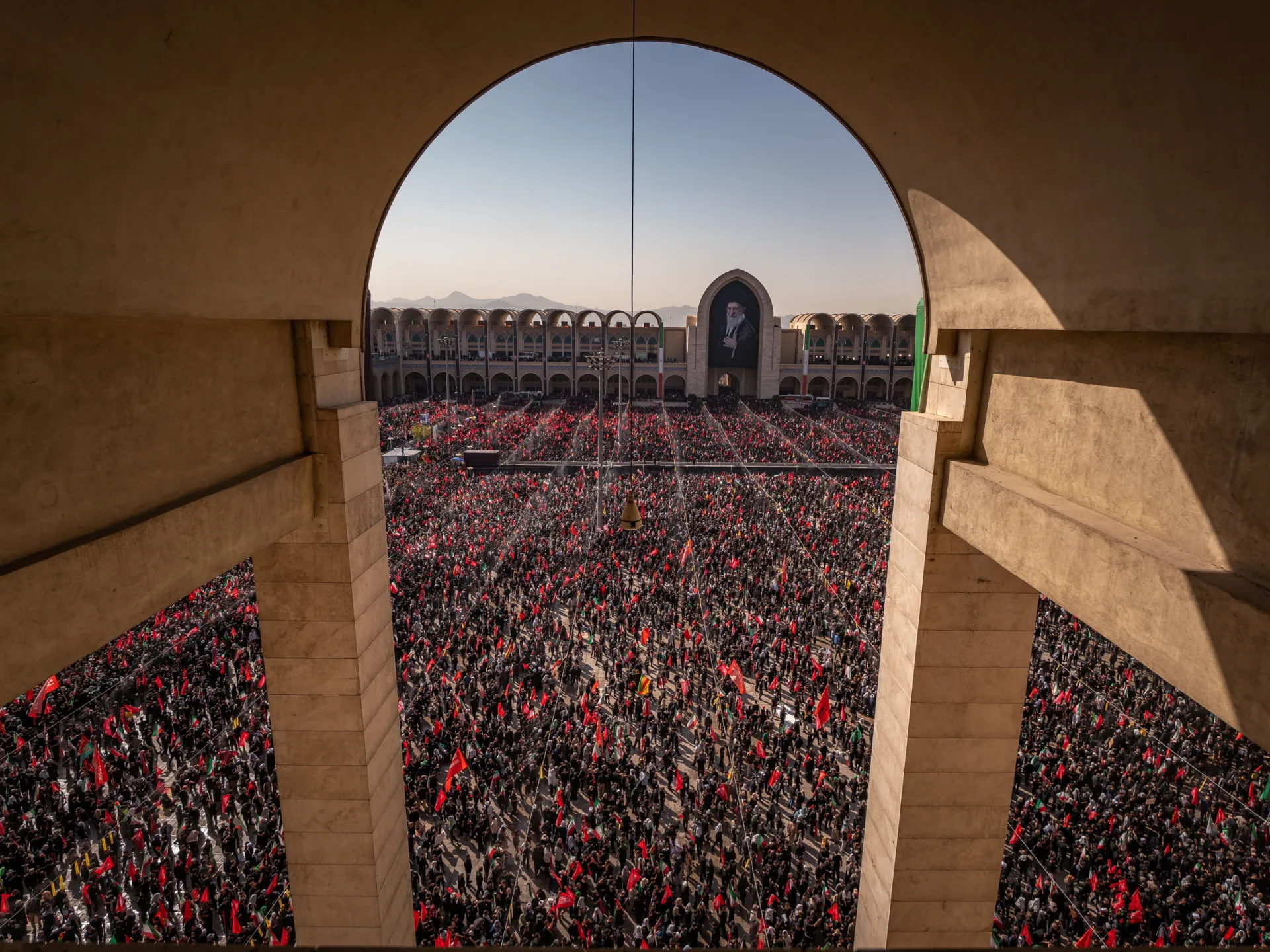
People mourn at the Enghelab Square in Tehran [Majid Asgaripour/West Asia News Agency via Reuters]

Protests denouncing Khamenei’s killing were also reported elsewhere, including Shiraz, Yasuj and Lorestan.

“There will be expected ceremonies,” he said, noting they would likely take place amid continuing bombardment across the country.

Footage aired by Iranian state media showed supporters mourning at the shrine of Imam Reza in Mashhad, with several people seen crying and collapsing in grief.

The killing also led to protests in neighbouring Iraq, which declared three days of public mourning. In Baghdad, protesters confronted security forces in the heavily fortified Green Zone, which houses Iraqi government buildings and foreign embassies.

Videos verified by Al Jazeera showed demonstrators waving flags and shouting slogans, with witnesses saying some were attempting to mobilise towards the US Embassy. Footage also showed protesters blocking vehicles at a roundabout near one of the entrances to the area.

Supporters of Iraqi Shi'ite armed groups gather after the killing of Iran's Supreme Leader Ayatollah Ali Khamenei, in Baghdad
Protesters demonstrate near the entrance of the Green Zone after the killing of Iran’s Supreme Leader Ayatollah Ali Khamenei, in Baghdad, Iraq, March 1, 2026 [Thaier Al-Sudani/Reuters]

There was also a protest in the Pakistani city of Karachi, where footage, verified by Al Jazeera, showed people setting fire to and smashing the windows of the US consulate.

However, there have also been reports of celebrations in Iran, with the Reuters news agency quoting witnesses as saying some people had taken to the streets in Tehran, the nearby city of Karaj and the central city of Isfahan.

Meanwhile, the official IRNA news agency reported that a three-person council, consisting of the country’s president, the chief of the judiciary, and one of the jurists of the Guardian Council, will temporarily assume all leadership duties in the country. The body will temporarily oversee the country until a new supreme leader is elected.

Khamenei assumed leadership of Iran in 1989 following the death of Ayatollah Ruhollah Khomeini, who had led the Islamic revolution a decade earlier.

While Khomeini was regarded as the ideological force behind the revolution that ended the Pahlavi monarchy, Khamenei went on to shape Iran’s military and paramilitary apparatus, strengthening both its domestic control and its regional influence.

Attacks across the region

Meanwhile, the Islamic Revolutionary Guard Corps (IRGC) pledged revenge and said it had launched strikes on 27 bases hosting US troops in the region, as well as Israeli military facilities in Tel Aviv.

Explosions have continued to be reported in Qatar and the United Arab Emirates, while security alerts are in place in several countries across the region.

US President Donald Trump, in a social media post on Sunday, warned Iran that it would be hit “with a force that has ⁠never been seen before” if it retaliated.

Iran’s retaliatory attacks since Saturday have targeted Israel and US assets across multiple Middle East countries, including Qatar, the UAE, Kuwait, Bahrain, Jordan, Saudi Arabia and Iraq.

Harlan Ullman, chairman of the strategic advisory firm Killowen Group and an adviser to the Atlantic Council in Washington, DC, said the US may have made a “big mistake” by killing Khamenei.

“Decapitation only works when you get all the leaders, and I don’t think that we got all the leaders,” Ullman said, adding that the US should not expect Iran’s leadership to enter negotiations in the immediate aftermath.

Iranian state media reported on Saturday at least 201 people have been killed in the joint US-Israeli attacks across 24 provinces, citing the Red Crescent. In southern Iran, at least 148 people were killed and 95 wounded in a strike on an elementary girls’ school in Minab on Saturday, with the toll continuing to rise, according to state media.

Source link

Trump: Khamenei dead after US strikes Iran | Conflict

NewsFeed

US President Donald Trump says Iran’s Supreme Leader Ayatollah Ali Khamenei was killed in joint US-Israeli strikes. Israeli officials cite “growing signs” he’s dead. Iranian state media deny the claim, saying Khamenei remains in command. At least 201 reported killed as Iran retaliates.

Source link