Khamenei

Khamenei ties US-Iran peace deal to Israel ending attacks on Lebanon | US-Israel war on Iran News

Iran’s supreme leader calls for ‘absolute, unconditional termination’ of Israel’s attacks on Lebanon amid reports of renewed diplomacy.

Iran’s Supreme Leader Mojtaba Khamenei has said that peace between Tehran and the United States is contingent on Israel stopping its attacks on Lebanon.

Khamenei made the statement in a post on X on Sunday.

Recommended Stories

list of 3 itemsend of list

Iran “has designated the preservation of Lebanon’s territorial integrity, and the absolute, unconditional termination of the Zionist regime’s aggression as the primary condition for any agreement to ending the imposed war against the aggressive US,” he wrote.

Khamenei also voiced his support for the Lebanese group Hezbollah, its former leader, Hassan Nasrallah, and the people of southern Lebanon – the focal point of Israel’s attacks – in a series of posts.

“The Islamic Republic of Iran considers the defense of these oppressed yet powerful mujahideen [of Hezbollah] to be its strategic mandate,” Khamenei said.

Khamenei’s intervention comes amid reports of a halt to attacks and renewed diplomacy between Tehran and Washington.

Iran has insisted on an end to Israeli strikes on Lebanon a precondition for ending the war, enshrining that demand in the first clause of the Memorandum of Understanding signed between the two countries in June.

That agreement has since collapsed amid a dispute over the Strait of Hormuz.

Lebanon was drawn into the conflict in March after Hezbollah launched strikes on northern Israel, citing both the killing of then-Supreme Leader Ali Khamenei on the war’s first day, February 28, and Israel’s near-daily bombardment of Lebanese territory – attacks it says violated a ceasefire that had ended an earlier round of hostilities in 2024.

On June 26, following the signing of the US-Iran MoU, Lebanon and Israel signed a US-mediated framework agreement stipulating a phased Israeli withdrawal from occupied Lebanese territory, but without a timetable for the withdrawal.

Instead, it said Israel will withdraw from occupied territories once Hezbollah is disarmed.

Iran and Hezbollah, which was not a party to the talks, have rejected the deal.

While the first phase is Israel’s withdrawal from three “pilot zones”, the Lebanese army said on Sunday that Israeli forces are obstructing the process, including by refusing to withdraw from designated territories.

As of Sunday, Israel was still bulldozing, shelling and conducting combing operations with machineguns across large areas of southern Lebanese territory it is occupying.

At least 4,329 people have been killed, while 37 Israeli soldiers and four Israeli civilians have died in the latest round of violence in Lebanon.

Israel violated a previous ceasefire between Hezbollah and Israel more than 10,000 times, according to UN peacekeepers.

Mojtaba Khamenei is the son of the former Iranian Supreme Leader Ali Khamenei. He was selected as supreme leader after the US and Israel’s assassination of his father.

Khamenei’s statement on Lebanon comes as war spreads into Yemen, with reports of an exchange of attacks between the Houthis and Saudi Arabia.

Source link

Iran’s Ayatollah Mojtaba Khamenei calls U.S. the ‘Great Satan’

Iranian women hold an image of supreme leader Ayatolla Mojtaba Khamenei as Iranian officials, military commanders, families of war victims and their supporters gathered at Imam Khomeini Mosque in Tehran on Sunday. On Saturday, Khamenei called the United States “The Great Satan.” Photo by Behnam Tofighi/UPI | License Photo

July 18 (UPI) — Iran’s supreme leader, Ayatollah Mojtaba Khamenei called the United States the “Great Satan,” ramping up the war of words amid an actual war in the Persian Gulf.

“Today, the Great Satan has once again revealed its true, unmasked face, so that this dark episode of criminality and broken promises serves as yet another indisputable testament to the U.S.’s dishonesty, irrationality, unreliability, and malicious nature,” a post on X from Khamenei’s account said Saturday.

He also said, in another post: “Coercion, totalitarianism, and brutality are inseparable components of the U.S. creed and doctrine.”

On his Telegram channel, Khamenei said, “The Great Satan has once again revealed its malicious nature.

“The repeated breaches of the agreement by the Great Satan [the U.S.] regarding the memorandum of understanding (MOU) signed by the Presidents of Iran and the United States have once again laid bare a fundamental truth: the signature of the U.S. President is utterly worthless and devoid of credibility. It further reaffirms that coercion, totalitarianism, and brutality are inseparable components of the U.S. creed and doctrine,” he said.

“The Great Satan” is an epithet for the United States and was coined by supreme leader Ayatollah Ruhollah Khomeini in November 1979, one day after 66 American diplomats and civilians were taken hostage at the U.S. embassy in Tehran. Most of the hostages were held for 444 days.

Iran and the United States have increased strikes in the region for the past week. Both countries are enforcing blockades in the Strait of Hormuz: Iran is preventing ships from passing, and the United States is blocking Iranian ships and ports. The strait is a vital waterway for oil and gas transport.

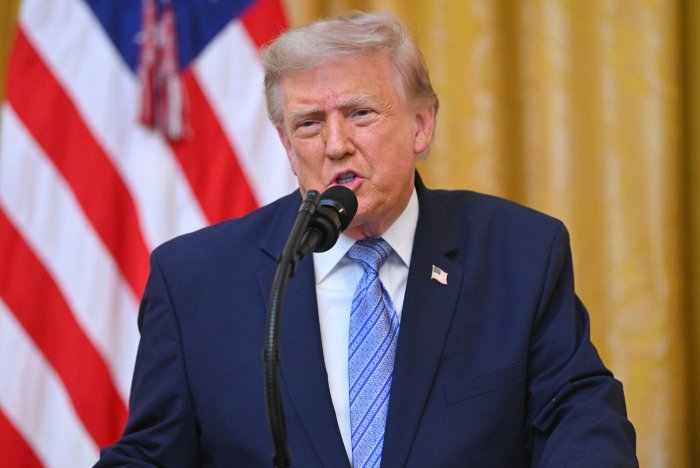
As of this writing, President Donald Trump hasn’t responded on his social media channel.

President Donald Trump delivers a prime-time address to the nation from the East Room of the White House on Thursday. Pool photo by Saul Loeb/UPI | License Photo

Source link

Iran prepares to bury slain leader Khamenei after mass funeral processions | US-Israel war on Iran News

The late supreme leader will be buried in his hometown, the eastern holy city of Mashhad.

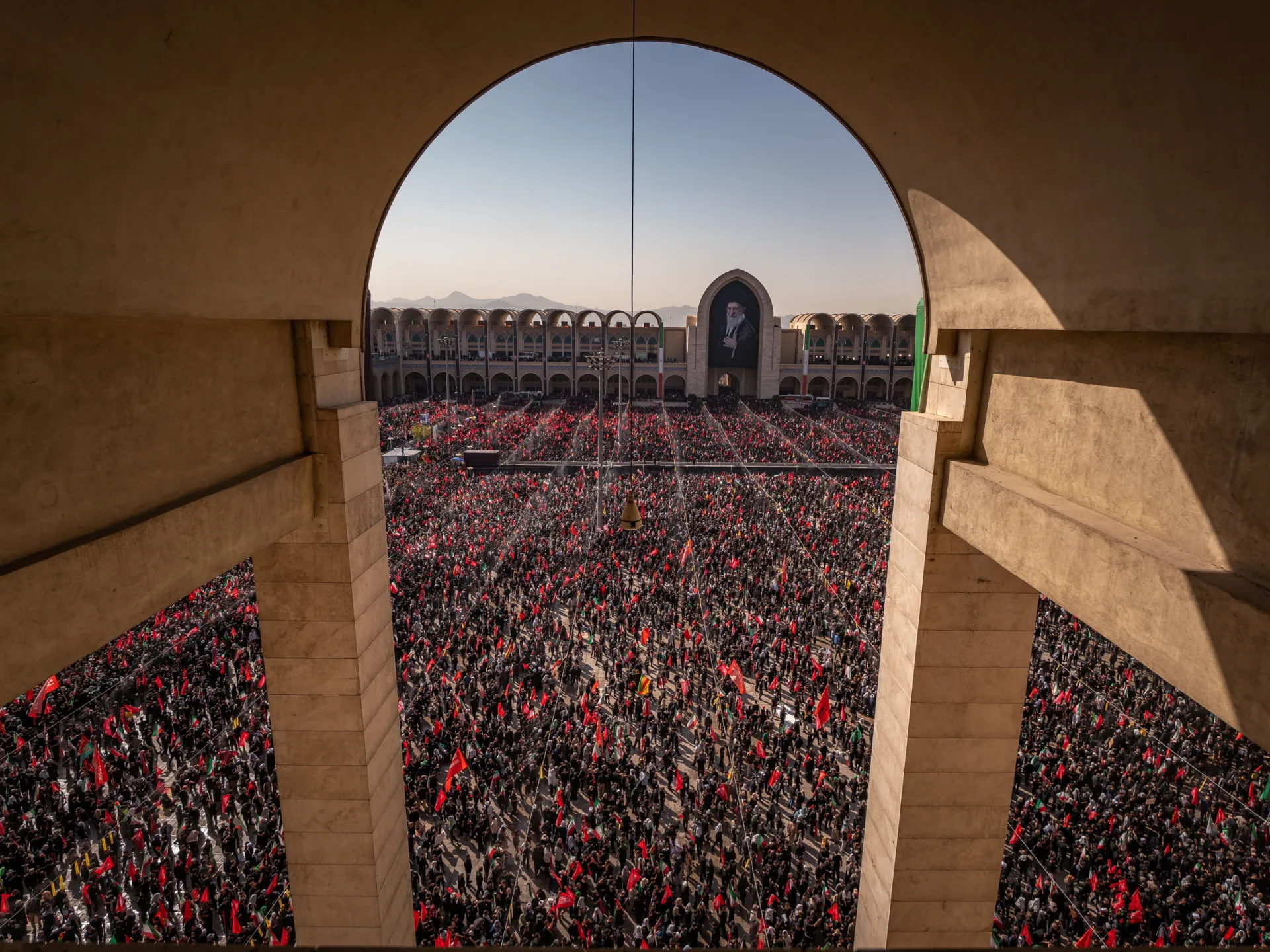
Huge crowds have gathered in the eastern holy city of Mashhad as Iran prepares to bury its slain Supreme Leader Ayatollah Ali Khamenei.

The burial in Khamenei’s hometown on Thursday follows a week of mass funeral processions, rallies and mourning ceremonies held across Iran, including a day dedicated to neighbouring Iraq.

Recommended Stories

list of 4 itemsend of list

There were marathon ceremonies to project strength and unity amid the US-Israel war on Iran, which began with strikes by the two countries on Tehran that killed Khamenei and several of his relatives on February 28.

Despite a promised pause in US attacks, Khamenei’s burial ceremony comes after the US and Iran traded attacks for a second day.

After massive processions in Iraq’s holy cities of Najaf and Karbala, Khamenei’s remains arrived on Thursday at Mashhad international airport, footage shared by the official news agency IRNA showed.

Iraq’s paramilitary group Popular Mobilisation Forces (PMF), or Hashd al-Shaabi, said on Wednesday more than 2.3 million people took part in Khamenei’s funeral procession in Najaf alone.

Khamenei’s remains, along with those of four family members killed alongside him, were also paraded through Tehran and the Shia clerical centre of Qom.

The Tasnim news agency and the broadcaster Press TV reported that millions of mourners attended the funeral procession in Tehran, with Iranian officials describing the event as the “largest public gathering in the country’s modern history”.

Crowds marched through Mashhad on Thursday morning, waving Iranian flags, photographs of Khamenei and placards with revolutionary slogans.

The mourners also chanted slogans demanding vengeance against US President Donald Trump for his role in the assassination.

“I swear by the blood of the supreme leader, Trump, we will kill you,” they shouted, with women holding up placards reading “Kill Trump”.

The incumbent supreme leader, Mojtaba Khamenei, has been notably absent from the processions. He has not yet appeared in public since taking over days after his father’s assassination.

Officials have said he was wounded in the air strikes that killed his father, but the severity of his injuries remains unclear.

Iranian state television reported that Khamenei’s burial ceremony in Mashhad would be pushed to 2:30pm local time (11:00 GMT) as larger-than-expected crowds had delayed the funeral processions in Iraq.

Reporting from Tehran, Al Jazeera’s Resul Serdar Atas said Iranian officials had confirmed that the overnight US attacks on the Tehran-Mashhad railway line, which have put it out of service, had not delayed the burial ceremony.

Mohammad Mohammadi Golpayegani, head of the late leader’s office, said Khamenei had requested to be buried in Mashhad, near the shrine of Imam Reza, a descendant of the Prophet Muhammad.

Source link