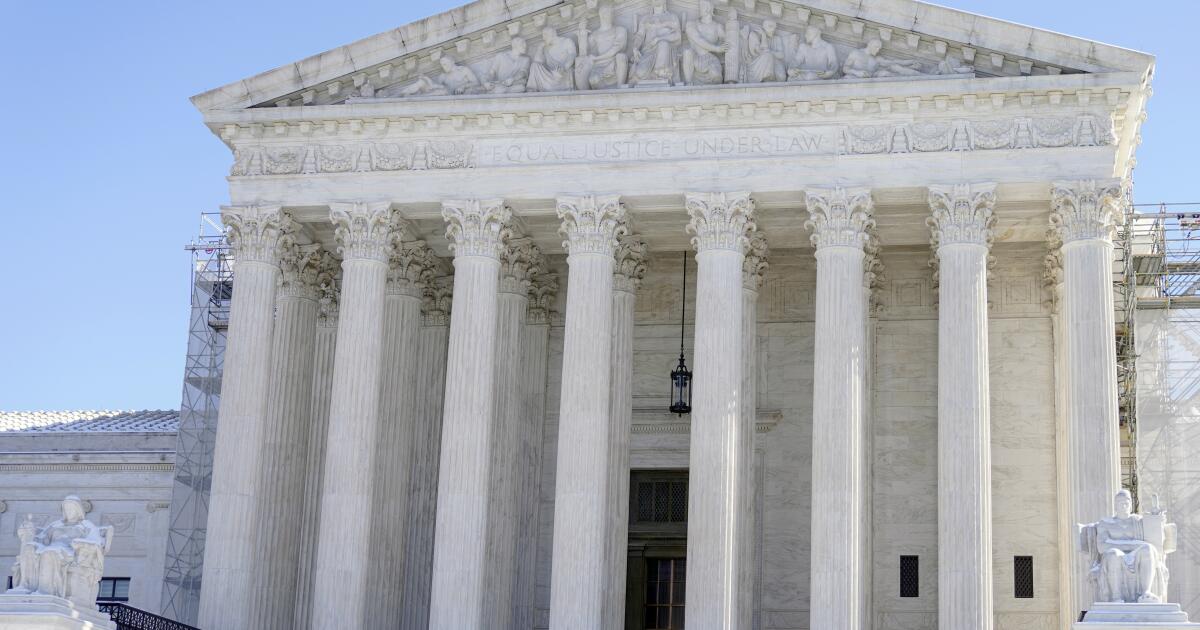
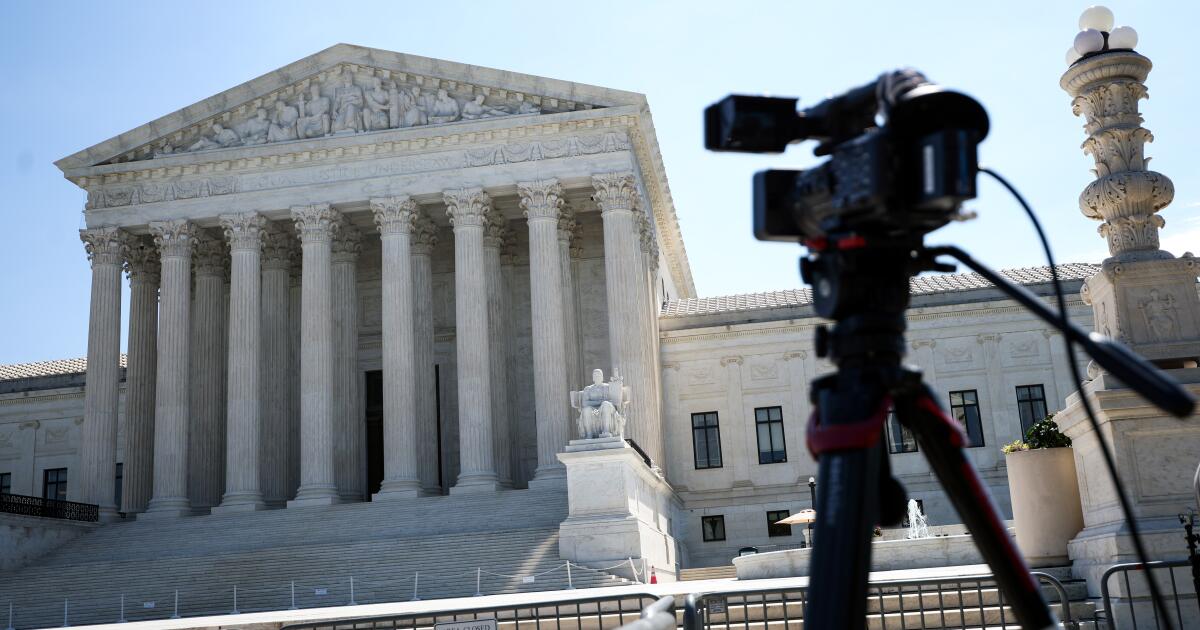
WASHINGTON — The Supreme Court announced Tuesday that it will hear a 2nd Amendment challenge to the gun laws in Connecticut and Cook County, Ill., that ban most semiautomatic assault weapons.
Before leaving for the summer recess, the justices issued orders on new cases that will be heard in the fall. The new 2nd Amendment case figures to be a major test of what kinds of firearms and ammunition are off-limits to state or federal regulation.
The outcome will affect California and all the states led by Democrats that strictly regulate or prohibit semiautomatic rifles, such as the AR-15.
Gun-rights advocates say these are among the most common and popular weapons in the country, and they should not banned in some states.
In response, Connecticut state attorneys said only about 2% of Americans own assault weapons, and they rarely use them for self-defense.
State lawmakers said these rapid-fire guns are not needed for self-defense but can be a weapon of mass murder. All of the blue-state bans could be struck down next year if the court’s conservatives rule in favor of the 2nd Amendment claim.
Gun-rights advocates say firearms in “common use” by law-abiding owners cannot be prohibited by the government.
Four of the court’s conservatives have said in past dissents they believe the state bans on assault weapons run afoul of the 2nd Amendment. They are Justices Clarence Thomas, Samuel A. Alito, Neil M. Gorsuch and Brett M. Kavanaugh.
That suggests the fate of those state laws depends on Chief Justice John G. Roberts and Justice Amy Coney Barrett.
Joining in support of the gun-rights challenge were the state attorneys for Montana, Idaho and 25 other Republican-led states.
They urged the court to prevent liberal judges and states led by Democrats from “rewriting the 2nd Amendment … to allow hostile jurisdictions to continue infringing on their citizens’ core constitutional right to keep and bear arms.”
In 2016, California’s voters approved a ballot measure that makes possession of large-capacity magazines illegal. At least 10 states have similar laws, but they apply only to the manufacture and sale of large-capacity magazines.
Gun-rights advocates sued in San Diego, leading to nearly a decade of back-and-forth litigation. A federal judge struck down these restrictions under the 2nd Amendment, but the state appealed. They were eventually upheld by the 9th Circuit Court in an en banc ruling.
Meanwhile, the 7th Circuit Court in Chicago has upheld an Illinois law and the Cook County ordinance prohibiting semiautomatic rifles and pistols. Its opinion said rapid-fire guns do not differ significantly “from machine guns and military-grade weaponry,” which can be banned under the 2nd Amendment.
Before Tuesday, the justices had repeatedly refused to weigh in on whether the 2nd Amendment’s right to “keep and bear arms” includes the right to semiautomatic “assault weapons” and large-capacity magazines.
Since 2015, the court has turned down gun-rights appeals from blue states like Illinois and Maryland over their bans on “assault weapons,” despite dissents from Justices Thomas, Alito and Gorsuch.
As an appeals court judge in Washington, D.C., Kavanaugh voted to strike down the city’s ban on assault weapons.
Three years after John Roberts became chief justice, the court ruled for the first time in 2008 that the 2nd Amendment protected individual gun rights, not just state militias. But the 5-4 decision simply struck down a city’s ban on having a hand gun at home for self-defense.
Ever since, advocates for gun rights and gun control have been arguing over whether semiautomatic guns with large-capacity magazines can be regulated because they are uniquely dangerous or are protected because they are very common.
In the past two years, the Supreme Court has a mixed record on gun regulation.
Last year, the justices in a 6-3 decision struck down a federal regulation that banned “bump stocks,” which allow rapid-fire shooting with a semiautomatic rifle.
That regulation was adopted in the first Trump administration in response to the mass shooting at an outdoor concert in Las Vegas where a lone gunman fired as many as 1,000 shots from a hotel window.
The conservative majority ruled the bump stock devices did not fit the definition of a prohibited machine gun.
Earlier this year, however, the court in a 7-2 decision upheld a regulation prohibiting unregistered “ghost guns” that were made by parts kits.
WASHINGTON — The Supreme Court on Tuesday upheld the Constitution’s promise that all those born here are citizens of the United States, regardless of the status of their parents.
In a 6-3 decision, the justices rejected President Trump’s plan to revise the Constitution by executive order and to end citizenship at birth for newborns whose parents were here illegally or temporarily.
Chief Justice John G. Roberts spoke for the court to reject Trump’s proposed limits on birthright citizenship.
“Citizenship, then and now, was the right to have rights — to freely participate in our political community,” he said. “The Framers of the 14th Amendment extended that promise to ‘every free-born person in this land.’ We keep that promise today.”
Justices Sonia Sotomayor, Elena Kagan, Amy Coney Barrett and Ketanji Brown Jackson joined in full. Justice Brett M. Kavanaugh concurred in the outcome based on the federal law that incorporates birthright citizenship.
But the outcome was closer than most had predicted.
Justices Clarence Thomas, Samuel A. Alito and Neil M. Gorsuch dissented in agreement with Trump.
The decision is the second major defeat for Trump from a conservative court that usually supports broad presidential power.
In February, the court struck down Trump’s sweeping worldwide tariffs, his signature economic policy. Roberts said Congress, not the president, has the power to raise revenue and impose taxes, including duties on imports.
In April, Trump came to the court to hear the arguments over birthright citizenship. He sat in the gallery while the justices posed steadily skeptical questions to his solicitor general.
He left after an hour having heard enough to know he was likely to lose.
It was the rare Supreme Court case which was decided based simply on the words of the Constitution.
The justices, both conservative and liberal, say they look to what the Constitution says and how its words were originally understood.
The 14th Amendment adopted in 1868 says: “All persons born or naturalized in the United States and subject to the jurisdiction thereof are citizens of the United States and of the State where they reside.”
In its place, the Reconstruction Congress adopted the broad view of citizenship based on the place of birth, not parentage, that had been part of English law for centuries.
In the 19th Century, it was understood that the only exceptions to this rule of birthright citizenship were for the children of foreign diplomats, foreign troops on American soil or, for a time, Native Americans who lived on tribal reservations.
In 1924, Congress extended full citizenship to all Native Americans who were born in this country.
The Supreme Court had also confirmed the broad understanding of birthright citizenship in 1898. The justices upheld the U.S. citizenship of Wong Kim Ark who born in San Francisco to Chinese parents who later returned to China.
“The 14th Amendment affirms the ancient and fundamental rule of citizenship by birth within the territory,” the court said then. “In clear words and in manifest intent, [it] includes the children born, within the territory of the United States, of all other persons, of whatever race or color.”
Congress added birthright citizenship to the immigration laws in 1952.
“The privilege of United States citizenship is a priceless and profound gift,” he wrote, and in the future, it will not extend to newborns whose parents are in this country unlawfully or temporarily, such as on tourist, student or work visa, he said.
His proposal was quickly blocked by judges as unconstitutional, and it never went into effect.
In his appeal, Trump’s attorney argued that judges have been “misreading” the phrase “subject to the jurisdiction.” He said this refers to “political allegiance.”
By that standard, the children of temporary visitors and unlawful immigrants are not citizens because they and their parents “not completely subject to the United States’ political jurisdiction,” according to the administration.
Trump could have proposed legislation on tariffs and birthright citizenship and urged the Republican-led Congress to adopt new laws. Instead, he chose to try to change the law and revise the Constitution by executive order.
Before the Supreme Court, Trump’s attorney pointed to the surge of illegal immigration in recent decades.
“We’re in a new world now,” he said, one that calls for new restrictions on citizenship.
“It’s a new world. It’s the same Constitution,” responded Roberts.
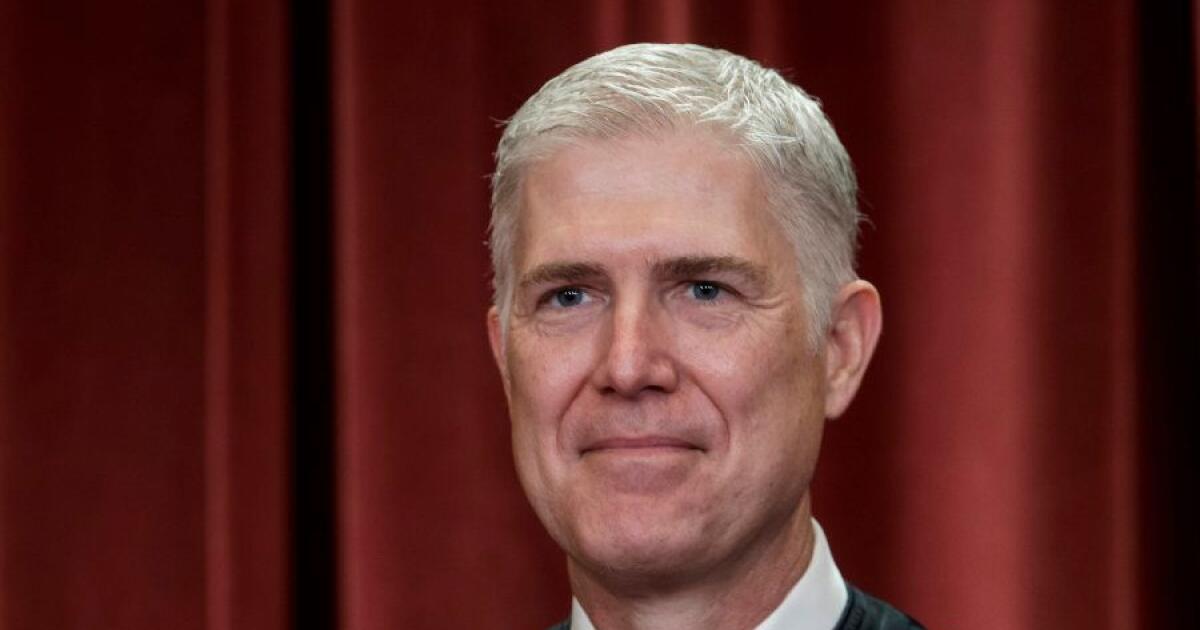
Reporting from Washington — Justice Neil M. Gorsuch, President Trump’s first appointee to the Supreme Court, is proving to be a different kind of conservative.
He is a libertarian who is quick to oppose unchecked government power, even in the hands of prosecutors or the police. And he is willing to go his own way and chart a course that does not always align with the traditional views on the right or the left.
In several of the term’s biggest cases, Gorsuch voted as expected. He joined the court’s conservatives, including Justice Brett M. Kavanaugh, to reject legal challenges to partisan gerrymandering. The two Trump appointees voted in dissent to uphold the administration’s plan to add a citizenship question to the 2020 census.
In the case of whether a giant cross on a Maryland highway violated the separation of church and state, Gorsuch took the most conservative position and said lawsuits filed by people who are “offended” but not actually harmed by such things should be tossed out.
But in the last month, he also wrote several broad and bold opinions — mostly in dissent — urging the court to revive the Constitution’s protections for individual liberty. He did so while taking the side of people not usually embraced by conservative justices, including a sex offender from Maryland, an Alabama man who was prosecuted twice for carrying a gun in his car, and two African American men from Texas who were sentenced to more than 50 years in prison for robbing gas stations.
Jonathan Adler, a law professor at Case Western Reserve University in Cleveland, calls Gorsuch “a maverick conservative with a libertarian streak. It’s remarkable that he and Kavanaugh disagreed in 30% of the term’s cases. This shows they are quite different types of conservatives.”
Earlier this year, Gorsuch wrote an opinion clearing the way for long-haul truckers to sue their employers over substandard wages, and he wrote dissents in favor of an injured railroad worker who was battling the train line over the damages he won, and a disabled construction worker fighting the Social Security Administration over disability benefits.
“Walk for a moment in Michael Biestek’s shoes,” he wrote in a dissent in the construction worker’s case that was joined by Justice Ruth Bader Ginsburg and in part by Justice Sonia Sotomayor. “As part of your application for disability benefits, you’ve proven that you suffer from serious health problems and can’t return to your old construction job. Like many cases, yours turns on whether a significant number of other jobs remain that someone of your age, education and experience, and with your physical limitations, could perform.”
At Biestek’s hearing, an expert testifying for the agency said there were 360,000 jobs nationwide that he could perform. “Where did those numbers come from?” Gorsuch asked. When pressed about the source of this data, the expert said it came from a confidential private survey. The agency examiner ruled this evidence was good enough to justify denying Biestek’s claim, and the high court agreed by a 6-3 vote. “Count me” with the lower-court judges who were skeptical, Gorsuch said.
His most important opinion of the term came in a case that was seen as an opening salvo in the war over the “administrative state.” Conservatives have sought to rein in federal regulators, including the Environmental Protection Agency. Liberals are just as determined to defend them. The battle was fought, oddly enough, in the case of Herman Gundy, a sex offender who served five years in prison in Maryland and then moved to New York in 2012.
There, he was charged with failing to register as a sex offender as required under a law adopted by Congress in 2006, two years after his crime. The law said the “attorney general shall have the authority” to decide whether to apply the registration rule to the more than 500,000 offenders like Gundy whose crimes predated it.
Sarah Baumgartel, a federal public defender in New York, appealed Gundy’s conviction, in part, for violating “the non-delegation doctrine.” This refers to the principle that Congress may not delegate its lawmaking power to the president or executive agencies. It’s a doctrine studied in law schools, but not since 1935 has the high court struck down a law on this basis.
But she thought the appeal might interest Gorsuch and other justices, even though it had lost in every lower court. “This has been considered a dead-letter doctrine by many people. But he has a libertarian streak and a greater skepticism about federal power,” she said.
Her instinct was right. The eight-member court heard the case in the first week of October, a week before Kavanaugh was confirmed. But on June 20, the court ruled against Gundy in a splintered 5-3 decision, with Gorsuch writing a 33-page dissent in Gundy vs. U.S.
“The Constitution promises that only the people’s elected representatives may adopt new federal laws restricting liberty,” Gorsuch wrote. “Yet the statute before us scrambles that design. It purports to endow the nation’s chief prosecutor with the power to write his own criminal code governing the lives of a half-million citizens. Yes, those affected are some of the least popular among us. But if a single executive branch official can write laws restricting the liberty of this group of persons, what does that mean for the next?”
Chief Justice John G. Roberts Jr. and Justice Clarence Thomas agreed with Gorsuch. Justice Samuel A. Alito said he would be willing to accept this argument in a future case. And with Kavanaugh on board, the conservatives would have a majority.
Gorsuch was also on the losing end of an effort to reject the “dual sovereigns” doctrine that allows both the federal government and a state to prosecute a person for essentially the same crime. This double prosecution seems, to some, to conflict with the 5th Amendment, which says: “No person shall … be subject for the same offense to be twice put in jeopardy for life and limb.”
The case began in 2015 when a police officer in Mobile, Ala., pulled over Terance Gamble for a damaged headlight and found a loaded handgun in his car. Gamble had an earlier robbery conviction and pleaded guilty to state charges for having a gun in his possession. Later, federal prosecutors also charged him as a felon with a gun, and he was given three more years in prison.
The Supreme Court rejected his double-jeopardy claim on June 17, over dissents by Gorsuch and Ginsburg. “A free society does not allow its government to try the same individual for the same crime until it’s happy with the result,” Gorsuch wrote in Gamble vs. United States. “Unfortunately, the court today endorses a colossal exception to this ancient rule against double jeopardy.… The separate sovereigns was wrong when it was invented, and it remains wrong today.”
But on June 24, Gorsuch spoke for a 5-4 majority to overturn about half of 50-year prison terms given to Maurice Davis and Andre Glover of Texas for robbing four gas stations. They were convicted of the robberies and for brandishing a gun and given long prison terms. They were given an extra 25 years under a 1986 law for conspiring to engage in conduct that, “by its nature, involves a substantial risk that physical force” will be used.
In United States vs. Davis, Gorsuch said this part of the law is so vaguely worded that no one can tell for sure what it means. “Vague statutes threaten to hand responsibility for defining crimes to relatively unaccountable police, prosecutors and judges, eroding the people’s ability to oversee the creation of the laws they are expected to abide,” said Gorsuch, who was joined by the court’s four liberals. In dissent, Kavanaugh called the ruling a “serious mistake” and said it could mean “many dangerous offenders … might walk out of prison early.”
Brandon Beck, a federal public defender in Lubbock, Texas, who appealed on behalf of Davis, said he tailored his argument to Gorsuch because he “is very concerned by the text and the separation of powers. … He is also very independent, and I have lot of respect for that.”
Progressive lawyers stress that Gorsuch is a reliable conservative on most issues. Brianne Gorod, counsel for the Constitutional Accountability Center, said he “is like the justice he replaced — Justice Antonin Scalia — in more ways than one.”
Gorsuch’s record is exceptionally conservative, she said. But also like Scalia, he has sometimes demonstrated a willingness to part ways with his fellow conservatives in criminal justice cases. “Those votes suggest possible libertarian-liberal alliances may be something to look out for in the terms ahead,” Gorod said.
A Colorado native, Gorsuch has also tilted the court in favor of Native Americans and tribal treaties. In March, he cast the fifth vote with the liberals to rule for the Yakama tribe, which relied on a 1855 treaty in refusing to pay a fuel tax to Washington state for using its highways.
Gorsuch wrote a concurring opinion in Washington State vs. Cougar Den, joined by Ginsburg, to explain the history and closed with this passage: “Really, this case just tells an old and familiar story. The state of Washington includes millions of acres that the Yakamas ceded to the United States under pressure. In return, the government supplied a handful of modest promises. The state is now dissatisfied with the consequences of one of those promises. It is a new day, and now it wants more. But today and to its credit, the court holds the parties to the terms of their deal. It is the least we can do.”
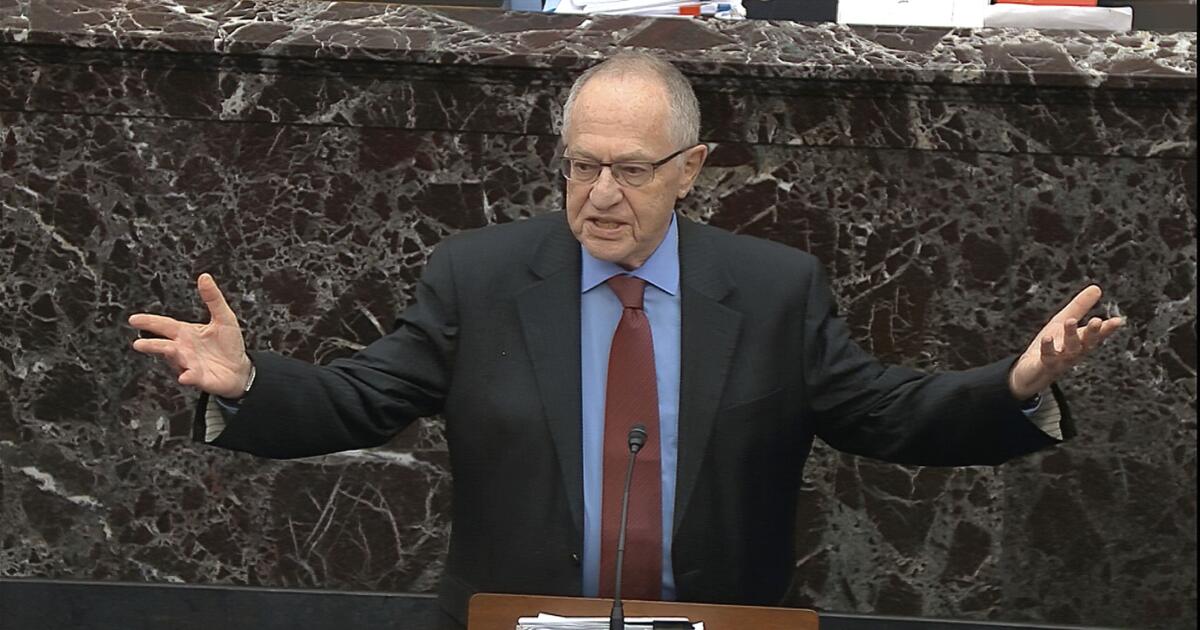
WASHINGTON — The Supreme Court on Monday turned away Harvard law professor Alan Dershowitz’s defamation suit against CNN, refusing to reconsider the high bar for press freedom set in the New York Times vs. Sullivan case.
Justices Clarence Thomas and Neil M. Gorsuch dissented.
The no-comment decision may signal the justices are not anxious to revisit another civil rights era landmark.
But the Dershowitz lawsuit may have been a less than ideal test case.
He sued CNN for $300 million, alleging its commentators distorted his arguments during President Trump’s first impeachment trial before the Senate.
He lost before a federal district judge and the 11th Circuit Court of Appeals in Atlanta. Judges said he had presented no evidence of “actual malice” or knowing falsehoods, citing the doctrine set in the landmark decision.
Dershowitz’s appeal urged the Supreme Court to reconsider and discard the “actual malice” rule or to limit its use against private citizens who are treated as public figures.
In 1964, a unanimous Supreme Court said the 1st Amendment’s protection for the freedom of speech and the press limited state libel verdicts.
An all-white Alabama jury had awarded a $500-million judgment to Montgomery city commissioner L.B. Sullivan over a fund-raising ad for the Rev. Martin Luther King that had appeared in the New York Times.
The ad did not mention Sullivan by name but he said he was defamed by the ad’s criticism of the police.
Reversing that verdict, the court’s opinion said the 1st Amendment was intended to protect debate and criticism of public officials.
With that goal in mind, the justices barred defamation suits over minor or honest mistakes and said plaintiffs must show the defendants displayed “actual malice” by making statements they knew were false or showed a “reckless disregard” for the truth.
The decision was later extended to include public figures like Dershowitz.
In 2020, he defended President Trump’s conduct and told senators it fell short of an impeachable offense.
The House had accused Trump of threatening to withhold military aid to pressure Ukrainian President Volodymyr Zelenskyy into investigating his political rival, Joe Biden, and his son Hunter.
In response to a question about an alleged quid pro quo, Dershowitz said a president can make deals that are in the public interest or his political interest, but not for a corrupt personal benefit.
“If a President does something which he believes will help get him elected — in the public interest — that cannot be the kind of quid pro quo that results in impeachment,” he said.
That statement drew sharp and immediate criticism on CNN.
Commentator Paul Begala asserted the “the Dershowitz doctrine would make presidents immune from every criminal act.”
CNN aired the full video of Dershowitz’s testimony and invited him to appear twice in the next two days to clarify his comments.
Months later, he filed a lawsuit alleging defamation and said CNN had perpetrated “a deliberate scheme to defraud its own audience.”
His suit was dismissed by judges who said he did not have enough evidence to send the case to a trial.
“If anything, the evidence shows that they believed in the truth of their reporting, and that they formed their opinions independently. Without evidence of actual malice Dershowitz’s defamation claim cannot go forward,” she said.
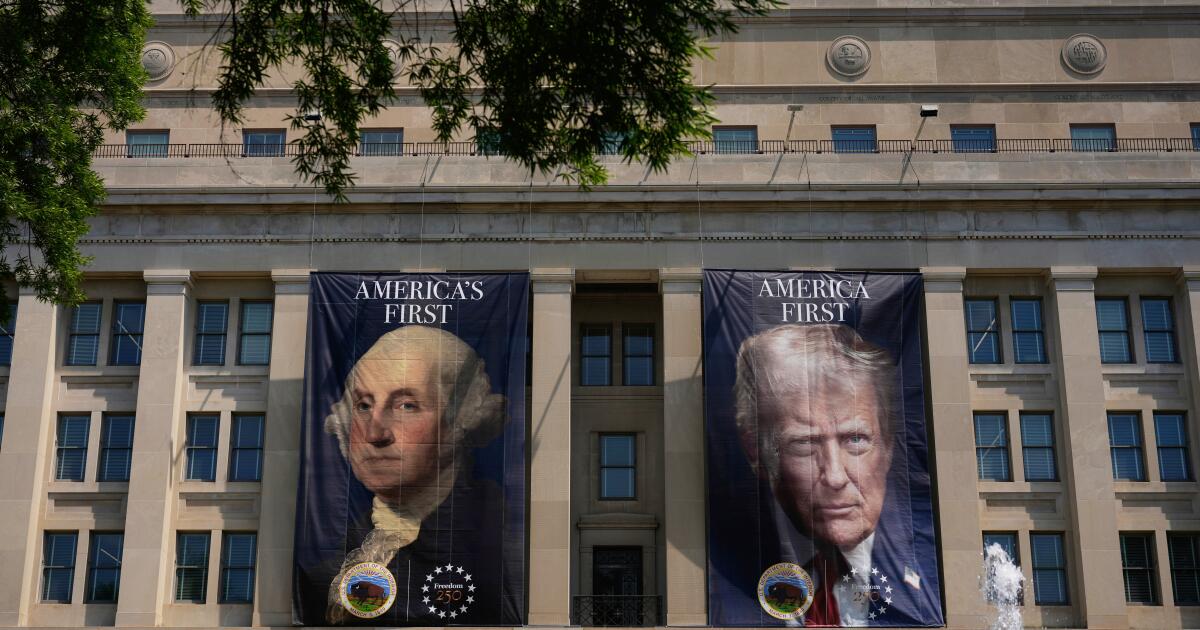
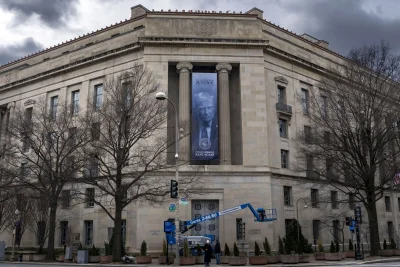
The 250th anniversary of America’s liberation from a king kicked off with a campaign-style rally on the National Mall by President Trump, whose face already stares down from banners fluttering from federal buildings across the nation’s capital.
The images illustrate how the president has dominated daily life since returning to power, evoking more the style of a monarch than the leader of the world’s oldest democracy. But more than anything, it is how he has wielded that power that has led to comparisons of an imperial reign.
Since returning to office in January 2025, Trump has nominated one of his personal lawyers to serve as attorney general, ordered the Department of Justice to pursue his political enemies, deployed the U.S. Marines to the nation’s second largest city and leveraged the presidency to enrich himself and his family.
He has demanded that comedians who mock him be fired, has slapped his name on the Kennedy Center, has pushed to seize control of elections, has filed lawsuits against news organizations whose coverage he disliked and has sued his own government seeking $10 billion in taxpayer money.
Trump also is the only convicted felon to hold the presidency, and a separate felony indictment over his attempts to keep himself in power after losing the 2020 election was dismissed only after he was reelected four years later despite those facts.
With the 250th anniversary of the nation’s founding approaching, Trump’s own celebrations have overshadowed the bipartisan, congressionally authorized commission that was supposed to coordinate events commemorating the moment. He plans to return to the National Mall on July Fourth for what he calls a “Trump rally.”
The president’s actions have led to comparisons with King George III, the British monarch whose rule inspired the American Revolution. It is a parallel Trump rejects.
“I’m not a king,” he told CBS’ “60 Minutes” earlier this year. “If I was a king, I wouldn’t be dealing with you.”
A different view of the presidency
There is a long American political traditional of opponents reviling presidents as kings. But Julian Zelizer, a Princeton University historian, said the label fits differently on Trump.
“It’s more about how he imagines who is he and what the presidency is,” Zelizer said. “We’re celebrating founding principles, and that was a driving issue — fears of how a centralized power can be corrupted. And here we are again.”
When King Charles III visited Trump this year, the official White House X account posted an image of the two men with the caption “Two Kings.” At the start of his second term, Trump declared he had ended a New York City transportation program and posted: “LONG LIVE THE KING.” The posts also seemed to indicate a willingness to leverage the label and the reaction it provokes in his critics.
The main resistance movement in Trump’s second term has adopted the slogan “No Kings.” Ezra Levin of the group Indivisible said activists were thinking ahead to 2026 and the America 250 celebration when they chose the label.
“It looks like the same kind of tyranny we were rebelling against 250 years ago, the type of domination of Americans by a secret police force that’s murdering people in the streets like in Minneapolis this year and in Boston in 1770,” Levin said, referring to demonstrations against the administration’s immigration crackdown that led to the fatal shootings of two protesters this year by federal officers.
When asked for comment, the White House referred to Trump’s statements about his use of executive power. The president has weighed in multiple times defending his maximalist approach.
During his first term, he referred to Article II of the Constitution when he told participants in a youth summit, “I have the right to do whatever I want as president,” while declaring that it “gives me all of these rights at a level nobody has ever seen before.” He told the New York Times in an interview this year that the only check on his global power was “my own morality. My own mind. It’s the only thing that can stop me.”
Yet he also has said that portrayals of his approach as authoritarian were wrong: “I’m not a dictator,” he told reporters last year. In response to a question about whether he was concentrating power in the presidency, Trump told Time in an interview last year, “I don’t think so. I think I’m using it properly, and I’m also using it as per my election.”
Supreme Court has sided with him
With a deferential, Republican-controlled Congress, courts have become the last check on Trump. The president has harshly criticized judges who have ruled against him, and his administration has sometimes defied their orders.
Yet his quest to expand presidential power has been aided by the conservative majority — including three of his appointees — on the U.S. Supreme Court, which has sided with Trump numerous times after lower court rulings hampered him.
In the middle of his 2024 campaign, the high court ruled that presidents have broad immunity from prosecution. The decision derailed multiple investigations stemming from Trump’s first term, including the one focused on his attempts to overturn his loss to Joe Biden in the 2020 election.
Trump has argued the courts cannot constrain the president on key issues, including his claims that he has the ability to fire members of independent agencies. The most notorious example was in 2024, when a judge asked during the immunity case whether a president could be prosecuted for ordering the assassination of a political rival. Trump’s lawyer, D. John Sauer, answered with a “qualified yes.”
Sauer is now solicitor general, the administration official who oversees arguments before the high court. He has continued to insist that courts cannot review presidential acts.
“Once the president has made a determination … at that point, there’s no work for the reviewing court to do,” Sauer said during Supreme Court arguments in a case over whether Trump could fire Lisa Cook, a Federal Reserve governor.
But the Supreme Court has allowed Cook to remain on the board while it considers the case. The majority also slapped down his global tariffs, finding that only Congress had the authority to impose them.
Such rulings demonstrate that presidential power does have its limits, according to John Yoo, a conservative law professor at UC Berkeley who served in the George W. Bush administration.
“The presidency today, even when colored by President Trump’s worst excesses, is not a monarchy,” he said.
Direct financial enrichment
Trump was the richest man to ever become president. During his first term, he was criticized for owning properties where foreign dignitaries and others hoping to curry his favor spent lavishly. The conflicts of interest have escalated in his second term.
Trump launched cryptocurrencies before and after returning to office. By conservative estimates, one has pulled in $320 million this year alone, while another sold $550 million worth of tokens. A third received a $2-billion investment from a foreign wealth fund.
Trump took a new step earlier this year, filing a private $10-billion lawsuit against the IRS for the leak of his tax returns during his first term. His Department of Justice directed the IRS to settle the litigation to create a $1.776-billion fund to pay damages to people who claimed the federal government unfairly prosecuted them.
The administration pulled back the settlement amid an outcry from congressional Democrats and some Republicans. But Todd Blanche, a former personal lawyer for Trump who is now acting attorney general, said at least one provision remains — a ban on the IRS auditing Trump.
Zelizer said Trump’s financial entanglements might be the most monarchical part of his administration.
“We have not seen a person who has a business operation of this scale and scope benefiting directly from the decisions he makes,” Zelizer said.
Targeting political rivals
The Justice Department’s role in the IRS lawsuit is one example of how Trump has decreed that executive branch employees should act as agents of his will.
In breaching what is supposed to be a firewall between the White House and Justice Department, Trump has demanded that federal prosecutors target his foes. In one social media post last year, he called out by name Pam Bondi, who was attorney general at the time, in pushing her to prosecute several of his political opponents: “JUSTICE MUST BE SERVED, NOW!!!” Trump wrote.
Indictments followed shortly after, including against former FBI Director James B. Comey and New York Atty. Gen. Letitia James. The charges against both eventually were dismissed, but the department under Blanche filed new charges against Comey.
The pursuit is not limited to Trump enemies of the past.
For his 80th birthday this month, the president hosted a fight held by UFC — a company he invested in — on the White House lawn. The event was broadcast on a network owned by the son of one of the president’s major donors. The spectacle drew a rebuke from California Gov. Gavin Newsom, a persistent critic and potential 2028 Democratic presidential contender.
“The White House was built to serve the American people. Tonight it was used to promote a company the President owns stock in, sell subscriptions, promote corporate sponsors, push Trump crypto, and enrich the President and his family,” Newsom wrote on X. “The founders warned us about kings enriching themselves from public office.”
Days later, Newsom disclosed that Trump’s Department of Justice was investigating him and his wife.
Riccardi writes for the Associated Press. AP writers Lindsay Whitehurst and Fatima Hussein contributed to this report.
June 23 (UPI) — The Department of Justice subpoenaed four journalists for a grand jury hearing, though it later withdrew them after The Washington Post and the Wall Street Journal challenged them.
One subpoena was for Washington Post reporter Ellen Nakashima and was related to sensitive reporting on a national security matter, The Post said.
The department also issued subpoenas to three Wall Street Journal journalists, who also reported on national security issues, The Post reported.
“The government’s subpoenas to The Wall Street Journal and our reporters represent an attack on constitutionally protected newsgathering,” Ashok Sinha, chief communications officer for Dow Jones, said in May. “We will vigorously oppose this effort to stifle and intimidate essential reporting.”
At the time, the Journal said the Justice Department issued subpoenas for records on reporting about the Iran war, but it did not report at the time that federal officials were trying to force their testimony.
Olivia Petersen, spokesperson for The Washington Post, confirmed that Nakashima was subpoenaed, calling the move an unwarranted violation of press freedom and “another sign of the government seeking to compel journalists to become instruments of its investigations,” Politico reported.
The Post was fighting the subpoena in federal court in the Eastern District of Virginia in sealed proceedings when the department rescinded Nakashima’s subpoena, an official familiar with the matter told The Post.
The Justice Department also withdrew the subpoenas for the Journal, which had been fighting in the same court. None of the journalists testified before a grand jury, the official said. The reasons for the subpoenas are not clear, though the source said they relate to national security.
In January, the FBI raided a Post reporter’s home, and the Pentagon last year revoked journalists’ credentials for not signing an agreement about what they can report.
June 23 (UPI) — Acting Attorney General Todd Blanche announced Tuesday that 455 people have been charged in a variety of healthcare fraud schemes totaling $6.5 billion.
Blanche held a press conference to discuss what he called the “2026 national healthcare fraud takedown.” He said 455 people have been charged since June 8 across 56 U.S. attorney’s offices and 45 states and territories.
“These individuals participated in healthcare fraud schemes involving more than $6.5 billion in false claims submitted to Medicare, Medicaid and other healthcare programs,” Blanche said.
Blanche highlighted some of the indictments, including one of a corporate executive in Arizona who was charged for being involved in a $1 billion fraud scheme involving wound grafts.
“This alleged scheme cost Medicare over $1 million per patient,” Blanche said. “In total, our indictment charges 11 defendants for over $2 billion in fraudulent claims in connection to alleged wound care schemes.”
Blanche adds that the money fraudulently claimed in these schemes was used to purchase “multi-million-dollar homes,” cars, jewelry and the construction of a $4.6 million seaside hotel on in the Philippines.
“We’re taking back the money, the luxury cars, the jewelry, and these alleged fraudsters will face justice,” Blanche continued.
Blanche said nine task forces, 57 U.S. attorney’s offices and 41 state attorney general’s offices partnered to investigate healthcare fraud schemes.
Blanche also announced the creation of the West Coast Strike Force and the deployment of more federal prosecutors to bring charges against 295 defendants in Medicaid fraud cases.
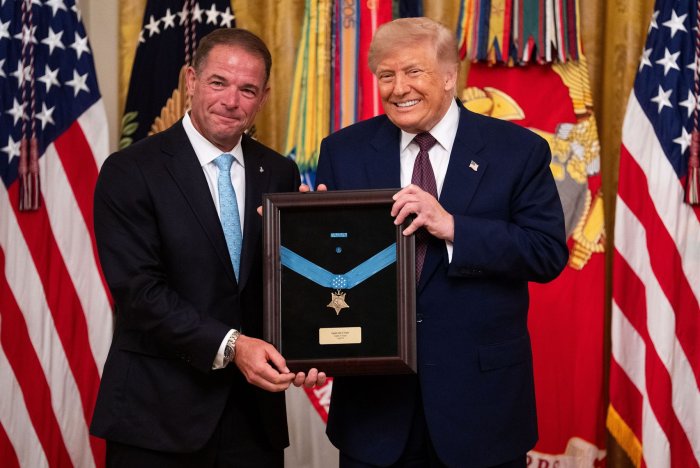
President Donald Trump presents a Medal of Honor to Tom Ripley on behalf of his father, John W. Ripley, during a Medal of Honor award ceremony in the East Room of the White House on Thursday. Photo by Aaron Schwartz/UPI | License Photo
WASHINGTON — Prison inmates whose religious rights are clearly violated by guards and wardens may not sue them for damages, a divided Supreme Court ruled Tuesday.
In a 6-3 decision, the justices said federal law protecting religious liberty allows for suits against state prison systems, but not employees of the prison.
The decision came in the case of a devout Rastafarian in Louisiana. Damon Landor had grown dreadlocks for nearly two decades. He had three weeks left in a five-month prison term when he was transferred to another prison in Louisiana.
He had with him a copy of a federal appeals court opinion that said Rastafarian inmates had a protected religious right to wear dreadlocks.
But the guards threw the appeals court decision in the trash, and the warden ordered the guards to handcuff Landor to a chair and shave his head.
Shortly after he was released, Landor sued the warden and the guards for violating the 2000 law, known as RLUIPA, which promised “appropriate relief” to those whose rights were violated.
But a federal judge, the 5th Circuit Court and now the Supreme Court have tossed out Landor’s suit.
Justice Neil M. Gorsuch wrote for the six conservatives.
He explained that when the federal government gives states money for prisons, education, healthcare and other matters, it can require them to follow the law but it does not authorize private lawsuits against their employees
“To know that is enough to know the Court of Appeals was correct. Mr. Landor does not have a federal RLUIPA cause of action against the officers,” Gorsuch wrote. “Congress lacks regulatory authority to impose liability on them directly.”
The three liberals dissented.
“Today’s decision magically transforms a federal statute into an invitation to be accepted or declined, deemed binding only if each particular defendant has explicitly agreed to be penalized,” wrote Justice Ketanji Brown Jackson. “Prisoners like Landor who suffer violations of their religious freedom in state prisons — no matter how blatant — will often be left remediless.” Justices Sonia Sotomayor and Elena Kagan agreed.
Civil liberties advocates denounced the decision.
“Our justice system is built on the promise of accountability when rights are violated,” said Rachel Rossi, president of the Alliance for Justice. “If there is no remedy for such a transgression, then there is no justice. This ruling will further erode critical civil rights protections of the far too many incarcerated people in this country.”
Rachel Laser, chief executive of Americans United for Separation of Church and State, said today’s decision “endangers the religious freedom of incarcerated people, like Damon Landor, who are particularly vulnerable to abuse and having unnecessary burdens placed on their religious exercise. Once again, we see a court that will bend over backward for the religious freedom of Christians, but allows the government to trample the religious freedom of non-Christians.”
WASHINGTON — A federal judge on Monday denied a request to disqualify top Justice Department officials from supervising the prosecution of the man charged with trying to kill President Trump at the White House Correspondents’ Association dinner.
Cole Tomas Allen had argued that involvement in his prosecution by Acting Atty. Gen. Todd Blanche and District of Columbia U.S. Atty. Jeanine Pirro created a potential conflict of interest because they were among many administration officials present at the April dinner. Allen’s attorney also had raised concerns about the close friendship between Trump and Pirro, a former Fox News commentator.
U.S. District Judge Trevor McFadden wrote in his ruling that neither their attendance at the dinner nor Pirro’s personal relationship with the president merited their disqualification. McFadden noted that Allen is not charged with attempting to harm Blanche and Pirro, and there is no evidence to suggest he even knew they would attend the dinner.
“They are unlikely to be trial witnesses, nor do they meet the legal definition of victims,” wrote McFadden, who was nominated to the bench by Trump.
Allen has been accused of trying to breach a security checkpoint armed with guns and knives. He has pleaded not guilty to various charges, including assaulting a federal official with a deadly weapon and attempted assassination of the president. He faces a maximum sentence of life in prison if convicted of the attempted assassination charge alone.
Allen also is accused of firing a shotgun at a Secret Service agent during the attack, which disrupted and ultimately prompted an early end to one of the highest-profile annual events in the nation’s capital. The Secret Service officer who was shot once in a bullet-resistant vest fired his own weapon five times without hitting anyone. Allen, of Torrance, California, was injured but was not shot.
June 19 (UPI) — A federal judge on Friday told the U.S. Department of Justice it cannot release a transcript and recording of former President Joe Biden and his biographer’s conversations.
Although U.S. District Court Judge Dabney Friedrich had earlier in the day denied Biden’s request for an injunction, she nonetheless told the department to wait three weeks for the release as his lawyers file an appeal, ABC News and CBS News reported.
Redacted versions of a transcript and recording of conversations between Biden and the ghostwriter of his biography, Mark Zwonitzer, were set to be released by the Justice Department on Friday afternoon after Friedrich’s initial ruling.
The recordings had been set for release to the conservative think tank The Heritage Foundation, which filed a Freedom of Information Act request in 2024 based on reports of Biden’s handling of sensitive and secret government records during the years between serving as vice president to President Barack Obama and being elected to the White House himself.
“Biden has not identified any public harm that would arise absent an injunction in this case,” Friedrich wrote in her decision.
“The harm to Biden’s diminished privacy interest is outweighed by the public’s interest in the Zwonitzer materials and FOIA’s ‘policy of broad disclosure of Government documents in order to ensure an informed citizenry, vital to the functioning of a democratic society,” she wrote.
Biden’s attorney’s argued that the conversations for his book were not intended to have been released and that the public’s only interest is because of the government records case, which investigators referred to in their report.
Biden was not charged or alleged of any wrongdoing after the investigation because while evidence suggested that he “willfully retained and disclosed classified material,” his guilt for having done so could not be fully established for a successful prosecution, investigators said at the time.
President Donald Trump presents a Medal of Honor to Tom Ripley on behalf of his father, John W. Ripley, during a Medal of Honor award ceremony in the East Room of the White House on Thursday. Photo by Aaron Schwartz/UPI | License Photo
“Officer, abeg! I go tell you everything. Na my friend na him deceive me. E de Sapele, I go carry you go the place. I no know anything concern. Officer!”
These were the last words of 28-year-old Oghenemine Ogidi before he was shot at close range by Usman Nuhu, an Assistant Superintendent of Police (ASP), on April 26, 2026, in Effurun, Delta State, South South Nigeria. Oghenemine died instantly from the gunshot.
A disturbing video had captured him speaking Nigerian Pidgin while begging for mercy from the police officer with his hands and legs tied. He was said to have visited the Effurun Main Park along the Warri-Sapele Expressway to collect a waybill for a friend. However, transport union workers intercepted the parcel, which allegedly contained a Beretta pistol and ammunition. The transport workers informed the Uvwie Area Police Command.
At the park, the police, led by ASP Usman, a former member of the disbanded Special Anti-Robbery Squad (SARS), arrived in a 2010 Toyota Sienna with other officers, supposedly to intervene and arrest the suspect, who had already been restrained by the transport unionists. The police whisked him away from the scene and took him to the front of the Ekpan Police Station in the state, where Usman allegedly shot him three times, while the other officers watched.
The horrific incident triggered a cascade of criticism against the police on the internet, with many condemning the extrajudicial operations of ASP Usman and other officers in the country. Before his death, Oghenemine was an up-and-coming musical artist and the second child in the family to have been killed by the police. The mother of the slain artist said his elder brother was also killed in 2022 by a high-handed police officer.
Human rights defenders and lawyers have condemned the incident, stressing that it betrayed Nigeria’s judicial system. Abba Hikima, a human rights lawyer, told HumAngle that it is unjust for a police officer to execute the most severe form of criminal justice without a fair trial or proper judicial process in any case. He emphasised the need for swift justice for the victim.
“If someone is found culpable or liable for the allegations against him and a judgment of a death sentence is passed, even the court has to hand that out to the executors of the judgment, which is a department of its own; even the judge cannot do that. It is the sheriffs of the court and the executors that execute the judgment of the court,” Abba said, noting that Usman’s job was to arrest, investigate, and charge the suspect in court so that justice could be administered accordingly.
Oghenemine’s murder forms a part of the troubling pattern of extrajudicial killings that have plagued Nigeria for decades, eroding public trust in law enforcement and fuelling cycles of protest and repression.
A disturbing pattern
Many civilian lives have been lost to police extrajudicial killings, ill-treatment, and abuse of power. Oghenemine only fell victim to a policing system enmeshed in impunity and brutality. Far worse cases have occurred in the past, and disturbing incidents of police officers unleashing cruelty against civilians continue to disrupt Nigeria’s civic spaces.
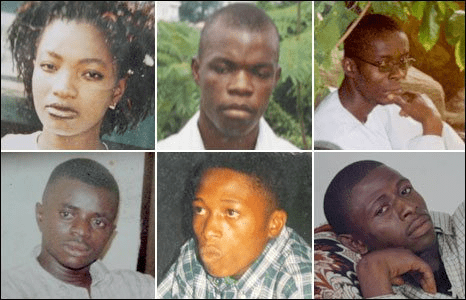
In 2005, for instance, six young traders were killed by some police officers during a supposed anti-robbery patrol. The traders were said to be returning from a nightclub in Abuja, North Central Nigeria. One of them, Augustina, had allegedly rejected the advances of a senior police officer, Danjuma Ibrahim, leading to a bitter confrontation. The angry Danjuma then told officers at a nearby police checkpoint that armed robbers were approaching. When the group arrived in their car, the police blocked them and opened fire. Four died instantly, while two survivors were taken away and left to die. The police had reportedly planted weapons on their bodies to frame them as criminals.
The killings sparked outrage across Nigeria, with widespread condemnation of police brutality and impunity. Then-President Olusegun Obasanjo ordered a panel of inquiry, which confirmed that the victims were innocent traders and not armed robbers. Findings from the panel revealed the deliberate framing of the victims and exposed the systemic abuse of power within the police force. The case became emblematic of the dangers of unchecked authority and the lack of accountability in Nigeria’s law enforcement system.
Image of ‘Apo six’ killed by police in 2005. Photo: Family members.
It took more than 11 years for justice to be partially served. In 2017, two of the six policemen involved, Ezekiel Acheneje and Baba Emmanuel, were sentenced to death for their roles in the killings, while others were discharged.
The Apo Six case remains a relevant example of extrajudicial killings in Nigeria, projecting a system that harbours police misconduct and the long struggle for justice faced by victims’ families. Between 2020 and 2023 alone, 848 Nigerians were victims of extrajudicial killings, according to Global Rights’ Mass Atrocities Tracker.
During the #EndBadGovernance protests in 2024, several protesters were killed in Kano, Jigawa, Katsina, and Kaduna, with experts raising concerns over growing police brutality. In Oghenemine’s case, however, the Nigerian Police Force seems to have moved swiftly to dismiss the officers involved and hand them over for prosecution.
“The Force does not shield officers who violate the law. No rank, no position, and no circumstance will be permitted to place any officer above accountability,” DCP Anthony Placid, the Police spokesperson, said in a statement at the time.
On June 1, a High Court in Delta State ordered the detention of five police officers over the alleged killing. The officers – ASP Usman Nuhu, ASP Onoloko Dauroupamo, ASP Okoh Kelechi, Inspector Goodluck Kingsley, and Inspector Omonigho Ahweyevu – were arraigned before Justice Marshal Onome Umukoro under Suit No. THC/ASB/CR/M/66C/2026. The court directed that they be remanded at the Ogwashi‑Uku Correctional Centre pending legal advice from the Directorate of Public Prosecutions (DPP) and adjourned the matter until June 15, 2026, for further proceedings.
On the scheduled hearing date, Harrison Gwamnishu, a human rights activist who has closely followed the case and was present at the High Court in Asaba, revealed that the DPP had filed the necessary information before the court. He noted that the matter is now awaiting legal advice before proceedings can continue.
The court document. Photo: Harrison Gwamnishu.
“The burial date has not yet been fixed, pending the conclusion of the trial,” he noted.
The activist emphasised that the murder of Oghenemine symbolises Nigeria’s ongoing challenges with police reform, noting that this incident shows the critical need for reform, accountability, and the protection of human rights. He added that moving forward, the Nigerian police should begin to use body cameras, as they will help reduce the incidents of extrajudicial killings of suspects who are supposed to be charged in court in the country.
“Even though Nigeria stands at a crossroads, I believe that justice will be served, and the judge has ordered that some of the hearings be delivered online to avoid technicalities, even right from the correctional centre. When there is accountability, justice is possible,” the activist said.
Get our in-depth, creative coverage of conflict and development delivered to you every weekend.
Subscribe now to our newsletter!
Nigeria’s policing system has long been associated with excessive use of force. SARS, for example, was established in 1992 as a branch of the police under the Criminal Investigation Department (CID) and was designed to find a lasting solution to violent crimes, specifically armed robbery, kidnapping, and carjacking across the country. However, it became notorious for torture, extortion, and unlawful killings.
Despite repeated promises of reform, the culture of impunity persisted. Amnesty International, a global human rights organisation, described the promises of Nigerian leaders to reform the police as “ineffective”. In its 2016 investigation, the organisation painted a damning portrait of SARS, exposing how the unit had strayed far from its original mission of tackling violent crime. SARS officers were accused of turning torture and extortion into a profitable enterprise, routinely brutalising detainees to extract confessions or money.
The report documented harrowing abuses, including beatings, shootings, starvation, and mock executions. Detainees were held in notorious centres such as the “Abattoir” in Abuja, where overcrowding and inhumane conditions compounded the suffering. Despite clear evidence, officers implicated in torture were rarely suspended or prosecuted; instead, they were transferred to other stations, perpetuating a cycle of impunity.
Beyond violent crimes, SARS extended its reach into civil disputes and business disagreements, exploiting its power to intimidate and extort. Victims reported theft of property, raiding of homes, and confiscation of valuables, with families describing how officers stole cars, emptied bank accounts, and looted homes during arrests.
The #EndSARS protests of October 2020 were a watershed moment in Nigeria’s struggle against police brutality. Sparked by years of abuses by SARS officers, the protests drew thousands of young Nigerians into the streets, demanding an end to extrajudicial killings, torture, and extortion. The movement culminated in the Lekki Toll Gate massacre, where security forces opened fire on peaceful demonstrators, killing and injuring dozens. According to Amnesty International, the government’s denial and lack of accountability deepened public mistrust.
“These shootings clearly amount to extrajudicial executions. There must be an immediate investigation, and suspected perpetrators must be held accountable through fair trials. Authorities must ensure access to justice and effective remedies for the victims and their families,” Osai Ojigho, former country director for Amnesty International in Nigeria, said.
The death of Oghenemine highlights the same issues that triggered the EndSARS protests: unchecked police violence, lack of accountability, and the erosion of public trust. However, extrajudicial killings are not confined to SARS alone. Regular police units, military detachments, and other security agencies have been implicated in unlawful killings during routine patrols, protests, and even minor disputes.
For instance, in April 2026, Abdulsamad Jamiu, a youth corps member, was shot in Abuja by Guards Brigade personnel. A similar incident occurred elsewhere on January 1, when Timothy Daniel, a 13-year-old boy, was killed by a soldier in Akwa Ibom. In May 2025, Japhet Njoku, a security guard, died in police detention at Tiger Base, Imo State, after severe beatings. Experts say this systemic problem reflects weak accountability structures, inadequate training, and a justice system that rarely prosecutes officers for abuses.
“If the lives of human beings can be taken by security personnel, whether or not they have been found guilty of any crime or not and no matter how harsh that crime is, someday somewhere, somebody may be framed for a similar offence, and his life will also be taken unjustifiably,” human rights lawyer Abba warned.
ATLANTA — A federal judge who was disciplined after an investigation found she had sex with a police officer in her chambers and attended a partisan event, then lied when confronted with the allegations, has recused herself in a fight over Georgia election records after the U.S. Department of Justice raised questions about her ability to be impartial.
The Justice Department sought to remove U.S. District Judge Eleanor Ross from the case, citing her reported attendance at an event for Fulton County Dist. Atty. Fani Willis, who prosecuted President Trump. Ross filed an order Tuesday recusing herself, writing that she was doing so “out of an abundance of caution for the potential perception of bias.”
The Justice Department had sued Georgia Secretary of State Brad Raffensperger for seeking an unredacted statewide voter list, and Ross was presiding over that case.
“Both the Trump administration’s present and Willis’s past efforts have become heavily polarized,” Ross wrote, explaining that she “cannot discount” that an objective observer might interpret her attendance at an event sponsored by Willis’ campaign as support for the district attorney’s position, even if she only went to see former colleagues.
Ross received a “private reprimand” after a court investigation found that she had sex in the courthouse with a high-ranking uniformed police officer within earshot of staff, attended a partisan event and then initially lied to deny the allegations.
The investigation report says Ross went to an event hosted by a district attorney’s campaign. The judge said the district attorney had been a friend since 1999 and acknowledged having gone to the a private mixer held on the sidelines of the event to visit with former colleagues in the district attorney’s office.
Ross previously worked in the Fulton County District Attorney’s Office and overlapped there with Willis there before Willis was district attorney.
Willis in August 2023 obtained an indictment against Trump and 18 others, accusing them of participating in a wide-ranging scheme to overturn Georgia’s 2020 election results. That case was ultimately dismissed in November.
The Trump Department of Justice going after people who make the president mad or even sad is nothing new, in this dangerous age when the presidency is increasingly about placating the desires of the old man in the Oval Office.
Leticia James, James Comey, Adam Schiff. Most recently, E. Jean Carroll, who sued President Trump personally and won a huge settlement on her claim that he sexually assaulted her. Now, the Department of Justice is investigating her for potential perjury.
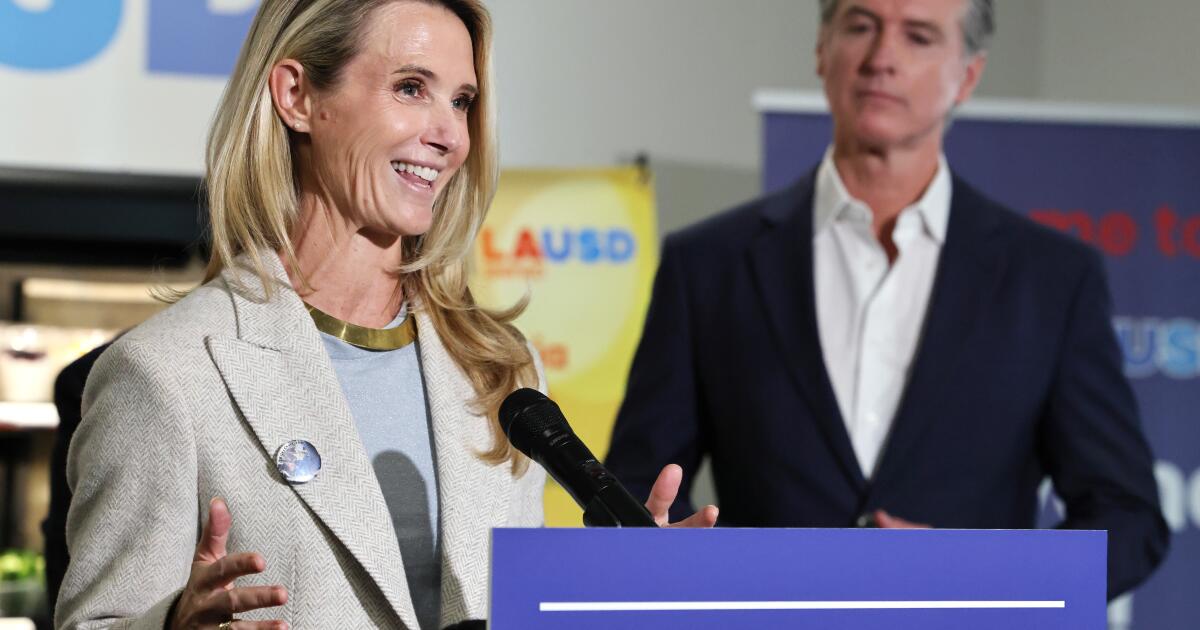
It would be easy to think of Gov. Gavin Newsom’s announcement Monday that the U.S. Department of Justice is now targeting his wife, Jennifer Siebel Newsom, as just another addition to that list.
But this attack on Siebel Newsom (alleged attack, anyway — the Department of Justice has not confirmed she is a target) is something much darker in our slide into authoritarianism. While the details of what is being investigated are murky and the president hasn’t chimed in yet, it has all the appearances of the Trump administration seeking to stop a political rival who has a real shot at knocking MAGA out of the top office.
“It’s not just random or accidental that the wife of a major presidential candidate is being investigated,” Steven Levitsky, a professor of politics at Harvard University, told me Monday. “That’s the nature of selective prosecution and that is a pillar of authoritarian rule.”
Levitsky is an expert on authoritarian regimes, and how they take and keep power. His point that Newsom is a viable challenger may seem obvious — Newsom himself is already fundraising off of it. But this particular alleged investigation bears a moment of pause because it is not the regular decline of justice we have been witnessing to this moment.
“This is different,” he said. “This is forward-looking persecution.”
Until now, Levistky points out, Trump has screamed and hollered for the prosecution of those who have wronged him in the past, sometimes even the distant past. Yes, he’s disgraced the Department of Justice with the demand it function as his own personal hammer of retribution, even putting his own personal attorney, Todd Blanche, in charge when Pam Bondi wasn’t accommodating or successful enough at stomping perceived enemies and quashing the Epstein files.
But those prosecutions have largely been grievance-based, not aimed at keeping power.
Going after Siebel Newsom seems more like a forward-looking, preemptive strike targeting Newsom ahead of the 2028 election through every decent man’s Achilles’ heel, his family.
In fact, the right-wing media — which is closely tied to the whims of the White House — has been targeting Siebel Newsom for months.
In particular, Siebel Newsom has been attacked for her work as a documentary filmmaker who focuses on female empowerment and parsing how and why we have the gender norms that we do when it comes to masculinity and femininity. I’ll let you figure out how popular that is in MAGA world, where real women make sandwiches.
And other media have focused on the fact that some of the films she has been involved with have been approved for use in California schools, leading to conspiracies that Newsom used his influence to force his wife’s “woke” agenda on kids, by which we are apparently talking about the liberal plagues of decency and inclusion.
Newsom’s office said that in recent weeks, relatives, friends and business associates of the family have been contacted by investigators from the FBI and IRS. Siebel Newsom also does work around online safety for children, but it seems likely that any attention would focus on these films, and related nonprofits, and the perennially popular MAGA boogeyman of schools forcing ideologies on kids. Throw in Siebel Newsom’s company making even a dollar, and the way the IRS can find problems with any tax return, and you’ve got about 10,000 hours of right-wing propaganda.
So whether the pressure to target Siebel Newsom came from the White House or not, Newsom’s announcement raises the troubling specter that this administration is getting more serious about remaining in control by kneecapping potential replacements before they grow too strong.
In his Monday video, Newsom urged Trump with mano a mano bravado to come after him as much as he wanted, but to leave his wife and family out of it. But I would not underestimate Siebel Newsom, who showed her strength when she testified against disgraced Hollywood mogul Harvey Weinstein, laying out publicly a private, painful tale.
Siebel Newsom’s office told me she’s fine being part of any fight against Trump.
“There are clearly no boundaries to what Donald Trump will do to get his way or to challenge those who get in his way,” Siebel Newsom said in a statement.
The “governor and I will continue to speak truth to power because the American people deserve so much more.”
By coming out in advance of any official announcement of an investigation by the Department of Justice, Siebel Newsom and her husband may be able to take control of the narrative, something Trump detests.
That pushback, Levitsky said, is critical, not just for them, but more importantly for all of us. After last year, when so many institutions and individuals crumbled in the face of Trump’s power, the strength of our democracy increasingly depends on those with political capital standing up to him.
The U.S. Justice Department has cleared the way for Paramount Skydance’s $111-billion purchase of Warner Bros. Discovery — a major milestone that moves David Ellison closer to his goal.
After a months-long review, Justice Department antitrust regulators on Friday concluded the combination would not violate federal anticompetition laws. Approval had been expected because President Trump — who has friendly ties with Ellison and his father, tech billionaire Larry Ellison — favors the deal.
The government stopped short of asking Paramount to make concessions or divestitures.
Buying Warner Bros. would allow Paramount — Hollywood’s smallest major company — to bulk up with such prestigious properties as HBO, CNN, HGTV and Food Network. Those would be combined with properties Paramount already owns, including CBS, Comedy Central, Nickelodeon and MTV.
The deal would put two historic film studios and two prominent news organizations under the same roof. It would give Paramount four streaming services, including HBO Max, and dozens of cable channels.
In its four-page closing statement, the Justice Department emphasized that career antitrust regulators — not political appointees — had performed a rigorous review, sifting through some two million documents the government received from dozens of sources, including third-party organizations.
They conducted meetings and deposed senior-level executives and other witnesses.
“These investigative efforts all led to the same conclusion: the film and television industry is highly dynamic, and the proposed transaction is not likely to harm competition or American consumers,” Justice Department regulators wrote in their summary.
Regulators zeroed in on three potential areas of concern. They looked at whether the merger would give Paramount too much power in the streaming video-on-demand market; the traditional linear television channel space; as well as in “studio development, production, or distribution of films for theatrical release,” the Justice Department said.
Competition in streaming would not be crimped, according to the regulators.
“To the contrary, the combined firm is likely to increase competition by offering consumers a more robust competitive alternative to the larger [streaming] offerings,” they wrote.
The antitrust division also found that theatrical distribution and opportunities for creators, including writers and actors, would not be harmed as long as the combined company maintained current production levels.
Ellison has promised to continue releasing 30 films a year with a combined Warner Bros.-Paramount studio. He also has said he would protect the HBO brand.
The proposed merger is controversial because many in Hollywood fear it will bring thousands of job losses, which was the result of past consolidations, including Walt Disney Co.’s 2019 takeover of Fox entertainment properties. More than 5,000 entertainment industry workers, including Jane Fonda, J.J. Abrams,Javier Bardem and Mark Ruffalo, have signed an open letter calling for the merger to be blocked.
There’s a political dimension as well. Paramount’s standing with the Trump administration (Paramount+ is set to televise Sunday’s UFC fight spectacle at the White House to celebrate Trump’s birthday as part of the company’s relationship with the UFC) has given left-leaning groups pause.
They worry about collapsing CNN and CBS News into one unit, particularly after all the turmoil that has ensued at CBS News since the Ellison family bought Paramount in August and installed Bari Weiss as CBS News editor in chief.
This month witnessed a dramatic shakeup at the iconic “60 Minutes,” with top executives and three well-known correspondents tossed out.
“We’ve already seen how far Paramount and the Ellison family are willing to go to diminish a once-proud network and news organization like CBS,” Craig Aaron, co-chief executive of the progressive group Free Press, said in a statement. His group fears the Ellisons would “do worse if they get their hands on Warner Bros., HBO, CNN and all the rest.”
Paramount, for its part, said it was grateful for “the Department of Justice’s thorough review of this transaction, as well as the work of the other agencies that have completed their reviews and provided clearance to date.”
“This deal is pro-competitive, resulting in a stronger company better positioned to compete against dominant technology platforms in an industry increasingly defined by intense competition for audiences, talent, technology, and investment,” Paramount said. “We remain focused on completing the transaction as soon as possible and delivering its benefits to consumers, creators, and the entertainment industry as a whole.”
Paramount wants to finalize its purchase by September.
With Friday’s victory, Paramount is staying on that timetable, but regulators in Europe and Britain have opened their own regulatory investigations and are expected to make their own determinations in the coming months.
In its statement, the Justice Department said it began its review last fall when it was clear Warner Bros. was in play. Regulators said they were familiar with Warner’s businesses, because the division had scrutinized four other mergers involving the company, dating back to the disastrous AOL-Time Warner merger in 2001.
Paramount’s deal would mark the third time Warner has changed hands in the last decade. AT&T bought the company in 2018 and then sold it to the smaller Discovery four years later. That deal left Warner Bros. burdened by debt, setting the stage for the Ellison takeover.
Justice Department approval could complicate efforts by Bonta and other state attorneys general to block the deal. Should Bonta or others sue, they would have to convince a judge that the nation’s top antitrust regulators failed to make a proper finding despite their lengthy review.
That may pose a high bar for the state officials, who are facing political pressure to stop the deal.
“State AGs must block this merger,” U.S. Sen. Elizabeth Warren (D-Mass.) said in a statement Friday, adding that the Justice Department’s approval was “terrible news for every American who doesn’t want Trump-aligned billionaires to control what they watch and how much they pay.”
The Justice Department said state attorney general offices had participated in its investigation, which allowed federal and state officials “to share information with each other and for the States to attend and participate in the [antitrust] Division’s depositions.”
Last month, David Ellison appeared before the regulators in a two-hour session.
Paramount’s Chief Legal Officer Makan Delrahim, who previously served as the nation’s top antitrust regulator during the first Trump administration, also was busy quarterbacking Paramount’s outreach with regulators.
The Justice Department of Friday approved the proposed Paramount Skydance merger with Warner Bros. Discovery, which will pave the way to the creation of an entertainment monolith. Photo by Allison Dinner/EPA
June 12 (UPI) — The U.S. Department of Justice on Friday said the proposed merger between Paramount Skydance and Warner Bros. Discovery does not harm competition or consumers in the United States.
The Justice Department said that it finds the proposed merger is unlikely to harm competition among similar companies or the ability of American consumers to access video-based media, it said in a press release.
Paramount in January hiked up its offer well beyond what Netflix had offered for the entertainment conglomerate, circumventing the streaming leader from acquiring it, and triggering antitrust investigations in a number of nations both operate in.
At least ten state attorneys general said last week they would sue the federal government to stop the proposed merger, which would create a monolith company comprised of several of the most significant companies in television, film and entertainment.
“This investigation included a review of reams of documentary evidence, hours of deposition testimony of senior-level executives, interviews with third-party witnesses and staff-led meetings with the parties themselves,” the Justice Department said in the release.
“These investigative efforts all led to the same conclusion: The film and television industry is highly dynamic and the proposed transaction is not likely to harm competition or American consumers,” the department said.
The Justice Department said in the release that, among other discoveries that drove its decision, the fact that Warner Bros. has “been a repeated acquisition target in the media and entertainment industry” shows that it is appropriate to approve the merger.
President Donald Trump speaks to reporters about restoring commercial fishing access to areas of the Pacific during a signing ceremony in the Oval Office of the White House on Thursday. Photo by Jim Lo Scalzo/UPI | License Photo
WASHINGTON — Vice President JD Vance is pressing federal prosecutors to investigate Minnesota Gov. Tim Walz and state Atty. Gen. Keith Ellison over allegations they failed to stop widespread social services fraud, amplifying concerns the White House will use a new Justice Department division to target political rivals.
Vance, who has been tapped to lead the Republican Trump administration’s anti-fraud efforts as he seeks to raise his political profile as a potential 2028 presidential candidate, cited in a letter to the Justice Department a report from the Republican-led House Oversight Committee that alleges Walz and Ellison were aware of pervasive misuse of government programs for years and let it flourish.
The Justice Department didn’t immediately respond to questions Tuesday about whether it would open an investigation. It was unclear what, if any, potential violations of federal law could support a probe into the Democratic Minnesota officials, who have characterized a separate Justice Department investigation involving state leaders as politically motivated.
A spokesperson for Walz didn’t immediately respond to a message seeking comment. Ellison called the allegations unfounded and said there’s no evidence his office ignored wrongdoing or failed to act as required by law. He dismissed Vance’s referral as “a political stunt from an administration that uses the machinery of government to target its perceived opponents while extending leniency to those aligned with its interests.”
“It is deeply troubling to see official powers and public resources diverted away from serving the people and instead aimed at pursuing political adversaries,” Ellison said in a statement. “That is not what government is for, and it diminishes public trust in our institutions.”
Vance’s referral to the Justice Department’s new National Fraud Enforcement Division marks an escalation in the Trump administration’s stated “war on fraud” in government programs that officials have said would not be political or partisan.
The new division has drawn intense scrutiny over the potential for political influence given its close relationship with President Trump’s White House, which announced its formation in January and initially said its leader would answer directly to the president instead of the typical Justice Department command.
In his referral, Vance wrote that officials in Minnesota or anywhere else in the country “must be held accountable” if they facilitated fraud, prevented officials from stopping it or retaliated against whistleblowers who tried to report it.
“Minnesota state officials are not above the law,” Vance wrote in a post on X.
WASHINGTON — President Trump has issued a pardon to Stephen Buyer, a Republican former congressman from Indiana who served nearly two years in prison for making illegal stock trades based on inside information after he left office.
Buyer was sentenced to 22 months in prison in 2023 for trades made while working as a consultant and lobbyist. He was ordered to forfeit more than $350,000, representing the amount of the illegal gains, and pay a $10,000 fine. He was released in 2025.
The Supreme Court in May rejected Buyer’s appeal without comment or noted dissent.
In granting “a full, complete, and unconditional pardon,” Trump cited Buyer’s career as a judge advocate general in the Army and in the House that was “distinguished and highly productive.” The pardon was dated Thursday and released by the White House late Friday.
Buyer asserted that the pardon “corrects a politically motivated prosecution” and that it was “horrific to be imprisoned for a crime that I did not commit.”
Trump used his social media platform May 31 to share a pair of letters requesting a presidential pardon for Buyer, a lawyer and Persian Gulf War veteran who left office in 2011. He was a House prosecutor at President Clinton’s 1999 impeachment trial and in 2016 he served on Trump’s transition team focusing on veterans issues.
A letter signed by more than 40 Republican former members of Congress said Buyer was “targeted by the deep state” because of his involvement in Clinton’s trial a generation ago.
A second letter, from five current House Republicans, including Ken Calvert of Corona, said pardoning Buyer would bring justice to his case. The June 2025 letter was also signed by Tom Cole of Oklahoma, Marlin Stutzman of Indiana, Jack Bergman of Michigan and Pete Sessions of Texas.
Buyer, 67, was convicted in connection with insider trading involving the $26.5-billion merger of T-Mobile and Sprint, announced in April 2018, and illegal trades in the management consulting company Navigant when his client Guidehouse was set to acquire it in a deal publicly disclosed weeks later.
The Constitution gives a president broad power to grant pardons for federal crimes. The pardons do not erase a recipient’s criminal record but can be seen as an act of mercy or justice.
WASHINGTON — The Trump administration is backing away from plans to create a $1.8-billion fund to compensate people who claim the government was weaponized against them, a retreat that comes amid a cascade of legal setbacks and a revolt within members of the Republican Party.
But Senate Democrats say the concession is not enough, and are pushing legislation to ensure no president can ever attempt the creation of such a fund again.
“If Republicans are serious about ending this brazenly corrupt scheme, they should have no problem voting for legislation banning any president from creating such a slush fund in the future,” Sen. Adam Schiff (D-Calif.) wrote Monday in a post on X.
Senate Minority Leader Chuck Schumer (D-N.Y.) added that Democrats plan to force a vote on a measure to ensure that Trump and Republicans are “truly abandoning this corrupt scheme.”
“Trump’s word is nowhere near enough,” Schumer wrote on X. Earlier in the day, Schumer vowed to force a floor vote to make Republican lawmakers take a public stance on the issue.
Schiff, along with Sens. Mark Kelly of Arizona and Elissa Slotkin of Michigan, introduced the “Drain the Slush Fund Act” on Monday. The bill, if approved, would bar any payout arising from a lawsuit filed by a president or vice president, language that is designed to permanently foreclose the fund, or anything like it, from being put in place by a future administration.
The White House did not comment on the president’s thinking. But in a statement, the Department of Justice said the decision to scrap the fund was in response to a federal judge’s ruling last week that temporarily blocked payouts from the fund while legal challenges remain pending. The department said it “disagrees strongly” with the move, but stopped short of saying it would challenge the decision.
“This fund was open to anybody who was so weaponized, targeted, or persecuted, whether they were Democrat, Republican, Conservative, Independent, or otherwise,” the statement read. “The Department will abide by the Court’s ruling.”
U.S. District Judge Leonie Brinkema, who was nominated to the bench by President Clinton, a Democrat, has scheduled a June 12 hearing for argument on whether to extend the order blocking the fund.
While the court ruling is not permanent, the unraveling over the fund is a notable defeat for Trump, who has cast it as a long-overdue reckoning for Americans he says were targeted by “an evil, corrupt and weaponized Biden administration.” For Republicans who publicly criticized the fund, it may come as a relief as the concept had been widely seen as a political liability heading into the midterm elections.
The Department of Justice created the fund to settle a lawsuit Trump personally brought against the Internal Revenue Service over the leak of his tax returns. The settlement also includes a clause permanently barring the IRS from pursuing any tax claims against Trump and his businesses that were filed before May 19 — a provision that, according to an analysis by Forbes, would save Trump and his family more than $600 million.
The White House declined to comment on whether the administration would also make changes to the tax immunity clause. The Democrats’ bill does not address that provision.
“Congress doesn’t need to pass a law to remind the Acting Attorney General [Todd Blanche] that he doesn’t have the authority to grant a blanket pardon for tax crimes by the president, much less when the AG is his personal attorney,” a Schiff spokesperson said in a statement. “The attempt at IRS immunity is corrupt and undoubtedly illegal — and we look forward to seeing it exposed as a fraud.”
Beyond Trump’s own legal disputes with the IRS, the fund was structured to accept claims from anyone who said they had been targeted by the government, a category the administration made clear could include those who were convicted for attacking the U.S. Capitol on Jan. 6, 2021.
Trump pardoned and commuted the prison sentences of 1,500 people who were charged in connection with the attack, and neither he nor Vice President JD Vance ruled out the possibility that those individuals would be able to receive money from the fund.
That possibility immediately ran into trouble with lawmakers. Senate Republicans, many of whom were caught off guard by the arrangement, publicly revolted against the fund and derailed plans to vote on legislation to fund Trump’s immigration crackdown amid the deep disagreement.
A closed-door meeting last month between Blanche and GOP senators grew heated, with lawmakers demanding answers the administration was seemingly not prepared to give.
Sen. Ted Cruz (R-Texas), who attended the meeting, described it as “angry” in an episode of his podcast last month. Cruz said that roughly 45 Senate Republicans had attended and estimated that “at least half of them were blasting the attorney general.” Based on those reactions, Cruz predicted the administration would need to amend its position on the fund.
“We will see the administration announcing at a minimum a modification of this, because if they don’t they’ve got a full-on revolt in the Senate,” he said.
The fund also led to criticism outside of Congress. Former Vice President Mike Pence, who served in Trump’s first administration, told NBC News in an interview Sunday that it was a “bad idea from the start.”
“I would encourage the administration just to drop it,” Pence said.
Weekly protests in Dublin are growing as people demand justice and accountability for Yves Sakila, a Congolese man who died after being restrained by security guards outside a shopping centre.
WASHINGTON — The Supreme Court heads into the final month of its yearly term facing decisions on birthright citizenship, gun rights, transgender athletes and President Trump’s power over independent agencies.
Unlike in years past, the term’s most significant rulings were not left for the last week in June.
The court dealt Trump a major defeat in February by striking down his sweeping worldwide tariffs. The president is likely to suffer a second defeat when the justices reject his plan to revise the citizenship laws via an executive order.
Republicans won when the court struck down a Louisiana congressional district that favored a Black Democrat.
That decision has already shifted several congressional districts toward the GOP, but its greatest impact will be seen in 2028 and 2030.
Republicans are likely to prevail in two other pending cases.
One would free party committees to raise and spend more money to support their candidates. A second would change state laws to bar counting of mail ballots that arrive after election day.
The justices have 26 cases waiting to be decided before they go on a summer recess. Here are the major cases due for decision:
Trump and birthright citizenship
Does the 14th Amendment of 1868 mean what it says about who is a citizen?
It declares: “All persons born or naturalized in the United States and subject to the jurisdiction thereof are citizens of the United States.”
The Supreme Court upheld that understanding in 1898, ruling that Wong Kim Ark, who was born to Chinese parents in San Francisco, was a U.S. citizen at birth. Congress adopted birthright citizenship in the Immigration and Nationality Acts of 1940 and 1952.
But on his first day back in the White House, Trump issued an executive order to deny citizenship to the newborns of parents who in the country unlawfully or temporarily on a student, work or tourist visa.
The best outcome for Trump would be a ruling that rejects his executive order based on U.S. immigration law alone. Although a defeat, that could in theory permit Congress to revise the law and deny citizenship to the newborns of so-called “birth tourists.” (Trump vs. Barbara)
Guns and drugs
Can the government make it a crime for “habitual users of unlawful drugs” to have a gun, or does that violate 2nd Amendment rights?
Since 1968, federal law has prohibited gun possession by anyone who is an “unlawful user of or addicted to any controlled substance.”
The 5th Circuit Court of Appeals in a Texas case struck down this provision as unconstitutional, except for someone who is “under an impairing influence” of drugs at the time of his arrest.
In a second gun rights case, the court will decide whether Hawaii, California and three other states led by Democrats may forbid licensed gun owners from carrying a firearm into stores or private businesses open to the public unless they have the “express authorization” of the owners. (Wolford vs. Lopez)
Transgender athletes and school sports
Can states maintain separate sports teams for boys and girls “based on biological sex determined at birth” or does excluding transgender girls violate the Title IX law or the Constitution’s guarantee of equal protection?
The justices heard appeals from West Virginia and Idaho after lower courts ruled they had discriminated against transgender girls, and most of them sounded ready to rule for the states.
The only question was whether the court will rule narrowly to uphold laws in the red states or go further to decide how Title IX applies nationwide. (West Virginia vs. B.P.J. and Little vs. Hecox)
Trump and independent agencies
Can the president fire the leaders of special agencies who were given a fixed term by Congress?
For most of American history, Congress created new boards or commissions with a specific mission, such as regulating railroad rates in the 1880s or nuclear power in the 1970s. By law, these agencies are led by a bipartisan board of experts who had a fixed term and could be fired only for cause.
But Trump and the court’s conservatives believe the president has the executive authority to control the government and to fire agency officials — but with one exception. The majority wants to preserve the independence of the Federal Reserve Board. (Trump vs. Slaughter)
Separately, the court will rule on whether Trump had the power to fire Fed Governor Lisa Cook for cause. He alleged she engaged in mortgage fraud and dismissed her in a social media post. The justices blocked her removal and sounded ready to rule she deserved due process of law and a full hearing to contest the allegations. (Trump vs. Cook)
In 1990, Congress created this protected status for foreign nationals who could not return home safely because of armed conflicts or natural disasters.
The Obama administration extended protection to Haitians and Syrians. Last year, Trump’s then-Homeland Security Secretary Kristi Noem sought to terminate it, but judges blocked her orders because it was still dangerous and unsafe in those countries.
Before the Supreme Court, Trump’s lawyers argued the law forbids “judicial review” of these executive decisions. (Mullin vs. Doe)
Campaign funds and political parties
Do the 50-year-old limits on how much political party committees can raise and spend to directly support their candidates violate the 1st Amendment?
During the Watergate era, Congress adopted limits on money in political campaigns, but the court has struck down the spending limits on free speech grounds. Left standing were the limits on direct contributions to candidates, including from political parties.
Republicans led by then-Sen. JD Vance sued, arguing the party limits were outdated and unwise in an era when super PACs are free to spend huge sums on campaigns. (National Republican Senatorial Committee vs. FEC)
The court also will rule on the GOP’s bid to strike down laws in California and most states that allow for counting mail ballots that were postmarked by election day but arrive a few days later. (Watson vs. Republican National Committee)
WASHINGTON — The Justice Department has opened an investigation into whether E. Jean Carroll, the longtime advice columnist who has said Donald Trump sexually assaulted her in a New York department store 30 years ago, lied during the course of civil litigation against the Republican president, according to a person familiar with the matter.
The person who confirmed the existence of the investigation was not authorized to publicly discuss an ongoing inquiry and spoke on the condition of anonymity. The perjury investigation is being led by the federal prosecutors’ office in Chicago, and acting Atty. Gen. Todd Blanche has had no involvement because of his prior work as Trump’s personal attorney, the person said.
Lawyers for Carroll did not immediately respond to requests for comment from the Associated Press on Thursday.
It’s the latest in a series of investigations the Trump administration Justice Department has opened into perceived adversaries of the president. The actions, including securing an indictment last month against former FBI Director James Comey, have raised alarm from Democrats and former officials that an institution meant to make prosecutorial decisions independent of the White House is being weaponized.
Carroll has said a flirtatious, chance encounter with Trump in 1996 at Bergdorf Goodman’s Fifth Avenue store in Manhattan ended violently. She said Trump slammed her against a dressing room wall, pulled down her tights and forced himself on her. Trump has called the allegations a “made-up scam,” and he has attacked her motivations, saying they were politically driven or arose from a desire to promote her memoir.
A jury in 2023 found Trump liable for sexually abusing Carroll, awarding her $5 million. The following year, another jury awarded Carroll $83.3 million in a defamation case related to Trump’s social media attacks on her.
The Justice Department is scrutinizing a statement Carroll made in the course of the civil litigation that no one else was paying her legal fees. It later became public that a Chicago-based organization backed by Reid Hoffman, the co-founder of LinkedIn, had helped fund Carroll’s case. Trump’s lawyers in the civil case accused Carroll of concealing that information, which they said called into question whether the case was politically motivated.
A court entry earlier this month said Trump won’t have to pay the award until the U.S. Supreme Court gets a chance to review the case or reject an appeal. The 2nd U.S. Circuit Court of Appeals agreed to a request by one of Trump’s lawyers that it let the president delay the payment to Carroll, though it required that he post a $7.4 million bond to cover any additional interest costs, a request Carroll’s attorney had made.
The Carroll investigation was first reported by CNN.
Isabelle R. Gunning is a professor of law at Southwestern University of Law
One year and four months ago, Jeremy Strohmeyer followed little 7-year-old Sherrice Iverson into a casino ladies’ room. His friend, David Cash, followed after them. There, Strohmeyer kidnapped, sexually assaulted and strangled Sherrice to death while Cash, according to his own testimony, watched the assault begin and then left without notifying authorities. Strohmeyer pleaded guilty to all the crimes, facing a lifetime in prison, and Cash remains at UC Berkeley. The disparate legal treatment of two young men who both appear so morally culpable has raised a lot passions, causing even a noted criminal defense attorney, Strohmeyer’s own Leslie Abramson, to call angrily for some retribution against Cash.
So why hasn’t Cash been charged? Many in the African American community believe that the whole case is about race. South-Central activists were highly critical of the Nevada district attorney’s willingness to accept a plea offer from Strohmeyer, wondering if the prosecution wouldn’t have been more eager to seek the death penalty through a trial if the victim were white and wealthy. Maybe. As a former public defender, it seems to me that the deal was typical when a defendant faces a real possibility of the death penalty. Moreover, as an opponent of the death penalty, I agree with Sherrice’s father when he said, “Killing that boy won’t bring my baby back.”
But when it comes to Cash, I wonder. This is not Mississippi in 1963. There is no great racist plot. Indeed, the public unease and outrage against Cash is a multiracial affair with blacks and browns, whites and reds, yellows and “mixeds” all horrified by his actions and indifference. But is there a subtle, perhaps unconscious combination of racial and class privilege causing the authorities to balk at charging a young middle-class white man with a bright future at an elite public university? Would they be so hesitant if he were darker hued, had no high school degree and had the uncertain economic future that too many young, poor black and brown men face?
It is said that neither Nevada nor California can charge Cash because neither state has a “good Samaritan” law–and they should.
I disagree with the pundits who oppose such laws with concerns that range from the infrequency with which Vermont uses its law to the suggestion that these laws turn “us into informants on each other.” It doesn’t matter if the new law is rarely used. Ideally, we hope that all criminal laws will rarely need to be used. What matters is that we believe that the moral obligation to help under certain circumstances is important. If so, then we should have a law for whenever it is needed. And these laws have less to do with us becoming informants on each other and everything to do with what we should already be doing for each other: helping each other out in times of need, regardless of our differences, because we are all part of a community.
But what about the laws we already have? Both states have laws that make accessories to a crime guilty of a crime. An accessory is the crime of knowing a felony offense has been committed and helping the perpetrator avoid arrest or trial. Several Nevada attorneys have suggested that Cash could be charged as an accessory for two reasons: If Cash saw the sexual assault and lied about it, that would be interference with the state’s ability to prosecute, or if Cash told friends, as he did, to keep quiet when they recognized Strohmeyer and Cash in the televised casino surveillance tape that, too, would hinder Strohmeyer’s arrest and prosecution. These attorneys are right. And their examples are bolstered by the fact that when Cash’s father told Cash that the two of them would have to go to the police, Cash’s first move was to call Strohmeyer and tell him, “Do whatever you’re going to do, but do it now.” It was a warning designed to help Strohmeyer avoid arrest or trial.
Frankly, as new information is revealed, the case against Cash grows stronger. While Cash swore under oath that he only witnessed the young girl struggling with Strohmeyer, Cash consistently told friends that he watched Strohmeyer molest the half-naked, terrified Sherrice. It was then, according to Cash’s former roommate, that Cash asked Strohmeyer that stomach-turning question “Was she aroused?” not after Strohmeyer left the bathroom and said that he’d killed Sherrice as Cash claims now.
If instead of ineffectually trying to stop his friend and leaving while “fear[ing] the worst,” Cash, in fact, encouraged his friend’s sick, deadly assault, Cash sounds more like an aider and abettor–beyond an accessory and as guilty as the principal. Surely, Sherrice’s hopes must have died when, in the last moments of her life, she saw her sole avenue of escape blocked by the head of the man in the next stall chatting with her assailant while she was tortured. One wonders whether Cash didn’t wait outside the bathroom door to act as a lookout for Strohmeyer. Moreover, this uglier version of Cash’s acts is evidence that he may have lied. The fact that he lied is more than perjury or inhibiting a police investigation or even protecting Strohmeyer. The lies are also about the specifics of what Cash himself saw and did and reflect his own consciousness of guilt.
If the Nevada authorities can look at all this and find no crime, it’s important to note that the California authorities could also charge Cash. Although the main crime, Sherrice’s murder, occurred in Nevada, many of the accessory acts–intimidating witnesses, lying to authorities, warning Strohmeyer–occurred in California. So the Nevada and the California authorities can do what justice demands.
Many of Cash’s fellow students are morally outraged and have taken action accordingly; the student council wanted to throw him out of school. Both the Nevada and California authorities ought to reexamine Cash’s immoral and illegal behavior and also act accordingly.