It appears Judge Judy has kicked off her retirement tour.
“Judy Justice” star Judy Sheindlin appeared with her son Adam Levy on “Good Morning America” on Wednesday to celebrate her 30th anniversary on TV, and to the hosts’ dismay, she confirmed she was “retiring from [the] in-front-of-the-camera TV bench.”
When asked why she felt now was the right time for her to conclude that chapter of her career, Sheindlin replied that there were a couple of factors.
“First of all, he was ready,” Sheindlin said, nodding toward Levy.
Levy’s syndicated courtroom TV show, “Adam’s Law,” which Sheindlin created and executive produces, premiered Monday.
“I’ve aged pretty well over the years,” she continued. “Reasonably. I look better than my grandmother did at my age, which didn’t take a lot. But it’s time for me to. I’m still going to be creative…. I’m just going to take the message and put it in a little bit of a different form. I’m going to become the Benjamin Button of court.”
Sheindlin previously mentioned that she now plans to focus on other endeavors, such as developing “Judyverse,” an adult animated series based on the viral “Baby Judge Judy” videos made with AI.
“I want to steal Baby Judge Judy back from AI,” Sheindlin told Amy Poehler on an episode of the “Good Hang” podcast last year. “I want to get more people involved with this character. Speaking through Baby Judge Judy would be a whole lot of fun, but you need the right writer.”
Sheindlin, 83, became one of the most recognized TV judges through her time on “Judge Judy.” The arbitration-based courtroom show premiered in 1995 and aired for 25 seasons before concluding in 2021. The streaming series, “Judy Justice,” launched shortly after in the same year and will wrap with its fourth season.
When Judy Collins comes to Los Angeles, she likes to stay at the Beverly Hilton in part because “they serve a fabulous breakfast,” she says over coffee at the hotel on a recent morning. “That’s rare today,” she adds. “Too often a place will just send up a cardboard shopping bag with the things you ordered in it.”
Collins knows her amenities: At 87, the Grammy-winning singer and songwriter still plays about 120 shows a year, drawing audiences around the world with her high, clear voice and an expansive repertoire that blends the hits that made her famous in the 1960s and ’70s — Joni Mitchell’s “Both Sides Now,” Leonard Cohen’s “Suzanne,” Stephen Sondheim’s “Send in the Clowns” — with traditional folk tunes and material of her own.
Yet now she’s preparing to hang it up with a lengthy farewell tour she’s calling Sweet Judy Blue Eyes (after “Suite: Judy Blue Eyes,” the folk-rock classic her one-time lover Stephen Stills wrote about her for Crosby, Stills & Nash). The night before our interview, Collins played L.A.’s Ford Theatre; she’ll be back through Southern California for a Sept. 27 date at the Lobero Theatre in Santa Barbara and again next year for shows in Palm Springs and Aliso Viejo.
After we talk, she plans to do a bit of tai chi, for which she uses an app on her phone and which she wishes more people practiced. “Maybe that would alter civilization,” she says. “If we were all doing tai chi, we couldn’t be at war with Iran.” Then she’ll head to the airport for a flight home to New York, where she’s lived for decades — most of them with her husband, industrial designer Louis Nelson, who died in 2024.
At breakfast, Collins is wearing a patterned turquoise jacket over a matching dress and high-heeled black leather boots.
“You like these?” she asks of the boots. “These are Stuart Weitzman. I bought them 30 years ago, and I’ve never stopped wearing them.”
That’s a well-made boot. They fit, they’re great and I reject all invitations to get rid of them.
Has your thinking about clothes changed over the decades? I used to dress in jeans because I was a cowgirl — I hung out with rodeo riders in Colorado. As I came up, I liked what was simple. My mother made all our clothes on a Singer sewing machine for years. Now I love beaded things. I have full closets I need to go through.
Before you came onstage last night, an announcer told the audience not to take pictures or videos. That’s my management’s doing — it’s important to them, so I go along with it. But the pictures are usually bad. Also, the phones take people’s minds off what’s going on onstage. People need the chance to focus. We’re in a period of insanity right now, so people need time to sit wherever they are. They could go to the ballet or to the theater, but they choose to come to me, and they get to sit there and they get to listen and they get to think about their own lives.
As a performer, that’s what you seek to provide. I’m providing silence. It’s such a noisy world — so full of crappy music that plays outside all these hotels and places where we stay. It drives me nuts.
You have a line in the show where you say, “Something unexpected happened — I turned 87.” It got a good laugh. People applaud too.
What are they saying by applauding? They want to be acknowledged for their own ages, whether they’re 87 or 90 or 19. People are coming to see me, but they’re also coming to see their history. They’ll remember what happened 60, 70 years ago — they were probably marching at the same things I was marching at. And if they’re 19, they want to know why we’re not marching now.
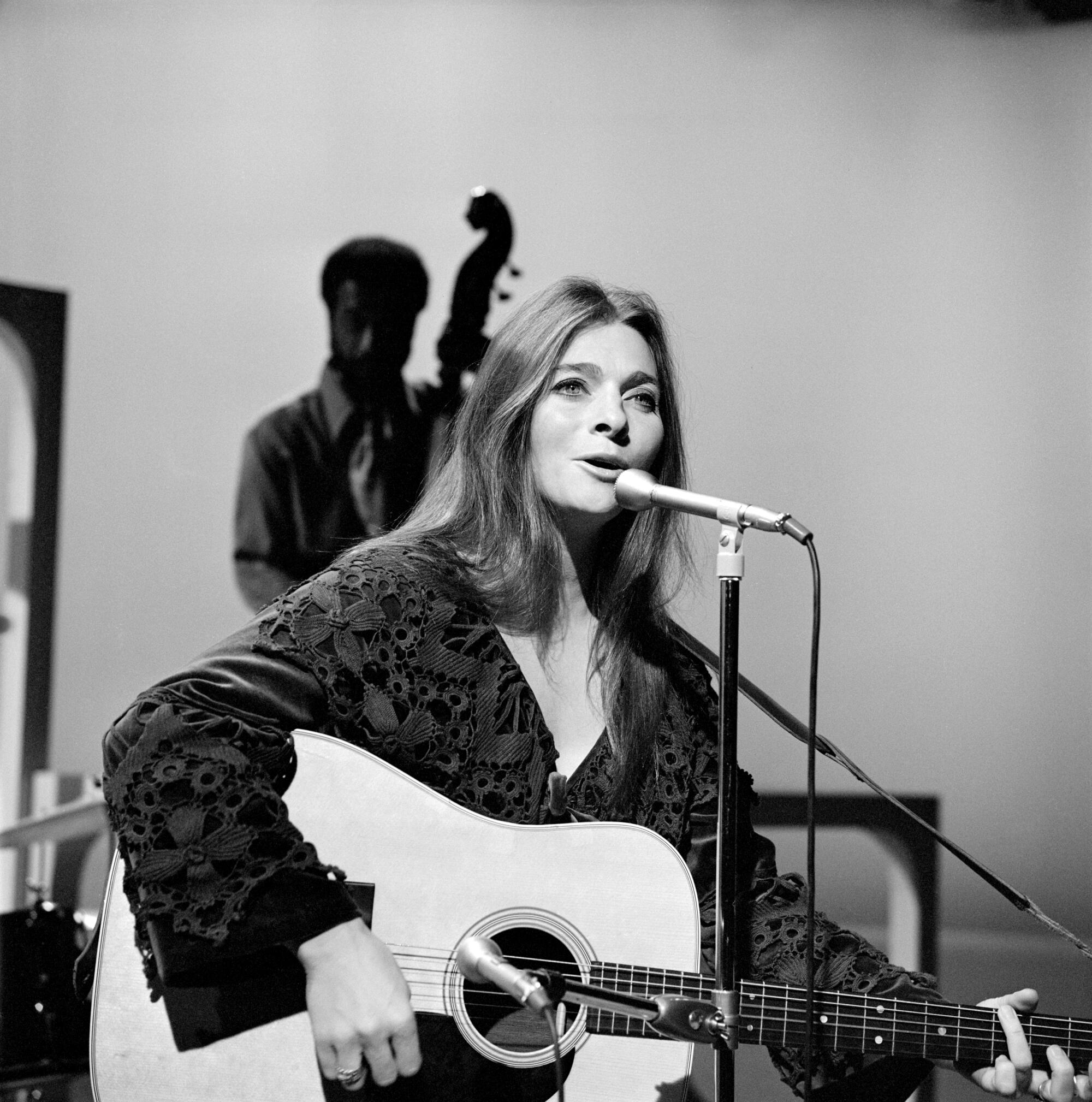
Judy Collins performs on “The Smothers Brothers Comedy Hour” in 1969.
(CBS via Getty Images)
You said we’re in a period of insanity. This country is losing so much of the depth of our origin. The fact that workers who’ve come to this country are being taken off to God knows where — it makes no sense. Number one, these people often have some sort of legality. And secondly, they do the work here. Nobody else wants to go up to the orchards in Oregon and pick the fruit. Do you?
I can’t say that I do. I don’t want to do that.
This tour is billed as your grand farewell. So long, you guys.
I’m always reluctant to trust that framing. Cher’s done like eight farewell tours. I hadn’t counted them up — shame on me.
Should we really believe you? I think we have to believe in the present tense. What you’re hearing is what’s happening.
You had a music stand onstage with you. What was on it? All the lyrics to all the songs.
You can’t possibly need the lyrics anymore. Oh, yes, I do.
You’ve been singing some of them for decades. Doesn’t matter — it has to be there in case you have to look at it.
Would you say you do look? Or is it more of a security blanket? It’s a security blanket. But my eyes wander — I like to see who’s in the audience and what’s going on. I like to look up and down the aisles, and I like to fantasize: How did this happen?
Your life and career? I mean, I know how it happened. I was 16, and I started going to the Denver Folklore Society, which was run by a guy named Lingo the Drifter. And Lingo the Drifter had these wonderful evenings where we all played the guitar and sang and drank illegal whiskey and so on.
Judy Collins last month in Beverly Hills.
(Allen J. Schaben / Los Angeles Times)
Before Denver, you lived briefly as a kid in Los Angeles. My father was a very eclectic and fabulous radio personality. He had a radio show for 30 years in Seattle then here in Hollywood, broadcasting out of CBS — a big deal. If we weren’t in school, we would drive up Santa Monica Boulevard into Hollywood and we’d stand around and watch them produce the radio mysteries. People would walk in a sandbox to get the sound of somebody walking up the gravel road to the door.
Are you familiar with the term “nepo baby”? No.
It refers to the child of a famous artist who follows in their parent’s footsteps. Oh, that’s interesting.
People use it derisively, as if to say that a kid has overly benefited from their advantages. We certainly had advantages. For instance, the Library of Congress, which is the jewel in the crown — I don’t know what they’re doing now — but they sent us Braille books and they sent us all the shows from New York and they sent us the recordings of all the Shakespearean plays by the great Dame Judith Anderson and John Gielgud. I had all that growing up. In some ways, I wasn’t raised — I was trained. I got to see how a professional has to handle his life. My father was a professional in all ways. He drank — occasionally, not all the time — but he was absolutely organized about everything, including that.
You’ve been sober for something like half a century. Forty-eight years. I’m in my 49th now.
You ever miss drinking? Oh, my God, no. I was so sick — I was gone. Bye-bye.
Some people replace one addiction with another. I had an eating disorder, which is still kind of … You know, last night, I asked for apple juice during the show — I was in trouble because I wasn’t eating. When my husband died, I stopped eating again. I’d stopped eating in the ’60s and ’70s and ’80s, but I got over that. But suddenly I didn’t want to eat again.
Would you consider that disordered eating? I don’t know. Anyway, I have to really be careful. We had a talk about it last night. I have to eat these protein bars, and I have to eat them all the time.
Do you remember the first gig you played after your husband died? Oh, yes — I had to go out. When my son took his life in 1992, I got a call from Joan Rivers — she and I knew each other pretty well. She was getting ready to go out and do her show in Las Vegas, and she called me in New York and she said, “I have to tell you this” — her husband had just killed himself — she said, “You cannot stay home. You have to go out.” I was canceling all my shows, and she said, “You can’t do that because you won’t ever get over this if you do.”
How did you take that advice? I said, “Thank you,” and I called my staff and I said, “Put ’em back on.” My mother came out with me, Louis came out with me, my sister came out with me, and it was incredibly true: I had to be working or else I would die. So when it came to Louis, I was out three days later.
What did that feel like? Well, it was wonderful because I was working. I can work and get through anything — that’s the psychological effect of what I’m doing on the stage. I’m interacting with people, I’m hearing the laughter, I’m hearing the music. What could be more healing?
This is why I’m wondering why you plan to stop touring. But you see, I have all these other things to do — I have a life that’s not just touring. I’m working on the music for a Broadway show. And I’m doing a new book — it’s called “Singing Through the Storm,” and it’ll be out next year, I hope.
Judy Collins and Leonard Cohen attend the 41st annual Songwriters Hall of Fame ceremony in New York in 2010.
(Larry Busacca / Getty Images)
You’ve interpreted the music of so many great songwriters: Joni Mitchell, Bob Dylan, Leonard Cohen. Was there ever a writer whose work you admired but couldn’t find your way into? No.
OK. I’ll tell you my funniest Leonard story. In 2014, I think it was, I went to this little group in Norway called Democrats Abroad — lonely group of people. That night, this woman came up to me and said, “Hi, I’m Marianne.” I said, “Hi, Marianne.” And then she said, “I’m Leonard’s Marianne.” She said, “There’s something I’ve wanted to tell you for many years: We were living together in Spain, Leonard and I, and he was writing songs and we were swimming in the nude. And then one day he came to me and he said, ‘Marianne, I’m going to New York to sing my songs for Judy Collins,’ and he went to New York and he played you all his songs and you recorded them.” Marianne said, “I just wanted to tell you that you ruined my life.” Fortunately, we became friends on Facebook.
You opened last night’s set with “Both Sides Now.” Oh, yes.
This might be the most famous song you do. Some artists would save it for later in the show. I don’t want people to wonder for an hour and a half: Will she? Won’t she? What will I do if she doesn’t?
Do you still enjoy singing “Both Sides Now”? I love it. It was Al Kooper who brought me to Joni — she sang it to me over the phone. Al is living a very sane, quiet life in the Northeast now. He’s married — never goes out anymore. It’s hard to think of Al Kooper just sitting there enjoying his marriage and his garden.
What will you do on the plane home today? I’ll probably get out the computer and noodle around on the book and see what I can come up with.
The work never ends. It never ends because it’s not done.
Nearly 30 years after Judy Sheindlin launched a career that made her TV’s most widely recognized judge — first on the syndicated small claims series “Judge Judy,” which premiered in 1996 and ran for 25 seasons; then on Amazon Prime’s streaming show “Judy Justice” starting in 2021 — she’s passing her gavel to a fitting successor: her son, Judge Adam Levy.
The 83-year-old Sheindlin told People magazine that when “Judy Justice” wraps in October, she’s moving away from on-camera work to focus on other endeavors, including afternoon naps and developing the animated series “Judyverse” based on the “Baby Judge Judy” videos circulating social media.
Created with AI, the videos feature a toddler version of Judge Judy overseeing cases with her signature New York accent and no-nonsense barbs.
“I don’t want to do hair and makeup anymore, but I still want my message to get out there,” she told the outlet.
Sheindlin will also produce her son’s syndicated court TV show, “Adam’s Law,” which debuts Monday.
“There aren’t a lot of people who can carry a half-hour on their own, unscripted,” Sheindlin continued, adding that Levy has what it takes.
The 58-year-old earned his law degree from Hofstra Law School in 1992. This isn’t his first foray into TV, as he joined a panel of judges on Prime’s “Tribunal Justice” in 2023. After three seasons, Sheindlin said he’s ready for his close-up.
On Sept. 22, CBS will air a 30th anniversary special looking back on Sheindlin’s career, “Judge Judy: Unfiltered, Unforgettable.”
“I don’t think that I’ve ever been this content before,” she told People of entering the next era of her life. “I don’t have to prove anything else. I did it.”