judge

Judge halts Trump plan to link USDA SNAP funds to gender, immigration

A federal judge sided with California and other Democratic states on Friday in a preliminary injunction that blocked the Trump administration’s attempt to condition food benefits on compliance with the president’s policies on gender and immigration.

Twenty states and the District of Columbia filed a lawsuit in March against the Trump administration in U.S. District Court in Massachusetts, arguing that the “unlawful” and “unconstitutional” funding requirements are vague and designed to force policies on states.

Billions in federal funding are ultimately at stake, including money for school lunch programs that provide meals to 30 million children nationwide and food stamps that support about 40 million Americans living in low-income households.

“As the Trump Administration tries to use essential programs and billions in funding as leverage to advance their hateful, discriminatory agenda, California continues to fight to uphold the law and ensure that our communities can continue to access the funding they need to thrive,” said California Atty. Gen. Rob Bonta in a statement.

The policy shift from the United States Department of Agriculture marks another effort by the president to force left-leaning states to submit to his positions on hot-button political and cultural issues to receive government funding. California’s current budget relies on $174.5 billion in federal dollars, or roughly one-third of the overall state budget funds.

Last year, the Trump administration canceled a sexual education grant to California after the state declined to remove gender identity from sexual education curriculum. The administration is also restricting federal funds in an attempt to force states to ban transgender athletes from competing in women’s sports.

The funding conditions from the USDA relate to gender ideology, women and girls’ sports and immigration, according to the lawsuit.

States argue that the conditions do not explain what activities are prohibited for entities that receive grants. The USDA did not cite any law allowing the organization to impose anti-discrimination policies that go beyond federal law, the suit states.

The states that joined the lawsuit contend that they are left with the “unlawful” choice of adhering to the conditions or risk losing up to $74 billion in collective federal assistance from the USDA.

U.S. District Judge Myong Joun approved a preliminary injunction Friday and is expected to issue a memorandum later explaining the decision, according to the Associated Press.


Source link

A federal judge strikes down Trump administration immigration policy affecting 39 countries

A federal judge on Friday struck down a Trump administration policy enacted after the shooting of two National Guard members that made it harder for immigrants from dozens of countries to stay and enter the U.S.

In a ruling harshly criticizing the administration, U.S. District Chief Judge John McConnell Jr. said the policy “threw the lives of countless immigrants living in the United States into indeterminate legal limbo,” and he accused the U.S. Citizenship and Immigration Services of ignoring the law.

“In enacting its latest immigration policies, USCIS: claims statutory and regulatory authority that it does not possess; makes decisions without the reasoned explanations that it must provide; acts without regard for the reliance interests of applicants that it must consider; and justifies its actions with pretextual concerns of ‘national security’ that mask anti-immigrant sentiments that it is forbidden from letting influence its decision-making,” he wrote. “In legal terms that means USCIS’s actions are contrary to law and arbitrary and capricious.”

A spokesperson for the Department of Homeland Security did not immediately respond to a request for comment.

The policies enacted after the National Guard shooting last year meant that immigrants from 39 African, Asian, Latin American and Middle Eastern countries have been “categorically barred” from receiving final decisions on, among other things, their asylum, work permit, green card and citizenship applications.

“This ruling reaffirms a basic principle: the federal government cannot shut down lawful immigration pathways or discriminate against people based on where they come from,” said Skye Perryman, president and CEO of Democracy Forward, which represented the plaintiffs in the case. “These unlawful policies caused enormous harm to families, workers, asylum-seekers, and communities across the country who were left in limbo, unable to work, access protections, or move forward with their lives.”

The policies apply to U.S. Citizenship and Immigration Services, which approves applications for immigrants to work and become citizens. The agency, which is within the Homeland Security Department, often grants asylum, but only for those already in the United States when they apply. Immigration judges grant asylum to those who are stopped at the border; the ruling does not affect them, and neither do the policies that sparked the lawsuit.

It is part of an ongoing effort by the administration to tighten U.S. entry standards for travel and immigration, in what critics say unfairly prevents travel for people from a broad range of countries. The administration suggested it would expand the restrictions after the arrest of an Afghan national suspect in the shooting of two National Guard troops over Thanksgiving weekend.

In its motion to dismiss, which the court denied, the government argued that Congress gave the executive branch broad authority over immigration policy, including “the entry of aliens into the United States as well as discretion within the statutory scheme to confer as well as withdraw various discretionary benefits.”

“This case rests on a remarkable premise: that a federal court should prevent an agency from issuing the very policy guidance that provides government personnel with the guardrails necessary to ensure consistent, non-arbitrary, and individualized decisionmaking consistent with federal law,” the government wrote in its brief.

Immigration groups celebrated the ruling.

“This ruling sets a powerful precedent that the administration cannot ignore the law as laid down by Congress and cannot arbitrarily bar immigration benefits on the basis of national origin by fiat,” said Jamal Abdi, president at the National Iranian American Council. “Fortunately, this is still a nation of laws, and those who uphold America’s values have recourse to challenge and push back on such discriminatory, arbitrary policies.”

Shawn VanDiver, a Navy veteran who heads a coalition that supports Afghan resettlement efforts called #AfghanEvac, said the ruling was a “significant victory for the rule of law and for thousands of Afghan allies and other immigrants who followed every requirement asked of them.”

“Just this week in Dallas and Fort Worth, we met people who feared losing jobs because delayed work permit renewals threatened their livelihoods, families who postponed education, travel, and homeownership because they did not know when their cases would be resolved, and future Americans who had expected to become citizens only to see their applications stall without explanation,” VanDiver said.

Casey writes for the Associated Press.

Source link

Judge orders pretrial detention for ex-CIA official accused of stashing $40 million in gold bars at home

A former senior CIA official accused of stashing more than $40 million worth of gold bars from the federal government at his Virginia home was ordered to remain jailed until his trial after a hearing Friday where a defense attorney accused prosecutors of smearing the official with “sensational,” irrelevant allegations.

The defendant, David J. Rush, has both the means and motive to flee while the case against him is pending, U.S. Magistrate Judge William Fitzpatrick ruled, citing Rush’s professional experience.

“He’s in a different position than most people to flee and avoid detection by law enforcement,” Fitzpatrick said.

Rush is charged with fraudulently claiming tens of thousands of dollars in compensation for military leave after he was honorably discharged from the U.S. Navy in 2015. He was arrested last month after investigators searched his home and seized more than 300 gold bars, roughly $2 million in U.S. currency and about 35 luxury watches, according to an FBI agent’s affidavit.

Rush’s attorney, Jessica Carmichael, noted that Rush isn’t charged with any crimes related to the discovery of the gold bars, which she referred to as “basically a non-issue” and “nothing more than a sensational tidbit.” She said Rush properly obtained the gold bars and kept them locked in a safe in his basement.

“Mr. Rush never claimed they were his,” she said.

Between last November and March, Rush requested and received a “significant quantity” of foreign currency and tens of millions of dollars in gold bars for “work-related expenses,” according to the FBI affidavit. Justice Department prosecutor Gavin Tisdale said Rush wasn’t supposed to have the gold bars at his home.

“That’s the issue — his skirting of rules and regulations,” he said.

Tisdale briefly summarized the case against Rush in open court after a portion of the hearing was sealed from the public. The evidence against Rush “grows stronger by the day,” Tisdale told the magistrate judge.

“Mr. Rush simply cannot be trusted to abide by this court’s conditions,” he said.

Rush enlisted in the Navy in 1997 and was honorably discharged from the U.S. Navy Reserves as a lieutenant in 2015, according to the affidavit.

Authorities claim Rush lied about his education and military background on job applications, falsely claiming to be a former Navy pilot who graduated with a bachelor’s degree from Clemson University in South Carolina and a master’s degree from Rensselaer Polytechnic Institute in New York.

Investigators determined that he didn’t serve as a Navy pilot and didn’t attend either school.

Kunzelman writes for the Associated Press.

Source link

Judge: Trump must restart immigration, asylum processing

June 5 (UPI) — A federal judge on Friday canceled a batch of President Donald Trump‘s immigration policies, forcing the administration to begin processing immigration and asylum applications.

The decision from a judge in Rhode Island said Trump’s immigration policies enacted last fall had left immigrants in the United States in “indeterminate legal limbo” because of “anti-immigrant sentiments that it is forbidden from letting influence its decision-making.”

The 135-page decision from Judge John J. McConnell Jr. said the decision to stop processing immigration applications from people from 39 countries “placed the lives of countless individuals on hold — solely by virtue of their countries of birth.”

The policies in question include a global pause on asylum applications filed with the U.S. Citizenship and Immigration Services, a pause on decisions on immigration applications of people from the 39 countries in a travel ban, which prevented them from getting permanent residency status, citizenship and more.

The administration announced the changes after an Afghan man allegedly shot two National Guard members in Washington, D.C., in November. Rahmanullah Lakanwal pleaded not guilty.

“USCIS’s hold on adjudications cannot be attributed to anything that these individuals did wrong; rather, it arises solely by the happenstance of their birth,” McConnell wrote.

“The court is reminded of a line often repeated in discussions around immigration policy: If people wish to immigrate to the United States, they ought to ‘follow the law’ and ‘do things the right way,'” he wrote. “This case serves as a perfect example of immigrants doing just that.”

Democracy Forward, a legal nonprofit that helped represent the immigration groups and unions behind the lawsuit, told The New York Times that it celebrates the ruling.

“This ruling reaffirms a basic principle: The federal government cannot shut down lawful immigration pathways or discriminate against people based on where they come from,” organization President Skye Perryman said. “These unlawful policies caused enormous harm to families, workers, asylum seekers and communities across the country.”

Shawn VanDiver, president of #AfghanEvac, also celebrated the ruling.

“For months, we have heard from Afghan allies whose citizenship ceremonies were canceled, work permits expired while waiting for decisions, green card applications stopped moving and families were left in uncertainty despite doing everything the right way,” The Hill reported VanDiver said in a statement.

“Today’s ruling is a significant victory for the rule of law and for thousands of Afghan allies and other immigrants who followed every requirement asked of them, only to see their cases frozen indefinitely.”

Source link

Federal judge pauses sentencing to weigh argument in Wisconsin judge’s immigration case conviction

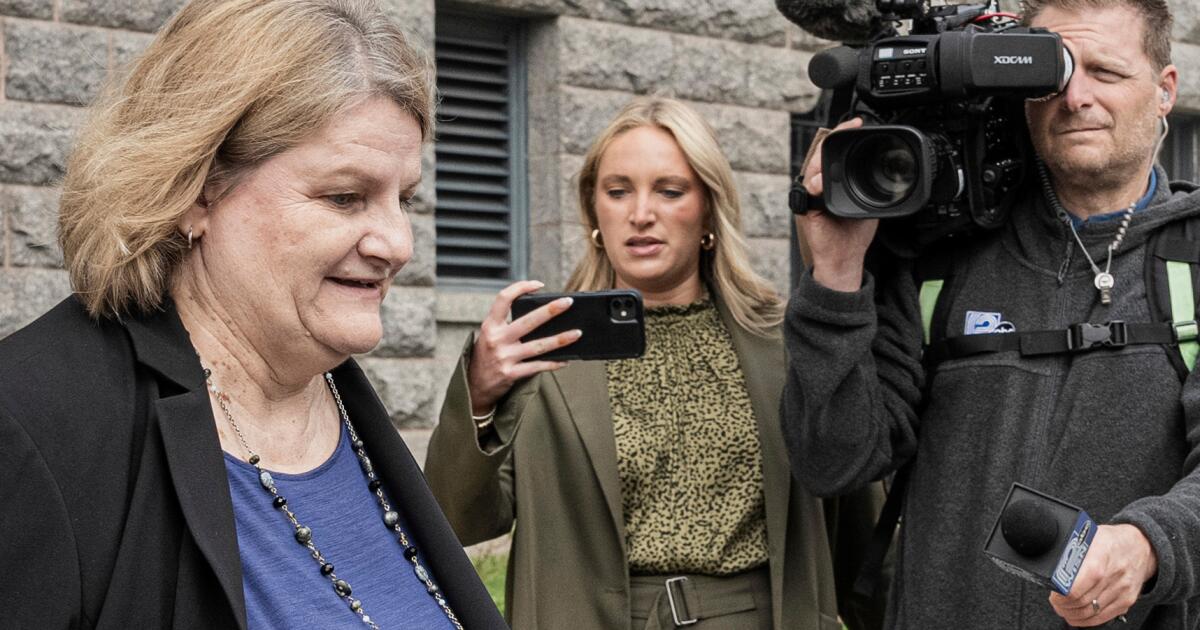
A federal judge on Wednesday considered whether to throw out a jury’s guilty verdict against former Wisconsin Judge Hannah Dugan, who was convicted of felony obstruction for helping an immigrant evade federal officers.

The case was an early test of how the courts would respond to President Trump’s sweeping immigration crackdown.

Dugan had been scheduled to be sentenced on Wednesday, but U.S. District Judge Lynn Adelman postponed the proceedings indefinitely to instead hear arguments about whether to overturn her conviction.

Adelman did not rule from the bench and did not indicate when he might issue a decision. Dugan and attorneys for both sides left the courtroom without commenting to reporters.

Former judge’s attorney points to a Virginia case

Dugan’s attorney Steven Biskupic argued that her conviction was invalid and should be overturned. He said that was necessary because a federal appeals court in April overturned a key Virginia immigration case that the judge and prosecutors had cited in the Dugan case.

Biskupic argued that based on the 4th U.S. Circuit Court of Appeals overturning that ruling, Dugan was improperly convicted, procedurally, under a certain federal law.

“Our primary argument is this was an invalid theory of conviction,” Biskupic said.

In the Virginia case, an immigrant who was in the country illegally was detained by U.S. Immigration and Customs Enforcement agents and later escaped. He was recaptured and indicted on a charge of obstructing a pending immigration proceeding.

The federal appeals court found that the ICE action did not constitute a “pending proceeding,” as is required under the federal obstruction law.

Dugan’s attorneys argue that she should not have been charged because there was no “pending proceeding” against the immigrant in her courtroom being sought by ICE agents, only a warrant filed for his arrest. The filing of a warrant does not constitute a “proceeding” under the law, Biskupic argued.

Prosecutors countered that the facts in the Virginia case are different and don’t apply to Dugan’s. They also argued that other cases support Dugan’s conviction.

“The court should stick with its ruling,” said Richard Frohling, acting U.S. attorney for the eastern district of Wisconsin.

In response to a question from the judge, he contended that the appeals court was wrong to overturn the Virginia case. The judge also quizzed Frohling on what constitutes a proceeding under the law and how long it lasts.

“It could be a couple minutes, it could be a couple years,” Frohling said. “It all depends on the context.”

Dugan’s sentencing was postponed so the court can hear new arguments

Dugan, 67, faces up to five years in prison after a jury convicted her on Dec. 19. But it is unlikely that Dugan would be sentenced to prison. Federal sentencing guidelines generally call for probation for defendants like her who have no criminal history and are convicted of a nonviolent crime.

She resigned from her position as a Milwaukee County circuit judge two weeks after her conviction amid threats of impeachment from Republican state lawmakers. She had been a judge for nine years.

Dugan was present for Wednesday’s arguments but did not speak.

The Trump administration brought the case against Dugan as the president pressed ahead with his sweeping immigration crackdown. Trump’s administration and his allies branded Dugan as an activist judge, while Dugan’s attorneys said she was being unfairly targeted and argued, unsuccessfully, that she was immune from being charged because she was a judge.

Dugan’s case marked the first time that a state judge in Wisconsin went to trial on charges of obstructing immigration agents. She was acquitted of concealing an individual to prevent arrest, a misdemeanor.

Dugan helped an immigrant wanted by ICE agents

On April 18, 2025, immigration officers went to the Milwaukee County courthouse after learning Eduardo Flores-Ruiz had reentered the country illegally and was scheduled to appear before Dugan for a hearing in a state battery case.

Dugan confronted agents outside her courtroom and directed them to the chief judge’s office because she told them their administrative warrant wasn’t sufficient grounds to arrest Flores-Ruiz.

After the agents left, she led Flores-Ruiz and his attorney out a private jury door. Agents spotted Flores-Ruiz in the corridor, followed him outside and arrested him after a foot chase. A week later, FBI agents arrested Dugan in the courthouse, leading her outside in handcuffs.

Flores-Ruiz was deported in November.

Bauer writes for the Associated Press.

Source link

Supreme Court rules Alabama may redraw congressional maps to oust a Black Democrat

The Supreme Court ruled Tuesday night that Alabama Republican leaders may redraw their congressional voting districts to oust a Black Democrat and elect a white Republican.

The court’s conservatives, who ruled for Louisiana Republicans in a redistricting dispute, extended that decision to Alabama. The three liberals dissented.

The decision clears the way for the governor and state lawmakers to redraw their congressional voting map with six districts that favor Republicans and one that favors a Democrat.

“Weeks ago, I warned that vacating the District Court’s injunction in these cases would ‘unleash chaos and … confuse voters,’ ” Justice Sonia Sotomayor wrote in dissent. “Yet just as Alabama doubled down on racial discrimination, the Court today doubles down on chaos. Because I choose to defend the rule of law and the right of all Alabamians to participate equally in democracy, I respectfully dissent.”

The justices granted an emergency appeal that was backed by the Trump administration and set aside the decision of a three-judge panel in Alabama.

The court in a brief opinion said the three judges should not have blocked Alabama’s new map.

“While federal courts should not impose changes close to an election, states are free to decide for themselves whether last-minute changes to an election are in their best interests,” the court said.

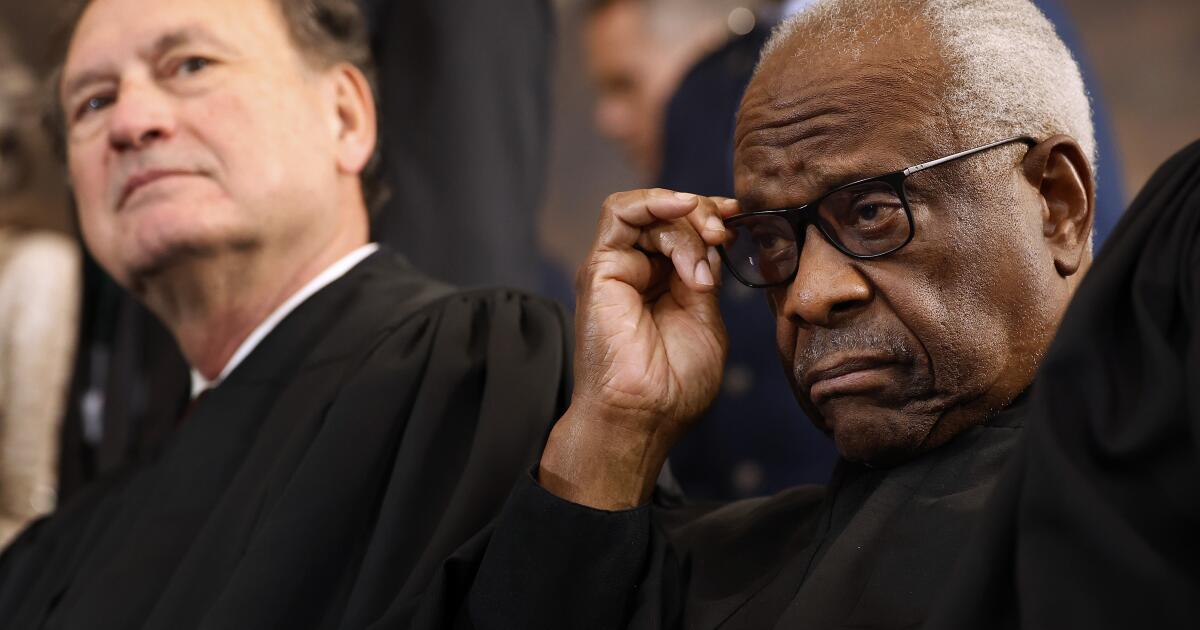
Alabama’s emergency appeal went to Justice Clarence Thomas, who referred it to the full court.

Those three judges, two of them Trump appointees, ruled that Alabama’s state lawmakers discriminated against Black voters, who made up a near majority in the center of the state.

Three years ago, the Supreme Court agreed.

In a 5-4 decision written by Chief Justice John Roberts, the justices upheld the creation of a second district in the center of the state where Black voters had a near majority.

The result then was an Alabama state voting map that favored five Republicans and two Democrats for the House of Representatives.

But last month, in the wake of the Louisiana decision, Alabama’s lawmakers went back to court, arguing that the state may return to the voting map with only a single Black majority district.

In his appeal to the Supreme Court, Alabama’s Atty. Gen. Steven Marshall argued that the high court’s decision in favor of Louisiana “vindicates Alabama position on the lawfulness” of its earlier voting map. He said the state should not be penalized for “refusing to intentionally discriminate” to favor Black voters.

The court’s decision has cleared the way for Republican-led states in the South to flip congressional districts in Louisiana, Tennessee, Florida and now Alabama.

Source link