john mckinney

On Skid Row, decades of frustration. Will the next mayor have a plan?

On my way through Skid Row to meet up with Estela Lopez, things looked pretty much as they did when I spent time there more than 20 years ago and first heard the promises that things would be better soon.

Tents lined some of the sidewalks, making them unpassable. Some people wore the damage of physical or mental disease, addiction, poverty, or all of the above. Outreach workers with ID lanyards strode through the trash-strewn landscape like lifeguards working against endless tides of fresh emergencies.

When I arrived at Lopez’s office in the 700 block of Crocker Street, where she runs a business improvement district on behalf of 600 or so beleaguered merchants, she had just completed a tour of the neighborhood with John McKinney, a candidate for city attorney.

She held a note card in her hand and shared some numbers, telling McKinney that by her latest count, 131 of the 702 streetlights in the district were out, 27 children were living on Skid Row, and 72 RVs were parked in the area.

“I came out here because I think this symbolizes the greatest failure in government,” McKinney said. “I think it’s the result of bad law and bad policy. I think it’s the result of a lack of leadership and indifference to the way people are living out here. To me, it’s completely untenable.”

But will anything ever change?

It’s a question two people in particular need to address, and I’ll get to that in a minute.

A lot of people I trust and admire work tirelessly to make a difference on Skid Row, and they’re always eager to share the success stories of those who move through and move on. (I’ve got a column on that coming up soon.)

The long-standing problem is that Skid Row is both a social service center and a mecca of drugs and other vices, with traps on every block. And so it’s a neighborhood at war with itself, with some viewing Skid Row as one of the largest recovery centers in the country while others see a snapshot of social collapse.

Estela Lopez has reached out to me several times over the years. About illegal dumping. Typhus. Calls to City Hall that don’t get answered. About the relentless plague of fires, overdoses and assaults.

“Can you imagine, in 24 years, how many people I’ve seen dead on these streets?” Lopez asked me near her office last week.

Estela Lopez walks through Skid Row

Estela Lopez runs a business improvement district on behalf of 600 or so beleaguered merchants.

(Genaro Molina / Los Angeles Times)

When the local post office closed recently in part because of security issues, Lopez told The Times’ Melissa Gomez that “we have reached a point in this city where we are unable to address criminal activity. … It’s surrender.”

We walked to the corner of 8th Street, where paramedics had just pulled away from a medical emergency. Cars and pedestrians stopped at tents for brief transactions, leaving little doubt as to the nature of the business being conducted.

We passed a caged dog and saw a puppy on a short leash being loaded into a vehicle. There’s a lot of talk about dogs being bred and sold, and Lopez said she’s seen evidence of animals being mistreated.

On 7th Street we passed the charred residue of a recent fire. A half block east, four men were slumped on the sidewalk, hitting pipes. Lopez gets calls from exasperated merchants dealing with vandalism and with people blocking their storefronts.

“I’ve never seen so many people overdose right here,” said Sergio Moreno, who runs a check-cashing business and said his family has been in business going back to the ‘70s. He said he’s seen paramedics use naloxone to revive opioid users, only to see the same people go down again just days later.

“How can you run a business?” asked Moreno, who chairs the board of the business improvement district Lopez runs. “This business is our life. This is how we got through school, this is how we put our kids through school.”

And yet despite paying city taxes and BID fees, Moreno said, problems persist and his customers fear for their safety.

Dr. Susan Partovi, a street medic for 22 years, has been advocating for more proactive intervention for those in obvious distress. Partovi told me she recently saw a man rise from a gutter, pull down his pants and defecate in front of her. She called to get help for him but said neither paramedics nor police determined him to be gravely disabled.

A woman walks past homeless and others residents of Skid Row in downtown Los Angeles

Lopez walks past residents of Skid Row last week. By her latest count, 131 of the 702 streetlights in the district were out, 27 children were living on Skid Row, and 72 RVs were parked in the area.

(Genaro Molina / Los Angeles Times)

“We have become complacent with having people lying in the gutter, having diarrhea, speaking nonsensically and putting their lives at risk,” said Partovi, whom I once accompanied as she administered long-acting anti-psychotic injections, arguing that people need clear heads to make better choices.

One sore point for Lopez is the Skid Row Care Campus in the 400 block of Crocker Street, which opened a little more than a year ago and offers all sorts of social services, meds that reduce drug cravings, and supplies that allow for safe use of drugs.

Lopez said she understands the theory of harm reduction: Engage people with a goal of getting them into treatment and back on track. But she wonders how successful such programs are, and argues that they become magnets for lawlessness.

As we talked, a young man approached and told Lopez he’d seen her airing her grievances on TV news.

“I’m wondering, what would be your solution?” he asked.

“I would hope that people could return to life in sobriety,” Lopez responded.

The man said he is “trying to elevate” himself, but that he’d been on a waiting list for housing for six months.

Lopez is tired of being on a waiting list, too.

“If something is working down here,” she told me, “you can’t prove it by me.”

Progress is undeniable, said Sieglinde von Deffner, a social worker and Skid Row coordinator for the Los Angeles County Department of Homeless Services and Housing. But given the “highly vulnerable” nature of the population, “the need is colossal,” she said.

A man stands among his belongings in Skid Row.

A man stands among his belongings along 7th Street in Skid Row in downtown Los Angeles.

(Genaro Molina / Los Angeles Times)

“I have not yet met someone here who doesn’t want housing of some kind. We just don’t have enough affordable housing for everyone,” Von Deffner said, and long-term homelessness makes people harder to reach. “Now, if we could just stop the inflow.”

Dennis Culhane, a University of Pennsylvania professor who researches homelessness and served as an L.A. County consultant, said there are other ways to get people indoors than investing billions of dollars in new housing that takes years to build. Culhane said single adults who are not veterans, including the elderly and disabled, constitute a majority of the homeless population. But assistance is scarce.

“It’s like you have a famine, and you’ve only got food for 15% of the people,” Culhane said.

Rapid rehousing is critical for the newly homeless, he said. But it can take two years for them to qualify for Social Security disability, and once they do, the $1,000 a month “is completely deficient in the face of rising rents.”

Culhane recommends faster approval of SSI benefits and supplementing that income with additional sources of rental assistance. He believes there are enough vacancies at the low end of the housing market to make a sizable dent in homelessness without new construction.

Judy Mauricio, 65, rests inside her ten.

Judy Mauricio, 65, who has been homeless for nine years, rests inside her tent next to her walker. She says her drug addiction has kept her on the street. She receives state disability funds and says she has cancer.

(Genaro Molina / Los Angeles Times)

As campaign season warms up, I’d like to know if Mayor Karen Bass and her challenger, Councilmember Nithya Raman, agree.

The mayor of L.A. is limited by a power split with the City Council, and the county oversees most addiction and mental health services. But Skid Row sits just a few blocks from the seat of city authority, and nobody has more power or responsibility to address the decades-long human catastrophe on Skid Row than the mayor.

Estela Lopez and the merchants deserve better. The people on the street deserve better. Thousands of housed residents deserve better.

Does Bass have a plan other than what’s currently in place? Does Raman have a better one?

If so, I’d like to hear the details, and I’m available.

steve.lopez@latimes.com

Source link

Los Angeles city attorney trails challengers early; incumbent city controller holds lead

Los Angeles City Atty. Hydee Feldstein Soto lagged behind her two well-funded challengers based on early returns Tuesday night. But her incumbent colleague, City Controller Kenneth Mejia, appeared to be faring better in his bid to stay in office, holding a double-digit lead over finance executive Zach Sokoloff.

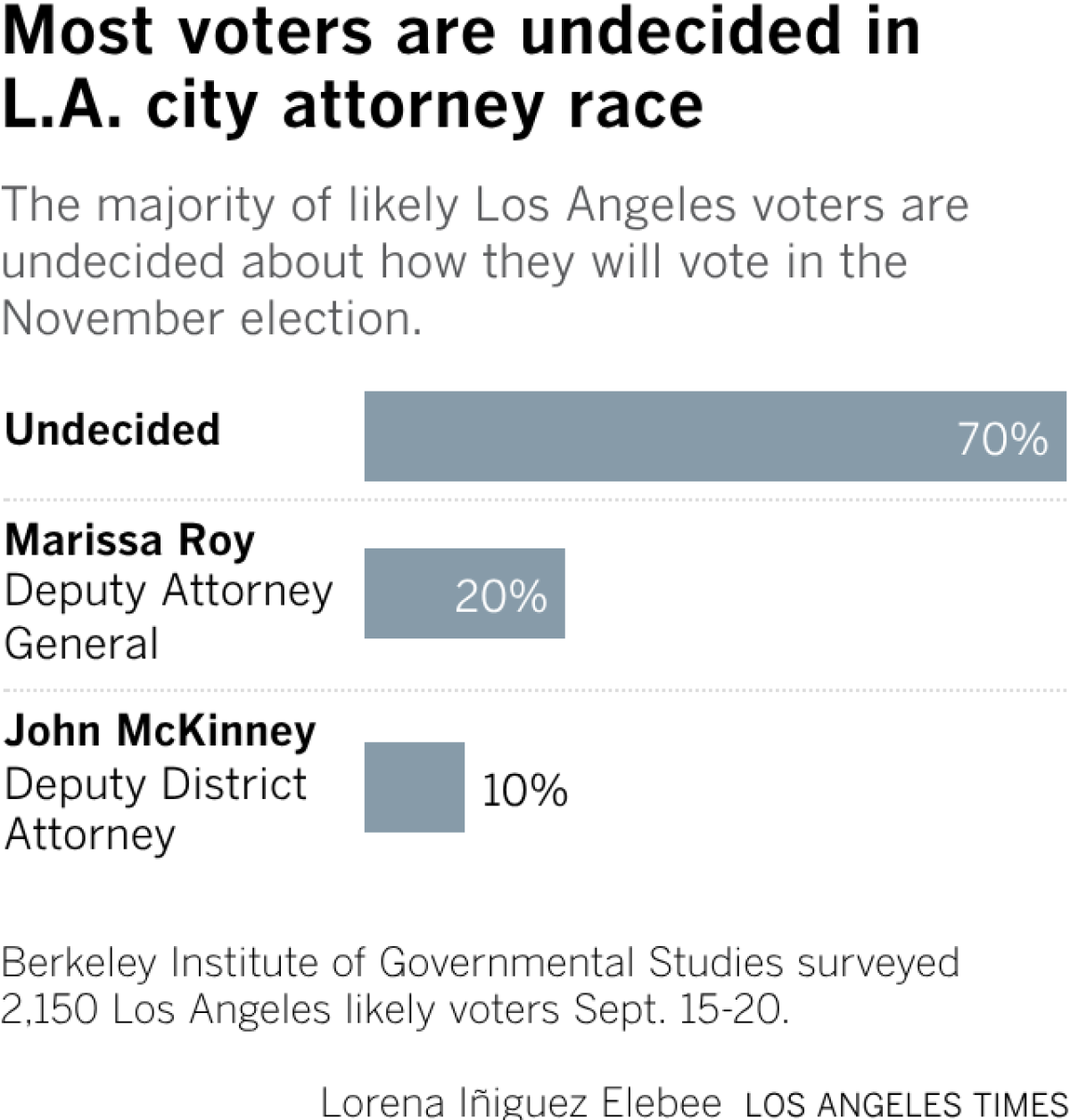
Progressive Marissa Roy led the field vying to serve as Los Angeles’ top lawyer in the first batch of returns surfacing around 8:20 p.m.

L.A. County Deputy Dist. Atty. John McKinney sat in second, while Feldstein Soto was positioned third. The top two finishers will advance to November’s general election. It could be days before the outcome of the race is clear. Mail-in ballots with a Tuesday postmark will be accepted by county election officials for another week.

With only two candidates running, the controller’s race will be decided this month and will not go to a runoff in November.

The city attorney’s race transformed suddenly this spring after the Los Angeles Police Department’s largest union broke with Feldstein Soto and backed McKinney. Independent expenditure campaigns have thrown $3 million behind McKinney in recent weeks, with much of that money coming from a political action committee controlled by Airbnb.

Feldstein Soto sued the rental giant for violating price gouging laws in the wake of the Palisades fire last year and has openly questioned whether McKinney would shy from aggressive litigation against Airbnb if elected.

“Special interests have gotten really accustomed to special treatment at City Hall. They get special treatment all the time,” Feldstein Soto said in a recent interview, suggesting that both McKinney and Roy had been compromised by outside spending. Independent expenditure campaigns supporting Roy also received roughly $725,000.

McKinney told The Times that if elected, he would “absolutely” sue Airbnb if necessary.

A representative for Feldstein Soto’s campaign declined to comment on the early returns late Tuesday night.

The three leading candidates often sounded like they were campaigning for different jobs.

Roy said she would run the city attorney’s office as L.A.’s “largest public interest law firm,” focusing on tenants’ rights, wage theft and other issues affecting working-class Angelenos. A deputy attorney general in the California Department of Justice, she also vowed to sue the Trump administration, linking arms with the attorney general’s office and other city attorneys in aggressive litigation to curb what many Californians see as targeted abuses of power.

McKinney talked more like he was running for city prosecutor, leaning heavily on his experience winning high-profile felony trials in the downtown courthouse. He said he would improve the way the city attorney prosecutes gun crimes and animal abusers. Despite his lack of experience as a civil litigator, McKinney also said he could bring down the city’s litigation costs, which exploded under Feldstein Soto.

“While all votes have not yet been fully counted, we feel optimistic about qualifying for the General Election in November. People want political courage. They want leadership,” McKinney said in a statement Tuesday night. “What is already clear, is that this election has been shaped by the pressing and undeniable concerns of the people of Los Angeles.”

McKinney previously ran for L.A. County district attorney in 2024 but disappeared in a crowded primary field.

While her term has been marked by financial strain, allegations of misconduct and mistreatment of employees and recent questions about her handling of a data breach that led to the leak of a trove of LAPD records, Feldstein Soto maintained that her opponents are far too inexperienced to serve as the city’s top lawyer.

She said she improved public safety by repairing her office’s relationship with the LAPD and filed more misdemeanors than her predecessor. Although legal costs surged, Feldstein Soto said she did her best to mitigate damage on a number of difficult cases she inherited when taking office in 2022. The rise of so-called “nuclear verdicts” in civil claims reflects a nationwide trend rather than a fault of her leadership, she said.

Feldstein Soto was endorsed by Mayor Karen Bass and U.S. Sen. Adam Schiff (D-Calif.). Roy had the support of the L.A. County Democratic Party, the city chapter of the Democratic Socialists of America and U.S. Sen. Bernie Sanders (I-Vt.). In addition to the police union, McKinney was backed by his boss, L.A. County Dist. Atty. Nathan Hochman.

The city controller’s race, normally a fairly sleepy affair, has turned into the second-highest-spending race in the city.

Mejia, 35, known for his two corgis that he often features on billboards across Los Angeles, sought to retain his seat as the city’s accountant and auditor.

His only challenger was Sokoloff, a senior vice president for asset management at Hackman Capital Partners. Sokoloff, 37, alleged Mejia did not properly utilize the controller’s office to run audits on city departments and failed to keep up the auditing pace of his predecessor.

Sokoloff’s mother, Sheryl, has spent $7.5 million on independent expenditures in the race, mostly on attack ads and mailers against Mejia. Often, the ads point to allegations that Mejia in 2023 fostered a toxic workplace and made inappropriate sexual remarks to female subordinates.

A woman who identified herself as Sheryl Sokoloff hung up on a Times reporter last week when asked about the race expenditures.

Mejia said Sokoloff’s mother — married to Jonathan Sokoloff, managing partner of private equity firm Leonard Green & Partners — was trying to bankroll the seat for her son.

Mejia has long run on accountability and transparency for the city’s budget and made public-facing databases across dozens of topics on the controller’s website in his first term.

A licensed certified public accountant, Mejia is a member of the Green Party and does not accept endorsements from political parties or politicians. He was endorsed by the Los Angeles Daily News and multiple labor unions, including the United Teachers of Los Angeles and United Auto Workers.

Sokoloff, a Democrat, was endorsed by multiple former controllers, notable Democrats — including Schiff — and the L.A. County Democratic Party, along with other business advocacy groups.

Source link