Trump’s handpicked GOP chair faces a rebellion after midterm landslide
NEW YORK — A nascent rebellion is underway against President Trump’s handpicked chairman at the Republican National Committee, and it’s already getting ugly.
Some members are calling for a forensic audit of spending decisions, including hair and makeup services for Trump and other officials, as well as the hiring of the daughter of Trump’s former chief of staff. Feuding Republicans are leaking emails and opposition research on rival factions. The White House is threatening to cut off fundraising assistance if the rebels don’t fall in line.
The emerging fight, which will shape the 2028 presidential nominating contest, represents a rare challenge to Trump’s dominance, even after the party’s worst midterm performance in more than a generation. Despite the heavy losses, Republican leaders across Washington have shown little desire to move past Trump and have largely stood behind his most unpopular policies.
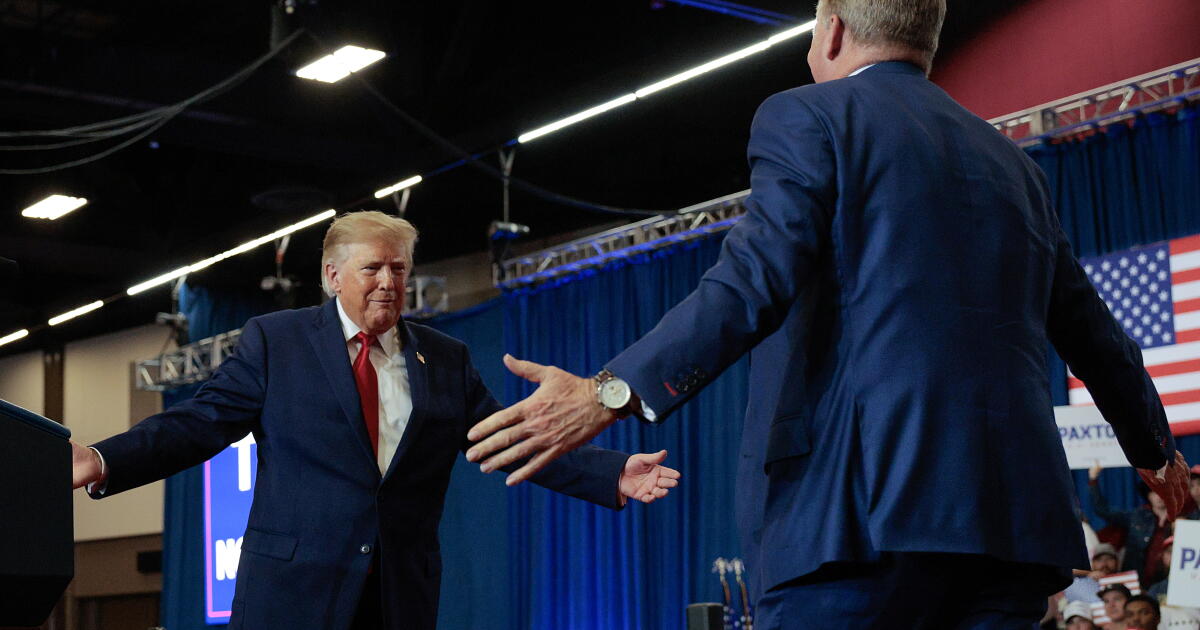
But inside the RNC, an organization of 168 members elected from every state who oversee the party’s national political operation, a small yet growing group is backing an attempt to depose Joe Gruters. Trump wants to keep him in charge.
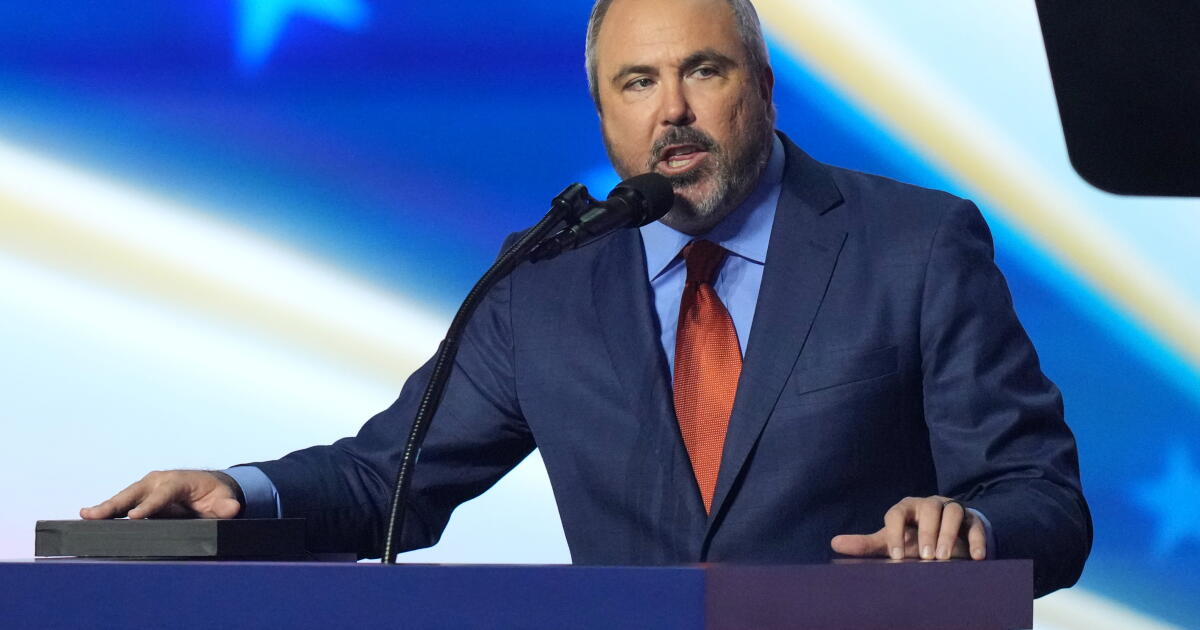
The dissidents are rallying behind Kentucky’s KC Crosbie, the RNC’s second in command, who launched her bid two days after the Nov. 3 election in a letter that drew the fury of the White House and Gruters’ allies.
Crosbie remains a vocal Trump supporter who backs his “Make America Great Again” agenda, but her opponents view her gambit as a direct challenge to the president and his power.
“We have an obligation to serve the Republican Party the most effective way we can. And if all we do is say yes to what the White House wants, I’m not sure that’s doing what’s best for the Republican Party,” said RNC member Oscar Brock of Tennessee, who is supporting Crosbie’s candidacy. “Our job is to elect Republicans broadly, not to support one man all the time.”
He said that requires a change in leadership.
“There’s so much frustration that Chairman Gruters didn’t pull his weight in this election, that the RNC was far less effective than it should have been,” he said.
In her letter, Crosbie described the midterms as “a serious setback” and called for the RNC to provide “an honest account” of what went wrong.
“We should preserve what we built and be equally willing to confront where we fell short,” she wrote.
Crosbie declined to be interviewed. The leadership election will be held in January at the RNC’s winter meeting in Arizona.
Inside the rebellion
It’s unclear how many RNC members will back Crosbie, although the number so far is believed to be small. Some would-be supporters privately acknowledge that they’re worried about a backlash from the White House, especially with Stephen Miller taking over as Trump’s new White House chief of staff. Others believe in the committee’s tradition of having presidents pick their own party chiefs.
Gruters also has vocal backers.
Lauren LePage, an RNC member from Maine, praised the chairman’s leadership and his efforts to help her father, Paul LePage, flip a congressional seat — a rare bright spot for Republicans this election cycle.
She described Gruters as “highly responsive” during the campaign and praised his “record-setting fundraising.”
“From my perspective, as chairman, he did his job,” she said, adding that Trump’s endorsement is “something that the committee should take very seriously.”
Nevada Republican Party Chairman Michael McDonald called Crosbie a “dear friend,” but said Trump is “the leader of our party” and “you always have to fall in line with the leader.”
“I don’t have a bad word to say about KC at all. It’s just that the president wants to go with Joe Gruters,” he said. “The president made his choice.”
The Republicans who have lined up behind Crosbie insist a leadership change is needed to send a clear message that the party will do things differently after losses even in conservative strongholds such as Texas, South Carolina and Mississippi.
Patti Lyman, an RNC member from Virginia, said it would be “catastrophic” and “insulting” to the party’s base “to keep the same leadership and pretend that we don’t need to do anything different, that we don’t need new players and a new plan.”
Lyman described Crosbie as “by far the best candidate currently running to lead the RNC forward to victory in 2028.”
Sue Cienki, an RNC committee member from Rhode Island, predicted that Crosbie would have the backing of at least two members from 10 states — for a total of 20 — at the committee’s January meeting. That number is the minimum required for a successful nomination.
She insisted that she wouldn’t be scared off by backlash from Trump or the White House, which has been actively lobbying RNC members.
“We should not be influenced by any one person or other. It’s our organization,” Cienki said. “We have to hold an election, not a selection.”
Trump is furious with Crosbie
Trump and senior White House officials were livid about Crosbie’s Nov. 5 letter and the fact that they were given no heads-up.
During a White House meeting Nov. 6, Trump threatened to punish the RNC if members crossed him and said he would refuse to help the organization, including appearing at fundraisers or allowing his name and image to be used in mail and digital solicitations. That’s according to a senior White House official with direct knowledge of the meeting who was not authorized to publicly discuss the private gathering and spoke on condition of anonymity.
Such a threat would be catastrophic to the party because Trump remains its most effective fundraiser.
An Axios story that first reported the threats was distributed via text message to all 168 RNC members.
The same senior White House official said staff convinced Trump that he should not go after Crosbie personally that day. Instead, he released a lengthy statement on his social media platform hailing Gruters as a “MAGA Warrior” and giving him his “Complete and Total Endorsement.”
The leadership fight comes as Trump has shown no interest in relinquishing power.
The Constitution bars Trump from seeking a third term, but he is expected to play a central role in picking the party’s next presidential nominee. Trump’s team contends that he remains the most popular Republican in the country, and House Republicans last week elected a slate of new leaders closely aligned with him.
The White House, in response to questions about the leadership fight, referred to Trump’s social media post.
The party’s future
The RNC will oversee the party’s presidential primary process, including setting the nominating calendar, the debate schedule, the national convention and the rules governing the selection of the nominee.
People close to Gruters, who spoke on condition of anonymity to discuss private conversations, said Crosbie’s campaign was “100% a challenge” to the president’s power and described the RNC as “the president’s political operation.”
Allies argued that a leadership change now would put the RNC at a severe disadvantage heading into the next presidential cycle because a new team would need time to get up to speed, and they warned that friction between the president and the committee’s leadership would curtail their ability to organize and raise money.
They also rejected Crosbie’s call for a postelection review, which they said would do little more than rehash the past and put all their grievances on paper. Similar demands for a retrospective were a headache for Ken Martin, the then-embattled leader of the Democratic National Committee, after Trump won in 2024.
But they said Gruters has taken the criticism seriously and has been soliciting feedback to make adjustments heading into 2028.
Gruters spent much of last week holding private phone conversations with committee members. Those who participated in the calls said Gruters listened to their grievances but said little about what he would do differently.
Spending faces scrutiny
The opposition to Trump’s choice to lead the RNC has little to do with Trump’s leadership or policy decisions, according to nearly a half-dozen Crosbie supporters.
Instead, they focused on the RNC’s spending decisions under Gruters. Republicans had a massive fundraising advantage and still lost the House and Senate.
“There’s clearly a groundswell of support for a forensic audit,” said Brock, the RNC member from Tennessee.
In a letter to RNC members sent Thursday night and obtained by the Associated Press, Gruters acknowledged concerns.
Gruters defended a $22,500 expenditure for hospitality space at the Presidents Cup, a golf event, saying it was offered to major donors and “resulted in $2.5 million in renewed contributions to the RNC.”
He also addressed concerns about “a brief contract” between the RNC and Caroline Wiles, a longtime Republican consultant who is the daughter of Susie Wiles, Trump’s former chief of staff. Gruters said she was hired by his predecessor at the committee, Michael Whatley.
“While I have no reason to doubt Caroline Wiles’s value to the RNC or Chairman Whatley’s reasons for bringing her on, this was a brief six-month engagement that ended when I was elected Chairman,” he wrote.
Gruters also defended the RNC’s decision to pay for “hair and make-up services” for senior White House officials, including Trump, Vice President JD Vance and former Press Secretary Karoline Leavitt.
“This was a request made of us so that the expense did not fall to taxpayers,” Gruters wrote. He said the beneficiaries “generously gave so much of their limited time and energies to help the RNC this cycle” and “did not ask for much of us in return, so we felt this was a request we could accommodate.”
Gruters promised to provide members “honest and direct answers to concerns raised” as conversations continue.
“I pledge to listen and learn from you about what happened in the field,” he wrote, “so together we can move forward stronger than ever.”
Peoples and Colvin write for the Associated Press.