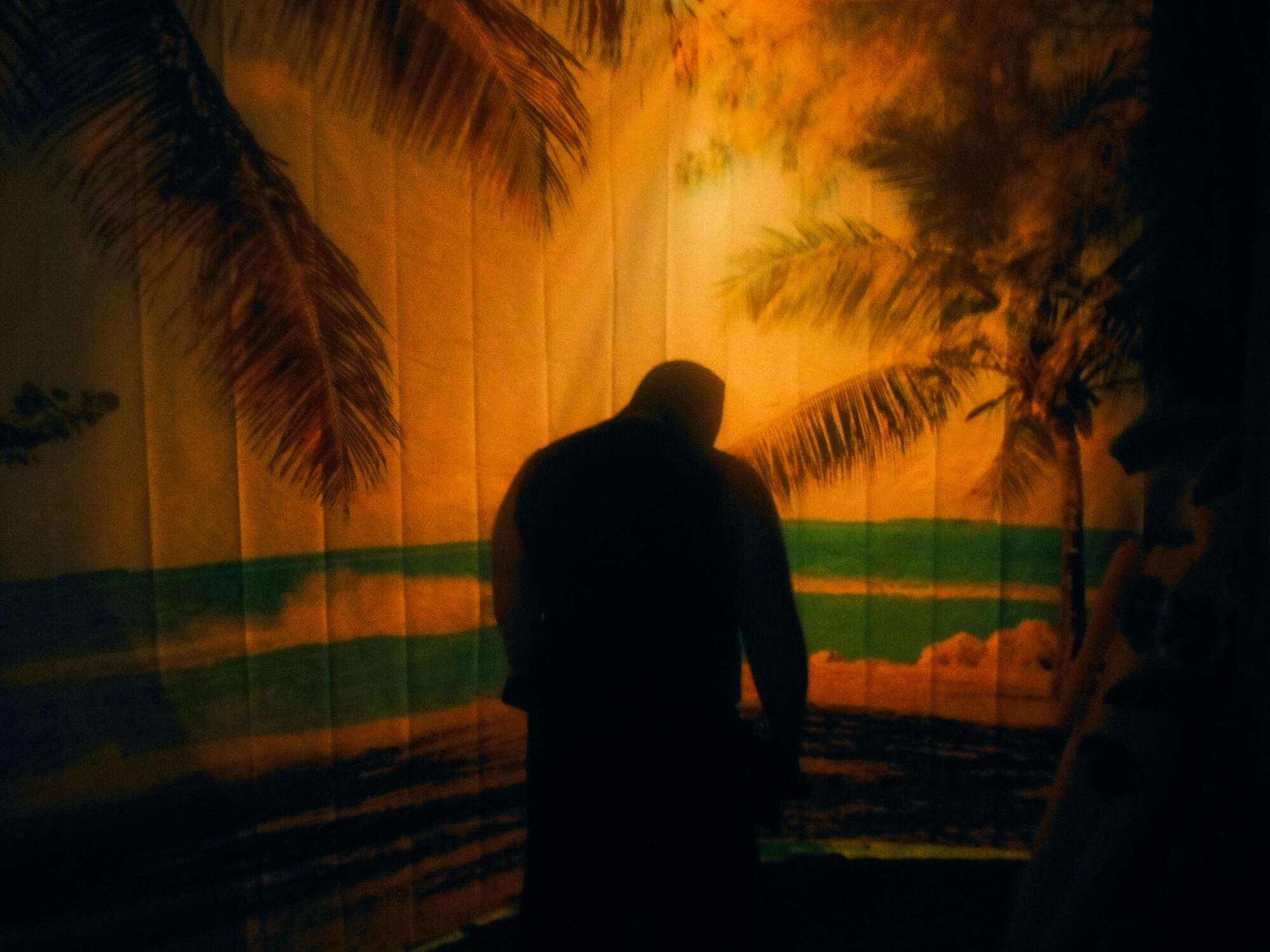
‘The Pineapple’ is a boundary-pushing show for an audience of one
“The Pineapple” promised to be intense, but even hours before the show had begun, it had me startled.
I was warned, via a waiver attendees must sign to experience the production, to expect “intimate, and/or aggressive physical contact,” “confined spaces and passageways,” and that I may be asked to crawl, kneel or lie down. All of it would happen in a show that I was cautioned would present simulated violence or “disturbing imagery.”
As much as I love participatory, immersive theater — productions that often rely on some form of audience participation — “The Pineapple” was providing me with a checklist of things I generally avoid. It was a feeling that only grew when I reached the waiver’s end, and signed off that I was OK with claustrophobia (I am not).
What had I done?
None of it, though, had fully prepared me for what Candle House’s “The Pineapple” actually was. By the time the hourlong experience in North Hollywood had reached its conclusion, I had been straddled by a woman who forced a gloved finger down my throat, outfitted with hooded, vision-impairing face masks, grabbed by the wrists as they were taped together, ordered to crawl toward a blood-stained room, and spooned or kissed by multiple male performers.

“The Pineapple” is a secretive hourlong show that seeks to disorient attendees.
(Sona Earnest)
“The Pineapple” is a buzzed-about show among the tight-knit immersive community, one that fits into the medium’s long tradition of productions designed for a sole audience member. A short run last year in New Jersey sold out. Candle House has such a devoted following that its L.A. shows have been selling out almost as instantly as they are announced. While it’s thus far been shrouded in secrecy — “The Pineapple” will not even release a program or cast list until its run has concluded — it comes highly recommended from acquaintances who saw it on the East Coast. I was alternately excited and apprehensive to take part, and my editor would like me to note that I pitched this story on my own accord.
“The Pineapple” in its limited online description promises an alien encounter. Sign up, and an email will tell you that it will “change your life.”
For the passionate crowd of immersive enthusiasts who may want to experience “The Pineapple” and are worried I just spoiled the show, I call nonsense. For one, I believe audiences should know exactly what they are paying for, and two, I do not think “The Pineapple” can be properly spoiled. It was at times otherworldly, in moments psychedelic, and while there were scenes in which I felt fear, there were also others in which I laughed. While “The Pineapple” flirts with horror, torture and conspiracy nuts, it also provides space for Jimmy Buffett’s “Margaritaville.”
And in “The Pineapple’s” best instances, it created a sense of personal intimacy with its performers. These were actors who may have earlier been needling at or attempting to push my boundaries. “The Pineapple” wants to toy with our trust, to create a safe space where it can intermix themes of abuse and empathy until their lines are blurred. Consider its waiver, then, not just a warning but an attempt to weed out those who may be offended or triggered.
“The Pineapple” tries to break us. And it charges nearly $250 for the privilege.
“How do I put this,” says the show’s core creator/director Evan Neiden when asked his intentions behind “The Pineapple.” “I think the show is designed to boil you. Like the lobster in the pot. It gets warmer and warmer and warmer and it’s slowly acclimating you to this new set of rules that keep changing to this new environment of degeneracy and conspiracy.”

“The Pineapple” teases an alien encounter. It is theatrical production designed for one guest.
(Sona Earnest)
Neiden, the 27 year-old founder of Candle House, has long specialized in one-on-one phone productions designed to be done from the caller’s home. While drastically different in narrative content, his horror show “Claws,” in which its solo guest acts as an emergency line operator, is good prep for “The Pineapple” as it also seeks to push people to the brink of comfort.
If there is an artistic thesis behind the work of the New York-based Candle House, it is to cast its audience as performers, but then poke, prod and disorient until they stop performing and start reacting on instinct — or, in theory, become unguarded. It’s an idea that simply to get through the day we are playing a role of sorts, tuning our conversations to please others, or presenting exaggerated, false or tidied-up versions of ourselves on social media.
“In an experience like this, you’re alone with the inhabitants of the world, and they’re all there as part of your hallucination, your dream and your journey,” Neiden says. “You don’t need to worry about presenting a certain way or being perceived in a certain way. All the characters in ‘The Pineapple’ are degenerates, and this show invites you to become one as well. That’s very hard to do if someone from the respectable, outside world is watching.”
The setup for “The Pineapple” is simple. I was playing a respondent to an ad for a meeting with an alien. But things quickly spiral beyond clear narrative recognition, as piecing together the story becomes a puzzle unto itself. And it will shift depending on how one reacts, as there are multiple endings. But know only that in its opening minutes we learn that we have been swindled and are now part of a ritual of sorts to summon said alien.

“The Pineapple” offers intimate actor interactions designed to push boundaries.
(Sona Earnest)
You may find yourself, as I did, raising your voice, as “The Pineapple” did light research on me. My career was insulted, and I was mocked for fumbling around while attempting to juice a pineapple with a woefully inadequate kitchen utensil. Neiden says many attendees try to break the show itself, to push back and see how far its narrative can bend. This is typically not how I play, wanting to experience a production as its designers have intended and thus I let “The Pineapple” take the lead rather than trying to force my will upon it.
I am not easily offended and never used the safe word provided, although there were instances where I came close, namely when my feet were being aggressively, unwelcomely massaged. And yet there were scenes in which I thought about deeply personal relationships I have had, specifically when a character asked me to think of a time when forgiveness or an apology was craved from someone I am no longer closely connected with.
“The Pineapple” then began to feel like a metaphor. As I moved from darkened room to darkened room, ridiculed in one, flirted with in another, a thread of finding one’s own personal paradise in a hellscape began to emerge. Is it aliens we are seeking, “The Pineapple” begins to ask, or simply perhaps purpose? The act of forgiveness, Neiden tells me, was on his mind when crafting the show.
“I never really felt like I fully understand it,” Neiden says. “What is forgiveness? Some people say it’s letting someone off the hook. Others say it’s releasing yourself of the burden of a grudge. And it’s a word wrapped in religion and politics. There are so many definitions of it, and we hear it everywhere — forgiveness and its counterparts of guilt, shame and accountability. What does it mean? The show doesn’t answer that.”
Maybe. That’s up to the audience, not its creator.
Days after I’ve seen “The Pineapple,” friends and peers keep asking if I enjoyed it, and I don’t think it’s a simple answer. It’s not for everyone. I’m not sure it’s even for me. Simulated torture is not my idea of a good time. But “The Pineapple” did wear me down, and it’s beautiful in the way it highlights the lonely anguish at the heart of Buffett’s “Margaritaville.”
As its small cast obsesses over a fabled alien encounter and seems willing to stop at nothing to find release in a divine being, be careful, “The Pineapple” argues, of the personal Eden you seek.
At least that was my takeaway. You might walk away with an entirely different message.
“Maybe you just fell in with the wrong crowd and got abducted by aliens,” Neiden says.