

Naomi Osaka has pulled out of the Japan Open before Friday’s quarter-final because of a leg injury sustained in the second round.
The former world number one held back tears and needed painkillers to come through a three-set last-16 win over defending champion Suzan Lamens on Wednesday.
Top seed Osaka, who completed the match with strapping on her left thigh, was due to face Jaqueline Cristian in the last eight but the Romanian will instead progress to the semi-finals.
The Japan Open made the announcement on X, saying: “We regret to announce that Naomi Osaka has not recovered from a left leg injury sustained during the second round of this tournament and has withdrawn from the quarter-finals scheduled for today.”
It is not yet known whether Osaka will play in the Pan Pacific Open in Tokyo later this month.
The four-time Grand Slam champion is the latest high-profile player to suffer late-season injury issues.
In September, Iga Swiatek complained the season is “too long and too intense” following a string of injuries among players at the China Open.
Past visits by top leaders to Yasukuni, which honours convicted war criminals, have angered Japan’s neighbours.
Published On 17 Oct 202517 Oct 2025
Share
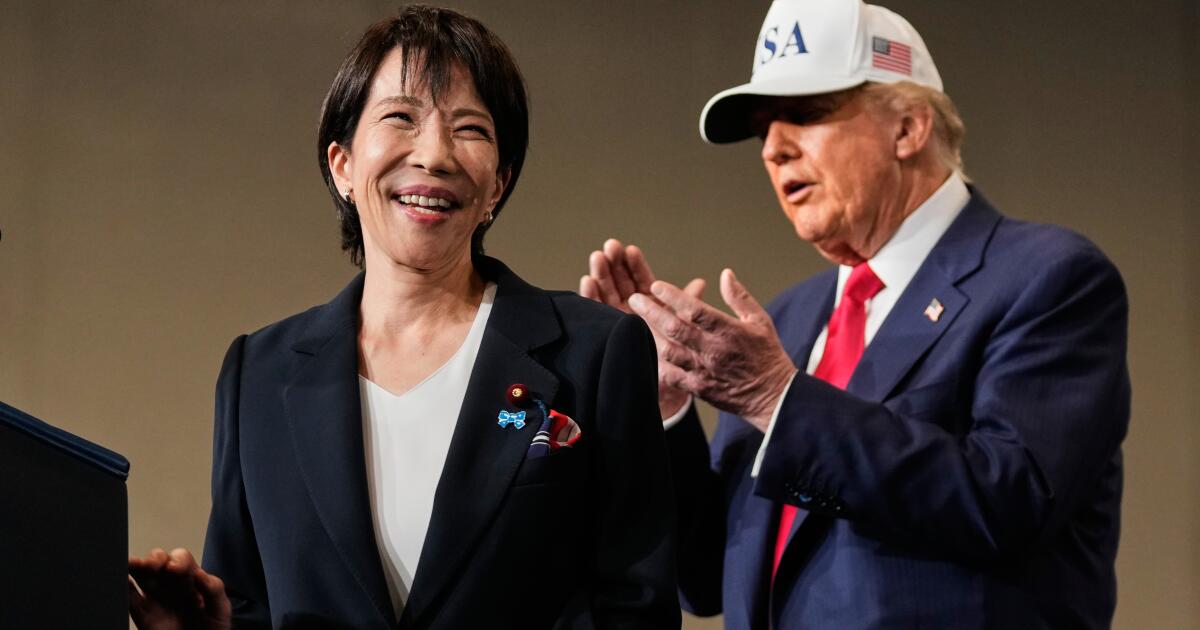
The new leader of Japan’s governing party, Sanae Takaichi, has decided not to visit a controversial World War II shrine in Tokyo, as uncertainty remains over whether she will be appointed prime minister ahead of a visit by United States President Donald Trump before the end of the month.
Takaichi, 64, seen as an arch-conservative from the right of the Liberal Democratic Party (LDP), has previously visited the Yasukuni Shrine, including as a government minister.
Recommended Stories
list of 3 itemsend of list
However, Takaichi opted on Friday to send an offering, and reports said she was likely to refrain from visiting in order not to antagonise the country’s neighbours whom Imperial Japan had occupied and committed atrocities against in the first half of the 20th century.
Past visits by top leaders to Yasukuni, which honours convicted war criminals, have angered China and South Korea. The last visit by a Japanese premier was in 2013 by the late Shinzo Abe, Takaichi’s mentor.
People visit Yasukuni Shrine on the 77th anniversary of Japan’s surrender in World War II, amid the COVID-19 pandemic, in Tokyo, Japan, on August 15, 2022 [Issei Kato/Reuters]
Takaichi’s decision not to visit the shrine came as Japan’s former Prime Minister Tomiichi Murayama, best known for making a statement apologising for atrocities Japan committed in Asia over the course of World War II, died aged 101.
Murayama, in office from 1994 to 1996, issued the 1995 “Murayama statement” on the 50th anniversary of Japan’s unconditional surrender.
Murayama died on Friday at a hospital in his hometown, Oita, in southwestern Japan, according to a statement from Mizuho Fukushima, head of Japan’s Social Democratic Party (SDP).
Hiroyuki Takano, secretary-general of the SDP in Oita, told the AFP news agency he had been informed that Murayama died of old age.
Political wrangling
Takaichi became LDP leader on October 4, but her aim to become Japan’s first female prime minister was derailed after the LDP’s coalition partner of 26 years, the Komeito party, pulled the plug on their alliance last week.
The LDP is now in talks about forming a different alliance, boosting Takaichi’s chances of becoming premier in a parliamentary vote that local media reports said will likely happen on Tuesday.
The clock is ticking for Takaichi to become Japan’s fifth prime minister in as many years with Trump’s impending visit.
Details of Washington and Tokyo’s trade deal remain unresolved and Trump – who had warm relations with Abe in his first term – wants Japan to stop Russian energy imports and boost defence spending.
Komeito said that the LDP has failed to tighten rules on party funding following a damaging slush fund scandal involving dodgy payments of millions of dollars.
The LDP this week began talks on forming a new coalition with the Japan Innovation Party instead.
The two parties would be two seats short of a majority but the alliance would still likely ensure that Takaichi succeeds in becoming premier.
A spanner in the works could be if opposition parties agreed on a rival candidate but talks earlier this week appeared to make little headway.
United Arab Emirates denied Japan and took the final place at next year’s men’s T20 World Cup with an eight-wicket victory in the qualifier in Oman.
Japan could have reached their first major tournament with a victory but UAE held them to 116-9 and then chased their target in 12.1 overs.
It means UAE join Oman and Nepal in progressing from the Asia and East Asia-Pacific qualifier to the World Cup held in India and Sri Lanka in February and March next year.
In addition to the two hosts getting automatic spots, England, Australia, Afghanistan, Bangladesh, South Africa, United States and West Indies qualified courtesy of reaching the Super 8 stage of the 2024 edition held in the United States and West Indies.
Ireland, Pakistan and New Zealand qualified via the rankings while Canada, Italy, Netherlands, Namibia and Zimbabwe came through their regional qualifying tournaments.
The tournament schedule is expected to be announced in the coming weeks.
Japan beat Kuwait and Samoa earlier in their qualifying tournament which meant they would have progressed had they beaten UAE and overturned a net run-rate deficit.
They slumped to 58-8, however, with spinner Haider Ali taking 3-20, and only limped to their total thanks to 45 not out from Wataru Miyauchi.
Alishan Sharafu and Muhammad Waseem put on 70 for the first wicket of the chase and, despite the pair falling for 46 and 42 respectively, UAE, who played at the 2014 and 2022 T20 World Cups, eased to victory.
YouTube users reported problems streaming content and accessing the app for about 60 minutes before the company resolved the issue.
Published On 16 Oct 202516 Oct 2025
Share
YouTube says it has resolved problems with its website and app after hundreds of thousands of users worldwide self-reported issues with its streaming services.
“This issue has been fixed – you should now be able to play videos on YouTube, YouTube Music, and YouTube TV!” YouTube wrote on X on Thursday morning in Asia.
Recommended Stories
list of 4 itemsend of list
YouTube did not disclose why users reported problems streaming videos for about 60 minutes on Thursday morning, or the global extent of the problem.
Disruptions began just before 7am in East Asia (23:00 GMT, Wednesday) for YouTube, YouTube Music and YouTube TV, according to Downdetector, a website that aggregates website disruptions in real time.
Users from Asia to Europe and North America soon reported problems streaming, accessing the website, and using the apps of YouTube and its affiliates, though error reports were most heavily concentrated in the US, according to Downdetector’s user-generated error map.
Major disruptions were also reported in Japan, Brazil and the United Kingdom, although the extent of the problem is unknown because Downdetector data is based on user-submitted reports and social media.
The number of error reports peaked at 393,038 reports in the US at 7:57am (23:57 GMT) before falling off sharply, according to Downdetector data.
Downdetector reported a smaller number of disruptions for YouTube Music and YouTube TV, which both peaked at fewer than 5,000 error reports in the US over the same period of time.
Oct. 15 (UPI) — The Japanese Diet is scheduled to vote on the nation’s next prime minister on Tuesday, which has political parties angling to gain support for their preferred candidates.
Sanae Takaichi is the president of the ruling Liberal Democratic Party and is its choice to become Japan’s next prime minister, but opposition parties might block her path, according to NHK World.
The LDP has asked the opposition Japan Innovation Party to join its political coalition and support Takaichi’s candidacy to replace outgoing Prime Minister Shigeru Ishiba.
The JIP would replace the Komeito party, which last week announced its withdrawal from the ruling coalition.
LDP members hold 196 of 465 seats in Japan’s House of Representatives and 100 of 248 seats in the House of Councillors [sic], which is the most of any political party.
While it holds more seats in the Japanese Diet than any other political party, it does not control of majority and seeks additional support to solidify Takaichi’s candidacy.
The opposition Constitutional Democratic Party of Japan also seeks support from the JIP and the Democratic Party for the People to promote a viable candidate capable of winning the Diet’s vote over Takaichi.
Despite the opposition to her candidacy to become prime minister, Takaichi told supporters she “will never give up” in her quest to win the election, which typically goes to the leader of the ruling party, China Daily reported.
The leaders of Japan’s various political parties have several meetings scheduled on Wednesday to potentially build support coalitions that could result in Takaichi or other candidates to replace Ishiba as Japan’s prime minister.
DPFP leader Yuichiro Tamaki is among those who might derail Takaichi’s effort to become prime minister.
If Takaichi should become Japan’s next prime minister, she would be the nation’s first woman to hold the position, according to CNBC.
Visitors to Japan are leaving behind their suitcases behind at hotels and airports, causing significant cost, hassle and even security concerns, Audrey Kohout, Co-CEO of Luggage Forward, told the Mirror
This article contains affiliate links, we will receive a commission on any sales we generate from it. Learn more
Suitcases are being dumped at the airport (file photo)(Image: Adam Gerrard / Daily Mirror)
Holidaymakers in the Asian country are leaving behind their suitcases. It’s not an isolated phenomenon. Hundreds of bags are being dumped, cluttering up airports and hotels.
At the root of the problem are souvenirs. The recent weakness of the yen in comparison to the dollar and pound means tourists can load up on cute gifts in Japanese gift shops in a way they have never done before.
Weighed down with a hotel room full of Pikachu dolls, unusual flavours of KitKats and yukata, tourists are buying large bags to take everything home with them. They then dump the bag they brought rather than paying to take two home.
A survey by the Osaka Convention and Tourism Bureau found that more than 80 percent of the hotels surveyed complain about abandoned suitcases. This can prove tricky for hotels, which end up storing the bags while they attempt to make contact with the departed guest.
The Best Western Hotel Fino Osaka Shinsaibashi reports about three or four suitcases left in rooms on some days. Disposal cost the hotel more than £1,400 last year.
While the issue is one of inconvenience and financial cost in hotels, it is a security matter in airports. Narita International Airport near Tokyo reported more than 1,000 abandoned suitcases last year alone, some of them prompting police responses to ensure that they aren’t a security threat.
Audrey Kohout, Co-CEO of Luggage Forward, told the Mirror: “A few things in Japan have led to this trend there as opposed to other surging places. Japan is a wonderful place for souvenir shopping. People are purchasing a huge amount and are upgrading to a bigger suitcase, as they didn’t plan ahead.
“You combine that with checking a bag on an airline, and it leaves people a bit squeezed and not wanting multiple bags. The dollar is strong there. You merge that with Japan having a lot of high-quality, affordable options and fun knick-knacks. It lends it to be a strong souvenir destination.
“Also, it is not an easy place to throw something away. It is built for residents. I remember walking around with a coffee cup for miles. You’re supposed to bring things home and dispose of them at home. Abandoning it can be easier than throwing it away.
“There is also often a language barrier. Japan is a pretty easy place to get around, but not a lot of people speak English. Just getting support on something that’s not wildly obvious is not the easiest thing to do there.”
Japan has quickly become one of the most popular destinations in the world for a holiday, and it’s having a bumper year. The weak state of the yen is encouraging visitors to book holidays in record numbers.
From the UK alone, just shy of 70,000 Brits travelled there in April, a 43% increase compared to the same month in 2024. Overall, Japan set a new visitor record with 21.5 million tourists in the first half of 2025, a 21% increase from last year.
Weekly insights and analysis on the latest developments in military technology, strategy, and foreign policy.
Japan continues to work toward enhancing its long-range cruise missile capability, with contracts issued for a new standoff capability for its submarine fleet, as well as improved anti-ship missiles for its destroyers. Contracts have now been issued for the mass production of both those weapons, which come as the country bolsters its abilities to attack both land targets and enemy surface warships, to counter the growing threats from China and North Korea, in particular.
Japan’s Ministry of Defense announced the new contracts for the upgraded ship-launched Type 12 anti-ship missile and the unnamed torpedo-tube-launched cruise missile for submarines on Tuesday. Both contracts were awarded to Mitsubishi Heavy Industries (MHI).
Test-firing of a Japan Ground Self-Defense Forces baseline Type 12 anti-ship missile. JGSDF
In a statement, Japan’s Ministry of Defense said the contracts were part of “strengthening […] standoff defense capabilities in order to intercept and eliminate invading forces against Japan at an early stage and at a long distance.” The ministry said it was “currently working to acquire domestically produced standoff missiles as soon as possible.”
The ministry today published its defense white paper, which further outlined its standoff defense capability, which is one of the core pillars of its modernization program.
According to the white paper, “Japan will acquire capabilities to deal with vessels and landing forces invading Japan, including its remote islands, from locations outside of threat zones.” As part of this, the paper calls for continued development of the upgraded Type 12, aiming to complete development of the ship-launched version of the missile by the end of Japan’s fiscal year 2026. Japanese fiscal years run from April 1 to March 31.
The defense white paper also specifies the “Buildup [of] submarine-type standoff defense capabilities that can be launched from submarines that can operate in a highly covert manner.”
Details about the submarine-launched missile remain strictly limited, but reports that Japan was considering introducing such a capability to its existing submarine fleet, or future submarines, emerged back in 2021, as we discussed at the time.
Back then, it was reported that the missile would have a range of over 620 miles and would be fielded from the latter half of the 2020s.
In terms of its mission, the submarine-launched missile will provide the Japan Maritime Self-Defense Force (JMSDF) with a new standoff capability to attack both targets on land and as well as enemy surface warships.
While the type of missile and even its name remain unknown, previous reports suggested it would be based on the Type 12. This is a subsonic anti-ship missile, the first version of which entered service with the Japan Ground Self-Defense Force (JGSDF), and which has a range of around 124 miles.
The Type 12 ground-launched anti-ship missile:
The fact that the contract was issued to MHI, at the same time as a contract for an improved ship-launched version of the Type 12, suggests that the sub-launched weapon may be a Type 12 derivative, too.
There had been previous discussions about the JMSDF considering firing the sub-launched missile from either a vertical launch system (VLS) or torpedo tubes. Based on the requirement to get the missile into service as soon as possible, the tube-launched version makes sense, since the JMSDF does not currently have any submarine-based VLS in service.
An earlier report from the Yomiuri Shimbun newspaper said that the JMSDF would first arm its submarines with an anti-ship version of the missile, before introducing a version with a land-attack capability.
The JMSDF submarine Soryu is pulled away from the submarine tender USS Frank Cable while operating in Guam. U.S. Navy photo by Mass Communication Specialist 3rd Class Randall W. Ramaswamy/Released Petty Officer 2nd Class Randall Ramaswamy
Currently, JMSDF submarines are armed with Harpoon anti-ship missiles that are launched from standard torpedo tubes. However, they have a much shorter range than the new weapon and don’t have a land-attack capability. The latest UGM-84L Harpoon Block II in JMSDF service can hit targets at a distance of around 80 miles.
With that in mind, a long-range cruise missile for its submarine fleet will be a big deal for the JMSDF and one that can rapidly add to the country’s broader strike capabilities.
Currently, the JMSDF operates a frontline fleet of 23 conventionally powered submarines, and with at least four more of the advanced Taigei class boats to be added in the future.
The first of Japan’s most advanced class of submarine, the Taigei is launched in October 2020 in the city of Kobe. Japanese Ministry of Defense
At this point, we don’t know the relationship between the sub-launched missile and the Type 12. However, work on an extended-range version of the Type 12 began back in the 2018 fiscal year. The redesigned missile has enlarged flying surfaces, a more efficient powerplant, and additional fuel.
In this way, the 124-mile range of the baseline Type 12 will be extended to 560 miles, and, later, up to 930 miles. Even the first version of these would roughly correspond to the requirements for the sub-launched missile.
Other changes in the improved Type 12 include a land-attack capability and radar cross-section reduction measures.
Taken together, all these developments also reflect Japan’s concerns about the threat it faces from a rapidly growing fleet of Chinese surface warships. People’s Liberation Army Navy (PLAN) activity in the waters around Japan and in the South China Sea and the East China Sea has steadily increased.
A Chinese People’s Liberation Army Navy Type 055 destroyer. via Chinese internet Chinese Navy
The East China Sea is also the scene of a long-running dispute over ownership of an uninhabited island chain. Tensions here have also grown in recent years, including patrols by PLAN aircraft carriers. The area is referenced in the latest defense white paper:
“The existing order of world peace is being seriously challenged, and Japan finds itself in the most severe and complex security environment of the postwar era. China has been swiftly increasing its national defense expenditures, thereby extensively and rapidly enhancing its military capability in a qualitative and quantitative manner and intensifying its activities in the East China Sea, including around the Senkaku Islands, and the Pacific.”
When it comes to land-attack capabilities, this is also a very significant development for the JMSDF’s submarine fleet.
The sub-launched land-attack cruise missile would be suitable for striking critical ground targets, including the proliferating ballistic missile and nuclear capabilities in North Korea. Pyongyang has repeatedly launched ballistic missiles capable of reaching Japan into waters off that country. At the same time, a long-range cruise missile of this kind would be able to strike critical military and leadership infrastructure, as well as airbases and air-defense sites, during a conflict.
Compared to other means of delivering strikes on critical land targets at great distances, a sub-launched cruise missile is much more survivable. It would provide Japan with a counterstrike capability, even if many of its aircraft and surface combatants had already been knocked out by an enemy’s first strike.
A diagram entitled Future Operation of Stand-off Defense Capabilities from the 2025 Defense White Paper. Japanese Ministry of Defense
The efficiency of such a weapon would be enhanced by the advanced nature of the JMSDF’s most recent submarines, including a propulsion system based on lithium-ion batteries in the newest examples. This ensures that the submarines are notably quiet and hard for an adversary to track.
Until this new capability is fielded, JMSDF will have an interim long-range missile capability, in the shape of the U.S.-supplied Tomahawk cruise missile. A first purchase of Tomahawk cruise missiles is something we reported on back in 2017.
Japan’s Ministry of Defense has described the Tomahawk plan as a crash program to supplement its efforts to locally develop new standoff missiles. Once fielded, the Tomahawks will enhance “standoff defense capabilities in order to intercept and eliminate invading forces against Japan at a rapid pace and at long range.” A total of 200 Tomahawk Block IV and 200Tomahawk Block V missiles are planned to be delivered between Japan’s fiscal years 2025 and 2027.
A diagram showing the capabilities of JMSDF Aegis destroyers, including future Tomahawk and upgraded Type 12 missiles. Japanese Ministry of Defense
The Block IV Tomahawk can strike targets at a range of almost 1,000 miles, carrying a 1,000-pound unitary warhead. Meanwhile, the Block V Tomahawk is an improved version that can also be used to hit moving targets, including enemy warships.
The first Japanese warship destined to receive a Tomahawk capability recently sailed to the United States for the required modifications, as you read about here.
The JMSDF destroyer Chokai departs Yokosuka Base on September 27, 2025, headed to the United States for Tomahawk modifications. JMSDF
Ultimately, the JMSDF will field the Tomahawk on all eight of its currently fielded Aegis destroyers and its two Aegis System Equipped Vessels (ASEV), but there are no plans to put it on its submarines as of yet.
Clearly, expanding its standoff missile capabilities, for both land-attack and anti-ship missions, is a priority for Japan right now. The latest contracts ensure that its submarines and surface warships will be very much at the spearhead of this new-look, more offensive posture.
Tourist taxes are being massively hiked up in a new bid to combat the effects of overtourism as locals have had it with the crowds of visitors coming for photos
(Image: Getty Images/iStockphoto)
Visitors heading to a beautiful city renowned for its gorgeous views and rich culture are about to face a 900% increase in tourist taxes.
Kyoto in Japan has long been a firm favourite with tourists from all over the world, thanks to its beautiful cobbled streets, traditional tea houses and countryside views. However, the city’s popularity means that it’s been fighting against overtourism for years, in a bid to manage the crowds.
Now, the city is taking new steps in a bid to help mitigate the effects of overtourism; last year alone the iconic destination saw over 10 million tourists visiting, marking a 53% increase on the previous year.
Kyoto has already had a tourist tax in place costing approximately £5 a night per tourist, but it’s set to increase this up to nearly £50 (£48.92) per person, per night. This will apply to visitors staying at the city’s more luxurious hotels, and is expected to come into force from early 2026. It marks a jump of approximately 900% cost for tourists.
It’s not the first steps that Kyoto has taken when facing the crowds of holidaymakers that flock to its picturesque districts.
Since 2019, the city has had a ban on tourists taking photos in its historic Gion district. Although some popular areas such as Hanamikoji Main Street are deemed acceptable, locals complained that tourists were heading to private streets and properties in the area, and taking photos without the owner’s permission. As a result, local authorities introduced a ban on photos, with fines for rule-breakers of 10,000 Japanese Yen (approximately £49).
The ban on entering private alleyways and taking photos was reinforced last year. Isokazu Ota, Gion Southside District councillor, said at the time that livelihoods were being “threatened”, not to mention the narrow alleys were becoming overcrowded and therefore posing a danger to both residents and tourists.
Signs have also been placed around private areas to warn off visitors, with requests for tourists not to sit down on people’s properties to eat and drink.
Visitors have also been warned not to take photos of the city’s geishas without requesting their permission first. Nicknamed the ‘maiko paparazzi’, tourists follow local maiko and geisha and wait outside teahouses where they work. Maiko and geisha live and work on these roads and apprentice geisha are often 16 to 17 years of age, with concerns for their safety amplifying after incidents which included them being hounded by strangers for a photo.
Sora News, a Japanese publication, stated last year: “One area struggling more than most is Gion, which, despite being a place of work and residence for many locals, has been treated like something of a theme park by tourists, who have been known to chase and photograph geisha and maiko (trainee geisha) in the area.”
A few years ago the city’s authorities also temporarily released an ‘etiquette guide’ for visitors to help them navigate the local customs and behave in a way that would be deemed appropriate.
Masanaga Kageyama was on a flight to Chile for the Under-20 World Cup when the crew raised the alarm.
Published On 7 Oct 20257 Oct 2025
Share
A senior Japanese Football Association official has been sentenced to an 18-month suspended jail term in France for “viewing child pornography images” during a plane journey.
Masanaga Kageyama, the association’s technical director, was arrested during a stopover at Charles de Gaulle airport in Paris on the way to Chile last week, according to Le Parisien newspaper.
Recommended Stories
list of 4 itemsend of list
It is believed he was heading to Chile for the Under-20 World Cup.
“The facts were discovered by the plane’s flight crew, who raised the alarm after noticing that the convicted man was viewing child pornography images on the plane,” the court prosecutor’s office in Bobigny, north of Paris, said on Tuesday.
The court sentenced the 58-year-old on Monday to a suspended jail term of 18 months and a fine of 5,000 euros ($5,830) for importing, possessing, recording or saving pornographic images of a minor below the age of 15.
His sentence includes a ban on working with minors for 10 years and a ban on returning to France for the period.
Kageyama will also be added to the French national sex offenders’ register.
Le Parisien reported that flight attendants caught him viewing the images on his laptop in the business class cabin of an Air France flight.
He claimed to be an artist and insisted the photos had been generated by artificial intelligence.
During his court appearance, the report said, Kageyama admitted viewing the images, saying he did not realise it was illegal in France and that he was ashamed.
He was held in police custody over the weekend until his court appearance on Monday. He was released after the hearing.
Kageyama is responsible for implementing measures to strengthen Japan’s football teams, including the national team, as well as educating coaches and nurturing youth players.
He was a professional J-League footballer himself and also coached several J-League clubs. He had also managed Japan’s under-20, under-19 and under-18 teams.
Japan’s governing Liberal Democratic Party (LDP) will choose the country’s fifth leader in five years on Saturday following the resignation of Prime Minister Shigeru Ishiba.
After governing Japan almost continuously since the 1950s, the conservative party has been in disarray following successive election defeats and a series of political scandals.
Recommended Stories
list of 4 itemsend of list
The LDP and its junior coalition partner Komeito lost their governing majority in lower house elections in October last year, a defeat followed by a drubbing in upper house polls in July.
After leading a badly damaged minority government for nearly a year, Ishiba announced on September 7 that he would step down.
Whoever takes over the LDP will face a public frustrated over the cost of living, an ascendant populism epitomised by the “Japan first” Sanseito party, and the headwinds of US President Donald Trump’s trade war.
LDP lawmakers and some one million rank-and-file party members will choose from five candidates, ranging from the son of a former prime minister to the protege of the late Prime Minister Shinzo Abe.
Their choice could determine whether Japan will enjoy a period of political stability or continue down the path of the “rotating prime ministership,” which marked Japanese politics in the late 1990s and early 2000s, said Jeffrey Hall, a lecturer at Japan’s Kanda University of International Studies.
“Even though it’s not historically abnormal for Japan to have a high turnover rate, this is a very bad time for Japan to not have stable political leadership,” Hall told Al Jazeera.
Here’s a look at the candidates:
Shinjiro Koizumi
Koizumi, 44, is the son of former Prime Minister Junichiro Koizumi and one of two frontrunners in the race.
Earlier this year, he stepped in as the minister of agriculture at a time when the price of rice – Japan’s beloved staple food – was rising sharply.
Koizumi’s work on Japan’s “rice crisis” won him a surge in public support, and he is also popular with a large swath of the LDP, said Kazuto Suzuki, a professor at the University of Tokyo’s Graduate School of Public Policy.
“Mr. Koizumi is supported by traditional LDP heavyweights and the centre of the party. He does not have a particular policy position, so he is flexible to meet demands from older LDP values,” Suzuki told Al Jazeera.
Viewed as a political moderate, Koizumi has pledged to work with opposition parties to reform the tax system while lowering the public debt ratio, and to pursue balanced policies geared towards economic growth with fiscal discipline.
His relatively young age and educational background could still keep him from winning the leadership despite his popularity, said Stephen Nagy, a visiting fellow with the Japan Institute for International Affairs.
Koizumi attended Kanto Gakuin University and later Columbia University, but three of his rivals – Toshimitsu Motegi, Yoshimasa Hayashi, and Takayuki Kobayashi – graduated from the more prestigious University of Tokyo and Harvard.
“Whether we like it or not, educational pedigrees bring respect in society and in the LDP,” Nagy told Al Jazeera.
Agriculture Minister Shinjiro Koizumi speaks during the Liberal Democratic Party Presidential Election Candidate Debate at Japan National Press Club in Tokyo, Japan, on September 24, 2025 [Jia Haocheng/Pool via Reuters]
Sanae Takaichi
Takaichi, 64, is the only woman in the race and the leading challenger to Koizumi.
A former economic security minister, Takaichi skews towards the right-wing flank of the LDP and has “strong conservative credentials” as Abe’s former protege, Nagy said.
All the candidates have focused on how to revive Japan’s economy after decades of stagnation, putting forward broadly similar expansionary policies, said Sota Kato, research director at the Tokyo Foundation.
Still, Takaichi is “closer in stance” to “Abenomics”, the three-pronged strategy of fiscal expansion, monetary easing and structural reform championed by her mentor, Kato told Al Jazeera.
Takaichi is known for conservative views on social issues, including immigration and same-sex marriage, and foreign affairs, including China-Japan relations.
While her views have earned her the support of the conservative wing of the LDP, they are at odds with more centrist members.
“Some believe she is exactly what the LDP needs to pull support away from the opposition parties, such as Sanseito … Others believe she will push more centrist voters away,” Nagy said.
Former Economic Security Minister Sanae Takaichi speaks during the Liberal Democratic Party Presidential Election Candidate Debate at Japan National Press Club in Tokyo, Japan, on September 24, 2025 [Jia Haocheng/Pool via Reuters]
Yoshimasa Hayashi
Hayashi, 64, is considered the “dark horse” of the election due to his experience and amenable personality, according to Kato of the Tokyo Foundation.
Currently serving as chief cabinet secretary, Hayashi previously held high-profile posts including defence chief and minister of foreign affairs, and is campaigning on an economic policy focused on fiscal discipline.
Like Koizumi, he is viewed as a political centrist.
“From the perspective of LDP lawmakers, Hayashi provides a sense of stability compared to figures like Koizumi or Takaichi,” Kato said.
“If Hayashi secures more votes than either Koizumi or Takaichi in the first round of voting and proceeds to the second round, his chances may improve.”
Hayashi cited his extensive ministerial experience while campaigning and argued that Japan should strengthen its cooperation with “like-minded” democratic countries to push back against China, Russia and North Korea.
Chief Cabinet Secretary Yoshimasa Hayashi speaks during the Liberal Democratic Party (LDP) Presidential Election Candidate Debate at Japan National Press Club in Tokyo, Japan, on September 24, 2025 [Jia Haocheng/Pool via Reuters]
Toshimitsu Motegi
Motegi, 69, is a former secretary-general of the LDP who also did stints as minister of foreign affairs and minister of economy, trade and industry.
His platform includes cuts to petrol and diesel prices, wage increases for nurses and childcare workers, and incentives to encourage investment.
His economic policies “fall somewhere in between” those of Takaichi and Koizumi, the latter of whom has placed greater emphasis on fiscal discipline than his more conservative rival, according to Kato of the Tokyo Foundation.
Motegi and Hayashi both have factional support within the LDP, but this may not translate into enough votes to win the leadership position, according to the University of Tokyo’s Suzuki.
“Mr Motegi and Mr Hayashi are very experienced politicians, but they represent the old-fashioned LDP. They have certain support within the party, but they are not popular among the public,” he said.
Former LDP Secretary-General Toshimitsu Motegi speaks during the Liberal Democratic Party Presidential Election Candidate Debate at Japan National Press Club in Tokyo, Japan, on September 24, 2025 [Jia Haocheng/Pool via Reuters]
Takayuki Kobayashi
Takayuki Kobayashi, 50, is a former economic security minister and previously ran for leader of the LDP.
His platform has heavily focused on economic growth and assisting citizens with cost-of-living issues.
Kobayashi has the support of many younger LDP members, but his youth and experience are potential handicaps, according to Nagy.
“Kobayashi is seen as very accomplished, smart, internationally minded, but still too young to fight with the 80-year-old sharks in the LDP,” he said.
His view was echoed by the University of Tokyo’s Suzuki.
“Mr Kobayashi is a new generation politician who has been a rising star, but not yet popular enough,” Suzuki said.
“Motegi, Hayashi and Kobayashi are very competent in policies and their sharpness in discussion, but these qualities are not the issue for this party leadership contest. The most important issue is the popularity and reactivation of the LDP,” he added.
Former Economic Security Minister Takayuki Kobayashi speaks during the Liberal Democratic Party (LDP) Presidential Election Candidate Debate at Japan National Press Club in Tokyo, Japan, on September 24, 2025 [Jia Haocheng/Pool via Reuters]
The contradictions of mixed martial arts brawler Mark Kerr can’t be contained by a ring, an octagon or a film. A vulnerable man with a brutal career, he went undefeated on the mat while struggling in his private relationships and public addiction to painkillers, which he bravely revealed in John Hyams’ 2002 HBO documentary “The Smashing Machine: The Life and Times of Extreme Fighter Mark Kerr.” In that footage, shot between 1997 and 2000, you’re continually startled by how Kerr could clobber his opponents until some lost teeth — putting himself in a mental state he once likened to being a shark in a feeding frenzy — and then after the bell, flash a smile so wide and happy, it split his own head in half.
That’s Dwayne “The Rock” Johnson’s whole thing, too: Kill ’em with charm. So it’s as all-natural as his daily diet of organic chicken breast that the wrestler-turned-blockbuster-star would want to play Kerr in his own pursuit of excellence. He’s overdue for a sincere indie movie. Fair enough. Yet bizarrely, Johnson and writer-director Benny Safdie (“Uncut Gems,”“Good Time”), working solo without his brother Josh, have decided to simply shoot Hyams’ documentary again.
These two high-intensity talents, each with something to prove, seem to have egged each other on to be exhaustingly photorealistic. Johnson, squeezed into a wig so tight we get a vicarious headache, has pumped up his deltoids to nearly reach his prosthetic cauliflower ears. And Safdie is so devoted to duplicating the earthy brown decor of Kerr’s late-’90s nouveau riche Phoenix home that you’d think he was restoring Notre Dame. In setting out to establish his own style, Safdie just mimics another.
Their version of “The Smashing Machine” tells the same story that Hyams did, across the same years with the same handheld aesthetics and rattle-snap jazz score (by composer Nala Sinephro). It’s stiff karaoke that earns a confounded polite clap. That can’t possibly have been the intention, yet even the songs used as needle-drops are conspicuously borrowed: covers of the country crooner Billy Swan singing Elvis, and Elvis singing Frank Sinatra. Meanwhile, Johnson’s Kerr huffs up a set of stairs in a training montage that already belongs to “Rocky.”
Once again, Kerr gets shaken by his first defeat to Igor Vovchanchyn (played by Oleksandr Usyk, the current heavyweight boxing champion) in Japan’s Yokohama Arena, and responds by bottoming out, getting sober and committing to win his next tournament. All the while he bickers with his on-again, off-again alcoholic girlfriend, Dawn (Emily Blunt), who gets blamed for everything that goes wrong in the ring. A teeth-grindingly mismatched couple, they can’t get through a conversation without arguing. Even trying her best to empathize, she’s overbearing. When Dawn alerts his friend and colleague Mark “The Hammer” Coleman (MMA fighter Ryan Bader in his acting debut) that her battering ram of a boyfriend was drinking before a bout, Coleman snaps at her for letting him act so stupid.
Safdie frames Dawn as a force of domestic destruction (although Kerr tears down doors like wet cardboard). In her introduction, she — horrors! — makes his smoothie with the wrong milk and, a beat later, insists on cuddling the cat on their leather sofa. A shattered Japanese kintsugi bowl is a newly added visual metaphor of their relationship, as is Dawn’s attempt to fix it with Krazy glue, a wink-wink at her emotional volatility. Still, we never understand what holds them together. Blunt is stuck in a reprise of her Oscar-nominated supporting role in “Oppenheimer” as the drunk whose cruelty pardons the male lead’s flaws. Yeah, Mark fizzled in Yokohama, but boy was she awful.
What’s the point? Having stripped away most of the documentary’s narration and sit-down interviews with Kerr’s family and friends, the film barely explores anyone’s psychology — and Blunt’s railroaded Dawn loses her chance to speak for herself. “I don’t think you know a damn thing about me,” she snipes mid-screaming match. She’s right. We don’t know much about her either, nor any of the noisy things onscreen, from the bloodrush of combat to the pull of their co-dependent affair.
We’re supposed to find depth in Johnson’s weary, pinched grin as he appreciates the sunset on a flight to Japan or watches fans at demolition derby cheer just as loudly for mindless chunks of metal getting crushed. He’s quieter than the real Kerr, who could come across like a guileless chatterbox, and when he does talk, it’s often about the control he must exert on his body and his backyard — the diet, the exercise, the sobriety, the gardening — delivered with the conviction of someone giving motivational advice to the manosphere.
If you squint, there’s an idea here that his personal needs set an unyielding tempo in their home, a notion Johnson must resonate with as someone who sets his morning alarm for 3:30 a.m. But we become better acquainted with how light ripples across Johnson’s shirtless back in a tracking shot than with whatever’s going on in his character’s head. More often than not, we’re just watching him walk around in a skin suit of Kerr, trying and failing not to see the movie star underneath. I wonder if Johnson might have channeled the open-faced Kerr better without the fake eyebrows, if he’d trusted his own inner glow instead of immediately going for the dramatic kill.
Look at how dutifully Safdie and Johnson have worked to re-create this world, the movie seems to be saying. Appreciate the intentionally cruddy camerawork by Maceo Bishop that duplicates Hyams’ low-budget limitations. Enjoy how costume designer Heidi Bivens has put Johnson in another silver-buckled black leather belt similar to the one in his infamous, much-memed Y2K-era photo, the one with the turtleneck, chain jewelry and fanny pack. You know without doing the math that, at this time, 39-year-old Safdie was in his early teens, an age that’s a sweet spot for nostalgia. This is his chance to go back to the future. No wonder he doesn’t want to change a thing.
But “The Smashing Machine” should be about change. For the MMA, this was an era of evolution as it transitioned from a contest of raw strength to one of endurance and skill. Former collegiate wrestlers like Kerr and Coleman could no longer win with their signature ground-and-pound techniques. Organizers forbade several of their key moves as their brusque victories weren’t telegenic. Kerr’s early contests often ended in less than two minutes, an oops-I-missed-it-grabbing-a-beer brevity that would have made pay-per-view buyers grumble. Headbutts were disallowed in part to draw the action out, and also because John McCain didn’t want what he called “human cockfighting” on TV.
These underlying tensions were just coming into focus. The original documentary felt blurry because Hyams didn’t yet know how the off-camera legalities would play out. He would have never guessed that the once-maligned Ultimate Fighting Championship league, purchased in 2001 for $2 million, would become a powerhouse with the clout to ink a $7.7-billion television deal just this summer. He also didn’t know that the cash payments Kerr earned in Japan would be revealed to have the yakuza’s fingerprints on them, or that Kerr’s opioid addiction was start of a burgeoning national health crisis that would soon have America in a chokehold.
Surely, Safdie with his two decades of perspective and his own knack for movies about hard-charging, charismatic screwups like Adam Sandler’s gambling addict Howard Ratner in “Uncut Gems” has something to add? Nope, just tell the same tale twice.
Hyams stopped filming in May 2000, at a point when it appeared that Kerr had chosen love over war. Safdie is aware that Kerr would live on to make more choices and that love doesn’t win, either. But despite the benefit of hindsight, Safdie doesn’t seem to have considered that the old narrative no longer fits. He just updates the title cards on the end: a sentence about Kerr and Dana’s future, a note that today’s MMA stars are better paid, a point undermined by a shot of the actual Kerr climbing into an exorbitantly glossy new truck. Turns out Kerr has been a car salesman for the last 15 years, but you wouldn’t know that leaving “The Smashing Machine.” You wouldn’t know why this movie existed at all.
The Japanese government has granted more protections to same-sex couples.
According to The Japan Times, the government have decided to recognise same-sex couples as being in “de facto marriages” under nine more laws, including the Disaster Condolence Grant law.
The recent development comes months after the government determined that 24 laws – including the Domestic Violence Prevention Act, Land and House Lease Act, Child Abuse Prevention Act, and Public Housing Act – would apply to same-sex couples, per asahi.com.
Over the last few years, the local LGBTQIA+ community in Japan have been embroiled in a battle for marriage equality.
Currently, the country’s constitution defines marriage as “mutual consent between both sexes” and doesn’t recognise marriage equality.
“From the perspective of individual dignity, it can be said that it is necessary to realise the benefits of same-sex couples being publicly recognised through official recognition,” the court said on 20 June.
“Public debate on what kind of system is appropriate for this has not been thoroughly carried out.”
A few months later, a Tokyo court upheld the aforementioned ruling.
However, despite the court doubling down on its stance, the presiding judge also stated that the lack of a legal system and protections for same-sex couples infringes on their human rights (per CNN).
While the marriage equality movement in Japan has suffered a handful of setbacks, it has also seen a few notable wins over the last three years.
When Friedia Niimura moved to the U.S. from Japan in her mid-20s, she shared a dream with many Angelenos: acting, or maybe fashion. A TV and media personality in Japan, it seemed a natural fit, only she didn’t take to the competitive pace of Los Angeles.
So she dove into one of her other passions: paper.
“When I came to L.A., I noticed there weren’t a lot of specialty stationery boutiques,” Niimura says. “When you’re in Japan, they’re everywhere and you take them for granted. That’s how I would spend my days off. I would go to the stationery and browse and take my notebook and draw.”
Friedia Niimura outside her shop Paper Plant Co., which occupies two Chinatown storefronts and shares a space with Thank You Coffee. Niimura spent her teen years in Japan before changing her career.
(Juliana Yamada / Los Angeles Times)
Niimura created a place where one can do just that. Chinatown’s Paper Plant Co. is her stationery outpost, made of two small storefronts that share a space with Thank You Coffee and boast outdoor seating. A communal destination since 2020, the shop has earned a reputation for specializing in notebooks, stickers and pens from Japan. Or, as Niimura describes Paper Plant’s aesthetic: “cute.”
“When we pick something and we all go, ‘Oh my gosh, it’s so cute,’ then we know it’s going to do really well,” Niimura, 45, says. “I don’t know how in Japan they always come up with cute scenarios and cute scenes and cute gestures. It’s almost like there’s a school on how to draw dogs doing cute things, cats doing cute things.”
Paper Plant will on Oct. 11-12 play host to Bungu LA, believed to be the first proper stationery festival in the city. Niimura has handpicked Bungu’s 60 or so exhibitors, with the vast majority of them traveling here from Japan. Bungu is inspired by similar events Niimura has gone to in Tokyo or New York. Paper Plant, for instance, exhibited last year at a festival hosted by Brooklyn’s Yoseka Stationery.
“There was a line every day,” Niimura says, describing the New York fest. “It was just my store manager and I, and we were like, ‘How come L.A. doesn’t have one?’ And then who would do it? It always came back to us, since we have that relationship with Japanese creators.”
Like most everything Paper Plant-related, Niimura has been figuring it out on the fly. Paper Plant, for instance, was initially funded almost entirely by credit cards, a business plan Niimura wouldn’t recommend to others. Bungu will take over part of a concourse at downtown’s Union Station, and the hope is to make it an annual event. The goal for the first year is to simply break even, as Niimura jokes that she doesn’t yet know the final cost of staging a festival.
“We had to also rent out a front sidewalk, which was another $10,000 that I hadn’t added to the budget,” Niimura says.
The response, however, has been overwhelmingly positive. Popular Japanese firms such as Hobonichi will be in attendance, but Niimura says she made an effort to secure vendors that have never before sold in the U.S. Advance tickets of $25, for which about 1,500 were made available per day, have sold out. There will, however, be walk-up tickets sold each day of the show. Niimura is hoping to attract 2,500 people per day.
Stickers, says Paper Plant Co. owner Friedia Niimura, are hugely popular at the moment. (Juliana Yamada / Los Angeles Times)
Paper Plant Co. makes and sells original greeting cards. (Juliana Yamada / Los Angeles Times)
Niimura herself is still discovering new joys in the stationery world. She notes that only recently has she become smitten with fountain pens.
“In Japan, fountain pens are geared toward older gentlemen,” she says. “And they’re expensive. The really nice ones can be thousands of dollars. We have ones that are a couple hundred, but also beginner ones for about $20. I started off with those, but I recently got a couple hundred dollar ones, and it’s life changing — the way the ink comes out is so smooth. Once you have one, it’s hard to go back to a regular pen.”
As part of Bungu, Niimura is encouraging attendees to explore L.A.’s public transit and the walkability of Chinatown. Maps will be given out at Bungu for which guests can collect three stamps, one at the event, one at the Chinatown Metro Rail station and one at Paper Plant. Those who complete the mini scavenger hunt will be given a free gift at Paper Plant, which Niimura is keeping a secret.
With the rise of collage and zine-making workshops, younger generations are connecting with paper and Niimura notes that one-day planners and scrapbooking today have become especially popular.
“I feel like anything work-wise, people have on their phones,” Niimura says. “But there’s this trend of scrapbooking everything — receipts for the day, the coffee cup holder, stickers. They call it ‘junk journaling.’”
Junk journaling, says Niimura, is fueling in part the sticker trend of the moment. Paper Plant sells a wide array of stickers and also makes its own — a dog, for instance, wearing a Dodgers hat, or a man wearing a dog as a hat. “The mini stickers are for the journalers and the planners,” Niimura says. “They have really teeny-tiny ones. It’s for the calendar. You use a sandwich sticker for lunch with a friend.”
The charm of Paper Plant’s two storefronts, where one can find lamps shaped like bread, diaries with adorable cats on the cover and those fancy fountain pens, belies the fact that 2025 is a stressful time for the stationery business. Niimura sighs as she notes that she’s had to raise prices this year due to tariffs imposed by President Trump.
“Everything has kind of gone up,” Niimura says when asked how the tariffs have affected her business. “If its coming from China, it’s a lot. If it’s coming from Japan, it’s a little bit.”
And yet that doesn’t deter her optimism. Niimura notes that in a way, she’s living out one of her childhood dreams, as she once envisioned her retirement life including a gig at a stationery shop.
“I always thought I would do this later in life,” she says. “I thought I would be the old lady putting out a sign and being behind the register.”
And now, Niimura speaks of Paper Plant and Bungu as something of a mission.
Chinatown’s Paper Plant Co. occupies two Chinatown storefronts, and sells everything from stickers and stationary to lamps shaped like bread.
(Juliana Yamada / Los Angeles Times)
“This analog style of things shouldn’t die just yet,” she says. “I think it’s important. Creativity starts with a pencil and a paper. Now my son, too, doesn’t have a cursive class. That hurts. You can recognize someone by their handwriting. My son calls cursive ‘fancy writing,’ and I don’t want that to die.”
Think of Paper Plant and Bungu, then, as a way to keep a lost art alive.
Maybe the change to a 3-4-2-1 formation unlocked the lively and innovative play that had been missing in the team’s first year under coach Mauricio Pochettino. Maybe Pochettino and his players have finally found the chemistry and coordination that was so obviously missing.
And maybe, just maybe, the U.S. really can make a deep run in next summer’s World Cup, the first to be played in the U.S. in 32 years.
Maybe.
Or maybe not.
One game can’t totally erase the dysfunctional and dispassionate performances that have marked much of the brief Pochettino era, one which included four consecutive losses at home and two losses in as many games with Mexico.
Nor can it make up for a player pool that has seemingly grown thin and ever-changing or speed the learning curve for a successful club coach who has struggled with the transition to the international game.
But it can buy the team and its coach some time.
“Touch the right buttons and we start to perform,” Pochettino said last September, shortly after he took the U.S. job. Just now, however, is he finding those buttons.
The win over Japan clearly lifts a huge weight off Pochettino and his players, but the reprieve may be temporary. If the U.S. regresses in friendlies with Ecuador and Australia next month, the angst and despair that have hovered over the team most of the year will return.
What it all means is Pochettino and the USMNT have reached a fork in the road. And the path they take will likely shape U.S. Soccer’s future for years, if not decades.
A World Cup the federation has been pointing to for years is just nine months away and much is riding on the U.S. team’s performance. A deep run in the tournament will engage and ignite the country, open the wallets of deep-pocketed sponsors and do more for the sport in the U.S. than any event since the last World Cup held here. That one led to the formation of MLS, which has grown into the largest first-tier professional league in the world, and the establishment of the U.S. Soccer Foundation, which has invested more than $100 million at the grassroots level, impacting nearly 100 million kids.
The coherent performance against Japan — albeit a young, inexperience Japanese “B” team — brought hope that a successful path, the longest one at the fork in the road, is still open.
But three days before beating Japan, the U.S. was thoroughly outplayed by South Korea in a 2-0 loss — the team’s sixth loss in 14 games this year — that raised alarm. According to The Athletic, the performance dropped the U.S. to 48th in the world in the Elo Ratings, a results-based formula for measuring all men’s national teams. It was the lowest ranking in 28 years for the Americans.
If the USMNT follows the South Korea path in the World Cup, its tournament run could be short, ending in the first two rounds and likely stunting both interest and investment in soccer in the U.S.
With just three international breaks remaining before the World Cup, there is reason for both hope and concern.
Pochettino’s lineup choices remain as unsettled as his tactical approach — although the Japan game may help settle that. As Stuart Holden, World Cup midfielder turned Fox Sports analyst, noted, the change to a three-man backline solved many problems.
Against Japan, Holden said, the center backs played with noticeable confidence and aggression. The formation also freed wingbacks Max Arfsten and Alex Freeman to be more creative and allowed attackers Christian Pulisic and Folarin Balogun, the team’s game-changers, to be more impactful.
There was much to like in the new approach and for the first time in his tenure, it seemed as if Pochettino had finally found a game plan that suited his players, with Balogun among those who benefited most: his goal, off an assist from Pulisic, was his first for the U.S. in nearly 14 months while his start was his first under Pochettino.
The other goal went to Alex Zendejas, who was called up for the first time this year despite having one of the best two-year runs of any USMNT attacker, scoring 16 goals and contributing 15 assists to help Mexico’s Club América to three straight Liga MX titles.
Another player who stepped up when given the opportunity was Seattle Sounders midfielder Cristian Roldan, who played an inspired 90 minutes, leading all players with 83 touches.
Pochettino welcomed the result but continued to argue it wasn’t the most important thing.
“It’s the process,” he told reporters.
“When you are strong in your ideas and your belief, it’s about never giv[ing] up.”
So which team is the real national team? The one that beat Japan or the one that was humiliated by South Korea? And what will the USMNT’s destiny be in the World Cup? A long, profitable run that changes the trajectory of soccer in the U.S. or a short, disappointing one that sets the sport’s progress back years?
The October games with Ecuador and Australia could go a long way toward determining that. There’s a lot riding on the answer.
World Cup ticket update
More than 1.5 million people registered for the chance to buy World Cup tickets in the first 24 hours of the tournament’s initial presale lottery, according to FIFA. Online applications came from 210 countries, FIFA said, with the three host countries — the U.S., Mexico and Canada — leading the way.
The presale draw, which began last Wednesday and will end Friday at 8 a.m. Pacific time, is the first phase of ticket sales for the tournament. After a random selection process, successful applicants will be notified via email starting from Sept. 29 and will be given a date and time slot to purchase tickets, starting at $60, beginning Oct. 1. When fans enter the window won’t affect their chances of winning.
Subsequent ticket sales phases will begin in October. Further details on the timeline and products are available at FIFA.com/tickets.
⚽ You have read the latest installment of On Soccer with Kevin Baxter. The weekly column takes you behind the scenes and shines a spotlight on unique stories. Listen to Baxter on this week’s episode of the “Corner of the Galaxy” podcast.
The secret to longevity in Japan is likely the healthy Japanese diet, which is low in foods containing heart-damaging trans fats and sodium and high in fresh vegetables and fatty fish such as salmon, fresh tuna, mackerel, sardines, and herring that are a great source of heart-healthy omega-3 fatty acids.
In addition, Japanese people have the lowest obesity rate in the developed world — 3%–versus 11% for the French and 32% for Americans, according to the International Obesity Task Force. This is not a genetic trait, say dietary experts, because when Japanese people adopt a Western-style diet heavy in red meat, fast foods, and fried foods, they put on weight quickly.
Still, studies show that the average Japanese adult eats about 25% fewer calories per day than the average American, which could partly explain their lengthy lifespan.
An anime film slayed its Hollywood competition at the box office this weekend.
“Demon Slayer: Kimetsu no Yaiba Infinity Castle,” already a big hit in Japan, was the highest-grossing movie domestically, beating new films “Downton Abbey: The Grand Finale,” “The Long Walk” and “Spinal Tap II: The End Continues.”
The film distributed by Sony Pictures and Crunchyroll opened with a better-than-expected $70 million in ticket sales from the U.S. and Canada, according to studio estimates, making it the biggest anime opening ever. It’s also the highest-grossing domestic debut of the year so far for an animated film.
Its global weekend for Sony, which owns the Crunchyroll anime brand and streaming service, totaled $132.1 million, which includes 49 international markets.
Globally, “Demon Slayer” had already made more than $272 million in box office revenue, with $213 million in Japan alone, according to data from Box Office Mojo.
The success of “Demon Slayer” is a relief to theater owners at a time when other genres are struggling, including superheroes, comedies and original animation. It’s the latest evidence of anime’s growing global clout.
The new “Demon Slayer: Infinity Castle” is part of a larger popular anime franchise.
It’s the first installment of a planned trilogy that will span the final showdown between the Demon Slayer Corps and the monstrous creatures the secret organization was created to defeat. A previous theatrical film, “Demon Slayer: Kimetsu no Yaiba — The Movie: Mugen Train,” was a box office hit in 2020.
The new “Downton Abbey” film from Focus Features launched with $18.1 million in ticket sales in the U.S. and Canada, which was good enough for third place behind the second weekend of New Line’s “The Conjuring: Last Rites.” Lionsgate’s “The Long Walk,” based on a Stephen King novel, opened in fourth with $11.5 million domestically.
“Spinal Tap II,” a sequel to the 1984 mockumentary comedy classic, opened with a weak $1.7 million.
Kim Jo Yong says the upcoming drills ‘will undoubtedly bring about negative consequences’ for Seoul and its allies.
Published On 14 Sep 202514 Sep 2025
Share
North Korean leader Kim Jong Un’s influential sister has condemned upcoming joint military exercises between the United States, Japan and South Korea, calling them “dangerous” and a “reckless show of strength”.
The comments by Kim Yo Jong, published by state media on Sunday, come a day before Seoul and its allies begin drills combining naval, air and missile defence exercises off South Korea’s Jeju Island.
Recommended Stories
list of 3 itemsend of list
The drills, called the “Freedom Edge”, will last through Friday.
Kim Yo Jong, who is vice department director of the North Korean governing party’s central committee, slammed the drills as a “dangerous idea”.
“This reminds us that the reckless display of power displayed by the US, Japan, and South Korea in the wrong places, namely around the Democratic People’s Republic of Korea, will undoubtedly bring about negative consequences for themselves,” Kim Yo Jong said, using the official name for North Korea.
The statement follows a visit by her brother to weapons research facilities this week, where he said Pyongyang “would put forward the policy of simultaneously pushing forward the building of nuclear forces and conventional armed forces”.
North Korea perceives the trilateral drills as “scenarios for limited or full-scale nuclear strikes and attempts to neutralise its launch platforms”, Hong Min, a senior analyst at the Korea Institute for National Unification, told the AFP news agency.
“The North is likely using the allied exercises as a pretext to push ahead with nuclear modernisation and conventional upgrades,” he added.
Aside from the trilateral exercises, the US and South Korea also plan to stage the “Iron Mace” tabletop exercises next week on integrating their conventional and nuclear capabilities against North Korea’s threats, South Korean local media reported.
South Korea hosts about 28,500 American soldiers in its territory.
“Iron Mace” will be the first such drills taking place under US President Donald Trump and newly elected South Korean President Lee Jae Myung, who have expressed willingness to resume dialogue with North Korea.
If “hostile forces” continue to boast about their power through those joint drills, North Korea will take countermeasures “more clearly and strongly”, North Korea’s top party official Pak Jong Chon said in a separate dispatch via the state news agency KCNA.
Since a failed summit with the US in 2019 on denuclearisation, North Korea has repeatedly said it will never give up its nuclear weapons and declared itself an “irreversible” nuclear state.
Kim Jong Un has been emboldened by the war in Ukraine, securing critical support from Russia after sending thousands of North Korean troops to fight alongside Moscow.
Moscow and Pyongyang signed a mutual defence pact last year when Russian President Vladimir Putin visited the reclusive state.
The Asian Champions League begins on Monday, elevated by a host of star names, including Cristiano Ronaldo.
Former English Premier League stars could make the difference in the Asian Champions League that begins Monday. Ivan Toney, Jesse Lingard, Riyad Mahrez and Darwin Nunez all have a chance of winning Asian football’s premier club tournament.
Saudi clubs dominated last season, providing three of the semifinalists before Al-Ahli won the final in front of 60,000 spectators at Jeddah in May. Al-Ittihad and Al-Hilal are also back and expected to challenge again for the title.
Recommended Stories
list of 4 itemsend of list
Since the country’s Public Investment Fund took over the leading clubs, including Cristiano Ronaldo’s Al-Nassr, in 2023, Saudi Pro League clubs have spent about $1.5bn on players.
Toney signed for Al-Ahli from Brentford in August 2024 and would welcome more success in Asia.
“It was great to win the Champions League in front of our fans, and they are so passionate,” Toney told The Associated Press news agency.
The England striker scored six goals in last season’s continental tournament and has forged a fruitful relationship with Riyad Mahrez, who won the UEFA Champions League with Manchester City in 2021.
“If you get into the right positions in the area, then great players like Mahrez will find you,” Toney said. “The standard in Saudi Arabia is very high.”
There are 24 teams in the group stage, split into western and eastern zones in Asia, with the top eight from each progressing to a round of 16.
Riyadh’s Al-Hilal is the most successful club in the tournament’s history with four titles, and was the only Asian team to get out of the group stage at the Club World Cup in June, defeating Manchester City to reach the quarterfinals.
Al-Hilal has been bolstered by the $70m signing of Uruguayan striker Nunez from Liverpool.
Al-Ahli’s Roberto Firmino lifts the trophy as he celebrates with teammates after winning the Asian Champions League by beating Kawasaki Frontale in the 2024-2025 final [Reuters]
Coach Simone Inzaghi guided Inter Milan to the final of the UEFA Champions League and a 5-0 loss to Paris Saint-Germain before quitting in June and moving to Al-Hilal.
The Italian coach will be hoping to go one better in Asia.
Two-time champion Al-Ittihad, meanwhile, is looking to Karim Benzema and N’Golo Kante, who have won the European version, to do the same in Asia.
Former Manchester United and England star Lingard is flying the flag for FC Seoul. The South Korean league is the most successful in Asian club competitions with 12 titles overall, but has produced just one winner since 2016.
Lingard joined the K-League team in 2023 and, after a slow start, became club captain and a fan favourite.
“Now, we have to compete in the league as well as the AFC Champions League Elite,” Lingard said. “As captain, I will do my best to help the team achieve good results.”
Seoul FC coach Kim Ki-dong is giving the 32-year-old Lingard more responsibility.
“He has played for England and in the Premier League, but this will be his first AFC Champions League,” Kim said. “I know he’s really looking forward to this, and he’s working hard for it.”
Japanese clubs have offered most of the opposition to Saudi clubs recently. Kawasaki Frontale beat Al-Nassr in the semifinals in April but didn’t qualify this time.
J-League champion Vissel Kobe may present the strongest challenge, but of the 12 eastern teams, only South Korea’s Ulsan has been a previous champion.
The state-of-the-art Fujian is in the final stages of testing before it officially begins active service in China’s navy.
Published On 12 Sep 202512 Sep 2025
Share
China’s newest aircraft carrier transited through the Taiwan Strait as part of a research and training exercise before its entry into service, according to the People’s Liberation Army Navy (PLAN).
PLAN spokesperson Senior Captain Leng Guowei said on Friday that the Fujian was bound for the South China Sea, where it will undergo testing.
Recommended Stories
list of 4 itemsend of list
“The cross-regional tests and training are a routine mission of the carrier’s construction process and do not target any specific objects,” Leng said, according to Chinese state media.
The 80,000-tonne Fujian has not been officially commissioned for service, but it will soon join the Liaoning and Shandong vessels as China’s third and most advanced aircraft carrier.
Fu Qianshao, a Chinese military affairs expert, told China’s State-run news outlet Global Times that the Fujian’s research trip to the South China Sea is a sign the aircraft carrier is nearly complete. It earlier underwent tests in the East China Sea and Yellow Sea.
The Fujian’s route was not unexpected, as Chinese state media shared photos and videos of the aircraft carrier leaving Shanghai’s shipyard on Wednesday.
A step forward for China’s blue water navy.
🇨🇳China’s third aircraft carrier, the Fujian passes through Taiwan Straits to hold tests, training in #SouthChinaSea.
By the way, the Taiwan Strait is not ‘international waters’.
Japan’s Maritime Self-Defense Force on Thursday spotted the Fujian sailing near the disputed but uninhabited Senkaku Islands, in the direction of the Taiwan Strait, accompanied by two PLAN destroyers.
The Senkaku Islands are known as the Diaoyu Islands in China and the Diaoyutai Islands in Taiwan.
The Fujian is just the second aircraft carrier in the world, after the USS Gerald Ford, to host an electromagnetic catapult system that makes it easier for aircraft to take off and land.
Developing such a launch system is a sign that the technology gap between China and the US is closing, according to maritime expert and former United States Air Force Colonel Ray Powell, but there are still some limitations.
The Fujian is 20 percent smaller than US super aircraft carriers and conventionally powered rather than nuclear-powered, Powell said.
The real challenge for China, Powell told Al Jazeera, will be crewing its aircraft carriers as the PLAN will need to divide veteran crew members between the three carriers: Fujian, Liaoning and Shandong.
“China is closing the hardware gap, but developing the operational expertise for effective blue-water carrier ops is what the US has spent nearly a century perfecting,” he said.
While no date has been announced yet for the Fujian’s official commission into active service, the US Naval Institute (USNI) said it is expected to “coincide with a date that holds historical significance to China”.
Possible dates include September 18, the anniversary of Japan’s 1931 invasion of Manchuria, or China’s October 1 national holiday, the USNI said.