Israel

US to provide consular services in illegal Israeli settlement | Occupied West Bank News

US embassy services will be available in the illegal West Bank settlement of Efrat, starting on February 27.

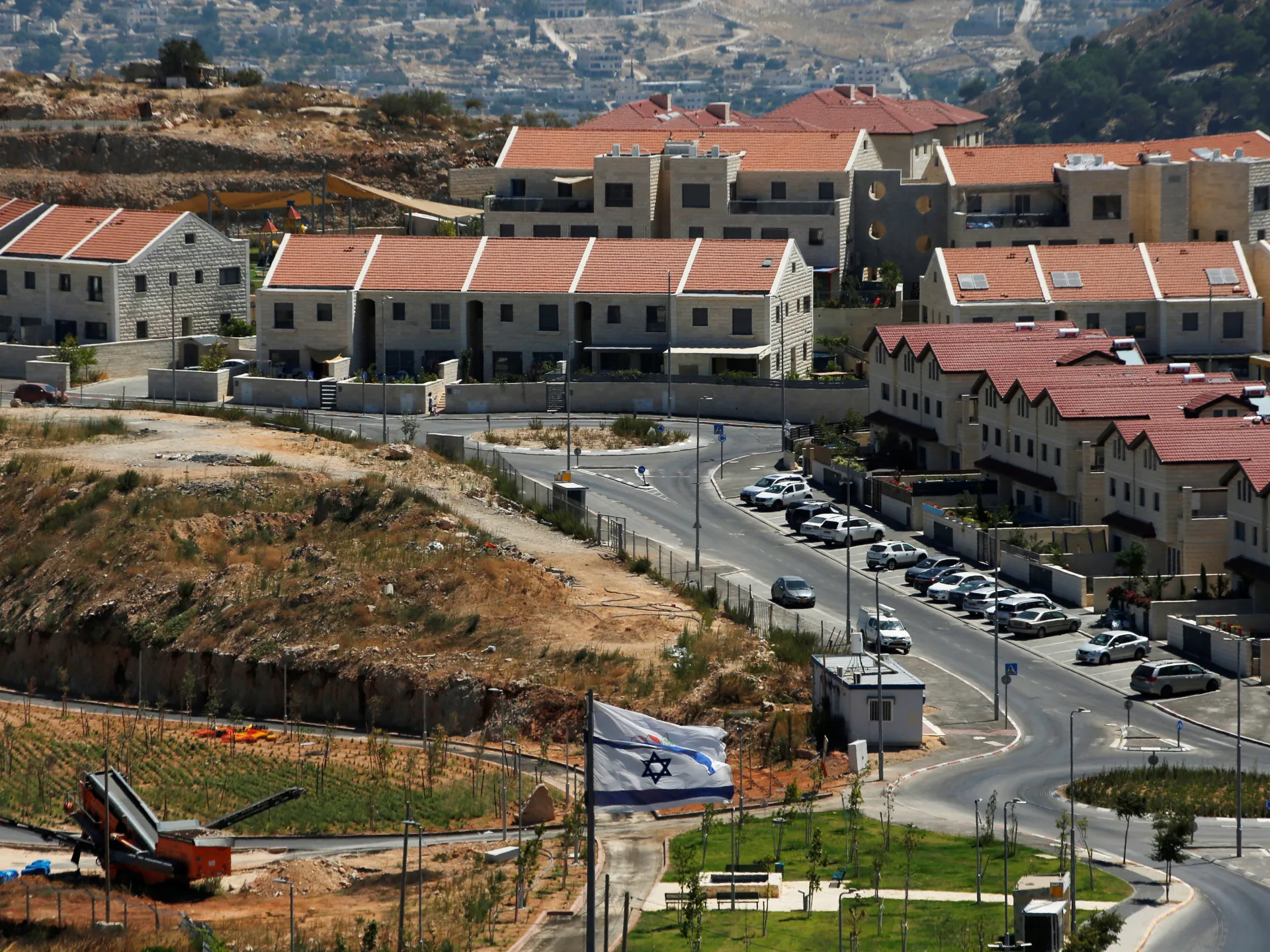
The United States has announced it will soon provide in-person passport services at an illegal Israeli settlement in the occupied West Bank.

The US Embassy in Jerusalem said it would start providing the service for Efrat, located between the Palestinian towns of Bethlehem and Hebron, on February 27.

Recommended Stories

list of 4 itemsend of list

It will be the first time the US has “provided consular services to a settlement in the West Bank”, according to a US embassy spokesperson quoted by the Reuters news agency.

The embassy said it would plan similar on-site services in the Palestinian city of Ramallah, the illegal Israeli settlement of Beitar Illit near Bethlehem, and in cities within Israel, such ⁠as Haifa.

The US currently offers passport and consular services at its embassy in West Jerusalem as well ⁠as at a Tel Aviv branch office.

Israeli settlements in the occupied West Bank, home to 3 million Palestinians who seek the territory as part of a future state, are illegal under international law.

Nevertheless, far-right Israeli politicians have openly called for Israel to increase settlement expansion, or even annex the Palestinian territory.

This month, Prime Minister Benjamin Netanyahu’s right-wing government approved measures to expand control over the occupied West Bank and claim large tracts of Palestinian territory as Israeli “state property”.

The move was roundly condemned by more than 80 United Nations member countries.

Much of the West Bank is already under Israeli military control, with limited Palestinian self-government in some areas run by the Western-backed Palestinian Authority.

According to the International Court of Justice, about 465,000 Israeli settlers live in the occupied Palestinian territory, spread across some 300 illegal settlements and outposts.

Among them are an estimated tens of thousands of dual US-Israeli nationals. The Efrat settlement is home to many American immigrants.

US President Donald Trump, a staunch supporter of Israel, has said he opposes Israeli annexation of the occupied West Bank. But his administration has ‌not taken any steps to curb Israel’s expanding settlement presence.

In addition to advancing settlements, Israeli forces regularly carry out violent raids, demolitions, and arrests in the occupied West Bank, where attacks by Israeli settlers against Palestinians have also intensified, often under the protection of Israeli soldiers.

In January alone, at least 694 Palestinians were driven from their homes in the West Bank because of Israeli settler violence and harassment, the highest number since Israel’s genocidal war on Gaza erupted in October 2023, according to the United Nations.

Source link

Nearly 20 countries slam Israel’s ‘de facto annexation’ drive in West Bank | Occupied West Bank News

Joint statement says Israeli land grab is ‘deliberate and direct attack’ on the viability of a Palestinian state.

Foreign ministers of 19 countries, including Turkiye, Qatar, France and Brazil, have signed a joint statement condemning Israel’s moves to unlawfully extend and consolidate its control over Palestinian land.

The statement issued late Monday by the Turkish Ministry of Foreign Affairs described Israel’s plans to begin land registration in the occupied West Bank, which will sanction the seizure of land from Palestinians who cannot prove ownership, as “de facto annexation”.

Recommended Stories

list of 4 itemsend of list

“Changes are wide-ranging, reclassifying Palestinian land as so-called Israeli ‘state land’, accelerating illegal ⁠settlement activity, and further entrenching Israeli administration,” said the joint statement, also signed by Saudi ‌Arabia and Egypt, as well as the heads of the Arab League and Organisation of Islamic Cooperation.

Israel’s plans, signed on February 15, will see registration introduced across Area C, which makes up about 60 percent of the West Bank’s territory, according to the illegal settlement monitoring organisation, Peace Now.

The joint statement warned Israel’s moves could permanently alter the “legal and administrative status” of territory that is largely under Israeli military control, with limited Palestinian self-rule, but which would constitute part of a future Palestinian state.

“Such actions are a deliberate and direct attack on the viability of the Palestinian State and the implementation of the two-State Solution,” the statement said, rejecting measures altering “the demographic composition, character and status of the Palestinian Territory occupied since 1967, including East Jerusalem”.

INTERACTIVE - Displacemnt across the occupied West Bank -west bank - February 17, 2026 copy-1771321245

Signatories also called on Israel to end settler violence against Palestinians, pledging to take “concrete steps, in accordance with international law, to counter the expansion of illegal settlements in Palestinian territory and policies and threats of forcible displacement and annexation”.

The foreign ministers stressed that Israeli settlements constitute “a flagrant violation of international law”, including previous United Nations Security Council resolutions and the 2024 Advisory Opinion of the International Court of Justice (ICJ).

The landmark ICJ ruling stated that Israel’s “abuse of its status as the occupying power” rendered its “presence in the occupied Palestinian territory unlawful”.

According to the ICJ, approximately 465,000 Israeli settlers live in the occupied West Bank, spread across some 300 settlements and outposts, which are illegal under international law.

INTERACTIVE - Settler attacks across theoccupied West Bank (2024-2025)-west bank - October 14, 2025-1771321248

Earlier this month, UN Secretary-General Antonio Guterres warned that Israel’s land registration plan could lead to the “dispossession of Palestinians of their property and risks expanding Israeli control over land in the area”.

Signatories of the statement urged Israel to immediately release withheld tax revenues owed to the Palestinian Authority in accordance with the 1994 Paris Protocol.

They also stressed the importance of preserving the historic and legal status quo in Jerusalem and its holy sites, particularly during the holy month of Ramadan.

Source link

Israeli settlers deface, set fire to West Bank mosque during Ramadan | Israel-Palestine conflict News

Attack on Nablus-area mosque is latest in surge of Israeli settler and military violence targeting Palestinians.

Israeli settlers have defaced and set fire to a mosque in the occupied West Bank during the Muslim holy month of Ramadan, marking the latest incident in a wave of Israeli violence against Palestinians in the territory.

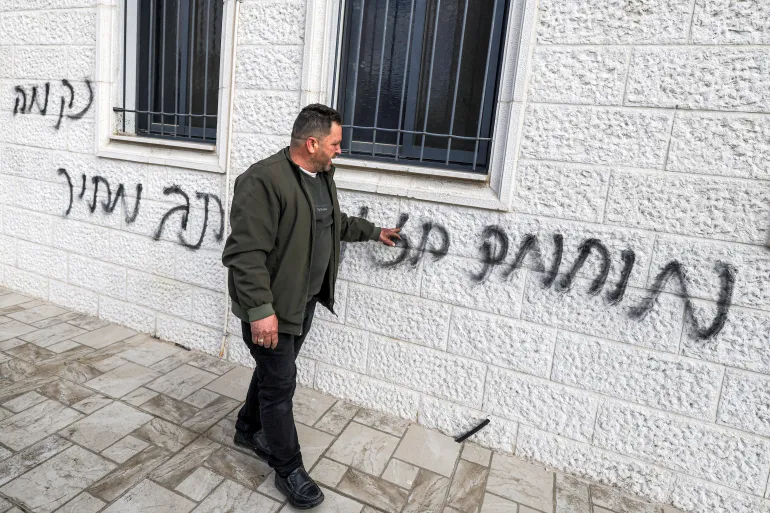
The Wafa news agency reported on Monday that settlers graffitied racist slogans on the walls of Abu Bakr as-Siddiq Mosque, located between the towns of Sarra and Tal, near Nablus in the north of the West Bank.

Recommended Stories

list of 3 itemsend of list

Worshippers arriving for the day’s first prayers found the damage and a smouldering fire that spewed black smoke across the mosque’s entrance and stained the ornate doorway, The Associated Press reported.

“I was shocked when I opened the door,” Munir Ramdan, who lives nearby, told the news agency. “The fire had been burning here in the area, the glass was broken here and the door was broken.”

Ramdan told AP that security camera footage showed two people walking towards the mosque carrying gasoline or petrol and a can of spray paint, and running away a few minutes later.

The attackers spray-painted graffiti denigrating the Prophet Muhammad, as well as the words “revenge” and “price tag” – a term used to describe attacks by Israeli settlers against Palestinians and their property.

A man inspects offensive Hebrew graffiti on the walls outside the Abu Bakr al-Siddiq Mosque in the village of Tell, west of Nablus in the occupied West Bank, on February 23, 2026 following a reported attack by Israeli settlers.
A man inspects Hebrew graffiti on the walls outside the Abu Bakr as-Siddiq Mosque after the attack [AFP]

The assault comes amid a wave of intensified Israeli settler and military violence across the West Bank in the shadow of Israel’s genocidal war against Palestinians in the nearby Gaza Strip.

At least 1,094 Palestinians have been killed by Israeli troops and settlers in the West Bank since the Gaza war began in October 2023, according to the latest United Nations figures.

Last week, the UN Human Rights Council warned in a new report (PDF) that Israeli policies in the West Bank – including “the systematic unlawful use of force by Israeli security forces” and unlawful demolitions of Palestinian homes – aim to uproot Palestinian communities.

“These violations, together with pervasive and growing settler violence committed with impunity, are fundamental to the coercive environment that induces forced displacement and forcible transfer, which is a war crime,” the report said.

It added that these policies are aimed at “altering the character, status and demographic composition of the occupied West Bank, raising serious concerns of ethnic cleansing”.

Back in the West Bank village of Tal on Monday, resident Salem Ishtayeh told AP that the Israeli settlers’ assault on the local mosque was “directed especially” at Palestinians who are fasting during Ramadan.

“So they like to provoke you with words. It’s not that they are attacking you personally, they are attacking your religion, the Islamic faith,” Ishtayeh said.

A Palestinian man, holding Misbaha prayer beads, inspects the debris at a mosque, which Palestinians say was damaged by Israeli settlers, in West Bank village of Surra, near Nablus in the Israeli-occupied West Bank, February 23, 2026. REUTERS/Mohamad Torokman TPX IMAGES OF THE DAY
A Palestinian man inspects the debris at the mosque that was attacked by Israeli settlers [Mohamad Torokman/Reuters]

According to the Palestinian Authority’s Ministry of Religious Affairs, settlers vandalised or attacked 45 mosques in the West Bank last year.

The Israeli military and police said they responded to the latest incident and were searching for suspects.

But human rights groups say the Israeli authorities have allowed the settlers to operate with total impunity in their attacks against Palestinians.

Israeli organisation B’Tselem has accused Israel of actively aiding the settlers’ violence “as part of a strategy to cement the takeover of Palestinian land”.

The UN also warned last year that settler attacks were being carried out “with the acquiescence, support, and in some cases participation, of Israeli security forces”.

Source link

What is Christian Zionism, the pro-Israel ideology invoked by US ambassador | Israel-Palestine conflict News

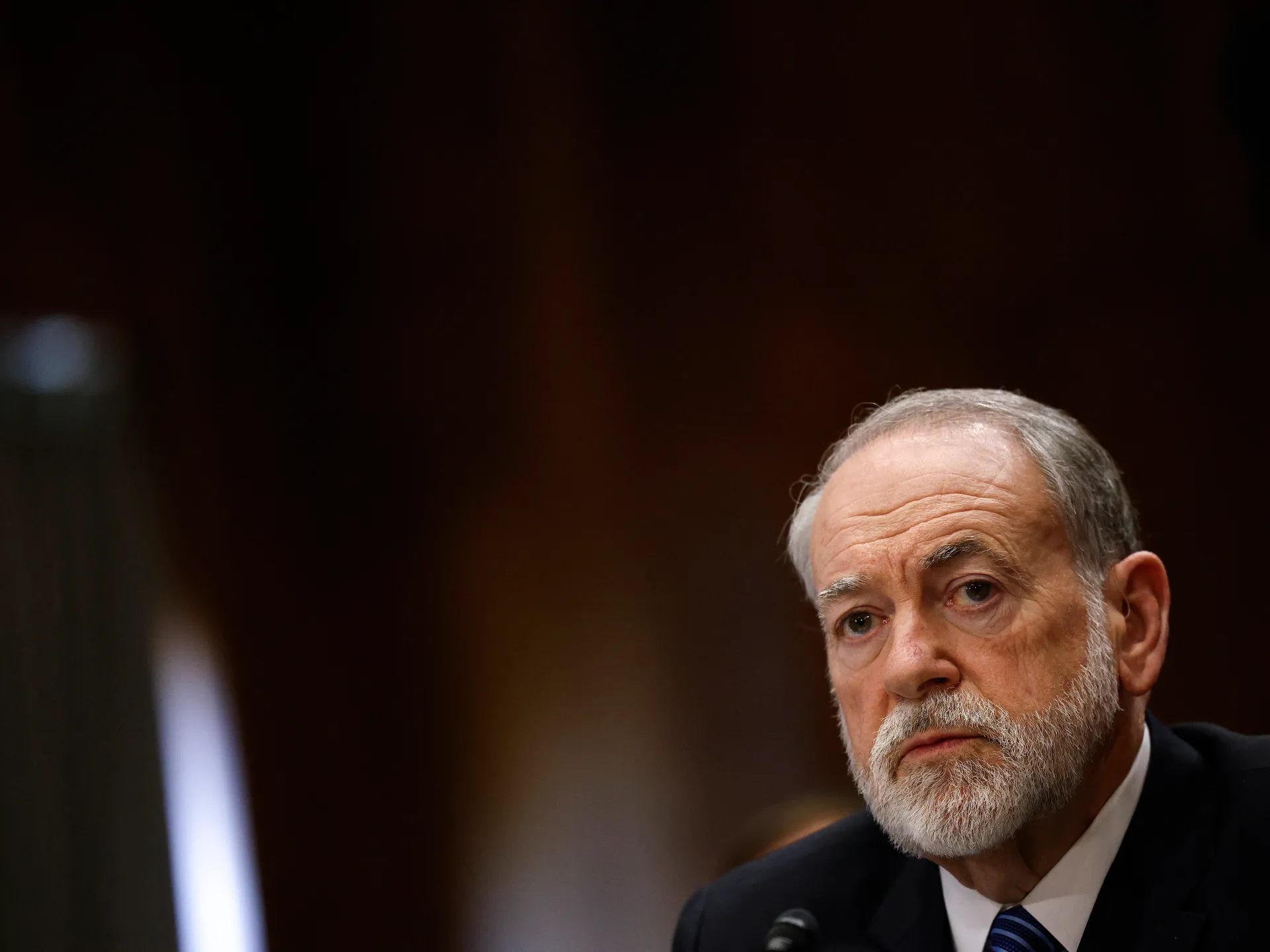
United States Ambassador to Israel Mike Huckabee has faced condemnation from Arab and Muslim countries after suggesting Israel has a biblical right to much of the Middle East.

In an interview with prominent right-wing American commentator Tucker Carlson, Huckabee suggested that Israel has a God-given right to land stretching from the Euphrates River to the Nile, which would encompass Lebanon, Syria, Jordan and parts of Saudi Arabia.

Recommended Stories

list of 3 itemsend of list

It would be fine if they took it all,” he said, arguing that the geographical borders of Israel are rooted in the Bible, a belief shared by Christian Zionists.

The US diplomat, a self-professed Christian Zionist and staunch supporter of Israel, later walked back his comments, calling them “somewhat hyperbolic” and adding that Israel is not seeking expansion but has a right to security within its current borders.

But were his comments indeed hyperbolic in the Christian Zionist worldview? Or is that precisely what he and his fellow proponents of the ideology believe?

How did Christian Zionism begin, and what are its tenets?

In 1878, William Blackstone, a student of the prominent American evangelist Dwight Moody and a believer in the biblical restoration of Israel, published a book titled Jesus Is Coming. The best-selling work popularised among Americans a belief held by some Christian leaders: that God had given the land of Israel to the Jewish people.

This conviction, often taken from a Protestant evangelical perspective, draws on the ancient biblical idea that, nearly four millennia ago, God promised the land to the Jews, who would rule it until the return of Jesus to Jerusalem for the rapture. According to this theology, Christians will be saved upon Christ’s return while non-Christians who do not convert will face damnation.

The most commonly quoted Bible verse relating to this covenant is Genesis 12:3, in which God tells Abraham: “I will bless those who bless you and I will curse those who curse you and in you all the families of the earth will be blessed,” according to the Religion Media Centre.

According to ChristianZionism.org, a website run by professors, pastors and leaders of church-related organisations, four themes can be found in Christian Zionist thought: One, the founding of today’s nation-state of Israel in 1948 marked the final human era and signals an end of times. Two, the ongoing conflict in the Middle East is a part of God’s plan with a great and final war preceding the second coming of Christ. Three, God’s covenant with Israel is eternal and unconditional. And four, failing to support Israel’s political dominance today will incur divine judgement.

Writer and historian David Swift said that although many Christians – evangelical or otherwise – supported the creation of Israel before 1948, they cannot be called Christian Zionists in the modern parlance.

“This is because Christian Zionism essentially fuses religious belief with a military, strategic and even economic programme,” Swift told Al Jazeera.

“Specifically, Christian Zionism is not just the belief that the biblical land of Israel is the ordained country of the Jewish people but that it is in America’s strategic, military and economic interest to support the expansion of Israel.”

Fathi Nimer, a policy fellow at Al-Shabaka: The Palestinian Policy Network, described the movement as one that “translates into absolute unquestioning support for the Israeli regime”.

He described hearing a podcast about a Christian Zionist woman visiting Bethlehem who, after seeing the separation wall, Israeli soldiers and the harsh conditions in Palestinian refugee camps, remarked: “I feel bad for them, but scripture is scripture.”

“‘Scripture is scripture’ – that overrides everything,” Nimer told Al Jazeera.

“That’s why it’s such a powerful tool for brainwashing.”

How many American Christian Zionists are there?

According to author and academic Tristan Sturm, the largest population of Christian Zionists is in the US, and it numbers more than 30 million. Most are affiliated with evangelical churches in the southeast and south-central regions, often referred to as the “Bible Belt”.

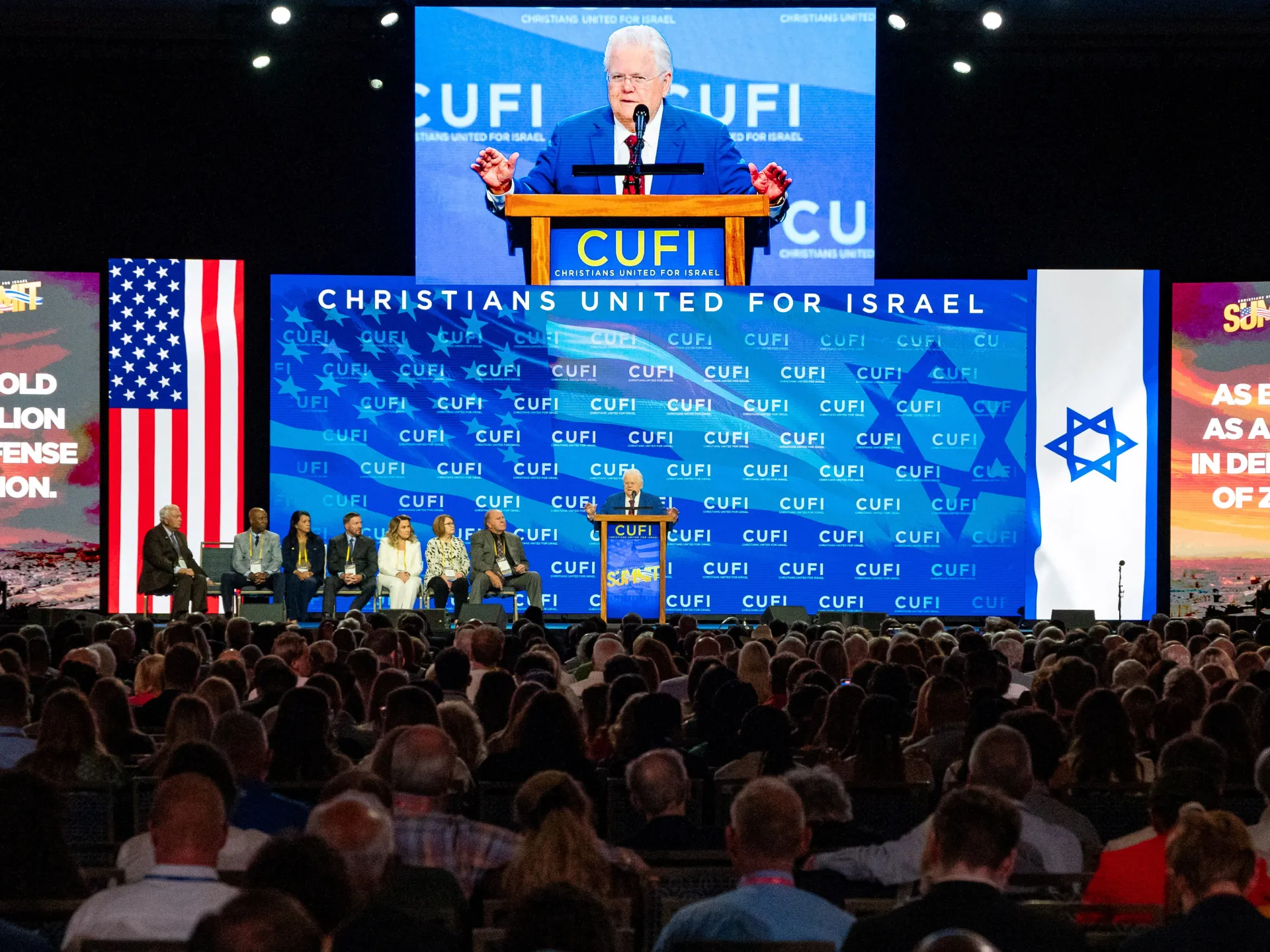
The biggest organisation is Christians United for Israel, which itself boasts 10 million members, Nimer said.

“They are overwhelmingly conservative Republicans, found mostly in the Bible Belt, but also other places in the United States, and they form one of the most formidable voting blocs in the Republican Party,” he said.

Swift stated that only a few million from this group, however, are “fully signed up to the political, military and religious aspects of Christian Zionism”.

What impact do Christian Zionists have on US policy?

Nimer argued that Christian Zionists are “deeply intertwined” with American politics. “A lot of the major donors to the Republican Party and also the Democratic Party are Christian Zionists,” Nimer said.

According to the analyst, Christian Zionists are a cornerstone of Israeli lobbying groups, ranging from the American Israel Public Affairs Committee (AIPAC) to the Anti-Defamation League, “that work to spread the Israeli narrative” in American society.

Meanwhile, a lot of members of the US Congress are “openly” Christian Zionist, Nimer said.

“[Politicians like] Mike Huckabee, … they reached the highest echelons of the state. And they bring these beliefs into their politics, into their policies,” the analyst said.

US foreign policy on Israel is, therefore, heavily influenced and shaped around the underlying biblical premise that the Jewish people are divinely destined to be restored to Palestine, he argued.

“When it comes to Palestine and the region in general, as you see right now with the [potential] war in Iran, they’re saying that the ballistic missile programme is now on the table,” Nimer said.

“It has nothing to do with the nuclear deal, … but the idea is that Israel must be able to maintain its superiority over every country in the region, and that’s a decree by God because if Israel prospers, then that’s another step towards the end of the world.”

Christian Zionist groups have also backed Israel’s illegal settlement project in the occupied West Bank and other measures that they see as reinforcing Israeli Jewish sovereignty.

Furthermore, for two decades, organisations such as HaYovel have been bringing in hundreds of American Christian volunteers to work in Israeli settlement agricultural projects, especially during the genocidal war on Gaza, when Jewish Israelis were called for military duty. Many also strongly endorsed US President Donald Trump’s moving of the US embassy from Tel Aviv to Jerusalem in 2017.

Swift, however, said Christian Zionists have played only a minor role in shaping US support for Israel and their influence is waning.

He argued that while Christian Zionism is integrated with a “broader neoconservative foreign policy agenda” also tied to the “US defence industry and broader military-industrial complex”, the group does not have much influence in American politics, and, in fact, it is declining.

Traditionally, US government support for Israel was driven by Cold War considerations and by pressure from the Jewish community within the US and lobbying groups like AIPAC. What played less of a role was support for Israel from evangelical Christians and the smaller community of Christian Zionists, Swift said.

“The US president is finally de facto abandoning the previous theoretical support for a two-state solution – although not for Christian Zionist reasons. When Trump talks of ethnically cleansing Gaza and turning it into a beach resort, he uses the language of real estate, not the Old Testament,” the historian said.

According to the analysts, very representative.

“It is pretty representative: Christian Zionists derive their understanding of the proper borders of Israel from the same place as people like [Israeli National Security Minister] Itamar Ben-Gvir and [Israeli Finance Minister] Bezalel Smotrich: the Old Testament. Therefore, they think Israel should expand to include all of the territory of ‘biblical Israel’,” Swift said, referring to the far-right Israeli cabinet members who have worked to expand and protect Israeli settlements and outposts in the occupied West Bank, which are illegal under international law.

Nimer said Huckabee’s statement is also not something that can be criticised within the Christian Zionist community.

“You’re not allowed to criticise that because it’s like you’re criticising prophecy and you’re criticising God and the return of Jesus,” he said.

Huckabee’s comments, therefore, come as no surprise despite infringing upon the sovereignty of US allies in the Middle East, Nimer said.

On Monday, Smotrich said Israel would eventually occupy the Gaza Strip and establish a Jewish settlement there despite a “ceasefire” that went into effect in October.

“We are giving US President Donald Trump the opportunity to do it in his own way. If he does not succeed in eliminating Hamas, the Israeli army will get international legitimacy and American support to do it,” he said in statements to Israeli radio.

How do Jewish Israelis view Christian Zionists?

Mimi Kirk, the director of the Institute for the Study of Christian Zionism and the associate director of Georgetown University’s Center for Contemporary Arab Studies, writes that “despite the matter of their supposed end-of-times demise according to this view, Jewish Israeli leaders have embraced the money and influence on US foreign policy that Christian Zionists offer,” especially as its adherents include top officials from the first Trump administration, including former Vice President Mike Pence and Secretary of State Mike Pompeo.

Nimer said it’s a rather “cynical relationship”, given that the Christian Zionist worldview, which sees all non-Christians going to hell, is “anti-Semitic to the bone”.

“But they support Israel, so it’s fine,” the policy analyst said.

“They care about what they can get out of them right now as the biggest support base in the West currently.”

Israel is further banking on this support because it is quickly losing its “progressive facade” of a “liberal democracy” with “all these progressive rights”, Nimer added.

“This has completely faded over the last few decades, and especially since the genocide in Gaza, this has become completely unacceptable.”

How do Christians in Palestine view Christian Zionists?

Palestinian Christians have long voiced concern that the Christian Zionist position threatens their existence, further entrenching Israel’s occupation while marginalising their community and undermining the historic churches of the Holy Land.

Just last month, the Patriarchs and Heads of the Churches in Jerusalem said activities by local individuals advancing “damaging ideologies, such as Christian Zionism” “mislead the public, sow confusion, and harm the unity of our flock”.

The Christian leaders warned that these efforts could undermine the Christian presence not only in the Holy Land but across the wider Middle East.

The statement came amid growing concern among Palestinian Christians that Israel’s policies – including land confiscation, settlement expansion and pressure on church property – are accelerating the erosion of one of the world’s oldest Christian communities.

Are there critiques of Christian Zionism among other Christians?

Criticism of Christian Zionists from within Christianity is abundant.

In the US, the Institute for the Study of Christian Zionism was created to critique and combat the movement through liberation theology, seeking justice for Palestinians and a resolution to the ongoing conflict.

Swift pointed out that many of the world’s most Catholic countries, from Ireland to those in South America and Southern Europe, “tend to be quite pro-Palestinian”.

Meanwhile, Palestinian Christian scholars “have written very detailed theological critiques of Christian Zionism”, Nimer said, as have pastors from other parts of the Global South.

A prize awarded by the Nelson Mandela Foundation last year was explicitly aimed at initiatives working against Christian Zionism, and a conference next month in Turkiye is being organised to combat the ideology, Nimer said.

“The world is waking up to how insidious this ideology is and how it creeps into societies and makes it impossible to have any kind of solidarity with Palestinians as long as they believe it,” he said.

Source link

How Modi ‘broke down walls’ between India, Israel – at Palestine’s expense | Narendra Modi

New Delhi, India – As Indian Prime Minister Narendra Modi emerged from his plane at Ben Gurion airport outside Tel Aviv on July 4, 2017, his Israeli counterpart, Benjamin Netanyahu, waited for him at the other end of the red carpet laid out on the tarmac.

Minutes later, the leaders hugged. Speaking at the airport, Modi said his visit was a “path-breaking journey” – it was the first time an Indian prime minister had visited Israel. Netanyahu recalled their first meeting in New York in 2014, where, he said, “we agreed to break down the remaining walls between India and Israel”.

Nine years later, as Modi prepares to fly to Israel on February 25 for his second visit, he can largely claim to have accomplished that mission, analysts say. A relationship that was once frowned upon in India, and then carried out clandestinely, is now one of New Delhi’s most public friendships. Modi has frequently described Netanyahu as a “dear friend”, despite the International Criminal Court having issued an arrest warrant in late 2024 for the Israeli premier over alleged war crimes carried out during Israel’s genocidal war on Gaza.

Indian diplomats and officials have justified the country’s pivot towards Israel as a “pragmatic approach” – Israel, with its tech and military expertise, has too much to offer to be ignored, they argue – balanced by efforts from New Delhi to strengthen ties with its Arab allies.

Yet, it has come at a cost, analysts say: to Palestine, and India’s relationship with it, and, according to some experts, to India’s moral credibility.

“The so-called realist turn of India has cost its moral power, which it used to enjoy in the Global South,” said Anwar Alam, a senior fellow with the Policy Perspectives Foundation think tank in New Delhi.

Amid an ongoing war in the Palestinian territory, Modi’s visit “amounts to legitimising the apartheid Israeli state”, Alam told Al Jazeera.

modi
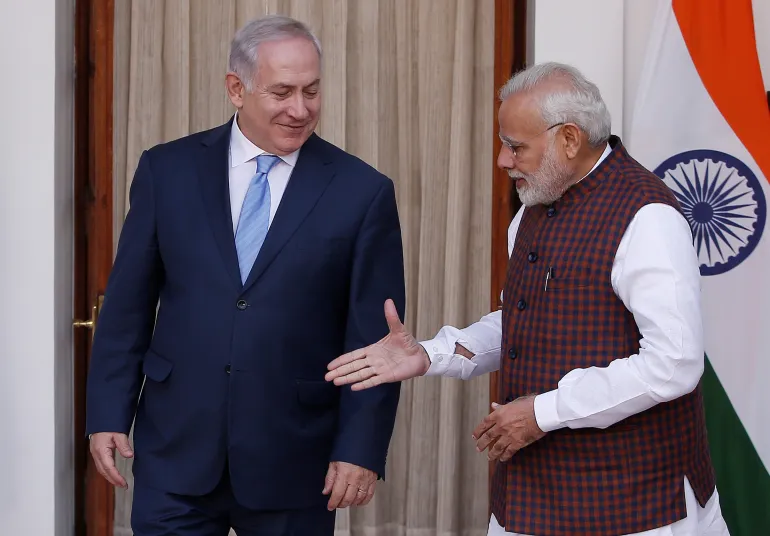
Indian Prime Minister Narendra Modi extends his hand for a handshake with his Israeli counterpart, Benjamin Netanyahu, during a photo opportunity ahead of their meeting at Hyderabad House in New Delhi, India, on January 15, 2018 [Adnan Abi/Reuters]

An ideological alliance

India was a staunch advocate for Palestine in the post-colonial world order, with major leaders backing Palestinian independence. In 1947, India opposed the United Nations plan to partition Palestine. And four decades later, in 1988, India became one of the first non-Arab states to recognise Palestine.

The end of the Cold War – India leaned towards the Soviet Union despite officially being non-aligned – forced a change in New Delhi’s calculations. Alongside an outreach to the United States, India also established diplomatic relations with Israel in January 1992.

Since then, defence ties have anchored the relationship, which has also expanded on other fronts in recent years.

Modi’s rise to power in India in 2014 proved to be the catalyst for the biggest shift in relations. Modi’s Hindu nationalist Bharatiya Janata Party (BJP) has an ideology rooted in the vision of making India a Hindu nation, a natural homeland for Hindus anywhere in the world – an approach that mirrors, in many ways, Israel’s view of itself as a Jewish homeland. Both Modi and Israel view “Islamic terrorism”, which critics say is also shorthand for justifications needed to pursue broader anti-Muslim policies, as major threats.

Under Modi, India has become Israel’s largest weapons buyer. And in 2024, as Israel waged its war on Gaza, Indian weapons firms sold Israel rockets and explosives, according to an Al Jazeera investigation.

Ahead of Modi’s upcoming visit, the two countries signed a memorandum of understanding that aims to further deepen defence ties, with India exploring the joint development of anti-ballistic missile defence with Israel. In Jerusalem, Modi is scheduled to address the Knesset, Israel’s parliament.

“Modi’s address is special because of how it underlines the scale of the shift in relations under the Bharatiya Janata Party towards an overtly pro-Israel policy,” Max Rodenbeck, project director at the Washington-based Crisis Group’s Israel-Palestine department, told Al Jazeera.

But Modi’s visit is also personal for Netanyahu, Rodenbeck said. Israel is months away from a national election that is, in effect, a referendum on Netanyahu’s government – from the intelligence failures that enabled the October 7 attack by Palestinian groups to the war on Gaza that followed, as well as his attempts to weaken judicial independence through reforms.

The visit appears “as almost a personal favour to Netanyahu by boosting his image as an international statesman just as Israeli election campaigning is getting underway”, Rodenbeck said.

While several Western leaders have visited Israel since it began its genocidal war on Gaza in October 2023, few leaders from the Global South have made the trip.

At a time when the Gaza war has shrunk the set of countries willing to be seen as Israel’s friends, especially among emerging economies, Modi’s visit is significant.

Israel does not “have many friends” globally at the moment, said Kabir Taneja, the executive director of the Middle East office at the Observer Research Foundation, a New Delhi-based think tank. “So India is playing that role,” he added. “[Modi’s visit] sort of shows that Israel is not fully isolated.”

modi
Indian Prime Minister Narendra Modi and Israeli Prime Minister Benjamin Netanyahu attend an Innovation conference with Israeli and Indian CEOs in Tel Aviv, Israel, on July 6, 2017 [Oded Balilty/Reuters]

The July 2017 visit

In many ways, Modi’s visit to Israel this week will look to build on his July 2017 trip, which was a watershed moment in the bilateral ties, analysts note.

No Indian Prime Minister had previously visited Israel, but even lower-level diplomats would, until then, pair their Israel visits with parallel engagements in the Palestinian territory.

Modi broke with that policy. He did not visit Palestine in 2017, only making a trip there in 2018, by which time he had already also hosted Netanyahu in New Delhi. It had also been the first visit by an Israeli premier to India.

The 2017 Modi visit has been under scrutiny recently. An email released by the US Justice Department as part of the Jeffrey Epstein files showed that the late disgraced financier had advised a billionaire close to Modi during his trip.

After the visit on July 6, Epstein, a convicted sex offender, had emailed an unidentified individual he referred to as “Jabor Y”, saying: “The Indian Prime minister modi took advice. and danced and sang in israel for the benefit of the US president. they had met a few weeks ago.. IT WORKED. !”

India’s Ministry of External Affairs has dismissed these claims as the “trashy ruminations” of a convicted criminal.

Nonetheless, Modi’s visit to Israel solidified the bilateral relationship. Trade between the two nations has grown from $200m in 1992 to more than $6bn in 2024.

India is still Israel’s second-largest Asian trading partner after China in goods, dominated by diamonds, petroleum, and chemicals. India and Israel signed a Bilateral Investment Treaty (BIT) in September last year and have both been looking to close negotiations on a free trade deal.

At the same time, people-to-people ties have grown as well. After Israel banned Palestinians from working in the country following the Hamas-led attack on October 7, 2023, thousands of Indians lined up to work in Israeli construction companies.

“India and Israel have a fairly deep strategic and economic relationship that has been flourishing since Prime Minister Modi came to office,” said the Observer Research Foundation’s Taneja.

Modi was also among the first world leaders to condemn the Hamas-led attack and throw India’s support behind Israel.

“It really, really feeds into India’s posture against terrorism,” Taneja said about the India-Israel ties. “Israel is a country that India sees facing similar crisis when it comes to terrorism.”

India accuses Pakistan of sponsoring armed attacks on its territory and in Indian-administered Kashmir. Pakistan has accepted that its nationals have, in some instances, been behind these attacks, but has rejected accusations that it has trained or financed the attackers.

modi
Israeli Prime Minister Benjamin Netanyahu and his wife, Sara, tie a garland made of cotton threads to the portrait of Mahatma Gandhi, as Indian Prime Minister Narendra Modi stands next to them, at Gandhi Ashram in Ahmedabad, India, on January 17, 2018 [Amit Dave/Reuters]

Over the horizon, a different Middle East?

Despite its close ties with Israel, New Delhi under Modi has not completely abandoned its position on the Palestinian cause, calling for a two-state solution and peace through dialogue. But it has been increasingly hesitant to criticise Israel over its war crimes in the occupied Palestinian territory.

India’s historical support for the Palestinian cause is rooted in its pivotal role in the non-alignment movement, the Cold War-era neutrality posture adopted by several developing nations. Even before India gained independence, the leader of its freedom struggle, Mahatma Gandhi, decried the “imposition of Jews over Arabs” through the creation of Israel.

India now no longer calls its approach non-alignment, instead referring to it as “strategic autonomy”.

“The Middle East is the only geography where this policy actually functions, and also provide[s] dividend[s],” Taneja told Al Jazeera. “India has good relations with Israel, Arab powers and Iran alike. One of the reasons [it works is] because India does not step into regional conflicts and confrontations.”

But under pressure from US President Donald Trump, India has stopped buying oil from Iran and taken steps to end its work on developing the strategically significant Chabahar port, which New Delhi viewed as a gateway into landlocked Central Asia and Afghanistan.

Now, Trump is threatening to attack Iran. The US has amassed warships and jets near Iran, even as Washington and Tehran continue to engage in diplomatic talks.

“I suspect India may be looking over the horizon to a Middle East where Iran has suffered heavy attack from the US and Israel, and no longer projects power in the region. In these circumstances, Israel will emerge as something of a regional hegemon,” said the Crisis Group’s Rodenbeck.

“India is perhaps positioning itself to benefit. Also, Modi sees Israel as influential in Washington, and may hope that friendliness to Israel wins points with Congress and Trump, which India badly needs.”

Source link

Netanyahu says Israel will forge regional alliance to rival ‘radical axes’ | Israel-Palestine conflict News

Israel to join with India, Greece, Cyprus and other Arab, African, Asian countries that ‘see eye to eye’, says PM.

Israeli Prime Minister Benjamin Netanyahu has announced that Israel plans to build a network of allied nations in or around the Middle East to collectively stand against what he called “radical” adversaries.

Netanyahu made the comments on Sunday while announcing the upcoming visit to Israel of Indian Prime Minister Narendra Modi, whose country the Israeli leader said would be part of the “axis of nations that see eye to eye” with Israel.

Recommended Stories

list of 3 itemsend of list

Netanyahu, who is wanted by the International Criminal Court on war crimes charges, also referred to Greece, Cyprus and other unnamed Arab, African and Asian countries.

“In the vision I see before me, we will create an entire system, essentially a ‘hexagon’ of alliances around or within the Middle East,” Netanyahu said, according to the Times of Israel.

“The intention here is to create an axis of nations that see eye to eye on the reality, challenges, and goals against the radical axes, both the radical Shia axis, which we have struck very hard, and the emerging radical Sunni axis.”

Modi said he fully agrees with Netanyahu on the “bond between India and Israel”, including the “diverse nature of our bilateral relations”.

“India deeply values the enduring friendship with Israel, built on trust, innovation and a shared commitment to peace and progress,” Modi wrote in a post on X.

Since the start of Israel’s genocidal war on Gaza, its assaults have been weakening the Iran-led “axis of resistance”, including Hezbollah in Lebanon. Israel and Iran also directly clashed last June in a 12-day war, in which the US military also joined to attack Iran’s nuclear sites.

Netanyahu did not elaborate on what he meant by “emerging radical Sunni axis”, but he has previously identified the Muslim Brotherhood as its leading element.

Relations between Israel and several predominantly Sunni Muslim states have soured amid the bloodshed in Gaza, including with Turkiye, whose President Recep Tayyip Erdogan has sharply criticised Netanyahu, and Saudi Arabia, which has accused Israel of genocide.

Prospects for normalisation between Israel and Saudi Arabia also appear to be eroding. In recent months, the kingdom has rebuked Israel’s recognition of Somalia’s breakaway region, Somaliland, as well as the Israeli moves towards annexation in the occupied West Bank.

Since 2020, Israel has pushed to establish formal ties with Arab and Muslim states as a way to shore up its regional standing as part of the US-backed so-called “Abraham Accords”.

Under that framework, Israel has been enjoying close relations with the United Arab Emirates, Bahrain and Morocco.

Source link

UEFA and FIFA may get a red card at the ICC for ignoring Israeli violations | Israel-Palestine conflict

On February 16, a group of Palestinian footballers, clubs and advocacy groups referred the heads of FIFA and UEFA to the International Criminal Court (ICC). The 120-page filing accuses Gianni Infantino and Aleksander Čeferin of “aiding and abetting war crimes (specifically, the transfer of civilian population into occupied territories) and crimes against humanity (specifically, apartheid)”.

This historic case marks the first time sports leaders are being accused of these crimes and sends a warning to presidents of all other corporate entities in and beyond athletics. It offers a perfect opportunity to challenge the impunity of Israeli apartheid, occupation and genocide.

Football is the world’s most popular form of cultural expression, with some five billion fans across the planet. Therefore, the stakes of this charge are immense in terms of the spectacle of accountability and legal precedent.

In the course of its campaign in Gaza, of genocide generally and “athleticide” particularly, Israel has killed 1,007 Palestinian sportspeople and destroyed 184 sports facilities, while damaging 81 others.

Although this “athleticide” cannot be directly attributed to the Israel Football Association (IFA), its activities linked to clubs from illegal Israeli settlements located on the occupied Palestinian territory and their participation in domestic and international tournaments can be seen as abetting Israeli crimes of occupation and apartheid.

Despite facing demands for the suspension of these clubs or the IFA, UEFA and FIFA leadership have taken no action. In a recent interview, FIFA chief Infantino said he opposed a ban on Israeli teams from participation in global football, calling it “a defeat”. He went on to add that he was in favour of enshrining in FIFA statutes that no country should ever be banned from “playing football because of the acts of their political leaders”.

Ironic, when you consider he is the very person who oversaw the suspension of Russia from FIFA in 2022 and the banning of Crimean clubs from playing in the Russian league, linked to UEFA, after the Russian occupation of the Ukrainian peninsula in 2014.

The complaint is filed against Infantino and Čeferin because private organisations cannot be defendants before the ICC, but those individuals responsible for their policies can be.

The focus of the complaint is the fact that the IFA has been permitted to materially support, recognise, and include in domestic and international competitions clubs that are based in the stolen settlement land of the occupied West Bank.

Article 64(2) of FIFA Statutes prohibits member associations and their clubs from playing on the territory of another member association without the latter’s approval.

The complaint alleges that by allowing the IFA to oversee clubs that operate on stolen land, Infantino and Čeferin are accountable for normalising illegal Israeli settlements, in direct contravention of a 2024 pronouncement by the International Court of Justice (ICJ) and a resolution from the United Nations General Assembly, which found the settlements to be “unlawful” and required Israel to “cease immediately all new settlement activities, and to evacuate all settlers from the Occupied Palestinian Territory”.

The existence of sanctioned Israeli clubs in West Bank settlements, the referral argues, contributes to the transfer of the civilian population into the occupied territory, contrary to the Rome Statute Article 8(2)(b)(viii), by normalising colonisation.

Likewise, because Israeli clubs in the occupied territory prohibit Palestinians from spectating matches or playing for or managing these teams, the continued sanction of these organisations falls under the definition of aiding and abetting apartheid (a crime against humanity pursuant to Rome Statute Article 7(1)(j).

In continuing to allow the membership of these clubs and the IFA in global and European sport, the filing alleges that Infantino and Čeferin have acted in full knowledge that they have participated in the violation of international law based on the fact that they have deliberately ignored numerous reports and letters advising them to intervene.

Now that the complaint has been formally filed, the Office of the Prosecutor of the ICC will conduct a preliminary examination to confirm that the elements of jurisdiction, admissibility, and the interests of justice have been satisfied. They will then have the option to either decline to open the investigation or proceed to investigate the legal issues raised in the complaint.

If an investigation does ensue, evidence-gathering will occur and arrest warrants or summonses may ultimately be issued. If that happens, this would set an important precedent and give momentum to the campaign for justice for Palestine.

It is notable that while Israeli Prime Minister Benjamin Netanyahu has been able to dodge an ICC arrest warrant by cowering away from Rome Statute signatory states, it would be impossible for Infantino and Čeferin to do so while still fulfilling their roles, assuming it is enforced.

Football is, without question, one of the most popular sports on the planet. When such a cultural juggernaut is connected to business, what emerges is an industry like no other. FIFA and UEFA are global regulatory monopolies, meaning their rules and regulations act the same way a country’s legislation acts on its population. They also preside over a huge, lucrative industry worth hundreds of millions of dollars.

Given the amount of eyeballs and money at stake, the impact of a ban on participation is enormous, as Russia understands all too well after being subjected to suspension. This is no doubt exactly why the presidents of these organisations have refused to act against Israel under the guise of “political neutrality”.

As former UN special rapporteur on the occupied Palestinian territory, Michael Lynk, told us: “When an occupying power is blatantly committing war crimes by creating civilian settlements in occupied territory, the rest of the world – including states, corporations and international sporting organisations – is required to ensure the enforcement of international law by doing everything in their power to bring the violations to a swift end. Yet, FIFA and UEFA are sportswashing the illegal Israeli occupation by allowing the Israeli Football Association to include clubs based in the illegal settlements to participate in their domestic leagues. Nothing could be further from the rules of fairness and equity.”

The bottom line is that sport is and has always been political. The veneer of “political neutrality” conceals the reality that politics is the name of the game for FIFA and UEFA.

Nobody is entitled to stand above international law. It is time for the ICC to prove it.

The views expressed in this article are the authors’ own and do not necessarily reflect Al Jazeera’s editorial stance.

Source link

‘Absurd and provocative’: Huckabee faces firestorm for Israel border stance | Israel-Palestine conflict News

Egypt, Jordan, Saudi Arabia, denounce US ambassador’s remarks suggesting Israel has right to much of the Middle East.

United States Ambassador to Israel Mike Huckabee has triggered an avalanche of criticism from Arab and Muslim countries after suggesting Israel has a right to expand its territory across a large swath of the Middle East.

Huckabee delivered the remarks during a sit-down interview with US commentator Tucker Carlson, broadcast on Friday, as he was pressed about the geographical borders of Israel.

Recommended Stories

list of 3 itemsend of list

Carlson asked Huckabee, a self-professed Christian Zionist and staunch supporter of Israel, to clarify his stance on the Biblical promise of the land spanning the area between the Euphrates River in Iraq and the Nile River in Egypt to the descendants of Abraham, and if the modern Israeli state had the right to claim that lineage.

“It would be fine if they took it all,” said Huckabee.

Such territory would encompass modern-day Lebanon, Syria, Jordan and parts of Saudi Arabia.

The US ambassador later appeared to walk back the claim, saying it was “somewhat of a hyperbolic statement”. He also said Israel was not looking to expand its territory and has a right to security in the land it currently holds.

‘Extremist rhetoric’

Huckabee’s comments sparked immediate backlash from neighbouring Egypt and Jordan, Saudi Arabia, the Organisation of Islamic Cooperation and the League of Arab States, which in separate statements called them “extremist”, “provocative” and “not in line with Washington’s official position”.

Saudi Arabia’s foreign ministry described Huckabee’s comments as “extremist rhetoric” and “unacceptable”, and called for the US Department of State to provide clarification.

Egypt’s Ministry of Foreign Affairs called the remarks a “blatant violation” of international law, adding that “Israel has no sovereignty over the occupied Palestinian territory or other Arab lands.”

Jordan’s foreign ministry dismissed them as “absurd and provocative,” a violation of diplomatic norms and “an infringement on the sovereignty of states in the region”.

“Statements of this nature — extremist and lacking any sound basis — serve only to inflame sentiments and stir religious and national emotions”, the League of Arab States also said in a statement.

Huckabee, whom US President Donald Trump nominated as ambassador in 2024, has long opposed the idea of a two-state solution for Israel and the Palestinian people, and denied the existence of an illegal Israeli occupation of the West Bank. Back in 2008, Huckabee went so far as to question Palestinian identity altogether, saying, “There’s really no such thing as a Palestinian.”

In 2024, the International Court of Justice ruled that Israel’s occupation of Palestinian territory is illegal and must cease immediately.

But Israeli law does not clearly demarcate the country’s borders. Israel also occupies the Golan Heights in Syria, which it illegally annexed in 1981.

The US is the only country that recognises Israel’s claimed sovereignty over the Syrian territory, and only since 2019, during Trump’s first term as president.

After its 2024 war with Hezbollah, Israel also set up military outposts in five points inside Lebanon.

Some Israeli politicians, including Prime Minister Benjamin Netanyahu, have openly promoted the idea of a “Greater Israel” with expanded borders.

Source link