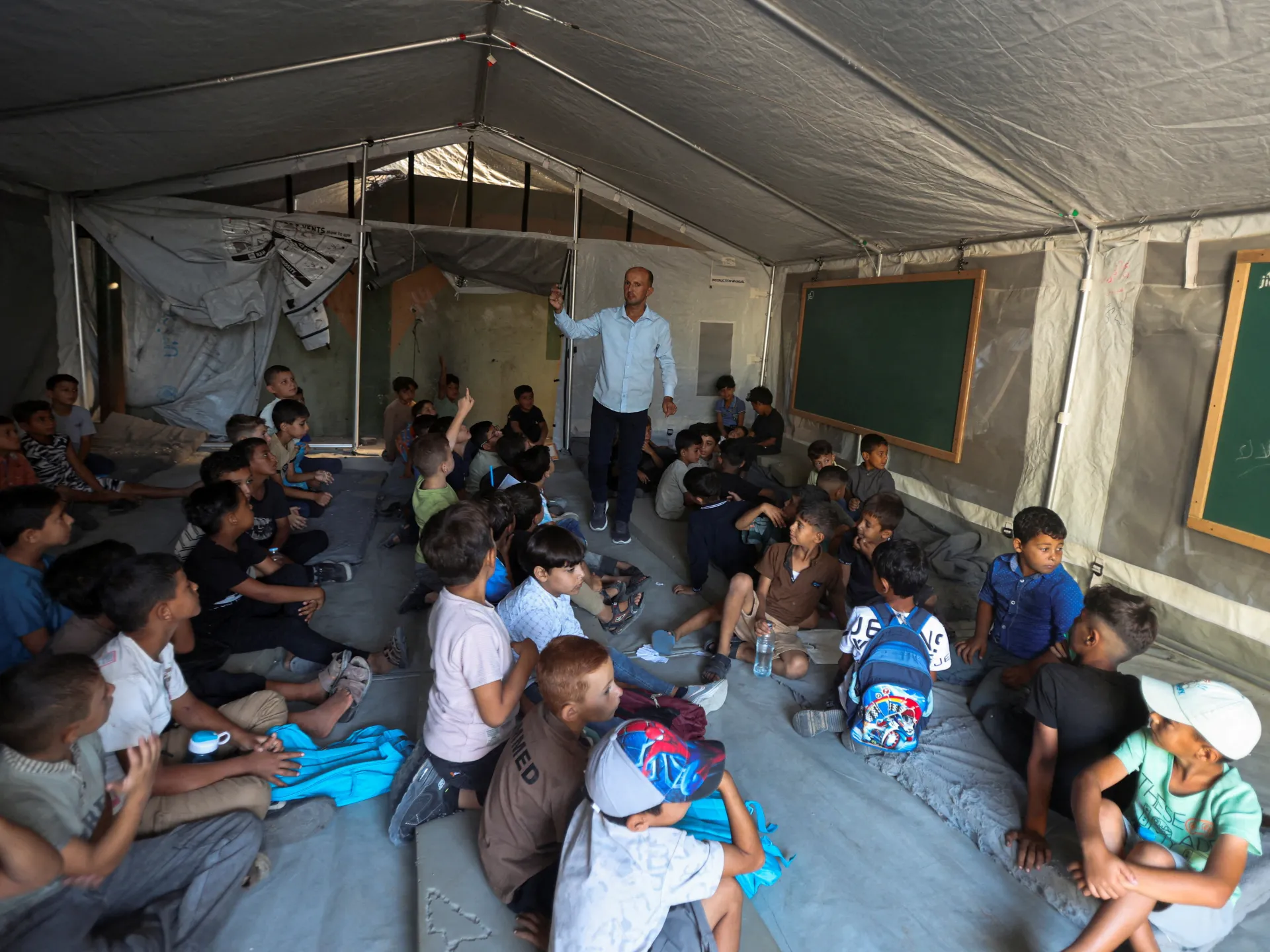
US band The Strokes used their Coachella set to showcase the US-Israeli destruction of universities in Gaza and Iran, including Gaza’s al-Israa University.
UN Children’s Fund calls on Israeli authorities to investigate and ‘ensure full accountability’.
Published On 18 Apr 202618 Apr 2026
The United Nations Children’s Fund says it is “outraged” after Israel killed two drivers it had contracted to deliver clean water to families in Gaza.
UNICEF said in a statement the incident occurred during routine water trucking on Friday morning at the Mansoura water filling point in northern Gaza, which supplies Gaza City. Two other people were wounded in the attack.
Recommended Stories
list of 3 itemsend of list
The agency said it had suspended activities at the site and called on Israeli authorities to investigate and “ensure full accountability”.
“Humanitarian workers, essential service providers, and civilian infrastructure, including critical water facilities, must never be targeted,” it said.
It said that “the protection of civilians and those delivering life-saving assistance is an obligation under international humanitarian law”.
More than 750 Palestinians have been killed by Israeli forces since the US- and Qatar-brokered “ceasefire” in Gaza took effect last October, according to Palestinian health authorities.
More than 72,000 people have been killed since Israel launched its genocidal war against Palestinians in Gaza on October 7, 2023, following a Hamas-led attack on southern Israel.
Meanwhile, in the occupied West Bank, a Palestinian man was shot and killed by Israeli forces in Khirbet Salama, the official Palestinian news agency WAFA reported.
Muhammad Ahmad Suwaiti, 25, was pronounced dead at the scene, WAFA said.
Israel’s military said a person carrying a knife in the illegal settlement of Negohot was killed. It did not say who was responsible.
Using the biblical term for the West Bank, the Israeli military said in a statement that “a terrorist who infiltrated the community of Negohot in Judea and Samaria was identified and eliminated in a rapid response”.
Israeli forces and settlers have killed more than 1,060 Palestinians in the occupied West Bank since the start of the Gaza war in October 2023, according to the Palestinian Ministry of Health.
Video shows Israeli police confiscating and destroying footballs that were being played with by children in the courtyards of Al-Aqsa mosque in occupied East Jerusalem, in what mosque authorities described as part of ongoing restrictions on Palestinians inside the holy site.
Some of the reservists accused of sexually assaulting a detainee have already started combat roles, reports Israeli Army Radio.
Published On 16 Apr 202616 Apr 2026
Israeli military chief Eyal Zamir has authorised five soldiers accused of sexually assaulting a Palestinian inmate in the notorious Sde Teiman detention camp to return to reserve service after charges against them were dropped, according to Israeli media reports.
The soldiers, all from the Force 100 unit assigned to guard military prisons, are being reinstated despite an ongoing, internal military inquiry into their conduct.
Recommended Stories
list of 3 itemsend of list
Israeli Army Radio reported that some of the reservists have already returned to active duty, including deployment to combat roles.
An Israeli army statement, cited by Israel’s Haaretz newspaper, said: “The investigation does not prevent them from continuing to serve … the command-level investigation will be completed as soon as possible.”
The reinstatement comes after Israel’s top military lawyer dropped all charges against the soldiers last month, closing a case that had been among the most divisive in Israel’s recent history.
The soldiers had been charged with aggravated assault and causing severe injury, after footage broadcast by Israeli television showed them abusing a Palestinian man in Sde Teiman. The military’s own indictment described soldiers stabbing the detainee with a sharp object near his rectum, causing cracked ribs, a punctured lung and an internal tear.
A doctor at the facility, Yoel Donchin, told Haaretz he was so shocked by the Palestinian inmate’s condition that he initially assumed it was the work of a rival armed group.
Military Advocate General Itay Offir said the indictments were scrapped partly because of “complexities in the evidentiary structure” and “difficulties” arising from the detainee’s release to the Gaza Strip.
Rights groups condemned the decision as a legal injustice, with Amnesty International calling it “yet another unconscionable chapter in the Israeli legal system’s long-standing history of granting impunity to perpetrators of grave crimes against Palestinians”.
“Since the start of Israel’s genocide against Palestinians in the occupied Gaza Strip, and despite overwhelming evidence of widespread torture and abuse, including sexual violence, against Palestinians in Israeli detention centers, only one Israeli soldier has so far been sentenced over torturing a Palestinian detainee,” said the rights group in a statement.
A February report by the Committee to Protect Journalists also cited dozens of formerly detained Palestinian journalists describing “routine beatings, starvation and sexual assault” in Israeli custody.
With the global attention fixated on the diplomatic efforts to end the war on Iran, Israel has systematically escalated its attacks on Gaza and choked off vital aid, plunging the besieged enclave into what economic experts are now calling an “engineered, compounded famine”.
The number of aid trucks entering Gaza has dropped drastically in violation of the October 2025 ceasefire with Hamas. Since then, the Government Media Office in Gaza has recorded 2,400 military violations by Israeli forces, resulting in the killing of more than 700 Palestinians.
Recommended Stories
list of 4 itemsend of list
On Tuesday, Israel’s military killed at least 11 Palestinians, including two children, in separate attacks across the war-torn Strip.
The intensity of these attacks spiked during peak regional tensions. Between February 28 and April 8, while Israel and the US were engaged in a bombing campaign against Iran, Israeli forces bombed Gaza on 36 out of those 40 days.
In the last five weeks alone, more than 100 people have been killed, including Al Jazeera journalist Mohammed Wishah. Israel has killed more than 72,336 people since launching the brutal military offensive on October 7, 2023.
The ‘truck deception’
While Israel frequently claims it is allowing hundreds of aid trucks into Gaza, Palestinian officials and economic experts argue these figures are a deliberate mathematical deception.
According to the Government Media Office, only 41,714 aid and commercial trucks have entered Gaza over the past six months. This represents a mere 37 percent of the 110,400 trucks stipulated under the ceasefire agreement. The fuel situation is even more critical, with only 1,366 fuel trucks entering out of a promised 9,200 – an abysmal 14 percent compliance rate.
Recent daily logs highlight the severity of the bottleneck. On April 13, a total of only 102 aid trucks and 7 fuel trucks were allowed into the entire Strip, alongside 216 commercial trucks – a fraction of the more than 600 total trucks required daily under the “ceasefire” deal. By April 14, the numbers remained critically low with 122 aid trucks and 12 fuel trucks entering.
Crucially, Israeli authorities entirely shut down additional entry points like the Zikim and Kissufim crossings, which had processed dozens of commercial and aid trucks just a day prior, bottlenecking all limited traffic exclusively through Karem Abu Salem.
Mohammed Abu Jayyab, a Palestinian economic expert based in Gaza, told Al Jazeera that Israel utilises a “technical and commercial deception” to inflate these numbers.
“An Israeli truck carries up to 32 or 34 pallets… which are then unloaded into two or three smaller, dilapidated Palestinian trucks on the Gaza side,” Abu Jayyab explained. “Consequently, the UN and Israel count double or triple the actual number of Israeli trucks entering.” One pallet holds roughly 1 tonne of goods or food items.
Furthermore, Israel recently banned mixed-load shipments. If a merchant brings in 20 pallets of sugar, the remaining 12 pallet spaces on the truck must remain empty, yet it is still registered as a full commercial truck.
“The political agreement stipulated a ‘truck’ but did not specify quantities, weights, or the number of pallets,” Abu Jayyab noted, allowing Israel to weaponise logistics to restrict aid while appearing compliant.
Engineering starvation
This logistical strangulation is part of a broader strategy. Hassan Abu Riyala, undersecretary of the Ministry of National Economy in Gaza, stated in a meeting published on the ministry’s official Telegram channel that Israel is “engineering a policy of starvation”.
To ensure chaos in the local markets and sky-high prices, Israel has deliberately dismantled civil regulatory bodies. “The occupation targeted the majority of the crews that monitored prices, and assassinated the [former] undersecretary of the Ministry of Economy and five directors general during the war,” Abu Riyala said.
The results have been devastating, basic commodities have become scarce, and bread production has plummeted to 200 tonnes daily, far below the 450 tonnes required to feed the population.
“We manage this structural deficit under exceptional and coercive conditions,” Ismail Al-Thawabteh, director general of the Government Media Office, told Al Jazeera.
He described the ongoing reduction of supplies despite the truce as a “systematic restriction of basic supplies” that pushes the population towards dangerous levels of food insecurity. Fresh produce has skyrocketed, with 1kg (2.2lb) of tomatoes jumping from $1.50 to nearly $4 in a matter of weeks.
Moreover, the humanitarian catastrophe is being accelerated by the withdrawal of major aid groups. Al-Thawabteh noted that the scaling back or suspension of operations by key international institutions, most notably the World Food Programme (WFP), due to Israeli restrictions, represents a “highly dangerous development” that threatens the complete collapse of Gaza’s relief system.
“We issue an urgent appeal to the international community and the guarantors of the agreement to immediately pressure Israel to open the crossings… before reaching a point of no return and an imminent human explosion,” he said.
A ‘compounded famine’
The crisis has evolved beyond a simple lack of food; it is now a complete collapse of the Palestinian economy.
Abu Jayyab described the current situation as a “compounded famine”. With unemployment soaring to 80 percent and the destruction of more than 160,000 jobs across industrial, agricultural, and commercial sectors, the population has entirely lost its purchasing power.
“It has become illogical to link the entry of food supplies from the crossings to their availability to Palestinian citizens,” Abu Jayyab told Al Jazeera. Even when goods reach the market, between 70 to 80 percent of families simply cannot afford to buy them due to the total absence of income.
This extreme deprivation is forcing civilians into life-threatening alternatives. “The return of long queues for bakeries, and citizens resorting to burning plastic and waste in the absence of cooking gas, are dangerous field indicators of an unprecedented deterioration,” Al-Thawabteh warned, noting that government health facilities are currently struggling to treat respiratory and skin diseases resulting from this toxic pollution.
The medical blockade
Meanwhile, the stranglehold extends to Gaza’s most vulnerable patients. While the ceasefire agreement mandated the opening of the Rafah crossing for medical evacuations, Israel has kept the borders tightly restricted.
Over the past six months, only 2,703 people have been allowed to cross through Rafah out of an expected 36,800 – a compliance rate of just 7 percent. Consequently, only 8 percent of the severely wounded and chronically ill patients slated for urgent medical evacuation have been permitted to leave. According to the World Health Organization, roughly 18,000 people are still trapped in Gaza waiting for life-saving treatment abroad.
Release of Mahdieh Esfandiari comes a week after Iran released two French citizens held on espionage charges.
Published On 15 Apr 202615 Apr 2026
Iranian national Mahdieh Esfandiari has returned home after being held in France for more than a year as part of what appears to be an exchange of detainees between the countries.
Iran’s state television reported on Wednesday that the “rights activist”, sentenced to one year in prison after making online comments supportive of Palestine and the 2023 Hamas attack on Israel that prompted the genocidal war on Gaza, had returned to Iran.
Recommended Stories
list of 2 itemsend of list
The University of Lyon graduate, who had been living in France since 2018, where she worked as a translator, was arrested in February last year on charges of promoting “terrorism”, and released on bail in October.
“I think it’s clear for everyone that there is no freedom of speech, at least not in France where I was. The court’s ruling was very unjust,” Esfandiari told state television in a Wednesday broadcast.
Esfandiari’s release comes a week after French citizens Cecile Kohler, 41, and Jacques Paris, 72, arrived in France after being held for more than three years in Iran.
Kohler and Paris were arrested by Iranian authorities in May 2022 but were freed in November last year, after more than three years in prison on espionage charges that their families vehemently deny.
They were taken by French diplomats to France’s mission in Tehran, where they lived under house arrest until their full release on April 7. Upon their release, they were driven from Iran to neighbouring Azerbaijan before taking a flight to Paris.
President Emmanuel Macron’s office said their release was the outcome of a “long-term effort”, but talks accelerated in recent weeks due to pressure from the US-Israel war on Iran, giving a sense of urgency to the situation.
While an exchange was not explicitly acknowledged by France, Iran’s state-run agency IRNA had previously said Tehran reached an agreement with Paris for the release of the French citizens in exchange for Esfandiari.
After the first direct talks in decades, Israel and Lebanon have agreed to begin ongoing negotiations for the ‘security of both countries’. Al Jazeera’s Mike Hanna explains why US Secretary of State Marco Rubio sees this ‘milestone’ meeting as just the ‘start of the process’.