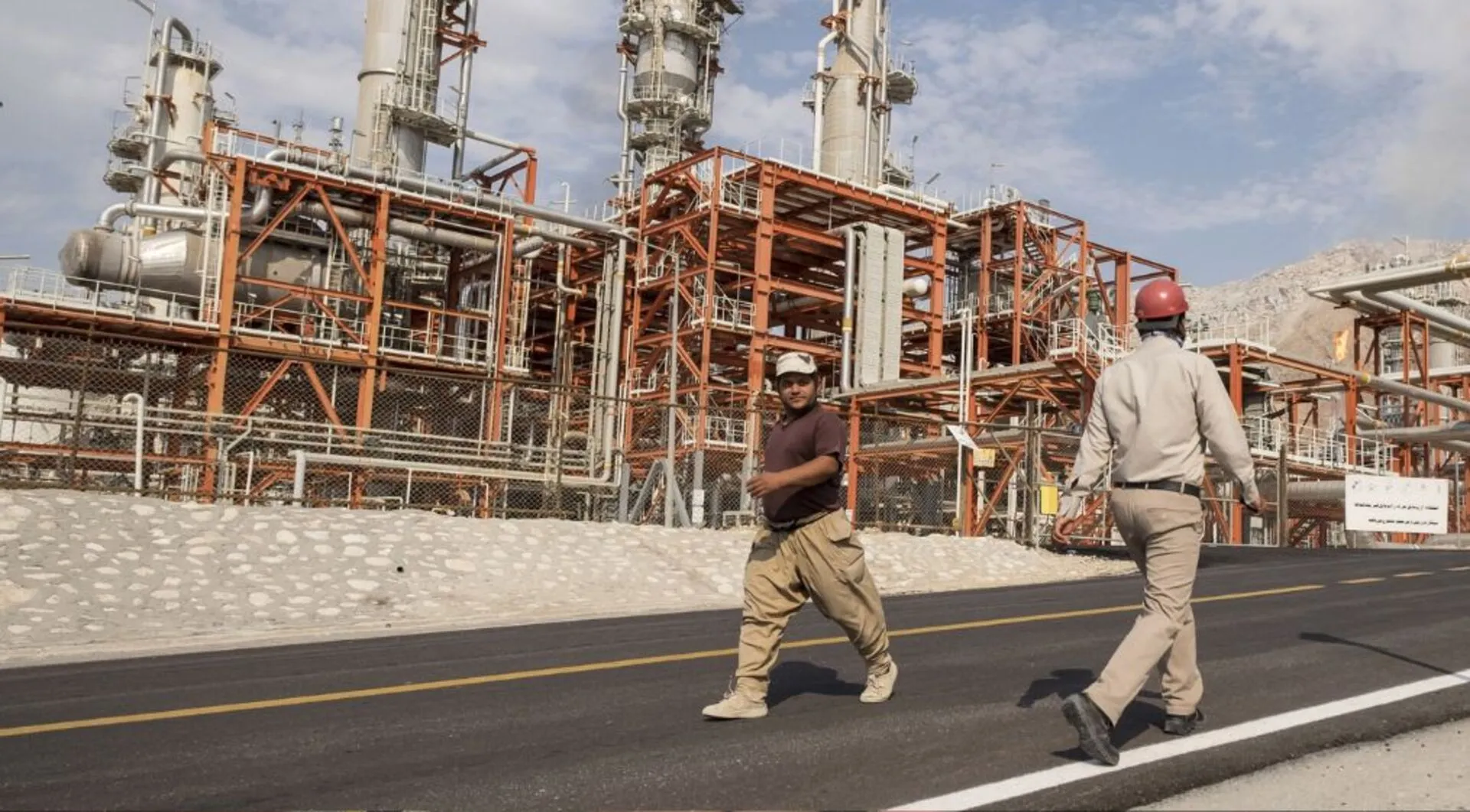
Brent crude oil prices reached $110 a barrel on Wednesday afternoon, after Iranian state media reported that part of the South Pars gas field, the largest plant in Iran, and the Asaluyeh oil facility were struck by Israel.
ADVERTISEMENT
ADVERTISEMENT
Moreover, the US oil benchmark WTI also rose and is trading at $98 a barrel at the time of writing.
In response to the latest Israeli attacks, the IRGC announced that some Gulf energy sites are once again “legitimate targets”.
The prospect of escalation and prolongation of the conflict in the Middle East, resulting in further destruction of energy infrastructure, and consequently disruption to global markets, has sent oil prices higher once again.
The climb occurs despite other positive news that would normally have a dampening effect on energy markets.
Saudi Arabia confirmed on Wednesday that its biggest oil refinery, Ras Tanura, restarted operations on 13 March.
Additionally, the Trump administration officially announced a 60-day waiver of the Jones Act, a century-old maritime law that restricts the movement of cargo between US ports to vessels that are American-built, American-owned, American-flagged and crewed.
However, in the face of increased tensions and more attacks on oil infrastructure, these potentially mitigating developments have not had any effect in taming prices.
Trump administration confirms Jones Act waiver
The White House Press Secretary, Karoline Leavitt, confirmed the Trump administration’s decision to issue a 60-day waiver of the Jones Act.
The measure lifts the restriction on the movement of cargo between US ports, allowing foreign tankers temporarily and cheaply to transport vital resources such as oil, gas and fertilisers along the US coastline.
In a post on X on Wednesday, Leavitt explained that the decision is “just another step to mitigate the short-term disruptions to the oil market as the US military continues meeting the objectives of Operation Epic Fury.”
The last Jones Act waiver was issued in October 2022 for a tanker supplying Puerto Rico after Hurricane Fiona.
Before that, the Biden administration temporarily eased the law in 2021 for refiner Valero Energy, after a cyberattack crippled a major East Coast fuel pipeline.
Trump renews pressure on allies to secure the Strait of Hormuz
In a separate development, US President Donald Trump has renewed pressure on allies to join a naval escort mission in order to secure the Strait of Hormuz and normalise the circulation of vessels in the region.
In a post on Truth Social, President Trump argued that allied countries need to use the Strait of Hormuz while the US does not, and warned that they could be left managing it on their own in the aftermath of the war.
Since President Trump’s original request, no firm commitments have emerged, but on Monday, the Wall Street Journal reported that the White House plans to announce as early as this week that multiple countries have agreed to join the escort mission.
The report also stated that officials are still deliberating whether such an operation would start before or after the war ends.
After meeting in Brussels, EU foreign ministers discussed extending the bloc’s Aspides naval mission to the Strait of Hormuz, but ultimately declined to participate.
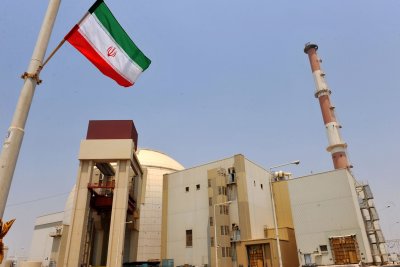
March 17 (UPI) — An unidentified projectile struck the premises of Iran’s Bushehr nuclear power plant on Tuesday evening, the U.N.’s nuclear watchdog said, raising fresh concerns about the risks the U.S.-Iran war poses to nuclear facilities in the region.
Little information about the strike was made public in the carefully worded and brief statement from the International Atomic Energy Agency, which said it had been informed that “a projectile hit the premises of the Bushehr NPP on Tuesday evening.”
“No damage to the plant or injuries to staff reported,” it said.
The IAEA’s director general, Rafael Grossi, reiterated his call “for maximum restraint during the conflict to prevent risk of a nuclear accident,” the agency said.
Located near Bushehr city on Iran’s southwest Persian Gulf coast, the Bushehr plant began construction in 1975, but its original German contractor abandoned the project following the Islamic Revolution four years later. In the mid-1990s, Russia agreed to complete Bushehr Unit 1, Iran’s first reactor, which began operating in 2011, according to the U.S. Congressional Research Service.
Rosatom, Russia’s state atomic energy corporation, said the projectile struck near the metrology service building in the vicinity of the plant’s operating power unit at 6:11 p.m. local time, according to Russian state-run TASS news agency.
“There were no casualties among personnel of the Rosatom State Corporation. Radiation levels at the site are normal,” Rosatom General Director Alexei Likhachev said.
The strike was the first on the premises of the nuclear power plant since the war between Iran and the United States and Israel began late last month, he noted.
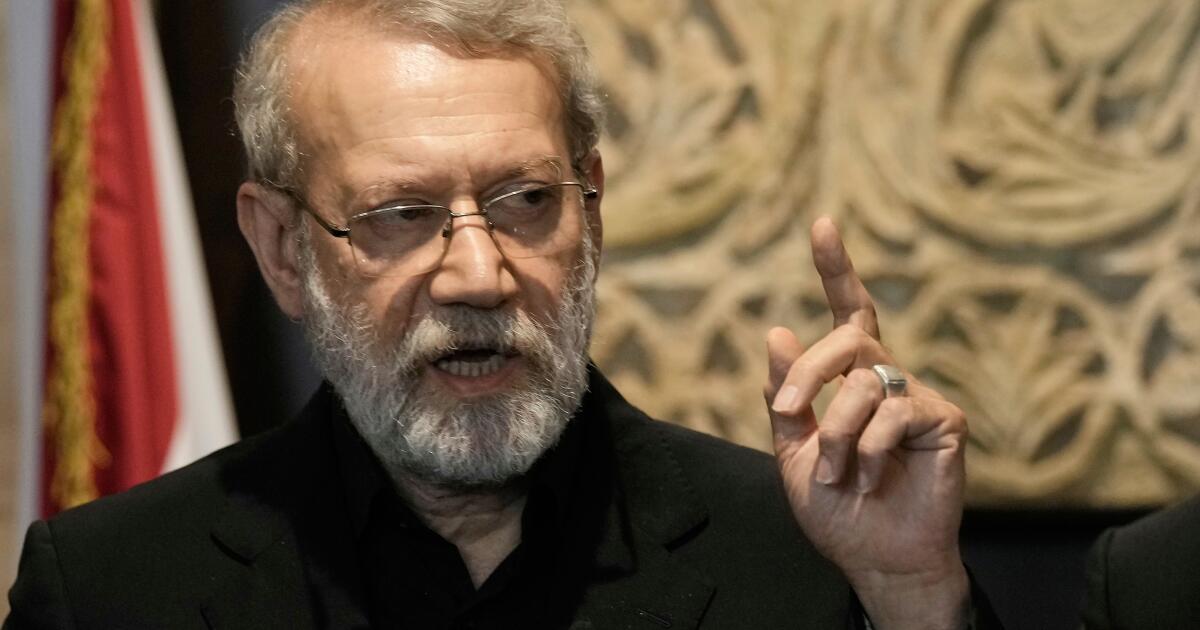
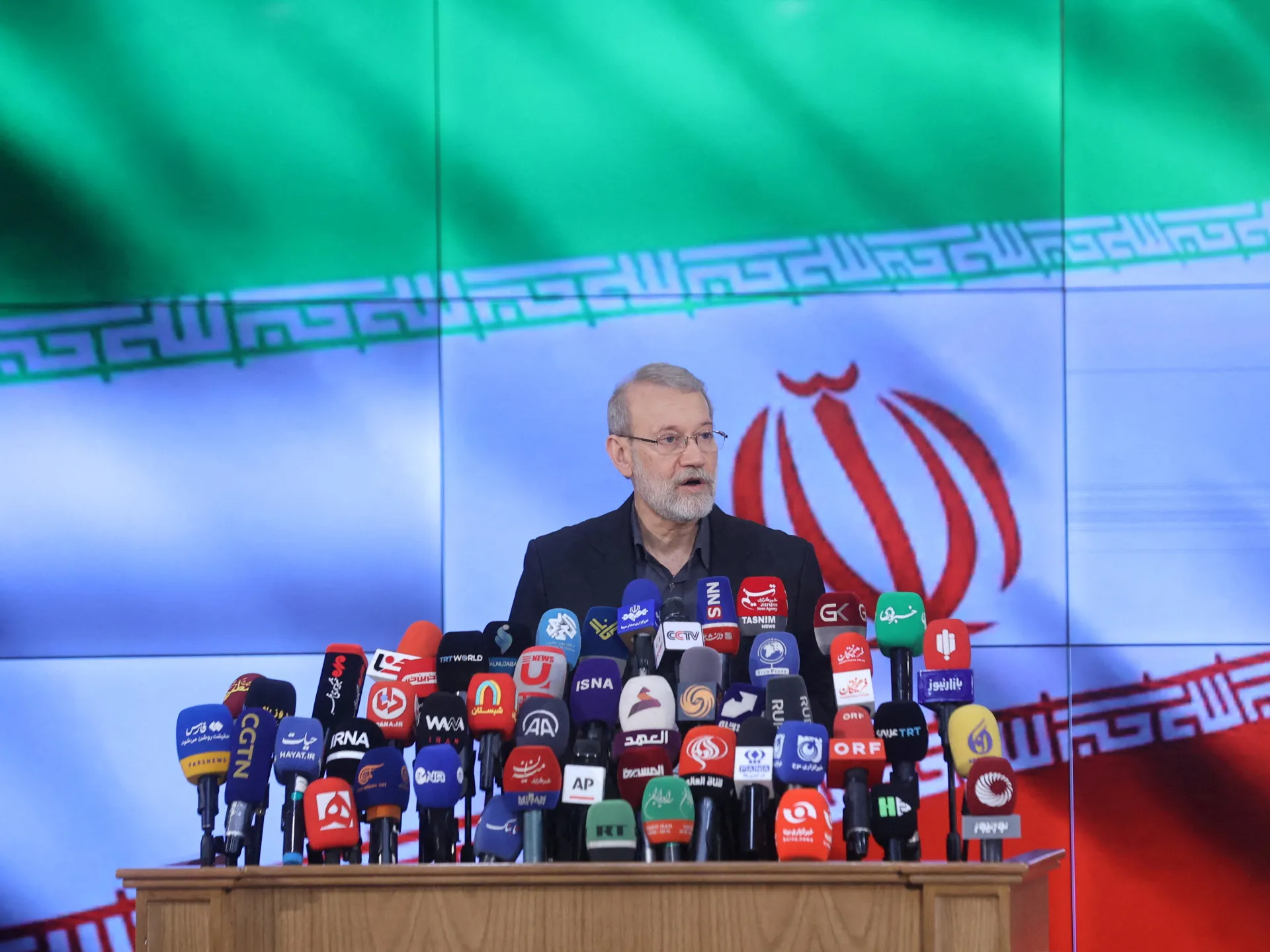
BEIRUT — Iran’s top security official, Ali Larijani, has been killed in an Israeli airstrike, a move that represents a palpable hit to an Iranian leadership that has shown little interest in compromise after almost three weeks of war with the U.S. and Israel.
Killing Larijani, who led Iran as de facto wartime leader after Supreme Leader Ayatollah Ali Khamenei died on the first day of the war, eliminates a veteran official seen as the consummate insider despite not having the religious credentials for the Islamic Republic’s highest offices. Israel, in an announcement Tuesday, said the attack occurred the night before.
For all his bellicose comments since the war began, Larijani was also seen as a pragmatist, and observers say his death might strengthen the resolve of what’s left of Iran’s leadership, rather than induce a willingness to compromise.
His post as secretary of Iran’s Supreme National Security Council gave Larijani control of the country’s top security body, where he tasked government forces with subduing anti-regime protests in January. Thousands of Iranians were killed.
Also killed in the Israeli strikes was Gen. Gholamreza Soleimani, the head of the Basij, the volunteer auxiliary wing of the Islamic Revolutionary Guard Corps and an integral part of the state’s ability to keep order.
“Larijani and the Basij commander were eliminated overnight and joined the head of the annihilation program, Khamenei, and all the eliminated members of the axis of evil, in the depths of hell,” Israeli Defense Minister Israel Katz said in a statement Tuesday.
Israeli officials have employed “axis of evil” to refer to Iran and its allies, including the militant groups Hamas and Hezbollah.
Larijani had served as parliamentary speaker for 12 years and became the point man on nuclear negotiations as well as relations with allies such as China and Russia. He often acted as the government’s representative in the media.
Iranian officials confirmed that Larijani and Soleimani had been killed. They said Larijani’s son, the head of his office and several guards were also killed in the strikes.
Soon after Katz’s announcement, Iranian authorities released an undated note said to have been written by Larijani in which he honored Iranian sailors killed in a U.S. attack. The image of the note was also posted to Larijani’s account on X.
There was no explanation why the note was released and whether it is signified Larijani was still alive.
“We are undermining this regime in the hope of giving the Iranian people an opportunity to remove it,” said Israeli Prime Minister Benjamin Netanyahu.
Netanyahu and President Trump have repeatedly called on ordinary Iranians to topple the government.
Though assassinating Larijani counts as yet another intelligence coup for Israel and the U.S., both may come to regret the loss of a figure who, despite his defiant rhetoric since the war began Feb. 28, was considered by some analysts as a realist.
His killing adds to the evisceration of Iran’s upper echelons, raising the question of who is left to negotiate an end to the war, or have enough influence to make Iran’s deep state accept compromise.
Some observers say that’s the point.
“Why did the Israelis take out Larijani in this moment? Because Netanyahu is focused on blocking Trump’s pathways for a ceasefire and follow-up negotiations with Iran,” said Ellie Geranmayeh, a senior policy fellow at the European Council for Foreign Relations, adding that “Larijani would have been the man to get that job done.”
Khamenei’s assassination, Geranmayeh said, had already empowered more hard-line figures in government, and Larijani’s death “could act as an accelerator to that path.”
“Israel seems to be turning its attention to targeting those that could push for a political solution to the current crisis,” she said.
Larijani’s death would add to the murkiness surrounding Iran’s leadership. After Khamenei was killed and it remained unclear who would replace him, Trump added to the uncertainty by saying that the country’s new leader would need his approval, but also that the U.S. had killed many of the leaders whom he would have deemed acceptable.
After Khamenei’s son, Mojtaba Khamenei, was named the new supreme leader, Trump expressed his displeasure but repeatedly dodged questions about what the transition under the younger Khamenei would mean for the U.S. war effort.
After the elder Khamenei’s death, Larijani emerged as a high-profile voice for Iran, saying that Trump must “pay the price” for the U.S. strikes on the country.
In response, Trump acted as if he didn’t know who Larijani was.
“I have no idea what he’s talking about, who he is. I couldn’t care less,” Trump told CBS News.
Benjamin Radd, a political scientist and senior fellow at the UCLA Burkle Center for International Relations, said Larijani was perceived to be “the last of the competent bunch” within the Iranian leadership — an intellectual who had a complex understanding of the geopolitical reality on the ground, who had negotiated with the U.S. in the past, and who was “adept at maneuvering” all the various parts of the Iranian power structure.
Radd said Larijani “lost that mantle of being the pragmatist” when he strongly backed the deadly January crackdown on protesters, for which he was “more responsible than anyone else.”
He “absolutely was responsible for a tremendous amount of carnage and death and destruction,” Radd said.
And yet, with his death, “all of that diplomatic, institutional experience” that he did have “is gone” from the Iranian leadership, Radd said.
Those left in power, he said, are “generally not the sharpest people, they’re not the people who understand the subtleties of diplomacy, of what negotiating with the U.S. is like.”
Bulos reported from Beirut and Rector from Colorado.
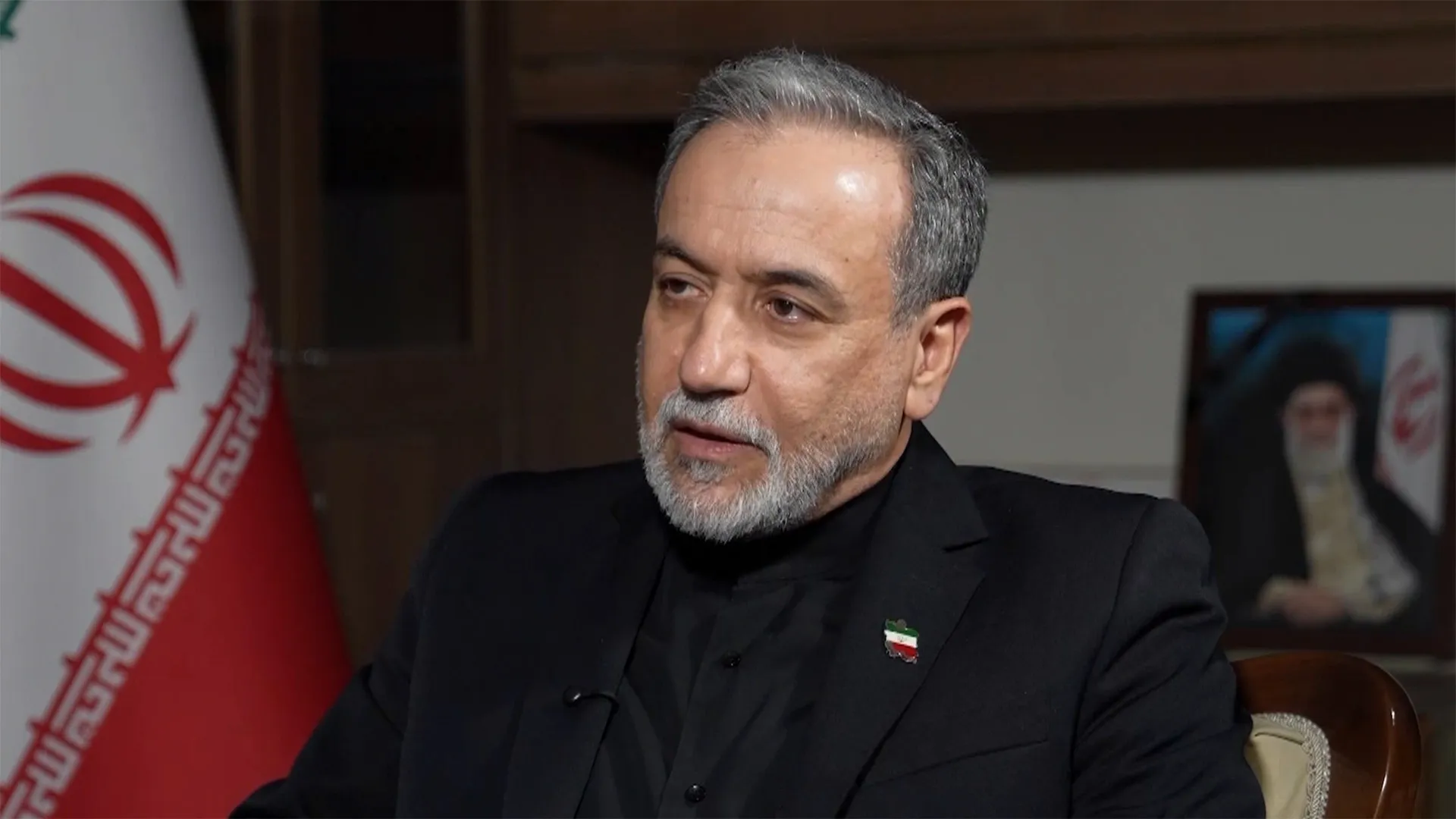
Iran’s foreign minister is pushing back after the killings of top officials Ali Larijani and Basij commander Gholamreza Soleimani. Abbas Araghchi says the Islamic Republic is built to withstand shocks, insisting that no single figure, no matter how powerful, can destabilise the system.
Ukrainian President Zelenskyy says Moscow and Tehran are ‘brothers in hatred’; claims Iran’s drones ‘contain Russian components’.
More than 200 Ukrainian military experts are in the Gulf region and wider Middle East helping governments in their defence against Iran’s drone attacks, Ukraine’s President Volodymyr Zelenskyy has said.
In an address to dozens of members of the United Kingdom Parliament in London on Tuesday, the Ukrainian leader said 201 Ukrainian anti-drone experts are in the region and another 34 “are ready to deploy”.
Recommended Stories
list of 4 itemsend of list
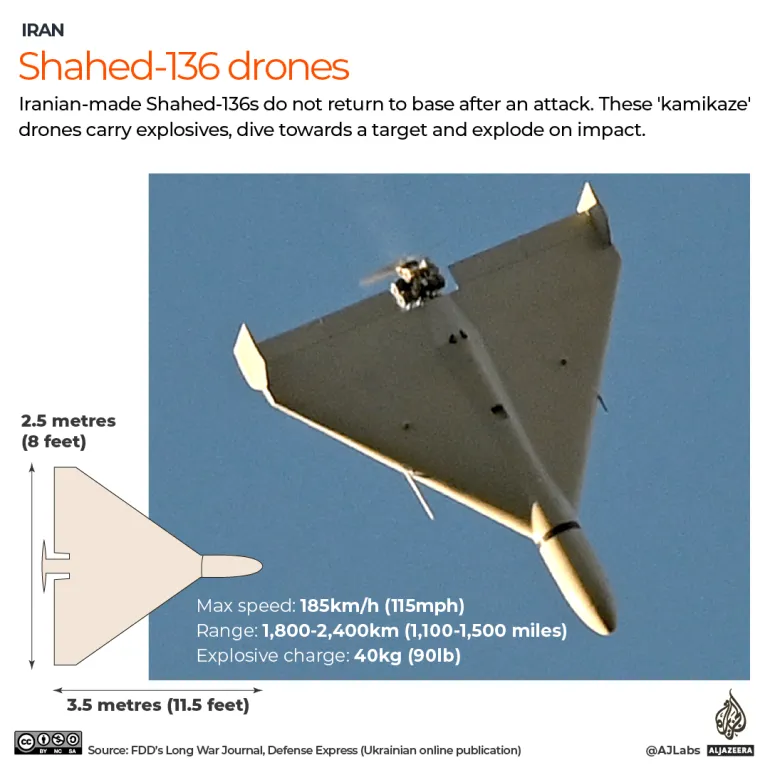
“These are military experts, experts who know how to help, how to defend against Shahed drones,” Zelenskyy said in his speech, referring to the Iranian-designed “kamikaze” drones that Russia has been using in its war against Ukraine since 2022.
“Our teams are already in the Emirates, Qatar, Saudi Arabia, and on the way to Kuwait,” the Ukrainian leader said.
“We are working with several other countries – agreements are already in place. We do not want this terror of the Iranian regime against its neighbours to succeed,” he said.
Last week, the Ukrainian leader said military teams had been sent to several Gulf states and Jordan.
Zelenskyy, who met with UK Prime Minister Keir Starmer and NATO chief Mark Rutte earlier on Tuesday, said Russia had received the Shahed-136 drones from the Iranians, who had “taught Russia how to launch them and gave it the technology to produce them”.
“Russia then upgraded them. And now we have clear evidence that Iranian Shaheds used in the region contain Russian components,” Zelenskyy said, describing the drones as designed for “low-cost destruction of expensive critical infrastructure”.
“So what is happening around Iran today is not a faraway war for us, because of the cooperation between Russia and Iran,” he said.
“The regimes in Russia and Iran are brothers in hatred, and that is why they are brothers in weapons. And we want regimes built on hatred to never win – in anything,” he added.
The Ukrainian leader then addressed his country’s newly developed prowess in drone warfare and manufacturing, claiming that 90 percent of Russian losses on the front lines in Ukraine are being “caused by our drones”.
Ukraine has moved on from making sea and aerial drones to producing interceptors that target drones, he said, adding that Ukraine is capable of producing at least 2,000 interceptors per day – half of which are required for its own defence and the remainder available for use by Kyiv’s allies.
“If a Shahed needs to be stopped in the Emirates – we can do it. If it needs to be stopped in Europe or the United Kingdom – we can do it. It is a matter of technology, investment, and cooperation,” he said.
While Ukraine has become one of the world’s leading producers of sophisticated, battlefield-proven drone interceptors, US President Donald Trump has said he does not need Ukraine’s help with countering Tehran’s drones targeting military targets in the Middle East.
After meeting with Zelenskyy at 10 Downing Street, Starmer said Russian President Vladimir Putin “can’t be the one who benefits from the conflict in Iran, whether that’s oil prices or the dropping of sanctions”.
During Zelenskyy’s visit on Tuesday, London and Kyiv signed a deal on a “defence partnership”, which is said to combine “Ukraine’s expertise and the UK’s industrial base to manufacture and supply drones and innovative capabilities”.
The 2026 World Cup matches will be played as per schedule announced last year, the football organisation says.
Published On 17 Mar 202617 Mar 2026
The world’s top football organisation, FIFA, has said the 2026 World Cup matches will take place per the schedule announced last year, shutting down Iran’s hopes of having its matches moved from the United States to Mexico due to the ongoing US-Israeli war on Iran.
“FIFA is in regular contact with all participating member associations, including Iran, to discuss planning for the FIFA World Cup 2026,” the organisation’s statement said. “FIFA is looking forward to all participating teams competing as per the match schedule announced on 6 December 2025.”
Recommended Stories
list of 3 itemsend of list
Following the outbreak of the war on February 28, Iran’s participation in the games has been cast in doubt.
Last week, US President Donald Trump said Iran was welcome to come to his country for its matches, but added: “I really don’t believe it is appropriate that they be there, for their own life and safety.”
In response to Trump’s comments, Iran’s football team said in a post on social media that “no one can exclude Iran’s national team from the World Cup”.
More recently, on Monday, Iranian football chief Mehdi Taj said on social media that “when Trump has explicitly stated that he cannot ensure the security of the Iranian national team, we will certainly not travel to America”.
“We are currently negotiating with FIFA to hold Iran’s matches in the World Cup in Mexico,” Taj said.
Iran’s Ambassador to Mexico Abolfazl Pasandideh also condemned on Monday Washington’s “lack of cooperation regarding visa issuance and the provisions of logistical support” for the Iranian delegation.
The 2026 World Cup is set to be played in three countries for the first time ever: the US, Mexico and Canada.
The first game is scheduled for June 11, and will be played between South Africa and Mexico.
But when asked if Mexico could host Iran’s games, Mexican President Claudia Sheinbaum said on Tuesday that the country was prepared to host its first-round matches.
“Mexico maintains diplomatic relations with every country in the world, therefore, we will wait to see what FIFA decides,” Sheinbaum said.
Iran was the second Asian team, after Japan, to qualify for the World Cup, securing its place almost a year ago after topping its qualifying group.
They are currently scheduled to play New Zealand and Belgium in Los Angeles, and Egypt in Seattle.
Israel’s Defence Minister Israel Katz says Ali Larijani, Iran’s security chief, has been killed in an Israeli strike overnight. There has been no confirmation from Iran.
Islamabad, Pakistan — The war launched by the United States and Israel on Iran has already killed more than 1,400 people, set off retaliatory attacks by Tehran targeting Gulf nations and Israel, and pushed global oil prices above $100 a barrel.
Now, eighteen days into the conflict, aid agencies and countries neighbouring Iran are increasingly concerned about a potential refugee crisis.
Recommended Stories
list of 4 itemsend of list
The United Nations refugee agency, UNHCR, estimates that 3.2 million people have already been displaced in Iran since US-Israeli strikes began on February 28. For now, the number of people physically crossing Iran’s borders remains comparatively modest. But this is what could happen next, and has put Iran’s neighbours on high alert.
Iran borders seven countries: Afghanistan, Armenia, Azerbaijan, Iraq, Pakistan, Turkiye and Turkmenistan. Iraq shares the longest frontier, stretching for almost 1,600km (994 miles).
Each of these states faces its own political pressures, economic limitations and security concerns.
But pressure on the ground in Iran is mounting. The country’s Red Crescent Society reports that more than 10,000 civilian sites have been damaged since the war began, including 65 schools and 32 medical facilities, while more than 1,400 people have been killed in the US-Israel attacks. Strikes have hit residential areas in Tehran, Shiraz and Isfahan.
Meanwhile, commercial flights out of Iran have been suspended as airspace is closed.
Eldaniz Gusseinov, head of research at the geopolitical advisory firm Nightingale International, noted that because strikes have so far been concentrated largely on Tehran and western and southwestern Iran, other parts of the country — especially provinces bordering Turkmenistan, Afghanistan and Pakistan are absorbing much of the internal displacement.
“If the strike pattern remains the same, internally displaced people inside Iran will increasingly concentrate in provinces located near those states, creating the preconditions for cross-border movement,” the Almaty-based analyst told Al Jazeera.
And things could get worse. If Tehran, a city of about 10 million people, were to lose its electricity grid or water supply in a US-Israel attack, for instance, residents could be forced to leave en masse.
“Infrastructure destruction does not produce the gradual, manageable flows that the Syrian war initially generated. It produces sudden, massive displacement, driven by the collapse of basic urban services,” Gusseinov said.
Turkiye fears repeat of Syrian migration crisis
Among Iran’s neighbours, only Turkiye, Iraq and Pakistan have extensive experience of hosting large refugee populations.
Imtiaz Baloch, an independent researcher focusing on conflicts in Pakistan and Central Asia, said that if the crisis in Iran deepens, many Iranians could seek refuge in neighbouring states, particularly Iraq and Turkiye.
Analysts say no country faces greater political exposure than Turkiye.
“Turkiye is currently hosting many refugees from Syria and other countries. A new influx of Iranian migrants would likely intensify the humanitarian burden and create new challenges for both host countries and international relief agencies in the coming days,” Baloch said.
Turkiye shares a 530km (329-mile) border with Iran and allows visa-free entry for Iranian citizens. It already hosts the world’s largest refugee population, including roughly 3.6 million Syrians, and anti-immigrant sentiment has hardened within domestic politics over the past decade.
Turkiye’s interior minister, Mustafa Çiftçi, said earlier in March that the government had prepared three contingency plans for the war in Iran.
The first involves intercepting migration flows within Iranian territory before they reach the border. The second proposes establishing buffer zones along the frontier. The third would allow refugees to enter Turkiye under controlled conditions as a last resort.
Turkish authorities say they have already strengthened the border with Iran, adding 380km (236 miles) of concrete wall, 203 optical towers and 43 observation posts – undertaken, according to a Turkish Ministry of National Defence statement issued in January, as the US was building up its armada in the Gulf late last year.
“Although there is currently no mass migration detection at our borders, additional measures have been taken on the border line, and these measures will be implemented if needed,” the Defence Ministry stated on January 15.
So far, this has not been necessary. According to Turkish government data on the movement of people from Iran, 5,010 entered Turkiye from between March 1 and 3, while 5,495 exited.
But Turkiye has felt the effects of the war’s spillover in other ways. On March 9, NATO confirmed it had intercepted an Iranian ballistic missile over Turkish airspace. The debris landed near Gaziantep, in the western-most part of the country, about 50km (31 miles) from the Syrian border. Iran denied that it was behind the attack on Turkiye.
Crisis on an unprecedented scale?
What makes the current situation in Iran particularly urgent is the scale of its population, say analysts.
Syria had approximately 21 million people at the start of its civil war. Iran has roughly 90 million. The Syrian conflict caused more than 13 million people to be displaced, including more than 6 million who fled the country.
A proportionate displacement from Iran would represent a humanitarian crisis with few modern parallels. To put it into perspective, if a country of 90 million experienced the exact same scale of crisis as Syria, nearly 56 million people would be forced to flee their homes, and nearly 26 million of them would become international refugees.
Gusseinov said such a scale of displacement and the capacity of international aid agencies is “fundamentally mismatched”.
Furthermore, Iran itself hosts one of the world’s largest refugee populations: about 3.7 million displaced people, most of them from Afghanistan.
“Any mass displacement from Iran, therefore, creates a dual crisis: Iranian civilians fleeing outward, and Afghan and Iraqi refugees who were already in Iran being displaced a second time, or pushed back to countries that cannot absorb them,” he said.
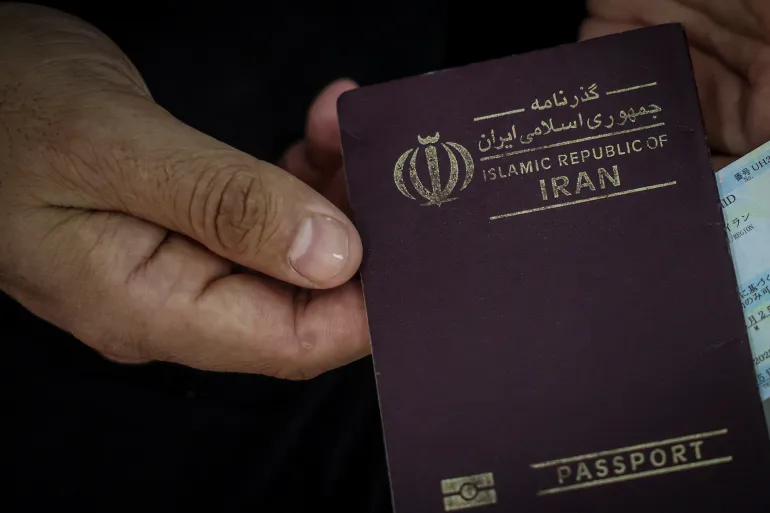
Hamid Shirmohammadzadeh, 35, who arrived in Turkiye from Iran, shows his passport while staying at a hotel in Van province, Turkiye, March 5, 2026 [Dilara Senkaya/Reuters]
Iraq and the South Caucasus face difficult choices
Although most population movement is still taking place within Iran rather than across its borders, Iran’s neighbours do have cause for concern, analysts say.
“Iran’s neighbouring countries are already dealing with their own crises, which limits their ability to absorb a potential refugee influx. Countries such as Syria, Iraq, Azerbaijan, Pakistan, and Afghanistan are facing varying degrees of economic, political, or security challenges. These internal pressures make it difficult for them to accommodate a large influx of refugees,” Gusseinov told Al Jazeera.
Iraq, which shares Iran’s longest border, faces a particularly complex situation.
The country is not only a potential destination for Iranian refugees, but has also been caught in military exchanges between Washington and Tehran. US forces have targeted armed groups operating from Iraqi territory, while Iran and pro-Iran armed groups have struck – or attempted to strike – US military and diplomatic positions inside the country.
The UN’s International Organization for Migration says disruptions on the Iranian side of the border have led to the closure of several crossing points, although Iraqi crossings remain technically open. Meanwhile, the UNHCR says it is monitoring developments closely, and that the Iraqi government would lead any emergency refugee response.
The semi-autonomous Kurdish region of northern Iraq, which, unlike the rest of the country, still allows visa-free entry for Iranian passport holders, adds another layer of complexity.
The region hosts several Kurdish armed groups, some of which have reportedly been in discussions with Washington about receiving military support in return for joining the war against Iran. The development has prompted Iran’s Revolutionary Guard Corps (IRGC) to strike Kurdish positions inside Iraqi territory.
Baghdad has publicly stated that it will not allow its territory to be used to infiltrate Iran, but experts on the region say its ability to enforce the position is limited.
Further north, the South Caucasus states of Armenia, Azerbaijan and Georgia have each expressed concern while attempting to carefully balance relations with both Washington and Tehran.
Azerbaijan has closed its land borders to routine traffic, requiring government approval for any crossing, while Armenia’s border with Iran, which is just 44km (27 miles) long, remains open.
“Armenia is a small economy already absorbing Russian and Ukrainian migrants,” Gusseinov said.
(Al Jazeera)
Pakistan and Afghanistan confront overlapping crises
To Iran’s east lie Pakistan and Afghanistan, each grappling with existing refugee pressures.
According to the UNHCR, since October 2023, about 5.4 million Afghans have returned to Afghanistan from Iran and Pakistan, many not by choice.
Following the withdrawal of US troops from Afghanistan and the Taliban’s return to power in August 2021, a huge wave of Afghans sought refuge across the country’s borders, fearful of economic collapse and security threats.
The UN and international migration agencies estimate that between 1 and 1.5 million Afghans fled to Iran in the immediate aftermath of the US withdrawal, pushing the total Afghan population in Iran to upwards of 5 or 6 million.
Concurrently, hundreds of thousands of newly displaced Afghans crossed into Pakistan, joining a long-established refugee community there and swelling the total number of Afghans in the country to more than 3 million.
In response to this influx and citing domestic economic and security pressures, both Pakistan and Iran initiated aggressive mass deportation campaigns, forcing millions back into Afghanistan. Between late 2023 and the end of 2025, between 2.8 million and 3.5 million Afghans are thought to have been sent back.
Pakistan’s stringent repatriation plans pushed out more than 1.3 million people, while Iran drastically accelerated its expulsions, deporting nearly 2 million individuals in 2025 alone.
According to the UNHCR, in 2026 so far, more than 232,500 Afghans have returned to their country, including 146,206 from Pakistan and 86,253 from Iran.
The primary concern now is that the war in Iran could accelerate these returns, pushing people into communities already struggling to cope and potentially triggering further onward migration. The UNHCR has also warned that largescale and hurried returns of refugees could trigger further instability in the region.
Further complicating the situation, Pakistan and Afghanistan have been engaged in fighting, as Islamabad claims that Afghanistan is providing a safe haven to armed groups launching attacks at Pakistan. Kabul has consistently denied the presence of any such groups on its soil.
Another bout of hostilities in October 2025 led Pakistan to close its borders with Afghanistan. Since then, Afghanistan’s trade and economic ties with Iran have deepened.
“Destabilisation of the Iranian economy, therefore, hits Afghanistan through two channels simultaneously: reduced trade flows and refugee return surges,” Gusseinov said.
Meanwhile, Pakistan faces its own geographical and security challenges.
The country’s border with Iran runs through Balochistan, its largest but most volatile province, where separatist sentiment has simmered for decades. The province has seen an increasing number of attacks by armed groups seeking independence from Pakistan. In February this year, Pakistan’s military concluded a weeklong security operation in the province, and claimed it had killed 216 fighters in targeted offensives.
While Balochistan’s provincial officials say they have sufficient resources to accommodate refugees if large numbers begin arriving across the southern border, researcher Baloch said the reality was more complicated. Any refugee crisis, he said, could make the situation in Balochistan difficult for Islamabad to manage.
“Balochistan’s porous border is next to Iran’s Sistan and Baluchestan province, a region that has historically been home to various separatist groups. Any significant influx of refugees across this border could impose additional security and economic costs on Pakistan,” Baloch said.
Alireza Enayati says relations with Saudi Arabia are ‘progressing naturally’ and he’s in direct contact with Saudi officials.
Published On 15 Mar 202615 Mar 2026
Share
Iran’s ambassador to Saudi Arabia denied Tehran is responsible for attacks on Saudi Arabia’s oil infrastructure, saying if it was behind the strikes, it would have announced it.
Alireza Enayati did not suggest who carried out the attacks, but added Iran is only attacking United States and Israeli military targets and interests during the ongoing war, Reuters news agency quoted him as saying on Sunday.
Recommended Stories
list of 4 itemsend of list
After the US and Israel launched attacks on Iran at the end of February, Tehran retaliated against US and Israeli military assets, including in Saudi Arabia, Qatar, Bahrain, Jordan, Iraq, and the United Arab Emirates (UAE).
Last week, the Ras Tanura oil refinery was forced to stop operations after debris from a drone caused a small fire. Attempted attacks were also reported on the Shaybah oilfield in the desert near the border with the UAE.
So far, Saudi Arabia’s Defence Ministry has not blamed anyone for the attacks.
Enayati said he’s in direct contact with Saudi officials, explaining that relations are “progressing naturally” in many areas.
Talks included Saudi Arabia’s publicly stated position that its land, sea, and air would not be used to target Iran. He didn’t elaborate.
Iran and Saudi Arabia re-established diplomatic relations in 2023, in a deal brokered by China, that saw the two sides, which backed rival groups across the region, agree on a new chapter in bilateral relations.
‘Reliance on external powers’
Enayati reiterated to the Gulf states that the war “has been imposed on us and the region” following coordinated US and Israeli attacks.
Asked about the attacks on Gulf nations, Enayati replied: “We are neighbours, and we cannot do without each other; we will need a serious review.”
“What the region has witnessed over the past five decades is the result of an exclusionary approach and an excessive reliance on external powers,” he said, calling for deeper ties between the Gulf Cooperation Council’s six members along with Iraq and Iran.
Iran’s Foreign Minister Abbas Araghchi also denied his country is targeting civilian or residential areas in the Middle East, and said Tehran is ready to form a committee with its neighbours to investigate the responsibility for such strikes.
So far, the UAE, which normalised relations with Israel in 2020, has faced the brunt of Iran’s attacks, with US bases and oil refineries heavily targeted.
While all countries targeted have strongly condemned Iran’s missile and drone strikes, regional sources say there remains growing frustration at the United States for dragging them into a war they did not sign up for but are now paying the heaviest price for, Reuters reported.
Enayati said to resolve the conflict, the US and Israel need to stop their attacks, and international security guarantees to prevent future “aggression” must be given.
Paul Musgrave, associate professor at Georgetown University in Qatar, said the administration of US President Donald Trump has lost much of its leverage in the region, and the US engaged in the wrong conflict at the wrong moment, without proper planning.
Iran’s strategy, meanwhile, now seems to be “not who has a bigger bomb or bigger munitions, but who has the highest threshold for pain”, Musgrave told Al Jazeera.
The captain of the Iranian women’s football team has withdrawn her bid for asylum in Australia, Iran’s state media says, making her the fifth member of the delegation to change her mind after her team’s participation in the Asian Cup.
Zahra Ghanbari will fly from Malaysia and travel to Iran within the next few hours, the IRNA news agency said on Sunday.
Three players and one backroom staff member had already withdrawn their bids for asylum and travelled to Malaysia from Australia, where the team participated in the AFC Women’s Asian Cup.
Australia’s Home Affairs Minister Tony Burke said his country had offered asylum to all players and support staff members prior to their departure over fears they might be punished upon their return home after the team refused to sing Iran’s national anthem at the tournament.
Iranian state broadcaster IRIB reported on Saturday that the three had “given up on their asylum application in Australia and are currently heading to Malaysia”, posting a picture of the women allegedly boarding a plane.
The news was confirmed by Burke a few hours later.
“Overnight, three members of the Iranian women’s football team made the decision to join the rest of the team on their journey back to Iran,” Burke said.
“After telling Australian officials they had made this decision, the players were given repeated chances to talk about their options.”
Five players took up the offer and signed immigration papers last week, with one more player and a member of staff joining them a day later. It leaves two Iranian players in Australia, where they have been promised asylum and an opportunity to settle.
Iran played their three group games of the Asian Cup at the Gold Coast Stadium in Queensland on March 2, 5 and 8, after the United States and Israel launched their war on Iran on February 28.
The initial attacks killed Iran’s Supreme Leader Ayatollah Ali Khamenei and other leaders.
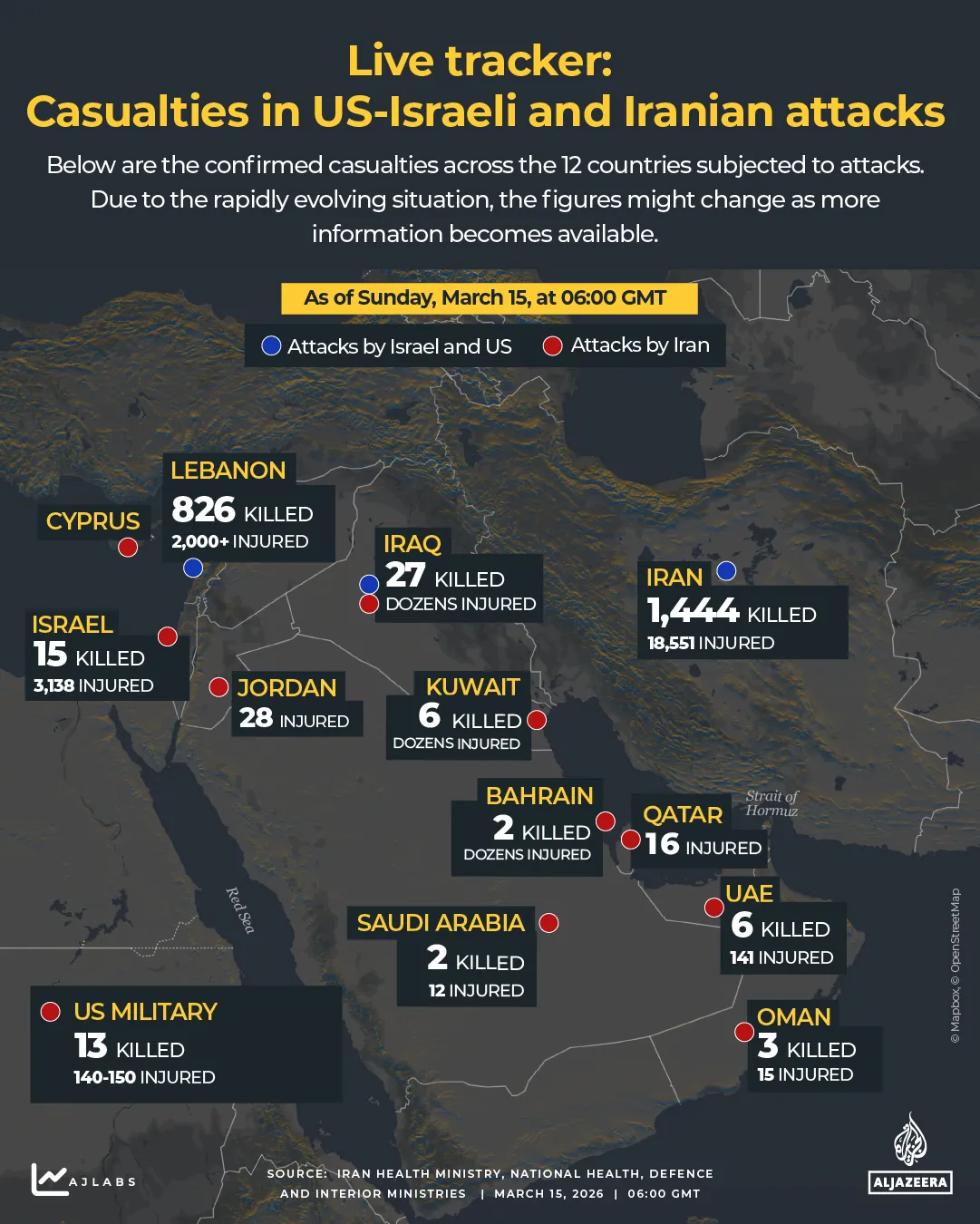
Overall, an estimated 1,444 Iranians have been killed since the war began, including more than 170 people, mostly schoolgirls, who were inside a primary school in the city of Minab.
After refusing to sing the Iranian national anthem at their first match, players on the Iranian women’s football team were branded “traitors” by an IRIB presenter.
When Iran played their second game of the tournament against Australia three days later, not only did the players sing the national anthem, but they also saluted it, prompting fears that they may have been forced to change their stance after receiving backlash in Iranian media.
While neither the players nor the team management explained why they refrained from singing before the first match, fans and rights activists speculated that it may have been an act of defiance against the Iranian government.
On the day of the team’s departure from Australia, Burke announced his government had offered all players and staff members the chance to stay back in the country.
On Tuesday, Burke told reporters that five Iranian players had decided to seek asylum in Australia and would be assisted by the government.
“They are welcome to stay in Australia, they are safe here, and they should feel at home here,” he said.
A day later, Burke confirmed that an additional player and a member of the team’s support staff had received humanitarian visas in the hours before their departure.
However, one player, who previously chose to stay behind, changed her mind and decided to return to Iran.
The player, who was later identified as Mohadese Zolfigol, changed her decision on the advice of her teammates, Burke told the Parliament of Australia.
“She had been advised by her teammates and encouraged to contact the Iranian embassy,” he said.
The players who managed to escape with the help of Iranian rights activists were taken away by Australian police officials to a safe house, where they met immigration officials and signed the paperwork.
“Our understanding is that every single member of the squad was interviewed independently by the Australian Federal Police,” Beau Busch, the Asia/Oceania president of players’ welfare body FIFPRO told Al Jazeera last week.
“[The players] were made aware of their rights and the support available to them. They certainly weren’t rushed through that process.”
United States President Donald Trump has said the country’s military bombed military installations on Iran’s Kharg island, warning the area’s critical oil facilities could be next if Iran continues to block the Strait of Hormuz.
Iran, in turn, threatened on Saturday to reduce US-linked oil facilities to “a pile of ashes” if oil structures on the island were attacked, as the US-Israel war on Iran, now in its punishing third week, spilled over into a global oil price crisis already in the making.
Recommended Stories
list of 3 itemsend of list
Kharg island is where more than 90 percent of Iran’s oil is exported. Crude oil prices have surged more than 40 percent since the war began.
Trump said on Friday that US forces had “totally obliterated” all military targets on Iran’s Kharg island oil export hub, describing it in a social media post as “one of the most powerful bombing raids in the History of the Middle East”. He provided no evidence of that.
The US president said he had chosen not to “wipe out” oil infrastructure on the Iranian island, for now.
“However, should Iran, or anyone else, do anything to interfere with the Free and Safe Passage of Ships through the Strait of Hormuz, I will immediately reconsider this decision,” he added.
Iran’s semi-official Fars news agency reported, quoting sources, that more than 15 explosions were heard on Kharg island during the US attacks.
The sources said the attacks targeted air defences, a naval base, and airport facilities, but caused no damage to oil infrastructure. Iran’s Fars news agency reported thick smoke was seen rising from the island.
Al Jazeera’s Mohamed Vall, reporting from Tehran, said Iran’s potential retaliatory attacks on Gulf oil facilities would be a “catastrophic scenario” for the region, and for the “entire industry of oil and gas”.
“The Iranians are keeping this, apparently, as a card to use,” he said. “They’ve been talking about restraint and the possibility of that restraint ending if the Iranian oil facilities are attacked, as the Americans are hinting and threatening.”
US ground operation in the works?
Meanwhile, 2,500 more Marines and an amphibious assault ship are being sent to the Middle East, a US official told the AP news agency.
Elements from the 31st Marine Expeditionary Unit and the amphibious assault ship USS Tripoli have been ordered to the region, according to the source, who spoke on condition of anonymity to discuss sensitive military plans.
(Al Jazeera)
Marine Expeditionary Units are able to conduct amphibious landings, but they also specialise in bolstering security at embassies, evacuating civilians, and providing disaster relief.
“What we’re to make of this is that the US is very slowly increasing its military posture in terms of prosecuting the war, and that it is not intending to wrap things up any time soon,” Al Jazeera’s Rosiland Jordan reported from Washington.
The deployment does not necessarily indicate that a ground operation is imminent or will take place.
Trump dismisses prospect of deal
Following the attack on Kharg island, Iran would be “wise to lay down their arms, and save what’s left of their country”, Trump wrote on his Truth Social platform.
“The Fake News Media hates to report how well the United States Military has done against Iran, which is totally defeated and wants a deal – but not a deal that I would accept!” he posted separately, providing no evidence Tehran was seeking any sort of deal.
At least 1,444 people have been killed and 18,551 injured by US-Israeli attacks on Iran since February 28, Iran’s Ministry of Health says.
Al Jazeera’s Tohid Asadi, reporting from Tehran, said US-Israeli air attacks hit targets across the country, including in Tehran, Karaj, Isfahan and Tabriz. He said this was a sign that “we are not close to de-escalation.
“Iranian officials are talking about retaliatory strikes, with the Islamic Revolutionary Guard Corps talking about using what they call their most advanced weaponry, including Heidar missiles, to target Israeli territories and US bases in the region,” he said.
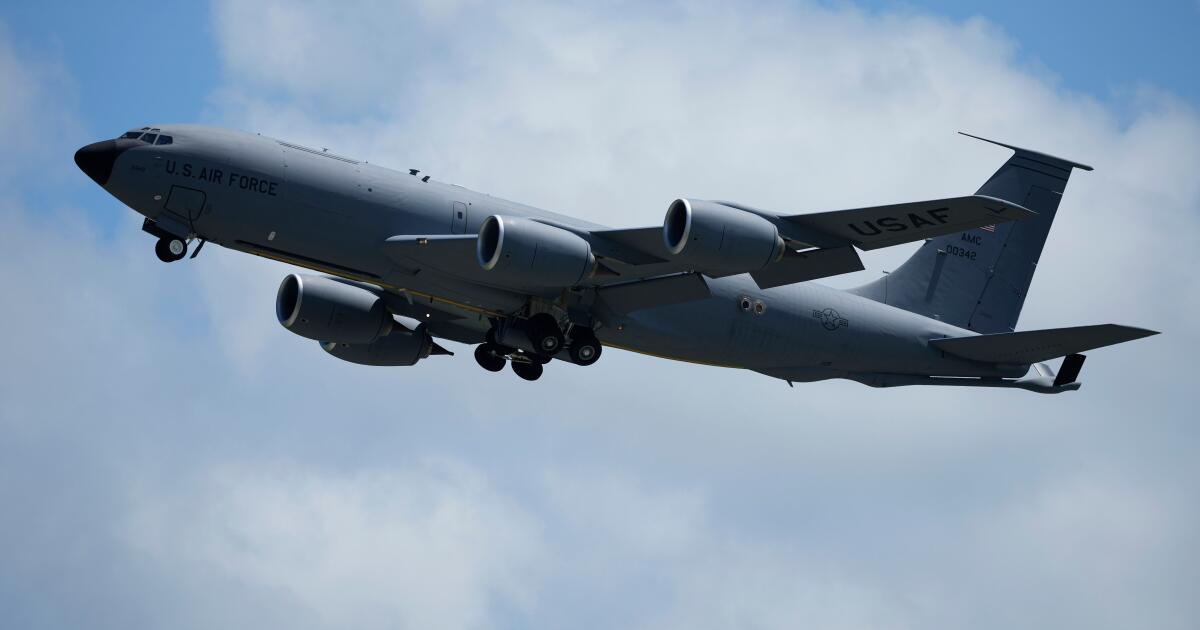
WASHINGTON — Six American airmen deployed to operations against Iran were killed after their refueling aircraft crashed in western Iraq, U.S. Central Command said Friday, bringing the U.S. death toll in the war to 13, as Defense Secretary Pete Hegseth announced the heaviest day of strikes yet.
The crash involved two aircraft in “friendly airspace,” the Pentagon said, adding that the other plane landed safely. The downed KC-135 refueling tanker is the fourth U.S. aircraft to crash during the war against Iran.
“American heroes, all of them,” Hegseth said at the Pentagon on Friday. “We will greet those heroes at Dover and their sacrifice will only recommit us to the resolve of this mission.”
Central Command said the incident is under investigation but was “not due to hostile or friendly fire.”
During the briefing, Hegseth described the Iranian leaders as “desperate” and “cowering” underground like rats. He said Iran’s Supreme Leader Ayatollah Mojtaba Khamenei “is wounded and likely disfigured,” but gave no intelligence to support the claim.
Khamenei has not been seen in public since he rose to leadership, but issued his first public statement Thursday vowing retaliation against U.S. and Israeli attacks, promising that Tehran will continue to choke off the world’s most crucial oil route — the Strait of Hormuz.
“Our revenge will be never ending, not only for the late supreme leader, but also for the blood of all of our martyrs,” he said.
The defense secretary said Friday would see Iran hammered with the heaviest round of air strikes yet seen in the two-week U.S.-Israeli operation that has razed buildings, complexes and factory lines all across Iran, killing at least 1,348 civilians, according to Iranian officials.
“No quarter, no mercy for our enemies,” Hegseth said.
And while Hegseth insisted that fighting will cease when the U.S. defeats Iran’s naval, missile, and nuclear weapons capabilities, President Trump’s public statements continue to sow doubt that the White House and Pentagon are aligned on the objectives of the mission.
Asked Friday by Fox News when the war might end, Trump said, “When I feel it — feel it in my bones.”
Iran’s blockade of the strait remains Tehran’s foremost leverage against its Western adversaries, and a serious political bane for Trump. The International Energy Agency warned Thursday that conflict has created “the largest supply disruption in the history of the global oil market,” which has sent oil prices surging 40% to $95 a barrel since Feb. 28.
Some 1,000 ships remain stranded in the Persian Gulf, many of them energy tankers that have been unable to carry oil and gas shipments from the Middle East to importers across the globe. Vessels that have attempted to traverse the embattled channel have been destroyed in Iranian attacks. Hegseth described Tehran’s strategy as “an act of desperation.”
The United Kingdom Maritime Trade Operations on Friday reported 20 incidents affecting vessels operating in and around the Arabian Gulf, Strait of Hormuz and Gulf of Oman in March.
Drone and missile attacks continue to assail gulf states, threatening to draw more players into the conflict. Thick black smoke was seen rising over Dubai’s skyline Friday after debris from an intercepted Iranian drone strike caused a fire and minor damage to a building within the Dubai International Financial Centre, according to the Dubai Media Office.
Europe has become increasingly involved, too. U.S. long-range bombers have begun flying offensive missions from British airbases, even as U.K. Prime Minister Keir Starmer explicitly permitted U.S. forces to use the bases “for defensive purposes only.” Starmer initially refused to cooperate in American hostilities in any capacity, but changed his approach after he drew criticism from Trump, who said, “He’s no Winston Churchill.”
The U.K., France, and Italy each deployed naval assets to the Eastern Mediterranean island of Cyprus, situated just 125 miles from Lebanon, after Iranian drone strikes hit U.K. bases. The island has emerged as a strategic — and exposed — nerve center in the U.S. offensive against Iran.
Meanwhile, Israel said Friday its strikes are “continuing and intensifying” in Lebanon and Iran. The Israel Defense Forces issued new evacuation orders in southern Lebanon on Thursday after overnight airstrikes in Beirut triggered retaliatory missile and drone attacks by the Iran-backed militant group Hezbollah.
Eight civilians were killed and nine others were wounded in attacks on the Lebanese city of Sidon on Friday, according to Lebanon’s Health Ministry. More than 100 children have been killed in the Israeli assault, the ministry said.
Iranian state TV video shows the Chief Justice Gholam-Hossein Mohseni-Eje’i speaking to a reporter when a blast, described by officials as an Israeli strike, hit near the al-Quds Day rally in Tehran. Despite the explosion, he continued marching with crowds taking part in the annual pro-Palestinian demonstration.
Energy markets remain on tenterhooks as the prospect of prolonged war in the Middle East grows.
Published On 13 Mar 202613 Mar 2026
Share
Oil prices have again risen above $100 per barrel as energy markets see little relief amid the biggest disruption to global energy supplies in a generation.
Brent crude, the international benchmark, surged more than 9 percent on Thursday as traders weighed the prospect of weeks, or even months, of turmoil in energy markets as the United States and Israel wage war on Iran.
Recommended Stories
list of 4 itemsend of list
Brent futures, which are traded outside of regular market hours, were priced at $101.13 as of 03:00 GMT.
Asian stock markets, including exchanges in Tokyo, Seoul and Hong Kong, opened sharply lower on Friday, following steep losses on Wall Street overnight.
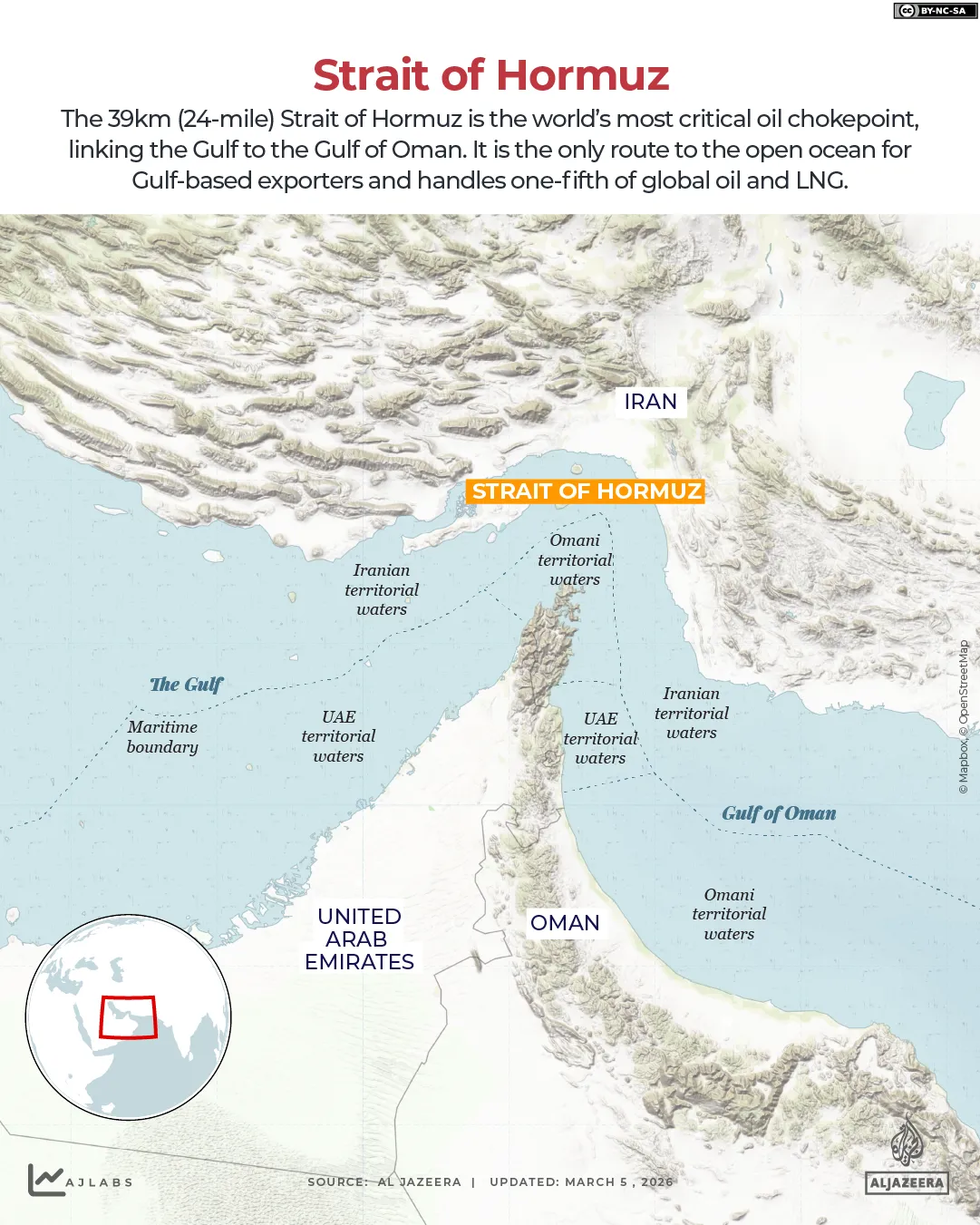
The latest surge in oil prices came after Iran’s Supreme Leader Mojtaba Khamenei pledged to maintain the effective closure of the Strait of Hormuz, which normally transports about one-fifth of global oil supplies.
In a statement read out on his behalf on Iranian state television, Khamenei described Tehran’s threats against shipping in the waterway as a “lever” that “must continue to be used”.
US President Donald Trump struck a similarly defiant tone on Thursday, posting on Truth Social that stopping Iran from getting nuclear weapons was of “far greater interest and importance” than rising oil prices.
‘Lack of tangible goals in this war’
Traffic through the strait has effectively ground to a halt due to Iranian threats, with only a handful of vessels passing through each day, many of them claiming links to China, Iran’s key economic partner.
According to the United Kingdom Maritime Trade Operations (UKMTO) centre, no more than five ships have passed through the waterway each day since the US and Israel launched joint strikes on Iran on February 28, compared with an average of 138 daily transits before the war. At least 16 commercial vessels have been attacked in the region since the start of the conflict, according to the UKMTO.
Tehran has claimed responsibility for several of the attacks, including a strike on Wednesday that crippled a Thai-flagged vessel off the coast of Oman.
Efforts to bring calm to the market have so far done little to tame prices, which are up nearly 40 percent compared with before the start of the war.
The International Energy Agency’s (IEA) announcement on Wednesday that member countries would release 400 million barrels of oil from emergency stockpiles drew a tepid response among traders eyeing a daily shortfall in global supplies estimated at 15-20 million barrels.
The US Department of the Treasury’s issuance on Thursday of a temporary licence authorising countries to purchase sanctioned Russian oil that has been stranded at sea also failed to move the market, with Brent crude staying above $100 a barrel after the Treasury announcement.
“The key problem is a lack of tangible goals in this war,” said Adi Imsirovic, an energy security expert at the University of Oxford.
“It makes it hard for oil traders to see the light at the end of the tunnel,” he said.
Trump has repeatedly floated the possibility of using the US Navy to escort commercial shipping through the strait, but the Pentagon has yet to conduct such operations amid concerns about the risks posed by Iranian attacks in the narrow waterway.
In an interview with CNBC on Thursday, US Energy Secretary Chris Wright said that Washington was “not ready” to provide navy escorts but that such operations could begin by the end of the month.
“It’ll happen relatively soon but it can’t happen now,” Wright said.
Iranian President Masoud Pezeshkian has laid out terms for ending the war with the United States and Israel in what analysts say is a possible sign of de-escalation from Tehran as the US-Israel war on Iran entered its 13th day on Thursday.
In a post on Wednesday on social site X, Pezeshkian said he had spoken to his counterparts in Russia and Pakistan, and that he had confirmed “Iran’s commitment to peace”.
Recommended Stories
list of 4 itemsend of list
“The only way to end this war – ignited by the Zionist regime & US – is recognizing Iran’s legitimate rights, payment of reparations, and firm int’l guarantees against future aggression,” Pezeshkian wrote.
This is a rare posture from Tehran, which has maintained a defiant stance and initially rejected any possibility of negotiations or a ceasefire when war broke out nearly two weeks ago.
Pezeshkian’s statement comes as pressure mounts on the US to halt what has become a very costly mission. Analysts say speculation from Washington that Iran would quickly submit after the killing of Supreme Leader Ayatollah Ali Khamenei were misguided.
Tehran is likely going to determine the end of this war, not the US or Israel, because of its ability to inflict economic pain broadly, they say.
Amid a military pummelling by the US and Israel, Iran has launched heavy retaliatory strikes at US assets and other critical infrastructure in Gulf countries, upsetting global supplies. It has also adopted what analysts call “asymmetric” tactics – such as disrupting the critical Strait of Hormuz and threatening US banking-linked entities – to inflict as much economic pain on the region and wider world as it can.
This is what we know about Pezeshkian’s stance and what the pressures are on both sides to draw the conflict to a close, quickly.
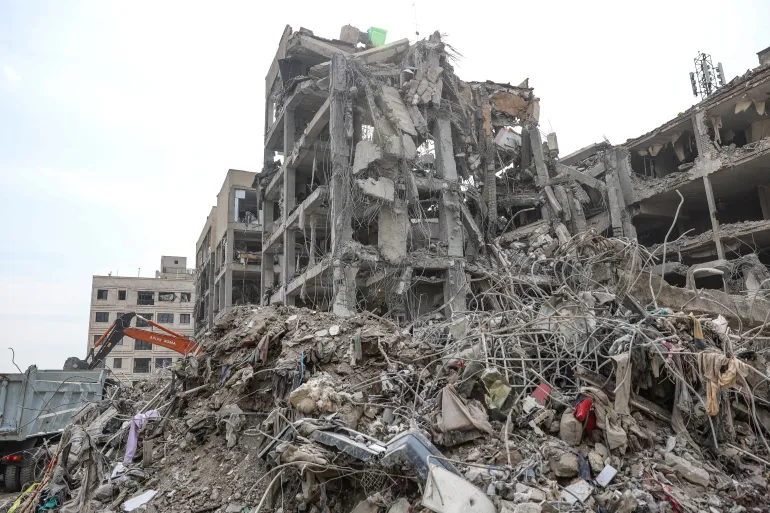
A building lies in ruins after a strike, amid the US-Israeli conflict with Iran, in Tehran, Iran, on March 12, 2026 [Majid Asgaripour/WANA (West Asia News Agency) via Reuters]
What has the war cost so far?
Economically, both sides have weaponised energy. Israel first targeted Iran’s oil facilities in Tehran on March 8, prompting an outcry from global health experts over the potential risk of air and water pollution.
Iran has, meanwhile, tightened its chokehold on the Strait of Hormuz shipping route – the only route to open sea for oil producers in the Gulf – with its military promising on Wednesday that it has the capabilities to wage a long war that could “destroy” the world economy.
Attacks on ships in the strait, through which about 20 percent of global oil and gas traffic normally passes, have effectively closed the route.
Oil prices rocketed above $100 per barrel late last week, up from around $65 before the war, with ordinary buyers feeling the increases at pumps in the US, Europe and parts of Africa.
On Wednesday, Iran upped the ante, saying it would not allow “a litre of oil” to pass through the strait and warned the world to expect a $200-per-barrel price tag.
“We don’t know how quickly it’ll revert back,” Freya Beamish, chief economist at GlobalData TS Lombard, told Al Jazeera. “We do think it’ll revert back to $80 in due course, but the ball is to some degree in Iran’s court,” she said, adding that because Iran needs oil revenue, the price hikes are expected to be time-limited.
The International Energy Agency agreed on Wednesday to release 400 million barrels from the emergency reserves of several member states but it is not yet clear what impact that will have, nor how quickly this quantity of oil can be released.
Tehran has also been accused of directly attacking oil facilities in neighbouring countries this week. Iraq shut all its oil port operations on Thursday after explosive-laden Iranian “drone” boats appeared to have attacked two fuel tankers in Iraqi waters, setting them ablaze and killing one crew member.
A drone was filmed striking Oman’s Salalah oil port on Wednesday, although Tehran has denied involvement.
What are Iranian officials saying about ending the war?
There has been conflicting messaging from the Iranian leadership.
Iran’s elite army unit and parallel armed force, the Islamic Revolutionary Guard Corps (IRGC), continues to show defiance, issuing threats and launching attacks on Israel and US military assets and infrastructure in neighbouring Gulf countries.
However, the political leadership has appeared more inclined towards diplomacy, analysts say. On Wednesday, President Pezeshkian said that ending the war would take the US and Israel recognising Iran’s rights, paying Iran reparations – although it’s unclear how much is being asked for – and providing strong guarantees that a future war will not be waged.
In a video recording last week, he also apologised to neighbouring countries for the strikes and promised that Iran would stop hitting its neighbours as long as they do not allow the US to launch attacks from their territory.
“I personally apologise to the neighbouring countries that were affected by Iran’s actions,” the president said, adding that Tehran was not looking for confrontations with its neighbours.
However, it is not known how much sway the political leadership has over the IRGC. Hours after the president’s apology last week, air defence sirens went off in Saudi Arabia, Qatar, the UAE and Bahrain, as strikes continued on the Gulf.
So, what is Iran’s actual position?
“Iran wants to go to the end to make sure that the United States and Israel never attack Iran again … so this has to be the final battle,” Al Jazeera’s Resul Serdar Atas explained.
Indeed, the IRGC sees this as an existential war, but the timing of Pezeshkian’s statement about ending the conflict also shows Tehran is pressured economically, politically and militarily, Zeidon Alkinani of Qatar’s Georgetown University told Al Jazeera.
“These differences and divisions [between IRGC and political leaders] always existed even prior to this war but we may notice it now more, given the fact that the IRGC believes that it has the right to take the front seat in leading this regional war, which is why a lot of the statements and positions are contradicting with the official ones from Pezeshkian,” he said.
The IRGC reports directly to Iran’s Supreme National Security Council (SNSC) and not to the country’s political leadership. That council is led by Ali Larijani, a top politician and close aide to the late supreme leader, Ali Khamenei, who analysts describe as a “hardliner”.
In a post on X on Tuesday, Larijani responded to threats from Trump about attacks on the Strait of Hormuz, saying: “Iranian people do not fear your hollow threats; for those greater than you have failed to erase it … So beware lest you be the ones to vanish.”
The newly elected supreme leader, Mojtaba Khamenei, was once in the IRGC and was put forward by the unit as the next ayatollah after his father was killed on the first day of the war, analysts say. He is thus not expected to follow the reformist, diplomatic ideals of President Pezeshkian and other political leaders which his father managed to marry with the IRGC militarised stance, they say.
Mojtaba Khamenei, son of Iran’s late Supreme Leader Ayatollah Ali Khamenei, attends a gathering in Tehran on March 2, 2016. Iran marked the appointment of Ayatollah Mojtaba Khamenei to replace his father as its supreme leader with a barrage of missiles against Israel and the Gulf states [File: Rouhollah Vahdati/ISNA via AFP]
What do the US and Israel say about ending the war?
There have also been conflicting messages from the Trump administration and Israel regarding when the war mission on Iran, codenamed Operation Epic Fury, is likely to end.
Trump told US publication Axios on Wednesday that the war on Iran would end “soon” because there’s “practically nothing left to target”.
“Anytime I want it to end, it will end,” he added. He had said earlier on Monday that “we’re way ahead of our schedule” and that the US had achieved its goals, even as speculation mounts about a possible US ground mission.
On the other hand, Israel’s Defence Minister Israel Katz said on Wednesday that the war would go on “without any time limit, for as long as necessary, until we achieve all the objectives and decisively win the campaign”.
Analysts say Trump’s stance that the conflict will be quick reflects increasing pressure on his administration ahead of upcoming mid-term elections in November.
Trump’s advisers privately told him this week to find a quick end to the war and avoid political backlash, according to reporting by The Wall Street Journal. That came as polls from Quinnipiac University and The Washington Post suggested that most Americans are opposed to the war in Iran.
In his 2024 presidential campaign, Trump promised to lower prices, and inflation had stabilised at 2.4 percent ahead of the war, according to government data released on Wednesday. Analysts speculate the conflict will likely push it back up.
The US spent more than $11.3bn in the first six days of the war, Pentagon officials told lawmakers in a classified briefing on Tuesday, Reuters reported this week – nearly $2bn a day.
The Washington-based think tank, Center for Strategic and International Studies (CSIS), estimated that the war cost Washington $3.7bn in its first 100 hours alone, or nearly $900m a day, largely due to its expenditure on costly munitions.
“It’s quite ironic that [Trump] chose a war that would make affordability worse, not better,” Rebecca Christie, a senior fellow at the Bruegel think tank, told Al Jazeera’s Counting the Cost.
“Every time the US loses even one object, air defence or a plane or something like that, that represents an awful lot of money that could have been used on some of these issues that have an impact on people’s day-to-day lives in the United States.”
Despite United States President Donald Trump’s repeated declarations of victory in the US-Israeli war on Iran, Tehran’s retaliatory strikes on Israel and US military assets in the region have continued, upending global financial and energy markets.
“We’ve had two decades to study defeats of the US military to our immediate east and west. We’ve incorporated lessons accordingly,” Iranian Foreign Minister Seyed Abbas Araghchi wrote in a post on X on March 1, the day after US and Israeli strikes on Tehran killed Iran’s Supreme Leader Ayatollah Ali Khamenei and other senior Iranian officials.
Recommended Stories
list of 3 itemsend of list
“Bombings in our capital have no impact on our ability to conduct war,” he wrote.
According to analysts, Iran has made use of “asymmetric” warfare tactics while striking the US and Israel. So, are Tehran’s war tactics working?
Here’s what we know:
What is ‘asymmetric’ warfare?
When the balance of capabilities is unequal in a conflict – as it is in relation to weapons in this one – the weaker party can turn to unconventional methods of warfare, John Phillips, a British safety, security and risk adviser and a former military chief instructor, told Al Jazeera.
This is known as “asymmetric” warfare.
This can include the use of guerrilla tactics, terrorism, cyberattacks, use of proxies and other indirect tools, Phillips said, in order “to offset conventional inferiority, avoid the enemy’s strengths, and exploit vulnerabilities in political will, logistics, and legal or ethical constraints”.
“Iran is conventionally weaker than the US and Israel, but relatively strong compared to many neighbours,” he said.
“What makes Iran distinctive is not that it uses these methods at all, but that they sit at the centre of its grand strategy rather than at its margins.”
Why is Iran using asymmetric warfare?
In the ongoing war between Iran and the US-Israel, Washington and Tel Aviv have been using expensive missiles and drones to attack Iran and to intercept missiles Iran has fired back. The Patriot and THAAD defence systems, for example, which launch interceptors to take out incoming drones and missiles, can cost millions of dollars for each missile they fire. This compares with the $20,000-$35,000 cost of each Iranian Shahed drone.
As a result, the US has reportedly spent $2bn a day in its war on Iran and there are fears it could run out of interceptor missiles altogether if the war goes on for more than a few weeks.
It is therefore in Iran’s interests to focus on holding out against strikes and protecting its own weapons supplies while it does so, military experts say.
However, Phillips explained that precision strikes and sabotage by Israel and the US have demonstrated that Iran is not able to fully shield its missile, drone and nuclear‑related assets, while sanctions and domestic pressures have limited its capacity to sustain a very high‑tempo confrontation.
“As a result, Iran’s asymmetric approach is best understood as an effective ‘survival and leverage’ mechanism that produces a chronic, costly ‘shadow war’, rather than a path to decisive regional hegemony or victory,” he said.
Iran began using asymmetric warfare techniques following the 1979 Iranian revolution, which overthrew Shah Mohammad Reza Pahlavi.
“Instead of trying to match high‑end aircraft, precision munitions, or blue‑water fleets, [Iran] has built a ‘forward deterrence’ posture that operates in the grey zone between war and peace,” Phillips said.
“This is backed by large inventories of ballistic and cruise missiles, mass‑produced drones [often handed to proxies], cyber-operations, and a posture of underground, dispersed and hardened facilities that make preemption difficult and preserve some retaliatory capability.”
What asymmetric tactics has Iran been using?
Enemy depletion tactics
Since US-Israeli strikes on Iran began on February 28, Tehran has launched a wave of ballistic missiles targeting Israel and US military bases across the Gulf region.
Using a mix of short and medium-range ballistic missiles, as well as drone swarms through this defence system, Iran aims to deplete Israeli and US interceptor stockpiles.
Economic warfare
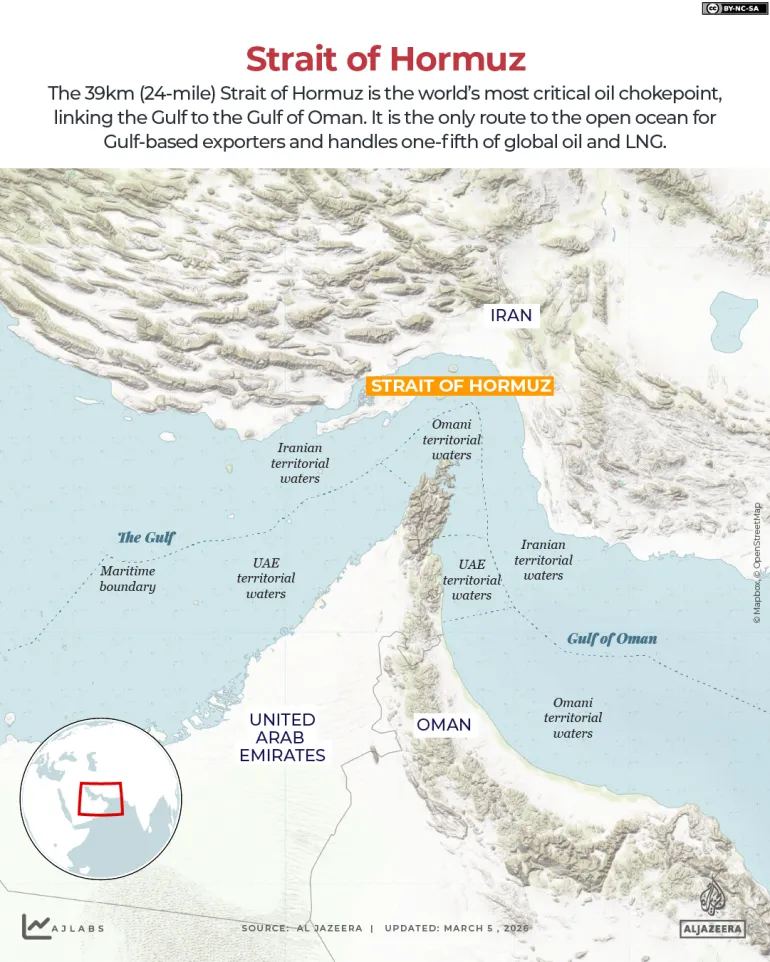
Iran has shut down the Strait of Hormuz through which about 20 percent of global oil and gas supplies are shipped. Linking the Gulf to the Gulf of Oman, the strait is the only waterway to the open ocean available to Gulf oil producers.
On Thursday, Iran attacked fuel tankers in Iraqi waters. Instability in and around the Strait of Hormuz drove Brent crude oil prices past $100 a barrel last week, with wild swings ongoing, prompting fears of a global energy crisis.
Iran has also targeted civilian infrastructure like airports and desalination plants which are crucial for water supply in the region, and it has launched drones targeting oil depots.
(Al Jazeera)
War on global finance
Meanwhile, on Wednesday this week, Iran’s Islamic Revolutionary Guard Corps (IRGC) threatened to attack “economic centres and banks” with links to United States and Israeli entities in the Gulf region after what it claimed was an attack on an Iranian bank, with the war in its 12th day.
Since then, many banks like Citibank and HSBC in Qatar, have begun shutting, further threatening global financial stability.
Top technology companies such as Google, Microsoft, Palantir, IBM, Nvidia and Oracle, as well as the listed offices and infrastructure for cloud-based services, are also located in several Israeli cities and in some Gulf countries, which Iran has also threatened to attack.
Use of proxies
Iran has aimed to keep the much more powerful US military and its allies off balance through proxies in Iraq, Lebanon and Yemen. Hezbollah in Lebanon, for example, has fired missiles and drones into northern Israel since March 2 as part of Iran’s retaliatory strikes.
“At the core of this [asymmetric] approach is a network of proxies and partners – Hezbollah in Lebanon, Shia militias in Iraq, groups in Syria, Hamas and Palestinian Islamic Jihad in Gaza and the Houthis in Yemen – which receive weapons, training, funding and ideological guidance from Iran,” Phillips said.
These actors allow Tehran to threaten Israeli and US forces, as well as regional shipping lanes, on multiple fronts, “often with a degree of deniability and at a fraction of the cost of deploying its own regular forces”, Phillips noted.
‘Mosaic’ defence system
Iran has organised its defensive structure into multiple regional and semi-independent layers instead of concentrating power in a single command chain that could be paralysed by a decapitation strike. This concept is most closely associated with the formation of the parallel military force, the Islamic Revolutionary Guard Corps (IRGC), particularly under former commander Mohammad Ali Jafari, who led the force from 2007 to 2019.
The doctrine has two central aims: to make Iran’s command system difficult to dismantle by force, and to make the battlefield itself harder to resolve quickly by turning Iran into a layered arena of regular defence, irregular warfare, local mobilisation and long-term attrition.
What damage have these tactics done to the US and Israel?
Iran’s asymmetrical playbook has made the war more expensive for the US. It has been forced to spend money on replacing stockpiles of expensive missiles like Tomahawks and defensive systems such as Patriot and THAAD interceptors.
According to the Center for Strategic and International Studies (CSIS), the first 100 hours alone of Operation Epic Fury – the codename for the US-Israeli assault on Iran – cost the US approximately $3.7bn, mostly unbudgeted. Israel, already reeling from the economic strain of its prolonged wars in Gaza and Lebanon, faces mounting domestic pressure as daily sirens force millions into bunkers.
While the Pentagon has not yet announced an official estimate for the cost of the war, late last week, two congressional sources told US broadcaster MS NOW that the war is costing the United States an estimated $1bn a day.
A day later, Politico reported that US Republicans on Capitol Hill privately fear the Pentagon is spending close to $2bn a day on the war.
Meanwhile, officials from President Donald Trump’s administration estimated during a congressional briefing this week that the first six days of the war on Iran had cost the US at least $11.3bn, a source familiar with the matter told the Reuters news agency.
Reporting from Washington, DC, following the publication of the CSIS analysis last week, Al Jazeera’s Rosiland Jordan said the Pentagon had put together a $50bn supplemental budget request in order to replace Tomahawk and Patriot missiles and THAAD interceptors already used in the first week of the war, along with other equipment that had been damaged or worn out so far.
Are Iran’s tactics working?
To a certain extent, they are.
According to a report by The Soufan Center, the “pattern of Iranian counterattacks suggests a layered operational approach designed to generate pressure on Gulf states, create regional disruption on land, sea, and air, while simultaneously attempting to exhaust US and allied defensive resources”.
“Tehran appears to be fighting a war of endurance: prolong the conflict, expand the economic battlefield, make the costs increasingly prohibitive, ration advanced capabilities, and impose steady human and financial costs on its adversaries. All with the hope that political tolerance erodes faster in Jerusalem and Washington than in Tehran,” the report noted.
This may be working. Questions about the cost of the war are already causing a political headache for the Trump administration in Washington.
Congress’s House Minority Leader Hakeem Jeffries told reporters at a Capitol Hill news conference last week that President Donald Trump is “plunging America into another endless conflict in the Middle East” and “spending billions of dollars to bomb Iran”.
“But they can’t find a dime to make it more affordable for the American people to go see a doctor when they need one,” he said. “Can’t find a dime to make it easier for Americans who are working hard to purchase their first home. And they can’t find a dime to lower the grocery bills of the American people.”
Trump won the presidency in 2024 largely on the back of a promise to handle the rising cost of living and he faces mid-term elections this year. It is likely that the cost of the war will not play well with voters, analysts say.
In Israel, opposition politician Yair Golan has also criticised his government’s economic management of the war.
In a post on X on Sunday, he wrote: “The war with Iran has been planned for months. The fact that the Israeli government has not prepared an orderly economic plan to support citizens during the war period is a disgrace.
“The serving and working public should not be the one footing the bill for the war out of its own pocket while billions of shekels go to the evading and non-working sector,” he said, adding that the opposition will soon replace the government.
Ali Vaez, director of the Iran Project at the International Crisis Group, told Al Jazeera that at a fraction of the cost – and despite a significant technological gap – Iran has demonstrated an ability to hold the global economy at risk, to pressure Washington into “blinking first”.
“A steady stream of inexpensive drones and limited missile strikes can disrupt the thriving economies of Israel and the Gulf, sending shockwaves through energy markets and ultimately translating into higher prices at American gas stations,” he said.
Phillips, the British safety, security and risk adviser, said the strategy has worked in important but limited ways.
“It has helped the Islamic republic survive intense sanctions, clandestine campaigns and periodic strikes while maintaining a credible ability to hit US bases, Israeli territory and Gulf infrastructure, which in turn raises the political and military cost of any attempt at regime-change war,” he said.
“Iran’s reach – stretching from Lebanon and Syria to Iraq and Yemen – allows it to shape crises, quickly raise the stakes of local conflicts, and force adversaries to devote substantial resources to missile defence, counter‑UAV systems, naval protection and regional coalition management,” he noted.
“However, there are clear constraints and growing problems. Key proxies such as Hezbollah and various militias have suffered leadership and infrastructure losses; the network has become more fragmented and sometimes less controllable, increasing the risk of unwanted escalation even as its coherence as an instrument of policy erodes,” he added.
A probe has been initiated by the US Justice Department into Iran’s use of Binance, the world’s largest crypto platform, to circumvent US sanctions and provide financial backing to terrorist organisations with ties to the IRGC, according to The Wall Street Journal.
ADVERTISEMENT
ADVERTISEMENT
The US DOJ’s examination stems from company documents and accounts provided by individuals familiar with the matter.
Authorities have contacted people with direct knowledge of the Iranian-linked transactions to request interviews and collect evidence, as per the WSJ report.
A monitor appointed by the US Treasury Department has reportedly asked Binance for details on the Iranian transactions, including information about a business partner responsible for a large share of the flows.
At this stage, it remains uncertain whether the investigation targets Binance for any potential misconduct or if it is confined to activity by customers on the platform.
A spokesperson for the company told the WSJ that Binance “categorically did not directly transact with any sanctioned entities”.
This development brings the company back to the centre of US regulatory attention, just months after its founder received a presidential pardon, highlighting persistent challenges in enforcing sanctions within the rapidly evolving crypto and fintech sectors.
Binance founder Changpeng Zhao, widely known as CZ, was pardoned by President Trump back in October.
The investigation reopens scrutiny of the exchange, which pleaded guilty in 2023 to breaching US sanctions and banking laws. That case resulted in a record $4.3bn (€3.7bn) penalty and a requirement for ongoing US oversight.
Under the terms of the 2023 agreement, Binance must actively screen clients for terrorism financing and sanctions breaches, as well as report suspicious activity promptly to authorities.
US congressional inquiry adds pressure
The developments have also drawn attention from Capitol Hill.
US Senator Richard Blumenthal, a senior Democrat on the Senate Homeland Security Committee, opened a formal inquiry last month into Binance’s handling of the Iranian transactions.
Citing the scale of the unreported flows, approaching nearly $2bn (€1.7bn) to sanctioned entities, and the suspension of internal investigators, Blumenthal questioned whether the exchange had met its obligations under US sanctions and banking laws.
He requested detailed records from Binance, which responded by describing media coverage as inaccurate and highlighting its “best-in-class compliance programme”.
The senator later described that reply as evasive and insufficient to address his concerns.
The timing of the US DOJ’s probe coincides with heightened efforts to disrupt financing networks linked to Iran’s IRGC.
Ahead of joint military actions with Israel against Iran, Washington stepped up measures to cut off revenue streams, particularly those involving crypto assets used to repatriate proceeds from oil sales to China.
In January, the US Treasury Department sanctioned two smaller crypto exchanges for moving large sums to digital wallets connected to the IRGC.
For years, Iran’s leaders believed time was on their side.
After the United States withdrew from the 2015 nuclear agreement, known as the Joint Comprehensive Plan of Action (JCPOA), Tehran effectively adopted what later came to be described as a “strategic patience” approach. Rather than immediately counter-escalating, Iran chose to endure economic pressure while waiting to see whether diplomacy could be revived.
The logic behind the strategy was simple: eventually, Washington would recognise that confrontation with Iran was against its own interests.
Today, that assumption lies shattered.
The collapse of diplomacy and the outbreak of war have forced Iran’s leadership to confront a painful reality: their belief that the US would ultimately act rationally may have been a profound miscalculation.
If Iran survives the current conflict, the lessons Iranian leaders draw from this moment may motivate them to pursue a nuclear deterrent.
The strategy of waiting
After the first Trump administration withdrew from the JCPOA and launched its “maximum pressure” campaign in 2018, Tehran initially avoided major counter-escalation. For nearly a year, it largely remained within the deal’s limits, hoping the other signatories, particularly Europeans, could preserve the agreement and deliver on the promised economic benefits despite US sanctions.
When that failed, Tehran began gradually increasing its nuclear activities by expanding enrichment and reducing compliance step by step while still avoiding a decisive break.
The pace accelerated after Iran’s conservative-dominated parliament passed a law mandating a significant increase in nuclear activities, in the wake of the assassination of top nuclear scientist Mohsen Fakhrizadeh. The shift was reinforced further by the 2021 election of conservative President Ebrahim Raisi.
The ultimate goal was to rebuild negotiating leverage, as Tehran believed that broader geopolitical and regional trends were gradually shifting in its favour. From its perspective, China’s rise, Russia’s growing assertiveness, and widening fractures within the Western alliance suggested that Washington’s ability to isolate Iran indefinitely might weaken over time.
At the same time, Iran pursued a strategy of reducing tensions with its neighbours, seeking improved relations with Gulf states that had previously supported the US “maximum pressure” campaign. By the early 2020s, many Gulf Cooperation Council countries had begun prioritising engagement and de-escalation with Iran, culminating in moves such as the 2023 Saudi-Iran rapprochement brokered by China.
Against this backdrop, even as tensions rose, Tehran continued to pursue diplomacy. Years of negotiations with the Biden administration aimed at restoring the JCPOA ultimately produced no agreement. Subsequent diplomatic efforts under Trump’s second presidency also collapsed.
Underlying this approach was a fundamental assumption: that the US ultimately preferred stability to war. Iranian officials believed Washington would eventually conclude that diplomacy, rather than endless pressure or a major war, was the most realistic and least costly path forward.
The joint US-Israeli assault on Iran has now exposed how deeply flawed that assumption was.
The return of deterrence
While Tehran based its strategy on mistaken beliefs about the rationality of US foreign policy, Washington, too, is misreading the situation.
For years, advocates of the maximum pressure campaign argued that sustained economic and military pressure would eventually fracture Iran internally. Some predicted that war would trigger widespread unrest and even the collapse of the regime.
So far, none of those predictions has materialised.
Despite the enormous strain on Iranian society, there have been no signs of regime disintegration. Instead, Iran’s political base — and in many cases broader segments of society — has rallied in the face of external attack.
Furthermore, Iran spent years reinforcing its deterrence capabilities. This involved expanding and diversifying its ballistic missile, cruise missile and drone programmes and developing multiple delivery systems designed to penetrate sophisticated air defences. Iranian planners also drew lessons from the direct exchanges with Israel in 2024 and the June 2025 war, improving targeting accuracy and coordination across different weapons systems.
The focus shifted towards preparing for a prolonged war of attrition: firing fewer but more precise strikes over time while attempting to degrade enemy radar and air defence systems.
We now see the results of this work. Iran has been able to inflict significant damage on its adversaries. Retaliatory attacks have killed seven Americans and 11 Israelis, placing a growing strain on US and Israeli missile defence systems, as interceptors are steadily depleted.
Iranian missile and drone strikes have hit targets across the region, including high-value military infrastructure such as radar installations. The closure of the Strait of Hormuz has sent global energy markets into turmoil.
Apart from the immense cost of war, the US decision to launch the attack on Iran may have another unintended consequence: a radical shift in Iranian strategy.
For decades, Supreme Leader Ali Khamenei maintained a longstanding religious prohibition on nuclear weapons. His assassination on the first day of the war may now motivate the new civilian and military leadership of the country to rethink its nuclear strategy.
There may now be fewer ideological reservations about pursuing nuclear weapons. The logic is simple: if diplomacy cannot deliver sanctions relief or permanently remove the threat of war, nuclear deterrence may appear to be the only viable alternative.
Iran’s actions in this conflict suggest that many leaders now see patience and diplomacy as strategic mistakes. These include the unprecedented scale of Iranian missile and drone attacks across the region, the targeting of US partners and critical infrastructure, and political decisions at home that signal a harder line, most notably the appointment of Mojtaba Khamenei as supreme leader.
The choice of Khamenei’s son breaks a longstanding taboo in a system founded on the rejection of hereditary rule and reflects a leadership increasingly prepared to abandon previous restraints.
If a more zero-sum logic of deterrence takes hold across the region, replacing dialogue as the organising principle of security, the Middle East may enter a far more dangerous era in which nuclear weapons are viewed as the ultimate form of deterrence and nuclear proliferation can no longer be stopped.
The views expressed in this article are the author’s own and do not necessarily reflect Al Jazeera’s editorial stance.
Iran has vast oil as well as gas reserves and is a key supplier to China.
Iran has significant oil and gas reserves, and is a key supplier to China.
A member of US President Donald Trump’s inner circle has said control of those reserves is a key United States aim amid the country’s war against Iran.
So, how valuable are Iran’s natural resources? And could they be a factor in US thinking?
Presenter: Imran Khan
Guests:
Foad Izadi – Professor in the faculty of world studies at the University of Tehran
Mohammad Reza Farzanegan – Professor of Middle East economics at Marburg University
Paolo von Schirach – President of the Global Policy Institute, an independent think tank
Protesters blocked a bus carrying Iran’s women’s football team outside a hotel in Australia after five players slipped away to seek asylum duing the Women’s Asian Cup. They say the remaining players could face danger if forced to return to Iran after staying silent during the national anthem.
When a state’s political leadership announces a ceasefire and its military keeps firing, the instinct is to reach for deception as the explanation. In Iran’s case, the more unsettling answer may be structural. The gap between what Iranian presidents say and what Iranian forces do reflects not a coordinated lie but a command architecture deliberately engineered to operate without central direction. In a serious conflict, the consequences of that architecture would be felt well beyond Iran’s borders.
A Command Architecture Designed to Survive Decapitation
In September 2008, IRGC Commander General Mohammad Ali Jafari oversaw a sweeping restructuring that divided the force into thirty-one provincial corps, each empowered to conduct military operations within its zone without requiring authorization from the center. As Michael Connell of the Center for Naval Analyses noted in his analysis for the United States Institute of Peace, the intent was to strengthen unit cohesion and ensure operational continuity under degraded command conditions. He flagged explicitly that the decentralization could produce unintended escalation dynamics, particularly in the Persian Gulf.
That warning deserves serious attention. The IRGC’s Mosaic Defense doctrine was not designed to make Iran more responsive to political leadership in a crisis. It was designed to ensure that military operations could continue regardless of what happened to that leadership. A force structured that way does not stop firing because a president gives a speech.
The Apology That Wasn’t
The internal contradiction becomes clearest when traced through a hypothetical cascade. A president announces a ceasefire and attributes the directive to an Interim Leadership Council. A fellow council member publicly declares that heavy strikes will continue. A hardline cleric addresses the president directly, calling his position untenable. By the time the president’s original statement is reposted, the ceasefire language has been quietly removed.
The IRGC’s own posture in this scenario resolves the ambiguity on structural grounds. It endorses the president’s language, then appends a caveat that renders it inoperative: all US and Israeli military bases and interests across the region remain primary targets. Since every GCC state hosts American forces, that framing preserves full operational freedom while allowing the presidency to project restraint. The contradiction is not incidental. It is the doctrine functioning as designed.
The Theological Dimension
Iran is not simply a military organization. It is a theocratic state whose constitutional legitimacy flows from velayat-e faqih, the guardianship of the Islamic jurist, which vests supreme authority in a single clerical figure whose religious and political mandates are inseparable. Remove that figure, and the system’s legitimating architecture is suspended rather than transferred. The Assembly of Experts is constitutionally mandated to elect a successor, but wartime conditions would disrupt that process at precisely the moment its resolution matters most.
A RAND Corporation analysis prepared for the Office of the Secretary of Defense identified the IRGC as the institution best positioned to shape any post-Khamenei transition, with the organizational reach and economic weight to determine outcomes that civilian institutions cannot contest. The result, in a decapitation scenario, is a theocratic state operating without its theological anchor and a military operating under pre-delegated authority with no one capable of recalling it.
Durability Without Effect
The Mosaic Defense doctrine would prove, above all, durable. A decentralized force can survive catastrophic leadership losses and sustain operations. But durability is not the same as capability, and sustained fire is not the same as strategic effect.
Iran’s theory of regional attrition, the calculation that sustained strikes against Gulf infrastructure and American basing would fracture GCC cohesion and coerce Arab neighbors toward neutrality, has produced no evidence of working. The GCC bloc has held. Individual member states have coordinated their responses rather than fractured under pressure. The country absorbing the sharpest volume of Iranian strike activity, the UAE, has demonstrated air defense performance that has exceeded even optimistic prewar assessments. Publicly available figures suggest UAE systems have defeated upward of ninety percent of inbound threats, a result that reflects years of sustained investment, deep integration with American and Israeli platforms, and an operational tempo that has stress-tested those systems at genuine scale.
The picture that emerges is not one of Iran winning a war of attrition. It is one of an Iran burning through accessible inventory, losing launch infrastructure faster than it can regenerate, and discovering that the regional architecture it spent years attempting to destabilize has proven considerably more resilient than it calculated.
That resilience carries its own strategic meaning. A weakened force operating under pre-delegated authority, without a supreme leader to set limits, remains dangerous in a narrow tactical sense. But it is operating without a coherent end state, and the environment it faces is not the one it anticipated. The GCC’s collective posture and the demonstrated effectiveness of layered air defense across the Gulf have closed off the strategic outcomes Iran’s doctrine was written to achieve.
The scenario is instructive for what it reveals about the limits of decentralized military design. A force built to keep firing regardless of political direction is also a force that cannot be steered toward an exit. But the Gulf states have demonstrated something of equal importance in response: that resilience, properly built and consistently resourced, can outlast a doctrine designed for chaos, and that the regional order Iran sought to unravel has shown itself capable of absorbing the blow.
Multiple outlets have now reported on deliberations within the U.S. and Israeli governments over a ground raid targeting Iran’s enriched uranium stocks this past weekend, citing unnamed sources. It is unclear whether the mission being considered would be carried out by U.S. or Israeli forces, or be conducted jointly by both parties.
Members of the US Army seen using nuclear material detection tools during an exercise. US Army
“People are going to have to go and get it,” Secretary of State and acting National Security Advisor Marco Rubio said at a congressional briefing back on March 3 in response to a question about securing Iran’s enriched uranium, according to a report from Axios on Saturday.
“We’re going to find out about that. We haven’t talked about it, but it was a total obliteration. They haven’t been able to get to it. And at some point, maybe we will,” President Donald Trump also told reporters on Air Force One on Saturday. “You know, that’d be a great thing, but right now we’re just decimating them. We haven’t gone after it, but it’s something we can do later on. We wouldn’t do it now. Maybe we’d do it later.”
Reporter: Mr. President, don’t you need ground troops to secure the enriched uranium at the nuclear sites?
Trump: We’re going to find out about that. We haven’t talked about it, but it was a total obliteration. They haven’t been able to get to it. And at some point, maybe we… pic.twitter.com/f9LR6BzIdn
NBC News reported last week that President Trump had “privately expressed serious interest” in sending “a small contingent of U.S. troops that would be used for specific strategic purposes” into Iran.
The U.S. government says that preventing Iran from developing a nuclear weapon is a core goal of its current operations targeting the country. If the Iranian government were to collapse, and do so suddenly, there would be additional concerns about the proliferation of the country’s nuclear material, including to regional proxies and terrorist groups, as well as other potential buyers on the black market.
What we know about Iran’s enriched uranium stockpile
By its last firm estimate, as of June 2025, the International Atomic Energy Agency (IAEA) assessed that Iran had just over 972 pounds (just under 441 kilograms) of uranium enriched to 60 percent purity. This stockpile has long been a proliferation concern and evidence of Iranian authorities maintaining the option of rapidly pursuing a nuclear weapon even in the absence of an active development program.
It is understood to be a relatively quick process, in technical terms, to get uranium from 60 percent to 90 percent purity, at which point it is considered highly enriched or weapons-grade. Per the IAEA, 92.5 pounds of 60 percent uranium is sufficient to be enriched into enough 90 percent material for one nuclear bomb. Using this metric, Iran’s declared stockpile of enriched uranium is enough for at least 10 bombs.
“In that first meeting, both of the Iranian negotiators said to us directly, with no shame, that they controlled 460 kilograms of 60 percent, and they were aware that that could make 11 nuclear bombs,” Steve Witkoff, U.S. Special Envoy to the Middle East, who had been leading talks with Iranian officials head of the current conflict, said in an interview with Fox News’ Sean Hannity on March 2. “They have 10,000, roughly, kilograms of fissionable material. That’s broken up into roughly 460 kilograms of 60 percent enriched uranium, another thousand kilograms of 20 percent enriched uranium, and the balance is at 3.67 [percent purity].”
Steve Witkoff, U.S. Special Envoy to the Middle East, at left, shakes hands with Israeli Prime Minister Benjamin Netanyahu at the White House in 2025. White House
Uranium that is not pure enough for a nuclear weapon could still be fashioned into a so-called ‘dirty bomb’ designed just to spread radioactive contamination across an area. Even if the immediate impacts of the detonation of such a device are minimal, it could cause widespread panic and would require significant effort to clean up. This is a threat that has also often been associated with non-state actors in the past.
Iran’s underground nuclear site at Isfahan has long been understood to be the primary storehouse for its stockpile of enriched uranium. That facility was among those targeted in U.S. strikes last June, dubbed Operation Midnight Hammer. Though access to any uranium there was subsequently curtailed, the U.S. Intelligence Community has more recently assessed that Iranian authorities have regained entry, at least to a degree, according to a report from The New York Times over the weekend.
NEW: High resolution satellite imagery taken yesterday shows the extent to which Iran has covered the tunnel entrances at the Esfahan nuclear complex with soil. The middle and southern entrances are unrecognizable and fully covered in soil. The northernmost tunnel entrance which… pic.twitter.com/baYI2zCuN0
NEW: Satellite imagery of the Esfahan nuclear site taken today shows new activity at the tunnel entrances. As of today, Iran has re-buried the middle entrance with soil and is adding more fresh soil to the southernmost entrance. The northernmost entrance, which was reworked after… pic.twitter.com/7ujiku8VRg
There are lingering questions about the degree to which Iran may have dispersed its enriched uranium beyond Isfahan. The day before the current conflict erupted, the AP reported that the IAEA had been circulating a report saying that it could not “verify whether Iran has suspended all enrichment-related activities” or the “size of Iran’s uranium stockpile at the affected nuclear facilities,” and was unable to “provide any information on the current size, composition or whereabouts of the stockpile of enriched uranium in Iran.”
“Publicly, U.S. officials have projected confidence that they know where the uranium is stored. Privately, there is said to be less certainty,” according to a report from Bloomberg today.
Options for a ground raid
In terms of the specifics of how a ground raid would neutralize Iran’s enriched uranium stockpile, multiple options are reportedly being considered.
“The first question is, where is it? The second question is, how do we get to it and how do we get physical control?” a U.S. official said, according to Axios. “And then, it would be a decision of the president and the Department of War, CIA, as to whether we wanted to physically transport it or dilute it on premises.”
“The mission would likely involve special operators alongside scientists, possibly from the International Atomic Energy Agency (IAEA),” Axios‘ report added.
U.S. Army soldiers with the 128th Chemical Company, 337th Engineer Battalion, conduct site reconnaissance in an underground tunnel during the Engineer Thunder 2025 exercise in Lithuania. US Army/Pfc. Gabriel Martinez
“U.S. special operations units are ideally suited to rapidly and discreetly infiltrate into a target area to extract items of interest from an objective like a nuclear facility in Iran. If the items in question are too large to be moved by the special operations force, depending on what they are, they could then be destroyed in place or secured until a larger follow-on force arrives. Conventional supporting forces and interagency elements offering unique capabilities could accompany special operations forces on initial raids, as well.”
“Special operations forces are also well-positioned to help intercept high-value targets on the move, including nuclear material that might make its way out of Iran, or threaten to do so, as the conflict with Israel continues. This could potentially include operations on land or at sea.”
U.S. special operations forces, especially so-called “tier one” units like the U.S. Army’s Delta Force and the U.S. Navy’s SEAL Team Six, train regularly to conduct exercises centering on counter-weapons of mass destruction (WMD) scenarios and others involving chemical, biological, nuclear, and radiological hazards. U.S. Special Operations Command (SOCOM) was formally designated the lead entity for the Counter Weapons of Mass Destruction (CWMD) mission set in 2016. An array of specialized conventional U.S. military units, as well as personnel from other ends of the U.S. government, such as the Department of Energy, are also expected to take part in these operations and are often integrated directly into relevant training events alongside special operations elements. You can read more about all of this here.
Members of the US Army’s Nuclear Disarmament Team 1 (NDT 1), a conventional unit specializing in neutralizing nuclear and radiological threats, seen in the control room of a nuclear power plant during an exercise that also involved Green Berets. US Army
As one particularly spectacular example, in 2024, Israeli forces destroyed an underground ballistic missile factory in Syria, which had been built with Iranian assistance. The raiding party was on the ground for approximately two and a half hours, during which time 660 pounds of explosives were rigged throughout the site. “A planetary mixer, numerous weapons, and intelligence documents,” were also extracted, according to the Israel Defense Forces (IDF). TWZ noted at the time that this operation sent a clear signal to Iran that its underground facilities were not untouchable.
100 Shaldag soldiers raid and dismantle Syrian missile factory in secret operation
There is the potential that Israel might have launched ground raids against Iran’s nuclear sites at Fordow, Natanz, and/or Isfahan unilaterally last year if the U.S. military had not conducted Operation Midnight Hammer. There would have been few, if any other options for Israel to have gone after those underground facilities. This, in turn, raises the possibility that Israeli forces may have prepared more explicitly to execute these operations just in the past year.
Risk and complexities
Executing any special operations raid targeting Iran’s stockpile of enriched uranium, wherever it might be held, would not be without immense challenges.
For one, there are real questions about what it would take to move nearly 1,000 pounds of enriched uranium out of Iran, even if it is largely located at one site. The material would be even heavier and bulkier when taking into account the secure containers it is likely to be stored in.
Similar questions have been raised about the feasibility of neutralizing the stockpile in place if it is determined to be impractical to move it. Experts and observers have highlighted the immense time and resources that would be required to try to dilute the purity of any nuclear material on-site, processes that typically require industrial machinery under normal conditions.
A picture showing work within a processing unit at the Isfahan Uranium Conversion Facility in Iran back in 2005. Getty Images / Stringer
Unlike conventional weapons, or even other key aspects of Iran’s nuclear program, like centrifuges, fissile material cannot simply be blown up to destroy it in place, either.
Having to carry out any such operation, however long it might take, in an active conflict zone and likely under enemy fire, would only add to the complexities of a ground raid. As already noted, Iran looks to have taken steps to physically hamper access to Isfahan and other sites, adding to the time it would take friendly forces to gain entry to their objectives in the first place. Heavy machinery could be required to dig into these facilities.
The longer friendly forces are on the ground, the more time Iran has to put together a response. Airpower can help keep hostile forces at bay, but Iranian security forces could eventually muster significant firepower, including artillery. Keeping nuclear facilities safe from attack has been a top priority for the regime in Tehran, and Iranian security forces will have reaction plans in place.
There is also simply the matter of getting the raiding force to and from the objective. As has been established, we are talking about what would have to be a relatively large contingent, burdened with specialized equipment, along with a typical array of weaponry and other gear.
Members of the US Army and South Korean Army in chemical, biological, nuclear, and radiological protective gear seen during a training exercise in a mock underground facility. US Army
The U.S. military, specifically, has a very complicated relationship with these kinds of operations, dating back to the failed attempt to rescue hostages being held in the American embassy in Tehran following the revolution that put the current Iranian regime into power in the first place. That operation exposed deficiencies that did lead to the development of new capabilities, as well as tactics, techniques, and procedures, and continues to be a key case study in special operations planning today.
We did get to see a demonstration of the U.S. military’s current capability and capacity to launch a major special operations raid in January with Operation Absolute Resolve, which resulted in the capture of Venezuelan dictator Nicolas Maduro from the middle of a fortress-like military facility. At the same time, it also showed the immense resources required to ensure the success of a mission like that, with hundreds of aircraft, ships offshore, and an array of other assets involved. The main raiding force consisted of 200 special operators. You can read more about what is known about the extensive preparations for the mission, including having forces specifically poised to destroy three airfields if it looked like Venezuelan Air Force fighters were attempting to scramble, here.
In addition, the Venezuela operation had the benefit of surprise, rather than coming in the middle of already ongoing major combat operations against an enemy that says it is actively prepared to respond to any kind of ground incursion. Iran’s military capabilities and overall capacity have been seriously degraded by U.S. and Israeli strikes in the past week, but significant threats remain, as TWZ regularly stresses.
Even under the most optimal conditions, launching a major special operations raid into Iran amid the ongoing hostilities would be extremely risky.
A question of timing and alternatives
Axios‘ report notably said a special operations raid against Iran’s enriched uranium stockpile “would likely only take place after both countries [the United States and Israel] are confident Iran’s military can no longer mount a serious threat to the forces involved.” This would also align with President Trump’s comments on Saturday.
However, other factors could still influence that decision-making process. As has been made clear, there are already serious questions about where all of Iran’s enriched uranium may be hidden away now. This is compounded by the reports that the Iranians may have regained access to where material was being stored in Isfahan, which could then allow them to move it elsewhere.
Even if persistent surveillance gives a good sense of where the material is being moved, dispersal can only increase the total number of sites that would have to be secured. It would also reduce any guarantees of neutralizing even the majority of the stockpile in one fell swoop.
Members of the US Army’s 75th Ranger Regiment and conventional supporting forces seen during a training exercise in 2024 involving a mock raid on a nuclear facility. US Army
As mentioned earlier, interdicting nuclear shipments on the move would still require a ground force of some kind to secure the material. Simply kinetically targeting vehicles carrying enriched uranium from the air would not be sufficient and would risk scattering nuclear material in an uncontrolled manner, making such a strike an absolute last resort option.
As pointed out earlier, there could also be a concern that regional proxies, terrorists, or other third parties might attempt to exploit the current conflict to spirit away a portion of Iran’s stockpile from Isfahan or sites for their own nefarious uses. This, in turn, could further drive a demand for action to secure that material on a timetable that does not allow for waiting for ideal conditions to emerge.
In the meantime, the United States and Israel could seek to carry out new strikes to try to seal entrances to underground facilities at Isfahan and other locations. Strikes last week on Iran’s nuclear site at Natanz look to have been intended to do just this. Those sites could then be surveilled to watch for any further attempts on the part of the Iranians to dig them out. Additional action, including more strikes or launching a ground raid, could then be taken, as necessary.
We have prepared an overview slide summarizing the visible damage at the Natanz uranium enrichment site from the recent attack, pulling together multiple images showing before and after satellite images of the two personnel entrances and the sole vehicle entrance with comparable… pic.twitter.com/mMGvOyHgkQ
On top of everything else, not being able to definitely find, fix, and secure Iran’s stockpile of enriched uranium would make it difficult for the U.S. government to say it has achieved its core objective of preventing the country from building a nuclear weapon. Inversely, doing so could be seen as essential, especially by the Trump administration, for creating the conditions necessary to end the current conflict.
Altogether, it remains to be seen whether or not the United States and Israel decide that mounting a major special operation targeting Iran’s enriched uranium outweighs the risks.