Iran

Aid groups bidding to boost relief shipments into Iran | US-Israel war on Iran News

Supply of humanitarian aid for people displaced by the conflict has been complicated by air and sea route closures.

Aid groups have said they’re seeking to boost humanitarian relief shipments into Iran as the effects of the United States-Israeli war hit the population.

The International Federation of Red Cross and Red Crescent Societies (IFRC) said on Tuesday that it had delivered “life-saving” aid and medical supplies, marking one of the first humanitarian shipments since the war began.

Recommended Stories

list of 4 itemsend of list

The shipment entered the country through Turkiye on Sunday, IFRC spokesman Tommaso Della Longa said in a statement. Iran faces a deepening humanitarian crisis after nearly six weeks of conflict that has killed more than 3,000 people, according to Iranian authorities, and displaced up to 3.2 million, he stressed.

“The operation is critical as humanitarian supply chains into Iran have been severely disrupted in recent weeks due to the conflict, making it increasingly difficult and more costly for essential medical and relief items to reach those in need,” the spokesman said.

The convoy, which departed from the Turkish capital Ankara on Friday, carried around 200 trauma kits containing emergency medical supplies along with tents and blankets.

epa12886919 People gather and view photographs of people killed in a US-Israeli airstrike on a residential building, displayed in front of the same building that was hit in Tehran, Iran, 13 April 2026. Iran and the US have failed to reach an agreement after peace talks held in Islamabad on 11 April. EPA/ABEDIN TAHERKENAREH
A residential building that was hit by a strike in Iran’s capital, Tehran  [Abedin Taherkenareh/EPA]

‘Needs are high’

The Turkish Red Crescent Society also dispatched four trucks separately carrying 48 tonnes of aid, including emergency shelters, hygiene kits and first-aid supplies.

“Needs are high, medical needs in particular, but also the psychological toll on people is immense,” Della Longa said.

He noted the toll on the Iranian Red Crescent Society has been high, confirming that the organisation had lost four relief workers in the line of duty.

The effort to respond to humanitarian needs in Iran is growing.

The International Committee of the Red Cross (ICRC) said on Tuesday that it had dispatched 14 trucks from Jordan carrying household supplies for around 25,000 people, including mattresses, jerry cans, kitchen sets and solar lamps.

In addition, ICRC said, 200 generators and 100 motor pumps purchased locally had been donated to the Iranian Red Crescent Society to support relief and rescue operations

Air and sea routes have been blocked by the conflict, it said, making overland crossings through Turkiye and Jordan critical for aid delivery.

The relief comes amid a fragile two-week ceasefire between the United States and Iran.

According to the Turkish Red Crescent Society’s president, Fatma Meric Yilmaz, around 3.6 percent of Iran’s 90 million people have been displaced, while 62,000 homes and more than 20,000 businesses have been destroyed.

Source link

No ships ‘make it past US blockade’ in Hormuz strait in first day: Pentagon | US-Israel war on Iran News

CENTCOM contradicts reports on ships breaking blockade as Trump says US-Iran talks could resume in the next two days.

The Pentagon says no ships “made it past” the United States military blockade in the Strait of Hormuz in its first 24 hours and six merchant ships followed orders to turn around.

The statement on Tuesday from the US military’s Central Command (CENTCOM) was the first update since US President Donald Trump announced the blockade of the waterway after US-Iran talks over the weekend in Pakistan failed to yield an agreement on ending the war the US and Israel launched on February 28.

Recommended Stories

list of 3 itemsend of list

CENTCOM said the blockade applies only to vessels “entering and exiting Iranian ports” and other vessels remain free to transit the waterway.

It added: “US forces are supporting freedom of navigation for vessels transiting the Strait of Hormuz to and from non-Iranian ports.”

The Reuters news agency reported at least three vessels transited the strait during the first 24 hours of the blockade, citing shipping data. They included two tankers sanctioned by the US. The three ships were not heading to Iranian ports, according to Reuters.

However, the AFP news agency and several US media outlets, citing data from the maritime tracker Kpler, reported two ships had transited the waterway after leaving Iranian ports on Monday.

CENTCOM said 10,000 US sailors, Marines and airmen were involved in the operation, along with more than a dozen US warships and dozens of aircraft.

Military observers have widely said US forces have the capability to maintain the blockade for the foreseeable future but the continued pressure increases the likelihood of Iranian attacks. That in turn could see a two-week ceasefire that began on Wednesday collapse.

Meanwhile, any efforts to intercept vessels from strategic foes, including China, could create new escalations. The strategy is also likely to continue to roil global oil markets.

Iran has decried the US approach as “piracy” while Trump on Monday promised to “eliminate” any Iranian ships that seek to break the blockade.

Trump says more talks are possible

The update on Tuesday came as both sides signalled they would be open to further talks after failing to reach a breakthrough during 21 hours of negotiations between a US delegation led by Vice President JD Vance and an Iranian delegation led by parliamentary Speaker Mohammad Bagher Ghalibaf.

The talks were the highest-level face-to-face contact between the two countries since the 1979 Islamic revolution.

Key unresolved sticking points include control of the Strait of Hormuz, the future of Iran’s nuclear programme and whether the ceasefire extended to Israel’s ongoing invasion and bombardment of Lebanon.

In an interview with the New York Post newspaper on Tuesday, Trump said “something could be happening over the next two days” in Islamabad as he hailed Pakistani Field Marshal Asim Munir, who has been among the officials shepherding the negotiations.

Reporting from Tehran, Al Jazeera’s Ali Hashem said sources stated there are already messages being exchanged regarding what both sides consider to be “bridgeable issues”.

“Iran is open to talks, and it showed that from last week when it went to Islamabad. The main hurdle always is the mistrust, distrust between both sides,” Hashem said.

“For the Iranians, they’ve been repeating that they’re open. If the Americans want to fight, they’re going to fight. And if they want to talk, they can talk.”

Source link

Who controls the Strait of Hormuz? | US-Israel war on Iran

A US move to block the strait has intensified a broader struggle over who controls access and under what terms.

Now, the United States is the one shutting the Strait of Hormuz, even as President Donald Trump was calling for it to reopen just a few days ago. He said ships entering or leaving Iranian ports would be stopped by the navy after talks between Tehran and Washington fell apart.

However, this is not just about a blockade. Iran is tightening its grip on the strait, demanding the right to impose tolls on ships passing through it.

The ripple effects could go beyond energy and trade flows, challenging the dominance of the US dollar in global shipping.

Source link

Russia’s Lavrov visits China as US pressures Iran with Hormuz blockade | US-Israel war on Iran News

Russian Foreign Minister Sergey Lavrov has arrived in Beijing as the United States blocks the Strait of Hormuz, through which China imports about a third of its oil supplies.

Lavrov received a red-carpet welcome on Tuesday, according to photos shared by Russia’s Ministry of Foreign Affairs.

Recommended Stories

list of 4 itemsend of list

Beijing and Moscow have condemned the US and Israel over their war on Iran, with China also being economically affected by the energy crisis it has caused.

China, a big importer of Iranian oil, also slammed a recently imposed US scheme to blockade vessels entering or departing Iranian ports and coastal areas, including in the Gulf and the Gulf of Oman.

“The Strait of Hormuz is an important international trade route for goods and energy, and maintaining its security, stability, and unimpeded flow is in the common interest of the international community,” China’s Ministry of Foreign Affairs spokesman Guo Jiakun said on Monday.

Lavrov speaks to Araghchi

Al Jazeera’s Alan Fisher, reporting from Washington, DC, said the US’s goal is to choke Iran off by blocking everything coming in and out of Iranian ports.

“What the US hopes is that there’ll be pressure on Iran from some of its main business partners, including China,” he said, adding that Beijing imports about a third of its oil from Iran. “The United States is hoping that pressure on China will mean China putting pressure on Iran and forcing Iran to get back to the negotiating table.”

On Monday, Lavrov held a telephone conversation with his Iranian counterpart, Abbas Araghchi.

The top Russian diplomat told  Araghchi it was important to guard against any resumption of hostilities in the Middle East, and said Russia stood ready to help with a settlement, according to a statement by the Russian Foreign Ministry.

“S Lavrov emphasised the importance of preventing a recurrence of armed confrontation and once again confirmed Russia’s unwavering readiness to assist in resolving the crisis, which has no military solution,” the ministry said.

It added Araghchi related to Lavrov details of US-Iran talks in Pakistan at the weekend, which failed to reach a breakthrough.

Beijing and Moscow are close economic and political partners, and the relationship has deepened further since Russia’s full-scale invasion of Ukraine in 2022.

Wang also held a call with Lavrov on April 5, when they agreed that Beijing and Moscow would work together to de-escalate tensions in the Middle East.

Diplomacy traffic in Beijing

China welcomed a string of leaders of countries that have been affected by the war and its economic fallout this week, including Spanish Prime Minister Pedro Sanchez and United Arab Emirates President Mohamed bin Zayed Al Nahyan, also known as MBZ.

Chinese President Xi Jinping met MBZ and Sanchez on Tuesday morning, and Vietnamese President To Lam is expected in China for a four-day trip.

“I think what this really speaks to is that many people around the world have been surprised that China has not played a more active role in the Iran war, given it has such strong ties with Tehran, including as Iran’s largest trading partner and buyer of crude oil,” Al Jazeera’s Katrina Yu, reporting from Beijing, said.

“But what China has been doing, besides calling for restraint and more negotiation, is taking advantage of this moment to really look at states that may be a little disenchanted with the US or looking to diversify from reliance on Washington,” Yu said.

“China has presented itself as the opposite of Washington – a reliable, stable and predictable partner. For many states, that message really appeals.”

Trump’s threats after ‘fabricated’ reports

Trump, who is scheduled to visit Beijing next month for talks with Xi, said on Sunday he would hit China’s goods with a 50 percent tariff if it provided military assistance to Tehran.

His comments came the same day CNN reported that US intelligence indicated China was preparing to deliver new air defence systems to Iran within the next few weeks, quoting three people familiar with the assessments.

On Tuesday, Chinese Foreign Ministry spokesman Guo said those reports were “completely fabricated”.

“If the US insists on using this as an excuse to impose additional tariffs on China, China will definitely take resolute countermeasures,” he said.

Source link

Iran war: What is happening on day 46 of the US-Iran conflict? | US-Israel war on Iran News

The US started a blockade on Iranian ports, but Trump said there is still a chance for Tehran to reach a deal.

President Donald Trump said there is still room for Iran to strike a deal, despite the US blockade of Iranian ports, as Israel intensified its invasion of southern Lebanon.

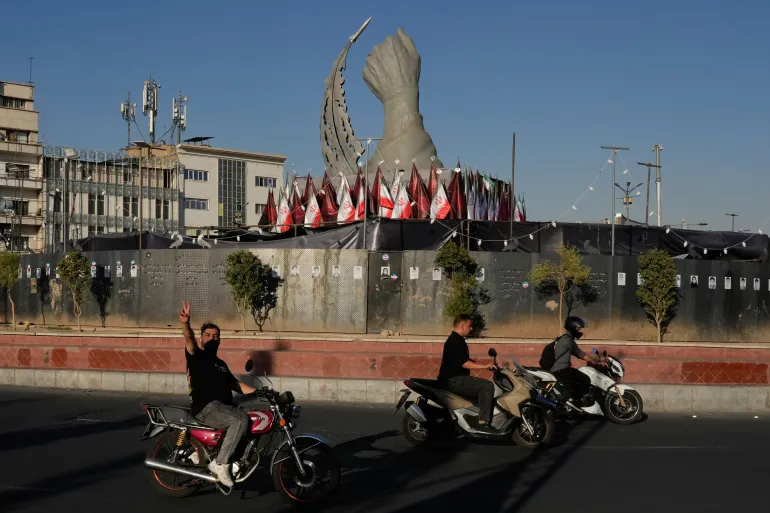
Iran has accused Washington of “piracy” as thousands rally in Tehran against the move, which targets shipping through the Strait of Hormuz.

Recommended Stories

list of 1 itemend of list

The Associated Press news agency reported on Tuesday that diplomatic efforts to revive US-Iran talks are continuing, with Pakistan offering to host a second round of negotiations in Islamabad this week.

Here is what we know:

In Iran

  • US blockade and protests: The US measures are now being enforced, prompting Iranian accusations of “piracy” and demonstrations in Tehran against the restrictions on maritime traffic.
  • Tehran calls blockade ‘illegal’: Iran’s armed forces condemned the move as unlawful, warning that targeting its ports could put shipping across the Gulf at risk.
  • IRGC warns of escalation: A Revolutionary Guard spokesperson said Iran still has “unused capabilities” and could deploy new tactics if the conflict deepens.
  • Tehran backs pope: Iran’s Parliament Speaker Mohammad Bagher Ghalibaf praised Pope Leo XIV for condemning the war, calling his stance “fearless”.
  • Russia withdraws nuclear staff: Russia has pulled most of its personnel from Iran’s only nuclear power plant, built with Moscow’s support, according to the head of the country’s atomic energy agency.

War diplomacy

  • Qatar urges mediation: Qatar’s Foreign Minister Sheikh Mohammed bin Abdulrahman bin Jassim Al Thani urged Iran and the US to engage constructively in mediation efforts.
  • Pakistan says truce ‘holding’: Prime Minister Shehbaz Sharif said the ceasefire between the US and Iran was “holding”, with efforts ongoing to reach a deal after weekend talks failed.
  • Shipping disruption grows: A UN spokesperson said there is “no military solution”, warning that instability in the Strait of Hormuz is worsening global economic fragility. About 20,000 vessels are reported stranded, with supply chains, including fertiliser, under strain.
  • Push to include Lebanon: The United Kingdom urged Lebanon’s inclusion in a broader US-Iran ceasefire framework, which currently excludes fighting involving Hezbollah.
  • Talks planned with Lebanon despite fighting: Israeli and Lebanese ambassadors will hold talks on Tuesday in Washington, DC, aimed at halting the war.
  • Hezbollah rejects negotiations: Hezbollah leader Naim Qassem on Monday urged Lebanon to cancel the planned meeting in Washington, reiterating his group’s opposition to any direct engagement with Israel.
  • Russia to accept Iran’s uranium: The Kremlin has repeated an offer to accept Iran’s enriched uranium as part of a potential agreement with the US. In comments carried by Russia’s state-owned RIA Novosti news agency, Kremlin spokesman Dmitry Peskov said the proposal “was voiced by President [Vladimir] Putin in contacts with both the United States and regional states”.

INTERACTIVE_LIVETRACKER_IRAN_US_ISRAEL_MIDDLEEAST_ATTACKS_April 13_2026_GMT1645-1776099548

In the US

  • Iran ‘wants a deal’: Trump said Iranian representatives had reached out to pursue a peace agreement after talks in Pakistan ended without a breakthrough. “They’d like to make a deal. Very badly,” he told reporters, without specifying who made contact.
  • No apology over pope remarks: Trump said he had “nothing to apologise for” after criticising Pope Leo XIV for calling for an end to the conflict. He described the pope as “weak” on key issues, including Iran.
  • Warning over Iranian vessels: Trump said US forces would destroy any Iranian “fast attack ships” approaching the naval blockade now in effect.
  • Domestic politics and war powers: Senate Democrats, led by Chuck Schumer, are pushing for another vote to curb Trump’s authority to wage war on Iran. Schumer criticised the campaign as an “epic fail”, citing rising US fuel prices, while previous efforts have been blocked by Republicans.
  • Arrests of protesters: Police in New York City have arrested about 90 protesters in Manhattan as they stopped traffic to protest against the war on Iran and the US’s arms sales to Israel. Jewish Voice for Peace, the group leading the protest, said those taken into custody included whistleblower Chelsea Manning, actor Hari Nef and New York City Council Member Alexa Aviles.
  • Trump rails at pope: Trump has doubled down on his criticism of Pope Leo XIV, saying the pontiff’s opposition to the war in Iran was “wrong” and accusing him of being “weak on crime”.

In Israel

  • Israel pushes ‘buffer zone’: Israel’s military is continuing ground operations and air raids across southern Lebanon, bulldozing buildings in border towns such as Naqoura as part of efforts to create a “buffer zone”.
  • Hezbollah steps up attacks: Fighters have launched rockets and drones at Israeli troops and vehicles in areas including Bint Jbeil and Biyyada.
  • Accusations against Israel: Hezbollah chief Qassem accused Israeli Prime Minister Benjamin Netanyahu of pursuing a “Greater Israel” agenda with US backing.
  • Tensions with Italy: Israel summoned Italy’s ambassador after Foreign Minister Antonio Tajani condemned attacks on Beirut as “unacceptable”, following reports of more than 300 deaths.
  • The Israeli military said one soldier has been killed and three others have been wounded during battle in southern Lebanon.

In Lebanon

  • Israel continues to attack Lebanon: Israel has intensified its invasion of southern Lebanon, as the death toll from Israeli attacks since March 2 rises to at least 2,089.
  • An Israeli drone attack has hit a car travelling near southern Lebanon’s Nabatieh, killing at least two people, the National News Agency reported on Tuesday. Our colleagues at Al Jazeera Arabic say Israeli forces have launched two raids on the towns of Machgharah and Sohmor in the eastern Bekaa Valley.
  • Public opinion divided: Lebanese citizens appear split about negotiations, with some expressing fatigue from the war and hoping for a diplomatic breakthrough, while others remain sceptical of Israel’s intentions and doubt any deal will hold.
  • Canadian Foreign Minister Anita Anand confirmed in a statement posted on X that a Canadian national has died in southern Lebanon. The minister did not provide details on the events that led to the Canadian’s death.

Strait of Hormuz and energy crisis

  • The Reuters news agency is reporting that a Chinese tanker sanctioned ⁠by Washington has passed through the Strait of Hormuz despite a ⁠US blockade on the waterway. The tanker and its ‌owner, Shanghai Xuanrun Shipping Co Ltd, were previously sanctioned by the US for dealing with Iran.
  • US Energy Secretary Chris Wright said oil prices could keep rising until “we get meaningful ship traffic through the Strait of Hormuz”.

Source link

Anti-war protesters arrested in New York urging end to Israel weapon sales | US-Israel war on Iran News

Police in New York have arrested around 100 anti-war protesters who were staging a sit-in outside the offices of Senators Chuck Schumer and Kirsten Gillibrand, demanding an end to US weapons sales to Israel. The demonstration comes as Senator Bernie Sanders pushes to block more than $600m worth of bombs bound for Israel’s military.

Source link

Energy prices rise despite Jones Act suspension by Trump | Shipping News

Shipping costs have increased by more than 10 percent in the past month due to the US-Israel war on Iran.

Shipping and oil costs have continued to surge a month after United States President Donald Trump issued a waiver for the Jones Act, a maritime law that bars foreign-flagged vessels from transporting goods between US ports.

The 60-day waiver came into effect on March 18, as the movement of energy supplies through the Strait of Hormuz, a strategic waterway that carries roughly 20 percent of the world’s oil and liquefied natural gas supply, was choked off on account of the US-Israel war on Iran.

Recommended Stories

list of 4 itemsend of list

Under the Jones Act, goods shipped between US ports must be carried on vessels that are US-built, US-flagged and mostly US-owned, limiting the number of tankers available for domestic shipments.

The Trump administration argued that the temporary waiver of the law would lower energy costs. As the waiver approaches the 30-day mark, it has had little impact on oil prices.

“It is estimated that it’s going to be about 3 cents on the East Coast and it might go up on the Gulf Coast, but these changes are so small that they’re overshadowed by the spikes in oil prices, and the oil prices keep going up,” Usha Haley, a professor of management at the Wichita State University, told Al Jazeera.

“It is minuscule, a drop in the bucket compared to the rise in oil prices.”

Oil prices have continued to rise amid the ongoing conflict, which is disrupting transit through the Strait of Hormuz.

Brent crude futures rose 4 percent on the day amid a US blockade of Iranian ports, reaching $98.91 after hitting $101.03 earlier in the day. US West Texas Intermediate (WTI) crude rose $2.53, or 2.6 percent, to $99.10.

The US Navy imposed a blockade of Iranian ports on Monday to prevent the movement of oil to and from Iran after talks between US and Iranian negotiators failed to reach an agreement.

The strain is also hitting consumers at the petrol pump in the US. The American Automobile Association reports that the average price of gas is $4.125 per gallon (3.78 litres), compared with $3.63 at this time last month.

Meanwhile, shippers have adapted their routes, with more than 34,000 ships diverting from the strait over the past month.

The Containerized Freight Index, the benchmark for shipping container costs, jumped more than 10 percent over the last month, and is up more than 35 percent from this time last year, amid pressure on the market to find alternative shipping strategies.

In March, Maersk and Hapag-Lloyd suspended vessel routes through the strait, a waterway connecting the Gulf of Oman and the Gulf.

Also in March, within days of the start of the US-Israel war on Iran, several major vessel insurers cancelled war risk coverage for ships travelling through the waterway, including Norwegian insurers Gard and Skuld, as well as the United Kingdom’s NorthStandard, dissuading ship owners from going through the Gulf.

Since then, even though maritime insurance has become available – at 10 times the price as before the war on Iran – fuel prices are expected to normalise only once traffic through the strait goes back to pre-war levels, experts have said.

Source link

Naval Blockade Of Iran Now In Full Effect

The U.S. military has said it will start enforcing a blockade of all Iranian Gulf ports and coastal areas today. The move follows on from U.S. President Donald Trump’s earlier promise to close off the Strait of Hormuz, the strategic shipping route that Iran has already effectively shut to the vast majority of maritime traffic in response to U.S.-Israeli strikes. It comes after negotiators from both sides failed to reach a deal to end the war, which began on February 28 but is currently under a two-week truce.

U.S. Central Command (CENTCOM) said it would start the blockade at 10:00 a.m. ET, effectively taking control of all maritime traffic linked to Iran.

“The blockade will be enforced impartially against vessels of all nations entering or departing Iranian ports and coastal areas, including all Iranian ports on the Arabian Gulf and Gulf of Oman,” CENTCOM said. “CENTCOM forces will not impede freedom of navigation for vessels transiting the Strait of Hormuz to and from non-Iranian ports.”

Reuters reports that the U.S. military sent the following message to seafarers providing more details of the blockade:

“Any vessel entering or departing the blockaded area without authorization is subject to interception, diversion, and capture,” the note reportedly said. “The blockade will not impede neutral transit passage through the Strait of Hormuz to or from non-Iranian destinations.”

We have reached out to CENTCOM for more details about how this will be enforced and what assets will be involved. In the meantime, The Wall Street Journal reports that “more than 15 U.S. warships” are currently involved in the operation.

Meanwhile, the U.K. Maritime Trade Operations (UKMTO) center has issued the following guidelines to ships:

  • The restrictions encompass the entirety of the Iranian coastline, including ports and energy
    infrastructure.
  • Transit passage through the Strait of Hormuz to or from non-Iranian destinations is not
    reported to be impeded by these measures; however, vessels may encounter military
    presence, directed communications, or right-of-visit procedures during passage.
  • Neutral vessels currently within Iranian ports have been granted a limited grace period to
    depart.

In a lengthy post on his Truth Social platform, Trump said Sunday that the U.S. Navy was going to start “BLOCKADING any and all Ships trying to enter, or leave, the Strait of Hormuz.”

US President Donald Trump says that the US is going to start “BLOCKADING any and all Ships trying to enter, or leave, the Strait of Hormuz” as Islamabad talks fail. https://t.co/GCmLstdLKR

— Sidhant Sibal (@sidhant) April 12, 2026

“I have also instructed our Navy to seek and interdict every vessel in International Waters that has paid a toll to Iran. No one who pays an illegal toll will have safe passage on the high seas,” Trump said.

“Any Iranian who fires at us, or at peaceful vessels, will be BLOWN TO HELL!” he continued.

In a statement today, maritime data and intelligence company Lloyd’s List Intelligence said “all traffic” through the strait had indeed stopped after Trump announced the blockade. It added that two vessels that were leaving the strait turned around after the post.

There has been some movement of vessels through the strait since the ceasefire was announced, but this has been extremely limited, and these ships are still exposed to risk.

Trump:

34 Ships went through the Strait of Hormuz yesterday, which is by far the highest number since this foolish closure began. pic.twitter.com/Wf2chAqHdS

— Clash Report (@clashreport) April 13, 2026

Referencing Iranian mines in these waters, Trump told Fox News Sunday that “it won’t take long to clean out the strait” and that “numerous countries are going to be helping us,” adding that the United Kingdom and other nations were sending minesweepers. At this stage, we are still awaiting confirmation of non-U.S. military participation in the blockade.

Trump:

NATO countries say they want to come, and they want to help with the strait, and it won’t take long to clean it out.

So we’re going to clean out the strait. pic.twitter.com/3xGW30ekvm

— Clash Report (@clashreport) April 12, 2026

Last week, the Iranian Ports and Maritime Organization published a graphic instructing ships to follow designated entry and exit routes to transit the strait. The organization warned that ships ran the risk of hitting mines outside of these routes. A spokesperson from Lloyd’s List told the BBC: “We know Iran is essentially still in control of the strait, and the assumption is that ship owners will still need to seek permission from the IRGC… and how that’s going to work is still not clear.”

Infographic with a map showing the two alternative maritime routes imposed on ships by Iran, which has warned of sea mines on the usual route through the Strait of Hormuz (Graphic by Valentina BRESCHI and Sylvie HUSSON / AFP via Getty Images)
Infographic with a map showing the two alternative maritime routes imposed on ships by Iran, which has warned of sea mines on the usual route through the Strait of Hormuz. Graphic by Valentina BRESCHI and Sylvie HUSSON / AFP VALENTINA BRESCHI; SYLVIE HUSSON

While Trump said the U.S. military would cooperate with other countries to halt maritime traffic through the strait, NATO allies said on Monday they would not take part in the blockade, Reuters reports. Instead, those countries have reportedly indicated they would only consider involvement after the fighting ends.

NATO allies refuse to join Trump’s Strait of Hormuz blockade

(Reuters) – The United States’ NATO allies said on Monday they would not get involved in President Donald Trump’s plan to blockade the Strait of Hormuz, further ratcheting up tensions within the increasingly fragile…

— Phil Stewart (@phildstewart) April 13, 2026

One country that stands behind the blockade is Israel. Benjamin Netanyahu, Israel’s prime minister, said on Monday that he supports Trump’s decision to impose a naval blockade on Iran and that Tel Aviv is coordinating with Washington on the situation.

“Iran violated the rules [of the peace talks in Pakistan], President Trump decided to impose a naval blockade,” Netanyahu said at a cabinet meeting, according to a video statement released by his office.

Netanyahu:

Since Iran violated the rules, Trump decided to impose a blockade, a naval siege, and we of course support this firm position. pic.twitter.com/BhpoAOdDp6

— Clash Report (@clashreport) April 13, 2026

In response, Iran’s Islamic Revolutionary Guard Corps (IRGC) warned that “approaching military vessels to the Strait of Hormuz is considered a violation of the ceasefire.”

An Iranian Armed Forces spokesperson said on Monday that restricting vessels in international waters was illegal and “amounts to piracy.”

Iran would decisively implement a “permanent mechanism” to control the Strait of Hormuz, the spokesman added.

“Security in the Persian Gulf and the Sea of Oman is either for everyone or for NO ONE,” the military said, according to the state broadcaster IRIB. “NO PORT in the region will be safe.”

While unclear at this point if related or not, the Ambrey maritime security firm told TWZ that a merchant vessel had sighted an explosion and a fire in the Fateh Oil Field, approximately 45 nautical miles northwest of the port of Jebel Ali, in the United Arab Emirates.

“Video footage and still imagery showed that the fire extended above the horizon to a significant altitude, Ambrey said. “The vessel did not report hearing any distress calls. At the time of writing, no casualties, damage to merchant vessels, or damage to port infrastructure had been reported,” the security firm added.

Iran’s parliamentary speaker, Mohammad Bagher Ghalibaf, took to X with a message to the United States yesterday, posting a map showing gas prices in Washington, DC, and the words: “Enjoy the current pump figures. With the so-called ‘blockade’, soon you’ll be nostalgic for $4–$5 gas.”

Enjoy the current pump figures. With the so-called ‘blockade’, Soon you’ll be nostalgic for $4–$5 gas.

ΔO_BSOH>0 ⇒ f(f(O))>f(O) pic.twitter.com/rVxlC6vFWG

— محمدباقر قالیباف | MB Ghalibaf (@mb_ghalibaf) April 12, 2026

Earlier, Ghalibaf said Trump’s new threats would not affect the Iranian nation: “If you fight, we will fight … We will not bow to any threats.”

Iran’s speaker Mohammad Bagher Ghalibaf, responds to Trump:
If you fight, we fight, and if you come with reason, we deal with reason. We will not succumb to any threat. Let them test our will once again so we can give them an even greater lesson.

— Ali Hashem علي هاشم (@Alihashem) April 12, 2026

Trump claims that the U.S. military has already “obliterated” 158 Iranian ships. “Iran’s navy is laying [sic] at the bottom of the sea,” he wrote on his social media platform Truth Social.

Trump:

Iran’s Navy is laying at the bottom of the sea, completely obliterated – 158 ships.

What we have not hit are their small number of, what they call, “fast attack ships,” because we did not consider them much of a threat.

Warning: If any of these ships come anywhere… pic.twitter.com/HPqcaSLiSs

— Clash Report (@clashreport) April 13, 2026

The Wall Street Journal previously warned that, while the United States and Israel have wiped out much of Iran’s conventional navy, the fleet of the Islamic Revolutionary Guard Corps, which Tehran relies on to exert control over the Strait of Hormuz, remains largely intact.

The paramilitary IRGC maintains a large fleet of smaller, more agile vessels built to dominate the strategic waterway using missiles, mines, and otherwise to harass commercial shipping.

Farzin Nadimi, an Iran-focused senior fellow with the Washington Institute, a U.S.-based think tank, told the WSJ that more than 60 percent of the IRGC’s fast-attack craft and speedboat fleet remains intact and that it continues to pose a threat.

Reflecting on Iran’s “fast attack ships,” Trump said they are not considered “much of a threat” to the blockade. He threatened to take down these ships using the same “system of kill” used against “drug dealers on boats,” a reference to U.S. military operations in the Caribbean.

“Warning: If any of these ships come anywhere close to our BLOCKADE, they will be immediately ELIMINATED, using the same system of kill that we use against the drug dealers on boats at Sea.” – President Donald J. Trump 🇺🇸 pic.twitter.com/Gj9nFCfG8T

— The White House (@WhiteHouse) April 13, 2026

Since the conflict began on February 28, the strait’s geography has enabled Iran to use it as a strategic lever, restricting access through the narrow passage and driving up oil prices as a result. Tehran has also been demanding large payments from some vessels for safe passage.

By enforcing the blockade, Trump could deprive the Iranian government of a key source of income, though it also runs the risk of pushing global oil and gas prices even higher.

This also ties in with reports that Trump and his advisers have received warnings from officials and corporate leaders about the potential hit on the U.S. economy from a prolonged war.

NEW: Inside the meetings + calls where President Trump and his team were given clear indicators that the economy (possible rise in prices) could take a hit if the war in Iran is prolonged.

Treasury Secretary Bessent and the president discussed various measures the Treasury could…

— Brian Schwartz (@schwartzbWSJ) April 12, 2026

On the other hand, there remains a question about just how significant an effect on Iran a blockade of this kind will have.

According to Lars Jensen, the chief executive of analysts Vespucci Maritime, in the near term, the blockade of the strait will only halt “a very tiny trickle of vessels.” Meanwhile, any other ships paying tolls to Iran already face sanctions for funding the regime.

While the blockade is calculated to help pressure Iran into making a deal on American terms, Trump has said he is unconcerned about whether Tehran returns to negotiations. “I don’t care if they come back or not,” he said on Sunday. “If they don’t come back, I’m fine.”

China is becoming an increasing factor in the crisis in the Middle East. With each passing day, Beijing’s energy situation becomes more of a problem, with impacts from the strangulation of oil out of the Strait becoming more pronounced. Iran is a key supplier of oil to China.

In a statement yesterday, before the blockade came into force, the Chinese defense minister, Adm. Dong Jun, said that his country was “monitoring the situation in the Middle East. Our ships are moving in and out of the waters of the Strait of Hormuz,” he added. “We have trade and energy agreements with Iran. We will respect and honor them and expect others to not meddle in our affairs. Iran controls the Strait of Hormuz, and it is open for us.”

CHINA BACKS IRAN

“We are commited for peace & stability in the world. We are monitoring the situation in the middle east. Our ships are moving in and out of the waters of Strait of Hormuz. We have trade & energy agreements with Iran. We will respect & honour them and expect… pic.twitter.com/7tgWQOo9Ib

— China in English (@En_chinaNews) April 13, 2026

CENTCOM declined to respond to our questions about the current rules of engagement or what would happen should a Chinese vessel try to pass through the strait.

According to The Wall Street Journal, citing officials and people familiar with the situation, Trump and his advisers are looking at resuming limited military strikes in Iran in addition to the blockade of the strait. The same officials reportedly said that a full-fledged bombing campaign is considered less likely, “given the prospect of further destabilizing the region and the president’s aversion to prolonged military conflicts.”

BREAKING: President Trump is looking at resuming limited military strikes in Iran, according to officials and people familiar with the situation. -WSJ

Trump could also resume a full-fledged bombing campaign pic.twitter.com/CUr0nFC0h9

— Faytuks News (@Faytuks) April 12, 2026

UPDATES:

UPDATE: 4:40 PM EDT –

President Trump’s remarks on Iran during an impromptu White House press appearance on Monday appeared to dampen expectations for a swift diplomatic resolution to the conflict.

“They will never have a nuclear weapon,” Trump told reporters shortly after accepting a DoorDash delivery of McDonald’s, staged to highlight his tax policy eliminating levies on tips.

“If they don’t agree, there’s no deal. There’ll never be a deal. Iran will not have a nuclear weapon, and we’re going to get the dust back. We’ll get it back, either we’ll get it back from them, or we’ll take it.”

.@POTUS: “Iran will not have a nuclear weapon… If they don’t agree, there’s no deal. There’ll never be a deal. Iran will not have a nuclear weapon and we’re going to get the dust back — either we’ll get it back from them or we’ll take it.” pic.twitter.com/SNani9M8hT

— Rapid Response 47 (@RapidResponse47) April 13, 2026

A U.S. official said “there is continued engagement between the U.S. and Iran and forward motion on trying to get an agreement,” multiple outlets reported.

CNN’s coverage of the ongoing U.S.-Iran conflict included a direct quote from the official, while a Reuters alert similarly referred to continued engagement, also attributing the information to an official.

UPDATE: 3:23 PM EDT –

AEI estimates Epic Fury costs between $25 and $35 billion.

As of the April 8th ceasefire, AEI’s Elaine McCusker estimates the cost of the war in Iran to be between $25 and $35 billion.

Read her tally of Operation Epic Fury’s cost below.https://t.co/vgFf9kA7mO

— American Enterprise Institute (@AEI) April 13, 2026

UPDATE: 1:30 PM EDT –

The United States asked that Iran agree to a 20-year moratorium on uranium enrichment during talks in Pakistan this weekend, Axios reported Monday.

Citing a source familiar with the situation as well as a U.S. official, Axios said that Iran responded with a proposed “single-digit” timeframe.

☢️🇺🇸🇮🇷The U.S. asked Iran to accept a 20-year moratorium on uranium enrichment during negotiations in Islamabad over the weekend, according the a U.S. official and a source with knowledge. My story on @axioshttps://t.co/rZZfAy72bc

— Barak Ravid (@BarakRavid) April 13, 2026

Bloomberg reports that it is unclear where Trump got the figure of 34 ships passing through the strait yesterday, saying that it has a smaller figure.

Bloomberg: “It was not clear where the president got that exact figure, as it appears to be higher than the number tracked by Bloomberg” pic.twitter.com/RWp0KkjJEi

— OSINTtechnical (@Osinttechnical) April 13, 2026

Trump says Iran wants to make a deal and that he will not come to any agreement that allows Tehran to have a nuclear weapon.

He said that Iran had “called this morning” and that “they’d like to work a deal.”

The aircraft carrier USS George H.W. Bush has reportedly passed through the Strait of Gibraltar and is expected to arrive in the eastern Mediterranean before the end of the week. The carrier will take the place of the USS Gerald R. Ford, which suffered a fire while underway in the Middle East, and is now being repaired at Souda Bay in Crete. You can keep up to date on these movements using TWZ’s weekly carrier tracker monitoring America’s flattop fleet, including deployed Carrier Strike Groups and Amphibious Ready Groups, using publicly available open-source information.

Carrier Tracker As of April 12, 2026

Trump orders U.S. Navy to blockade Strait of Hormuz as a third carrier strike group steams towards the CENTCOM area of responsibility.https://t.co/fxxOfsHfkE

— The War Zone (@thewarzonewire) April 13, 2026

U.K. Prime Minister Keir Starmer on Monday reaffirmed that Britain will not take part in any blockade of the Strait of Hormuz.

Speaking to the BBC, Starmer said the government’s priority is ensuring the strait is fully reopened.

“All the time the strait is shut or not free for navigation in the way it should be, that means oil and gas is not getting to market, that means the price is going up, and everybody listening to this is facing higher energy bills,” Starmer said. “I don’t want that to happen. I want their energy bills to be stabilized and lower.”

The ongoing closure of the Strait of Hormuz is deeply damaging. Getting global shipping moving is vital to ease cost of living pressures.

The UK has convened more than 40 nations who share our aim to restore freedom of navigation.

This week the UK and France will co-host a…

— Keir Starmer (@Keir_Starmer) April 13, 2026

After the Islamabad talks, it is clear that the Iranian nuclear issue remains the top sticking point. In a cabinet meeting today, Israel’s prime minister, Benjamin Netanyahu, said he had spoken to U.S. Vice President JD Vance about the negotiations. “The explosion came from the American side, which could not tolerate Iran’s blatant violation of the agreement to enter the negotiations,” Netanyahu said. “The agreement was that they would cease fire, and the Iranians would immediately open the gates. They did not do that. The Americans could not accept that. He also made it clear to me that the main issue on the agenda for President Trump and the United States is the removal of all enriched material, and ensuring that there is no more enrichment in the coming years, and that could be in decades, no enrichment within Iran.”

Again, on the nuclear issue, Kremlin spokesman Dmitry Peskov told reporters on Monday that Russia is ready to take in Iran’s highly enriched uranium as part of a future peace deal with the United States.

Russia is ready to take in Iran’s enriched uranium as part of a future peace deal with the United States, the Kremlin says

— Faytuks Network (@FaytuksNetwork) April 13, 2026

Israel’s military announced on Monday that it has started what it described as targeted ground operations in the Bint Jbeil area of southern Lebanon.

Although Iran and Pakistan claim that the temporary ceasefire brokered by Pakistan last week also covers Lebanon, Netanyahu stated that there is “no ceasefire in Lebanon” and that Israel will continue to strike Hezbollah “with full force.”

David Ignatius, an associate editor and columnist for The Washington Post, has provided his prediction on what might happen after the failure to reach a deal in Islamabad over the weekend. Ignatius writes:

“After talking Sunday with people close to the negotiations, my sense is that the Islamabad impasse won’t necessarily mean a return to war. The blockade is a pressure tactic, to be sure, but not primarily a military one. Trump has no appetite for further armed conflict. He knows that the upsides are limited and the ‘tail risk,’ as financial traders like to say, is large. His aim instead is to put a severely battered Iran into an economic vise to see if its leaders will set a different course in a big, comprehensive deal.”

David Ignatius: “After talking Sunday with people close to the negotiations, my sense is that the Islamabad impasse won’t necessarily mean a return to war. The blockade is a pressure tactic, to be sure, but not primarily a military one. Trump has no appetite for further armed…

— Karim Sadjadpour (@ksadjadpour) April 12, 2026

Meanwhile, citing a regional source and a U.S. official, Axios reports that Pakistani, Egyptian, and Turkish mediators will continue talks with the United States and Iran in the coming days, “in an effort to bridge the remaining gaps and reach a deal to end the war.”

Pakistani Prime Minister Shehbaz Sharif also indicated on Monday that efforts are still being made to resolve the conflict.

ISLAMABAD, April 13 (Reuters) – Full efforts are still being made to resolve the conflict between the U.S. and Iran, Pakistani Prime Minister Shehbaz Sharif said on Monday, a day after talks between the two sides, held in Islamabad, ended without agreement.

— Idrees Ali (@idreesali114) April 13, 2026

Trump launched a sharp attack on Pope Leo XIV over the weekend, calling him “weak on crime and terrible for foreign policy” and accusing him of harming the Catholic Church. “Leo should get his act together as Pope,” he wrote on Truth Social. The criticism came after Leo condemned the “delusion of omnipotence” as driving the U.S.-Israel war in Iran and urged political leaders to halt the fighting and pursue negotiations.

“Pope Leo is WEAK on Crime,” begins a Sunday evening message from the President.

Also: “Leo should get his act together as Pope.” pic.twitter.com/2Bl1jTOsc0

— Niall Stanage (@NiallStanage) April 13, 2026

“I have no intention to debate with [Trump],” Leo said today. “The message is the same: to promote peace,” he added.

Contact the author: thomas@thewarzone.com

Thomas is a defense writer and editor with over 20 years of experience covering military aerospace topics and conflicts. He’s written a number of books, edited many more, and has contributed to many of the world’s leading aviation publications. Before joining The War Zone in 2020, he was the editor of AirForces Monthly.


Source link

EU: No peace possible while “Lebanon is in flames” | Israel attacks Lebanon

NewsFeed

European Commission President Ursula von der Leyen warned that a potential closure of the Strait of Hormuz and ongoing Israeli strikes on Lebanon threaten regional stability after a meeting in Brussels on the fallout from the Iran conflict. Al Jazeera’s Abdullah Elshamy reports on the bloc’s response.

Source link

Bahrain summons Iraqi envoy as pro-Iranian attacks persist in Gulf | US-Israel war on Iran News

Move reflects regional alarm over attacks by pro-Iranian groups based in Iraq, which continue despite ceasefire.

Bahrain has summoned an Iraqi envoy over drone attacks launched at the kingdom and other states in the region, which persist despite the US-Iran ceasefire.

The summoning of the diplomat on Monday followed similar action by Saudi Arabia the previous day, signalling growing regional concern over the activities of pro-Iranian groups based in Iraq and complicating Baghdad’s efforts to rebuild ties with its Arab neighbours.

Recommended Stories

list of 4 itemsend of list

Bahrain’s Ministry of Foreign Affairs strongly condemned the “continued malicious drone attacks” launched from Iraq towards Bahrain and several Gulf Cooperation Council countries, the state news agency BNA reported.

The ministry said Abdullah bin Ali Al Khalifa, director general of bilateral relations, had delivered an official protest note during the meeting with the Iraqi charge d’affaires, Ahmed Ismail al-Karawi.

The diplomatic missive called on Baghdad to address “these threats and attacks urgently and responsibly”.

Launchpad

During the United States-Israel war on Iran, Iraq has become a staging ground for a secondary conflict as drones and missiles are launched by Iran-aligned armed groups repeatedly targeting the Gulf states and Jordan.

US interests in Iraq also have been targeted, particularly the embassy in Baghdad.

Last month, several Gulf countries and Jordan demanded in a joint statement that Baghdad act immediately to stop attacks from its territory by Iran-aligned groups.

The statement was signed by Bahrain, Jordan, Kuwait, Qatar, Saudi Arabia and the United Arab Emirates.

Baghdad has categorically rejected the use of its territory to target Gulf states or Jordan, adding that it is taking necessary measures “in accordance with the constitution and the law”.

The attacks are severely testing Iraq’s painstakingly rebuilt ties with its Arab neighbours, leading Baghdad to issue a statement in which it offered “full readiness” to receive any information or evidence regarding the attacks to address them “responsibly and swiftly”.

Iran-aligned groups in Iraq had announced their commitment to a two-week Iran-US ceasefire that has been in place since dawn on Wednesday, and said they were suspending their actions towards the Gulf countries.

However, just hours after the ceasefire was announced, several Gulf nations reported missile and drone attacks on their territories.

Source link

What are the pros and cons of Trump’s Iranian naval blockade? | US-Israel war on Iran

NewsFeed

What does Donald Trump’s naval blockade of Iranian ports look like and can it achieve what the US president wants? It is hard to know when the planning appears to have been done on the fly, according to war studies lecturer Samir Puri.

Source link

UK Breaks with US on Iran Strategy, Refuses to Back Strait Blockade

Britain has publicly distanced itself from Washington’s escalating strategy against Iran, with Prime Minister Keir Starmer making clear that the UK will not support any blockade in the Gulf.

Speaking after the United States announced sweeping restrictions on Iranian shipping, Starmer emphasized that Britain’s priority is not enforcement but de-escalation. He stressed the importance of keeping vital trade routes open rather than contributing to further disruption.

What Starmer Said

Starmer’s message was direct. The UK will not be drawn into the conflict and will not support a blockade of the Strait of Hormuz.

Instead, Britain is focused on ensuring the strait remains open. While confirming the presence of British minesweepers in the region, he made clear their role is defensive and aimed at maintaining safe passage, not enforcing restrictions.

Contrast with Washington

The stance puts London at odds with the approach taken by Donald Trump.

The U.S., through United States Central Command, has announced a broad blockade targeting Iranian maritime traffic. Trump has gone further, warning that vessels linked to Iranian payments could be intercepted and threatening force against any resistance.

While Washington frames the move as pressure on Tehran, Britain is signaling concern about the wider consequences.

Why the Strait Matters

The Strait of Hormuz remains one of the most critical energy routes in the world. A significant share of global oil supply passes through it, meaning even partial disruption can send shockwaves through markets.

For the UK, keeping this route open is not just a regional issue but a global economic priority.

Implications: Cracks in Western Unity

Britain’s refusal highlights a growing divide among Western allies on how to handle the Iran crisis.

The U.S. is pursuing a strategy of maximum pressure, while the UK is prioritizing stability and the prevention of further escalation. This divergence could complicate coordinated action and weaken the overall Western response.

Analysis: A Strategic Balancing Act

Starmer’s position reflects a careful calculation. Supporting the blockade risks entangling Britain in a wider conflict and worsening global economic strain. Opposing it, however, creates visible distance from a key ally.

By focusing on keeping the strait open, the UK is attempting to balance security concerns with economic stability, while avoiding direct confrontation.

Britain’s stance sends a clear signal. Even close allies are not fully aligned on how far to go against Iran.

As tensions rise, that lack of unity could shape the next phase of the crisis just as much as the actions taken in the Gulf itself.

With information from Reuters.

Source link

Pakistan eyes narrow window to resuscitate US-Iran talks after breakdown | US-Israel war on Iran News

Islamabad, Pakistan – More than 12 hours of face-to-face negotiations between the United States and Iran ended without agreement in Islamabad on Sunday, leaving a fragile two-week ceasefire as the only barrier between diplomacy and a return to war.

Pakistan, which spent weeks positioning itself as a mediator and succeeded in bringing both sides into the same room, emerged with its role intact. But officials acknowledge the harder phase now begins — getting American and Iranian negotiators back into talks before their differences explode into full-fledged war again.

Recommended Stories

list of 4 itemsend of list

“Pakistan has been and will continue to play its role to facilitate engagements and dialogue between the Islamic Republic of Iran and the United States of America in the days to come,” Pakistan’s Deputy Prime Minister and Foreign Minister Ishaq Dar said in a statement after the conclusion of the talks.

The talks, the highest-level direct engagement between Washington and Tehran since the 1979 Islamic Revolution, faltered over differences surrounding Iran’s nuclear programme.

“The simple fact is that we need to see an affirmative commitment that they will not seek a nuclear weapon, and they will not seek the tools that would enable them to quickly achieve a nuclear weapon,” said US Vice President JD Vance, who led the American delegation alongside special envoy Steve Witkoff and US President Donald Trump’s son-in-law Jared Kushner.

However, Vance left a narrow opening for the resumption of talks.

“We leave here with a very simple proposal, a method of understanding that is our final and best offer. We’ll see if the Iranians accept it,” Vance said, tapping the podium for emphasis, before ending his brief remarks, which lasted for less than five minutes.

Pakistani and Iranian sources confirmed that the Iranian delegation met senior Pakistani officials later on Sunday before departing for Tehran, though details of those discussions remain unclear.

What is clear is that Pakistan isn’t giving up yet.

Washington’s red lines

US officials said that Iran had entered negotiations misreading its leverage, believing it held advantages that, in Washington’s assessment, it did not.

.
US Vice President JD Vance speaks during a news conference after meeting with representatives from Pakistan and Iran, on Sunday, April 12, 2026, in Islamabad, Pakistan [Jacquelyn Martin/Pool via Reuters]

According to these officials, Vance spent much of his time during the talks correcting what they described as Iranian misperceptions about the US position — asserting that no deal would be possible without a full commitment on the nuclear issue.

Officials also suggested that Trump’s subsequent announcement of a blockade in the Strait of Hormuz was not an impulsive reaction, but a pre-planned step aimed at removing the waterway as an Iranian bargaining tool and forcing the nuclear issue back to the centre of any future talks.

But the US officials, speaking on background, also acknowledged that the gulf in the positions between Washington and Tehran that they failed to bridge extended to issues beyond Iran’s nuclear programme.

In essence, they said, the two sides failed to agree on six key points: ending all uranium enrichment; dismantling major enrichment facilities; removing Iran’s stockpile of highly enriched uranium; accepting a broader regional security framework involving US allies; ending funding for groups Washington designates as “terrorist” organisations, including Hamas, Hezbollah and the Houthis; and fully reopening the Strait of Hormuz without tolls.

Hours after the talks ended, Trump acknowledged partial progress, but underscored the central impasse.

“The meeting went well, most points were agreed to, but the only point that really mattered, NUCLEAR, was not,” he wrote on Truth Social.

“Effective immediately, the United States Navy, the Finest in the World, will begin the process of BLOCKADING any and all Ships trying to enter, or leave, the Strait of Hormuz,” Trump said. “Iran will not be allowed to profit off this Illegal Act of EXTORTION.”

Iran has effectively controlled access to the Strait of Hormuz, through which roughly 20 percent of global oil supplies pass, since the US-Israeli attacks began on February 28.

Iran’s Islamic Revolutionary Guard Corps (IRGC) has imposed what analysts describe as a de facto toll system, requiring vessels to secure clearance codes and transit under escort through a controlled corridor.

The disruption has pushed oil prices above $100 per barrel at times, unsettling global markets and placing sustained pressure on energy-importing countries across Asia and Europe.

Tehran has framed its control of the strait as both a security measure and a key negotiating lever, one it has shown little willingness to relinquish without a broader settlement.

Tehran’s point of view

Iran’s account of the breakdown differed sharply.

In a post on X early on April 13, after returning to Tehran, Iran’s Foreign Minister Abbas Araghchi said his country had engaged in “good faith”, only to face shifting demands.

Pakistani Prime Minister Shehbaz Sharif meets with Iranian Parliament Speaker Mohammad Bagher Ghalibaf, as delegations from the United States and Iran are expected to hold peace talks, in Islamabad, Pakistan, April 11, 2026. Pakistan's Prime Minister Office/Handout via REUTERS THIS IMAGE HAS BEEN SUPPLIED BY A THIRD PARTY. BEST QUALITY AVAILABLE. REFILE - ADDING NATIONALITY 'PAKISTANI PRIME MINISTER SHEHBAZ SHARIF'.
Iranian Parliament Speaker Mohammad Bagher Ghalibaf, left, meets with Pakistani Prime Minister Shehbaz Sharif, right, in Islamabad on April 11, 2026 [Handout/Prime Minister’s Office via Reuters]

“When just inches away from an Islamabad MoU, we encountered maximalism, shifting goalposts, and blockade,” he wrote. “Zero lessons learned. Good will begets good will. Enmity begets enmity.”

The reference to an “Islamabad MoU”, a memorandum of understanding, was the clearest public signal yet that the two sides had come closer to a formal agreement than either government had previously acknowledged.

Iran’s Parliament Speaker Mohammad Bagher Ghalibaf, who led the country’s delegation, said his team had proposed “forward-looking initiatives”, but failed to secure trust.

“Due to the experiences of the two previous wars, we have no trust in the opposing side,” he wrote on Sunday.

Foreign Ministry spokesperson Esmaeil Baghaei also pointed to partial progress but unresolved differences.

“On some issues we actually reached mutual understanding, but there was a gap over two or three important issues and ultimately the talks didn’t result in an agreement,” he said.

Tehran’s key demands, including an end to Israeli strikes on Lebanon, the release of $6bn in frozen assets, guarantees on its nuclear programme and the right to charge vessels transiting the Strait of Hormuz, remained unmet.

Iran’s ambassador to Pakistan, Reza Amiri Moghadam, however, offered a more measured view — suggesting that Tehran was not closing the window on talks.

“The Islamabad Talks is not an event but a process,” he wrote in his message on X on Sunday. “The Islamabad Talks laid the foundation for a diplomatic process that, if trust and will are strengthened, can create a sustainable framework for the interests of all parties.”

Pakistan’s balancing act

For Pakistan, analysts say, the outcome represents a setback but not a failure.

Officials were careful to describe the talks as “an important opening step in a continuing diplomatic process”, stressing that issues of such complexity cannot be resolved in a single round.

The emphasis, they said, was on keeping the channel open.

Muhammad Obaidullah, a former Pakistan Navy commodore who has served in Iran as a diplomat, said expectations of a breakthrough were always unrealistic.

“The mere fact of bringing both parties face to face is a significant diplomatic achievement in itself,” he told Al Jazeera. “The diplomacy is not dead.”

Ishtiaq Ahmad, professor emeritus of international relations at Quaid-i-Azam University in Islamabad, went further.

“The talks did not collapse; they concluded without agreement but with a defined US offer on the table and the channel still intact,” he said.

“Pakistan’s role was to move the crisis from escalation to structured engagement, which it achieved. The absence of convergence reflects structural differences between the US and Iran, not a failure of mediation.”

Both Trump and Iranian officials have praised Pakistan’s Prime Minister Shehbaz Sharif and Chief of Army Staff Field Marshal Asim Munir for their efforts to secure the ceasefire, and for hosting the talks in Islamabad. That, say analysts, suggests that they remain open to further Pakistan-brokered negotiations.

Sahar Baloch, a Germany-based scholar of Iran, said that trust remains Pakistan’s most valuable asset.

“The real test of credibility is not preventing breakdowns, but remaining relevant after them,” she said.

U.S.-Iran peace talks in Islamabad
A man walks past a billboard announcing peace negotiations as delegations from the United States and Iran hold high-level talks in Islamabad, Pakistan, April 11, 2026 [Asim Hafeez/Reuters]

Fragile ceasefire

The immediate threat to Pakistan’s role comes from the evolving situation in the Strait of Hormuz and in Lebanon.

Iran has already warned that continued Israeli strikes on Lebanon could render negotiations meaningless. Iran’s President Masoud Pezeshkian has framed such attacks as a direct challenge to the ceasefire.

Trump’s blockade announcement now adds pressure from a second front.

Ahmad, a former Pakistan chair at Oxford University, warned that a collapse of the truce would sharply narrow diplomatic options.

“If the ceasefire collapses, the immediate consequence is the loss of the diplomatic window,” he said. “A second round becomes far more difficult because both sides would return to negotiating under active escalation, where positions tend to harden rather than converge.”

Obaidullah drew a historical parallel with the US naval quarantine of Cuba during the 1962 missile crisis. What if China were to use its own ships to import Iranian oil? Would the US attack them?

“The world will again be watching who blinks first,” Obaidullah said. “However, it may turn into a far greater conflict if neither side does.”

The Cuban Missile Crisis of October 1962 brought the US and the Soviet Union to the brink of nuclear war, after Washington discovered Moscow had installed nuclear missiles on Cuban soil, within striking distance of the American mainland.

The US blocked the Soviets from providing more equipment to Cuba, and eventually, a diplomatic settlement was reached, with the Soviets agreeing to withdraw the missiles in exchange for a US pledge not to invade Cuba.

Baloch, the Berlin-based scholar, agreed that the situation remains volatile.

“The ceasefire risks becoming more symbolic than substantive,” she said. “But paradoxically, escalation can sometimes force a return to talks, even if under more urgent and less favourable conditions.”

What is the road ahead?

Pakistan’s room for manoeuvring is also shaped by its economic fragility.

The disruption in the Strait of Hormuz has driven up energy prices, compounding pressures on an economy already under strain before the conflict.

Ahmad said this creates both urgency and limits.

“Economic exposure, especially to energy shocks and external financing, creates urgency for Pakistan to prevent a prolonged conflict,” he said.

“But it also reinforces a constraint: Pakistan cannot afford escalation with either side. Its leverage is not coercive; it is positional. It comes from being the only channel acceptable to both sides, not from the ability to impose outcomes,” Ahmad said.

Eight days remain until the end of the initial two-week truce, a window Pakistani officials said privately represents a genuine opportunity for further technical and political alignment, if both sides choose to use it.

Ahmad suggested that any breakthrough would depend on creating a sequence of steps acceptable to both sides.

“The US is asking for early nuclear commitments; Iran is asking for guarantees and relief first,” he said.

Pakistan’s role, he added, would be to help “structure this sequencing, keep both sides engaged, and prevent breakdown at each stage”.

Islamabad won’t be the one drafting a deal itself, he emphasised, noting, “At this point, maintaining the channel is as important as the substance of the deal itself.”

Source link

Starmer says UK will not support US blockade of Strait of Hormuz | US-Israel war on Iran News

Other US allies criticise Trump’s move, including France, Spain and Turkiye, and China also condemns the plan.

British Prime Minister Keir Starmer says his country will not join the blockade of the Strait of Hormuz announced by United States President Donald Trump, a move also criticised by other US allies.

“We are not supporting the blockade,” Starmer told BBC radio on Monday, adding that the United Kingdom “is not getting dragged in” to the US-Israel war on Iran.

Recommended Stories

list of 4 itemsend of list

Starmer said it was vital to get the strait reopened. In peacetime, about 20 percent of the world’s oil supplies pass through the strategic waterway that links the Gulf to the Indian Ocean.

“It is in my view vital that we get the strait open and fully open, and that’s where we’ve put all of our efforts in the last few weeks, and we’ll continue to do so,” he said.

Al Jazeera’s Rory Challands, reporting from London, said Starmer has continued to “maintain a delicate balancing act” of saying the UK will not be joining the war while being careful not to level any criticism directly at Trump regarding his actions in the war.

Traffic through the strait has been heavily restricted since the start of the war. Iran has allowed through only some vessels serving friendly countries, such as China.

Starmer made his statement as the US military announced it would block all maritime traffic entering and exiting Iranian ports starting from 14:00 GMT. It was unclear, however, how the US military would enforce the blockade.

“The blockade will be enforced impartially against vessels of all nations entering or departing Iranian ports and coastal areas, including all Iranian ports on the Arabian Gulf and Gulf of Oman,” the US military’s Central Command said.

US forces would not impede vessels transiting the Strait of Hormuz to and from non-Iranian ports, it added.

A map of the Strait of Hormuz
A map of the Strait of Hormuz [Courtesy of Roudi Baroudi]


In a lengthy social media post on Sunday, Trump said his goal was to clear the strait of mines and reopen it to all shipping and Iran must not be allowed to profit from controlling the waterway.

Meanwhile, French President Emmanuel Macron announced that France and the UK would hold a conference in the coming days aimed at restoring freedom of navigation in the strait.

Macron reiterated that no diplomatic effort be spared in reaching a lasting end to the US-Israel war on Iran.

Nicole Grajewski, assistant professor at the Center for International Research at the Paris Institute of Political Studies, said a US blockade was “not a minor coercive signal” but could rather be considered essentially a resumption of the war.

Other US allies also criticised Trump’s move, including Spanish Defence Minister Margarita Robles, who said the planned naval blockade “makes no sense”.

“It’s one more episode in this whole downward spiral into which we’ve been dragged,” she said.

Fellow NATO ally Turkiye said the Strait of Hormuz should open “as soon as possible”.

“Negotiations with Iran should be conducted, persuasion methods should be used and the strait should be opened as soon as possible,” Turkish Foreign Minister Hakan Fidan told the state-run Anadolu news agency.

China, Washington’s great power rival and a big importer of Iranian oil, also criticised the plan.

“The Strait of Hormuz is an important international trade route for goods and energy, and maintaining its security, stability and unimpeded flow is in the common interest of the international community,” Ministry of Foreign Affairs spokesman Guo Jiakun said, urging Iran and the US not to reignite the war.

Source link

Refugee in my own city: Surviving Tehran’s bombing, with my cat for company | US-Israel war on Iran News

Sana* is a 27-year-old woman living with her roommate, Fatemeh, in a two-bedroom apartment in western Tehran. The economics master’s student and risk control analyst at an investment firm had already survived the June 2025 Israel-Iran war. When the latest war began in late February, she promised herself she would not run away from the city again. As told to Ariya Farahand. 

The night before the war, every piece of news arriving on my phone had two possibilities: Either they strike, or they don’t. I stayed up late, waiting. Previously, the strikes had come around midnight, so I kept watching. When nothing happened, I put on some Persian music, poured myself a drink to take the edge off, and went to bed. I told myself the night had passed without an attack.

Recommended Stories

list of 3 itemsend of list

I was wrong.

It was 9:40am on February 28 when the first missiles hit Tehran. I was caught between sleep and wakefulness in my apartment in the west of the city. My neighbourhood hadn’t been targeted yet. I hadn’t heard any explosions. I didn’t know what to expect.

My phone began chiming with text messages I couldn’t bring myself to get up and check. When it started ringing, I realised that it was urgent. It was my boyfriend, his shaky voice enquiring if I was OK. Before I could answer, he blurted out: “They struck. They attacked.”

He didn’t need to elaborate further.

Within minutes, my mother, my father and my younger sister were calling from Sari, 250 kilometres (155 miles) north in Mazandaran province, where they’re based, begging me to leave the capital. I stared at my cat, Fandogh (Hazelnut). She stared back. I made myself a promise: No matter what happens, I am not leaving Tehran.

The 12-day war last June had broken something in me. On its third day, my family’s pressure forced me out of the city. The drive to Sari was miserable, and my parents’ house was crowded; none of us found peace. This time, I refused. My boyfriend urged me to go somewhere safer. I said no.

By mid-afternoon, my roommate Fatemeh had finally made it home from work, the gridlock traffic making her typical hour-and-a-half journey take four hours. She walked in, still wearing her coat, sat down in the middle of the living room, and wept – the first explosion, she told me, had hit right near her office.

Routine

The war settled into a grim routine. We learned to anticipate strikes during certain windows: early morning, the afternoon, and after 11 at night. The bombings were never predictable enough to be safe, but those were the hours we instinctively braced. We relied on supermarket deliveries to avoid going outside. If we absolutely needed something, we made a frantic dash to the shops and rushed straight back.

The internet was another kind of suffocation. When friends who had emigrated abroad heard there was “no internet”, they assumed it meant social media was blocked. But, for most people, it was a total blackout – we couldn’t even load Google. We kept buying virtual private networks (VPNs) that would work for a day and then stop. My daily life ran on podcasts and YouTube. Now there was nothing. I downloaded foreign TV series from local servers that were still operating just to keep my mind occupied. I read. I found a copy of Baghdad Diaries (a 2003 book recounting the war in Iraq), and its mirroring of my own reality sent a chill through me. You could write a whole book, I kept thinking, about what we were living through.

March 16 was one of the worst nights of my life – though it had started gently enough.

At my friends’ urging, I had gone to a nearby cafe that evening, the first time in weeks that anything felt briefly, superficially normal. I got home about 9pm, did some light cleaning, and was asleep by 11.

At 2:30 in the morning, a massive explosion tore through the silence. The force of it jolted me upright. Fatemeh was already awake. We stumbled into the hallway, peered out the window – and then an intense flash of light flooded the apartment, followed by a blast so violent we both screamed. Still in our pyjamas, without stopping to grab our phones, we sprinted down the fire escape to the lowest level of the parking garage. Several neighbours were already there.

Seven or eight more explosions followed. They were bombing near Mehrabad airport, close to us. I genuinely thought I was going to die.

When I finally went back upstairs, my cat was hiding in the wardrobe, trembling. My family and boyfriend had been calling and texting, without response, for hours, watching the news reports about strikes near the airport and imagining the worst. Guilt washed over me for leaving my cat behind. I called everyone to say I was alive.

Attempting normality

I felt like a refugee in my own city.

The days had already been darkening before that night. One day, an oil depot was struck. I had stepped out to do some shopping at the corner of the street. I stopped and looked up. It was the middle of the day, but the sky had turned black. Pitch black. Like the end of the world.

April 4 was my first day back in the office – and the day we would find out whether our contracts were being renewed or not. When I arrived, a colleague was already standing in the hallway, termination letter in hand, crying about how she would pay her rent, how she was supposed to find work in the middle of a war. I will never forget her tears. By midday, half the staff – 18 out of 41 – had been laid off. Nobody did any work.

I kept my job. Three days later, on my commute home, the streets were nearly empty – a journey that once took more than an hour took less than 20 minutes. The only queues were at petrol stations, snaking down deserted roads, after US President Donald Trump threatened to strike Iran’s energy infrastructure and destroy our “whole civilisation”. In the lift, my neighbour stepped in, carrying two large packs of bottled water and talked anxiously about pooling money for a building generator. That night, Fatemeh went to bed early, claiming she didn’t care about any of it. She had been biting her nails all evening. She showered before bed – so that she would be clean, she told me, if the water was cut off after an attack.

When the ceasefire was announced, I couldn’t believe it. I waited for the denial that never came. When it was finally clear the war was on pause, it felt as though a 100-kilogramme weight had been lifted from my chest.

I pulled the blanket over my head, but found I still couldn’t sleep. What happens next?

The first thing I did the following morning was book an appointment to get my hair cut and my nails done. The second thing I did was buy a high-grade VPN – expensive, about $4 a gigabyte — and scroll through Instagram for the first time in weeks.

Small things. The kind that makes you feel human again.

*The names used in this article are pseudonyms chosen for security reasons

Source link