As tensions between Israel and Iran periodically escalate, Israel has developed one of the world’s most sophisticated multi-layered air defence networks to counter ballistic missiles, drones, rockets, and cruise missiles. The system is designed to intercept threats at different ranges and altitudes, creating overlapping layers of protection against attacks from state actors and non-state groups.
The architecture reflects decades of missile threats from regional adversaries and has been refined through repeated real-world use. It combines domestically developed systems with U.S.-supported technology and integrated radar, command, and interception capabilities.
Long-Range Interception: Arrow System
The Arrow-2 and Arrow-3 systems form Israel’s top defensive layer against long-range ballistic missiles. Arrow-2 intercepts incoming missiles in the upper atmosphere, while Arrow-3 is designed to destroy threats in space before re-entry.
Developed primarily by Israel Aerospace Industries with support from Boeing, the Arrow program is tailored to counter high-altitude missile threats and allows for the safe dispersal of potential non-conventional warheads away from populated areas.
Mid-Range Shield: David’s Sling
David’s Sling targets medium-range ballistic missiles and cruise missiles fired from roughly 100 to 200 km away. It also intercepts aircraft and drones.
The system was jointly developed by Rafael Advanced Defense Systems and RTX Corporation and fills the operational gap between long-range Arrow interceptors and the short-range Iron Dome.
Short-Range Defence: Iron Dome
The Iron Dome system is designed to intercept short-range rockets, mortars, and drones. Operational since 2011, it uses radar tracking to determine whether an incoming rocket threatens a populated area. If the projectile is projected to land harmlessly, the system conserves interceptors by not engaging.
Originally designed to counter rockets with ranges of 4–70 km, analysts say its effective coverage has expanded. A naval variant deployed in 2017 protects maritime assets.
Directed Energy Layer: Iron Beam
Declared fully operational in late 2025, Iron Beam is a ground-based high-energy laser system designed to neutralize small aerial threats such as UAVs and mortar rounds. Instead of firing interceptors, the laser superheats targets until they fail mid-air.
Because it uses directed energy rather than missiles, Iron Beam is expected to dramatically reduce interception costs and provide rapid response against swarms of low-cost threats.
U.S. Support: THAAD Deployment
The United States deployed the THAAD (Terminal High Altitude Area Defense) system to Israel in 2024 to strengthen protection against ballistic missiles during heightened regional tensions. THAAD intercepts missiles in their terminal phase of flight and is a key component of U.S. strategic missile defence.
U.S. naval assets and ground-based systems have also assisted in intercepting missiles during previous attacks, highlighting close defence coordination between the two allies.
Air-to-Air Interception Capability
Beyond ground systems, Israeli fighter jets and attack helicopters have used air-to-air missiles to destroy incoming drones before they enter Israeli airspace. This adds flexibility and an additional interception layer, particularly against slow-moving aerial threats.
Analysis: A Layered Shield for a Complex Threat Environment
Israel’s defence network is built on the principle of layered interception, ensuring that if one system fails or is overwhelmed, another layer can engage the threat. This redundancy is crucial given Iran’s missile arsenal and the increasing use of drones and precision-guided munitions by regional actors.
The integration of Arrow, David’s Sling, Iron Dome, Iron Beam, and U.S. systems creates a comprehensive defence umbrella capable of engaging threats from space to low altitude. The addition of directed-energy weapons reflects a shift toward countering mass drone attacks and reducing the financial burden of interceptor missiles.
However, even sophisticated systems face challenges. Large-scale salvos could strain interceptor inventories, while evolving missile technologies and swarm tactics may test response capacity. As regional tensions fluctuate, Israel’s layered defence remains both a technological achievement and a critical strategic necessity.
Feb. 27 (UPI) — Secretary of State Marco Rubio will visit Israel Monday and Tuesday to discuss Iran and other issues, the State Department announced Friday.
The visit comes amid concern that the United States will attack Iran, despite continued negotiation between the two. On Thursday, the U.S. embassy in Israel told its staff that they could leave because of “safety risks,” though there is no emergency.
“Persons may wish to consider leaving Israel while commercial flights are available,” the State Department said in its new guidance. “In response to security incidents and without advance notice, the U.S. Embassy may further restrict or prohibit U.S. government employees and their family members from traveling to certain areas of Israel, the Old City of Jerusalem, and the West Bank.”
CNBC reported Friday that Omani Foreign Minister Badr al-Busaidi will meet Friday with Vice President JD Vance and other officials in Washington for “previously unreported talks in an effort to stave off war with Iran.”
Al-Busaidi has mediated talks between American and Iranian officials to ease tensions over President Donald Trump‘s demands that Iran abandon its nuclear program.
Rubio’s visit to Israel is to “discuss a range of regional priorities including Iran, Lebanon and ongoing efforts to implement President Trump’s 20-Point Peace Plan for Gaza,” State Department spokesperson Tommy Pigott said in a statement.
Democrats are speaking out against a potential strike.
“The American people are still waiting for the strategic justification for a war with Iran that puts thousands of American personnel across the region in harm’s way,” Sen. Chris Coons, D-Del., said on X. “What is the evidence of an imminent threat?”
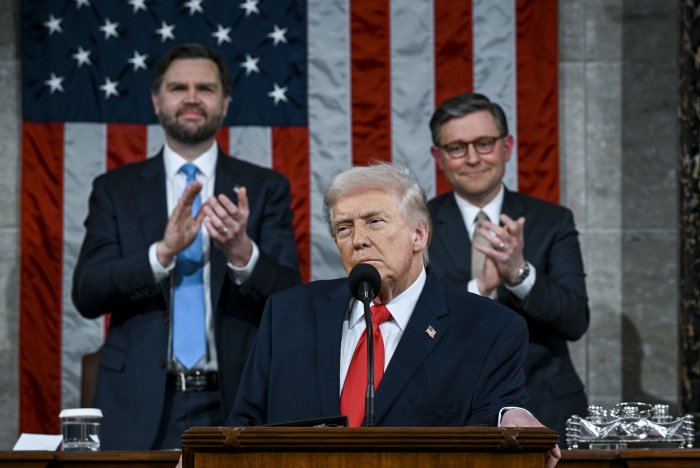
Trump said in his State of the Union speech Tuesday that he is still planning to work the differences out diplomatically.
“My preference is to solve this problem through diplomacy, but one thing is certain: I will never allow the world’s No. 1 sponsor of terror — which they are by far — to have a nuclear weapon,” he said.
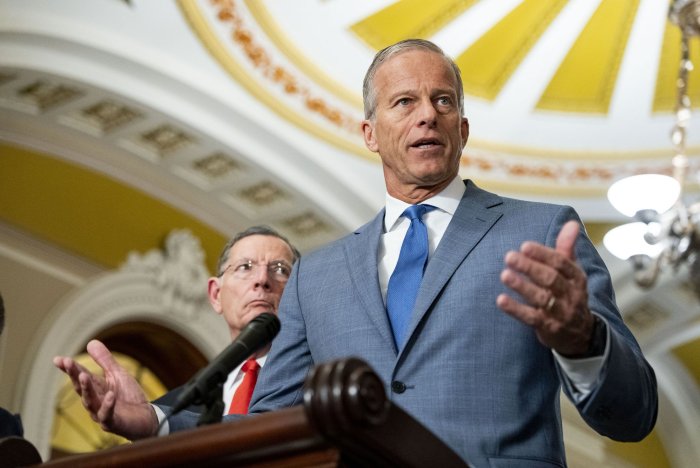
Senate Majority Leader John Thune, R-S.D., speaks during a press conference after the weekly Republican Senate caucus luncheon at the U.S. Capitol on Wednesday. Photo by Bonnie Cash/UPI | License Photo
Tehran, Iran – Another round of indirect talks between Iranian and United States officials ended with a mediator claiming “significant progress” but still no clear evidence that either side was willing to concede enough on their positions to avoid war.
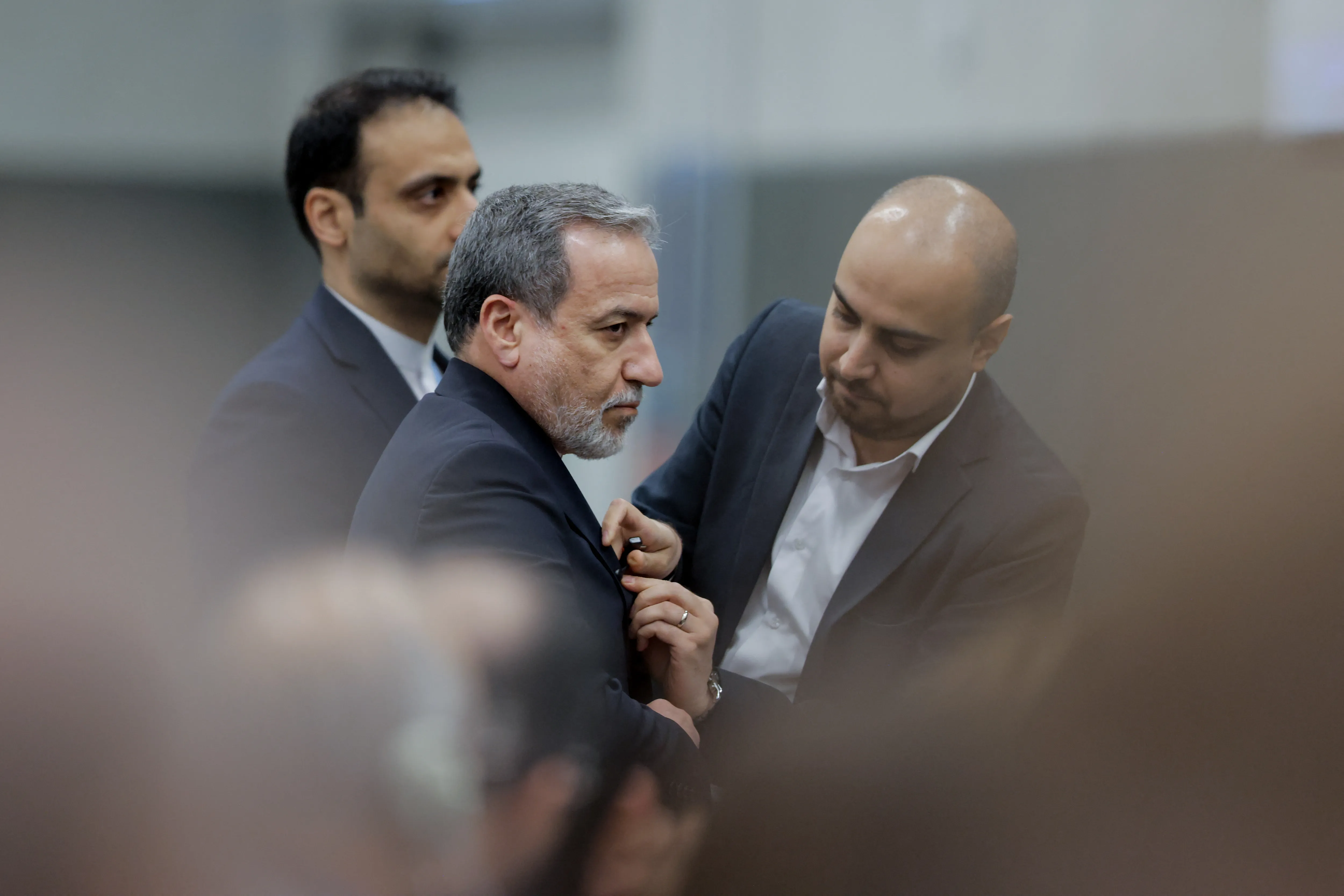
After the conclusion of the talks in Geneva on Thursday, Iranian Foreign Minister Abbas Araghchi said further technical talks would be held next week in Vienna and progress had been “good”.
Recommended Stories
list of 3 itemsend of list
“These were the most serious and longest talks,” Araghchi said.
Omani Foreign Minister Badr bin Hamad Al Busaidi, who mediated the talks, said Iranian and US diplomats would consult with their governments before the Vienna talks.
Few details have emerged about the discussions, but Araghchi was reported to have met US envoy Steve Witkoff – if only briefly, according to Iran’s Tasnim news agency.
The Iranian team, led by Araghchi, handed over on Wednesday night Tehran’s written proposals to Al Busaidi, who also mediated previous rounds of talks in Geneva and Muscat.
The Omani diplomat then met with the US delegation on Thursday, led by Witkoff and US President Donald Trump’s son-in-law Jared Kushner. Al Busaidi mediated between the two teams throughout the day, and the US delegation also held separate talks over Ukraine.
Also taking part in the talks was Rafael Grossi, the director general of the International Atomic Energy Agency (IAEA), which will have to undertake nuclear monitoring and verification duties in Iran in case of any agreement.
The UN watchdog will hold several days of board meetings starting on March 6, which is around the 10- to 15-day deadline floated by Trump last week for Iran to reach a deal.
Western media outlets have suggested the board could once again consider a move to censure Iran depending on the results of the Geneva talks. Iran has accused Grossi of taking politicised action and criticised the IAEA after Israel attacked Iran in June, one day after the agency passed a resolution saying Tehran was not complying with its commitment to nuclear safeguards.
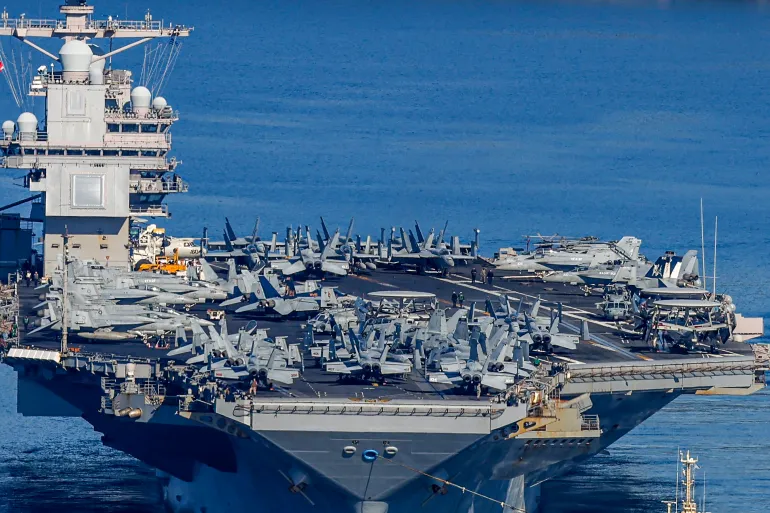
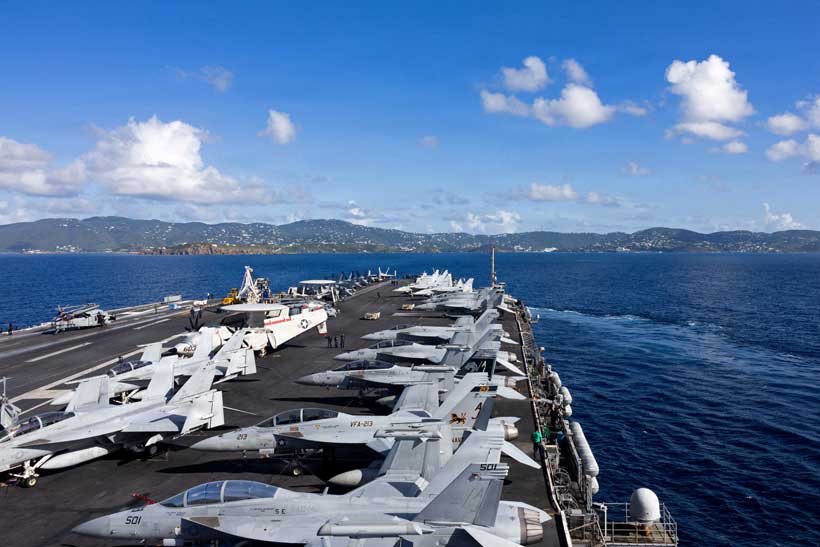
The US Navy aircraft carrier USS Gerald R Ford departs Souda Bay on the island of Crete on February 26, 2026, for the coast of Israel, leading a second US carrier strike group to take up positions against Iran [Costas Metaxakis/AFP]
Fundamental differences
The two sides have been at odds over key issues, including uranium enrichment and missiles.
Washington has repeatedly emphasised, in lockstep with Israel, that it will not accept any nuclear enrichment taking place on Iranian soil, even at civilian-use levels agreed during the 2015 nuclear deal that Iran agreed with world powers. Trump unilaterally abandoned that deal in 2018.
In the days leading up to the Geneva talks, US officials increasingly focused on Iran’s ballistic missile programme, saying the missiles threaten US military bases across the Middle East as well as Israel. Iran has refused to entertain any talks on its conventional weapons. Iranian officials, including President Masoud Pezeshkian, have repeatedly said they will never develop nuclear weapons.
Speaking to local officials during a provincial visit, Pezeshkian also shot back at Trump’s assertion during a lengthy State of the Union speech that Iran was “the world’s number one sponsor of terror”.
Pezeshkian said numerous Iranian officials and nuclear scientists have been assassinated over the decades, particularly in the immediate aftermath of the country’s 1979 Islamic revolution.
“If the realities are seen fairly, it will become clear that Iran is not only not a supporter of terrorism, but one of the main victims of terror in the region and across the world,” he said.
The Iranian government’s IRNA news agency said Tehran’s proposal was expected to gauge US “seriousness” in the talks because it contained “win-win” offers.
Iranian officials have not publicly discussed all the details of their proposals, but they are believed to include diluting part of the country’s 60-percent enriched uranium and keeping the uranium inside the country. Iranian authorities envisage that could be paired with economic opportunities for the US related to Iranian oil and gas and the purchase of airplanes.
People shop at Tajrish bazar in Tehran on February 21, 2026 [Majid Saeedi/Getty Images]
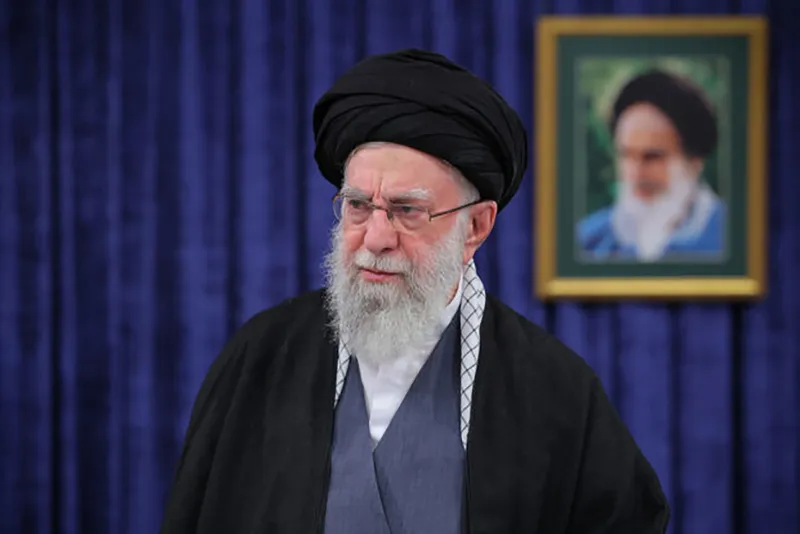
Supreme Leader Ali Khamenei has maintained his tough rhetoric against the US as well, casting doubt on the chances of any agreement. He also said Trump would be unable to overthrow Iran’s government after the US president said regime change would be “the best thing that could happen” in Iran.
Araghchi said during an interview on Wednesday that even if Khamenei is killed, the theocratic establishment in Iran would carry on because it has legal procedures in place to appoint a successor. Pezeshkian added on Thursday: “They can eliminate me, eliminate anyone. If they hit us, a hundred more like us will come up to run the country.”
Double-digit inflation as Iran braces for war
Iranian and US officials have been hailing supposed “progress” in the indirect talks this month, but many Iranians continue to prepare for war.
In Tehran and across the country, people are buying bottled water, biscuits, canned foods and other essentials in case of a war.
“A few days ago, I bought a power bank to keep the electronics charged. Now I’m looking for a short-wave radio so we can hear the news if the state shuts down the internet and electricity infrastructure is bombed,” said a 28-year-old resident of the capital who asked not to be named.
As bombs fell during the 12-day war with Israel in June, Iranian authorities cut off almost all internet access for several days, followed in January by an unprecedented 20-day total blackout imposed on about 92 million people as thousands of people were killed during nationwide protests.
The Iranian government, which blames “terrorists” armed and funded by the US and Israel for the protests, has rejected Trump’s claim that 32,000 Iranians were killed during the demonstrations. It said more than 3,000 people were killed, and rejects documentation by the United Nations and international human rights organisations that its security forces were behind the killings.
As the threat of war intensifies, not all Iranians are capable of stocking up on food and other necessities due to rising inflation that has gripped the country for more than a decade as a result of a mix of chronic local mismanagement and US and UN sanctions.
According to separate reports by the Statistical Centre of Iran and the Central Bank of Iran released on Thursday, inflation has now shot beyond 60 percent.
The Statistical Centre put annual inflation in the Iranian month of Bahman, which ended on February 19, at 68.1 percent, while the Central Bank said it was 62.2 percent.
Food inflation was by far the strongest driver at a whopping 105 percent. That included a 207-percent inflation rate for cooking oil, 117 percent for red meat, 108 percent for eggs and dairy products, 113 percent for fruit and 142 percent for bread and corn.
Iran’s national currency, the rial, stood at about 1.66 million rials to the US dollar on Thursday, near an all-time low.
Weekly insights and analysis on the latest developments in military technology, strategy, and foreign policy.
So, here we are, once again. The United States has flooded the Middle East with combat capabilities. A massive investment has already been made in airframe hours, manpower, and naval resources in preparation for what could be the biggest initial military action America has taken in more than 20 years. Such an operation is not without absolutely massive risks. Iran has prepared for this day for many decades, and so many questions remain outstanding. Glaring ones. Ones that impact the globe and especially those tasked with fighting what could very well be a bloody war that has, at least at this time, highly opaque goals.
Let’s talk about those questions.
What is the goal?
This is the biggest unknown. What are we getting into here? Aside from the possibility that this is a giant feint — a hammer and anvil tactic to force a diplomatic outcome — there have to be clear military goals. Would an air campaign be focused on destroying Iran’s nuclear program alone? There are limitations to achieving that goal with airpower. Israel, too, is well aware of this. Is this goal to be paired with absolutely neutering Iran’s military-industrial base, along with its existing combat capabilities? That would seem more likely, but doing so would require a much larger, sustained operation.
There have also been reports that the White House is eyeing a limited operation in order to force Iran to make a deal. This seems wildly reckless both on a military and diplomatic level, and I doubt these reports are true. The Pentagon would never recommend this. It would ruin any element of surprise and the cumulative impact of using everything at its disposal to shock, blind, and deafen Iran’s command and control. It would also likely result in Iran counter-attacking, which sets off a chain of events that will be hard to pull back from.
The limited strike to pressure Iran to make a deal with the threat of more seems extremely problematic on so many levels. Messaging that now is a sign of weakness in the negotiations. Sorry, that’s the reality. I can’t believe military commanders would recommend this. https://t.co/1R5TwcRhOZ
Then there is regime change. That term comes with immense baggage for obvious and totally relevant reasons. Even if this goal is achieved — the collapse of the current regime — mainly through strikes, what comes next? Is there a plan in place for who will succeed Khamenei, and what would that group’s own goals be? How would they seize power when the power vacuum appears? Or will decapitating the regime throw Iran into civil war or even worse, a country controlled by the fanatical IRGC, which, on paper, would seem to be a prime candidate with the might and infrastructure to assume control.
In other words, could lopping off the head of the snake just see another, even more gruesome serpent take its place?
Iran’s Supreme Leader Ali Khamenei addresses the public on the occasion of the 47th anniversary of the Iranian Revolution, according to Iranian state television in Tehran, Iran on February 9, 2026. (Photo by Iranian Leader Press Office/Anadolu via Getty Images) Anadolu
We don’t know the intelligence or what is going on clandestinely to see that such a risky operation has any chance of long-term success. Without a solid plan, such a move would seem to only invite more risk.
And once again, obtaining this level of transformation largely via airpower is a highly questionable proposition, at best. There is absolutely no appetite domestically to engage in another ground war in the Middle East, so that option is a non-starter, which is a good thing, as America’s track record in this regard is terrible.
Finally, as we have mentioned before, the U.S. military has a lot of combat capability now in the region, and more that can strike from afar, but there doesn’t appear to be enough to sustain a long campaign with a wider set of objectives. So this may limit what can be achieved.
That brings us to the next question.
What will Israel’s role be?
I think it’s safe to assume that Israel will be involved deeply in any major military operation the United States executes against Iran. Frankly, for any sustained campaign, based on the airpower capabilities in the region, America will need Israel’s help, and for that to be en masse.
Israel brings hundreds of fighter aircraft, unique munitions, and more to the fight. Supported fully by America’s tanker force, Israel’s tactical airpower will be far more effective than it was during the 12 Day War less than a year ago. Combining forces fully to achieve a common outcome is more powerful than the sum of its parts in this case.
Beyond traditional airpower, leveraging Israel’s intelligence would be critical. Traditional intelligence products from Israel will be key in achieving any outcome faster in an air war. The same can be said for the flow of U.S. information in Israel’s direction. Still, operating seamlessly is very tough in such a complex, long-range combat scenario. While Israel and the United States have repeatedly trained on smaller scales for this type of operation, doing it on a massive scale is a different story. How the tasking orders would be assigned and deconflicted would be very interesting to watch.
An Israeli Air Force F-15 Strike Eagle moves into formation with a U.S. Air Force B-1B Lancer over Israel as part of a presence patrol above the U.S. Central Command’s area of responsibility Oct. 30, 2021. Multiple partner nations’ fighter aircraft accompanied the B-1B Lancer at different points during the flight, which flew over the Gulf of Aden, Bab el-Mandeb Strait, Red Sea, Suez Canal, Arabian Gulf, Strait of Hormuz and the Gulf of Oman before departing the region. (U.S. Air Force photo by Senior Airman Jerreht Harris) Staff Sgt. Jerreht Harris
But even above the traditional combat power and intelligence Israel can offer such a mission, Israel’s deep presence on the ground in Iran will be arguably of the greatest value. Nobody is anywhere as deeply embedded inside Iran as Israel. And this will impact the full gamut of potential operational scenarios.
Case in point is the Mossad’s novel operation to take out Iran’s air defenses in key areas using operatives on the ground equipped with one-way attack drones and loitering anti-tank guided missiles. While suppression and destruction of enemy air defenses is largely thought to be relegated to the role of airpower, it is anything but limited to just this domain. And Israel proved this on an unprecedented level in the opening stages of the air war in June. Those near-field attacks on Iranian air defense sites allowed standoff munitions, drones, and eventually manned aircraft to make it to their targets, firmly setting the momentum in Israel’s favor during the opening parts of the campaign. It wouldn’t be that surprising if this is repeated, at least in some altered fashion, during whatever could happen in the coming days.
תיעוד מטורף: הכוח המבצעי של המוסד בשטח איראן בעת פריסת מערכות תקיפה מדויקות שנועדו להשמיד את מערכות ההגנה האווירית האיראנית pic.twitter.com/X3Xtcc5JJ9
— איתי בלומנטל 🇮🇱 Itay Blumental (@ItayBlumental) June 13, 2025
Mossad operatives on the ground also worked to assassinate the cream of Iran’s nuclear scientist corps during the operation, mainly using drones launched from near their targets. We would likely see a similar operation take place against military and regime leadership in the opening stages of the looming conflict, if it comes to pass. There are no indications that the United States has anywhere near this capability working inside Iran.
This morning, Israel launched a strike to Iran and killed Iranian nuclear scientist and military head, IIRG, Hossein Salami.
Look at the place of impact. It was exactly the bedroom of the man. How did they conduct this strike such that it only affected just his flat, without any… pic.twitter.com/UNLEVUCf0G
— Apostle Michael Olowookere (@myk_da_preacher) June 13, 2025
Israel continues targeting Iran’s nuclear scientists: Israeli media report that the strike on a residential apartment in Tehran moments ago aimed to assassinate an Iranian nuclear scientist. pic.twitter.com/oRTv2zcj4w
As we have discussed for years, Israel would likely be willing to put special operations units on the ground to seize and destroy absolutely critical hardened targets, such as nuclear sites or possibly individuals hidden within regime bunkers, that are not capable of being destroyed from the air. The United States could as well, but the political risks would be far higher if such an operation went awry.
Finally, it is worth noting that going to war alongside Israel against Iran brings additional diplomatic risks in the region, although these have waned in recent years as Arab countries have become far less hostile to the Jewish State. These Arab states also could see a massive benefit from a successful campaign that rejiggers the status quo in the region and ends Iran’s troublesome influence throughout it. Still, the economic disruption alone could be large, especially if the war carries and if Iran actively works to deny access to the Persian Gulf.
Real dangers
We have not seen modern Iran fight for its very life against the United States or even Israel. On paper, Iran can do immense damage to the region. Yes, it can close and mine the Strait of Hormuz, causing massive repercussions that could last long after the war ends, a possibility which you can read about here. This is a well-understood danger. But above even that, Iran has an absolutely huge inventory of standoff weapons — specifically cruise missiles, long-range one-way attack drones, and most importantly, ballistic missiles. On the latter, there is a broad misconception that Israel wiped out Iran’s ballistic missile capabilities. This couldn’t be further from the truth.
During the 12 Day War, Israel was concerned with Iran’s long-range ballistic missiles — MRBMs and IRBMs. These are also the easiest to find, fix, and destroy. They are large and their launchers are vulnerable because of it, especially during the pre-launch fueling stage. The location of the storage areas for these missiles is well known, including the missile cave complexes, some of which have the ability to launch the missiles through apertures in launch room ceilings. By hitting the entry and exit points of these facilities, these weapons are not destroyed but they are trapped inside.
In addition, Israel focused their interdiction ‘missile hunting’ efforts on these long-range weapons that threaten its homeland. They were also the weapons that had to be exposed as they were employed in retaliatory strikes during the war. The shorter-range stuff didn’t need to be as it was largely not used.
To make this clear, Iran’s far more plentiful short-range ballistic missiles that threaten American bases in Gulf Arab allied states were not heavily targeted. The same can be said for the shorter-range drones and cruise missiles.
So no, these capabilities were not knocked out by any means, and they are also by far the easiest for Iran to disperse and hide. This makes hunting for them from the air extremely problematic. This is especially true when Iran enters into a combat state, where it distributes these missiles, which are largely loaded onto common truck platforms, into population centers and hidden under pretty much anything. They can also shoot and scoot much faster than their long-range counterparts.
The IRGC-N took a massive delivery of anti ship missiles for coastal defense
Note the dual tube launcher in the pics, which we’ve never seen before. Seems to be a new anti ship new cruise missile. Sadly no information was given besides pics
— Iran Defense commentary (unofficial) (@IranDefense) August 9, 2024
With all of America’s intelligence capabilities, finding and destroying these weapons from the air will be extremely challenging. Even the relatively meager arsenal belonging to Yemen’s Houthis proved vexing for the U.S. military after many months of sustained ‘hunting.’ The Houthis continued to get off successful coastal launches throughout these operations. The scale of the Iranian threat is exponentially larger, and the country has more complex terrain to hide these weapons.
Iran’s shorter-range standoff weapons number in the thousands. They have the ability to saturate the best defenses on earth and lay waste to prized targets across the Persian Gulf and the Arabian Sea, and deeper into allied Arab nations. This not only makes nearby basing of U.S. aircraft and personnel problematic, but it greatly increases the cost of any war the United States could execute against Iran.
We have seen what it took to defend against just one volley of Iranian short-range ballistic missiles. It resulted in the largest volley of Patriot interceptors in history. Even that defensive action wasn’t entirely successful at rebuffing the attack, let alone repeated ones that would include layers of drones, as well as cruise and ballistic missiles.
Footage of a US/Qatari PATRIOT surface to air missile system conducting a large ballistic missile engagement over Al-Udeid this evening, salvoing out dozens of PAC-3 interceptors at incoming Iranian ballistic missiles. pic.twitter.com/a7OHrs9svr
There is also a risk to American warships, even those that are operating far out to sea. Iran has shown it has the ability to launch long-range anti-ship weaponry not just from its coasts and warships, but from unassuming seaborne platforms, including using containerized missiles and drones. The farther U.S. Navy vessels have to operate from Iranian territory also means their missiles won’t be able to penetrate as far into the country. A carrier’s air wing will need additional tanking support to get to its targets, and sortie rates will be lowered.
These capabilities, along with the possibility of closing the Strait of Hormuz, drastically increase the chances of expanding the conflict by pulling Arab countries into it, as well, which would complicate, not help the cause, at least in many respects.
Iran knows full well where American aircraft are currently based, and they will throw everything they have at these sites. This includes America’s sprawling airbase in Jordan that is packed with tactical airpower. They know what defenses are there and have an understanding of what it will take to overwhelm them if they get the chance to do so. So the idea that we could not see mass losses of aircraft and other materiel, and even lives, on the ground, even when striking from afar, is not reality.
The same can be said about an air war. The U.S. has the most advanced air combat capabilities on earth, but ‘shit happens,’ especially during war. Even the Houthis nearly downed U.S. fighter aircraft optimized to destroy enemy air defenses. But regardless of defenses and the state of Iran’s air defense overlay, putting Americans over Iran, and repeatedly over days and weeks, is a risk. Aircraft can malfunction and mistakes can be made. When that happens, it will require even more risk to push combat search and rescue assets into the area to try and recover the crew. In other words, regardless of America’s outstanding air warfare capabilities, there is still a real risk involved in any operation over Iran.
A U.S. Air Force F-16 Fighting Falcon conducts night time air refueling operations above the U.S. Central Command area of responsibility, June 26, 2023. The KC-135 Stratotanker allows air assets to significantly increase flight time and decrease time spent on the ground. (U.S. Air Force photo by Senior Airman Jacob Cabanero) Senior Airman Jacob Cabanero
Finally, if Iran is really backed into a corner, and especially if its most extremist elements remain in play, it could resort to weapons of mass destruction. Specifically, chemical weapons and rudimentary radiological ones (dirty bombs) could be used in a dying gasp of the regime. If they did this, it would mean a certain end for the sitting power structure in the country, but if that is going to happen anyway, they could lash out in horrible ways. There is debate as to whether Iran would, or even could, actually do this, but historically, the regime in Tehran is no stranger to the use of chemical weapons.
Defending Israel again
Iran did not run out of long-range ballistic missiles during the 12 Day War, either. They ran out of ones available for launch, and they likely saw real degradation in their ability to launch those accessible due to Israel’s interdiction efforts and disarray in Iranian command and control after nearly two weeks of being bombarded. Since that war, Iran has been pumping out more of these missiles at a high rate, despite Israel’s attacks on missile production-related targets. Some of these weapons are quite advanced, proving their ability to penetrate the IDF’s multi-tier integrated air defense system, the most advanced one on Earth, an air defense capability you can read all about here.
The Israel Missile Defense Organization (IMDO) of the Directorate of Defense Research and Development (DDR&D) and the U.S. Missile Defense Agency (MDA) completed a successful flight test campaign with the Arrow-3 Interceptor missile. (MDA) Missile Defense Agency
If Iran was truly fighting for its life and knowing the end could be near, how many missiles will it send at Israel, and how many interceptors are available to defend against those barrages? Iran also has become increasingly savvy on what tactics to employ and where in order to overwhelm Israel’s defenses. While targeting has focused, at least to a degree, on military and governmental targets, if this was an all-out conflict, it’s likely Iran would just concentrate on population centers with whatever it has to throw at the cause.
The U.S. stockpile of advanced munitions is already a real concern after multiple campaigns to defend Israel, the long and violent standoff in the Red Sea, and the war in Ukraine. This is especially true for its more advanced interceptors, which are also in extreme demand among allies globally. This is all happening as the threat from China is growing more concerning by the day. A war in the Pacific will consume stocks of these weapons at a vastly higher rate than anything we have seen before. If those magazines run dry, it could mean the difference between winning and losing in that critical theater. And remember, these weapons take years to produce and cost many millions of dollars each. So it’s not like you can just say, ‘we’ll buy more.’ Of course, we will, but we won’t get those weapons for years, even as expansion of production is now underway across the DoW’s munitions portfolio.
Lt. Gen. Patrick Frank, U.S. Army Central Commanding General, meets with a Terminal High Altitude Area Defense (THAAD) crew next to a launcher emplaced and prepared to launch interceptors to counter ballistic missile threats at an undisclosed location in the CENTCOM Area of Operations, Dec. 12, 2023. THAAD is an important component of the integrated air and missile defense network that defends critical assets in the U.S. Central Command area of responsibility amidst needs for increased force protection. (U.S. Army Courtesy Photo) Capt. Duy Nguyen
So the cost of taking on Iran is not just in money and assets, and especially blood, it’s the opportunity cost of expending precious weapons in a war of choice that would be essential in a war of necessity that could erupt at any time.
Wild cards
There are capabilities and war plans we know nothing about. It may be possible that the United States thinks it can break Iran’s command and control capabilities so quickly that it can preempt many of its most dangerous weapons from being used in large quantities. This could come in the form of cyber attacks, other forms of espionage, electronic warfare, and exotic weaponry — and more likely a combination of the above. It could also be the orchestration of an insider coup-like scenario.
There is also the possibility that the United States thinks Iran’s military apparatus would simply collapse under a full combined aerial assault by the U.S. and Israel. A possible decapitation of the regime is another factor here.
If this is the case, and Iran’s warfighting capabilities can be left largely unused, then the risk equation changes. But this is a massive bet to make, and just how certain whatever measures are used will have the exact crippling effects intended could mean the difference between go and no-go for a major campaign.
The guided-missile destroyer USS Arleigh Burke (DDG 51) launches Tomahawk cruise missiles to conduct strikes against ISIL targets. Arleigh Burke is deployed in the U.S. 5th Fleet area of responsibility supporting maritime security operations and theater security cooperation efforts. (U.S. Navy photo by Mass Communication Specialist 2nd Class Carlos M. Vazquez II/Released) Chief Petty Officer Carlos Vazquez II
In other words, we really don’t know what the United States and Israel still have up their sleeves. And maybe they have nothing that would cause such a dramatic effect at all. Instead, hitting them traditionally fast and hard, along with cyber, espionage, electronic warfare, and everything else, will be needed to erode Iran’s ability to fight back over time.
Regardless, the United States and Israel have prepared for exactly this eventuality for decades, so there certainly are bound to be some surprises. Of what magnitude is the question.
What if a deal is made, but Israel doesn’t think it’s good enough?
It’s possible that the game tree could expand in such a way that the United States makes a nuclear deal with Iran, but it does not address the long-range missile threat, or even the nuclear program, to a sufficient degree in Israel’s eyes. If this occurs, there is still the chance that Israel goes it alone and tries to do as much damage as possible to both of these elements. In some ways, this could be played to America’s advantage as it could deny being involved in the conflict and work to see if the deal sticks even after Israel’s kinetic action. In this case, American resources would be used to defend Israel, but not participate in the attack.
This may sound far-fetched, but it really isn’t an impossibility. Especially if Trump realizes how much of a commitment achieving something meaningful via an air campaign could become, as well as the risks of what comes after on the ground in Iran.
Whether a nuclear deal would even survive such a situation is unclear, but it’s possible.
Why now?
In the end, these are the fundamental questions Trump has to be asking himself and his aides: Is going to war with Iran really worth the risks, both the known ones and unknown ones, and what is the goal in doing so? Is that goal readily attainable and at what cost?
These questions also bleed directly into the political arena. Trump claimed to be the President that would get America out of wars, not start them, and especially ones that seem like they could spiral out of control relatively easily, resulting in much longer-term commitments. While he has had some stunningly successful military victories as of late, and there is a danger for politicians to think it will always turn out a similar way, that can change very quickly. If America wakes up to seeing a U.S. pilot being dragged through the streets of Tehran, any support for this conflict could quickly evaporate.
Above all else, the question has to be asked, why now? What has prompted the idea of declaring war on Iran at this moment? Yes, the protests and the brutal deaths of thousands at the hands of the regime seemed to have moved Trump, but that was subsequently used as a pretext for nuclear negotiations, not to correct human rights abuses.
President Donald J. Trump and First Lady Melania Trump receive honors from rainbow sideboys aboard the Nimitz-class aircraft carrier USS George H. W. Bush (CVN 77) during a Titans of the Sea Presidential Review Oct. 5, 2025. (U.S. Navy photo by Mass Communication Specialist 2nd Class Pierce Luck) Petty Officer 2nd Class Pierce Luck
In addition, Trump has declared repeatedly that he destroyed Iran’s nuclear program after the B-2 strikes in June. So why, just eight months after that action took place, is the United States about to go all-in against Iran over its nuclear program? We have heard anecdotes about possible threats of Iran starting the nuclear program back up, the threat posed by the enriched uranium they already have, and the possibility that they could develop new, longer-range missiles that could hit the U.S. one day, maybe. Yet nothing has been presented in a concrete manner as to why doing this right now is essential. It doesn’t match Trump’s long-standing political rhetoric at all.
There is obviously much the public doesn’t know, but the risk-reward equation seems like a uniquely puzzling one with this crisis, at least at this time.
If Iran doesn’t make a deal, it seems clear that Trump has put himself in a position where he will either have his bluff called or he will need to commit to an air war against Iran.
What happens from that historic split in the road is really anyone’s guess.
Feb. 25 (UPI) — The Treasury Department’s Office of Foreign Assets Control announced sanctions Wednesday on more than 30 people, entities and vessels that it said are “enabling illicit Iranian petroleum sales and Iran’s ballistic missile and advanced conventional weapons production.”
The sanctions are part of the federal government’s pressure campaign against Iran.
The vessels targeted are part of Iran’s “shadow fleet,” which the department said in a press release “serve as the regime’s primary source of revenue for financing domestic repression, terrorist proxies and weapons programs.”
“Iran exploits financial systems to sell illicit oil, launder the proceeds, procure components for its nuclear and conventional weapons programs and support its terrorist proxies,” said Secretary of Treasury Scott Bessent in a statement. “Treasury will continue to put maximum pressure on Iran to target the regime’s weapons capabilities and support for terrorism, which it has prioritized over the lives of the Iranian people.”
The vessels sanctioned are: Hoot, Ocean Koi, North Star, Felicita, Ateela 1, Ateela 2, Niba, Luma, Remiz, Danuta 1, Alaa and Gas Fate.
The organizations sanctioned are: Poros Maritime Ventures S.A., Ocean Kudos Shipping Co Ltd., Mistral Fleet Co Ltd., Vast Marine Inc., Behengam Tadbir Qeshm Shipping and Maritime Services Company, Paros Maritime S.A., Wansa Gas Shipping Co., Goldwave Maritime Services Inc. and Ithaki Maritime and Trading S.A.
OFAC also targeted the following entities based in Iran, Turkey and the United Arab Emirates that have aided in the purchase of precursor chemicals and sensitive machinery for Iran. They are Iran-based Oje Parvaz Mado Nafar Company; Turkey-based Utus Gumrukleme Gida Tekstil Ithalat Ihracat Dis Ticaret ve Sanayi Limited Sirketi, Turkey-based Arya Global Gida Sanayi ve Ticaret Limited Sirketi, Turkey-based Altis Tekstil Makina Ticaret Limited Sirketi (Altis), Iran-based Adak Pargas Pars Trading Company and UAE-based Mostafa Roknifard Prime Choice General Trading LLC.
Four people being sanctioned are Iran-based Mohammad Abedini, Mehdi Zand, Mehrdad Jafari and Ebrahim Shariatzadeh. They are allegedly employees of Iran’s Qods Aviation Industries, which was sanctioned in 2013.
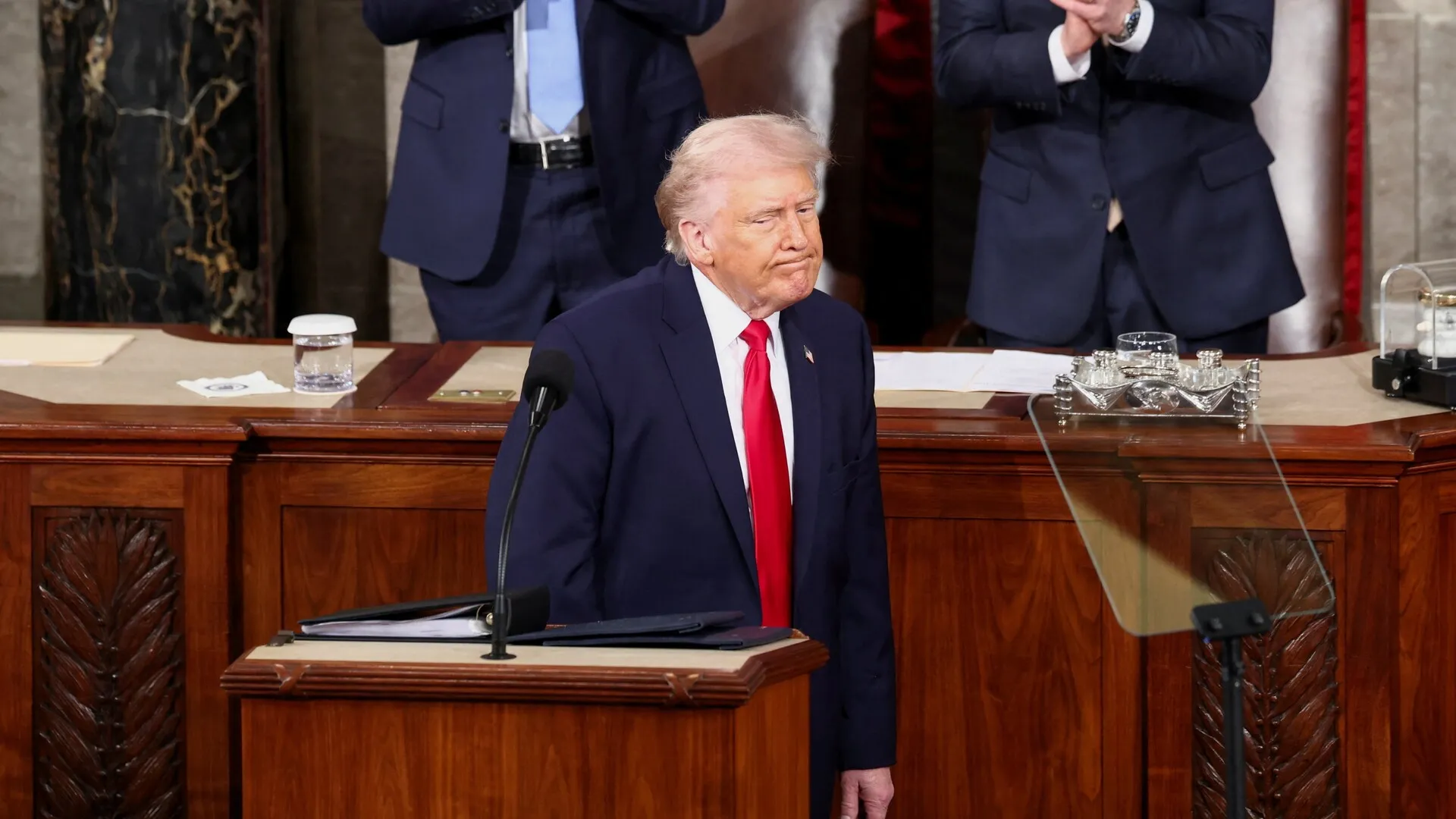
President Donald Trump delivers his State of the Union address during a joint session of Congress in the House Chamber at the U.S. Capitol in Washington, on February 24, 2026. Pool photo by Kenny Holston/UPI | License Photo
In his State of the Union address, US President Trump reiterated claims the US “obliterated” Iran’s nuclear programme last year, contradicting his special envoy Steve Witkoff, who said Iran is “one week away” from a nuclear bomb.
Last week, American diplomats and their Iranian counterparts sat down in Geneva for yet another round of talks mediated by Oman. The outcome seemed unclear. While the Iranians said “good progress” had been made, the Americans claimed there was “a little progress”. Meanwhile, United States President Donald Trump threatened once again to strike Iran.
In recent weeks, there has been a heavy US military build-up in the Middle East in preparation for what many observers see as an imminent attack. In this context, it may be apt to question whether the current negotiations are not simply a tactic to buy time to better prepare for the inevitable.
In the face of US military might, some have suggested that Iran’s only option is negotiating an agreement with the US, however unfair it may be. While Iranian military capabilities stand no chance against an army with the world’s biggest budget, accepting capitulation through a debilitating deal that may be broken again by Washington may not necessarily be Tehran’s only choice.
There is another way in which Iran can stand up to US bullying and win.
The fate of past negotiations
The ongoing US-Iran talks cannot be viewed in isolation. For Iran, any diplomatic engagement with the US is overshadowed by the legacy of the Joint Comprehensive Plan of Action (JCPOA).
Signed by the US, China, Russia, France, the United Kingdom, Germany, the European Union and Iran in 2015, the agreement provided sanctions relief in exchange for full transparency of the Iranian nuclear programme. Tehran accepted the deal even though it had some unfair provisions, including some US sanctions remaining in place.
Nevertheless, it fulfilled its obligations – a fact that was repeatedly verified by the International Atomic Energy Agency.
In return, however, the US as a signatory did not uphold its end of the deal. In 2018, Trump unilaterally withdrew from the JCPOA and reimposed maximum pressure sanctions aimed at crippling Iran’s economy.
It was a stark reminder that American promises are nonbinding. As a leader who has shown no regard for the interests of American allies in pursuit of an “America first” policy, Trump could hardly be expected to respect the interests of American adversaries.
However, even if a Democratic president had been in the White House, there would not have been any guarantee that the JCPOA would have remained in place. In the US’s polarised political climate, an American president’s signature is only valid until the next election.
For the US, negotiations can also be little more than a facade intended to lull adversaries into a false sense of security. Last year, just as US and Iranian representatives were scheduled to meet in Oman for another round of talks, Israel, a key American ally, launched a massive military campaign against Iran.
While the US denied direct involvement, it acknowledged having received prior notice. Given the close ties between the two countries, this prior knowledge strongly implied that the US had given Israel tacit approval for the air attacks.
Today, Iran is engaging in negotiations with the US again, and it is being pressured to accept an even more unfair deal. Should it back down and submit to US demands, then Trump – who preys on perceived weakness – would simply move the goalpost. Demands would shift from Iran’s nuclear programme today to its ballistic missiles tomorrow and regime change the day after.
The special US relationship with Israel means that Washington is fundamentally hostile to an Iranian government that sees the Israeli state as an enemy. Consequently, Trump’s goal is not to reach a durable agreement but to ensure that Iran can never fully comply with his demands, thereby justifying a permanent campaign of maximum pressure and hostility.
In this context and given its recent experience, it would be foolish for Iran to rely on US promises and negotiated agreements.
Leverage through strong regional ties
The current US-Iran standoff is a high-stakes game in which an all-out war is a likely outcome. While the US could achieve an initial victory through overwhelming military superiority, it could also get bogged down fighting a protracted counterinsurgency in Iran’s mountainous terrain.
Conversely, while Iran could eventually repel an American invasion – just as its Afghan neighbours did – the country would be reduced to rubble in the process.
That does not mean Iran should back down. The Greenland crisis and the China-US trade war have demonstrated that Trump’s propensity for sabre-rattling is tempered by his aversion to losses. Even though the EU and China are far more powerful than Iran, a clear show of resolve could compel Trump to retreat.
And Tehran does not have to be alone in its defiance. In its neighbourhood, there are other big players who recognise that another disastrous war led by the US is not in their interests. Iran can and should leverage the regional desire for stability.
For years, Iran pursued a policy of confrontation in the region until it realised that carving out a sphere of influence was actually exacerbating its security dilemma. This recognition ultimately led to the historic normalisation of relations with Saudi Arabia in 2023 – a breakthrough facilitated by China, Oman and Iraq – which in turn set in motion a broader detente with other Arab countries.
Three years later, that decision is yielding dividends. Notably, Saudi Arabia, Oman, Turkiye and Qatar are lobbying Trump to exercise restraint. Building on this neighbourly diplomacy and investing in developing regional stability and a security architecture could help stave off another major US war in the region.
The most important path to peace – and the only means of countering American gunboat diplomacy – does not lie in matching American military might, a contest Iran is destined to lose, but in establishing good relations with its neighbours and accepting regional stability as part of its national security.
The views expressed in this article are the author’s own and do not necessarily reflect Al Jazeera’s editorial stance.
The incident in Isfahan province follows crash of fighter jet in Hamadan province less than a week ago.
Published On 24 Feb 202624 Feb 2026
Share
Tehran, Iran – Two military pilots and two merchants have been killed after an army helicopter crashed into a fruit market in central Iran.
The crash on Tuesday morning occurred in Dorcheh, a town in Isfahan province, where the army has a major airbase, according to state media, which said the cause was likely a technical fault in the aircraft.
Recommended Stories
list of 3 itemsend of list
Footage broadcast by state media from the scene of the crash showed the wreckage and emergency responders putting out the fire.
The Army Aviation Training Centre, in a statement, identified the killed soldiers as Colonel Hamed Sarvazad, the pilot; and his co-pilot, Major Mojtaba Kiani.
Two people working at their booths in the market were also reportedly killed on the scene after the helicopter crashed and caught fire.
The army centre said the cause of the crash is under investigation. The local judiciary chief, Asadollah Jafari, said he had also opened a case and dispatched investigators.
The crash comes less than a week after an Iranian Air Force fighter jet, reportedly an old United States-built F-4 model, crashed during a late-night training mission in the western province of Hamadan.
State media reported that one of the pilots was killed, but the other survived after successfully ejecting. The cause of that crash is under investigation, but state media said it was likely caused by a technical fault, as well.
Iran has been largely unable to upgrade its ageing fleet of aircraft, both military and civilian, as a result of decades-long sanctions imposed by the US and its allies.
Iran has purchased a number of fighter and training aircraft from Russia, and has been seeking to buy advanced Su-35 jets, but they have yet to be delivered by Moscow.
The crash of the helicopter took place amid rising tensions between the US and Iran before a new round of nuclear talks, which are set to take place in Geneva, Switzerland, on Thursday.
Iranian officials have warned that the country will not “bow down” to US pressure as Washington bolsters its military presence in the region.
In recent weeks, the US military has amassed hundreds of advanced fighter aircraft, both in military bases and on two aircraft carrier strike groups, as it threatens to strike Iran if it fails to reach a deal on its nuclear and missile programmes.
Tehran has rejected negotiations about its missiles, but has said an agreement may be possible to ensure it will never possess a nuclear weapon.
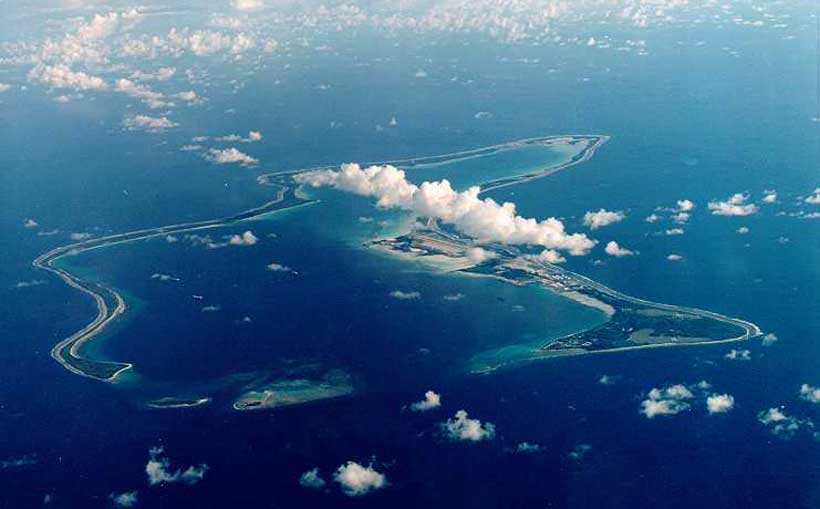
On 18 February 2026, reports emerged that Britain was withholding American permission to use Diego Garcia in any hypothetical strike against Iran. The following day, Trump posted “DO NOT GIVE AWAY DIEGO GARCIA” on Truth Social, linking the base directly to potential operations against Tehran in terms that left no room for diplomatic interpretation. The sequence lasted forty-eight hours and revealed what months of careful legal construction had obscured: that the architecture of conditional access Britain had built around a strategically significant military installation was worth precisely what the decisive power chose to make it worth. Whether the intervention also carried tactical signalling toward Tehran is a legitimate question, and intra-alliance friction of this kind sometimes functions as maximalist positioning before settlement. What matters analytically, however, is not the post itself but what the post revealed when operational pressure arrived. It was also, for anyone who had read Washington’s December 2025 National Security Strategy carefully, entirely predictable.
Power Does Not Ask
There are two ways to understand how military power operates in the international system, and the Chagos episode forces a choice between them. The first holds that great powers are meaningfully constrained by the frameworks they inhabit, alliance structures, legal agreements, and diplomatic settlements, and that these frameworks produce stable, predictable behavior even when the underlying interests they were designed to manage come under pressure. The second holds that frameworks are expressions of power relationships at a given moment rather than independent constraints upon them, so that when power shifts or decides to assert itself, the frameworks adjust to reflect the new reality rather than containing it. The first is the language of liberal internationalism. The second is the language of realism, and what February produced was an unambiguous realist moment.
The December 2025 National Security Strategy had already committed this diagnosis to paper. The document did not describe Europe as weak through circumstance. It described Europe as having chosen weakness, identifying a “loss of national identities and self-confidence” as the continent’s defining condition and stating openly that it is “far from obvious whether certain European countries will have economies and militaries strong enough to remain reliable allies.” The strategy framed European concerns about Russia as evidence of that same condition, noting that this lack of self-confidence was most evident in Europe’s relationship with Russia, despite the fact that European allies enjoy a significant hard power advantage over Russia by almost every measure save nuclear weapons. Washington’s reading of its European partners, formalized two months before the Diego Garcia friction became public, was of states that had systematically preferred institutional solutions over sovereign ones, legal arrangements over unconditional control, and managed conditionality over the exercise of will. Britain’s handling of Chagos was, in that context, not an anomaly. It was a confirmation.
What is analytically significant about Trump’s intervention is not simply that he rejected the deal but that he did not engage it at all, did not address the ICJ ruling that gave it legal foundation, did not contest the lease terms that were its operational expression, and did not enter the diplomatic logic that had produced it over months of negotiation. A decision of this kind does not derive its authority from the framework it overrides, because it precedes that framework, and the framework itself only ever existed on the sufferance of the power now choosing to move against it. When Trump asserted that leases are “no good when it comes to countries,” he was not making a legal argument that could be answered within the same register. He was stating a principle about the nature of sovereign will: that when it moves, it moves prior to and above whatever conditional arrangements were constructed in the period of its dormancy.
This is realism in its purest operational form, in which states pursue interests, great powers pursue interests with the capacity to enforce them, and legal architecture functions as an instrument of power when it serves those interests and an obstacle to be displaced when it does not. The Chagos deal did not alter the underlying power relationship between Washington and London, but it did create a layer of conditionality over an asset Washington considers operationally essential, and when operational pressure arrived, that conditionality became intolerable, not because Mauritius is hostile, not because Britain is an adversary, but because no great power conducting military projection at a global scale can accept that a weak state sits structurally inside the chain of its operational decisions, regardless of how that state arrived there or how benign its intentions are understood to be.
Beneath the realist logic sits a transactional one, and the two reinforce each other in ways that matter for how Britain should read what happened. Trump does not evaluate alliance relationships by their historical depth or their institutional architecture. He evaluates them by what they yield in the current moment, and every asset is a leverage point to be maximized. Diego Garcia represents unconditional American operational value. The Chagos deal reduced that value by inserting a condition. From a transactional perspective, that insertion was not a diplomatic nuance to be managed but a concession to be reversed, because Trump’s governing principle across every alliance relationship is maximum American gain, and conditionality is by definition a reduction of gain. The decisionism explains how he responded. The transactionalism explains why.
The Geography of Decision
Diego Garcia is not incidental to American power projection in the region, though its significance is that of an enabler rather than a prerequisite. The base sits at the center of the Indian Ocean, within operational reach of the Persian Gulf, the Strait of Malacca, and the East African littoral, and it has supported American military operations across that entire arc for half a century through bomber rotations, logistics chains, and a sustained forward presence that no other installation in the basin fully replicates at the same scale and permanence. It does not make American power projection possible in any absolute sense, but it makes it faster, cheaper, and more sustained, which in the context of time-sensitive operational planning against a target like Iran is not a marginal difference but a meaningful one.
The Iran dimension exposes the conditionality problem with particular clarity because the operational context in which Diego Garcia’s value is most acute is precisely the context in which conditional access is most dangerous. American military assets have accumulated across the Middle East, talks are active, and a base capable of projecting strategic airpower directly into the Persian Gulf theater is not a background consideration but a variable whose availability, or unavailability, shapes what options exist and on what timeline. Britain’s reported reluctance to grant operational clearance, under a deal still unratified and still contested in domestic courts, still legally dependent on Mauritius’s continued cooperation, revealed that the conditionality embedded in the arrangement had already entered the operational calculus before any of the stabilizing assumptions behind the deal had time to establish themselves. Strategic friction did not arrive at the end of a long maturation period. It arrived in weeks, because operational pressure does not wait for diplomatic frameworks to consolidate.
That compression of the timeline is itself the most realistic lesson. Power does not defer to the developmental logic of legal arrangements, and when the operational moment arrives, whatever sits between a great power’s will and its objective is reclassified from a framework to be respected into a problem to be solved.
The Structural Position of the Weak
The analytical core of the Chagos case is not about Mauritius’s intentions, which by all available evidence are not hostile, but about the structural position that the deal assigned to it within the architecture of American operational planning, because in the logic of great power competition, it is position rather than intention that determines strategic relevance. By inserting itself, or being inserted, into the chain of conditions governing a great power’s operational freedom, a weak state acquires a form of leverage it could never achieve through military means, and the Chagos deal gave Mauritius exactly that position, not through hostility but through legal standing, not through power but through presence within a conditional architecture that a great power now had reason to find constraining.
For Washington operating within a decisionist strategic logic, that presence is categorically unacceptable regardless of Mauritius’s intentions. The relevant question is not whether Mauritius would obstruct American operations but whether, under the terms of the arrangement, it structurally could, and the answer is yes in a way that no amount of diplomatic goodwill can fully neutralize. Sovereignty transferred to Mauritius is not sovereignty parked with a neutral party but sovereignty that now sits within reach of Chinese economic leverage, meaning the lease does not merely introduce conditionality but introduces conditionality whose future content Washington cannot determine or guarantee. A great power conducting global military projection cannot organize its operational planning around the sustained goodwill of a small state whose strategic orientation it cannot guarantee. That such goodwill is required at all is the problem the deal created.
Weak states do not constrain great powers through legal arrangements in any durable sense, because the constraint only holds when the great power chooses to honor it, and great powers choose to honor constraints only when the cost of non-compliance exceeds the cost of compliance, a calculation that shifts decisively once operational necessity enters the equation and the framework reveals itself to be dependent on tolerance rather than grounded in power.
Conclusion
Britain converted unconditional sovereign control over a strategically significant military installation into a conditional leasehold arrangement whose operationalization depended on a small state’s legal cooperation and presented that conversion as a resolution of vulnerability rather than the creation of a new one. Britain was not being naive. It was an attempt to preserve the base’s long-term legal viability against mounting international pressure, a calculation that the alliance relationship would absorb any friction that followed. What Britain did not account for was that its ally evaluates arrangements not by their legal durability but by whether they constrain American will, and a solution sophisticated enough to satisfy international law was simultaneously insufficiently decisive to satisfy Washington.
From the perspective of the December 2025 National Security Strategy, that conversion was not a surprise. It was the predictable output of a European strategic culture that Washington had already formally diagnosed: one that reaches instinctively for institutional solutions when strong states would resolve through will, that mistakes legal legitimacy for strategic security, and that has internalized the habits of the post-Cold War order to the point where it can no longer easily distinguish between a framework and the power that makes frameworks real.
Trump’s response was the most realistic verdict on that presentation, not an argument against the deal’s legal coherence, which was never in question, but a decision that the framework was insufficient for the operational reality it was meant to serve, delivered in terms that made the underlying logic unmistakable. The framework did not collapse under the pressure. It was revealed, under pressure, to have rested entirely on the assumption that the decisive power would continue to choose not to decide otherwise, an assumption that realism has always identified as the central fragility of arrangements built on consent rather than grounded in power.
The strong do not negotiate with the architecture of constraint, and for Europe, February was less a shock than a reminder that the rules it has built its strategic identity around have always depended on the continued willingness of a decisive power to operate within them.
The aircraft carrier USS Abraham Lincoln, six frigates, three light warships, and approximately thirty fighter jets and support aircraft have entered the Middle East by order of Donald Trump who, by repeatedly touting the slogan “I have ended six/seven/eight wars,” has considered (and continues to consider) himself deserving of the Nobel Peace Prize. What objective do all these tensions that the U.S. administration has generated in the region actually pursue? The weakening of Iran, or the overthrow of the incumbent government? Whatever his and his administration’s aim may be, it appears that—within the cost–benefit calculations of his trader’s mindset—he has yet to arrive at a definitive conclusion as to what kind of blow, and at what scale, could deliver the desired outcome. His recent military posturing around Iran and his increasingly threatening rhetoric against the Islamic Republic have placed him in a no-win situation whose end few can predict.
Why a no-win situation for Trump?
First Strike Doubt: Trump and the constellation of officials currently in the White House—who, notably, are far from unified or aligned on how to approach Iran—have reached no certainty regarding the effectiveness of a first strike against Iran or the likelihood of achieving their desired results. It is evident to all that the Islamic Republic of Iran is neither Venezuela, nor Libya, nor Syria, nor Afghanistan, nor Iraq, nor anything akin to the historical cases in which the United States has intervened militarily in the name of democracy verbally and in pursuit of its own interests operationally. This very reality has, thus far, prevented Trump from issuing the order to “open fire” on Iran up to now.
On the other side, there is no sign of the flexibility or concession sought by the United States in the behavior or rhetoric of Iranian officials—a fact acknowledged by American officials themselves. This indicates that pressure, intimidation, and threats have thus far yielded no results. The reason is clear: the Islamic Republic views any potential confrontation as an existential war and is unwilling to grant any concessions. Trump, however—who seeks to manufacture achievements out of even the smallest events and whose penchant for exaggeration is among his defining traits—perceives such circumstances as detrimental to his personal prestige and standing.
Iran’s Resilience: The experience of the Israeli attack and the hybrid war launched against Iran in June 2025, with direct assistance from the United States and indirect support from so many others, demonstrated that the instability they sought within the governing structure of the Islamic Republic and even the internal social fragmentation and rifts that had been cultivated for years through various media tools did not materialize. Despite the blows inflicted on Iran, none of the long-term strategic objectives of the United States and Israel were achieved. Likewise, the unrest and riots of January 8 and 9, despite the violence and damage they caused to the public and the state, were ultimately brought under control and culminated in a multi-million-person rally on January 12 condemning the unrest and supporting the central government of the Islamic Republic.
High costs and Persian Gulf Worries: Operationalizing a military threat would impose heavy costs on the United States and its allies. The Islamic Republic has explicitly declared that any military action against its territory, at any scale, would be regarded as all-out war, and that, consequently, the entire region—as well as U.S. interests wherever they may be—would fall within range of Iran’s retaliatory strikes. This serious warning has also prompted Persian Gulf states to mobilize their capacities to dissuade Trump from attacking Iran. The strikes on U.S. bases at Ayn al-Asad and Al-Udeid entrenched the perception that the Islamic Republic does not shy away from responding to foreign aggression, even if large segments of the world regard the attacking state as a “superpower.”
Global Energy Risks: The ignition of war in the Persian Gulf would amount to a grave threat to global energy supply routes. Roughly 30 percent of the world’s crude oil and 20 percent of liquefied natural gas are supplied by Persian Gulf countries, and 20–25 percent of global crude oil transits the Strait of Hormuz. Any aggressive action by the United States would jeopardize the security of one-fifth of the world’s fuel and profoundly affect the global economy.
Although the U.S. National Security Strategy does not place the Middle East among America’s top strategic priorities, the same document states that: “We (the United States) want to prevent an adversarial power from dominating the Middle East, its oil and gas supplies, and the chokepoints through which they pass while avoiding the forever wars”, which shows Persian Gulf oil is still of high importance for Washington.
Tilting Power Balance: In addition, heightened tensions in the Persian Gulf would endanger China’s economic interests, and any large-scale military confrontation would likely lead to a more pronounced military-security presence by Russia and China in the Gulf—tilting the balance in favor of America’s rivals.
And finally?
The embers beneath the region’s ashes today could be ignited by the slightest breeze, engulfing a vast area. Israel, while likely the first target of Iran’s retaliatory response in the event of a U.S. attack, is nevertheless eager to initiate confrontation based on the calculation that a war waged with the full might of the United States could ultimately erode the very existence of the Islamic Republic or weaken it to the point of capitulation. In this context, it is not far-fetched to suggest that the disclosure of new documents and details concerning Trump’s links to the notorious Epstein case and his mysterious island may have been driven by the Mossad, as such revelations could compel the U.S. president to undertake an irrational action to divert attention elsewhere.
Today, Trump is acting more than ever in contradiction to his own professed principles—from trampling on his signature MAGA slogan and morphing it into MIGA (Make Israel Great Again), to undermining his administration’s efforts to reduce unnecessary international expenditures; from his paradoxical pride in having ended “eight wars” to the strategy of off-shore balancing the Middle East. Should a war of this magnitude and consequence erupt, no country involved—whether through direct action or geographic proximity—would be spared its consequences. Regarding these circumstances, it appears that the only desirable scenario for Trump, the region, and the world at large is the opening of a genuine dialogue, free from the shadow of threats, intimidation, and American bullying.
Diplomacy continues despite the significant United States military build-up.
More talks are planned for Thursday between Iran and the United States, which is mobilising its largest military force since the invasion of Iraq more than two decades ago.
Amid mixed messages from US President Donald Trump, Tehran says it wants talks, but is ready for war, too.
So, where do both sides stand?
Presenter: James Bays
Guests:
Jamal Abdi – President of the National Iranian American Council
Hassan Ahmadian – Associate professor at the University of Tehran
Richard Weitz – Senior fellow at the NATO Defense College
Weekly insights and analysis on the latest developments in military technology, strategy, and foreign policy.
Amid the steady drumbeat of reports pointing to the growing likelihood of strikes on Iran, there are indications that officials from Washington and Tehran will meet this week for another round of talks centered on the Iranian nuclear program. While the two sides remain generally at loggerheads, Iranian officials are now openly talking about possible concessions on their nuclear program in return for sanctions relief and the right to enrich uranium for peaceful purposes.
The Iranian foreign minister, Abbas Araghchi, told CBS over the weekend that U.S. and Iranian negotiators would likely hold more discussions in Geneva on Thursday, with the aim of making “a fast deal.” Iran and the United States resumed negotiations earlier this month.
Iranian Foreign Minister Abbas Araghchi (center) before delivering a speech during a session of the United Nations Conference on Disarmament, on the sidelines of a second round of U.S.-Iranian talks with Washington, in Geneva, on February 17, 2026. Photo by Valentin Flauraud / AFP
Now, Araghchi says that he thinks there is still a good chance of finding a diplomatic solution in planned talks with U.S. special envoy Steve Witkoff. However, he added that “If the United States attacks us, then we have every right to defend ourselves.” Iran has repeatedly threatened to strike U.S. bases in the region if it is attacked.
Aragachi raised the possibility of a new nuclear deal that would see Iran committing to keep its nuclear program “peaceful forever.” This would be a major advance over the previous, time-limited agreement, which was negotiated by the Obama administration in 2015, but from which U.S. President Donald Trump withdrew in 2018, during his first term in office.
Araghchi’s growing importance reflects the belief of U.S. officials that Iran’s supreme leader, Ali Khamenei, together with the country’s president, Masoud Pezeshkian, are increasingly being marginalized within the negotiations.
BREAKING: Iran’s Supreme Leader Ali Khamenei was the target of an internal effort to sideline him, allegedly led by former President Hassan Rouhani, just before the January 8–9 crackdown when protests were at their peak, Le Figaro reports.
Among the latest movements, it appears that additional U.S. Air Force KC-135 Stratotankers are being repositioned from the Indo-Pacific region and closer to the Middle East. These refueling assets would be vital to sustaining any kind of air campaign against Iran.
Other tankers and transports also continued to pour into the wider region after transatlantic flights over the weekend.
In terms of aircraft basing, the apparent postponement of planned runway reconstruction work at Diego Garcia in the Indian Ocean might point to one of the windows of opportunity for U.S. airstrikes. Work at the base, which could be important to any U.S. plans for a sustained campaign of airstrikes against Iran, has been pushed back successively from February to March, and now to April, according to notices to airmen (NOTAMs). As well as the long-range bombers that periodically operate out of Diego Garcia, the facility would need to host cargo and refueling support aircraft, as well as assets to defend the island from possible Iranian attack. As we reported last week, the United Kingdom has apparently said it would not allow the use of the island for strikes on Iran, although this position could certainly change. It is worth noting, too, that satellite imagery available to TWZ does not reveal any visible changes in terms of deployments to Diego Garcia.
Construction on Diego Garcia’s runway was initially expected to begin in February, then moved to March, and is now delayed again until April 2.
RWY 13/31 will close weekdays (0700–1700 local) for ~80 working days, according to the latest NOTAM pic.twitter.com/4q35SOfwHh
There are also reports, currently unconfirmed, from Israel’s Channel 12, of U.S. Air Force KC-135s at Ben Gurion Airport in Israel. Photos apparently show at least two of the tankers on the tarmac at the civilian airport, one of them wearing the markings of the 452nd Air Mobility Wing from March Air Reserve Base, California. The presence of U.S. KC-135s in Israel reflects the fact that Israel will likely be fully integrated into any upcoming operation against Iran, so putting tankers or even fighter aircraft there makes sense. Moreover, the United States has limited basing options in the region, including countries that have said they would not allow operations to run out of their airspace. Meanwhile, the threat of Iranian short-range missiles and drone strikes also limits where these U.S. assets can go.
לגבי מטוסי התדלוק האמריקאים בנתבג, לפחות אחד מהם (הקדמי – מס זנב 58-0052) הגיע לפה מקטאר
At least one of the two USAF kc135r photographed at Tel Aviv airport has arrived from Al-Udeid, Qatar
Elsewhere in Israel, Prime Minister Benjamin Netanyahu today delivered brief remarks in the Israeli parliament. He said Israel is facing “complex and challenging days,” but expressed confidence in the public. “We have pushed back an existential threat from the Iranian tyrant,” Netanyahu continued. “No one knows what tomorrow will bring. We are keeping our eyes open.”
Netanyahu delivers rare brief speech on Iran: ‘We are in complex days’
‘No one knows what tomorrow will bring,’ Netanyahu said in a rare brief Knesset speech a day after Cabinet talks, amid reports of US preparations for a strike …https://t.co/orF04TqzD7pic.twitter.com/1CliDX4eVQ
Meanwhile, the aircraft carrier USS Gerald R. Ford, its embarked airwing, and elements of its carrier strike group (CSG) are still in transit. Last Friday, TWZ reported on its transit into the western Mediterranean via the Strait of Gibraltar. As of today, the carrier was in Souda Bay, Crete, in the eastern Mediterranean. The Ford CSG will eventually be joining the Lincoln CSG, already deployed to the Middle East, as well as other Navy ships and scores of tactical jets, surveillance planes, tankers, airborne early warning and control aircraft, and additional air defense assets.
President Trump has consistently refused to rule out potential strikes against Iran, while stressing that no final decision has been made.
“The most I can say — I am considering it,” Trump said last Friday when asked if he was thinking about a “limited strike” against Iran. The president did not provide details of what that could entail or when it might be launched.
As to how “limited” a strike on Iran might be, the Washington-based Center for Strategic and International Studies (CSIS) think tank assesses that the assets currently deployed would not be sufficient for an extended, multi-week air campaign.
Good analysis. US build-up largest in 23 years, but smaller than 1991, 1998 or 2003. “there are not enough forces for an extended, multi-week air campaign. That would require a substantial logistical buildup, which…would take additional time.” https://t.co/tMsOVBxfw6pic.twitter.com/nzJCpGYz9g
Indicative of growing fears of a new conflict in the region, it was reported today that the U.S. Embassy in Beirut had evacuated “dozens” of non-essential personnel as “a precautionary measure due to anticipated regional developments.”
APNewsAlert: WASHINGTON (@AP) — State Department orders nonessential US diplomats and families to leave Lebanon as tensions with #Iran soar.
In contrast, in other public statements, Trump and administration officials have been pushing for a diplomatic resolution to the current Iranian crisis.
Speaking over the weekend, special envoy Witkoff said that the U.S. president was unsure why Iran had not yet yielded to U.S. pressure to curb its nuclear ambitions. “He’s curious as to why they haven’t … I don’t want to use the word ‘capitulated,’ but why they haven’t capitulated,” Witkoff told Fox News.
“Why, under this pressure, with the amount of sea power and naval power over there, why haven’t they come to us and said, ‘we profess we don’t want a weapon, so here’s what we’re prepared to do’?”
And there you have it: Witkoff says that Trump is frustrated/curious as to why Iran has not “capitulated” yet, despite massive US military threats.
This is the core of the matter: As I have written extensively, Israel and pro-Israeli voices have sold Trump a narrative that… pic.twitter.com/HkQlBJ6fqY
Also this weekend, the New York Times published a report stating that Trump is eyeing a smaller initial set of strikes in order to pressure Iran to make a deal, prior to a much larger follow-on campaign if that pressure didn’t work. Our analysis sees that as being either unlikely to be true or a very poor decision if it is indeed in the works as reported.
The limited strike to pressure Iran to make a deal with the threat of more seems extremely problematic on so many levels. Messaging that now is a sign of weakness in the negotiations. Sorry, that’s the reality. I can’t believe military commanders would recommend this. https://t.co/1R5TwcRhOZ
Breaking News: President Trump told advisers he would consider a larger attack on Iran if diplomacy or a targeted strike failed to deter its nuclear program. https://t.co/dsVODr28du
However, the fact that more talks are being lined up suggests that the U.S. government is more confident that Iran will demonstrate that it’s not seeking to develop a nuclear weapon, including a commitment to diluting its stockpile of highly enriched uranium, which is critical to producing such a device.
Iran wants to retain the right to enrich uranium for peaceful purposes. This would involve a new verification process overseen by the International Atomic Energy Agency (IAEA), the United Nations nuclear inspectorate. As well as diluting its highly enriched uranium, the process would provide the IAEA with access to Iranian nuclear facilities, while sanctions placed on Tehran would be eased. The Iranian facilities would include the three nuclear sites that were targeted by U.S. strikes in June last year.
Last year, the IAEA estimated that Iran had stockpiled more than 970 pounds of uranium enriched to up to 60 percent fissile purity. A purity of 90 percent is considered weapons-grade.
Why Iran 2.0? Because the US was never going to have the intel after the Fordo strike to identify what happened to the 60% enriched uranium. After 8 months, there has been plenty of time to clandestinely speed forward — as Iraq did after Israel’s Osirak attack in 1981. pic.twitter.com/xznZsywpbh
According to Reuters, one option includes Tehran sending half of its most highly enriched uranium abroad, while the remainder is diluted, as well as establishing a regional enrichment consortium.
A senior Iranian official also toldReuters that Iran is willing to offer U.S. companies the opportunity to participate as contractors in its oil and gas industries.
With the possibility of a new nuclear deal, Republican lawmakers who have been pushing for a new military campaign against Iran are finding themselves being increasingly sidelined.
However, the Iranian government remains worried that, despite apparent progress being made on the nuclear issue, the Trump administration may still sanction an attack.
As well as U.S. pressure on its nuclear program, the Iranian regime is also facing serious problems closer to home, including a wave of protests, with violent clashes between demonstrators and the state-backed Basij militia. Most recently, violence has flared at universities in Tehran and the northeastern city of Mashhad.
Students chanted “Basij, Guards, you are our Daesh,” during a rally at Ferdowsi University in the northeastern city of Mashhad on Monday.pic.twitter.com/cDJ7Tbdzf2
Thousands of deaths have been reported in Iran since the protests began in December.
The full extent of the violence remains unclear, however, since the Iranian government has refused to permit a UN-led fact-finding team access to the country.
When the protests began, Trump made statements in support, telling the protesters that “help is on its way.” So far, however, a threatened military intervention has not materialized.
Now, Iran’s nuclear program is the subject of renewed focus, with talks likely later this week. Meanwhile, a significant U.S. military presence remains in the region, meaning that a large-scale attack on Iran is very much still an option.
For the time being, it looks like Iran’s offer of new concessions may be a last-ditch effort to keep diplomacy alive and avoid the prospect of a new military conflict.
Remarks from Ministry of Foreign Affairs come after Trump says he is considering an attack if a nuclear deal is not reached.
As a new round of talks between the United States and Iran is scheduled to take place in Geneva, Tehran has reiterated that it wants to find a diplomatic solution with the US on its nuclear programme but will defend itself if Washington resorts to military action.
Iran’s Ministry of Foreign Affairs spokesman Esmaeil Baghaei said on Monday that any US attack, including limited strikes, would be considered an “act of aggression” that would precipitate a response after US President Donald Trump said he was considering a limited strike on Iran.
Recommended Stories
list of 4 itemsend of list
“An act of aggression would be regarded as an act of aggression. Period. And any state would react to an act of aggression as part of its inherent right of self-defence ferociously, so that’s what we would do,” Baghaei said during a media briefing.
Trump said on Friday that he was considering a limited strike if Tehran did not reach a deal with the US. “I guess I can say I am considering that,” he said in reply to a question from a reporter.
On Sunday, Iranian President Masoud Pezeshkian said nuclear talks with the US have produced “encouraging signals” but warned that Tehran is prepared for any scenario in advance of another round of negotiations set for Thursday.
“Iran is committed to peace and stability in the region,” Pezeshkian wrote on X.
The two countries concluded a second round of indirect talks in Switzerland on Tuesday under Omani mediation against the backdrop of the largest US military build-up in the region since the 2003 Iraq war. They resumed talks in Oman this month.
A third round of indirect talks is scheduled for Thursday in Geneva, but the US has yet to confirm. Oman said on Sunday that the talks are set “with a positive push to go the extra mile towards finalising the deal”.
Iranian Foreign Minister Abbas Araghchi has been leading the negotiations for Iran while the US is represented by envoy Steve Witkoff and Trump’s son-in-law Jared Kushner.
‘Iranians had never capitulated’
Baghaei dismissed any claim that a temporary agreement had been reached with Washington, adding that speculation on the nuclear talks is not uncommon.
“We do not confirm any of the speculation. The details of any negotiation process are discussed in the negotiating room. The speculation raised about an interim agreement has no basis.”
Al Jazeera’s Tohid Asadi, reporting from Tehran, said there was a “mixture of optimism and pessimism” in Iran’s capital.
“Let’s call it a pragmatically calibrated cautiousness that we see when it comes to Iran’s statements over the past few weeks, specifically following the major military build-up by the Americans in the region,” he said.
He said Iran is considering both scenarios “on the basis of readiness for diplomatic engagement on the one hand and regional confrontation on the other hand”.
The Trump administration said it has been intensifying its build-up of an array of military assets in the Middle East during the talks with Iran. In an interview with the Fox News TV channel on Sunday, Witkoff said Trump was wondering why Iran has not “capitulated” in the face of the military deployment.
Baghaei on Monday stressed that Iranians had never capitulated at any point in their history.
“This is not the first time we have encountered contradictory claims,” the Foreign Ministry spokesman said.
“We leave the judgement to the discerning people of Iran and the country’s political elites to decide about Iran’s negotiating approach and, in turn, the negotiating approach of the United States,” he added.
“No negotiation that begins with an imposed burden and prejudgement will naturally reach a result,” the official said.
He also stressed that Iran’s positions on its nuclear programme and sanctions relief are clear-cut.
“Any negotiation process requires joint action, and there is hope for results if there is goodwill and seriousness on both sides,” Baghaei said.
Oman’s Foreign Minister Badr Al Busaidi has confirmed that further talks between the United States and Iran will take place on Thursday amid spiralling tensions between the two countries.
“Pleased to confirm US-Iran negotiations are now set for Geneva this Thursday, with a positive push to go the extra mile towards finalizing the deal,” Albusaidi said in a social media post on Sunday.
Recommended Stories
list of 3 itemsend of list
The announcement comes as the US continues to amass military assets in the Middle East, raising concerns about an all-out war against Iran.
Hours before Oman’s announcement, Iran’s Foreign Minister Abbas Araghchi said Tehran was ready to put in place a “full monitoring mechanism” to guarantee the peaceful nature of its nuclear programme and ease tensions.
Asked by Face the Nation moderator Margaret Brennan why Iran would want to pursue enrichment on its soil rather than buy enriched uranium from abroad, given the US military build-up and risk of an escalation, Araghchi said the issue was a matter of “dignity and pride” for Iranians.
“We have developed this technology by ourselves, by our scientists, and it is very dear to us because we have created it – we have paid a huge expense for that,” he said.
“We’re not going to give [our nuclear programme] up; there is no legal reason to do that while everything is peaceful and safeguarded” by the United Nations nuclear watchdog, the International Atomic Energy Agency (IAEA), Araghchi said.
As a “committed member” of the Non-Proliferation Treaty (NPT), which requires non-nuclear-weapon states not to seek or acquire nuclear weapons, Iran is “ready to cooperate with the agency in full”, Araghchi added.
But he stressed that under the treaty, Tehran also has “every right to enjoy a peaceful nuclear energy, including enrichment”.
“Enrichment is a sensitive part of our negotiations. The American team knows about our position, and we know their position. We have already exchanged our concerns, and I think a solution is achievable,” the minister noted.
Enrichment is the process of isolating and garnering a rare variant, or isotope, of uranium that can produce nuclear fission. At low levels, enriched uranium can power electric plants. If enriched to approximately 90 percent, it can be used for nuclear weapons.
US officials, including President Donald Trump, have previously suggested that Washington is seeking “zero enrichment” by Tehran.
Earlier this month, US Secretary of State Marco Rubio said any deal with Iran would need to include agreements on ballistic missiles and support for its allies in the region.
Araghchi, however, said on Sunday that Iran was “negotiating only nuclear” at the present time.
“There is no other subject,” he told CBS News, adding that he was optimistic that a deal could be reached.
The second round of nuclear talks concluded in Geneva on February 17. The US and Iran also held indirect talks in Oman earlier this month.
The Iranian delegation is working ahead of the meeting to present a draft that includes “elements which can accommodate both sides’ concerns and interests” to reach a “fast deal”, Araghchi said.
The top Iranian diplomat added the agreement would likely be “better” than the Joint Comprehensive Plan of Action (JCPOA), negotiated by former US President Barack Obama in 2015.
“There are elements that could be much better than the previous deal,” he said, without elaborating. “Right now, there is no need for too much detail. But we can agree on our nuclear programme to remain peaceful forever and at the same time, for more sanctions [to be] lifted.”
Some observers were less optimistic about the chances of striking a deal. Trita Parsi, executive vice president of the Quincy Institute, told Al Jazeera that Iran is likely to put forward a proposal that goes beyond anything they ever offered, but even that may not be enough.
“Trump has been sold a narrative by the Israelis that portrays Iran far, far weaker than it actually is. As a result, he’s adopting maximalist capitulation positions that are simply unrealistic based on how the power reality actually looks,” Parsi told Al Jazeera.
“Unless this gets corrected, even if the Iranians put forward a very far-leaning proposal that is extremely attractive to the US, Trump may still say no because he’s under the false belief that he can get something even better.”