intimidating

Surfing felt ‘super straight’ and ‘intimidating.’ These locals are building a safe space of their own

At age 14, Glen Walsh started surfing because of a crush. He was a boogie boarder until the object of his adoration told him, “What are you riding that for? You should be surfing. Get a surfboard.” So, he did. “I was terrible at it, but I kept going. I was super persistent.”

That resilience proved useful. As a gay teenager in Santa Monica, Walsh was often called slurs on the Venice Pier. “You think you’re like a unicorn — a weirdo,” he says. He felt at odds with the local surf community. To Walsh, surfing was “super straight, very hypermasculine, very intimidating.” Yet his love of the ocean — and sure, crush-worthy surfers — kept him returning to the water. “I wanted to be around them, and surf with them,” he says.

When Instagram launched in 2010, Walsh began posting one of his early loves — only this time, it was morning surf conditions. Every morning, before surfers paddled out, the longtime Venice resident described swells, winds and surf conditions to his followers, becoming for some the town’s trusted surf chronicler.

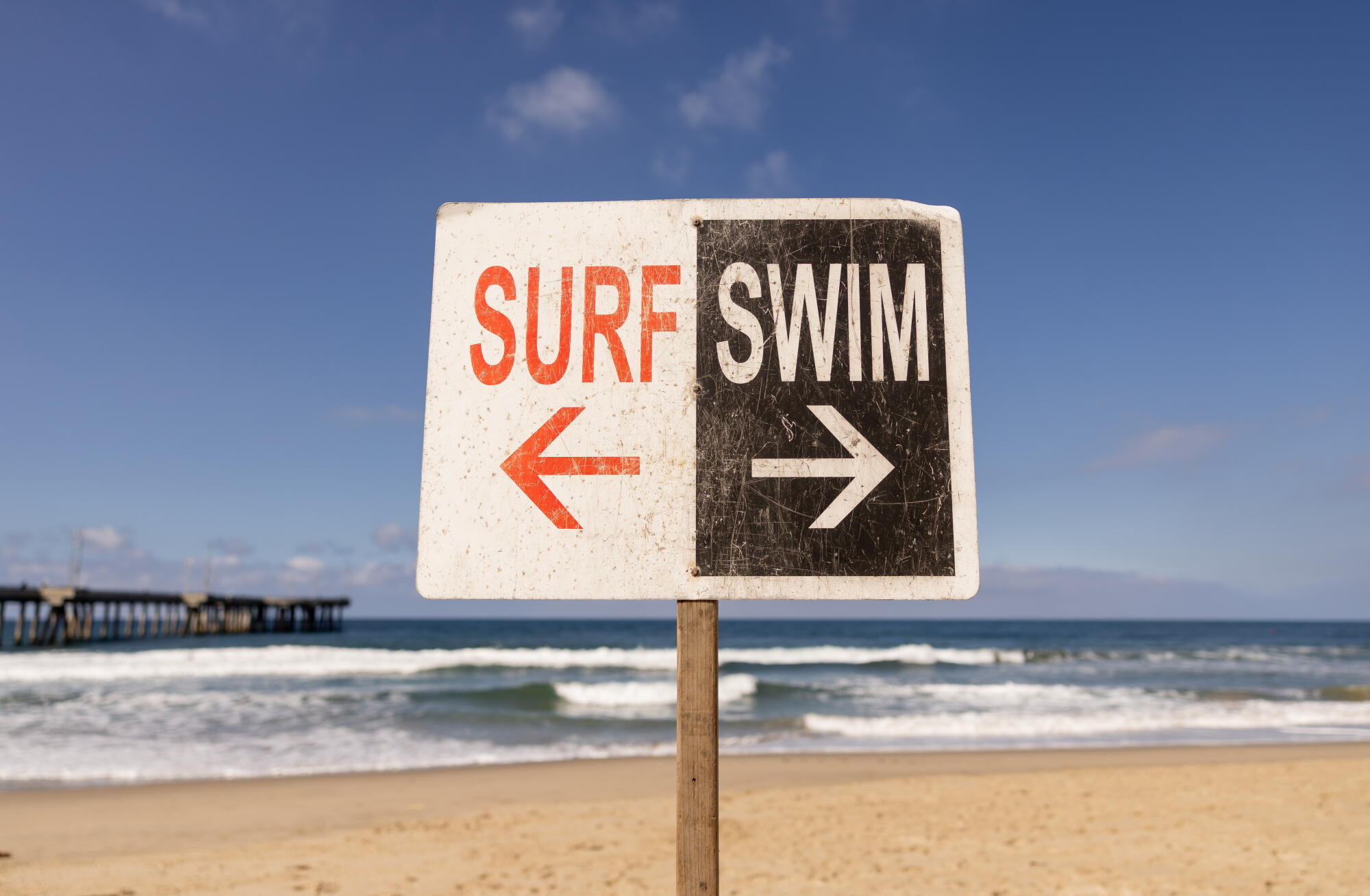
A "Surf Swim" sign at Venice Beach

A “Surf Swim” sign greets beachgoers at Venice Beach — a stretch of coast where daily surf reports and grassroots organizing have helped break down traditional surf stereotypes.

(Christina House / Los Angeles Times)

His videos combined informative dispatches with the laid-back vibe of surfer ASMR. “Light offshore wind. Clean, glassy barrels,” he declares softly to the camera as gray waves break behind him. “Lumpy close-out with hollow barrels with low tide, fam.”

At first, the account functioned like a group chat for local surfers. “Friends were asking me how the waves were, and I was texting them. I figured I’d jump on Instagram and start doing it for them,” says Walsh, who has been a Venice resident for 15 years.

What began as a practical update for a handful of friends eventually attracted followers in London, Berlin and Tokyo — people who checked in daily to see whether the surf was firing in Venice Beach. The account has amassed over 10,000 followers, inspiring imitator accounts. “Now it’s just for everybody,” says Walsh. “I built a community around the surf reports. It really blew me away. I didn’t realize that people were so interested.”

His surf reports have made him an unofficial mayor of Venice surf culture, getting recognized at the beach town’s local hangouts like Hinano Cafe and the Cow’s End. “People stop me and tell me they love my surf reports. They don’t even surf, but they see it every day,” says Walsh. “I always tell people I’m very popular between Washington Boulevard, Lincoln Boulevard and Rose Avenue.” His nickname around town is Glenice Venice.

However, the real triumph wasn’t becoming recognizable around Venice — it was finding other queer surfers, something that felt elusive in Walsh’s youth in Southern California. “I had met a lot of other surfers from all over the world and built a queer community of surfers here in L.A.,” says Walsh. “It was pretty awesome.”

Walsh saw an opportunity to use his surf report to not only report on the condition of the ocean — which is especially unpredictable during our current El Niño cycles — but to also create a burgeoning queer space in the Venice surf scene. “I could set up a community-based surf report for everybody, and the fact that I happen to be queer made it a little more unique,” he says. He began to connect with gay surfers, organizing trips with them and building lasting friendships. “It was just a lot of fun, building a little team.”

Later, Walsh became a co-producer and music supervisor of a movie about homophobia in surfing titled “Out in the Line-Up” that premiered at film festivals across the world in cities such as New York, San Francisco and Sydney, Australia. “The movie kind of spoke for itself. It was a worldwide issue — homophobia in surfing.” Since then, Walsh has served on panels about queer people in the surf world. Last June, the film had a 10th anniversary screening in Venice, hosted by the Venice Surfing Assn. “At some point, I brought some diversity to this culture. I put my name on it,” he says.

In recent years, others have joined Walsh’s efforts to create a burgeoning queer surf scene at Venice Beach. In 2020, Shelly Guidera relocated to Venice and noticed that there wasn’t a strong queer presence in surfing. “My friend and I were maybe the only queer people some of these surfers had ever seen,” she says. Shortly after, Guidera started Dream Team Surf, a collective for queer surfers to meet up and build camaraderie.

Its mission is simple. “It’s all of us looking out for each other,” Guidera says. “ Having a team of people makes the experience that much more enriching and safe.”

Surfers ride the waves near the Venice Pier, where Glen Walsh does his daily surf reports.

Surfers ride the waves near the Venice Pier, where Glen Walsh does his daily surf reports.

(Eric Thayer / Los Angeles Times)

Early on, Guidera was inspired by Walsh’s uplifting presence in the Venice surf scene. “This person is respected in the community for what he brings, which is knowledge and insight and fun and flair,” says Guidera. In turn, Walsh has championed Dream Team Surf.

In January 2025, Dream Team Surf hosted a Pride beach party with a banner that read: “Trans bodies belong on the beach.” In some San Diego area beaches, Guidera says, queer representation can still feel like an anomaly. “It’s so funny because it’s like these people have maybe never seen a woman in a bathing suit with hairy legs,” she says. “I’m like, ‘Oh my God, it’s not that deep.’”

Guidera is certified in surf therapy, taking courses through Groundswell Community Project, a surf therapy program that uses surf to promote holistic healing. The mental health benefits of surfing are lifelong, Guidera explains. “Growing up as a swimmer, surfing was a form of play and wellness,” she says. “It eased the brakes on competition and the structure within competitive swimming.”

Group photo of Dream Team Surf, which hosted a Pride beach party.

Group photo of Dream Team Surf, which hosted a Pride beach party.

(Sara Werner)

Even if you don’t shred waves, being in the ocean can promote healing. “To give people access to the ocean that is in and of itself a form of wellness,” she says. “There’s a level of surrender and humility that comes with surfing and that comes with being in nature. … You have to be so present in such a way that makes you a stronger person.”

Like Guidera, Walsh also works as a surf instructor with a similar goal to instill confidence in his students. “I was teaching a lot of people to surf, mostly women who didn’t want a straight man to teach them how to surf because it feels vulnerable enough,” says Walsh. “I try to break down the stereotypes and have a little fun with them and let them become a kid again.”

When done correctly, he argues, surfing can invite expansiveness. “I love seeing people out there. Feel the fear and do it anyway,” says Walsh. “And creating a lifestyle around it — going to different beaches — and meeting friends.”


Source link

Russia mobilisation fears grow amid reports of intimidating tactics | Russia-Ukraine war News

Owing to his illness, 26-year-old Sasha from Orenburg, a city in Russia close to the Kazakhstan border, has a Category V military ID, which under normal circumstances makes him ineligible for service.

But not during wartime.

Recommended Stories

list of 4 itemsend of list

Just before partial mobilisation was declared in 2022, he considered leaving for Kazakhstan. But while awaiting the bus, he struck up a conversation with his soon-to-be girlfriend.

As they turned back together, they decided against making the drastic move.

Over the past year, however, they have grown increasingly anxious.

“Since mid-2025, my girlfriend and I have been experiencing a severe decline in mental health. We see psychiatrists and take antidepressants,” Sasha told Al Jazeera.

He requested to be identified only by his first name to protect his anonymity.

“I don’t go outside unless it’s urgent and try never to be alone. I carry pepper spray for protection against aggression if it happens, like in Penza.”

Since June, there have been reports of attempted press-ganging in Penza, 625km (388 miles) southeast of Moscow.

Recent footage shared on social media has shown individuals dressed in plainclothes trying to force fighting-age men into vehicles to take them to the recruitment centre, while weeping women try to intervene – echoing similar scenes in Ukraine.

Potential recruits have also been reportedly summoned to police stations under bureaucratic pretexts, then beaten or threatened – for example, by having illicit drugs planted on them – into signing a military contract.

Local authorities deny the reports, claiming only men attempting to dodge the draft, who have already been mobilised, are being approached. They have also accused residents who have shared footage of the roundups of spreading disinformation.

Although the Penza roundups have received attention lately, local authorities throughout Russia have been accused of coercive methods for some time.

“In October 2022, a friend was stopped at night by military police,” said Sasha. “They identified themselves as civilians and didn’t show identification. They demanded a passport or military ID, and that he accompany them. My friend ran away.”

INTERACTIVE-WHO CONTROLS WHAT IN UKRAINE-1787233039
(Al Jazeera)

According to Mikhail Liberov, from the Conscientious Objectors Movement, military recruiters select the “right targets who, for one reason or another, are vulnerable to seduction, deception, blackmail, or are simply unaware of their actions”.

He said this group includes drug addicts, alcoholics, mentally unwell people, those with large debts and migrants “who don’t speak Russian or barely know what’s actually written, and are also afraid of deportation”.

Men above 35 years of age are also approached, and some are “willing to risk their lives and the lives of others for big money and the chance to become ‘heroes’.

“Then comes the threat of prison: A man arrested for petty hooliganism might be intimidated by the idea that, say, ‘We’ll plant drugs on you and put you in prison for 12 years,’ and many agree to sign contracts.”

Oleg Ignatov, senior Russia analyst at the International Crisis Group, said the recent roundups in Penza are likely isolated instances of local authorities trying to fill their recruitment quotas, rather than a systemic, nationwide effort.

‘Mobilisation will still happen’

These renewed recruitment incidents come amid rumours of a mobilisation effort and an expected Russian offensive this winter that will likely involve ramped-up attacks on Ukrainian energy infrastructure.

“I’ve already accepted that mobilisation will still happen, unless something happens that forces (Russian President Vladimir) Putin to end the war in Ukraine,” said Liberov, who believes Russia will ready troops within a year.

“Human rights activists are already working on the assumption that mobilisation will take place this fall,” he said.

In September 2022, Putin signed a decree allowing for partial mobilisation. Fearing deployment, thousands of men fled to neighbouring countries. But that mobilisation effort effectively ended two months later.

Russia has since been able to replenish its ranks by enlisting prisoners, as well as promising generous payouts.

However, the recruitment pool is dwindling.

According to the independent Russian news site IStories, the number of people voluntarily signing military contracts halved by late 2025. Those who enlist are disproportionately from underprivileged corners of society.

“The protracted war with Ukraine, the large number of dead soldiers, and the degradation of the Russian economy demotivate people from participating in such an adventure in the name of Putin,” said Liberov.

Official casualties are not made public in Russia.

The Washington, DC-based Center for Strategic and International Studies puts the number of deaths among Russian forces since the invasion of Ukraine in early 2022 at nearly 450,000.

Meanwhile, the 2022 mobilisation decree remains in effect, and the Russian offensive in Ukraine is lagging. The war is now being felt at home as Ukrainian drones strike deep into Russian territory.

“I only live once. I’m not going to sacrifice it for someone else’s wishes and will fight to the bitter end,” said Sasha. “Human life is priceless, and you have to cling to it until the end.”

Vladimir from Ulan-Ude, who has previously served as a conscript and is thus eligible for mobilisation, said he has a “generally negative attitude” about Russia’s war in Ukraine.

“I am preparing for a possible draft. In the event of an escalation, I will insist on the alternative civil service,” said the 35-year-old, who requested to withhold his surname over fears of reprisal. “I wouldn’t want to leave the country.”

According to the Russian constitution, alternative civilian service can be applied for when “convictions or religious beliefs contradict military service”.

Conscripts can serve either for 21 months at an organisation “subordinate to the bodies of the executive branch”, often taking jobs as nurses, cleaners or postal workers, or for 18 months at a defence manufacturing plant. According to the Ministry of Defence, about 2,000 people apply for alternative civilian service each year, with approximately half receiving approval.

Earlier this summer, Ukrainian President Volodymyr Zelenskyy claimed the Kremlin was secretly preparing for a mass mobilisation – a claim backed by reports in Russian independent media.

In June, lawmaker Andrey Gurulev of the governing United Russia party wrote on Telegram that “there’s now active talk, both behind the scenes and in high places, about the need for a new large-scale mobilisation.”

But expanding the army is expensive while budgets are under strain, and a huge influx of recruits still leaves a shortage of experienced officers and trained specialists.

“I would say that Russia’s problems right now are less about the quantity, but more about the quality of contractors,” said Crisis Group’s Ignatov.

“Russians need more skilled soldiers who can operate drones, who can operate modern warfare systems. And here they have more problems than the Ukrainians.

“But if this war continues, of course, we can assume that (mobilisation) could happen.”

Source link