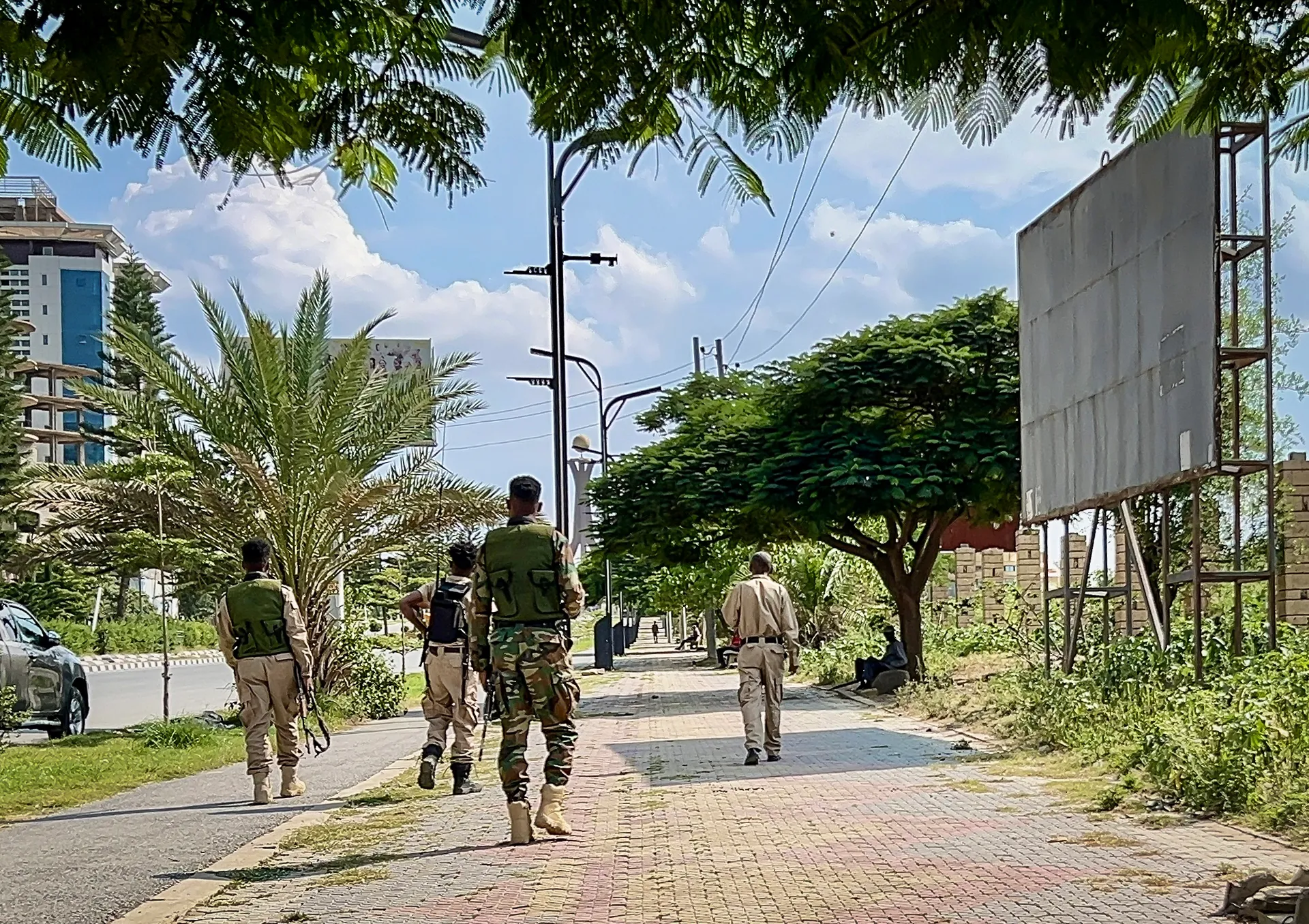
Addis Ababa, Ethiopia – After nearly two weeks of fierce fighting, Ethiopian federal forces entered the Tigrayan capital of Mekelle as forces from an alliance of rebel groups, including the Tigray People’s Liberation Front (TPLF), withdrew from the city.
The fighting that erupted late last month has effectively ended the 2022 Pretoria ceasefire and the fragile peace that followed the devastating Tigray war.
But Mekelle’s capture may mark the end of conventional warfare rather than the end of the conflict. Fighting has continued elsewhere in Tigray, while reports of Eritrean troops entering northern Tigrayan towns have added a potentially more dangerous regional dimension.
Ethiopian federal forces used air power and ground forces to advance across Tigray. After suffering successive defeats around the towns of Alamata and Kobo, rebel forces withdrew into the surrounding countryside. They have pledged to continue fighting.
“We will confront the enemy on our terms and where we choose,” TPLF leader Debretsion Gebremichael said.
A war that may not be over
There are echoes of the war that began in 2020, when Prime Minister Abiy Ahmed’s government declared victory after federal forces captured Mekelle. Tigrayan forces subsequently regrouped in the mountains, retook much of the region and recaptured the capital, prolonging the war for nearly a year and a half.
The renewed conflict could follow a similar trajectory, particularly if the TPLF and other armed groups succeed in turning the mountainous terrain into a prolonged armed rebellion. Ethiopia is already fighting insurgencies in Amhara and Oromia, raising the prospect of its federal forces being stretched across multiple fronts.
But the battlefield reversals suffered by the rebels could have implications well beyond Tigray. They have raised concern in Egypt and among other Ethiopian rivals, according to Hossamaldeen Ibrahim, an African analyst at the Bloomsbury Intelligence and Security Institute.
“Egypt views the Renaissance Dam, and any Ethiopian [army] move towards the Red Sea, as a strategic threat, so it has allied with Eritrea, Sudan and Somalia against any Ethiopian unilateralism,” Ibrahim told Al Jazeera.
“Ethiopia is seeking a sea outlet; Eritrea sees this as an existential threat.”
Ethiopia’s Red Sea ambitions
Ethiopia has been landlocked since Eritrea won its war of independence in 1991, leaving Addis Ababa heavily dependent on neighbouring countries for access to international trade.
Abiy has increasingly made access to the Red Sea a strategic priority since 2023, raising concerns in Eritrea over Ethiopia’s ambitions, particularly over the port of Assab.
Ethiopia currently relies heavily on Djibouti for maritime trade, while also pursuing alternative arrangements, including through Kenya and Somaliland.
After being sworn in on Monday for another five-year term following his party’s victory in the June 1 election, Abiy again put the issue at the centre of his parliamentary address.
“Based on the principle of give and take, we will work diligently to ensure that Ethiopia has an outlet to the sea,” he told parliament.
The issue has increasingly become part of a wider regional contest.
A loose regional alignment
In recent months, Egypt, Eritrea, Sudan and Somalia have found themselves sharing concerns over Ethiopia’s regional ambitions. On October 4, the leaders of the four countries met for a quadrilateral consultative summit in New Alamein, Egypt, where they discussed regional issues and pledged to strengthen political, economic and trade cooperation as well as consultation and coordination.
The meeting does not amount to a formal military alliance, and the four countries have different interests in their dealings with Addis Ababa. The summit’s joint declaration also called for respect for sovereignty and territorial integrity, noninterference in internal affairs and the peaceful resolution of disputes.
But their concerns increasingly overlap around Ethiopia’s ambitions in the Red Sea, the Nile and the wider Horn of Africa.
Relations between Ethiopia and Eritrea have also deteriorated sharply since the Pretoria ceasefire. Ethiopia closed its embassy in Eritrea and expelled Eritrean diplomats on October 1, accusing Asmara of hostile acts and involvement in the renewed fighting. Eritrea responded by severing diplomatic ties, while denying that it supported the opposition alliance. Egypt and Sudan have also denied Ethiopian accusations that they are backing the alliance.
The Ethiopian army’s advance into Tigray has added another layer to that rivalry.
“The [Ethiopian army’s] advance in Tigray directly threatens [Eritrean President] Isaias [Afwerki] and the Eritrean state,” said Etana H Dinka, an assistant professor of African history at the University of Miami.
Eritrean forces fought alongside Ethiopian troops during the 2020–22 Tigray war, but relations between Abiy and Isaias have since deteriorated. Eritrean troops have reportedly been seen in towns in northern Tigray, adding a potentially significant new dimension to the conflict. The Associated Press news agency reported Eritrean troops entering Adigrat and Idaga Hamus after crossing into Ethiopia, while Eritrea has neither confirmed nor denied the troop movements.
Eritrea’s role could be decisive
For Eritrea, the location of the fighting matters as much as its outcome.
A prolonged conflict in Tigray could keep Ethiopian forces tied down and limit Addis Ababa’s ability to pursue its Red Sea ambitions. But a decisive Ethiopian victory could leave the federal government with greater freedom to turn its attention towards regional rivals.
“With reports that Eritrean troops are moving into Tigray, Eritrea seems keen on boosting TPLF forces withdrawing northwards, so that the engagement between Ethiopian and Eritrean soldiers takes place in Tigrayan territory, and not in Eritrea,” said Mohamed Kheir Omer, a researcher focused on the Horn of Africa.
That could create an incentive for Eritrea to support forces capable of keeping the Ethiopian army tied down, without necessarily entering a direct confrontation of its own.
Sudan adds another layer
Sudan’s war adds another dimension to the regional rivalry.
Egypt has provided political backing and logistical and technical support to Sudan’s army, according to the Reuters news agency, while the Rapid Support Forces (RSF) have been accused of atrocities in Darfur.
Ethiopia has faced accusations of facilitating support for the RSF. A Reuters investigation reported in February that Ethiopia was hosting a camp in its western Benishangul-Gumuz region where thousands of fighters linked to the RSF were being trained. Reuters cited eight sources, including a senior Ethiopian government official, who said the United Arab Emirates financed the camp’s construction and provided military trainers and logistical support. The UAE denied the allegations, and Reuters said it could not independently verify the UAE’s role.
Those competing relationships are part of a broader contest over the Nile, Sudan, the Red Sea and access to trade routes.
For Egypt, its dispute with Ethiopia over the Grand Ethiopian Renaissance Dam remains a major strategic concern. For Eritrea, Ethiopia’s search for a Red Sea outlet is viewed through the lens of national security. For Sudan’s neighbours, the conflict threatens to reshape regional power balances.
Will Egypt, Eritrea, Sudan and Somalia intervene?
The shared interests of Ethiopia’s regional rivals do not necessarily translate into direct intervention.
Egypt has its own calculations over the Nile and Sudan. Eritrea has a direct security interest in developments in Tigray. Somalia is dealing with its own security challenges and a complicated relationship with Addis Ababa. Sudan remains consumed by its devastating civil war.
At the same time, Ethiopia’s federal forces now face the possibility of fighting on several fronts.
The TPLF, Amhara Fano and the Oromo Liberation Army (OLA) have each sought to challenge the federal government in different parts of the country. If they can maintain pressure on the army while retreating from major population centres, the fall of Mekelle could prove to be only the first phase of a much longer conflict.
For Ethiopia’s rivals, the question is whether to exploit that vulnerability or avoid being drawn into another regional war.
The extent of any regional involvement may ultimately depend on whether the TPLF can keep federal forces tied down in Tigray, and away from the Eritrean border.
“It isn’t difficult to understand Cairo’s commitment to prevent Ethiopia from succeeding in the current warfare, whatever its army’s intended goals, including Abiy’s acclaimed access to the Red Sea, are,” University of Miami’s Dinka said.
The question now is whether those regional calculations will remain largely diplomatic or spill into the battlefield.